University of Windsor University of Windsor
Scholarship at UWindsor
Scholarship at UWindsor
Electronic Theses and Dissertations Theses, Dissertations, and Major Papers
2010
MEMS based radar sensor for automotive collision avoidance
MEMS based radar sensor for automotive collision avoidance
Ahmad Sinjari
University of Windsor
Follow this and additional works at: https://scholar.uwindsor.ca/etd
Recommended Citation Recommended Citation
Sinjari, Ahmad, "MEMS based radar sensor for automotive collision avoidance" (2010). Electronic Theses and Dissertations. 7873.
https://scholar.uwindsor.ca/etd/7873
MEMS BASED RADAR SENSOR FOR
AUTOMOTIVE COLLISION AVOIDANCE
By Ahmad Sinjari
A Dissertation
Submitted to the Faculty of Graduate Studies Through Electrical and Computer Engineering
In Partial Fulfillment of the Requirements for The Degree of Doctor of Philosophy at the
University of Windsor
Windsor, Ontario, Canada
2010
1*1
Library and Archives CanadaPublished Heritage Branch
395 Wellington Street OttawaONK1A0N4 Canada
Bibliotheque et Archives Canada
Direction du
Patrimoine de I'edition
395, rue Wellington OttawaONK1A0N4 Canada
Your file Votre reference ISBN: 978-0-494-81734-6 Our file Notre reference ISBN: 978-0-494-81734-6
NOTICE: AVIS:
The author has granted a
non-exclusive license allowing Library and Archives Canada to reproduce, publish, archive, preserve, conserve, communicate to the public by
telecommunication or on the Internet, loan, distribute and sell theses
worldwide, for commercial or non-commercial purposes, in microform, paper, electronic and/or any other formats.
L'auteur a accorde une licence non exclusive permettant a la Bibliotheque et Archives Canada de reproduire, publier, archiver, sauvegarder, conserver, transmettre au public par telecommunication ou par I'lnternet, preter, distribuer et vendre des theses partout dans le monde, a des fins commerciales ou autres, sur support microforme, papier, electronique et/ou autres formats.
The author retains copyright ownership and moral rights in this thesis. Neither the thesis nor substantial extracts from it may be printed or otherwise reproduced without the author's permission.
L'auteur conserve la propriete du droit d'auteur et des droits moraux qui protege cette these. Ni la these ni des extraits substantiels de celle-ci ne doivent etre im primes ou autrement reproduits sans son autorisation.
In compliance with the Canadian Privacy Act some supporting forms may have been removed from this thesis.
Conformement a la loi canadienne sur la protection de la vie privee, quelques
formulaires secondaires ont ete enleves de cette these.
While these forms may be included in the document page count, their removal does not represent any loss of content from the thesis.
Bien que ces formulaires aient inclus dans la pagination, il n'y aura aucun contenu manquant.
1*1
A MEMs Based Radar Sensor For Automotive Collision Avoidance
by
Ahmad Sinjari
APPROVED BY:
R. Mansour, External Examiner
NSERC/IRC - University of Waterloo - Dept of Electrical & Computer Engineering
l/TCi^U^ 7<bm
ru-A. Sodan, Outside Department Reader
School of Computer Science
/ E . Abdel-Raheem, 1
s tDepartmental Reader
department of Electrical & Computer Engineering
R/MusceHereT?*
1Depa>tmer
sntal Reader
Department oAEIectrical & Computer Engineering
S. Chowdhtffy, Advisor
Department of Electrical & Computer Engineering
Author's Declaration of Originality
I hereby certify that I am the sole author of this thesis and that no part of this thesis has been published or submitted for publication.
I certify that, to the best of my knowledge, my thesis does not infringe upon anyone's copyright nor violate any proprietary rights and that any ideas, techniques, quotations, or any other material from the work of other people included in my thesis, published or otherwise, are fully acknowledged in accordance with the standard referencing practices. Furthermore, to the extent that I- have included copyrighted material that surpasses the bounds of fair dealing within the meaning of the Canada Copyright Act, I certify that I have obtained a written permission from the copyright owner(s) to include such material(s) in my thesis and have included copies of such copyright clearances to my appendix.
Abstract
Acknowledgements
First and foremost I thank Allah subhanahu wa taala for his almighty support and
blessing without whom this work would not have completed. I would like to
acknowledge the aid and support provided by individuals and organizations. First I want
to express my sincere gratitude to my supervisor, professor Sazzadur Chowdhury for his
invaluable technical support, financial support, guidance, and encouragement. His
appreciation of my progress was a source of continuous inspiration that helped me to
make a steady progress towards the completion of this work. His encouragement to
break-through the limits rather than bypass and to take care of all minute phenomenal
possibilities in the design methodology, played the most significant role throughout this
research work.
I would like to acknowledge the financial support and encouragement provided by
the Ontario Centre of Excellence (OCE), whose interest in this research work formed the
major financial support of this project. I would like to acknowledge the financial support
provided by the Natural Sciences and Engineering Research Council of Canada
(NSERC).
I would like to thank Ansoft Corporation of Pittsburgh PA, for the collaborative
partnership that has enabled me to have access to their outstanding MEMS design
environment. Thanks for the customer supporting team for their timely response in
solving software related problems.
I would like to thank the crews at (CIRFE) Centre for Integrated RF engineering
process of the system, for many technical discussions and interactions that have made
significant contributions in this research work.
I would like to express my deepest gratitude to my friends, peers and co-workers
associated with in the MEMS group for providing a friendly, helpful and enlightened
learning atmosphere.
Finally, special thanks to my wife, whose encouragement, support, and patience
Table of Contents
Author's Declaration of Originality iii
Abstract i v
Dedication v
Acknowledgements vi
List of Tables xi
List of Figures xii
List of Symbols and Abbreviations xv
1. Introduction
1.1. Goal 1
1.2. Research Methodolgy 6
1.3. Principal Results 7
1.4. Dissertation organization 9
2. Research Perspective
2.1. Background 10
2.2. Radar Basics 11
2.3. Pulse-Doppler vs FMCW Radar 16
2.4. Automotive Radar 17
2.5. State-of-the-Art in Automotive Radars 18
2.6. Beamforming in Automotive Radars 22
2.6.1 Analog Beamforming 23
2.6.2 Digital Beamforming 24
2.7 Rotman Lens Beamformer 26
2.7.1 Microstrip Rotman Lens 27
2.7.2 Synthesized Rotman Lens 28
2.7.3 Dielectric Rotman Lens 28
3. New Radar Architecture and MEMS Rotman Lens
3.1 Architecture of MEMS Radar 36 3.1.1 Radar type selection 36 3.1.2 Frequency Selection 37 3.1.3. Beamformer selection 38 3.1.4 Switch selection 38 3.1.5 Antenna Selection 38 3.1.6 Signal processor selection 38 3.1.7 New Radar Sensor Architecture 39
3.2 Rotman Lens Design Principles 40 3.3 Rotman Lens Design for Automotive Radar 43
3.3.1 Rotman Lens Design Methodology 44 3.3.2 New Approach of Rotman Lens Design 45
3.4 Fabrication 55 3.5 Conclusions 60
4 MEMS SP3T RF Switch
4.1 MEMS RF Switch Overview 61 4.2 Cantilever MEMS RF Switches 62 4.3 Bridge MEMS RF Switches 63 4.4 Design of SP3T MEMS RF Switch for 77 GHz Radar 64
4.5 CG MEMS SP3T RF Switch 66
4.6 Material Selection 66 4.7 Mathematical Modeling 67 4.8 HFSS and IntelliSuite Simulation Results for Both Types of RF Switches 69
4.9 Fabrication 75 4. lOConclusions 79
5. Microstrip Patch Antenna
5.1 Microstrip Antenna Overview 80
5.4 Design Requirements for Target Automotive Radar Antenna 88
5.5 Microstrip Antenna Array Design Considerations 88
5.5.1 Microstrip Antenna array Design 88 5.6 Microstrip Antenna Simulation Results 92
5.7 Microstrip Antenna Fabrication 94 5.7.1 Microstrip Antenna Array Fabrication Steps 96
5.8 Conclusions 98
6 Conclusions and Future Work
6.1 Conclusions 99 6.2 Future work 101
References 103 Appendices
Appendix A: Program code for Rotman lens design 109 Appendix B: Program code for (SP3T) switch design 143 Appendix C: Release recipe for the Single pole triple through (SP3T) switch.. 180
Appendix D: Program code for microstrip antenna design 181
List of Tables
Table 2.1 Road fatalities per 100,000 inhabitants 10 Table 2.2 Rank change order of the global burden of disease 11
Table 2.3 Commercially available new generation of automotive radar systems 20
Table 2.4 Bosch LLR3 Radar sensor features 20 Table 2.5 Requirements for Future Radar Systems 21 Table 3.1 Rotman Lens Final Design Specifications 55 Table 4.1 Layer Names, Thickness and Mask Level 67
List of Figures
Figure 1.1 Phased array based automotive radar 4 Figure 1.2 Improved version of the phased array based automotive radar 5
Figure 2.1 Pulse characteristics in a pulsed-radar 12 Figure 2.2: Transmit signal frequency for FSK-CW radar 13
Figure 2.3 Up sweep and down sweep signal characteristics in a FMCW radar 14
Figure 2.4 A car fitted with radar 17 Figure 2.5 Different range radar system in a vehicle 18
Figure 2.6 Analog beamformer with power and phase adjustment to rotate the beam.. ..23
Figure 2.7 Bosch LLR automotive radar 24 Figure 2.8 Toyota CRDL 77 GHz LRR radar sensor 25
Figure 2.9 Schematic of the intrinsic beamforming capability of the Rotman lens 26
Figure 2.10 Microstrip Rotman lens 27 Figure 2.11 Synthesized Rotman lens 28 Figure 2.12 Dielectric Rotman lens 29 Figure 2.13 RF-MEMS-based automotive radar front-end 30
Figure 2.14 MEMS cantilever type RF 31 Figure 2.15 Microstrip patch antenna 33 Figure 2.16 Microstrip antenna array 33 Figure 3.1 Block diagram of the new MEMS based radar sensor 39
Figure 3.2 Rotman lens schematic diagram 41
Figure 3.3 Target scanning angle 44 Figure 3.4 design methodology of the Rotman lens 45
Figure 3.5 TEio propagation mode in a rectangular waveguide 48
Figure 3.6 Lens contour for a=\, g=\ 49 Figure 3.7 Lens contour for a=2, g=\ 50 Figure 3.8 Lens contour for a=3, g=l 50 Figure 3.9 Lens contour for a=4, g=\ 50 Figure 3.10 Rotman lens of 2.5 urn thickness 51
Figure 3.12 (b) Rotman lens of 50 urn thickness excited from beam port 2 52 Figure 3.12 (c) Rotman lens of 50 um thickness excited from beam port 3 52
Figure 3.13 characteristic impedance of the Rotman lens 53
Figure 3.14 Return loss of the Rotman lens 53 Figure 3.15 Insertion loss between beam port 1 and array port 2 53
Figure 3.16 Insertion loss between beam port 1 and array port 3 53 Figure 3.17 Insertion loss between beam port 1 and array port 4 54 Figure 3.18 Insertion loss between beam port 1 and array port 5 54 Figure 3.19 Insertion loss between beam port 1 and array port 6 54 Figure 3.20 Silicon wafers immersed in the RCA solution 56
Figure 3.21 Rotman lens mask 56 Figure 3.22 Alcatel 601E Deep Silicon Etch 57
Figure 3.23 SEM profiles of the silicon wafers 57 Figure 3.24 Rotman lens Fabrication process diagram 58 Figure 3.25 Fabricated Rotman lens and the cap 59 Figure 3.26 Fabricated Rotman lens after bonding process 59
Figure 4.1 Cantilever MEMS RF switch 63 Figure 4.2 Bridge MEMS RF switch 63
Figure 4.3 Bias tee 64 Figure 4.4 Conventional MEMS SP3T RF GCB switch 65
Figure 4.5 HFSS simulation shows the coupling capacitance between the GCB and a
CPW line of a conventional MEMS SP3T RF operating at 77 GHz 65
Figure 4.6 CG MEMS SP3T RF switch 66 Figure 4.7 Characteristic impedance (Both GCB and CG type switches) 70
Figure 4.15 Chromium deposition and patterning 75 Figure 4.16 Silicon Nitride deposition and patterning 76
Figure 4.17 Chromium and Gold deposition 76 Figure 4.18 Gold and chromium patterning 76 Figure 4.19 Anchor and dimple patterning 77 Figure 4.20 G2 deposition using Electron Beam Evaporation method 77
Figure 4.21 Pattern of the top gold G2 77 Figure4.22 SP3T MEMS RF switch release 78 Figure 4.23 SEM pictures of the RF switch before and after release 78
Figure 5.1 Microstrip patch antenna 80 Figure 5.2 Electric field along the patch length 81
Figure 5.3 Microstrip patch equivalent circuit 83 Figure 5.4 Physical and effective length of microstrip patch 86
Figure 5.5 Microstrip antenna array 91 Figure 5.6 Microstrip antenna array return loss 93
Figure 5.7 Microstrip antenna array gain and half power beam width (HPBW) 93
Figure 5.8 Antenna array gain versus frequency 94
Figure 5.9 Antenna array efficiency 94 Figure 5.10 Ultrafast laser pulses 95 Figure 5.11 Microstrip antenna array fabrication zones 96
Figure 5.12 Fabricated microstrip antenna array 97 Figure 5.13 SEM figures of the fabricated microstrip antenna array 97
Figure 6.1 MEMS Multimode radar block diagram 101 Figure 6.2 FPGA Reconfigurable microstrip antenna array 102
List of Symbols and Abbreviations
G
F
W
w,
a
V
A0
c
Sr
K
Pr
P,
K
h
o
ao
bPZT
TEl0
HFSS RF DRIE
Ex,Ey,Ez
Hx,Hy,Hz
K
fc ZTE
On-axis focal length Off-axis focal length
Off-axis length of the transmission path On-axis length of the transmission path Scanning angle
Lens numerical aperture
Wavelength of the operating frequency f Velocity of light
Dielectric constant Modified wavelength
Received power Transmitted power Array port length
Beam port length
Array port angle
Beam port angle
Lead zirconium titanium Transverse electric mode 10 High frequency structure simulator Radio frequency
Deep reactive ion etching Electric field components
Magnetic field components
Cut-off wavelength Cut-off frequency
V Phase velocity
Vg Group velocity
kc Propagation constant
CIRFE Center for integrated RF engineering
U W M E M S University of Waterloo M E M S process
SP3T FET SPST CPW
C
A
d
Q
V
k
E
w
t
I
VP
go
£0
W
c
rAu Siox HPBW MIC's
Single-Pole-Triple-Throw Field effect transistor Single-pole-single-throw Coplanar waveguide Capacitance
Area Distance Charge Voltage
Beam stiffness Young's modulus Beam width Beam thickness Length of the beam
Pull-in voltage of the cantilever
zero bias gap
Permittivity of free space Length of the DC pad Chromium
Gold
Silicon oxide
tan 8
/ ,
h
L
Mo
c
£reff
Z0
ADS
K
Dissipation factor Resonance frequency Substrate height Patch length
Permittivity of the air Velocity of the light
The effective dielectric constant
Chapter 1
Introduction
1.1 Goal
A significant research effort is going on worldwide to develop a system that can provide collision warning to a driver, act to avoid collisions and to provide pre-crash warning to a driver in case a collision is unavoidable [1-5]. Realization of such systems requires sensors, which are able to observe the complete surrounding of cars and sophisticated signal processing algorithm to evaluate the sensor data fast and reliably. Current vehicle mounted proximity detection systems employ sensors like electromagnetic radars (short, medium and long range), lasers, vision-based sensors like video cameras; GPS based systems, and ultrasonic sensors. Out of all these systems, radar based systems offer superior performance compared to others as they work under nearly all weather conditions whereas the performance of other systems are compromised in bad weather situations [1,3]. Additionally radars are able to provide information about location (distance and angular direction) and relative velocity of objects.
However, due to high cost of stand-alone manufacturing and GaAs technology, current radar based automotive collision avoidance systems are too expensive and automakers are reluctant to incorporate these solutions in low-end vehicles. As a result the overall highway safety situation remains almost the same even if some of the vehicles are equipped with advanced radar systems. To put the problem in perspective, less than
1% of vehicles running in Canadian highways are equipped with radar sensors.
state-of-the-art automotive radars, MEMS based radio frequency (RF) components such as Rotman lens, RF switches, antennas, filters, etc. can be used to realize a high performance smaller size radar that can be mass produced cost-effectively due to the batch fabrication capability. As the Rotman lens that exploits the physical geometry of a cavity to realize a directional beam without any signal processing, a microfabricated Rotman lens can eliminate the use of conventional microelectronic beamforming to minimize the latency time and integration issues while improving system reliability and thermal management situations. Similarly, MEMS based RF switches can be used to rout the signal among different components of the radar sensor with a much superior performance in terms of return loss, insertion loss and isolation compared to microelectronic microwave switches.
The basic idea is to minimize and replace conventional microelectronic components in a typical radar sensor by superior performance but low cost MEMS based components to realize a compact small form-factor cost effective high performance radar sensor that will have much higher penetration rate in the automotive market, and consequently will help to minimize life losses and property damage due to automotive collisions. Consequently, the overall highway safety situation will be dramatically improved. In this context, the over all goal of this dissertation is to develop a radar architecture using MEMS based Rotman lens and RF switches and design and fabricate the MEMS based RF components and a microstrip antenna array that can be used to realize the developed radar architecture.
Market research firm Strategy Analytics predicts that over the period 2006 to 2011, the use of long-range distance warning systems in cars could increase by more than 65 percent annually, with demand reaching 3 million units in 2011, with 2.3 million of them using radar sensors. By 2014, 7 percent of all new cars will include a distance warning system, primarily in Europe and in Japan [6].
the end of 2010. German government formed a consortium called KOKON (which is a consortium of semiconductor manufacturers Infineon and Atmel, the automotive sensor suppliers Bosch and Continental Automotive Systems, and the car manufacturer Daimler-Chrysler that are supported by several universities and institutes) to develop 77/79 GHz radar systems and their components for automotive safety applications. The objective of the project is to develop cost effective short range radar (SRR) and long range radars (LRR) in order to achieve a higher market penetration of life-saving safety systems. Similar research initiative like IVBSS, VII, VSC-2 are being pursued vigorously in the US by the Department of transportation (DOT) and in Japan where forward collision warning system for vehicles using a long range radar has been identified as a most critical component for highway safety. However, due to the high price of the radar sensor based ranging systems, only the expensive vehicles (less than 1%) in Canadian highways are equipped with long range radars. As an outcome of the KOKON project, Infineon developed a SiGe based 77 GHz radar chip set and is expecting that the new SiGe based chip will be able to lower the price tag of automotive long range radar.
The development of both European and North American automotive radar technology is relying on the 76-81 GHz frequency range as this range of frequency enables to fabricate smaller radars and offers better performance compared to 24 GHz solutions.
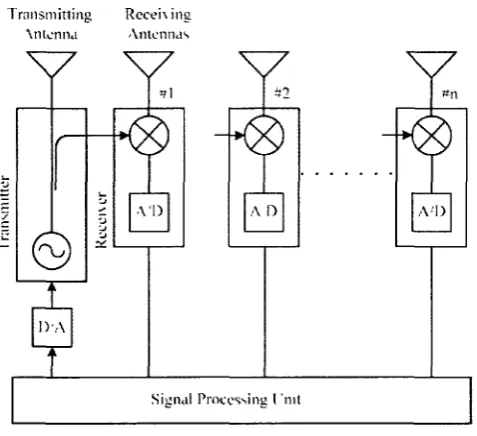
The basic architecture of automotive radar working on the phased array principle is shown in figure 1.1.
Transmitting Receiving \tHeniij Antennas
\ 7
X7 X7
Hg>
\7
A D
->0
*nA-'I)
Signal Processing I nit
Figure 1.1 Phased array based automotive radar
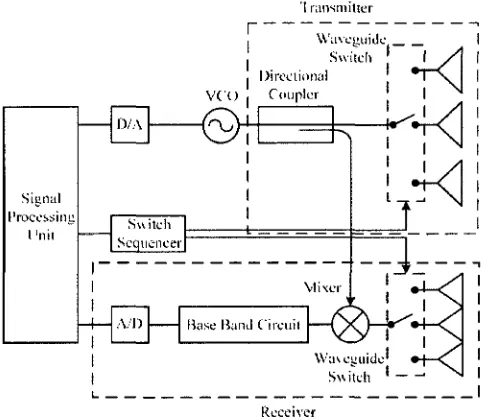
An improved version of the basic architecture is shown in figure 1.2 where two single-pole-triple-throw (SP3T) switches have been used to multiplex three transmit and three receive channels to minimize the number of antennas from 10 to 6 and the number of receivers from 9 to 1. A control circuit switches the 3 equal transmitting antennas and 3 receiving Antennas using the SP3T switches to result in one base band channel, and, after demultiplexing in the digital domain, nine digital receiver channels are obtained for digital beamforming. However, due to the transmission loss in the switches, the SNR is degraded and the angular resolution may be decreased.
I ransmilter
Base Band C'ireuil ( Y V - T ^ *+~ \
VVa'.cjaiide' 1—<f
<>. it,.i, I • ^
Switch
Receiver
Figure 1.2 Improved version of the phased array based automotive radar Investigation shows that the limitations associated with both the systems can be overcome or minimized if the beamforming operation is shifted from electronic domain to a passive microfabricated Rotman lens beamformer. This will drastically reduce the system complexity, processing time, system integration, and thermal drift issues. Additionally, if the waveguide switches are being replaced by MEMS based RF switches that exhibit superior performance as compared to the waveguide ones, a highly improved radar sensor can be realized. The MEMS based radar sensor can be commercialized at a much lower cost due to the batch fabrication capability of the MEMS components.
needs to be optimized for 77 GHz to minimize the losses. As the radiating elements, high performance microstrip antenna arrays are also needed to be designed.
In summary this dissertation investigates the development of a MEMS based radar. The specific goals of this research are thus summarized as:
1. Develop the architecture of a MEMS based 77 GHz FMCW long range radar sensor for automotive collision avoidance application. Due to the passive nature, true time delay, and high reliability characteristics of the target MEMS Rotman lens, high performance MEMS RF switches and a high gain high efficiency microstrip patch antenna array, a relatively enhanced cycle time can be achieved as compared to current state-of-the-art systems, and with appropriate off-the-shelf radar front end, the target system would offer a highly compact higher performance small form factor radar solution for automotive applications.
2. Investigate to develop a small size Rotman lens for the target radar sensor that can be microfabricated using standard microfabrication techniques such as deep reactive ion etching (DRIE). Carry out the design and simulation of the developed Rotman lens for performance evaluation using industry standard software such as HFSS, ADS, and Intellisuite.
3. Develop and realize a fabrication process sequence to fabricate the Rotman lens. 4. Design, simulate and fabricate a MEMS based SP3T switch operating in the 77
GHz range for use in the target radar sensor.
5. Design, simulate and fabricate a 77 GHz microstrip antenna array for use in the target radar sensor
It is to be mentioned here that two other groups of students in the University of Windsor MEMS lab are working on the packaging and FPGA implementation of the signal processing algorithm to realize the complete radar sensor.
1.2 Research Methodology
The course of developing a MEMS-based 77 GHz radar sensor involves the following steps:
2. Develop the architecture of a new MEMS based radar sensor to meet or overcome the industry set specifications for a future automotive long range radar.
3. Investigate the state-of-the-art in Rotman lens technology to design and develop a new 77 GHz MEMS based Rotman lens.
4. Investigate the state-of-the-art in MEMS based RF switches and microstrip antenna arrays to develop and design MEMS switches and an antenna array suitable for use in the target radar sensor.
5. Simulation of the designed MEMS devices using HFSS, ADS and IntelliSuite software for performance evaluation.
6. Optimization of the devices to yield maximum performance considering the design constraints.
7. Devices fabrication.
1.3 Principal Results
The principle results of this research work are summarized as follows:
1. The architecture of new MEMS based 77 GHz long range radar has been developed for automotive collision avoidance application. A provisional patent (US 61/282,595, March 5, 2010) has been filed in the US patent Office. The radar has a form factor of 40 mm x 30 mm x 10 mm after packaging, which is smaller than the state-of-the-art Bosch 3rd generation long range radar LRR3 that has dimensions of 77 mm x 74 mm x 58 mm. The new radar architecture has been evaluated by Keith Warble, an industry expert in radar technology who commented that "The device is superior in architecture and can out-perform the current industry leading state-of-the-art Bosch/Infineon LRR3 (3rd generation long range radar) in performance and cost".
a cavity depth of 50 um with a footprint area of 11 mm x 14 mm. The lens has been simulated using HFSS and exhibits better than -2 dB insertion loss and better than -20 dB return loss between the beam ports and the array ports. The lens can steer a beam by ±4 degrees.
3. Two types of MEMS based single-pole-triple-throw (SP3T) cantilever type RF switches were designed and fabricated. One of them uses ground connecting bridges (GCB) to connect the ground associated with different ports while the other uses a novel continuous ground (CG) geometry. The CG configuration SP3T switch has improved the switch performance by eliminating the coupling capacitance between the ports and ground connecting bridges. Both the switches have a footprint area of 500 urn x 500 urn. The GCB type switch has been fabricated using the UWMEMS process in the University of Waterloo while the fabrication of the CG type switch is in progress. The GCB type switch exhibits a return loss of-16 dB. Insertion loss of-1.1 dB and maximum isolation of-13 dB between input and the non-actuated output ports. The CG type switch exhibits a return loss of -20 dB. Insertion loss of -0.65 dB and maximum isolation of -16.5 dB between input and the non-actuated output ports. The S-parameter values are better than the measured values of a cantilever type MEMS RF switch published in [36]. This validates the design of both types of switches. In summary, the CG configuration has improved the return loss by 4 dB compared with the GCB version of the switch. The insertion loss has improved by 0.5 dB and the isolation has been improved by 3.5 dB.
1.4 Dissertation organization
Chapter 2 of this dissertation will cover the literature review of the automotive radar.
Chapter 3 presents the architecture of the new MEMS based 77 GHz FMCW radar sensor and design, simulation and fabrication of a novel MEMS Rotman lens, that propagate TE) 0 mode only. The air-cavity Rotman lens forms the core beamforming and beam steering component of the new radar sensor.
Chapter 4 will cover design and fabrication of a MEMS Single-Pole-Triple-Throw (SP3T) RF switch to sequentially feed the FMCW signal among the beam ports of a microfabricated Rotman lens that forms an integral part of a MEMS based 77 GHz automotive radar sensor. The series type MEMS RF switch relies on electrostatic actuation of a microfbaricated cantilever beam and incorporates 1 input port and 3 output ports. Two different versions of the MEMS RF switch have been designed: a ground connecting bridge (GCB) conventional geometry where microfabricated bridges have been used to provide the ground connectivity and a new continuous ground (CG) without any bridge. Both the switches have been optimized for operation in the 77 GHz; however, the CG version provides improved performance as it eliminates the effects of coupling capacitance between the ports and the ground.
Chapter 5 describe the design, simulation and fabrication of a microstrip antenna array that forms an integral part of a MEMS based radar working in the 77 GHz range. The microstrip antenna array incorporates 5 sub-arrays and 12 patches in each sub-array. The design is based on a serial array inset fed method.
Chapter 2
Research Perspective
2.1 Background
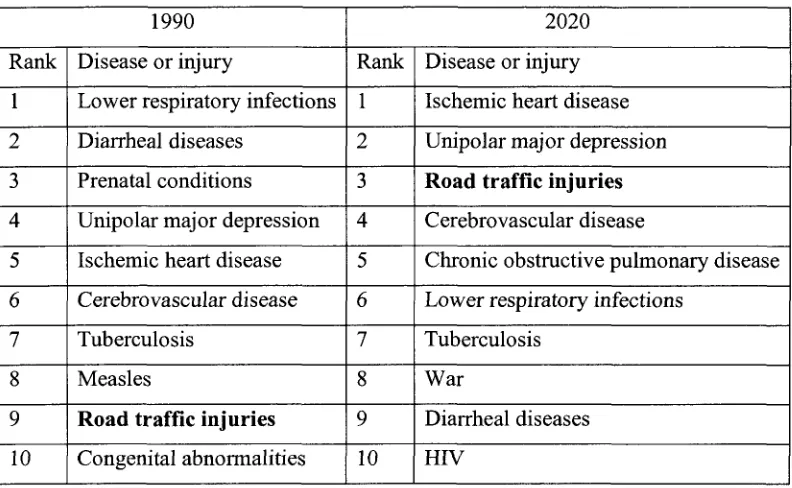
Car accidents claim the lives of 1.2 million annually and 52 million injuries globally up to the (WHO) world health organization latest statistics. Car accidents claim a life every 15 minutes in the U.S. Nevertheless, one-third of all accidental deaths in the U.S. per year still involve cars. In North America alone the rate of fatalities related to road accidents has been stagnant at approximately 43,000 per year, which sums to a huge annual loss of life and property [8]. Table 2.1 shows the road fatality rates in selected countries or areas
Table 2.1 Road fatalities per 100,000 inhabitants Country or area
Australia European Union
Great Britain Japan Netherlands
Sweden
United States of America
Per 100,000 inhabitants 9.5
11.0 5.9 8.2 6.8 6.7 15.2
Table 2.2 Rank change order of the global burden of disease 1990 Rank 1 2 3 4 5 6 7 8 9 10
Disease or injury
Lower respiratory infections Diarrheal diseases
Prenatal conditions
Unipolar major depression Ischemic heart disease Cerebrovascular disease Tuberculosis
Measles
Road traffic injuries
Congenital abnormalities 2020 Rank 1 2 3 4 5 6 7 8 9 10
Disease or injury Ischemic heart disease Unipolar major depression
Road traffic injuries
Cerebrovascular disease
Chronic obstructive pulmonary disease Lower respiratory infections
Tuberculosis War
Diarrheal diseases HIV
Canada and USA have set a target to reduce road traffic fatalities by 30% and 20% respectively by the end of 2010. The use of Forward Collision Warning long range radar and Lane Departure Warning camera-based sensor among other security features will become very effective to reduce road fatality rates.
2.2 Radar Basics
The history of radar starts with experiments by Heinrich Hertz in the late 19th century that showed that radio waves were reflected by metallic objects. This possibility was suggested in James Clerk Maxwell's seminar work on electromagnetism [8]. However, it was not until the early 20th century that systems able to use these principles were becoming widely available, and it was German engineer Christian Huelsmeyer who first used them to build simple ship detection device intended to help avoid collisions in fog [8].
range (distance) information for a target. Before 1934, no single system gave this performance; some systems were Omni-directional and provided ranging information, while others provided rough directional information but not range. A key development was the use of pulses that were timed to provide ranging, which were sent from large antennas that provided accurate directional information. Combining the two allowed for accurate plotting of targets.
Radar systems can be classified by two major types: Pulsed and Continuous Wave [10]. Both implementations have distinct operating principle, transmit signal generation, receive signal conditioning and processing, control and synchronization issues, and power requirements.
Pulsed Radar: Pulsed radars send short-duration in the range of a few hundred
nanoseconds, high-power (typically in kilowatts range) pulses which illuminate a target in the line-of-sight. A pulse is essentially a sinusoid (carrier wave) at the chosen operating frequency as shown in figure 2.1.
Pulse Repetition Period
Pulse Width
^ w w v w w w
f W W W W W \ r
Time
Figure 2.1 Pulse characteristics in a pulsed-radar.
In Pulsed radar the range and relative velocity of the target are determined as follows:
Range,
Relative velocity,
ex 71
r = •
vrel =
two-way
2
- / d
xA )
(2.1)
Here, c is the speed of electromagnetic radiation in air, rtwo_way is the two-way travel
time for a pulse reflected from the target to return to the source, /d is the Doppler shift
and AQ is the operating wavelength.
The Doppler shift in the carrier wave frequency within the pulse corresponds to the relative velocity of the target, and the time taken for the radar to detect a return of the pulse determines the range of the target.
Continuous Wave Radar: Continuous Wave (CW) radars continuously transmit the RF
wave at a pre-specified frequency at a lower power level (typically less than 50mW). The CW radar systems continuously receive the echo from a target over a period of time, commonly called the Coherent Processing Interval (CPI). During the CPI, the instantaneous transmit and receive signals are mixed, and the resultant intermediate frequency (IF) signal is assessed over the CPI for valid targets. The CW radar technology is still under constant refinement with new strategies related to both hardware and signal processing algorithms being developed. There are two prime implementations of CW radar, FSK-CW (Frequency Shift Keying) radar and FMCW (Frequency Modulated) radar. In FSK-CW the RF frequency jumps between multiple frequencies over a CPI, whereas FMCW makes use of a frequency chirp in a sine, saw-tooth or triangular fashion [66]. The transmit waveforms for both CW radar types are shown in Figure 2.2.
F2
-'step
^CPI 2 7C P I
Time
'CPI ^ C P ITime
Figure 2.2: Transmit signal frequency for FSK-CW radar (left) and triangular FMCW radar (right) linear frequency up and down sweeps (or chirps).
The target range in FSK-CW radar can be determined as following:
cA<J> r = An{F2-Fx)
^rel _ ~ / d
x^ 0 (2.4)
Where, c is the speed of electromagnetic radiation in air, A<£ is the difference in phase shift at the two frequencies Fx and F2, f& is the Doppler shift and A0 is the operating wavelength. The main disadvantage of the FSK-CW radar is that it can not detect targets in the direct path of the radar.
The up sweep and down sweep signal characteristics in a FMCW radar is shown in figure 2.3, the beat frequency for the up and down sweeps is different due to a change in range of a moving target. If the target is stationary relative to the radar, both up and down sweep beat frequencies will be the same. In the figure 2.3, B is the chirp bandwidth and
T is the chirp duration.
B f
0transmitting signal
up sweep f-'
xdown sweep
A> /'
receiving signal . /
• < - K
T
i #
lU P ;
i
output signal
l"iT~
A i
\
t
max. range
Figure 2.3 Up sweep and down sweep signal characteristics in a FMCW radar.
The range and velocity in FMCW radar can be calculated in the following manner:
For relatively stationary target, transmitted radar signal:
i f 1 s(/) = exp j2n fTt + -kt2
\ V 2
(2.5)
&=Rate of change of frequency =5/T
Received signal:
f f
jln V v
( ( 1
r ( 0 = exp jln fT{t-T)+-k{t-rf (2.6)
Mixing (2.5) and (2.6) results in:
IF(t) = exp jln fTr + ktT—kr (2.7)
V v *
Differentiate the phase in (2.7) with respect to time to get instantaneous frequency:
fup=kr = k(lR/c) (2.8)
For a moving target, with velocity vr relative to the radar and assuming r0 is round trip time, following the same methodology as the stationary target, after mixing:
IF(t) = exp jln f ( v^ fTr0+ kr0+2fT-^-lkT0^ V c c j
1 , 2 ^k
1 c
( ..2\
V v
Differentiate the phase of (2.9) signal with respect to time:
fuP=kTo + 2fT — = kT0+fd c
Similar analysis with the "down sweep" gives the result:
J down = k?Q - fd
\ t ) J)
(2.9)
(2.10)
(2.11)
Combining (2.9) and (2.10), we can extract the Doppler frequency shift and the frequency shift due to distance to the target as:
fd
fr =
_ J up J down
J up """ J down
(2.12)
(2.13)
4
J up J down
V B
And from fd the relative velocity vr can be obtained as
' f -f ' J up J down
(2.14)
V' = 2 /o
(2.15)
2.3 Pulse-Doppler vs FMCW Radar
FMCW radar can provide an accurate range measurement. It is also possible to measure the range of a single target by comparing the phase difference between two or more FMCW frequencies [9]. Range measurement with FMCW waveforms has been widely employed, as in aircraft radar altimeters and surveying instruments. Weather robustness of the FMCW radar options versus the mass, volume, power, and heat shield blowout the Doppler radar features. The FMCW Radar is the lowest risk option based on a better technological understanding of the design and its shorter development timeline. Furthermore, it provides the weather robustness of a radar
Low cost and short range detection/localization of the FMCW radars arouse a growing interest for civil and military applications such as automotive anti-collision radars or target detection devices [10]. This field of application is principally devoted to FMCW radars, which allow a direct range measurement, but are less expensive.
Some of the earlier automotive radar applications relied on a high-power Pulsed Doppler radar technique, but the suitability of the technique came under criticism after the televised failure of the Mercedes-Benz pulsed radar assisted Distronic cruise control system on Stern TV in 2005 [11]. This has instigated the industry to study and use the FMCW radar technique for modern radar systems. FMCW radar in automotive applications is still a developing field of study, with on-going research at all system levels including signal processing and RF hardware design.
The advantages of the FMCW radar can be summarized as:
• No lower theoretical limit to range resolution.
• Lower power rating than Pulse radar; e.g. 100ns pulse width with 2kW peak power, whereas 77 GHz continuous wave can operate with as low as 20mW to same range.
• Typically, energy used by Pulse radar systems is 2.0-4.0J, whereas for CW radar it is 1.2J-2.0J.
2.4 Automotive Radar
The first patent of radar application on car was claimed by Christian Huelsmeyer
in a German Patent on Apnl 30, 1904- In the 70's, more intensive automotive radar developments started at microwave frequencies. A car fitted with radar in 1974 is shown in figure 2.4.
Figure 2.4 A car fitted with radar [54].
Competing technologies in vehicular surround sensing and surveillance are ultrasonic's, lasers and video cameras. Car manufacturers and suppliers are developing optimized sensor configurations for comfort and safety functions with respect to functionality, robustness, reliability and dependence on adverse weather conditions. The total system costs have to meet the marketing targets to be attractive for the end customers. First applications with surround sensing technologies were parking aid (based on ultrasonic's), collision warning, and Adaptive Cruise Control (ACC).
2.5 State-of-the-Art in Automotive Radars
First commercialization of the automotive radars started at late 90's. European and US companies have been focused mainly on radar based ACC. Figure 2.5 shows the automotive radar application portfolio, which has set an industry-wide standard for radar systems. It has been identified that different capability radar technology can be used for Long range radar (LRR) for ACC, medium range (MRR), short range (SRR) for stop and go, parking aid, blind spot detection, back up, and lane change support to realize a comprehensive collision avoidance, pre-crash warning, and collision mitigation system by establishing a safety shell around the vehicle as shown in Figure 2.5 below.
Collision Vamine
SRR Collision Mitigation
I'recrash
Figure 2.5 Different range radar system in a vehicle [53].
Japanese competitors Honda and Toyota introduced an active brake assist for collision mitigation (additionally to ACC) in 2003 based on 77 GHz long range radar (LRR) technology [14]. In contrast to the only smooth deceleration capability of an ACC system (because ACC is only marketed as a comfort feature), the active brake assist provides much higher braking forces for deceleration, when a threatening situation is identified and the driver starts braking, but maybe not as strong as it would be necessary to avoid a crash.
A joint research project on "Automotive high frequency electronics - KOKON" was started in September 2004, funded by the German Ministry of Education and Research (BMBF) [15]. The consortium consists of two semiconductor companies (Atmel and Infineon), two automotive radar sensor manufacturers (Bosch and ContiTemic), and one automotive company (DaimlerChrysler) supported by institutes and universities. Silicon Germanium (SiGe) has been identified as the chip technology which may fulfill the technological requirements and the cost constraints and which might be an alternative to already existing GaAs solutions used in 77 GHz LRR systems [16]. Within the KOKON project the development of both 77 GHz LRR and 79 GHz SRR radar chip technology is investigated. As spin-off cost reduction and performance improvement of 77 GHz LRR sensors were expected.
The ROCC project essays a study of automotive radar vehicular integration and live testing, investigation of complete sensor packaging including DSP unit(s), evaluation of automotive radar beyond 100 GHz, SMD packaging of RF MMICs, feasibility study for 500 GHz UWB automotive radar based on LFMCW technique, improvement of energy efficiency and multi-mode multi-range self-calibrating sensors. The lattermost objective is currently one of the most pursued topics in automotive radar; recent self-calibrating dual-band MMICs such as those presented in [17] and [18] propose the capability of switching between 24 GHz and 77 GHz SRR, MRR and LRR using the same MMIC RF radar frontend.
Table 2.3 Commercially available new generation of automotive radar systems [19]. Developer TRW Automotive Delphi Denso Bosch Operation Frequency 77 GHz 76 GHz 77 GHz 77 GHz Radar Type Pulsed Doppler Pulsed Doppler FMCW FMCW Range (m) 1-250 1 -174
2 - 1 5 0 0.5 - 250
Relative Velocity
(km/h)1
±220
-360 to +90
±200 -500 to +250 Field of View ±8° ±10° ±20° ±30° Refresh Time (ms)2 50 50 50 50
One of the most recent systems from Table 2.3 is the Bosch LRR3 which was launched in September 2009 on the Porsche Panamera 2010 model. One of the claims of Bosch LRR3 is being the world's smallest radar sensor package at 74mm x 77mm x 58mm, as it shown in tables 2.3 and 2.4.
Table 2.4 Bosch LLR3 Radar sensor features. Frequency range Distance Accuracy Relative speed Accuracy Vision range
Horizontal opening angle Vertical opening angle Modulation
Max. number of detected objects Operating temperature
Vehicle connector
Cycle time (incl. auto diagnosis)
Dimensions (H x W x D)
Weight
Power consumption typically ISO certification 76...77 GHz 0.5...250 m ±0.1 m -75 ...+60m/s ±0.12 m/s
30 ° (-6 dB) 5 ° (-6 dB) FMCW 32
-40°C...+85°C MQS 8 Pins typically 80 ms
77 mm x 74 mm x 58 mm 285 g
4 W
The requirements for future radar systems to establish a safety shell around the vehicle as shown in figure 2.5 as identified by the industry are listed in Table 2.5. [14]
Table 2.5 Requirements for Future Radar Systems [14]
Function Parking Aid Blind Spot Surveillanc e ACC ACC plus ACC plus Stop&Go Closing Velocity Sensing Pre-Crash Reversible Restraints Pre-Crash Non-Rev. Restraints Collision Mitigation Collision Avoidance Requirements Range/Velocity Field of view 0.2...5m 0...±30km/h full vehicle width 0.5...10m/0.5. 40m
reasonable velocity interval
two lane beside vehicle lm...l50m
reasonable velocity interval
three lanes in front of vehicle in 65m
lm ..150m/0.5...40m
reasonable velocity interval
three lanes in front of vehicle in 20m
0.5m.. 150m/0.5 40m reasonable velocity interval
three lanes in front of vehicle in 10m
full vehicle width in 0.5m 0.5m.. 10m/0 5...30m any velocity
about 45°
0.5m. .10m/0 5...30m any velocity
full vehicle width in 0 5m
0.5m. ..10m/0.5... 30m any velocity
full vehicle width in 0.5m
0.5m...l50m/0 5 . . 4 0 m any velocity
three lanes in front of vehicle in 10m
full vehicle width in 0.5m
0.5m. ..150m/0.5.. .40m any velocity
three lanes in front of vehicle in 10m
full vehicle width in 0 5m
Sensors, Category 2-4xSRR per bumper l-2xSRR or l-2xMRR per side lxLRR lxLRR lxMRR lxLRR 2xMRR lxLRR lxMRR 2xSRR 2xMRR 2xSRR 2xMRR lxLRR 2xMRR lxLRR/ 2xMRR Proposed Radar Principle UWB pulsed FMCW/ FSK/ Pulsed FMCW/ FSK/ Pulsed FMCW/ FSK/ Pulsed FMCW/ FSK/ Pulsed FMCW/ FSK/ FMCW/ FSK/ FMCW/ FSK/ FMCW/ FSK/ FMCW/ FSK/ Proposed Carrier Frequency 24 GHz 24 GHz 77GHz 77GHz/ 24GHz 77GHz/ 24GHz 24GHz 24GHz 24GHz 77GHz/ 24GHz 77GHz/ 24GHz Alternative Sensors Ultrasonic Video/ Laser Laser Laser Laser None None None None None Remarks
100 ms cycle time
50ms cycle time
50ms cycle time
50ms cycle time Laser/Video
sensor fusion reasonable
50ms cycle time Laser/Video
sensor fusion reasonable
10ms cycle time
10ms cycle time function is add-on to line above very low false alarm rate
10ms cycle time function is add-on to line above ultra low false alarm rate
laser/video sensor fusion requ. 10ms cycle time function is add-on to ACC plus ultra low false alarm rate
Though GaAs, or SiGe based MMIC are being pursued vigorously to minimize the cost and size while improving the performance of automotive radars, the auto industry is eyeing on to exploit the small cost, batch fabrication capability of the MEMS technology to realize more sophisticated radar system that can provide improved performance over the microelectronic based radars. The project goal of a European consortium SARFA has been set to utilize RF MEMS as an enabling technology for performance improvement and cost reduction of automotive radar front ends operating at 76-81 GHz. [20].
It has been determined that the radar sensors for automotive applications need to have a beamforming, and beamsteering capability to scan the target area to precisely determine the location of an obstacle, vehicle or a pedestrian, for example. Current systems employ analog or digital beamforming and beamsteering techniques that employ extensive microelectronic signal processing to realize a narrow beam that can be electronically steered to determine the position of a target.
2.6 Beamforming in Automotive Radars
Beamforming is a signal processing technique used in sensor arrays for directional signal transmission or reception. Beamforming can be used for both radio and sound waves. It has found numerous applications in radar, sonar, wireless communications, radio astronomy, speech, acoustics, and biomedicine [21].
Beamforming takes advantage of interference to change the directionality of the array. When transmitting, a beamformer controls the phase and relative amplitude of the signal at each transmitter, in order to create a pattern of constructive and destructive interference in the wavefront.
When receiving, information from different sensors is combined in such a way that the expected pattern of radiation is preferentially observed. In automotive radar systems, beamforming allows a means of electronic steering of a narrow scanning beam to detect targets with higher angular resolution.
• Analog Beamforming
• Digital Beamforming
2.6.1 Analog Beamforming
The general layout of an analog beamformer is illustrated in figure 2.6 that can be implemented using analog RF circuit components. A directional beam is formed at the radiating elements after the generated RF signal is phase shifted using tuned phase shifting elements and constant weights. An analog sine or triangle wave generator can be used to continuously vary the phase shifting elements, which effectively causes the beam to be steered [21].
A/2 A/2 A/2 A/2 A/2 A/2 A/2
RF Source
Figure 2.6 Analog beamformer with power and phase adjustment to rotate the beam.
Figure 2.7 Bosch LLR automotive radar [13].
2.6.2 Digital Beamforming
77 GHz radar sensors with digital beamforming (DBF) front ends were introduced into the market by Toyota motor company in 2003. Denso built a bistatic LRR with planar patch antennas with a range capability up to 150m and a field of view of approx. ±10 degrees [11].
Traiibmilliiig Antenna
Transmitter
Signal Processing Unit
Figure 2.8 Toyota CRDL 77 GHz LRR radar sensor
Digital control circuits will replace the analog circuits to control the phase and power of the signal fed at every antenna patch, digital control offers the following advantages [21-22].
• Improved beamformer control: The phase at individual patch or sub-array level can be accurately controlled. The beam shape and size can be controlled electronically to any degree resulting in a more selective beamforming.
• Switching between multiple beams: Switching between beams of different widths by enabling or disabling array elements or generating distinct beams using separate sub-arrays.
• High precision control of phase shift and power: DSPs or FPGAs are powerful tools for high-resolution high-speed precise digital control of antenna components. These digital circuits can be used to drive high power antenna circuits with improved control and precision as compared to conventional analog implementations.
Digital beamforaiing does require more signal conditioning prior to digital processing. If the signal frequency is too high (greater than 100 MHz, say) direct sampling is not possible. To overcome this issue, the signal needs to be down-converted to an intermediate frequency (IF) using an RF mixer which can be sampled. Various beamformer architectures are available in [21-22].
2.7 Rotman lens Beamformer
A Rotman lens [23] is a passive device that can enable a beamforming and beamsteering capability without any microelectronic signal processing as needed by analog or digital beamformers. During operation, the electromagnetic property of a dielectric cavity is exploited to realize a directional in-phase signal.
Antenna Beam ports Array ports
Figure 2.9 Schematic of the intrinsic beamforming capability of the Rotman lens [23].
the signal through the beam ports, the radiating beam from the array ports can be steered by an angle determined from the position of the beam ports. Detailed design methodology of a Rotman is presented in chapter 3. Typical Rotman lenses are large and are realized using micro strip geometries or dielectric material filled waveguides.
The Rotman Lens features a true time delay phase shift capability and removes the need for costly phase shifters to steer a beam over wide angles. The Rotman Lens has a long history in military radar, but it has also been used in communication systems. The United States Army use it in C band (4-8 GHz) up to Ka Band (27.5-31 GHz) [24], [25]. The broadband performance of Rotman Lenses meets a key need of allowing the same antenna system to serve multiple functions, thus further reducing cost, complexity, and weight. Detailed techniques to design a conventional Rotman lens are available in [24-27].
Rotman lens could be categorized as following:
2.7.1 Microstrip Rotman Lens
Although the Rotman lens of this category has a conformal geometry, the lens suffers a high interference between the adjacent beam and array ports, mutual coupling, fringing field and is limited to low power and low beamdwidth applications as only higher order modes can propagate through the lens. In this type of Rotman lens, the beamwidth usually is adjusted by combining adjacent beams to produce a broader beam with a lower gain that results in a high fabrication cost.
2.7.2 Synthesized Rotman Lens
In [27] a Rotman lens is presented that has dielectric contours of varying permittivity within the lens cavity. The varying permittivity is realized through a synthesized dielectric technique, where a periodic lattice of holes is formed within the dielectric substrate. The top side of the fabricated lens is shown in Figure 2.11 (a), while the bottom side is shown in Figure 2.11 (b). The region of synthesized dielectric material is placed upon a copper ground plane. The design improves the insertion loss by 1.2 dB and it is usable only up to 11 GHz. The frequency limit of 11 GHz makes this type of lens unsuitable for fabrication using typical micromachining techniques as the fabrication of the synthesized dielectric layer involves etching of quarter wavelength (A/4) deep holes of pre-specified diameters.
Arra'i ports
Beam ports
(a) Top side (b) Bottom side
Figure 2.11 Synthesized Rotman lens.[27]
2.7.3 Dielectric Rotman Lens
The dielectric Rotman lens consists of a dielectric slab, tapered slot (TS) structure, and the transitions between the antipodal slots and microstrip lines [28]. The top and side views of the lens are shown in figures 2.12 (a) and (b) respectively.
coupling between the adjacent ports that leads to change in the characteristic impedance seen at the port due to the presence of nearby elements which makes the impedance matching more difficult and a high drop in the power transferred from the beam ports to the array ports (lower efficiency).
(b)
Figure 2.12 Dielectric Rotman lens (a) top view (b) side view.[28]
The above mentioned three categories of Rotman lens can't be realized using microfabrication technology to fabricate them at 77 GHz, either due to their lower efficiency and poor performance (due to interference, mutual coupling, fringing field, low beamwidth, attenuation and impedance matching)or the availability of such high thickness wafers.
Dielectric lens - ^ Antenna columns
To p r e - a m p l ^ r ^ ^ ^ , r a n s t e i v i n g F V ^ R F - M E M S (SP4T)
mixers
Dela\ lines
^ Parallel plate line
C*-iQ mixer ^•Uunn VCO
(a) (b)
Figure 2.13 RF-MEMS-based automotive radar front-end. [29]
2.8 RF Switching
Switching signals between ports is a critical function in many microwave systems such as radars, communications links, and electronically scanned antennas. In a radar, the RF signal (pulse, FSK-CW or FMCW) needs to be fed to a beamforming and beamsteering networks and the output of the beamforming and beamsteering networking needs to be fed to an antenna system to radiate the signal. Similarly, the echoed RF signal reflected back from the target also needs to be switched to generate a signal that can be processed using microelectronic signal processing techniques to obtain the range, angle, and velocity information of the target. In such an operation, the switch's insertion loss adds directly to receiver noise figure and reduces transmitter power. Thus, low insertion loss is an important requirement for switches to be used in a radar system. Isolation is another very important parameter that quantifies the leakage from an "ON" to an "OFF" port.
Advances in MEMS technology enabled to realize lost cost high performance micromechanical RF switches that exhibit low resistive loss, negligible power consumption, good isolation and high power handling capability compared with semiconductor switches. Additionally MEMS RF switches can be batch fabricated and easily integrated with the semiconductor drive and control circuits. Furthermore, being smaller, lighter, faster and less power consuming, the MEMS RF switches and relays have a high off-state to on-state impedance ratio. These improved performance characteristics of MEMS RF switches can be exploited to rout signals among different components of a highly compact small form-factor low cost high performance radar sensor for automotive applications.
Typical operation of a MEMS cantilever type RF switch is shown in figure 2.14. A bias voltage across the beam and the DC pad causes an electrostatic attraction force between the beam and the DC pad that pulls the beam down towards the DC pad. At a certain voltage, the electrostatic force overcomes the elastic restoring force of the beam and the beam collapses on the DC pad to establish the connectivity (ON state). When the bias voltage is withdrawn, the beam moves back to its rest position due to inertia (OFF state). A detailed review of MEMS RF switches is presented in chapter 4.
Cantilever beam
Support T
CPW ~ V i i _ ^-CPW RF In — ^ M l l H f c B 3 H I i^^ssssmm-* RF Out OFF State
DC Pad
RF in - » - H M ^ H mmmm immmum-*- RF Out ON state Bias voltage
Figure 2.14 MEMS cantilever type RF.
In [31] a capacitive type RF MEMS switch was presented to be used at 60 GHz, it has a membrane size of (10x240) jim2. It exhibits a return loss of-25 dB, insertion loss of-0.2 dB, isolation of-15 dB and actuation voltage of 10 V.
The performance of a cantilever MEMS RF switch was reported in [32]. It has been designed to operate at 40 GHz and it exhibits a return loss of -27 dB, insertion loss of-0.7 dB.
The goal of this research work is to design and fabricate a high performance MEMS based RF switch to be used as an integral part of the system.
2.9 Antenna System
The Antenna subsystem forms an integral part of a radar sensor to radiate and receive the signal (pulse, FSK-CW of FMCW) that enables to determine the range, velocity, or location of the target. There are different kinds of antennas used in automotive radars like horn antenna, reflector antenna, dual reflector antenna, and microstrip antenna Out of different types of antennae, microstrip antennas have become the technology of choice for automotive radars for their simple and inexpensive manufacturing using modern printed-circuit technology. They are mechanically robust when mounted on rigid surfaces, compatible with MMIC designs, and when the particular patch shape and mode are selected, they are very versatile in terms of resonant frequency, polarization, pattern, and impedance.
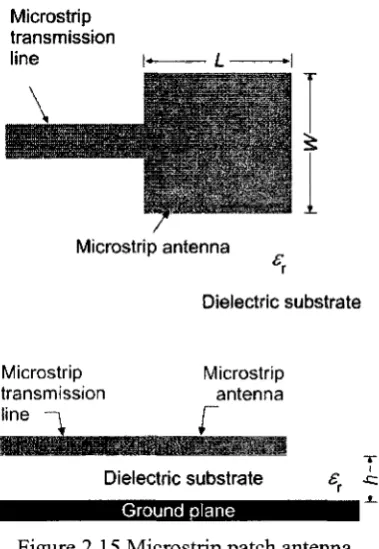
Microstrip antennas are planar resonant cavities that utilize the fringing fields along the edges of a microstrip patch to radiate electromagnetic energy. A typical microstrip patch antenna consists of a very thin metallic strip (patch) of thickness /
placed on a dielectric substrate of thickness h and of dielectric constant of sr above a ground plane as shown in figure 2.15.
Microstrip transmission line
|-"l
/
Microstrip antenna
Microstrip transmission line
Dielectric substrate
Microstrip antenna
Dielectric substrate
Ground plane
Figure 2.15 Microstrip patch antenna.
An array of patches has to be used to get certain gain, directivity and efficiency required by the application to be performed using the microstrip antenna array. Figure 2.16 shows a microstrip antenna array.
C LI LI LI LI LI LI LI LI LI LI LI I
T_rT_j-T_JTL_j-T_j-T_jnL_rT_j-r_rT_jnLjnLj
_ f r n _ r r - i _ j r n _ j r n _ x
—i _ x
-i _ x
—L j r n - r r - i j r - L j r - L i n
r f T I~T r~r I T I T I T rnr r~T I T r~r r~r I
T_J-T_rT_JT_JT_JT_JT_JT__JT_JT_JT_JT_J
_ T T L i - n _ j r - i _ r r - L x n _ r r - u r T _ x - - L X - ^ ^
T_JT_JT_JT_JT_JT_JT_JT_JT_JT_JT__rT_J
T_J-TL_rT__rT_JT_JT_JT__rT_JT_JT_JT__rT_J
Figure 2.16 Microstrip antenna array.
A microstrip antenna array was presented in [40] in which corporate feed was used to feed the array in the 77 GHz range. It has a gain of 17.5 dB, return loss of -7 dB, efficiency of 69% and half power beamwidth of 12°.
In [41] a corporate feed microstrip antenna array was presented to be operated in the range of (32-36) GHz. It has a HPBW of 27°, gain of 16 dB.
A 2x8 microstrip corporate feed antenna array is presented in [42] to be used in 12 GHz, it exhibit a return loss of-15 dB, gain of 20 dB and half power beamwidth of 10°.
All above mentioned designs are using corporate feed which suffers high RF losses due to the feed line lengths. They also use a normal rectangular patch that lead to a lower gain microstrip antenna array.
2.10 The MEMS Radar
The MEMS technology will have a great impact in automotive radar sensors by introducing electronically scanned arrays (ESA) using recent UWB antenna array developments, true-time-delay beamformers, transmit/receive (T/R) switches and tuneable matching networks [43]. The integration of RF MEMS radar components in automotive radar subsystems will make the new generation of automotive radars more efficient, reliable and cost effective. It incorporate passive electronically scanned arrays (lens arrays, and beamformers), passive subarrays, and T/R modules for active electronically scanned arrays [44]
The application of an automotive radar system is classified according to the range it covers. Long range radar (LRR) and medium range radar (MRR) are used in cruise control and collision avoidance, and short range radar (SRR) is used in collision avoidance, crash-prevention and parking-assist systems.
Chapter 3
New Radar Architecture and MEMS Rotman
Lens
This chapter presents the architecture of the new MEMS based 77 GHz FMCW radar sensor and design, simulation and fabrication of a novel MEMS Rotman lens. The TEio mode air-cavity Rotman lens forms the core beamforming and beam steering component of the new radar sensor. The Rotman lens has a footprint area of 27 mm x36.2 mm including the transmission lines, incorporates 3 beam ports, 5 array ports, and 6 dummy ports. The Rotman lens has a cavity depth of 50 um with a cavity footprint area of 11 mm x 14 mm. The lens has been designed to steer a beam by ±4 degrees. HFSS simulation shows that the designed Rotman lens has an insertion loss of -2 dB, return loss of -20 dB and characteristic impedance of 50Q. The lens has been fabricated using deep reactive ion etching and thermo-compression bonding of two 500 um thick silicon wafers.
3.1 Architecture of MEMS Radar
Following the review of the state-of-the-art in automotive radars and requirements set by the auto industry for long range radar as listed in table 2.5, a decision can be made to select the radar type that can provide the best performance while addressing the design constraints.
3.1.1 Radar type selection
The visible disadvantages of the 3 main radar types, pulsed, FSK-CW and FMCW can be summarized as:
Pulsed Doppler disadvantages:
• Velocity measurement limited by blind speed when fd is a multiple of the PRF.
• Maximum measurable Doppler shift has to be less than PRF to avoid IS I among different pulses and target returns.
• Relatively high power requirements in the automotive scenario.
• Greater risk of jamming or confusion due to high-power pulses from other Pulsed radars.
FSK-CW disadvantages:
• Invisible targets in the direct path of the radar.
• Target range is computed based on the difference in phase shift for two consecutive frequency hops. This makes the system subject to phase noise.
• The CPI needs to be large enough to avoid range ambiguity.
FMCW radar overcomes these disadvantages with:
• No theoretical limit to range resolution and better short range detection.
• Reduced effects of clutter and atmospheric noise.
• Lower power rating than Pulsed radar.
• Less effects of phase noise.
• More resistance to interference from other similar radars in the vicinity.
• No theoretical blind spots.
• Resistance to jamming (frequency modulation is a common tool in ECCM -Electronic Counter-Countermeasures to overcome jamming effects)
This qualitative comparison warrants the use of FMCW for the new MEMS radar sensor for long range radar (LRR) application.
3.1.2 Frequency Selection
With regard to the automotive long range radar, the maximum range (150 meters following Table 2.5) is proportional to the effective antenna aperture size and to the square root of the frequency. Therefore, highest frequencies should be preferred to get smaller radar size. It will be also a cost saving approach.
3.1.3. Beamformer selection:
To eliminate the need for microelectronic based analog or digital beamforming engine, a Rotman lens has been adopted to perform the operation of beamforming and beamsteering.
3.1.4 Switch selection:
Instead of non-MEMS waveguide type switches, MEMS based RF switches have been selected to feed the FMCW signal to the beam ports of the Rotman lens.
3.1.5 Antenna Selection
Microstrip based antenna arrays have been selected to radiate and receive the signal due to their established superior performance, ease of fabrication, and small planar geometry while offering high directivity and lower sidelobes.
3.1.6 Signal processor selection
The aspects of frequency generation, tuning and linearity become critical in FMCW radar due to the requirement of highly linear frequency sweeps. In FMCW radar the signal generation and sweep modulation can be accomplished using analog or digital modulation. Analog PLLs or Phase Locked Loops containing a VCO were used in early CW systems, however were overtaken by digital systems with better frequency response, excellent linearity, easier design and improved performance in noise [45].
In digital implementation of a radar transmitter, the control and modulation algorithm can be based on a Digital Signal Processor (DSP) or a Field Programmable Gate Array (FPGA). Due to their highly parallel nature, ability to run several tasks simultaneously without stalling other tasks, and on-chip resources (such as RAM blocks, LUTs, fast DSP multipliers) FPGAs are the preferred solution for digital signal processing for a radar sensor with a lower cycle time.

![Table 2.5 Requirements for Future Radar Systems [14]](https://thumb-us.123doks.com/thumbv2/123dok_us/1455856.1178381/40.599.113.525.142.693/table-requirements-future-radar-systems.webp)
![Figure 2.7 Bosch LLR automotive radar [13].](https://thumb-us.123doks.com/thumbv2/123dok_us/1455856.1178381/43.598.195.439.81.295/figure-bosch-llr-automotive-radar.webp)

![Figure 2.9 Schematic of the intrinsic beamforming capability of the Rotman lens [23].](https://thumb-us.123doks.com/thumbv2/123dok_us/1455856.1178381/45.598.216.405.303.394/figure-schematic-intrinsic-beamforming-capability-rotman-lens.webp)
![Figure 2.12 Dielectric Rotman lens (a) top view (b) side view.[28]](https://thumb-us.123doks.com/thumbv2/123dok_us/1455856.1178381/48.598.201.435.162.459/figure-dielectric-rotman-lens-top-view-side-view.webp)