R E S E A R C H
Open Access
Selection based inter-relay power allocation for
multiple AF single-antenna relays
Youngtaek Bae and Jungwoo Lee
*Abstract
This article deals with inter-relay power allocation for multiple-input multiple-output systems with multiple single-antenna relays. It is difficult to derive an optimal solution in a closed form for the case of multiple multi-single-antenna relays as well as the case of multiple single-antenna relays. In this article, we propose an approximate solution which is effective only for the case of multiple single-antenna relays. A key contribution of this article is a low complexity inter-relay power allocation method which is based on relay selection. This approach also reduces the feedback information of the gain factors of all the relays. An incremental greedy search algorithm is also proposed to further reduce the complexity of the relay selection process with negligible performance degradation.
Simulations indicate that the performance is comparable to the optimal exhaustive search algorithm.
1 Introduction
The relay channel was first studied by Meulen [1] and Cover and Gamal [2], which ignited research interest on the relay channel. Using a relay node, the transmission coverage can be extended with low cost, and a source node can transmit the signal more reliably through increased diversity. These advantages come from the cooperation between the source, the geographically dis-tributed relays, and well developed combining techni-ques at the destination. Many articles have considered different forwarding schemes at the relay node to use the system resource efficiently [3,4]. They are usually classified by regenerative and non-regenerative methods depending on whether or not the source signal is regen-erated at the relay node. The well known decode-and-forward (DF) and amplify-and-decode-and-forward (AF) schemes are examples of the two cases [5]. This general area is called cooperative communication, but some authors call it user cooperation by considering the case where each user can act as a source and a relay [6].
Power allocation methods for cooperative relay chan-nel have been considered in [7,8]. However they all focused on the scenario of three nodes, each of which is equipped with a single antenna. The solutions can be obtained with a relatively straightforward manner. Recently, the scenario was extended to two different
cases. One is the scenario of multiple relay nodes with a single antenna. In this case, the optimal power alloca-tion has been derived in [9,10]. The other is the scenario of a single relay with multiple antennas while there are still three nodes in the entire system, and the source and the destination also have multiple antenna. The optimal power allocation for the latter case was pro-posed in [11,12], which minimizes mean square error (MSE). Pairwise error probability (PEP) using distributed space-time codes was investigated in [13]. Overall chan-nel capacity was considered in [14,15]. They all compute the singular value decomposition of the first hop and the second hop channels, and distribute the total power among the eigenmodes to optimize the performance cri-teria, MSE or channel capacity.
Recently the most general extension, i.e., a multiple-antenna source and a multiple-multiple-antenna destination aided by multiple relays with multiple antennas, is considered in [16,17]. They computed the precoding matrix which is used for forwarding in the second hop. In [16], even though the proposed approach has a closed form for a diagonal matrix denoted byF, the final relay precoding matrix should be chosen in order to be a block diagonal matrix with minimum norm. That is, the solution does not have a closed form. Several relaying schemes for each relay are proposed in [17], but they are not capacity-opti-mal solutions. In [18,19], the authors considered a similar system model with relaying through distributed space-time codes, and showed that the power allocation solution
* Correspondence: [email protected]
School of Electrical Engineering, Seoul National University, Seoul, Korea
results in the best relay selection. In fact, it is difficult to obtain a closed form solution for this general case with the block diagonal constraint. As a simpler case, if multiple relays with a single antenna are distributed geographically in a network, the matrix formed by all relay gains should be a diagonal matrix when full cooperation is not possible. However, few related results exist even for this simple case. Recently, [20] considered this simple system model, and derive an asymptotical capacity scaling law. However, they did not deal with the relay power allocation problem as in this article. Thus we focus on this simplified system where there are multiple relays with a single antenna while the source and the destination have multiple anten-nas. This may also be a practical scenario in the sense that the computational complexity of the relay nodes needs to be minimized. In order to focus on the effect of relay power gain, and compare with the performance of conven-tional non-regenerative relaying schemes, we only consider the AF scheme and real valued power gainain this article. For the aforementioned scenario, we propose a relay selec-tion based approach as an approximaselec-tion to solve for the power allocation problem. It will be shown by simulations that the performance of the proposed method is close to that of the exhaustive (optimal) search approach. We then apply an incremental greedy search algorithm to this pro-posed method in order to further reduce the computa-tional complexity of the selection based approach. This article deals only with the AF scheme, but a similar approach can be applied to the DF scheme with a modi-fied object function instead of channel capacity.
The remainder of the article is organized as follows. In Section 2, we describe the system model and formulate the problem. We consider the existing inter-relay power allocation in Section 3, and propose the relay selection based approach for capacity maximization in Section 4. In Section 5, we discuss the feedback overhead and the computational complexity. Simulation results are given in Section 6 to assess the performance of the proposed method. Finally, we provide the conclusion in Section 7.
Notation: Boldface lowercase and uppercase letters represent vectors and matrices, respectively. (·)* denotes the complex conjugate transpose of a matrix. |·| means
the determinant or the Euclidean (l2-) norm depending
on the operand (a matrix or a vector).
2 System model and problem formulation
The source node and the destination node have M
transmit antennas andNreceive antennas, respectively. In the network, there areRrelays with a single antenna. To satisfy the rank requirement of a multiplexing
sys-tem, we assume M ≤ N and M ≤ R. However, we do
not constrain the relationship between Rand N. First,
the source broadcasts M symbols to all relays in the
first hop, and each relay multiplies the received noisy
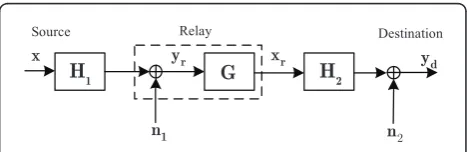
signal with a power gain. After that, all relays transmit these signals to the destination simultaneously in the second hop assuming perfect synchronization among relays. As depicted in Figure 1, the equivalent discrete time signal model can be summarized as follows,
yr = H1x + n1
yd = H2xr + n2 = H2GH1x + H2Gn1 + n2
Hx +n,
(1)
wherex is the (M ×1) transmitted signal vector from the source node with covariance matrixRx, andyr(R × 1) and yd (N ×1) denote the received signal at all the relays and the destination.H1 andH2 are (R × M) and (N × R) channel coefficient matrices from the source to all the relays, and from all the relays to the destination, which have independent and complex Gaussian distribu-ted elements with zero mean and unit variance, i.e., Ray-leigh fading. We assume that the source-relay and the relay-destination channels have an identical Rayleigh distribution, which means that all the relays are equidi-stant from the source and the destination. n1 andn2are additive complex Gaussian noise with covariance
matrices Rn1 and Rn2, and G is a diagonal matrix
made by relay power gainsg= (g1, . . . ,gR).H=H2GH1 is the equivalent channel matrix,n=H2Gn1 +n2 is the
compounded noise vector with covariance
Rn = H2GRn1G∗H∗2 +Rn2.
The general capacity formula or the mutual informa-tion can be written as in [21]
Ix;yd = 1
where the factor 1/2 is multiplied because we use two hops to transmit the signal. Our goal is to maximize this value with the individual power constraint allocated on each relay, g2 mum value of thekth relay power. In addition, there is the average power constraint on the relay output such
Relay Destination
as tr{Rxr} ≤Er, where Rxr = GH1RxH∗1G∗ + GRn1G∗
andEris the total power of all the relays. Problem formulation:
In the objective function, the diagonal matrix G
depends on the first hop and the second hop channels, so it is difficult to obtain a closed form solution.
3 Inter-relay power allocation
Since the problem may have no closed form solution, we try to find a solution for optimal power allocation by numerical search. Power allocation is performed at the destination node, and the power gain values are fed back to all the relays. We assume that the destination node knows all the channel state information. We also
assume Rx = values of this matrix and the determinant in the capacity formula have bounded real values.
3.1 Uniform
A simple method is to use a uniform gain across all the relays. If the values ofgkare a constant (b), we can setG=
bIwherebis chosen to satisfy the constraints. In this case, the capacity can reach the maximum when the equality of the constraint holds. From the average power constraint,
β2 = Er individual power constraint, this value should be less than or equal to (gk)maxfor eachk. Therefore,
If the individual constraint is sufficiently large, allgk’s will be the same asb.
3.2 Conventional power allocation
In [4], the authors proposed a so called conventional power gain. It is given by the following equation
gConv.k =
It should be noted that the conventional power alloca-tion depends only on its own first hop channel while the uniform gain allocation depends on the first hop channels of all the relays.
4 Proposed relay selection based approach The utility function to be maximized is the determinant of K = IM +RxH∗R−n1H. substituting the equivalent channel and the compounded noise covariance, it is given by
It was observed that the optimal solution for Gmay
never use certain relays in a poor channel condition, which motivates us to develop a relay selection based approach. In the selection based approach, the solution can be found by
max
complexity, the optimization over gr can be skipped. A
sub-optimal solution can be obtained by finding a solu-tion for the lower bound of the original problem as
max
g |K| ≥ r⊂{max1, . . . ,R}
KgUnif.r , (10)
where gUnif.
r denotes the gain vector for uniform gain
even with the sub-optimal approach which maximizes the lower bound, the proposed method can achieve per-formance similar to the optimal solution obtained by exhaustive search. The proposed approach obviously has lower complexity than the exhaustive search.
5 Feedback requirement and computational complexity
5.1 Feedback requirement
Let us consider the required amount of feedback bits from the destination to the relays. In the optimal solu-tion by the exhaustive search, the power gain values need to be fed back to the corresponding relays. To use uniform gain allocation, we need to feed back the
com-mon power gain b to the relays, which can be
broad-casted by the destination. The conventional power allocation depends only on its own first hop channel from the source to each relay which is assumed available at the relay. Thus relay power can be calculated in each
relay. Assuming that the total powerEr and the number
of relaysRare known at the relays, there is no need for feedback in this scheme.
The relay selection based approach needs to feed back the selection indicator bits as well as the power gain values of the selected relays. As for the selection indicator bits, one bit (0 or 1) for each relay can be used to indicate whether a given relay is selected or not. Note that the feedback overhead of the proposed method will be signif-icantly less than that of the optimal exhaustive search. When uniform gain allocation is used with the relay selection, only a single value (the common power gain) can be broadcasted by the destination. If conventional power allocation is used with the relay selection, the number of selected relays need to be broadcasted by the destination. As mentioned before, we employ uniform gain allocation in this article because it has slightly better performance than the conventional power allocation when no relay selection is used, which will be shown in the simulation results.
5.2 Computational complexity
The full search solution of proposed method gives us information on which relays are selected. However, the full search needs the computation of the utility function for every possible relay subset, and comparison of these values. When the number of relaysRis large, the number of possible relay subsets is
R
which increases exponentially as Rincreases, O(2R). Thus the complexity of the selection process itself may become infeasible. In order to reduce this selection
complexity, we use an incremental greedy search algo-rithm. This algorithm first selects the relay with maxi-mum utility function assuming that there is only one relay in the network. At the second stage, the algorithm
searches for another relay (among the remaining R-1
relays) which maximizes the utility function when com-bined with previously selected relay. These operations are repeated until the utility function decreases or all the relays are selected. This greedy algorithm is sum-marized as in Algorithm 1. We use the notations where
H1([S,n], :) and H2
:, [S,n] denote the matrices containing only row vectors or column vectors corre-sponding to index [S,n] in H1andH2 where S is the set of pre-selected relays, andnis the index for a candi-date relay.
Algorithm 1 Greedy search algorithm of the pro-posed method
From simulations, it was observed that the greedy algorithm usually stops at a value much smaller thanR. Even in the worst case where the iteration continues untilm=R, this only requires R(R2+1) computations and comparisons which have quadratic growth rate, O(R2).
Therefore, if R ≥ 3, the greedy algorithm becomes
advantageous over the full search in terms of
large. For example, when R = 8 which is used in our simulations, the full search considers 255 combinations while the greedy algorithm considers 36 combinations even in the worst case.
Let us compare the overall complexity roughly. We denote the complexity of the optimal numerical search
by Fopt, and that of our selection based method by
Fsel. If the grid size (interval) used by optimal
numeri-cal search is Δ, the total number of grid points is
xmaxk / for each relay. Thus Fopt = O
xmaxk /R.
On the other hand, the selection process even for full search has the relay combination number which is pro-portional to Fsel=O
2R. Thus it is obvious that we
have FoptFsel even if we use the well-developed
optimization tools for optimal solution. This complexity gap will be larger when the grid is sufficiently dense and/orRis large. Furthermore, if we combine the selec-tion process with a greedy algorithm, the complexity reduction can be much greater.
6 Simulation results
In this section, we compare the proposed power alloca-tion methods with the optimal (ex-haustive) method and two existing power allocation methods. In all
simu-lations, we use Es = Er, and the noise variance is
σ2
R = σD2 = 1. ‘Exhaustive’means the power gains
opti-mally found by a numerical method. ‘Uniform’ and
‘Conventional’ use the power allocation methods
described in the section of inter-relay power allocation. The above three methods use all the relays since relay selection is not used. ‘FullSearch’and ‘Greedy’are the proposed relay selection based approaches.
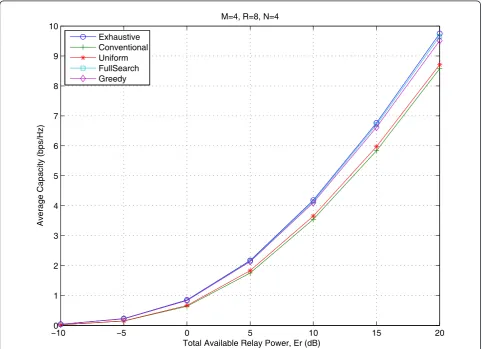
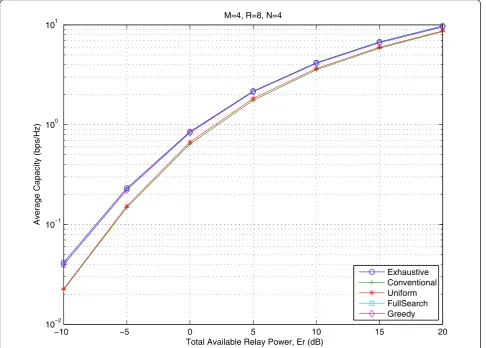
Figures 2 and 3 shows the performance of various power allocation methods in terms of average capacity. Figure 2 is in linear scale for the y-axis, and a log scale is used for the y-axis in Figure 3 to see the difference clearly in the low SNR regime, It is observed that the selection based methods perform similarly to the opti-mal (exhaustive) method. When the solution for power allocation problem can not be easily derived in a closed
−010 −5 0 5 10 15 20
1 2 3 4 5 6 7 8 9 10
Total Available Relay Power, Er (dB)
Average Capacity (bps/Hz)
M=4, R=8, N=4
Exhaustive Conventional Uniform FullSearch Greedy
form solution, high SNR assumption or an asymptotical approach is usually used in the literature. These tend to deviate from the optimal solution especially in the low SNR regime. However, it is interesting to note that our
proposed selection techniques which are ‘FullSearch’
and ‘Greedy’ have comparable performance in all SNR
regimes.
Let us consider the performance difference between the uniform gain allocation gUnif.and the conventional
power allocation GConv.. To simplify the analysis, we
focus ong1. The gain factors are then
g1
Conv. =
Er/R
Es
Mh T 11
2
+σ2 R ,
g1
Unif. =
Er
i
Es
Mh T 1i
2
+σ2 R
.
If it is assumed that hT112 is the largest among all
rows, that means the first hop channel to the first relay is very good. In this case, it is intuitively better to allo-cate more power for this relay. However, the conven-tional case allocates less power than the uniform case since R · |h11|2 ≥
i|h1i|2. Therefore, the uniform method performs slightly better than the conventional method. This is why we use the uniform gain allocation instead of the conventional power allocation in the pro-posed relay selection based approach.
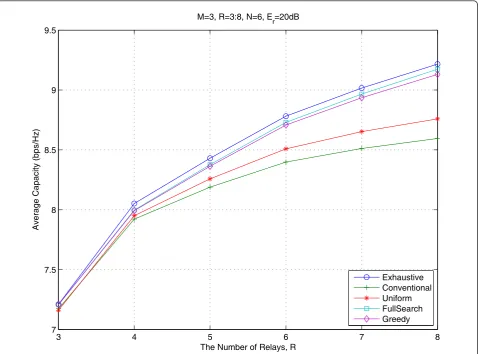
In order to show the results for more general antenna configurations, we show the performance comparison with respect to the number of relays in Figure 4, where
we use Er = 20 dB to show the performance difference
more clearly. We fix M = 3 and N= 6. The proposed
methods have similar performance to the optimal
(exhaustive) case for all Rvalues. The performance of
the two proposed methods begin to deviate from the exhaustive method slightly as the number of relays gets
−10 −5 0 5 10 15 20
10−2 10−1 100 101
Total Available Relay Power, Er (dB)
Average Capacity (bps/Hz)
M=4, R=8, N=4
Exhaustive Conventional Uniform FullSearch Greedy
larger. Note that the deviation is less than 0.1 bps/Hz at
R= 8. But the reduction of feedback overhead and
com-putational complexity will be more significant as Rgets larger, so the proposed methods may still be attractive in practice. Figure 4 also shows that if we remove the relays in bad condition and allocate more power to the other remaining relays, the performance can be improved when uniform gain allocation is used. It is also observed that the incremental greedy search algo-rithm has negligible performance loss compared to the full search case.
7 Conclusions
In this article, we proposed a relay selection based approach for inter-relay power allocation problem. Since it is difficult to obtain a closed form solution for the problem, we propose a low-complexity technique based on relay selection using uniform gain allocation, which has near-optimal performance in terms of capacity. We also combine with the proposed method with an incre-mental greedy search algorithm in order to further
reduce the search complexity for the relay selection. Simulations show that the proposed methods for relay power allocation have performance close to the optimal (exhaustive) power allocation in terms of average capa-city. The proposed methods appear to be promising in terms of computational complexity and capacity performance.
Endnote a
If we consider the complex valued gain, the perfor-mance can be improved by adjusting the phase with extra processing. When a complex number is treated as two real values (magnitude and phase), the feedback overhead (as will be discussed) may overshadow the benefit of power allocation. Thus we focus on the real valued power allocation problem in this article.
Acknowledgements
This research was supported in part by the Basic Science Research Programs (KRF-2008-314-D00287, 2010-0013397), Mid-career Researcher Program (2010-0027155) through the NRF funded by the MEST, Seoul R&BD Program
3 4 5 6 7 8
7 7.5 8 8.5 9 9.5
The Number of Relays, R
Average Capacity (bps/Hz)
M=3, R=3:8, N=6, Er=20dB
Exhaustive Conventional Uniform FullSearch Greedy
(JP091007, 0423-20090051), the KETEP Grant (2011T100100151), the INMAC, and BK21.
Competing interests
The authors declare that they have no competing interests.
Received: 9 July 2011 Accepted: 30 May 2012 Published: 30 May 2012
References
1. EC van der Meulen, Three-terminal communication channels. Adv Appl Probl.3, 120–154 (1971). doi:10.2307/1426331
2. T Cover, AE Gamal, Capacity theorems for the relay channel. IEEE Trans Inf Theory.25(5), 572–584 (1979). doi:10.1109/TIT.1979.1056084
3. JN Laneman, DNC Tse, GW Wornell, Cooperative diversity in wireless networks: efficient protocols and outage behavior. IEEE Trans Inf Theory. 50(12), 3062–3080 (2004). doi:10.1109/TIT.2004.838089
4. JN Laneman, GW Wornell, Distributed space-time-coded protocols for exploiting co-operative diversity in wireless networks. IEEE Trans Inf Theory. 49(10), 2415–2425 (2003). doi:10.1109/TIT.2003.817829
5. A Nosratinia, TE Hunter, A Hedayat, Cooperative communication in wireless networks. IEEE Commun Mag.42(10), 74–80 (2004). doi:10.1109/ MCOM.2004.1341264
6. A Sendonaris, E Erkip, B Aazhang, User cooperation diversity–Part I, II. IEEE Trans Commun.51(11), 1927–1948 (2003). doi:10.1109/TCOMM.2003.818096 7. MO Hasna, MS Alouini, Optimal power allocation for relayed transmissions
over Rayleigh-fading channels. IEEE Trans Wirel Commun.3(6), 1999–2004 (2004). doi:10.1109/TWC.2004.833447
8. X Deng, AM Haimovich, power allcoation for cooperative relaying in wireless networks. IEEE Commun Lett.9(11), 994–996 (2005). doi:10.1109/ LCOMM.2005.11012
9. Y Zhao, R Adve, TJ Lim, Improving amplify-and-forward relay networks: optimal power allocation versus selection. IEEE Trans Wirel Commun.6(8), 3114–3123 (2007)
10. N Khajehnouri, AH Sayed, Distributed MMSE relay strategies for wireless sensor networks. IEEE Trans Signal Process.55(7), 3336–3348 (2007) 11. W Guan, H Luo, Joint MMSE transceiver design in non-regenerative MIMO
relay sys-tems. IEEE Commun Lett.12(7), 517–519 (2008)
12. R Krishna, Z Xiong, S Lambotharan, A cooperative MMSE relay strategy for wireless sensor networks. IEEE Signal Process Lett.15, 549–552 (2008) 13. H Muhaidat, M Uysal, Cooperative diversity with multiple-antenna nodes in
fading relay channels. IEEE Trans Wirel Commun.7(8), 3036–3046 (2008) 14. O Muñoz-Medina, J Vidal, A Agustín, Linear transceiver design in
nonregenerative relays with channel state information. IEEE Trans Signal Process.55(6), 2593–2604 (2007)
15. X Tang, Y Hua, Optimal design of non-regenerative MIMO wireless relays. IEEE Trans Wirel Commun.6(4), 1398–1407 (2007)
16. AS Behbahani, R Merched, AM Eltawil, Optimizations of a MIMO relay network. IEEE Trans Signal Process.56(10), 5062–5073 (2008) 17. H Shi, T Abe, T Asai, H Yoshino, Relaying schemes using matrix
triangularization for MIMO wireless networks. IEEE Trans Commun.55(9), 1683–1688 (2007)
18. B Maham, A Hjørungnes, Opportunistic relaying through amplify-and-forward distributed space-time codes with partial statistical CSI at relays, in
Proc IEEE Allerton Conference on Communication, Control an Computing, Monticello, IL, pp. 1004–1008 (2008)
19. B Maham, A Hjørungnes, Opportunistic relaying for MIMO amplify-and-forward cooperative networks. Wirel Pers Commun 1–25 http://dx.doi.org/ 10.1007/s11277-011-0499-9 (2012)
20. L Sun, MR McKay, Opportunistic relaying for MIMO wireless communication: relay selection and capacity scaling laws. IEEE Trans Wirel Commun.10(6), 1786–1797 (2011)
21. TM Cover, JA Thomas,Elements of Information Theory(Wiley, New York, 1991)
doi:10.1186/1687-1499-2012-183
Cite this article as:Bae and Lee:Selection based inter-relay power allocation for multiple AF single-antenna relays.EURASIP Journal on Wireless Communications and Networking20122012:183.
Submit your manuscript to a
journal and benefi t from:
7Convenient online submission
7Rigorous peer review
7Immediate publication on acceptance
7Open access: articles freely available online
7High visibility within the fi eld
7Retaining the copyright to your article