© 2014, IJCSMC All Rights Reserved 898
Available Online atwww.ijcsmc.com
International Journal of Computer Science and Mobile Computing
A Monthly Journal of Computer Science and Information Technology
ISSN 2320–088X
IJCSMC, Vol. 3, Issue. 6, June 2014, pg.898 – 906
RESEARCH ARTICLE
Different QoS based OLSR Proactive
Routing Protocol using 802.11b
Sonia
1, Lokeshwar
2, Kuldeep Vats
31
M.Tech Scholar, Department of ECE, RN College of Engineering & Management, Rohtak, Haryana, India
2
Assistant professor, Department of ECE, RN College of Engineering & Management, Rohtak, Haryana, India
3
B.E. (Honors), M.Tech (CSE), Department of Computer Science Engineering, Sonepat, Haryana, India
________________________________________________________________________________________________________
Abstract- In this paper we have discussed and evaluated the comparative analysis of performance of OLSR routing protocol in two different networks with different number of users to find out with which network OLSR shows better performance. We are using OPNET simulator tool for the simulation of networks. Few performance metrics like Delay, throughput, end to end delay, MPR calculations, OLSR performance neighborhood Change, OLSR performance route table calculations, OLSR performance topology changes and OLSR performance total neighbor additions are analyzed in both networks and compared with each other to find out the better performance results.
Keywords- MANET, Routing Protocols, OLSR, OPNET
_____________________________________________________________________________________________
I. INTRODUCTION
© 2014, IJCSMC All Rights Reserved 899
networks are divided into two main groups that is infrastructure wireless network and Ad hoc or infrastructure-less network.
Ad-Hoc networks have no particularly defined infrastructure and the mobile nodes are free to join and left the network. The nodes are connected with each other through a wireless link. A node can serve as a router to forward the data to the neighbors‟ nodes. Therefore this kind of network is also known as infrastructure less networks [1]. These networks have no centralized administration. Ad-Hoc networks have the capabilities to handle any malfunctioning in the nodes or any changes that its experience due to topology changes. Whenever a node in the network is down or leaves the network that causes the link between other nodes is broken [2]. The affected nodes in the network simply request for new routes and new links are established Ad-Hoc network can be categorized in to static Ad-Hoc network (SANET) and Mobile Ad-Hoc network (MANET).
Fig. 1 Mobile Ad-Hoc Network
In MANET, nodes are autonomous and can play the role of router and host at the same time. MANET is self governing, where there is no centralized control and the communication is carried out with blind mutual trust amongst the nodes on each other. The network can be set up anywhere without any geographical restrictions.
Because of its rapid dynamic topology, MANET is prone to various types of external attacks and thus more security is required in comparison to wired network. One kind of these attacks is known as the wormhole attack. The wormhole attack is very powerful, and preventing the attack has proven to be very difficult. In wormhole attacks, an attacker creates a tunnel between two points in the network and creates direct connection between them as if they were directly connected [3][4].
Routing is the main issue in ad-hoc networks for sending packets from one node to another. Routing protocols works well in wired networks but does not show the same performance in mobile ad hoc networks due to their dynamic topology. Keeping this point in mind, many routing protocols have been proposed for the mobile ad hoc network and classified as: Reactive or On Demand Routing Protocol, Proactive or Table Driven routing Protocol, Hybrid routing protocols.
II. Proactive Routing Protocols
The proactive routing protocols designed for ad hoc networks are derived from the traditional distance vector and link state protocols developed for use in wire-line internet [5]. The primary characteristic of proactive protocols is that each node in the network maintains a route to every
Table-© 2014, IJCSMC All Rights Reserved 900
driven proactive routing protocols which keep routes to all other nodes in the network also
considering those nodes to which packets are not sent. Route creation and maintenance are accomplished through some combination of periodic and event-triggered routing updates. Periodic updates consist of routing information exchanges between nodes at set time intervals. The updates occur at specific intervals, regardless of the mobility and traffic characteristics of the network. On the other hand, event-triggered updates are transmitted whenever some event, such as a link addition or removal, occurs. The mobility rate directly affects the frequency of event-triggered updates because link changes are more likely to occur as mobility increases. Proactive approaches have the advantage of readily available routes the moment they are required. Because each node consistently maintains an up-to-date route to every other node in the network, a source can simply check its routing table when it has data packets to send to some destination and begin packet transmission. However, the primary disadvantage of these protocols is that the control overhead can be significant in large networks or in networks with rapidly moving nodes. OLSR is an example of Proactive Protocol which is the focus of our study in this paper.
2.1 Optimized Link State Routing Protocol (OLSR)
The Optimized Link State Routing (OLSR) is proactive routing protocol that is also known as table driven protocol by the fact that it updates its routing tables. Conceptually, OLSR contains three generic elements: a mechanism for neighbor sensing, a mechanism for efficient flooding of control traffic, and a specification of how to select and diffuse sufficient topological information in the network in order to prove optimal routes [6].
2.1.1 Multi Point Relaying (MPR)
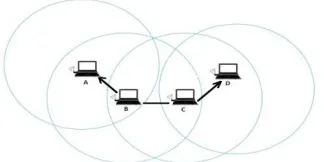
OLSR diffuses the network topology information by flooding the packets throughout the network. The flooding is done in such way that each node that received the packets retransmits the received packets. These packets contain a sequence number so as to avoid loops. The receiver nodes register this sequence number making sure that the packet is retransmitted once. The basic concept of MPR is to reduce the duplication or loops of retransmissions of the packets. Only MPR nodes broadcast route packets. The nodes within the network keep a list of MPR nodes. MPR nodes are selected with in the vicinity of the source node. The selection of MPR is based on HELLO message sent between the neighbor nodes. The selection of MPR is such that, a path exist to each of its 2 hop neighbors through MPR node. Routes are established, once it is done the source node that wants to initiate transmission can start sending data [7].
Fig. 2 Flooding Packets using MPR
© 2014, IJCSMC All Rights Reserved 901
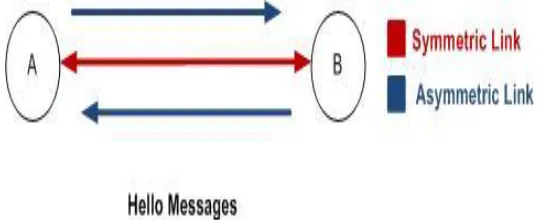
Fig. 3 Hello Message Exchange
When there is two way communications between both of the nodes we call the link as symmetric link. HELLO message has all the information about the neighbors. MPR node broadcast topology control (TC) message, along with link status information at a predetermined TC interval.
III.RELATED WORK
Several researchers have been done to analyze the characteristics and performance of Ad-hoc Routing Protocols by means of different performance metrics using different simulators.
Kuldeep vats [8] analyzed the performance of DSR, OLSR and GRP routing protocols using OPNET simulation tool. They created a network containing 150 mobile nodes with the data rate of 18 mbps. According to their simulation result, OLSR presented the best performance and GRP presented low to OLSR and high to DSR or finally DSR presented the low performance (DSR<GRP<OLSR) is analyzed.
Ravinder Ahuja [9] evaluated performance of three types of routing protocols (AODV, OLSR
and ZRP) based on random waypoint mobility model. They analyzed and compared the performance of protocols using Qualnet 4.5 from scalable network. Simulation results showed that Reactive protocols are better in terms of packet delivery ratio and throughput.
Pankaj Palta, Sonia Goyal [10] compared the reactive routing protocols (TORA) and Proactive routing Protocols (OLSR) on the basis of their few parameters. Results showed that OLSR is better in those scenario where bandwidth is large as OLSR always updated their nodes so large bandwidth is used than TORA on same conditions.
Razan Al-Ani [11] simulated and evaluated the AODV, OLSR, GRP, TORA and DSR routing
© 2014, IJCSMC All Rights Reserved 902
IV.Simulation Infrastructure
Our protocol evaluations are based on the simulation using OPNET simulator version 14.5. It provides a graphical environment for modeling and simulation of wireless communications. The scale up network model consists of 20, 50 mobile nodes distributed randomly in a space of 1000m X 1000m.
V. SIMULATION RESULT
The network designed consists of basic network entities with the simulation parameters presented in table 1.
Table1 OLSR PARAMETERS
Parameter Value
Willingness Default
Hello interval(sec) 2.0
TC interval(sec) 5.0
Addressing mode IPv4
Memory size 16Mb
Duplicate message
hold time(sec)
30.0
Physical sequence Direct sequence
802.11b
Data rate 11 Mbps
Transmit Power(W) 0.005
Simulation time(sec) 1000
No. of nodes 20, 50
Mobility Random way
point Datagram switching
rate(Packets)
500,000
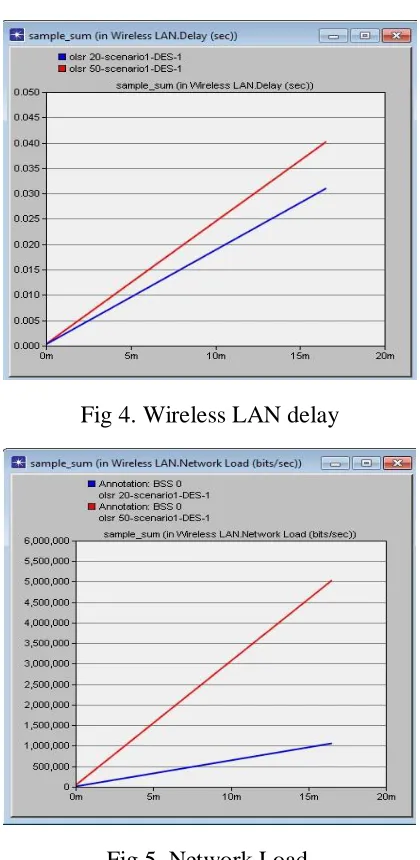
The following graphs were obtained after collecting statistics on OPNET. The graphs give a comparative picture of the two scenarios.
© 2014, IJCSMC All Rights Reserved 903
Fig 4. Wireless LAN delay
Fig 5. Network Load.
© 2014, IJCSMC All Rights Reserved 904
Fig 6 Wireless LAN throughput
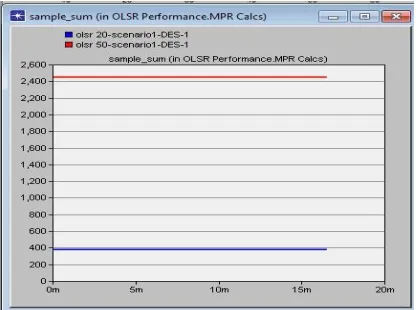
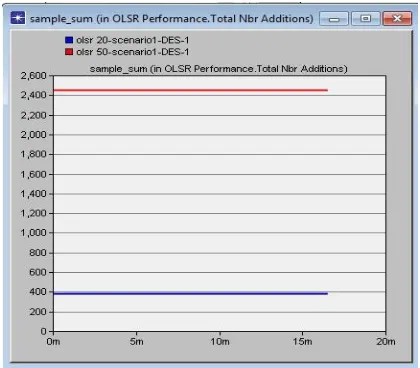
The below figures (7- 11) are showing MPR calculations, OLSR performance neighborhood Change, OLSR performance route table calculations, OLSR performance topology changes, OLSR performance total neighbor additions in two scenarios having 20 and 50 mobile nodes with OLSR routing protocol. From these figures we concluded that all of these QoS are higher for 50 nodes scenario than 20 nodes scenario with a major difference.
© 2014, IJCSMC All Rights Reserved 905
Fig 8. OLSR performance neighborhood Change
Fig 9. OLSR performance route table calculations.
© 2014, IJCSMC All Rights Reserved 906
Fig 11. OLSR performance total neighbor additions
VI.CONCLUSION
A Mobile AD-hoc Network OLSR routing protocol was simulated in two scenarios with 20 and 50 nodes moving randomly in an area of within the network range 1000 sq m. In this paper, performance of MANET‟s proactive routing protocol OLSR is analyzed. This paper carried out a comparative analysis on the performance of OLSR protocol in two different sized networks and concluded that it carries less load, throughput and delay in small sized network but it shows overall better performance in large network when compared with respect to different aspects.
REFERENCES
[1] Al-Maashri. A. and Ould-Khaoua. M. (2006) “Performance Analysis of MANET Routing Protocol in the Presence of self-similar traffic”, In Proceeding of the 31st IEEE Conference on Local Computer Networks, pp. 801-807, Tampa, Florida, USA.
[2] Nguyen, U.T. and Xiong, X.X. (2005) „„Rate-adaptive Multicast in Mobile Ad-hoc Networks‟‟, Department of
Computer Science and Engineering York University Toronto, Canada M3J 1P3.
[3] ACHINT GUPTA, Dr. PRIYANKA V J, SAURABH UPADHYAY,” Analysis of Wormhole Attack in AODV based MANET Using OPNET Simulator”, International Journal of Computing, Communications and Networking,
ISSN 2319-2720, Volume1, No.2, September-October 2012.
[4] Rajpal Singh Khainwar, Mr. Anurag Jain, Mr. Jagdish Prasad Tyagi,” Elimination of Wormhole Attacker Node in MANET Using Performance Evaluation Multipath Algorithm”, International Journal of Emerging Technology and Advanced Engineering, ISSN 2250-2459,Volume 1, Issue 2, December 2011.
[5]Clausen, T. and Jacquet , P. (2003) “Optimized Link State Routing Protocol (OLSR)”, RFC 3626.
[6] T.H. Clausen, ”The optimized link state routing protocol evaluating through experiments and simulation” mind pass centre for distributed system, Aalborg university ,Denmark.
[7] Huawei, Z. and Yun, Z. (2008) “Comparison and Analysis AODV and OLSR routing protocols in Mobile ad hoc
network” IEEE Network Magazine, Vol. 8, 2, pp. 16-23.
[8] Kuldeep Vats, “Simulation and performance analysis of OLSR routing protocol using OPNET”
[9]Ravinder Ahuja, “Simulation based Performance Evaluation and Comparison of Reactive, Proactive and Hybrid Routing Protocols based on Random Waypoint Mobility Model”, International Journal of Computer Applications, Vol. 7, No.11, pp. 20-24, Oct. 2010. IJARCSSE ,Vol. 2, Issue 2, Feb. 2012.