Weakness of two ID-based remote mutual authentication with key
agreement protocols for mobile devices
He Debiao*, Chen Jianhua, Hu Jin
Mathematics & Statistics School of Wuhan University, Wuhan, Hubei province, 430072, China
Abstract: Recently, Yoon et al. and Wu proposed two improved remote mutual authentication
and key agreement schemes for mobile devices on elliptic curve cryptosystem. In this paper, we show that Yoon et al.’s protocol fails to provide explicit key perfect forward secrecy and fails to
achieve explicit key confirmation. We also point out Wu’s scheme decreases efficiency by using the double secret keys and private/public pair, and is vulnerable to the password guessing attack and the forgery attack.
Key words: ID-based; Mutual authentication; Key agreement; Elliptic curve Cryptosystem; Perfect forward secrecy; Modular multiplication
1.
Introduction
With the rapid development of electronic technology, various mobile devices (e.g., cell phone, PDA, and notebook PC) are produced and people’s life is made more convenient. More and more electronic transactions for mobile devices are implemented on Internet or wireless networks. In
electronic transactions, remote user authentication in insecure channel is an important issue. For example, when one user wants to login a remote server and access its services, such as on-line
shopping and pay-TV, both the user and the server must authenticate the identity with each other for the fair transaction.
Generally, the remote user authentication can be implemented by the traditional public-key
cryptography (Rivest et al., 1978; ElGama, l985). The computation ability and battery capacity of mobile devices are limited, so traditional public-key cryptograph, in which the computation of
modular exponentiation is needed, can’t be used in mobile devices. Fortunately, Elliptic curve cryptosystem (ECC) (Miller, 1986; Koblitz, 1987) has significant advantages like smaller key sizes, faster computations compared with other public-key cryptography. Thus, ECC-based
authentication protocols are more suitable for mobile devices than other cryptosystem. However, like other public-key cryptography, ECC also needs a key authentication center (KAC) to maintain
the certificates for users’ public keys. When the number of users is increased, KAC needs a large storage space to store users’ public keys and certificates. In addition, users need additional computations to verify the other’s certificate in these protocols
To solve the above problems, several ID-based authentication protocols on ECC are proposed (Abichar et al., 2007; Choie et al., 2005; Cao et al., 2008; Chen and Song, 2007; Jiang C et al.,
2007; Jia Z. et al., 2006; Tian et al., 2005; Wu et al.,2005). But there are some disadvantages in the previous user authentication protocols on ECC (Yang et al. 2009). That is, some of these
*Corresponding author
protocols do not provide the mutual authentication (Chen and Song, 2007; Jiang et al., 2007; Jia et al., 2006; Wuet al., 2005) or the session key agreement (Cao et al., 2008; Chen and Song, 2007; Jia et al., 2006;Wuet al., 2005) between the user and the server. For some applications, the user
and the server need a session key to encrypt the secret information for the subsequent communications after they authenticate with each other.
In 2009, Yang et al. propose the first ID-based remote mutual authentication with key agreement protocol on ECC (Yang et al., 2009). Based upon the ID-based concept, the protocol does not require public keys for users so that the additional computations for certificates can be
reduced. Moreover, the protocol not only provides mutual authentication but also supports a session key agreement between the user and the server. Recently, Yoon et al. (Yoon et al., 2009)
found Yang et al.’s protocol is vulnerable to an impersonation attack and does not provide perfect forward secrecy. At the same time, Wu (Wu, 2009) pointed out Yang et al.’s protocol depends solely on a long-term private key stored in the mobile device, does not provide perfect forward
secrecy and does not consider personal privacy problem.
Nevertheless, we find Yang et al.’s protocol does not provide perfect forward secrecy and
fails to achieve forward secrecy. We also find Wu’s protocol is vulnerable to the password guessing attack and the forgery attack. In addition, Wu’s protocol decreases efficiency by using the double secret keys. In this paper, we propose an efficient ID-based remote mutual
authentication with key agreement protocol for mobile devices on elliptic curve cryptosystem. Compared with that of Yang et al., Yoon et al. and Wu, the proposed protocol is more secure,
efficient, and more suitable for mobile devices.
The rest of our paper is organized as follows. Section 2 gives the some basic concept. Section 3 reviews the protocols of Yoon et al. and Wu. Section 4 analyzes the security of the protocols of
Yoon et al. and Wu. Section 5 and Section 6 propose our protocol and the security of the proposed protocol. Finally, Section 7 concludes the paper.
2.
Preliminaries
2.1 Notations
We first introduce common notations used in this paper as follows.
z
F
p: a finite field;z
E
: an elliptic curve defined on finite fieldF
p with large order;z
G
: the group of elliptic curve points onE
;z
P
: a point on elliptic curveE
with ordern
, wheren
is a large prime number;z
H
1( )
⋅
: a secure one-way hash function, whereH
1:{0,1}
*→
G
;z
H
2( )
⋅
: a secure one-way hash function, whereH
2:{0,1}
*→
Z
*p;z
H
4( )
⋅
: a secure one-way hash function, whereH
4:{0,1}
*→
Z
*p;z
U
: the user;z
S
: the server;z
ID
U: the identity of the userU
;z
ID
S: the identity of the serverS
;z (
q Q
S,
S): the serverS
’s private/public key pair, whereQ
S=
q
S⋅
P
.2.2 Background of elliptic curve cryptograph
We will just give a simple introduction of elliptic curve defined on prime field
F
p. Theknowledge of elliptic curve defined on binary field can be found in (Miller, 1986; Koblitz, 1987).
Let the symbol
E F
/
p denote an elliptic curveE
over a prime finite fieldF
p, definedby an equation
b
ax
x
y
2=
3+
+
,a
,
b
∈
F
p (1)and with the discriminant
3 2
4
a
27
b
0
Δ =
+
≠
. (2)The points on
E F
/
p together with an extra pointO
called the point at infinity form agroup
{( , ) : ,
p, ( , )
0}
{ }
G
=
x y
x y
∈
F E x y
= ∪
O
. (3)Let the order of
G
isn
,
G
is a cyclic additive group under the point addition “+” definedas follows: Let
P Q
,
∈
G
,l
be the line containingP
andQ
(tangent line toE F
/
p ifP
=
Q
), andR
, the third point of intersection ofl
withE F
/
p. Letl
′
be the line connectingR
andO
. ThenP
“+”Q
is the point such thatl
′
intersectsE F
/
p atR
andO
andP “+” Q. Scalar multiplication over
E F
/
p can be computed as follows:( )
3.
Review of Two Protocols
3.1 Yoon et al.’s Protocol
Yoon et al.’s protocol consists of three phases: system initialization phase, user registration phase, and mutual authentication with key agreement phase.
z System initializing phase
In this phase,
S
generates parameter of the system.1).
S
chooses an elliptic curveE
over a finite fieldF
p. LetE F
(
p)
denote the set of allthe point on
E
.2).
S
chooses a pointP
∈
E F
(
p)
, such that the subgroup generated byP
has a largeorder
n
.3).
S
chooses three hash functionsH
1( ),
⋅
H
2( ),
⋅
H
3( )
⋅
described in section 2.1.4).
S
publishes the parameter( , , , ,
p E G n H
1( ),
⋅
H
2( ),
⋅
H
3( ))
⋅
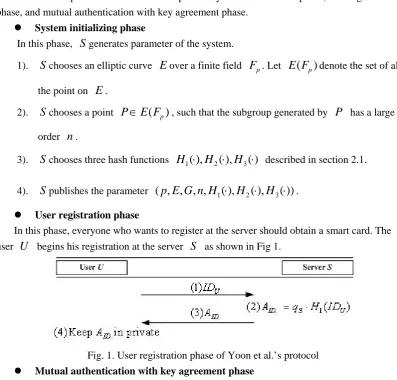
.z User registration phase
In this phase, everyone who wants to register at the server should obtain a smart card. The
user
U
begins his registration at the serverS
as shown in Fig 1.Fig. 1. User registration phase of Yoon et al.’s protocol
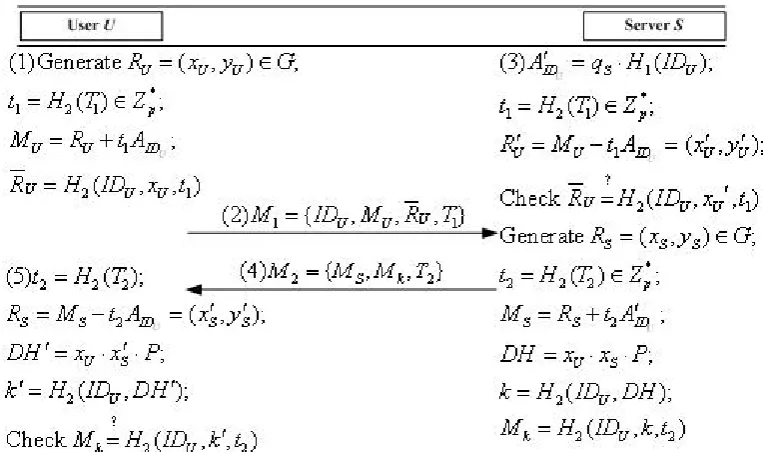
z Mutual authentication with key agreement phase
In this phase, the user
U
sends a login request message to the serverS
wheneverU
Fig. 2. Mutual authentication with key agreement phase of Yoon et al.’s protocol
3.2 Wu’s Protocol
Wu’s protocol also consists of three phases: system initialization phase, user registration
phase, and mutual authentication with key agreement phase.
z System initializing phase
In this phase,
S
generates parameter of the system.1).
S
chooses an elliptic curveE
over a finite fieldF
p. LetE F
(
p)
denote the set of allthe point on
E
.2).
S
chooses a pointP
∈
E F
(
p)
, such that the subgroup generated byP
has a largeorder
n
.3).
S
chooses three hash functionsH
2( ),
⋅
H
3( ),
⋅
H
4( )
⋅
described in section 2.1.4).
S
computes private/public key pair (q Q
S,
S) and selects a private keyd
S.5).
S
publishes the parameter( , , , ,
p E G n H
2( ),
⋅
H
3( ),
⋅
H
4( ))
⋅
.z User registration phase
In this phase, everyone who wants to register at the server should obtain a smart card. The
user
U
begins his registration at the serverS
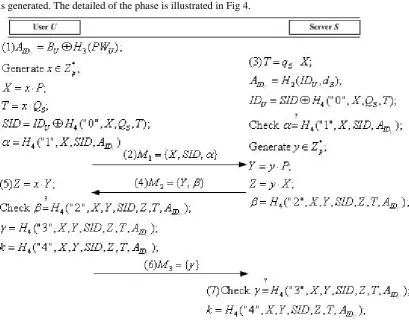
as shown in Fig 3.z Mutual authentication with key agreement phase
In this phase, the user
U
sends a login request message to the serverS
wheneverU
wants to access some resources upon
S
. Then the serverS
verifies the authenticity of the login message requested by the userU
. At the same time, a session generation betweenU
andS
is generated. The detailed of the phase is illustrated in Fig 4.Fig. 4. Mutual authentication with key agreement phase of Wu’s protocol
4.
Analysis of Two Protocols
4.1 Analysis of Yoon et al.’s Protocol
This section shows that Yoon et al.’s protocol does not provide perfect forward secrecy and does not achieve explicit key confirmation.
z Failure to provide explicit key perfect forward secrecy
Perfect forward secrecy is one of desirable attributes of key agreement protocols, it means that if the long-term private keys of one or more entities are compromised, the secrecy of previous
session keys, which was established by honest entities, is not affected (Blake-Wilson S. et al., 1997).
We find that Yoon et al.’s protocol could not provide perfect forward secrecy. The following is our reasons.
In Yoon et al.’s protocol, since all transcripts are transmitted over an open network, a benign
2
{
M
S,
M T
k,
}
.If the long-term private key U
ID
A
of the user is compromised, and the key is derived by theattacker
A
, thenA
can compute all the session key generated between the user and the server as follow.1)
A
computest
1=
H T
2( )
1 , and(
,
)
1 UU U U U ID
R
=
x
y
=
M
−
t A
.2)
A
computest
2=
H T
2( )
2 , and(
,
)
2 US S S S ID
R
=
x
y
=
M
−
t A
.3)
A
computesDH
=
x
U⋅ ⋅
x
SP
.4) The attacker
A
get the session keyk
=
H ID
2(
U,
DH
);
.If the long-term private key
q
sof the serverS
is compromised, the attackerA
cancompute the session key at the same way, because the attacker
A
can get the long-term privatekey U
ID
A
of any userU
by computing 1(
)
UID s U
A
= ⋅
q H ID
.Since the attacker can get the session key through the method described above, then we can
conclude that Yoon et al.’s protocol does not provide perfect forward.
z Failure to achieve explicit key confirmation
A key agreement scheme is said to provide the explicit key confirmation if one entity is
assured that the second entity has actually computed the session key (Blake-Wilson S. et al., 1997). In many applications, it is highly desirable for a key agreement scheme to provide the explicit key
confirmation. We can see that the scheme of Yoon et al. merely provides the implicit key confirmation, because
S
cannot confirmU
has correctly computed the session key after the Mutual authentication with key agreement phase. However, in general, key agreement scheme canprovide the explicit key confirmation. Hence, the scheme of Yoon et al. is not practical for application.
4.2 Analysis of Wu’s Protocol
This section shows that Wu’s protocol decrease the efficiency by using double secret keys and is vulnerable to the password guessing attack and the forgery attack.
z Inefficiency of double secret keys
We can see that the scheme of Wu requires
S
to keep two keys secret, i.e., the secret keyS
d
and the private keyq
S for the elliptic curve algorithm. In common sense, it is possible toonly use one secret key for achieving the user authentication and key agreement service. Therefore,
two secret keys mean more overheads without the security enhancement for the whole authentication system. Furthermore, we need to point out the drawback of using the elliptic-curve
algorithm in the scheme of Wu. Since
S
uses the private/public key pair (q Q
S,
S), thise.g., X.509 (ITU-T, 2005). To maintain the certificate framework, the public key infrastructure incurs a nontrivial level of system complexity and implementation costs.
z Vulnerable to password guessing attack and forgery attack
We assume that an attacker
A
has total control over the communication channel between the userU
and the remote serverS
, which means that he can insert, delete, or alter anymessages in the channel. According to the researches in (Kocher et al.’s, 1999; Messerges et al.’s 2002), all existing smart cards are vulnerable since the secret values stored in a smart card could be extracted by monitoring its power consumption. Therefore, we further assume that the attacker
A
can steal the user’s smart card and extract the values stored in the smart card. Under these two assumptions, we will examine some security flaws of Wu’s remote user authentication method.The server
S
storesB
Uinto the smart card of the userU
in the registration phase. If theattacker
A
steals the smart card and extracts the secret values from the smart card as in (Kocher et al.’s, 1999; Messerges et al.’s 2002 ), he can then easily figure outU
’s password as follow.1)
A
get a messageM
1=
{ ,
X SID
, }
α
transmitted betweenU
andS
.2)
A
selects a passwordPW
′
s
from a uniformly distributed dictionaryD
.3)
A
computes 3(
)
UID U
A
′
=
B
⊕
H PW
′
.4)
A
computes 4("1",
,
,
)
UID
H
X SID A
α
′
=
′
5)
A
then verify the correctness ofPW
′
s
by checking thatα
is equal toα
′
. 6)A
repeats steps 1, 2, and 3 of this phase until the correct password if found.After the adversary has obtained the password
PW
U (using the above method), since shehas also
B
U,A
can compute 3(
)
UID U U
A
=
B
⊕
H PW
. In this way he can impersonateU
by forging her login message
{ ,
X SID
, }
α
and{ }
γ
. Therefore, Wu’s scheme is vulnerable toforgery attacks. Please observe that the results of a successful guessing attack can be used to forge
a valid login message and carry out a forgery attacks.
5.
Conclusion
In this paper, we review Yang et al.’s protocol and Wu’s protocol then point out the security vulnerability of the two protocols.
Reference
[1] Abichar PE, Mhamed A, Elhassan B. A fast and secure elliptic curve based authenticated key agreement protocol for low power mobile communications. In: Proceedings of the 2007
2007:235–240.
[2] Blake-Wilson S., Johnson D. and. Menezes A, ”Key Agreement Protocols and Their Security Analysis”, P roceedings of Sixth IMA International Conference on Cryptography and Coding,
Cirencester, UK, 1997:30-45.
[3] Cao X, Kou W, Dang L, Zhao B. IMBAS: identity-based multi-user broadcast authentication
in wireless sensor networks. Computer Communications 2008, 31:659–671.
[4] Chen ZG, Song XX. A distributed electronic authentication protocol based on elliptic curve. In: Proceedings of the sixth international on machine learning and cybernetics; 2007:
2179–2182.
[5] ElGamal T. A public key cryptosystem and a signature protocol based on discrete logarithms.
IEEE Transactions on Information 1985;IT-31:469–72.
[6] Institute of Electrical and Electronics Engineers, IEEE Standard Specifications for Public-Key Cryptography, http://grouper.ieee.org/groups/1363/.
[7] ITU-T, Recommendation X.509-the Directory: Public-Key and Attribute Certificate Frameworks, ITU-T Study Group 17, Aug. 2005. (equivalent to ISO/IEC 9594-8).
[8] Jia Z, Zhang Y, Shao H, Lin Y, Wang J. A remote user authentication protocol using bilinear pairings and ECC. In:Proceedings of the sixth international conference on intelligent system design and applications; 2006:1091–1094.
[9] Jiang C, Li B, Xu H. An efficient protocol for user authentication in wireless sensor networks. In: Proceedings of 21st international conference on advanced information networking and
applications workshops; 2007:438–442.
[10]Kocher P., Jaffe J., Jun B., Differential power analysis, Proceedings of Advances in Cryptology (1999) 388–397.
[11]Koblitz N. Elliptic curve cryptosystem. Mathematics of Computation 1987, 48:203–209. [12]Messerges T.S., Dabbish E.A., R.H. Sloan, Examining smart-card security under the threat of
power analysis attacks, IEEE Transactions on Computers 51 (5) (2002) 541–552.
[13]Miller V.S. Use of elliptic curves in cryptography. In: Advances in cryptology, proceedings of CRYPTO’85, vol. 218. LNCS, Springer-Verlag; 1986: 417–426.
[14]Rivest RL, Shamir A, Adleman L. A method for obtaining digital signatures and public key cryptosystems. Communications of the ACM 1978;21(2):120–126.
[15]Tian X, Wong DS, Zhu RW. Analysis and improvement of authenticated key exchange protocol for sensor networks. IEEE Communications Letters 2005;9(11):970–972.
[16] Wu S., Practical remote mutual authentication with key agreement protocol for mobile
devices on elliptic curve cryptosystem, 2009, http://eprint.iacr.org/2009/536.pdf.
[17]Wu ST, Chiu JH, Chieu BC. ID-based remote authentication with smart cards on open
distributed system from elliptic curve cryptography. In: Proceedings of IEEE international conference on electro information technology; 2005.
[18]Yang J.H., Chang C.C., An ID-based remote mutual authentication with key agreement
protocol for mobile devices on elliptic curve cryptosystem, computers & security 28(2009) 138 – 143.