Available online:
https://edupediapublications.org/journals/index.php/IJR/
P a g e | 883Using Hidden Markov Model for Face
Recognition with Singular Value Decomposition
Jyoti Antil#1, Ms Rashmi2
1Department of Computer Science
South Point Institute of Technology and Management (SITM)
Deenbandhu Chhotu Ram University of Science & Technology (DCRUST), Sonepat
2Department of Computer Science
South Point Institute of Technology and Management (SITM)
Deenbandhu Chhotu Ram University of Science & Technology (DCRUST), Sonepat
Abstract— Facial recognition systems are
computer-based security systems that are able to automatically detect and identify human faces. Facial recognition has gained increasing interest in the recent decade. Over the years there have been several techniques being developed to achieve high success rate of accuracy in the identification and verification of individuals for authentication in security systems. Face recognition systems are commonly trained with a database of face images, becoming “familiar” with the given faces. Many reported methods rely heavily on training database size and representativeness. But collecting training images covering, for instance, a wide range of viewpoints, different expressions and illumination conditions is difficult and costly. Moreover, there may be only one face image per person at low image resolution or quality. In these situations, face recognition techniques usually suffer serious performance drop. Here we present effective algorithms that deal with single image per person database, despite issues with illumination, face expression and pose variation.
Keywords— Face Recognition, Hidden Markov
Model, Singular Value Decomposition
I. INTRODUCTION
Facial recognition systems are computer-based security systems that are able to automatically detect and identify human faces. Facial recognition has gained increasing interest in the recent decade. Over the years there have been several techniques being developed to achieve high success rate of accuracy in the identification and verification of individuals for authentication in security systems.
Face recognition systems [1, 2] are commonly trained with a database of face images, becoming “familiar” with the given faces. Many reported methods rely
heavily on training database size and
representativeness. But collecting training images covering, for instance, a wide range of viewpoints, different expressions and illumination conditions is difficult and costly. Moreover, there may be only one face image per person at low image resolution or quality. In these situations, face recognition techniques usually suffer serious performance drop. Here we present effective algorithms that deal with single image per person database, despite issues with illumination, face expression and pose variation.
This paper presents a new approach using Hidden Marko Model [3] as classifier and Singular Values Decomposition (SVD) coefficients as features for face recognition. As face is a complex multi-dimensional structure and needs good computing techniques for recognition and it is an integral part of biometrics. Features extracted from a face are processed and compared with similar faces which exist in database. The recognition of human faces is carried out by comparing characteristics of the face to those of known individuals. Here seven state Hidden Markov Model (HMM)-based face recognition system is proposed. A small number of quantized Singular Value Decomposition (SVD) coefficients as features describing blocks of face images. SVD is a method for transforming correlated variables into a set of uncorrelated ones that better expose the various relationships among the original data item. This makes the system very fast.
The proposed method is compared with the existing techniques. The proposed approach has been examined on ORL database and some personal database. The results show that the proposed method
is the fastest one, having good ac
curacy.
Available online:
https://edupediapublications.org/journals/index.php/IJR/
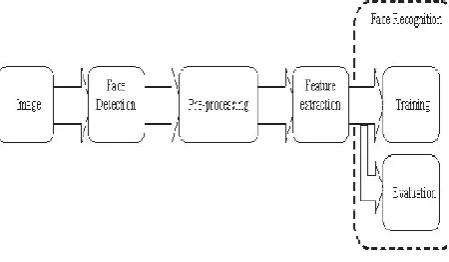
P a g e | 884In this section we outline the basic architecture of a face recognition system based on Gonzalez’s image analysis system [4] and Costache’s face recognition system [5]. At a top-level this is represented by the functional blocks shown in Figure 1.
Figure 1: The architecture of a face recognition system
1. Face detection and cropping block: This is the first stage of any face recognition system and the key difference between a semi-automatic and a fully automatic face recognizer. In order to make the recognition system fully automatic, the detection and extraction of faces from an image should also be automatic. Face detection also represents a very important step before face recognition, because the accuracy of the recognition process is a direct function of the accuracy of the detection process [6, 7].
2. Pre-processing block: The face image can be treated with a series of pre-processing techniques to minimize the effect of factors that can adversely influence the face recognition algorithm. The most critical of these are facial pose and illumination.
3. Feature extraction block: In this step the features used in the recognition phase are computed. These features vary depending on the automatic face recognition system used. For example, the first and most simplistic features used in face recognition were the geometrical relations and distances between
important points in a face, and the
recognition ’algorithm’ matched these distances [34]; the most widely used features in face recognition are
KL or eigenfaces, and the standard
recognition ’algorithm’ uses either the Euclidian or Mahalanobis distance [8] to match features.
4. Face recognition block: This consists of 2 separate stages: a training process, where the algorithm is fed samples of the subjects to be learned and a distinct model for each subject is determined; and an
evaluation process where a model of a newly acquired
test subject is compared against all existing models in the database and the most closely corresponding model is determined. If these are sufficiently close a recognition event is triggered.
III. PROPOSED WORK
Many large-scale identification applications, such as law enforcement, driver license or passport card identification have only one face image per person. Keeping only one sample per person in the database has several advantages. It reduces storage and computation cost, particularly when the number of people managed by the system is very large. Thus the ‘one sample per person’ problem, which in this dissertation is called the one sample problem, needs to be carefully addressed. The one sample problem is defined as follows: “Given a stored database of faces with only one image per person, the goal is to identify a person from the database later in time in any different and unpredictable poses, lighting, etc. from just one image” [9].
Given its challenge and significance for real-world applications, this problem is rapidly emerging as an active research sub-area of face recognition. Finding effective algorithms that deal with this problem is the goal of this dissertation. In order to achieve the goal of building a system recognizing face images, we need a model that can capture selective spatial information. In this dissertation, a Hidden Markov Model (HMM) [10] framework is employed. In this framework, the assumptions are formulated as probabilities and inference corresponds to finding the probability of hypotheses given observations. In the context of face recognition, we first extract observations from given face images.
We can use observation sequences extracted from samples or ‘training’ images to ‘train’ HMMs. For each person in the recognition system, we must build a model λr, where r є {1, . . . , R}, R is the number of
possible persons. Each model is based on an HMM that is trained so as to best describe given observation sequences, i.e. to optimize the likelihood of the training set. For each unknown face image x, which is to be recognized, the processing must be carried out as follows:
• Extract observation sequence O from x
• Calculate model likelihoods for all possible models, P (O | λr), 1 ≤ r ≤ R
• Select the subject whose model likelihood is highest, i.e.
r* = argmax [P (O | λr)] 1 ≤ r ≤ R
Available online:
https://edupediapublications.org/journals/index.php/IJR/
P a g e | 885Following diagram (Figure 2) shows flow of processing flow in face recognition:
Figure 2: Face recognition process
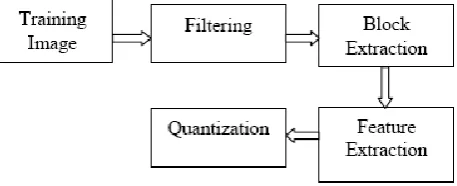
Face recognition using Singular value Decomposition and HMM consist of steps in which it captures the information content in an image of a face which are further useful for face recognition efficiently. In processing flow of face recognition using SVD and HMM approach, it includes extraction of face features by SVD coefficient, Seven state HMM divides face image in seven states then by using classifier, there is comparison of input image with training data set. If input image matches with training dataset image then face is said to be recognized otherwise face is unrecognized. Figure 3 below shows training process of a training image which includes filtering, block extraction, feature extraction and quantization.
Figure 3: The training process of a training image
Figure 3 shows training process of training image which consists of steps like filtering, block extraction, feature extraction and quantization. All these steps are useful in face recognition using hidden Marko model.
A. HIDDEN MARKO MODEL
Hidden Marko Models are useful in modeling one dimensional data in face finding, object recognition and face recognition. HMM is associated with non-observable hidden states and an non-observable sequence generated by the hidden states individually. The elements of a HMM are as N = S is the number of states in the model, where S = {s1, s2 …, sN} is the set
of all possible states. M = V is the number of the different observation symbols, where V={v1, v2, .…, vM}
is the set of all possible observation symbols. HMM models are performed in the observation vectors space.
HMMs generally work on sequences of symbols called observation vectors, while an image usually is represented by a simple 2D matrix. The observation
vector is a vector of observation symbols of length T.
T is defined by user based on the in hand problem. A =
{aij} is the state transition probability matrix, where:
B = {bj(k)} is the observation symbol probability
matrix, where
So HMM is defined as follows
HMMs generally work on sequences of symbols called observation vectors, while an image usually is represented by a simple 2D matrix.
Here face image is divided into seven regions which each is assigned to a state in a left to right one dimensional HMM. In hidden Marko model probability of each subsequent state depends only on what was the previous state.
B. SINGULAR VALUE DECOMPOSITION
Available online:
https://edupediapublications.org/journals/index.php/IJR/
P a g e | 886algebraic features from an image. A singular value decomposition of a m × n matrix X is any function of the form
Where U (m × m) and V (n × n) are orthogonal
matrix,. The columns of the orthogonal matrices U
and V are called the left and right singular vectors respectively. An important property of U and V is that they are mutually orthogonal. Singular values represent algebraic properties of an image.
C. FILTERING
In this system a specific filter is used which directly affects the speed and recognition rate of the algorithm Here Order-statistic filter is used for filtering process. Most of the face recognition systems commonly use processing to improve their performance. Order-statistic filters are nonlinear spatial filters. A two dimensional order statistic filter, which replaces the cantered element of a 3 × 3 window with the minimum element in the window, is used in the proposed system. It can simply be represented by the following equation.
In this equation, g(s, t) is the grey level of pixel (s, t)
and Sxyis the mentioned window.
Since HMMs require a one-dimensional observation sequence and face images are two dimensional, the images should be interpreted as a one dimensional sequence. The observation sequence is generated by
dividing each face image of width W and height H into
overlapping blocks of height L and width W. The
technique is shown in Figure 4.
Figure 4: The sequence of overlapping blocks
These successive blocks are the mentioned
interpretation. The number of blocks extracted from each face image is given by:
A high percent of overlap between consecutive blocks significantly increases the performance of the system which increases the computational complexity. This experiment showed that as long as P is large (P ≤ L −1) and L ≈ H /10, the recognition rate is not very sensitive to the variations of L.
In order to reduce the computational complexity and memory consumption, it is necessary to resize both face databases into 64 × 64 which results in data losing of images, so to achieve high recognition rate feature extraction method is necessary. A successful face recognition system depends heavily on the feature extraction method. One major improvement of our system is the use of SVD coefficients as features instead of gray values of the pixels in the sampling windows. Using pixels value as features describing blocks, increases the processing time and leads to high computational complexity. This process computes SVD coefficients of each block and uses them as our features.
The problem of feature selection is as there is given a set of d features; select a subset of size m that leads to the smallest classification error and smallest computational cost. This procedure selects features from singular values which are the diagonal elements. It has been shown that the energy and information of a signal is mainly conveyed by a few big singular values and their related vectors.
D. QUANTIZATION
The SVD coefficients have innately continuous values. These coefficients build the observation vectors. If they are considered in the same continuous type, it is necessary to determine infinite number of possible observation vectors that can’t be modeled by discrete HMM. So quantization is important. In quantization process, used in the proposed system, consider a vector X = (x1, x2, …, xn) with continuous
components. Suppose xi is to be quantized into Di
distinct levels. So the difference between two successive quantized values will be as equation x.
Available online:
https://edupediapublications.org/journals/index.php/IJR/
P a g e | 887ximax and ximin are the maximum and minimum values
that xi gets in all possible observation vectors
respectively.
At last each quantized vector is associated with a label that here is an integer number. Considering all blocks of an image, the image is mapped to a sequence of integer numbers that is considered as an observation vector. After representing each face image by observation vectors, they are modeled by a 7-state HMM.
E. FACE RECOGNITION
After learning process, each face class is associated to a HMM. For a K-class classification problem, it finds K distinct HMM models. Each test image experiences
the block extraction, feature extraction and
quantization process as well. Here each test image like training images is represented by its own observation vector. Here for an incoming face image, simply calculate the probability of the observation vector (current test image) given each HMM face model. A face image m is recognized as face d if:
The proposed recognition system tested on the ORL face database and some personal database. The database contains 10 different face images per person of 40 people with the resolution of 112 × 92 pixels.
V.CONCLUSION
Recognition approaches heavily depend on the nature of the data to be recognized. The recognition process needs to be much efficient and accurate to recognize the characters written by different users. As neural network is used here for recognition of offline English character images and it has been seen that recognition increases, although at a slow rate. Also some characters like I & J are similar, so the recognition system gives sometimes bad results for similar character. Also it is based on the handwriting style e.g.
G may be written as or . This may also create
problem sometimes. Also it can be concluded that system is not stable. Every time it gives different results. This may be due to the number of character set used for training was reasonably low. As the network is trained with more number of sets, the accuracy of recognition of characters will increase definitely. It can be concluded that the work successfully does the character recognition. It has the limitation that it performs the training as well as testing at a slow rate. But from the above results, it may be said that
accuracy may be achieved better if number of training set is taken larger and also if better image processing techniques are considered.
REFERENCES
[1] M.-H. Yang, D.J. Kriegman, and N. Ahuja. “Detecting faces in images: A survey”, IEEE Trans. on Pattern Analysis and Machine Intelligence, 24(1):34–58, Jan 2002.
[2] Shaogang Gong, Stephen J McKenna, and Alexandra Psarrou, “Dynamic Vision, From Images to Face Recognition”, Imperial College Press, London, 2000.
[3] W. Zhao, R. Chellappa, A. Rosenfeld, and P.J. Phillips, “Face recognition: a literature survey”, ACM Computing Surveys, 35(4):399–458, December 2003.
[4] R.C. Gonzalez and R.E. Woods. Digital image processing. Addison-Wesley, Reading, MA, 1992.
[5] G.N. Costache. “Advances in automated image
categorization: Sorting images using person
recognition techniques”, Ph D thesis, Dept of Electronic Engineering, NUI Galway, 2007.
[6] E. Rentzeperis, A. Stergiou, A. Pnevmatikakis, and L. Polymenakos. Impact of face registration errors on recognition. Artificial Intelligence Applications and Innovations, 204:187–194, 2006.
[7] P. Corcoran, C. Iancu, and G. Costache. Improved HMM based face recognition system. OPTIM, Brasov, Romania, 4:143–146, 2006.
[8] R. Chellappa, B.S. Manjunath, and C.V.D. Malsburg. A feature based approach to face recognition. IEEE Conference on Computer Vision and Pattern Recognition, pages 373–378, 1992.
[9] X. Tan, S. Chen, Z.-H. Zhou, and F. Zhang. Face recognition from a single image per person: A survey. Pattern Recogn., 39(9):1725–1745, 2006.
[10] Lawrence R. Rabiner. A tutorial on Hidden Markov Models and selected application in speech recognition. Proceedings of The IEEE, 77(2):257–286, 1989.
[11] Klema V. C. and Laub A. J., “The Singular Value
decomposition: Its Computation and Some