Volume 2008, Article ID 675787,13pages doi:10.1155/2008/675787
Research Article
A Statistical Multiresolution Approach for Face Recognition
Using Structural Hidden Markov Models
P. Nicholl,1A. Amira,2D. Bouchaffra,3and R. H. Perrott1
1School of Electronics, Electrical Engineering and Computer Science, Queens University, Belfast BT7 1NN, UK 2Electrical and Computer Engineering, School of Engineering and Design, Brunel University, London UB8 3PH, UK 3Department of Mathematics and Computer Science, Grambling State University, Carver Hall, Room 281-C,
P.O. Box 1191, LA, USA
Correspondence should be addressed to P. Nicholl,[email protected]
Received 30 April 2007; Revised 2 August 2007; Accepted 31 October 2007
Recommended by Juwei Lu
This paper introduces a novel methodology that combines the multiresolution feature of the discrete wavelet transform (DWT) with the local interactions of the facial structures expressed through the structural hidden Markov model (SHMM). A range of wavelet filters such as Haar, biorthogonal 9/7, and Coiflet, as well as Gabor, have been implemented in order to search for the best performance. SHMMs perform a thorough probabilistic analysis of any sequential pattern by revealing both its inner and outer structures simultaneously. Unlike traditional HMMs, the SHMMs do not perform the state conditional independence of the visible observation sequence assumption. This is achieved via the concept of local structures introduced by the SHMMs. Therefore, the long-range dependency problem inherent to traditional HMMs has been drastically reduced. SHMMs have not previously been applied to the problem of face identification. The results reported in this application have shown that SHMM outperforms the traditional hidden Markov model with a 73% increase in accuracy.
Copyright © 2008 P. Nicholl et al. This is an open access article distributed under the Creative Commons Attribution License, which permits unrestricted use, distribution, and reproduction in any medium, provided the original work is properly cited.
1. INTRODUCTION
With the current perceived world security situation, govern-ments, as well as businesses, require reliable methods to ac-curately identify individuals, without overly infringing on rights to privacy or requiring significant compliance on the part of the individual being recognized. Person recognition systems based on biometrics have been used for a signifi-cant period for law enforcement and secure access. Both fin-gerprint and iris recognition systems are proven as reliable techniques; however, the method of capture for both lim-its their versatility [1]. Although face recognition technol-ogy is not as mature as other biometric verification meth-ods, it is the subject of intensive research and may provide an acceptable solution to some of the problems mentioned. As it is the primary method used by humans to recognize each other, and because an individual’s face image is already stored in numerous locations, it is seen as a more acceptable method of automatic recognition [2]. A robust face recogni-tion solurecogni-tion has many potential applicarecogni-tions. Business orga-nizations are aware of the ever-increasing need for security,
this is mandated not only by both their own desire to protect property and processes, but also by their workforce’s increas-ing demands for workplace safety and security [3]. Local law enforcement agencies have been using face recognition for rapid identification of individuals suspected of committing crimes. They have also used the technology to control ac-cess at large public gatherings such as sports events, where there are often watchlists of known trouble-makers. Simi-larly, face recognition has been deployed in national ports-of-entry, making it easier to prevent terrorists from entering a country.
term (e.g., hairstyle change) and in the long term (aging pro-cess). These issues all increase the complexity of the recogni-tion task [4].
A multitude of techniques have been applied to face recognition and they can be separated into two categories: geometric feature matching and template matching. Geo-metric feature matching involves segmenting the distinctive features of the face, eyes, nose, mouth, and so on, and ex-tracting descriptive information about them such as their widths and heights. Ratios between these measures can then be stored for each person and compared with those from known individuals [5]. Template matching is a holistic ap-proach to face recognition. Each face is treated as a two-dimensional array of intensity values, which is compared with other facial arrays. Techniques of this type include prin-cipal component analysis (PCA) [6], where the variance among a set of face images is represented by a number of eigenfaces. The face images, encoded as weight vectors of the eigenfaces, can be compared using a suitable distance mea-sure [7,8]. In independent component analysis (ICA), faces are assumed to be linear mixtures of some unknown latent variables. The latent variables are assumed non-Gaussian and mutually independent, and they are called the independent components of the observed data [9]. In neural network models (NNMs), the system is supplied with a set of train-ing images along with correct classification, thus allowtrain-ing the neural network to ascertain a weighting system to determine which areas of an image are deemed most important [10].
Hidden Markov models (HMMs) [11], which have been used successfully in speech recognition for a number of decades, are now being applied to face recognition. Samaria and Young used image pixel values to build a top-down model of a face using HMMs. Nefian and Hayes [12] modi-fied the approach by using discrete cosine transform (DCT) coefficients to form observation vectors. Bai and Shen [13] used discrete wavelet transform (DWT) [14] coefficients
taken from overlapping image subwindows taken from the entire face image, whereas Bicego et al. [15] used DWT coef-ficients of subwindows generated by a raster scan of the im-age.
As HMMs are one dimensional in nature, a variety of approaches have been adopted to try to represent the two-dimensional structure of face images. These include the 1D discrete HMM (1D-DHMM) approach [16], which models a face image using two standard HMMs, one for observations in the vertical direction and one for the horizontal direction. Another approach is the pseudo-2D HMM (2D-PHMM) [17], which is a 1D HMM, composed of super states to model the sequence of columns in the image, in which each super state is a 1D-HMM, itself modeling the blocks within the columns. An alternative approach is the low-complexity 2D-HMM (LC 2D-2D-HMM) [18], which consists of a rectangu-lar constellation of states, where both vertical and horizon-tal transitions are supported. The complexity of the LC 2D-HMM is considerably lower than that of the 2D-P2D-HMM and the two-dimensional HMM (2D-HMM), however, recogni-tion accuracy is lower as a result. The hierarchical hidden Markov models (HHMMs) introduced in [19] and applied in video-content analysis [20] are capable of modeling the
complex multiscale structure which appears in many natural sequences. However, the original HHMM algorithm is rather complicated since it takesO(T3) time, whereTis the length
of the sequence, making it impractical for many domains. Although HMMs are effective in modeling statistical in-formation [21], they are not suited to unfold the sequence of local structures that constitutes the entire pattern. In other words, the state conditional independence assumption inher-ent to traditional HMMs makes these models unable to cap-ture long-range dependencies. They are therefore not opti-mal for handling structural patterns such as the human face. Humans distinguish facial regions in part due to our ability to cluster the entire face with respect to some features such as colors, textures, and shapes. These well-organized clus-ters sensed by the human’s brain are the facial regions such as lips, hair, forehead, eyes, and so on. They are all com-posed of similar symbols that unfold their global appear-ances. One recently developed model for pattern recognition is the structural hidden Markov model (SHMM) [22,23]. To avoid the complexity problem inherent to the determina-tion of the higher level states, the SHMM provides a way to explicitly control them via an unsupervised clustering pro-cess. This capability is offered through an equivalence re-lation built in the visible observation sequence space. The SHMMs approach allows both the structural and the statisti-cal properties of a pattern to be represented within the same probabilistic framework. This approach also allows the user to weight substantially the local structures within a pattern that are difficult to disguise. This provides an SHMM rec-ognizer with a higher degree of robustness. Indeed, SHMMs have been shown to outperform HMMs in a number of ap-plications including handwriting recognition [22], but have yet to be applied to face recognition. However, SHMMs are well-suited to model the inner and outer structures of any sequential pattern (such as a face) simultaneously.
As well as being used in conjunction with HMMs for face recognition, DWT has been coupled with other techniques. Its ability to localize information in terms of both frequency and space (when applied to images) makes it an invaluable tool for image processing. In [24], the authors use it to ex-tract low frequency features, reinforced using linear discrim-inant analysis (LDA). In [25], wavelet packet analysis is used to extract rotation invariant features and in [5], the authors use it to identify and extract the significant structures of the face, enabling statistical measures to be calculated as a re-sult. DWT has also been used for feature extraction in PCA-based approaches [26,27]. The Gabor wavelet in particular has been used extensively for face recognition applications. In [28], it is used along with kernel PCA to recognize faces where a large degree of rotation is present, whereas in [29], AdaBoost is employed to select the most discriminant Gabor features.
The objective of the work presented in this paper is to de-velop a hybrid approach for face identification using SHMMs for the first time. The effect of using DWT for feature extrac-tion is also investigated, and the influence of wavelet type is analyzed.
The rest of this paper is organized as follows.Section 2
Section 3proposes the use of SHMM for face recognition.
Section 4describes the experiments that were carried out and presents and analyzes the results obtained.Section 5contains concluding remarks.
2. RECOGNITION USING WAVELET/HMM
2.1. Mathematical background
(1) Discrete wavelet transform
In the last decade, DWT has been recognized as a powerful tool in a wide range of applications, including image/video processing, numerical analysis, and telecommunication. The advantage of DWT over existing transforms such as discrete Fourier transform (DFT) and DCT is that DWT performs a multiresolution analysis of a signal with localization in both time and frequency [14,30]. In addition to this, functions with discontinuities and functions with sharp spikes require fewer wavelet basis vectors in the wavelet domain than sine-cosine basis vectors to achieve a comparable approximation. DWT operates by convolving the target function with wavelet kernels to obtain wavelet coefficients representing the con-tributions of wavelets in the function at different scales and orientations.
DWT can be implemented as a set of filter banks, com-prising a high-pass and low-pass filters. In standard wavelet decomposition, the output from the low-pass filter can then be decomposed further, with the process continuing recur-sively in this manner. DWT can be mathematically expressed by
DWTx(n)=
⎧ ⎪ ⎨ ⎪ ⎩
dj,k=
x(n)h∗j
n−2jk,
aj,k=
x(n)g∗j
n−2jk. (1)
The coefficientsdj,krefer to the detail components in
sig-nalx(n) and correspond to the wavelet function, whereasaj,k
refer to the approximation components in the signal. The functionsh(n) andg(n) in the equation represent the co-efficients of the high-pass and low-pass filters, respectively, whilst parameters jandkrefer to wavelet scale and transla-tion factors.Figure 1illustrates DWT schematically.
For the case of images, the one-dimensional DWT can be readily extended to two dimensions. In standard two-dimensional wavelet decomposition, the image rows are fully decomposed, with the output being fully decomposed columnwise. In nonstandard wavelet decomposition, all the rows are decomposed by one decomposition level followed by one decomposition level of the columns.
The decomposition continues by decomposing the low resolution output from each step, until the image is fully decomposed. Figure 2 illustrates the effect of applying the
nonstandard wavelet transform to an image from the AT&T Database of Faces [31]. The wavelet filter used, number of levels of decomposition applied, and quadrants chosen for feature extraction are dependent upon the particular appli-cation. For the experiments described in this paper, the non-standard DWT is used, which allows for the selection of ar-eas with similar resolutions in both horizontal and vertical
directions to take place for feature extraction. For further in-formation on DWT, see [32].
(2) Gabor wavelets
Gabor wavelets are similar to DWT, but their usage is dif-ferent. A Gabor wavelet is convolved with an image either locally at selected points in the image, or globally. The out-put reveals the contribution that a frequency is making to the image at each location. A Gabor waveletψu,v(z) is defined as [28]
ψu,v(z)= ku,v
2
σ2 e
−(ku,v2z2)/2σ2eiku,vz−e−σ2/2, (2)
wherez=(x,y) is the point with the horizontal coordinatex and the vertical coordinatey. The parametersuandvdefine the orientation and scale of the Gabor kernel,·defines the norm operator, andσis related to the standard deviation of the Gaussian window in the kernel and determines the ratio of the Gaussian window width to the wavelength. The wave vectorku,vis defined as follows:
ku,v=kveiφu, (3)
wherekv = kmax/ fv andφu = πμ/nifndifferent
orienta-tions have been chosen.kmaxis the maximum frequency, and
fvis the spatial frequency between kernels in the frequency
domain.
(3) Hidden markov models
HMMs are used to characterize the statistical properties of a signal [11]. They have been used in speech recognition ap-plications for many years and are now being applied to face recognition. An HMM consists of a number of nonobserv-able states and an observnonobserv-able sequence, generated by the in-dividual hidden states.Figure 3illustrates the structure of a simple HMM.
HMMs are defined by the following elements.
(i) Nis the number of hidden states in the model. (ii) Mis the number of different observation symbols. (iii) S= {S1,S2,. . .,SN}is the finite set of possible hidden
states. The state of the model at timetis given byqt ∈ S, 1≤t≤T, whereTis the length of the observation sequence.
(iv) A = {ai j} is the state transition probability matrix,
where
ai j=P
qt+1=Sj|qt=Si
, 1≤i, j≤N, (4)
with
0≤ai,j≤1, N
j=1
ai j=1, 1≤i≤N.
x(n)
First-level
Low-pass High-pass
2 2
Second-level
Low-pass High-pass
2 2
Third-level Low-pass High-pass
2 2
Approximate signal (a3)
Detail 3 (d3)
Detail 2 (d2)
Detail 1 (d1)
Figure1: A three-level wavelet decomposition system.
(a) (b)
(c)
Figure2: Wavelet transform of image: (a) original image, (b) 1-level Haar decomposition, (c) complete decomposition.
a11 a22 a33 a44
a12 a23 a34
a13 a24
1 2 3 4
Figure3: A simple left-right HMM.
(i) B = {bj(k)}is the emission probability matrix,
indi-cating the probability of a specified symbol being emit-ted given that the system is in a particular state, that is,
bj(k)=P
Ot=k|qt=Sj
(6)
with 1 ≤ j ≤N andOt is the observation symbol at
timet.
Face image being segmented into strips j
k
Face strip being segmented into blocks
Face block j
k
p
p
· · ·
···
Figure 4: An illustration showing the creation of the block se-quence.
(ii) Π = {πi}is the initial state probability distribution,
that is,
πi=P[q1=Si], 1≤i≤N, (7)
withπi≥0 and N
i=1πi=1.
An HMM can therefore be succinctly defined by the triplet
λ=(A,B,Π). (8)
HMMs are typically used to address three unique problems [11].
(i) Evaluation.Given a modelλand a sequence of obser-vationsO, what is the probability thatOwas generated by modelλ, that is,P(O|λ).
(ii) Decoding. Given a model λ and a sequence of ob-servations O, what is the hidden state sequence q∗ most likely to have produced O, that is, q∗ =
arg maxq[P(q|λ,O)].
(iii) Parameter estimation.Given an observation sequence O, what modelλis most likely to have producedO.
For further information on HMMs, see [11].
2.2. Recognition process
(1) Training
with overlap ofp. This is illustrated inFigure 4. For an im-age of width w and height h, there will be approximately (((h/(j−p)) + 1)∗(w/(k−p)) + 1) blocks.
Each block then undergoes wavelet decomposition, pro-ducing an average image and a sequence of detail images. This can be shown as [aJ,{d1j,d2j,d3j}j=1,...,J] where aJrefers to
the approximation image at theJth scale anddkj is the detail
image at scale j and orientationk. For the work described, 4-level wavelet decomposition is employed, producing a vec-tor with one average image and twelve detail images. The L2 norms of the wavelet detail images are subsequently calcu-lated and it is these that are used to form the observation vector for that block. The L2 norm of an image is simply the square root of the sum of all the pixel values squared. As three detail images are produced at each decomposition level, the dimension of a block’s observation vector will be three times the level of wavelet decomposition carried out. The image norms from all the image blocks are collected from all im-age blocks, in the order the blocks appear in the imim-age, from left to right and from top to bottom, this forms the image’s observation vector [13].
In the case of Gabor being used for feature extraction, the image is convolved with a number of Gabor filters, with 4 orientations and 6 scales being used. The output images are split into blocks in the same manner as that used for DWT. For each block, the L2 norm is calculated. Therefore, each block from the original image can be represented by a feature vector with 24 values (4 orientations×6 scales). The image’s observation vector is then constructed in the same manner as for DWT, with the features being collected from each block in the image, from left to right and from top to bottom.
This vector, along with the observation vectors from all other training images of the same individual, is used to train the HMM for this individual using maximum likelihood (ML) estimation. As the detail image norms are real values, a continuous observation HMM is employed. One HMM is trained for each identity in the database.
(2) Testing
A number of images are used to test the accuracy of the face recognition system. In order to ascertain the identity of an image, a feature vector for that image is created in the same way as for those images used to train the system. For each trained HMM, the likelihood of that HMM producing the observation vector is calculated. As the identification process assumes that all probe images belong to known individuals, the image is classified as the identity of the HMM that pro-duces the highest likelihood value.
3. STRUCTURAL HIDDEN MARKOV MODELS
3.1. Mathematical background
One of the major problems of HMMs is due to the state con-ditional independence assumption that prevents them from capturing long-range dependencies. These dependencies of-ten exhibit structural information that constitute the entire pattern. Therefore, in this section, the mathematical
expres-sion of SHMMs is introduced. The entire description of the SHMM can be found in [22,23].
Let O = (O1,O2,. . .,Os) be the time series sequence
(the entire pattern) made of s subsequences (also called subpatterns). The entire pattern can be expressed as: O =
(o11o12. . . o1r1,. . .,os1,os2,. . .,osrs), where r1 is the number of observations in subsequence O1 and r2 is the number
of observations in subsequenceO2, and so forth, such that
i=s
i=1ri = T. A local structureCj is assigned to each
sub-sequenceOi. Therefore, a sequence of local structuresC =
(C1,C2,. . .,Cs) is generated from the entire patternO. The
probability of a complex patternOgiven a modelλcan be written as
P(O|λ)= C
P(O,C|λ). (9)
Therefore, we need to evaluateP(O,C | λ). The modelλis implicitly present during the evaluation of this joint proba-bility, so it is omitted. We can write
P(O,C)=P(C,O)=P(C|O)×P(O)
=PCs|Cs−1· · ·C2C1Os· · ·O1
×PCs−1· · ·C2C1|Os· · ·O1
×P(O). (10)
It is assumed thatCidepends only onOiandCi−1, and the
structure probability distribution is a Markov chain of order 1. It has been proven in [22] that the likelihood function of the observation sequence can be expressed as
P(O|λ)≈
C s
i=1
PCi|Oi
PCi|Ci−1
PCi
×P(O)
. (11)
The organization (or syntax) of the symbolsoi=ouv is
in-troduced mainly through the termP(Ci | Oi)since the
tran-sition probabilityP(Ci | Ci−1)does not involve the
interrela-tionship of the symbolsoi. Besides, the termP(O) of (11) is
viewed as a traditional HMM.
Finally, an SHMM can be defined as follows.
Definition 1. A structural hidden Markov model is a quintu-pleλ=[π,A,B,C,D], where
(i) πis the initial state probability vector; (ii) Ais the state transition probability matrix;
(iii) Bis the state conditional probability matrix of the vis-ible observations,
(iv) C is the posterior probability matrix of a structure given a sequence of observations;
(v) Dis the structure transition probability matrix.
An SHMM is characterized by the following elements.
(i) Nis the number of hidden states in the model. The individual states are labeled as 1, 2,. . .,N, and denote the state at timetasqt.
(ii) Mis the number of distinct observationsoi.
(iii) πis the initial state distribution, whereπi=P(q1=i)
and 1≤i≤N,iπi=1.
(iv) Ais the state transition probability distribution ma-trix:A= {ai j}, whereai j =P(qt+1 = j |qt =i) and
C1 C2 Ci Cm
O1 O2 Oi Om
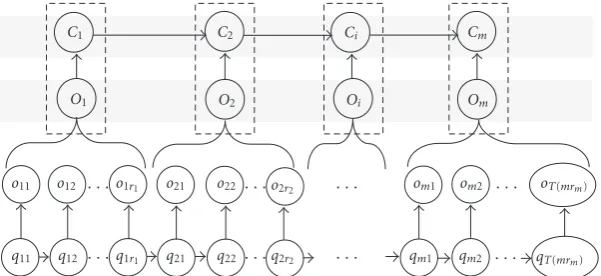
o11 o12 · · ·o1r1 o21 o22 · · ·o2r2 · · · om1 om2 · · · oT(mrm)
q11 q12 · · ·q1r1 q21 q22· · ·q2r2 · · · qm1 qm2 · · · qT(mrm)
Figure5: A graphical representation of a first-order structural hidden Markov model.
(v)Bis the state conditional probability matrix of the ob-servations,B = {bj(k)}, in whichbj(k)=P(ok|qj),
1 ≤ k ≤ M, and 1 ≤ j ≤ N,kbj(k) = 1. In the
continuous case, this probability is a density function expressed as a finite weighted sum of Gaussian distri-butions (mixtures).
(vi) Fis the number of distinct local structures.
(vii) C is the posterior probability matrix of a structure given its corresponding observation sequence: C =
ci(j), where ci(j) = P(Cj | Oi). For each particular
input stringOi, we have
jci(j)=1.
(viii) D is the structure transition probability matrix:D = {di j}, wheredi j = P(Ct+1 = j | Ct = i),
jdi j = 1,
1≤i,j≤F.
Figure 5depicts a graphical representation of an SHMM of order 1. The problems that are involved in an SHMM can now be defined.
3.2. Problems assigned to a structural HMM
There are four problems that are assigned to an SHMM: (i) probability evaluation, (ii) statistical decoding, (iii) struc-tural decoding, and (iv) parameter estimation (or training).
(i) Probability evaluation.Given a modelλand an obser-vation sequenceO=(O1,. . .,Os), the goal is to
evalu-ate how well does the modelλmatchO.
(ii) Statistical decoding. In this problem, an attempt is made to find the best state sequence. This problem is similar to problem 2 of the traditional HMM and can be solved using Viterbi algorithm as well.
(iii) Structural decoding. This is the most important prob-lem. The goal is to determine the “optimal local struc-tures of the model.” For example, the shape of an ob-ject captured through its external contour can be fully described by the local structures sequence: round, curved, straight,..., slanted, concave, convex,..., . Sim-ilarly, a primary structure of a protein (sequence of amino acids) can be described by its secondary struc-tures such as “Alpha-Helix,” “Beta-Sheet,” and so forth. Finally, an autonomous robot can be trained to recog-nize the components of a human face described as a
sequence of shapes such asround (human head), ver-tical line in the middle of the face (nose), round (eyes), ellipse (mouth),..., .
(iv) Parameter estimation (Training). This problem con-sists of optimizing the model parameters λ =
[π,A,B,C,D] to maximizeP(O|λ). We now define each problem involved in an SHMM in more details.
(1) Probability evaluation
The evaluation problem in a structural HMM consists of de-termining the probability for the modelλ=[π,A,B,C,D] to produce the sequenceO. From (11), this probability can be expressed as
P(O|λ)= C
P(O,C|λ)= C
s
i=1
ci(i)×di−1,i PCi
×
q πq1bq1
o1
aq1q2bq2
o2
· · ·aq(T−1)qTbqT
oT
.
(12)
(2) Statistical decoding
The statistical decoding problem consists of determining the optimal state sequenceq∗=arg maxq(P(Oi,q|λ)) that best
“explains” the sequence of symbols withinOi. It is computed
using Viterbi algorithm as in traditional HMM’s.
(3) Structural decoding
The structural decoding problem consists of determining the optimal structure sequenceC∗= C∗1,C∗2,. . .,C∗t such that
C∗=arg max
C
P(O,C|λ). (13)
We define
δt(i)=max C
PO1,O2,. . .,Ot,C1,C2,. . .,Ct=i|λ
that is, δt(i) is the highest probability along a single path,
at timet, which accounts for the firsttstrings and ends in structurei. Then, by induction we have
δt+1(j)=
max
i δt(i)di j
ct+1(j)P
Ot+1
PCj
. (15)
Similarly, this latter expression can be computed using Viterbi algorithm. However, δ is estimated in each step through the structure transition probability matrix. This op-timal sequence of structures describes the structural pattern piecewise.
(4) Parameter estimation (training): the estimation of the density function
P(Cj | Oi)∝P(Oi | Cj) is established through a weighted
sum of Gaussian mixtures. The mathematical expression of this estimation is
POi|Cj
≈ m=R
r=1
αj,rN
μj,r,Σj,r,Oi
, (16)
whereN(μj,r,Σj,r,Oi) is a Gaussian distribution with mean μj,rand covariance matrixΣj,r. The mixing terms are subject
to the constraintmr==1Rαj,r=1.
ThisGaussian mixture posterior probability estimation technique obeys the exhaustivity and exclusivity constraint
jci(j) = 1. This estimation enables the entire matrixC
to be built. The Baum-Welch optimization technique is used to estimate the matrixD. The other parameters,π = {πi}, A= {ai j},B = {bj(k)}, were estimated like in traditional
HMM’s [33].
(5) Parameter reestimation
Many algorithms have been proposed to re-estimate the pa-rameters for traditional HMM’s. For example, Djuri´c and chun [34] used “Monte Carlo Markov chain” sampling scheme. In the structural HMM paradigm, we have used a “forward-backward maximization” algorithm to re-estimate the parameters contained in the modelλ. We used a bottom-up strategy that consists of re-estimating{πi},{ai j},{bj(k)}
in the first phase and then re-estimating{cj(k)}and{di j}in
the second phase. Let us define
(i)ξr(u,v) as the probability of being at structureuat
timerand structurevat time (r+ 1) given the modelλand the observation sequenceO. We can write
ξr(u,v)=P
qr=u,qr+1=v|λ,O
= P
qr=u,qr+1=v,O|λ
P(O|λ) .
(17)
Using Bayes formula, we can write
ξr(u,v)=
PO1O2· · ·Or,qr=u|λ
duvPv(Or+1)
PO1O2. . . OT|λ
×P
Or+2Or+3· · ·OT |qr=v,λ
PO1O2· · ·OT |λ
.
(18)
Then we define the following probabilities:
(i) αr(u)=P(O1O2· · ·Or,qr=u|λ),
(ii) βr(u)=P(Or+1Or+2· · ·OT |qr=u,λ),
(iii) Pv(Or+1)=P(qr+1=v|Or+1)×P(Or+1)/P(qr+1=v),
therefore,
ξr(u,v)=
αr(u)duvsr+1(v)P(Or+1)βr+1(v)
P(O1O2· · ·OT|λ)P(qr+1=v).
(19)
We need to compute the following:
(i) P(Or+1) = P(o1r+1· · ·okr+1 | λ) =
allqP(Or+1 |
q,λ)P(q|λ)=q1,...,qTπq1bq1(o1)aq1q2· · ·bqk(ok), (ii) P(qr+1=v)=
jP(qr+1=v|qr=j),
(iii) The termP(O1O2· · ·OT | λ) requiresπ,A,B,C, D. However, the parameters π, A, and B can be estimated as in traditional HMM. In order to re-estimateCandD, we define
γr(u)= N
v=1
ξr(u,v). (20)
Then we compute the improved estimates ofcv(r) andduvas
duv=
T−1
r=1ξr(u,v) T−1
r=1γr(u)
, (21)
cv(r)=
T−1
r=1,Or=vrγr(v) T
r=1γr(v)
. (22)
From (22), we derive
cr(v)=cv(r)× Pqr=v
P(Or)
. (23)
We calculate improved ξr(u,v), γr(u), duv, and cr(v)
re-peatedly until some convergence criterion is achieved. We have used the Baum-Welch algorithm also known as forward-backward (an example of a generalized expectation-maximization algorithm) to iteratively compute the esti-matesduvandcr(v).
The stopping or convergence criterion that we have se-lected in line 8 halts learning when no estimated transi-tion probability changes more than a predetermined positive amountε. Other popular stopping criteria (e.g., as the one based on overall probability that the learned model could have produced the entire training data) can also be used. However, these two criteria can produce only a local opti-mum of the likelihood function, they are far from reaching a global optimum.
3.3. Novel SHMM modeling for human
face recognition
(1) Feature extraction
(1)Begin initializeduv,cr(v), training sequence, convergence criterionε
(2) repeat (3) z←z + 1
(4) computed(z) fromd(z−1) andc(z−1) using (21) (5) computec(z) fromd(z−1) andc(z−1) using (22) (6)duv(z)←duv(z−1)
(7)crv(z)←crv(z−1)
(8)untilmaxu,r,v[duv(z)−duv(z−1),crv(z)−crv(z−1)]< ε(convergence achieved)
(9)returnduv←duv(z);crv←crv(z)
(10)End
Algorithm1
O1 O2 O3 O4 O5 O6· · ·
Hair Forehead Ears Eyes Nose Mouth
Figure6: A faceOis viewed as an ordered sequence of observations
Oi. EachOicaptures a significant facial region such as “hair,”
“fore-head,” “eyes,” “nose,” “mouth,” and so on. These regions come in a natural order from top to bottom and left to right.
O11 O12 O13
O14 O15 O16
An observation sequenceOi
Its local structureCi
Figure7: A blockOiof the whole faceOis a time-series of norms
assigned to the multiresolution detail images. This block belongs to the local structure “eyes.”
community. Our approach of adapting the SHMM’s machine learning to recognize human faces is novel. The SHMM ap-proach to face recognition consists of viewing a face as a se-quence of blocks of informationOiwhich is a fixed-size
two-dimensional window. Each blockOibelongs to some
prede-fined facial regions as depicted in Figure 6. This phase in-volves extracting observation vector sequences from subim-ages of the entire face image. As with recognition using stan-dard HMMs, DWT is used for this purpose. The observation vectors are obtained by scanning the image from left to right and top to bottom using the fixed-size two-dimensional win-dow and performing DWT analysis at each subimage. The subimage is decomposed to a certain level and the energies of the subbands are selected to form the observation sequence Oifor the SHMM. If Gabor filters are used, the original
im-age is convolved with a number of Gabor kernels, produc-ing 24 output images. These images are then divided into blocks using the same fixed-size two-dimensional window as for DWT. The energies of these blocks are calculated and form the observation sequenceOifor the SHMM.The local
structuresCiof the SHMM include the facial regions of the face.
These regions are hair, forehead, ears, eyes, nose, mouth, and so on.However, the observation sequenceOicorresponds to
the different resolutions of the block images of the face.The sequence of norms of the detail imagesdk
j represents the
obser-vation sequenceOi. Therefore, each observation sequenceOi
is a multidimensional vector. Each block is assigned one and only one facial region. Formally, a local structureCjis simply
an equivalence class that gathers all “similar”Oi.Two vectors Ois(two sets of detail images) are equivalent if they share the
same facial region of the human face.In other words, the facial regions are all clusters of vectorsOisthat are formed when
using thek-means algorithm.Figure 7depicts an example of a local structure and its sequence of observations. This mod-eling enables the SHMM to be trained efficiently since several sets of detail images are assigned to the same facial region.
(2) Face recognition using SHMM
(a)
(b)
Figure8: Samples of faces from (a) the AT&T Database of Faces [17] and (b) the Essex Faces95 database [35]. The images contain variation in pose, expression, scale, and illumination, as well as presence/absence of glasses.
conducted via thek-means clustering algorithm. The value of kcorresponds to the number of facial regions (or local struc-tures) selected a priori. The selection of this value was based in part upon visual inspection of the output of the cluster-ing process for various values ofk. When kequalled 6, the clustering process appeared to perform well, segmenting the face image into regions such as forehead, mouth, and so on. Each face is expressed as a sequence of blocksOi with their
facial regionsCi. The recognition phase will be performed by
computing the modelλ∗ in the training set (database) that maximizes the likelihood of a test face image.
4. EXPERIMENTS
4.1. Data collection
Experiments were carried out using three different training sets. The AT&T (formerly ORL) Database of Faces [17] con-tains ten grayscale images each of forty individuals. The im-ages contain variation in lighting, expression, and facial de-tails (e.g., glasses/no glasses). Figure 8(a) shows some
im-118 109 100 91 82 73 64 55 46 37 28 19 10 1
Rank Hear / HMM
Hear / SHMM 0
10 20 30 40 50 60 70 80 90 100
Cor
re
ct
m
at
ch
(%
)
Figure9: Cumulative match scores for FERET database using Haar wavelet.
ages taken from the AT&T Database. The second database used was the Essex Faces95 database [35], which contains twenty color images each of seventy-two individuals. These images contain variation in lighting, expression, position, and scale. Figure 8(b) shows some images taken from the Essex database. For the purposes of the experiments carried out, the Essex faces were converted to grayscale prior to train-ing. The third database used was the Facial Recognition Tech-nology (FERET) grayscale database [36,37]. Images used for experimentation were taken from the fa (regular facial ex-pression), fb (alternative facial exex-pression), ba (frontal “b” series), bj (alternative expression to ba), and bk (different illumination to ba) images sets. Those individuals with at least five images (taken from the specified sets) were used for experimentation. This resulted in a test set of 119 indi-viduals. These images were rotated and cropped based on the known eye coordinate positions, followed by histogram equalization. Experimentation was carried out using Matlab on a 2.4 Ghz Pentium 4 PC with 512 Mb of memory.
4.2. Face identification results using wavelet/HMM
118 109 100 91 82 73 64 55 46 37 28 19 10 1 Rank Biorthogonal9 7 / HMM Biorthogonal9 7 / SHMM 0 10 20 30 40 50 60 70 80 90 100 Cor re ct m at ch (% )
Figure 10: Cumulative match scores for FERET database using Biorthogonal9/7 wavelet. 118 109 100 91 82 73 64 55 46 37 28 19 10 1 Rank Coiflet3 / HMM
Coiflet3 / SHMM 0 10 20 30 40 50 60 70 80 90 100 Cor re ct m at ch (% )
Figure 11: Cumulative match scores for FERET database using Coiflet(3) wavelet.
The experiments were carried out using five-fold cross validation. This involved splitting the set of training images for each person into five equally sized sets and using four of the sets for system training with the remainder being used for testing. The experiments were repeated five times with a different set being used for testing each time to provide a more accurate recognition figure. Therefore, with the AT&T database, eight images were used for training and two for testing during each run. When using the Essex95 database, sixteen images were used for training and four for testing during each run. For the FERET database, four images per individual were used for training, with the remaining image being used for testing.
One HMM was trained for each individual in the database. During testing, an image was assigned an identity according to the HMM that produced the highest likelihood value. As the task being performed was face identification,
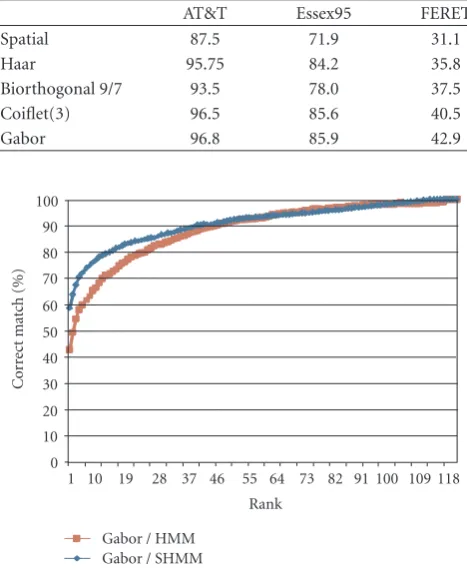
Table1: Comparison of HMM face identification accuracy when performed in the spatial domain and with selected wavelet filters (%).
AT&T Essex95 FERET
Spatial 87.5 71.9 31.1
Haar 95.75 84.2 35.8
Biorthogonal 9/7 93.5 78.0 37.5
Coiflet(3) 96.5 85.6 40.5
Gabor 96.8 85.9 42.9
118 109 100 91 82 73 64 55 46 37 28 19 10 1 Rank Gabor / HMM
Gabor / SHMM 0 10 20 30 40 50 60 70 80 90 100 Cor re ct m at ch (% )
Figure12: Cumulative match scores for FERET database using Ga-bor features.
it was assumed that all testing individuals were known indi-viduals. Accuracy of an individual run is thus defined as the ratio of correct matches to the total number of face images tested, with final accuracy equalling the average accuracy fig-ures from each of the five cross-validation runs. The accuracy figures for HMM face recognition performed in both the spa-tial domain and using selected wavelet filters are presented in
Table 1.
Table2: Comparison of face identification accuracy when performed using wavelet/HMM and wavelet/SHMM (%).
AT&T Essex FERET
DTW/HMM DWT/SHMM DWT/HMM DWT/SHMM DWT/HMM DWT/SHMM
Haar 95.75 97.5 84.2 89.4 35.8 62.0
Biorthogonal 9/7 93.5 95.1 78.0 84.6 37.5 63.9
Coiflet(3) 96.5 97.8 85.6 90.7 40.5 65.2
Gabor 96.8 97.3 85.9 88.7 42.9 58.7
Table3: Comparative results on AT&T database.
Method Accuracy (%) Ref.
DCT/HMM 84 [12]
ICA 85 [38]
Weighted PCA 88 [39]
Gabor filters and rank correlation 91.5 [40]
2D-PHMM 94.5 [17]
NMF 96 [41]
LFA 97 [42]
DWT/SHMM 97 (Proposed)
Table4: Comparison of training and classification times for AT&T database images (s).
Training time Classification time per image per image
Spatial/HMM 7.24 22.5
DWT/HMM 1.09 1.19
DWT/SHMM 4.31 3.45
4.3. Face identification results using wavelet/SHMM
The next set of experiments was designed to establish if SHMM provided a benefit over HMM for face recogni-tion. Where appropriate, the same parameters were used for SHMM as for HMM (such as block size). The experiments were carried out solely in the wavelet domain, due to the benefits identified by the previous results. The recognition accuracy for SHMM face recognition is presented inTable 2. In addition, Figures9 to 12 present the cumulative match score graphs for the FERET database.
As can be seen from the results, the use of SHMM in-stead of HMM increases recognition accuracy in all cases tested. Indeed, the incorrect match rate for Haar/SHMM is 40% lower than the equivalent figure for Haar/HMM when tested using the AT&T database. This is a significant increase in accuracy.
The most significant increases in performance, how-ever, were for the FERET dataset. The use of 5-fold cross-validation constrained options when it came to choosing im-ages for experimentation. As the system was not designed to handle images with any significant degree of rotation, they were selected from those subsets which were deemed suitable—Fa, Fb, ba, bj, and bk. Within these subsets,
how-ever, there was variation in illumination, pose, scale, and ex-pression. Most significantly, the “b” set images were captured in different sessions from the images in the “F” sets. Coupled with the number of identities in the FERET dataset that were used (119), the variation among the images made this a dif-ficult task for a face identification system. It is for this reason that the recognition rates for wavelet/HMM are rather low for this database, ranging from 35.8% when Haar was used to 42.9% for Gabor. The recognition rates increase dramati-cally though when SHMM is used. 62.9% of images are cor-rectly identified when Haar is used, with a more modest in-crease to 58.7% for Gabor filters. The Coiflet(3) wavelet pro-duces the best results, with 65.2% correctly identified, as op-posed to 40.5% for wavelet/HMM. In many face recognition applications, it is less important that an individual is recog-nized correctly than it is that an individual’s identity appears within the topxmatches, wherexcould be, perhaps, 10. The cumulative match score graphs allow for this information to be retrieved. SHMM provides a substantial benefit in cases where the topxmatches can be considered. For example, us-ing the Biorthogonal9/7 wavelet, the correct identity appears within the top 10 matches 60.2% of the time. This increases to 81.3% with SHMM. If the Haar wavelet is used, the figure increases from 65.0% to 82.9%.
Experiments were also carried out to enable comparison of the results with those reported in the literature. Although the ability to compare works was an important consideration in the creation of the FERET database, many authors use sub-sets from it that match their particular requirements. There are, however, many studies employing the AT&T database that use 50% of the database images for training and the re-maining 50% for testing. With this in mind, an experiment was performed with these characteristics.Table 3shows that the DWT/SHMM approach performs well when compared with other techniques that have used this data set.
recognition stage, as the time required is reduced from 22.5 seconds to 1.19 seconds.
SHMM does increase the time taken for both training and classification, although this is offset by the improvement in recognition accuracy. Fortunately, the increase in time taken for classification is still a vast improvement on the time taken for HMM recognition in the spatial domain. The time taken for classification is particularly important, as it is this stage where real-time performance is often mandated.
5. CONCLUSION
In this paper, we have carried out an analysis of the benefits of using DWT along with HMM for face recognition. In ad-dition, a novel approach to this problem has been proposed, based on the fusion of the DWT and, for the first time in the field of face recognition, the SHMM. It is worth noting that the SHMM allows both the statistical and the structural in-formation of a pattern to be modeled within the same prob-abilistic framework. The combination of the DWT and the SHMM has been shown to outperform the combination of DWT and HMM for face identification, as well as techniques such as PCA and ICA. Our future work is twofold: we plan to (i) study the effect of window size (block dimension) on the SHMM model parameters and therefore on the ac-curacy;
(ii) adapt the SHMM modeling to account for prior infor-mation such as morphological differences of human faces with respect to their geographical environment, this external information will enhance the power of generalization of the SHMMs.
REFERENCES
[1] W. Zhao, R. Chellappa, P. J. Phillips, and A. Rosenfeld, “Face recognition: a literature survey,” ACM Computing Surveys, vol. 35, no. 4, pp. 399–458, 2003.
[2] R. Gross, S. Baker, I. Matthews, and T. Kanade, “Face recogni-tion across pose and illuminarecogni-tion,” inHandbook of Face Recog-nition, S. Z. Li and A. K. Jain, Eds., Springer, New York, NY, USA, June 2004.
[3] G. Lawton, “Biometrics: a new era in security,” Computer, vol. 31, no. 8, pp. 16–18, 1998.
[4] L. Torres, “Is there any hope for face recognition?” in Proceed-ings of the 5th Internationl Workshop on Image Analysis for Mul-timedia Interactive Services (WIAMIS ’04), pp. 2709–2712, Lis-bon, Portugal, April 2004.
[5] A. Amira and P. Farrell, “An automatic face recognition sys-tem based on wavelet transforms,” inProceedings of Interna-tional Symposium on Circuits and Systems (ISCAS ’05), vol. 6, pp. 6252–6255, Kobe, Japan, May 2005.
[6] M. Turk and A. Pentland, “Eigenfaces for recognition,”Journal of Cognitive Neuroscience, vol. 3, no. 1, pp. 71–86, 1991. [7] H. Moon and P. J. Phillips, “Computational and performance
aspects of PCA-based face-recognition algorithms,” Percep-tion, vol. 30, no. 3, pp. 303–320, 2001.
[8] P. Nicholl, A. Amira, and R. Perrott, “An automated grid-enabled face recognition system using hybrid approaches,” in Proceedings of the 5th IEE/IEEE Postgraduate Research Confer-ence on Electronics, Photonics, Communications and Networks (PREP ’05), pp. 144–146, Lancester, UK, March 2005.
[9] P. C. Yuen and J.-H. Lai, “Face representation using indepen-dent component analysis,”Pattern Recognition, vol. 35, no. 6, pp. 1247–1257, 2002.
[10] E. Kussul, T. Baidyk, and M. Kussul, “Neural network system for face recognition,” inProceedings of International Society for Computer Aided Surgery (ISCAS ’04), vol. 5, pp. 768–771, Van-couver, Canada, May 2004.
[11] L. R. Rabiner, “A tutorial on hidden markov models and selected applications in speech recognition,” inReadings in Speech Recognition, pp. 267–296, Morgan Kaufmann, San Francisco, Calif, USA, 1990.
[12] A. V. Nefian and M. H. Hayes, “Hidden markov models for face recognition,” inProceedings of the IEEE International Con-ference on Acoustics, Speech, and Signal Processing (ICASSP ’98), pp. 2721–2724, Seattle, Wash, USA, May 1998.
[13] L. Bai and L. Shen, “Combining wavelets with hmm for face recognition,” inProceedings of the 23rd International Confer-ence on Innovative Techniques and Applications of Artificial In-telligence (SGAI ’03), Cambridge, UK, December 2003. [14] I. Daubechies, “Wavelet transforms and orthonormal wavelet
bases,” inDifferent Perspectives on Wavelets (San Antonio, Tex, 1993), vol. 47 ofProceedings of Symposia in Applied Mathemat-ics, pp. 1–33, American Mathematical Society, Providence, RI, USA, 1993.
[15] M. Bicego, U. Castellani, and V. Murino, “Using hidden markov models and wavelets for face recognition,” in Proceed-ings of the12th International Conference on Image Analysis and Processing (ICIAP ’03), pp. 52–56, Mantova, Italy, September 2003.
[16] H.-S. Le and H. Li, “Recognizing frontal face images using hid-den Markov models with one training image per person,” in Proceedings of International Conference on Pattern Recognition (ICPR ’04), vol. 1, pp. 318–321, Cambridge, UK, August 2004. [17] F. Samaria,Face recognition using hidden markov models, Ph.D. thesis, Department of Engineering, Cambridge University, Cambridge, UK, 1994.
[18] H. Othman and T. Aboulnasr, “A separable low complexity 2D HMM with application to face recognition,”IEEE Transactions on Pattern Analysis and Machine Intelligence, vol. 25, no. 10, pp. 1229–1238, 2003.
[19] S. Fine, Y. Singer, and N. Tishby, “The hierarchical hidden markov model: analysis and applications,”Machine Learning, vol. 32, no. 1, pp. 41–62, 1998.
[20] G. Jin, L. Tao, and G. Xu, “Cues extraction and hierarchical hmm based events inference in soccer video,” inproceedings of the 2nd European Workshop on the Integration of Knowledge, Semantics and Digital Media Technology, pp. 73–76, London, UK, November-December 2005.
[21] A. V. Nefian and M. H. Hayes, “Maximum likelihood training of the embedded HMM for face detection and recognition,” in IEEE International Conference on Image Processing (CIP ’00), vol. 1, pp. 33–36, Vancouver, Canada, September 2000. [22] D. Bouchaffra and J. Tan, “Introduction to structural hidden
markov models: application to handwritten numeral recogni-tion,”Intelligent Data Analysis Journal, vol. 10, no. 1, 2006. [23] D. Bouchaffra and J. Tan, “Structural hidden markov models
using a relation of equivalence: application to automotive de-signs,”Data Mining and Knowledge Discovery, vol. 12, no. 1, pp. 79–96, 2006.
[25] S. Gundimada and V. Asari, “Face detection technique based on rotation invariant wavelet features,” inProceedings of Inter-national Conference on Information Technology: Coding Com-puting (ITCC ’04), vol. 2, pp. 157–158, Las Vegas, Nev, USA, April 2004.
[26] G. C. Feng, P. C. Yuen, and D. Q. Dai, “Human face recog-nition using PCA on wavelet subband,”Journal of Electronic Imaging, vol. 9, no. 2, pp. 226–233, 2000.
[27] M. T. Harandi, M. N. Ahmadabadi, and B. N. Araabi, “Face recognition using reinforcement learning,” inProceedings of International Conference on Image Processing (ICIP ’04), vol. 4, pp. 2709–2712, Singapore, October 2004.
[28] C. Liu, “Gabor-based kernel PCA with fractional power poly-nomial models for face recognition,”IEEE Transactions on Pat-tern Analysis and Machine Intelligence, vol. 26, no. 5, pp. 572– 581, 2004.
[29] M. Zhou and H. Wei, “Face verification using gaborwavelets and adaboost,” inProceedings of the 18th International Con-ference on Pattern Recognition (ICPR ’06), vol. 1, pp. 404–407, Hong Kong, August 2006.
[30] S. Mallat, “A theory for multiresolution signal decomposi-tion: the wavelet representation,”IEEE Transactions on Pattern Analysis and Machine Intelligence, vol. 11, no. 7, pp. 674–693, 1989.
[31] F. S. Samaria and A. C. Harter, “Parameterisation of a stochas-tic model for human face identification,” inProceedings of the 2nd IEEE Workshop on Applications of Computer Vision (ACV ’94), pp. 138–142, Sarasota, Fla, USA, December 1994. [32] E. J. Stollnitz, T. D. DeRose, and D. H. Salestin, “Wavelets for
computer graphics: a primer.1,”IEEE Computer Graphics and Applications, vol. 15, no. 3, pp. 76–84, 1995.
[33] L. Rabiner and B. H. Juang,Fundamentals of Speech Recogni-tion, Prentice-Hall, Upper Saddle River, NJ, USA, 1993. [34] P. M. Djuri´c and J.-H. Chun, “An MCMC sampling approach
to estimation of nonstationary hidden Markov models,”IEEE Transactions on Signal Processing, vol. 50, no. 5, pp. 1113–1123, 2002.
[35] D. Hond and L. Spacek, “Distinctive descriptions for face pro-cessing,” inProceedings of the 8th British Machine Vision Con-ference (BMVC ’97), pp. 320–329, Essex, UK, September 1997. [36] P. J. Phillips, H. Wechsler, J. Huang, and P. J. Rauss, “The FERET database and evaluation procedure for face-recognition algorithms,”Image and Vision Computing, vol. 16, no. 5, pp. 295–306, 1998.
[37] P. J. Phillips, H. Moon, S. A. Rizvi, and P. J. Rauss, “The FERET evaluation methodology for face-recognition algo-rithms,”IEEE Transactions on Pattern Analysis and Machine In-telligence, vol. 22, no. 10, pp. 1090–1104, 2000.
[38] J. Kim, J. Choi, J. Yi, and M. Turk, “Effective representation using ICA for face recognition robust to local distortion and partial occlusion,”IEEE Transactions on Pattern Analysis and Machine Intelligence, vol. 27, no. 12, pp. 1977–1981, 2005. [39] H.-Y. Wang and X.-J. Wu, “Weighted PCA space and its
ap-plication in face recognition,” inProceedings of International Conference on Machine Learning and Cybernetics (ICMLC ’05), vol. 7, pp. 4522–4527, Guangzhou, China, August 2005. [40] O. Ayinde and Y.-H. Yang, “Face recognition approach based
on rank correlation of Gabor-filtered images,”Pattern Recog-nition, vol. 35, no. 6, pp. 1275–1289, 2002.
[41] Y. Xue, C. S. Tong, W.-S. Chen, W. Zhang, and Z. He, “A modified non-negative matrix factorization algorithm for face
recognition,” inProceedings of International Conference on Pat-tern Recognition (ICPR ’06), vol. 3, pp. 495–498, Hong Kong, August 2006.