R E S E A R C H
Open Access
Extinction for a discrete competition
system with feedback controls
Shengbin Yu
**Correspondence:
[email protected] Department of Basic Teaching and Research, Yango College, Fuzhou, Fujian 350015, P.R. China
Abstract
We consider a nonautonomous discrete competition system with nonlinear interinhibition terms and feedback controls. By constructing a suitable Lyapunov function, we obtain some criteria about the extinction of one of the two species and the corresponding feedback controls varieties. Our conclusions not only supplement but also improve some existing ones. Numerical simulations are used to illustrate our analytic analysis. We show that feedback control variables play an important role in the extinction property of the system.
Keywords: extinction; discrete; competition; feedback controls
1 Introduction
Recently, much attention has been paid to the competition systems. For example, Wanget al.[] considered the following two-species competition system with nonlinear interinhi-bition terms:
⎧ ⎨ ⎩
˙
x(t) =x(t){r(t) –a(t)x(t) – c(t)x(t)
+x(t) },
˙
x(t) =x(t){r(t) –a(t)x(t) –c(t)x(t)
+x(t) },
(.)
wherex(t),x(t) are the population densities of two competing species,a(t),a(t) are the intraspecific competition rate of the first and second species,c(t),c(t) represent the interspecific competing rates andr(t),r(t) are the intrinsic growth rates of species. Wang et al.[] showed the existence and global asymptotic stability of positive almost periodic solutions of model (.). For the ecological sense of model (.), we refer to [] and the references therein.
Considering that the discrete-time models governed by difference equations are more appropriate than the continuous ones when the populations have a short life expectancy and nonoverlapping generations, Qinet al.[] introduced the following discrete analogue of system (.):
⎧ ⎨ ⎩
x(n+ ) =x(n)exp{r(n) –a(n)x(n) –c(n)x(n)
+x(n) },
x(n+ ) =x(n)exp{r(n) –a(n)x(n) –c(n)x(n)
+x(n) }.
(.)
A good understanding of the permanence, existence, and global stability of positive pe-riodic solutions was obtained in []. As for the almost pepe-riodic case, Wang and Liu []
further studied the existence, uniqueness, and uniformly asymptotic stability of a positive almost periodic solution of system (.). Extinction of species and the stability property of another species were considered in []. Yue [] investigated system (.) with one toxin producing species. Sufficient conditions that guarantee the extinction of one of the com-ponents and the global attractivity of the other one were obtained in [].
Noting that ecosystems in the real world are often distributed by unpredictable forces that can result in changes in biological parameters, Wanget al.[] proposed the following model, system (.) with feedback controls:
⎧ ⎪ ⎪ ⎨ ⎪ ⎪ ⎩
x(n+ ) =x(n)exp{r(n) –a(n)x(n) –c(n)x(n)
+x(n) –e(n)u(n)},
x(n+ ) =x(n)exp{r(n) –a(n)x(n) –c+(nx)x(n(n))–e(n)u(n)},
u(n) = –b(n)u(n) +d(n)x(n),u(n) = –b(n)u(n) +d(n)x(n).
(.)
Wanget al.[] established a criterion for the existence and uniformly asymptotic stability of unique positive almost periodic solution of system (.) with almost periodic parame-ters. Yu [] further considered the influence of feedback control variables on the persistent property of the system. On the other hand, as we all know, the extinction property is also an important topic in the study of mathematical biology; however, until now there are still no scholars investigating this property of system (.). Indeed, in this paper, we apply the analysis technique of Chenet al.[], Xuet al.[], and Zhanget al.[] to obtain a set of sufficient conditions that guarantee one of the two species and the corresponding feed-back controls varieties will be driven to extinction. For more works in this direction, we refer to [–] and the references therein.
For any bounded sequence{g(n)}, we denotegL=inf
n∈Z{g(n)},gM =supn∈Z{g(n)}. For convenience, we introduce the following assumptions:
(H) {ri(n)},i= , , are bounded sequences defined onZ, and{ai(n)},{ci(n)},{di(n)}, and
{ei(n)},i= , , are bounded nonnegative sequences defined onZ. (H) Sequences{bi(n)}satisfy <biL≤bMi < for alln∈Z. (H) There exists a positive integerωsuch that, for eachi= , ,
lim inf n→∞
n+ω– s=n
ri(s) > .
(H) There exists a positive integerρsuch that, for eachi= , ,
lim sup n→∞
n+ρ– s=n
–bi(s) < .
As regards the biological background, we focus our discussion on the positive solutions of system (.). So, we consider (.) together with the following initial conditions:
xi() > , ui() > , i= , . (.)
It is obvious that the solutions of (.)-(.) are well defined and satisfy
The rest of this paper is organized as follows. In the next section, we study the extinc-tion of one species and the corresponding feedback control varieties of system (.). Some examples together with their numerical simulations are carried out to show the feasibility of our results in Section . We end this paper with a brief discussion.
2 Extinction
In this section, we’ll establish sufficient conditions on the extinction of one of the two species and the corresponding feedback controls varieties of system (.). Wanget al.[] showed that the positive solutions of system (.) were bounded eventually:
Lemma .(see []) Any positive solution(x(n),x(n),u(n),u(n))Tof system(.) satis-fies
We now come to study the extinction of speciesxand the feedback controls varieties uof system (.).
Theorem . In addition to(H)-(H),further suppose that:
(H) lim sup
For the same ε, according to (H)-(H) and (.), we can choose positive constants
α,β,γ,δ, andn≥nsuch that
n+ω– s=n r(s) n+ω–
s=n r(s) <α
β –ε< α β <
a(n) c(n),
e(n) b(n)<
γ α <
βc(n) –α( +B+ε)a(n)
α( +B+ε)d(n)
and
e(n) b(n)>
δ β >
αc(n) –βa(n)
βd(n)
for alln≥n. Hence, we have:
n+ω– s=n
βr(s) –αr(s) < –εβη, (.)
αe(n) –γb(n) < , (.)
αa(n) – βc(n) +B+ε
+γd(n) < , (.)
δb(n) –βe(n) < , (.)
αc(n) –βa(n) –δd(n) < . (.)
Consider the Lyapunov function
V(n) =x–α (n)xβ(n)expγu(n) –δu(n). (.)
By calculating we get
V(n+ ) V(n) =exp
βr(n) –αr(n) +αe(n) –γb(n) u(n)
+δb(n) –βe(n) u(n) +
αa(n) – βc(n)
+x(n)+γd(n)
x(n)
+
αc(n)
+x(n)–βa(n) –δd(n)
x(n)
≤exp
βr(n) –αr(n) +αe(n) –γb(n) u(n)
+δb(n) –βe(n) u(n) +
αa(n) –
βc(n)
+B+ε+γd(n)
x(n)
+αc(n) –βa(n) –δd(n) x(n)
.
It follows that from (.)-(.) that
For anyn≥n, we choose an integerm≥ such thatn∈[n+mω,n+ (m+ )ω).
Inte-Hence,x(n)→ exponentially asn→ ∞. Similarly to corresponding proof of Theo-rem . in Chenet al.[], we can easily see thatu(n)→ asn→ ∞. This ends the proof
of Theorem ..
Now, let us investigate the extinction property of speciesxand the feedback controls varietiesuin system (.), which is also an interesting problem, and we obtain the follow-ing result.
Theorem . Let(x(n),x(n),u(n),u(n))T be any positive solution of system(.). Sup-pose that(H)-(H)and the following inequalities hold:
(H) lim inf
For the same ε, according to (H)-(H) and (.), we can choose positive constants
Consider the Lyapunov function
V(n) =xα
By calculating and inequalities (.)-(.) we obtain that
V(n+ )
Whenei(n) =bi(n) =di(n) = (i= , ), (.) becomes (.), as discussed in []. Similarly to the proofs of Theorems . and ., we can obtain the following:
Corrolary . In addition to(H)-(H),further suppose that
(H) lim sup
Corrolary . Let(x(n),x(n))Tbe any positive solution of system(.).Suppose that
(H) lim inf assumptions in Corollaries . and . are weaker.
3 Example and numeric simulation
In this section, we give the following two examples to illustrate our main results.
Example . Consider the following system:
⎧
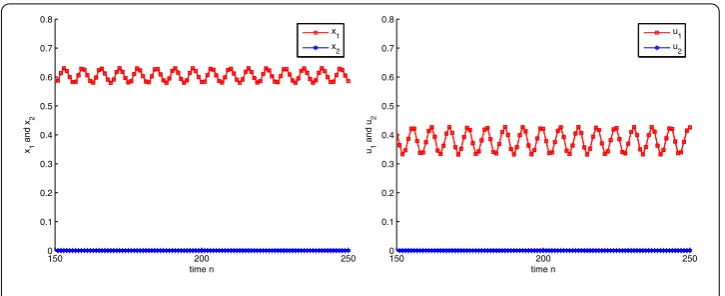
Figure 1 Dynamic behavior of system (3.1) with the initial conditions (x1(0),x2(0),u1(0),u2(0)) = (0.1, 0.3, 0.2, 0.04)Tand (0.2, 0.1, 0.6, 0.5)T.
Example . Consider the following system:
⎧ ⎪ ⎪ ⎪ ⎪ ⎪ ⎨ ⎪ ⎪ ⎪ ⎪ ⎪ ⎩
x(n+ ) =x(n)exp{. – .x(n) –(.+.sin(n))x(n)
+x(n) – .u(n)},
x(n+ ) =x(n)exp{. – .x(n) –(+cos(n))x(n)
+x(n) – .u(n)},
u(n) = –(. + .sin(n))u(n) + .x(n),
u(n) = –(. + .cos(n))u(n) + .x(n).
(.)
In this case, we have that (H)-(H) hold andB=exp(r
M
–)
aL ≈., and hence
lim inf n→∞
n+ω– s=n r(s) n+ω–
s=n r(s)
= >lim sup n→∞
c(n)
a(n)≈.,
lim sup n→∞
e(n) b(n)≈,
lim inf n→∞
c(n)
( +B)d(n)lim infn→∞
n+ω– s=n r(s) n+ω–
s=n r(s) –a(n)
d(n)
≈..
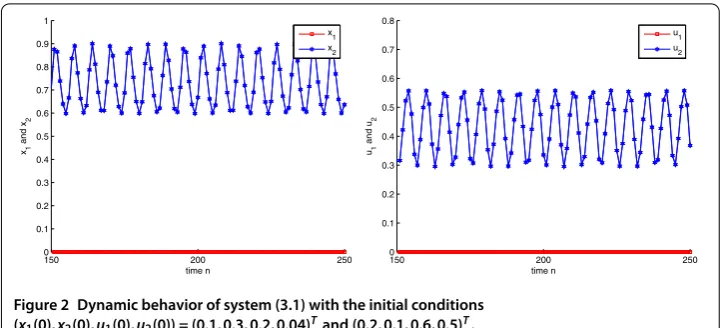
So all conditions in Theorem . are satisfied, andxanduin system (.) are extinct. Numerical simulation also confirms our result (see Figure ).
4 Discussion
Figure 2 Dynamic behavior of system (3.1) with the initial conditions (x1(0),x2(0),u1(0),u2(0)) = (0.1, 0.3, 0.2, 0.04)Tand (0.2, 0.1, 0.6, 0.5)T.
systems, feedback control variables play an important role in the extinction property of the system.
Competing interests
The author declares that there is no conflict of interests regarding the publication of this paper.
Author’s contributions
The author wrote the manuscript carefully, read, and approved the final manuscript.
Acknowledgements
This work was funded by Program for Outstanding Youth Scientific Research Talents Cultivation in Fujian Province University (2016) and the Natural Science Foundation of Fujian Province (2015J01012, 2015J01019).
Received: 2 August 2016 Accepted: 26 December 2016
References
1. Wang, Q, Liu, Z, Li, Z: Existence and global asymptotic stability of positive almost periodic solutions of a two-species competitive system. Int. J. Biomath.7, 1450040 (2014)
2. Gopalsamy, K: Stability and Oscillations in Delay Differential Equations of Population Dynamics. Mathematics and Its Applications, vol. 74. Kluwer Academic Publishers, Dordrecht (1992)
3. Qin, W, Liu, Z, Chen, Y: Permanence and global stability of positive periodic solutions of a discrete competitive system. Discrete Dyn. Nat. Soc.2009, Article ID 830537 (2009)
4. Wang, Q, Liu, Z: Uniformly asymptotic stability of positive almost periodic solutions for a discrete competitive system. J. Appl. Math.2013, Article ID 182158 (2013)
5. Yu, S: Extinction and stability in a class of discrete non-autonomous competition system. J. Yanbian Univ. Nat. Sci. Ed. 41, 279-284 (2015) (in Chinese)
6. Yue, Q: Extinction for a discrete competition system with the effect of toxic substances. Adv. Differ. Equ.,2016, 1 (2016)
7. Wang, Q, Liu, Z, Li, Z: Positive almost periodic solutions for a discrete competitive system subject to feedback controls. J. Appl. Math.2013, Article ID 429163 (2013)
8. Yu, S: Permanence for a discrete competitive system with feedback controls. Commun. Math. Biol. Neurosci.2015, Article ID 16 (2015)
9. Chen, L, Chen, F: Extinction in a discrete Lotka-Volterra competitive system with the effect of toxic substances and feedback controls. Int. J. Biomath.8, 1550012 (2015)
10. Xu, J, Teng, Z: Almost sufficient and necessary conditions for permanence and extinction of nonautonomous discrete logistic systems with time- varying delays and feedback control. Appl. Math.56, 207-225 (2001)
11. Zhang, L, Teng, Z, Zhang, T, Gao, S: Extinction in nonautonomous discrete Lotka-Volterra competitive system with pure delays and feedback controls. Discrete Dyn. Nat. Soc.2009, Article ID 656549 (2009)
12. Pu, L, Xie, X, Chen, F, Miao, Z: Extinction in two-species nonlinear discrete competitive system. Discrete Dyn. Nat. Soc. 2016, Article ID 2806405 (2016)
13. Chen, F, Xie, X, Miao, Z, Pu, L: Extinction in two species nonautonomous nonlinear competitive system. Appl. Math. Comput.274, 119-124 (2016)
14. Li, Z, Chen, F: Extinction in two dimensional discrete Lotka-Volterra competitive system with the effect of toxic substances. Dyn. Contin. Discrete Impuls. Syst., Ser. B, Appl. Algorithms15, 165-178 (2008)
15. Shi, C, Li, Z, Chen, F: Extinction in a nonautonomous Lotka-Volterra competitive system with infinite delay and feedback controls. Nonlinear Anal., Real World Appl.13, 2214-2226 (2012)
17. Li, Z, Chen, F: Extinction in two dimensional nonautonomous Lotka-Volterra systems with the effect of toxic substances. Appl. Math. Comput.182, 684-690 (2006)
18. Hu, H, Zhu, L: Permanence and extinction in non-autonomous logistic system with random perturbation and feedback control. Adv. Differ. Equ.2016, 192 (2016)
19. Xie, X, Xue, Y, Wu, R, Zhao, L: Extinction of a two species competitive system with nonlinear inter-inhibition terms and one toxin producing phytoplankton. Adv. Differ. Equ.2016, 258 (2016)
20. Chen, F, Wang, H: Dynamic behaviors of a Lotka-Volterra competitive system with infinite delays and single feedback control. J. Nonlinear Funct. Anal.2016, Article ID 43 (2016)