Volume 2006, Article ID 90652, Pages1–11 DOI 10.1155/WCN/2006/90652
SeGrid: A Secure Grid Framework for Sensor Networks
Xiuzhen Cheng,1Fang Liu,1and Fengguang An2
1Department of Computer Science, The George Washington University, Washington, DC 20052, USA 2Institute of Computing Technology, Chinese Academy of Sciences, Beijing 100080, China
Received 10 October 2005; Accepted 22 December 2005
In this paper, we propose SeGrid, a secure framework for establishing grid keys in low duty cycle sensor networks, for which estab-lishing a common key for each pair of neighboring sensors is unnecessary since most sensors remain in sleep mode at any instant of time. SeGrid intends to compute a shared key for two grids that may be multihop away. This design explores the fact that for most applications, closer grids have higher probability and desire for secure message exchange. SeGrid relies on the availability of a low-cost public cryptosystem. The query and update of the corresponding public shares are controlled by a novel management protocol such that the closer the two grids, the shorter the distance to obtain each other’s public share. We instantiate SeGrid based on Blom’s key establishment to illustrate the computation of a grid key.
Copyright © 2006 Xiuzhen Cheng et al. This is an open access article distributed under the Creative Commons Attribution License, which permits unrestricted use, distribution, and reproduction in any medium, provided the original work is properly cited.
1. INTRODUCTION
Security provisioning is a critical service for many sensor net-work applications [1–3]. However, the severely constrained resources (memory, processor, battery, etc.) within a sensor render many of the popular public key-based security primi-tives inapplicable [4]. Therefore, much research effort [5–11] has been placed on how to establish a shared key between two sensors such that their communications can be secured with low-cost symmetric encryption techniques.
Most existing schemes [8] for key establishment in sen-sor networks intend to design light weight (in computational complexity) algorithms for computing pairwise keys between neighboring sensors. The induced key-sharing graph con-taining edges incident at two sensors sharing a common key should be globally connected in order for the network to function properly. Another constraint considered by these techniques is the memory budget allocated for a priori key information storage. The tradeoff between the consumed memory space versus the security of the scheme and the connectivity of the induced key-sharing graph has been well studied in many of these works.
As understood by the research society, the utmost prob-lem in a sensor network is the operation time elongation. Even though the above-mentioned works do take resource (especially memory space) consumption into consideration, none of them explores the density dimension for further energy conservation. In this paper, we propose SeGrid, a
grid-based framework for establishing grid keys in low duty cycle sensor networks. We envision that all sensors within a grid are equivalent in routing (as in [12]), and thus a secret key is needed between two grids (instead of two nodes) that demand secure communication. In SeGrid, only one or a few sensors (for fault tolerance) within a grid are active at any in-stant of time and all other sensors fall asleep for energy con-servation. This design explores the fact that sensors are low cost and are densely deployed in a typical network. When a new sensor becomes active, or an active sensor dies due to en-ergy depletion, the shared grid keys should be recomputed. Note that this is different than group key construction. If all sensors within a grid form a group, then SeGrid intends to compute a shared key between two group leaders, with the help of all active group members. We instantiate this idea by applying Blom’s key establishment scheme [13] to demon-strate the grid key computation. Note that putting redundant sensors to sleep for energy conservation is a popular method in topology control [12,14,15] and energy-efficient protocol design [16–18]. However, to the best of our knowledge, this work is the first to combine energy-efficient topology control with key establishment.
computation cost (e.g., Blom’s key establishment scheme [13]) such that each sensor can be preloaded with a crypto-pair containing a public share and a private share before de-ployment. In SeGrid, sensors compute the grids they are re-siding in and choose to sleep or wake up based on some schedule (e.g., the wake-up schedule proposed in [18]). Each grid has agrid head, an active sensor for message transmis-sion and public share storage. The grid head stores the pub-lic shares of all active nodes within its grid at designated lo-cations and queries the nearest grid that stores the public shares of another grid based on a novel public share man-agement protocol. After obtaining the public shares of the destination grid, the source grid computes a keyksthat will
be used to secure all transmissions between these two grids. The destination grid can follow the same procedure to com-pute the grid keyks. The public share management protocol ensures that the closer the two grids are, the shorter the ex-pected query distance to obtain each other’s public shares is. This protocol involves only simple algebraic (shift and addi-tion) operations, thus has very low computation overhead. We finally instantiate SeGrid based on Blom’s key establish-ment scheme [13] to demonstrate how the grid key can be computed based on the underlying public cryptosystem.
The features of SeGrid and the contributions of this pa-per are summarized as follows.
(i) SeGrid divides sensors into a grid structure and re-alizes a secure grid communication with only a few number of nodes being active in each grid. The major-ity of the sensors fall asleep for energy conservation, and rely on the associated grid heads for intergrid se-cure communication. This design is extremely useful for energy constrained sensor networks. To our best knowledge, SeGrid is the first work that considers key establishment and topology control for energy conser-vation at the same time.
(ii) SeGrid can be easily applied to multihop end-to-end secure communication. Existing key establishment schemes rely on intermediary sensors for path key computation to construct a shared key between two sensors that are multihop away. Path keys are vul-nerable because they are exposed to all intermediary nodes, violating the security requirement that a pair-wise secret should be known to only the communicat-ing pairs.
(iii) The required storage space per grid is proportional to log √N, whereN is the total number of grids in the network. This indicates that memory space consumed by SeGrid grows very slowly with the increase of the network size.
(iv) The proposed grid-based public share management scheme explores the communication overhead trade-offbetween queries and updates for public share man-agement in SeGrid. This design investigates the fact that in many sensor network applications, two grids that are farther away have weaker desire to communi-cate directly.
This paper is organized as follows. Section 2 briefly outlines the most related works. Network model and the
underlying assumptions are elaborated in Section 3. We propose our grid-based framework for establishing grid keys in sensor networks (SeGrid) inSection 4. The performance of SeGrid is studied inSection 5. An example instantiation of SeGrid is sketched inSection 6. We conclude this paper with a discussion inSection 7.
2. RELATED WORK
Since the pioneer work of Eschenauer and Gligor [9], many researchers have been working on how to bootstrap shared keys for two sensors that desire secure communication. In this section, we summarize the major related works along the lines ofrandom key/keying information predistributionandin situ pairwise key establishment.
The basic random key predistribution scheme is pro-posed by Eschenauer and Gligor in [9], in which a large key poolKis computed offline and each sensor pickskkeys ran-domly fromKwithout replacement to form a key ring be-fore deployment. Two sensors can establish secure commu-nication as long as they have at least one common key in their key rings. To enhance the security of the basic scheme, Chan et al. [6] propose theq-composite keys scheme in whichq >1 number of common keys are required for two nodes to estab-lish a shared key. To improve scalability, Du et al. [8] employ the group deployment concept, in which sensors are grouped before deployment and each group is dropped at one deploy-ment point. Correspondingly the large key poolKis divided into subkey spaces, with each associated with one group of sensors. Subkey spaces overlap if the corresponding deploy-ment points are adjacent. Such a scheme ensures that close-by sensors have higher chance to establish a pairwise key di-rectly. In all these schemes [6,8,9], a path key can be estab-lished for two neighboring sensors that demand secure com-munication but have no common keys in their key rings. A drawback of this mechanism is that the path key is exposed to all intermediary nodes. To overcome this problem, Zhu et al. [11] propose to break the secret (the shared key) into multi-ple shares and each share is delivered to the destination along a different logical path. The secret is restored at the destina-tion when a number of shares are received.
To further improve security and scalability, a couple of random key space predistribution schemes [7,10] have been proposed. These two schemes are very similar in nature, ex-cept that the key spaces are defined differently. In [7], a key space is constructed based on Blom’s method [13], and a shared key between two nodes corresponds to one entry of a symmetric matrix. In [10], a key space is defined by a sym-metric bivariatet-degree polynomial [24], and the shared key of two sensors is the value obtained by plugging the two IDs into a polynomial. In both schemes, a number of key spaces are precomputed and each sensor is associated with one or more key spaces before deployment. Two sensors can com-pute a pairwise key after deployment if they have keying in-formation from a common key space.
As claimed by [25], random key and key space predistri-bution schemes explore the tradeoffof security and mem-ory consumption, since the amount of preloaded informa-tion is constrained by the memory budget within each sensor. A stronger security results in higher memory consumption. This seems unavoidable in all predistribution schemes, due to the randomness since no sensor network topology infor-mation is available before deployment.
iPAK [26] and SBK [27], two truely in situ key establish-ment schemes that remove the randomness, achieve good security with a small amount of memory consumption. In iPAK and SBK, a number of service sensors are sacrifices and therefore worker sensors do not need any predeployment knowledge for pairwise key establishment. In iPAK, service sensors, with each carrying a key space, and worker sensors, with no a priori knowledge, are deployed at the same time. In SBK, homogeneous sensors are preloaded with several sys-tem parameters and they differentiate their roles as either ser-vice nodes or worker nodes after deployment. A key space is constructed after the role of a service node is determined. In both schemes, worker sensors obtain security information through an asymmetric secure channel from service nodes and then compute shared keys with their neighbors. Each service node has aλ-secure key space, and distributes keying information to at mostλworker sensors through an asym-metric secure channel established by Rabin’s algorithm [28]. Compared to iPAK, SBK is “perfect” against node capture at-tack, achieves high connectivity (close to 1) in the induced key-sharing graph, and consumes a small amount of mem-ory in worker sensors.
SeGrid is different from all those mentioned above in that secure communication is realized based on the shared keys between two grids instead of two sensors. SeGrid divides the sensor network into a virtual grid structure based on loca-tion informaloca-tion, and computes a localoca-tion-aware grid key between any two grids. Only one or a few number of sen-sors are active at any instant of time in each grid, with one of them as the grid head. All the intergrid communications must be directed through the associated grid heads. SeGrid is able to provide multihop end-to-end secure communica-tion, and thus does not require the establishment of a path key. SeGrid considers topology control for energy conserva-tion and key establishment at the same time, a practical so-lution for network lifetime elongation. In SeGrid, memory
consumption grows very slowly when the size of the network increases fast (proportional to log√N); therefore, SeGrid has good scalability.
3. NETWORK MODEL AND ASSUMPTIONS
We consider a sensor network deployed in outdoor environ-ments. Each sensor is able to position itself through any of the techniques proposed in literature (e.g., [29–31]). A vir-tual grid will be computed based on position information and each sensor resides in one grid. The ID of a grid is de-noted by (X,Y). At any instant of time, one ort >1 number of sensors, wheretis a small integer, are active within a grid and all other sensors fall asleep for energy conservation. A sleeping sensor wakes up periodically in order to replace a sensor with depleted energy. An active sensor is in full oper-ation and all active sensors collaborate together to guarantee the functioning of the network. Sensors within neighboring grids can communicate directly. The wake-up/sleep schedule, the active/inactive status transition, and the underlying rout-ing protocol for message dissemination are out of the scope of this paper. We just simply assume that they are available for us to employ. Existing works that are related to these top-ics can be found in [18,32], and so forth.
We will explore a public cryptosystem that contains pub-lic and private crypto-pairs. The pubpub-lic share in a crypto-pair can be disseminated to the public as plain text while its cor-responding private share must be kept secret. By exchang-ing their public shares, two nodes can compute a shared key based on their private shares and the exchanged public shares. Examples of cryptosystems satisfying these conditions include the Diffie-Hellman key exchange protocol [33], the symmetric matrix-based key establishment scheme [13], and the polynomial-based scheme [24]. InSection 6, we are go-ing to instantiate SeGrid based on Blom’s method.
We assume each sensor is preloaded with a crypto-pair before deployment. The operation of the sensor network is unattended after deployment. Each grid may have more than one public share, if it has more than one active sensor. An update message will be directed to all locations storing the public shares of the grid such that the public shares of newly introduced active (old inactive) sensors can be inserted (re-moved). A grid demanding the public shares of another grid can just query the nearest grid storing the corresponding in-formation. We will propose a simple protocol for public share management inSection 4.2.
We envision that in a sensor network all nodes within a grid are equivalent. Therefore we only consider the secure communication between two grids. The computation of the shared keyksbetween the two grids depends on the
under-lying public cryptosystem. We will show how to compute ks based on Blom’s key establishment scheme inSection 6.
Note that intragrid secure communications are needed when more than one sensor is active simultaneously within a grid. The shared keys between these active nodes can be computed based on the underlying public cryptosystem too.
within a grid is in charge of all intergrid communications and public share storage. This sensor is the grid head. In other words, the grid head stores all public shares for the associated grid. Note that a grid head will be replaced by a new one when its energy is depleted. This procedure is out of the scope of this paper too. Existing works that cover the role transition of grid heads can be found in [12,16]. The new grid inherits all stored public shares from the old one for the associated grid.
4. SEGRID: THE GRID-BASED FRAMEWORK FOR KEY ESTABLISHMENT
In this section, we propose the basic idea of SeGrid, a grid-based framework for key establishment in sensor networks. Note that this elaboration does not depend on any public cryptosystem. We will instantiate this idea inSection 6based on Blom’s key establishment scheme [13].
In SeGrid, each sensor computes the associated grid ID locally and independently based on its position information according to the grid and grid head determinationscheme. Therefore all sensors are partitioned based on a virtual grid structure after deployment. All active nodes within a grid store their public shares at designated locations (grids) de-termined by thepublic share managementscheme. When two grids need to set up their shared key, each grid first figures out the nearby location from which to query the public shares of the other grid, and then applies the grid key computa-tiontechnique. After a secret is computed, two grids can se-curely communicate with each other to protect all message exchange.
SeGrid considers both key establishment and network lifetime extension through topology control simultaneously. With only one or a few number of active nodes in each grid, the majority of the sensors can sleep most of the time and rely on the associated grid heads for grid-to-grid communi-cation. The novel public share management scheme ensures that two grids get the public shares of each other from a posi-tion within a short distance. A shared key between two grids can be further secured with the location information.
In the following, we will first describe a simple algorithm for each sensor to locally and independently compute the ID of the grid in which it resides. Then we give a novel proto-col for each grid to determine where to store its own pub-lic shares, and also where to obtain the pubpub-lic shares of the other communicating grid to establish a shared grid key. In the last, we propose how to apply SeGrid for protecting the unicast communications between two grids.
4.1. Grid and grid head determination
In GAF [12], the size of a grid is determined based on node equivalence for routing. In other words, any node within a grid can communicate directly with any other node in any neighboring grid. This constraint specifies that the size of a grid, denoted byr, can be at mostR/√5, whereRis the nomi-nal transmission range. In our study, we adopt this idea since we also intend to turn offmost of the sensors within a grid
for energy conservation in order to extend network lifetime. GAF specifies the length of the grid edge but does not specify how to determine the grid a node resides in. In the follow-ing, we propose a very simple algorithm to allow each node independently and locally determine its grid.
Assume a sensorSis deployed at position (x,y). Then the grid ID (X,Y) whereSresides in can be derived as
X= x÷2log2r,
Y= y÷2log2r. (1) Note that the grid ID (X,Y) can be computed through shift operations only, as long aslog2ris computed offline and uploaded into each sensor before deployment. This is a rea-sonable assumption since r depends only on the nominal transmission range R, which can be made available before deployment. Therefore we can simply shift the binary rep-resentations ofx and yto the right fork positions, where k= log2r, to obtainXandY.
If only one active sensor is required within a grid, the protocol proposed in [12] for active node selection suffices. In this case, the unique active sensor serves as the grid head. Whent >1 active sensors per grid are required, these nodes can be elected based on node ID, or residual power. For ex-ample, a simple protocol may require that thetsensors with the smallesttIDs in a grid whose residual powers are above some threshold remain active while others go to sleep after the grid ID of each sensor is computed and broadcasted. In this case, we can choose the sensor with minimum ID as the grid head. Requiring more than one active sensor per grid provides better fault tolerance since the grid head is in charge of both message dissemination and keying information stor-age. When a grid head needs to be replaced due to reasons such as power depletion, it can delegate another active sen-sor as the new grid head and transfer all stored public shares before turning to sleep mode. If no active sensor within the same grid is available, the grid head should wait until a sleep-ing sensor wakes up. A similar procedure for grid head role transition has been proposed in [12].
4.2. Public share management
As stated before, each grid needs to store the public shares of all its active nodes at designated positions (grids) for the convenience of being queried by other grids to establish in-tergrid shared keys. To solve this problem, we need to an-swer two questions. First, for any grid (X0,Y0), where shall
we store its public shares? Second, if grid (X1,Y1) would like
to securely communicate with (X0,Y0), where to find out the
latter’s public shares? We propose a simple protocol for stor-ing and querystor-ing the public shares of a grid.
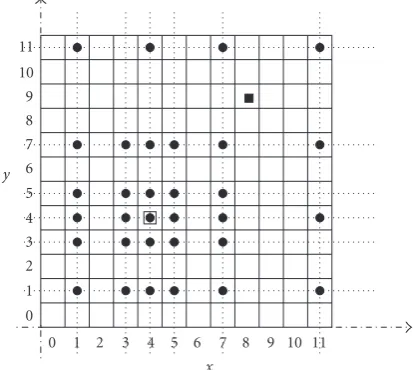
0 1 2 3 4 5 6 7 8 9 10 11
Figure1: The public shares of the grid (4, 4) will be stored at (4, 4),
(3, 4), (4, 3), (4, 5), (5, 4), (3, 3), (5, 5), (3, 5), (5, 3), (1, 1), (3, 1), (4, 1), (5, 1), (7, 1), (1, 3), (7, 3), (1, 4), (7, 4), (1, 5), (7, 5), (1, 7), (7, 7), (3, 7), (4, 7), (5, 7), (1, 11), (4, 11), (7, 11), (11, 11), (11, 7), (11, 4), (11, 1). If the grid (8, 9) needs the public shares of (4, 4), it can query either (7, 7) or (7, 11) since they are closer.
gives a simple example to illustrate the storage locations of the public shares for the grid (4,4).
The answer to the first question is very simple. The public shares of the grid (X0,Y0) will be stored at the grid (X,Y)
To identify the nearest grid that stores the public shares of (X0,Y0), the grid (X1,Y1) computes
Note that the grids formed by
X=X0+ sign Figure 1when grid (8, 9) queries the public shares of (4, 4). Based on (5),i−x =2,i+
x =3,i−y =2, andi+y =3. The nearest
grids storing (4, 4)’s public shares are either (7, 7) or (7, 11) since they are the closest among the 4 grids formed byX = 4 + 3,X=4 + 7,Y =4 + 3, andY=4 + 7.
As shown by (2)–(4), the computation of the storage lo-cations for a grid contains only shift and addition opera-tions. However, the identification of the nearest grid for pub-lic share query (see (5)) involves the complicated log func-tions. Nevertheless, this can be done easily through a lookup table. Hence, each grid can easily determine where to store and query the public shares.
Note that if Manhattan distance instead of Euclidean dis-tance is used as a routing metric for public share queries and updates, the computation overhead is further decreased since only simple addition and subtraction operations are in-volved.
Remarks 1. (i) This protocol guarantees that closer grids ob-tain the public shares within shorter distance. Therefore, the farther away the two grids are, the higher the communication overhead for their public share queries is. In reality, closer grids intend to communicate with higher probability.
(ii) The update of the public shares for a grid always takes the same number of messages, as long as the routing protocol remains unchanged.
(iii) The grid head will store all public shares for other grids based on (2)–(4). Before turning to sleep mode, the grid head should transfer all stored information to the new grid head.
4.3. Grid key computation
4.4. Secure grid communication
Now we are ready to propose our secure grid communication scheme. We assume there exists a routing protocol, either geography-based (e.g., [34]) or topology-based (e.g., [32]), such that we can employ directly.
Recall that SeGrid is built upon a public cryptosystem that contains public and private crypto-pairs. By exchanging their public shares, two sensors can establish a shared secret based on the private shares and the exchanged public shares. Therefore two nodes within the same grid can communicate securely with each other. However, intergrid secure commu-nications must seek the help of the grid heads, as illustrated by the following procedure.
(1) Each active sensor first establishes a secure intragrid communication link with the associated grid head. The nodes exchange their public shares, and compute the shared key with their private shares.
(2) The two corresponding grid heads are responsible for the secure intergrid communication. Each grid head first queries the nearest grid that contains the public shares of the other party based on the procedure pro-posed inSection 4.2to obtain the public shares, then computes a secret keyksshared by these two grids.ks
will be used to secure all the future communications between the two grids.
5. PERFORMANCE ANALYSIS
In this section, we study the performance of SeGrid in terms of memory overhead, communication cost, and resilience against node capture attack. Note that in SeGrid, only a few number of sensors are active in each grid at any instant of time, and are involved in grid key computation. LetSdenote the sensor network under consideration and letNbe the to-tal number of grids inS. For simplicity we assume that all grids form a square region, and each grid has an edge length of “1” unit.
5.1. Storage overhead
In the proposed SeGrid framework, the public shares of each grid need to be stored at designated grids for the convenience of being queried by other grids to establish shared grid keys. In this subsection, we study the storage overhead, that is, the maximum number of public shares a grid head may store for other grids. To simplify the analysis, we assume each grid has only one active sensor, the grid head. Therefore each grid stores at most one public share for another grid. Letτbe the maximum number of public shares a grid stores in a sensor networkS.
Lemma 1. WhenN=22k−2k+1+ 1, wherek=1, 2,. . ., the grid in the center storesτpublic shares in the network. Further,
τ=1fork=1, andτ=16k−23fork >1.
Proof (Induction). Whenk = 1, only one grid exists. It is obvious that the lemma holds true. When k = 2,N = 9,
A
B S
S1
S
S 1
2m−1 2m−1 2m−1
2m+1−1
Figure2:Ais the central grid and stores the maximum number of
public shares inS. WhenSis enlarged intoSandN is increased from 22m−2m+1+ 1 to 22(m+1)−2m+2+ 1,A’s public shares stored in
Sare still the maximum.
the center grid stores a copy for each of the other 8 grids, while a boundary grid stores less based on the public share management protocol. Therefore the lemma holds true since 16×2−23=9.
Assume the argument holds true untilk=m. Now con-siderk=m+ 1. The network is enlarged fromSwith an edge length of 2m−1 toSwith an edge length of 2m+1−1. LetAbe
the central grid of bothSandS, thenAstores the maximum number of public shares inS. For contradiction, we assume that another gridBother thanAstores the maximum num-ber of public shares inS.
For gridA, the public shares stored inScome from two sources: the public sharesAstores in the 16m−23 grids ofS from the assumption, and the public shares in the newly en-larged area. According to (2)–(4), 16 public shares are added to the area defined byS−S, (2)–(4) show that 16 more grids are included whenevermis increased by 1 for allm >1. Thus, Astores 16(m+ 1)−23 copies of public shares inS.
The public shares stored atBcome from two sources too. As indicated byFigure 2,Bstores at most 16m−23 num-ber of public shares within the areaS1whose edge length is
2m−1, sinceS1overlap withS.Balso stores public shares
from the areaS1−S1, whereS1is centered atB. According
to (2)–(4), this area contains less than 16 public shares ofB. Therefore the total number ofB’s public shares inSis less than (16m−23) + 16, that is, 16(m+ 1)−23. This contra-dicts with the previous assumption. Thus,Bcannot store the maximum number of public shares in the enlarged network S.
Corollary 1. When22(k−1)−2k+1< N <22k−2k+1+1, where k=2, 3,. . ., then the maximum number of public shares stored by a grid in the network is at most16k−23.
Based onLemma 1andCorollary 1, we obtain the fol-lowing theorem.
Theorem 1. LetNbe the total number of grids in a network following the proposed public share management scheme, where
N >9. Then the number of public shares stored at each grid is at most16× log2(√N+ 1) −23.
Proof. For anyN >9, there exists an integerksatisfyingk >1 such that
22(k−1)−2k+ 1< N ≤22k−2k+1+ 1,
that is, 2k−1−1< N≤2k−1,
that is,k−1<log2( N+ 1)≤k.
(8)
Thereforek = log2(√N+ 1). According toLemma 1and Corollary 1, each grid stores at most 16k−23 public shares in the network, which means that the maximum storage per grid is at most 16× log2(√N+ 1) −23.
Theorem 2. For a network following the public share manage-ment scheme, the number of public shares stored at a gridAis equal to the total number ofA’s public share stored within the network.
Proof. Let (X,Y) be a grid that stores the public share of the grid (X0,Y0) in the network. AssumeX =X0and/orY =Y0.
Rewrite (4) as follows:
X=
⎧ ⎪ ⎨ ⎪ ⎩
X0±
2i−1, X0±
2i+1−1,
Y=
⎧ ⎪ ⎨ ⎪ ⎩
Y0±
2i−1, Y0±
2i+1−1,
(9)
wherei=0, 1, 2,. . .. It follows that
X0=
⎧ ⎪ ⎨ ⎪ ⎩
X∓2i−1, X∓2i+1−1,
Y0=
⎧ ⎪ ⎨ ⎪ ⎩
Y∓2i−1, Y∓2i+1−1,
(10)
Hence for any gridB,BstoresA’s public share if and only if AstoresB’s public share. From (2) and (3), it is easy to argue that the same relationship holds true for the cases ofX=X0
and/orY =Y0.
According to Theorems1and2, the storage overhead re-quired in each grid is at most 16×log2(√N+1)−23, where N >9. This indicates that in the worst case, storage overhead increases very slowly whenN grows fast.Figure 3plots the average number of public shares stored at each grid obtained from simulation study as well as the previously computed theoretical upper bound. Both trends imply that the storage in each grid grows slowly as the number of grids increases.
0 0.5 1 1.5 2 2.5 3 3.5 4
×104
N 20
30 40 50 60 70 80 90 100 110
St
or
age
p
er
gr
id
Upper bound Measured value
Figure3: The memory storage for public shares at each grid.
5.2. Communication overhead
In SeGrid, public shares of each grid need to be stored at des-ignated locations at the system initialization phase and to be updated later when sensors change state. Further, querying public shares of another grid also involves message transmis-sion.
Storing public shares of each grid during the initializa-tion phase contributes the most to the communicainitializa-tion over-head, since each grid needs to store a copy of its public shares in every designated position according to the public share management scheme. Nevertheless, public shares can be transmitted just in plain texts, and can be very small (e.g., as implemented by [7], only the seed of the public share needs to be exchanged). On the other hand, SeGrid explores the communication overhead tradeoffbetween public share queries and updates. An update happens only when there is an active membership change, and this update may travel long distance. However, query overhead can be decreased since no global flooding will be involved. For a system with frequent public share acquisition request, the proposed pub-lic share management protocol is efficient in energy conser-vation.
5.3. Resilience against node capture
SeGrid relies on the availability of the underlying public cryptosystem for shared key computation between two sen-sors in the network. By compromising a number of sensen-sors, an attacker may obtain the grid key and conduct further at-tacks. The security of SeGrid is dependent on the underlying public cryptosystem.
λ-security of the Blom’s key establishment system. Once more thanλnumber of sensors are compromised, the whole system becomes insecure. Increasingλ does improve secu-rity, but this requires a larger amount of memory. A possible strategy to overcome this problem is to hierarchically apply multiple key spaces. We target this as a future research.
6. A SIMPLE REALIZATION
In this section, we provide a simple realization of SeGrid for sensor networks based on Blom’s key establishment scheme [13]. For completeness, we give a brief overview on Blom’s scheme first. Then we describe how to compute a grid key based on Blom’s scheme. Finally, we propose a location-aware grid key computation as an enhancement.
6.1. Preliminary: Blom’s key management scheme
Blom’sλ-secure key establishment scheme [13] has been well tailored for light-weight sensor networks by [7]. In the fol-lowing, we will give an overview on Blom’s scheme based on [7].
LetGbe a (λ+ 1)×M matrix over a finite fieldGF(q), where q is a large prime. The connotation of M will be-come clear later.Gis public, with each column called a public share. LetDbe any random (λ+ 1)×(λ+ 1) symmetric ma-trix.Dmust be kept private, which is known to the network service provider only. The transpose ofD·Gis denoted byA. That is,A=(D·G)T.Ais private too, with each row called a private share. SinceDis symmetric,A·Gis symmetric too. If we letK =(kij)= A·G, we havekij =kji, wherekij is
the element at theith row and thejth column of matrixK, i,j=1, 2,. . .,M.
The basic idea of Blom’s scheme is to usekij as the
se-cret key shared by nodeiand nodej.DandGjointly define akey space(D,G). Any public share inGhas a unique pri-vate share in A, which form the so-calledcrypto-pair. For example, the ith column ofG, and the ith row ofAform a crypto-pair and the unique private share of the ith col-umn ofG, a public share, is theith row ofA. Two sensors whose crypto-pairs are obtained from the same key space can compute a shared key after exchanging their public shares. From this analysis, it is clear thatMis the number of sensors that can compute their pairwise keys based on the same key space.
In summary, Blom’s scheme states the following protocol for nodesiand jto computekijandkji, based on the same key space.
(i) Each node stores a unique crypto-pair. Without loss of generality, we assume nodeigets theith column of Gand theith row ofA, denoted bygkiandaik, where k = 1, 2,. . .,λ+ 1, respectively. Similarly, node jgets the jth column ofGand the jth row ofA, denoted by gk jandajk, wherek=1, 2,. . .,λ+ 1, respectively.
(ii) Nodeiand node jexchange their stored public shares drawn from their crypto-pairs as plain texts.
(iii) Nodeicomputeskijas follows:
kij= λ+1
k=1
aik·gk j. (11)
Similarly, nodejcomputeskjiby
kji= λ+1
k=1
ajk·gki. (12)
Blom’s key establishment scheme ensures the so-calledλ -secure property, which means that the network should be perfectly secure as long as no more thanλ nodes are com-promised. This requires that anyλ+ 1 columns ofGmust be linearly independent. An interesting method of computing Gis proposed by Du et al. in [7]. This idea is sketched as the following. Letlenbe the number of bits in the symmetric key to be computed. Chooseqas the smallest prime that is larger than 2len. Letsbe a primitive element ofGF(q) andM < q.
Then
G=
⎡ ⎢ ⎢ ⎢ ⎢ ⎢ ⎢ ⎢ ⎢ ⎢ ⎢ ⎢ ⎣
1 1 1 · · · 1
s s2 s3 · · · sM
s2 s22 s32 · · · sM2
.. .
sλ s2λ s3λ . . . sMλ
⎤ ⎥ ⎥ ⎥ ⎥ ⎥ ⎥ ⎥ ⎥ ⎥ ⎥ ⎥ ⎦
(13)
Note that G is a Vandermonde matrix. Each column ofG represents the public share of some sensor node storing that column. In Blom’s key establishment scheme, public shares need to be exchanged between sensors that require secure peer-to-peer communication. Based on the structure of G, we observe that only the second element of each column, the
seedof the column, needs to be stored and exchanged. Thus both storage and communication overheads can be greatly decreased.
6.2. Grid key computation based on Blom’s method
Assume that a large key space (D,G) following Blom’s key es-tablishment scheme has been computed offline. Before de-ployment, each sensor receives a crypto-pair from the key space. Note that we do not require the crypto-pairs to diff er-ent sensors to be unique, but we require that all active sen-sors within one grid have different crypto-pairs. It is possible that more than one active node exists in each grid, thus the key shared by two grids may be computed based on multiple public shares.
Let tA(tB) be the number of active sensors in a grid
(XA,YA)((XB,YB)). Following the public share management
protocol proposed in Section 4.2, all these tA(tB) public
shares will be stored at designated grids, and are available to other grids upon a request. If (XA,YA) and (XB,YB) need secure communication, the grid head of (XA,YA) computes and queries the nearest grid holding (XB,YB)’s public shares,
1A
3A K11
K12
2A K31
K22
K32
K21 1B
2B Grid (XA,YA) Grid (XB,YB)
Hash to obtainKs
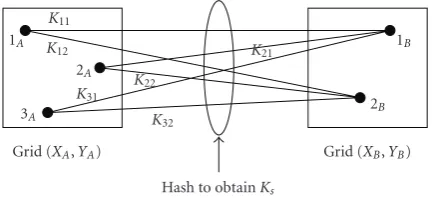
Figure 4: There exist three active sensors in grid (XA,YA) and
two active sensors in grid (XB,YB). The two nodes labeled by 1A and 1B are the grid heads in the corresponding grids. After ob-taining the public shares of (XB,YB), nodes 1A, 2A, and 3Ain grid (XA,YA) computek11 and k12, k21 and k22, andk31 and k32, the shared keys with the two nodes in grid (XB,YB) independently. Then each nodeiA within (XA,YA) computeskiA = Hash(ki1,ki2) fori=1, 2, 3. This value will be securely transmitted to node 1A. After obtaining allkiA’s, wherei=1, 2, 3, node 1Acomputesksas
ks =Hash(k1A,k2A,k3A). Similarly, node 1B in grid (XB,YB) com-putesksbased on the public shares of (XA,YA).
(XA,YA). The grid head of (XB,YB) conducts the same
pro-cedure.
Now the grid key shared by (XA,YA) and (XB,YB) is ready
to be computed independently in each grid based on the ex-changed public shares. In Blom’s key establishment scheme, two sensors can compute a shared key as long as they know each other’s public share. We can derive a shared keyks
be-tween two grids from the keys shared by all pairs of sensors within the two grids, as shown inFigure 4.
Let us use grid (XA,YA) as an example to demonstrate the procedure of computing a shared key with the grid (XB,YB). After obtaining the public shares of grid (XB,YB) (consisted
of the public shares from nodes 1B and 2B), each nodeiin
(XA,YA) computes a shared key with each node j in grid
(XB,YB). These pairwise keys are denoted bykij, wherei =
1, 2,. . .,tAand j =1, 2,. . .,tB. Then each nodeicomputes ki=Hash(ki1,. . .,kitB). This value is securely transmitted to
the grid headhof (XA,YA) based on the shared key between
nodesiandh. After receiving allki’s, wherei=1, 2,. . .,tA,
hderives the grid keyksby computing Hash(k1,k2,. . .,ktA).
The same procedure is conducted at the grid (XB,YB). Note that the hash function exploited must be linear, and must be able to take arbitrary number of inputs. The simple XOR function is an example.
All affected grid keys must be reestablished whenever a new sensor becomes active or an old sensor dies due to en-ergy depletion. Note that only the public shares of the node with role change needs to be updated (inserted or removed from designated grids).
Remarks 2. (i) The private shares of each sensor must be kept secret.
(ii) The security of the grid key computation proto-col based on Blom’s key establishment scheme [13] is de-termined by theλ-secure property of the key space (D,G). Therefore if the crypto-pairs of more than λ sensors are
exposed to the adversary, the security of the whole network is compromised. This is the major drawback of applying Blom’s key establishment scheme for grid key computation since the memory budget within a sensor for security information storage is limited.
(iii) The space consumed for storing the crypto-pairs within a sensor is related toλ. The larger theλis, the higher the security level is, and the larger the storage space is.
(iv) The computation overhead of a grid key is deter-mined byλtoo. Each shared key computation between two active nodes takesλ+ 1 number of modular multiplications.
6.3. Location-aware grid key enhancement
For the purpose of secure grid communication, the grid keys are desired to be unique. However, sensors may receive the same crypto-pairs in our realization based on Blom’s method. Therefore two pairs of grids may have the same grid key.
LetG1 andG2be two grids that compute a secure grid
key ks(G1,G2). Assume there are altogether n(≥ 2) active
nodes in these two grids. Let c1,. . .,cn denote the
crypto-pairs associated with these nactive nodes. Let G1 andG2
be another pair of grids containingnactive nodes. The grid key ks(G1,G2) is to be computed based on the associated
crypto-pairsc1,. . .,cn. With the Blom’s grid key computa-tion scheme, the probability that the two pairs of grids derive the same grid key can be estimated as
Pr(ksG1,G2
=ksG1,G2
≤Pr c1,. . .,cn
= c
1,. . .,cn
=Prc1=c1,. . .,cn=cn
×n!
=Mn!n,
(14)
whereMis the total number of crypto-pairs in the key space. Figure 5plots the probability that two pairs of grids com-pute the same grid key. We observe that a larger M or a larger nresults in a lower probability. However, a largern may shorten the network lifetime. In the following, we pro-pose to apply grid position information for unique grid key derivation.
Assume that gridG1wants to compute its shared key with
gridG2. AfterG1’s grid headhhas collected the confidential
contributionsk1,k2,. . .,kt from all the active nodes within G1,hcomputes the grid key as
Hash(k1,k2,. . .,kt,X1,Y1,X2,Y2), (15)
where (X1,Y1)((X2,Y2)) is the grid ID ofG1(G2) computed
from (1).
2 3 4 5 n
0 0.02 0.04 0.06 0.08 0.1
P
robabilit
y
M=20 M=30
M=40 M=50
Figure5: The probability that two pairs of grids obtain the same
grid key.
7. CONCLUSION AND FUTURE RESEARCH
In this paper, we have proposed SeGrid, a grid-based key es-tablishment framework for sensor networks. We have instan-tiated SeGrid based on Blom’s key establishment scheme to demonstrate how to compute a grid key shared by two grids. To our best knowledge, SeGrid is the first work that targets key establishment and energy conservation simultaneously. This is a more practical consideration since sensors may stay in sleep mode most of the time for network lifetime exten-sion. We will explore new instantiation ideas for better secu-rity provisioning.
As another future research we will explore the applicabil-ity of ID-based cryptosystems [35] to SeGrid. In an ID-based encryption system, the public key can be any string (e.g., an email address), and the private key needs to be computed from the public key and other system parameters. The idea of using the grid ID as a public key in SeGrid is very attrac-tive since public key management can be totally avoided.
ACKNOWLEDGMENT
The research of Dr. Xiuzhen Cheng is supported by the NSF CAREER Award no. CNS-0347674.
REFERENCES
[1] W. Liu and Y. Fang, “SPREAD: enhancing data confidentiality in mobile ad hoc networks,” inProceedings of the 23rd Annual Joint Conference of the IEEE Computer and Communications Societies (INFOCOM ’04), vol. 4, pp. 2404–2413, HongKong, March 2004.
[2] E. Shi and A. Perrig, “Designing secure sensor networks,”IEEE Wireless Communications, vol. 11, no. 6, pp. 38–43, 2004. [3] Y. Zhang, W. Liu, and W. Lou, “Anonymous communications
in mobile ad hoc networks,” inProceedings of the 24th Annual
Joint Conference of the IEEE Computer and Communications Societies (INFOCOM ’05), Miami, Fla, USA, March 2005. [4] D. W. Carman, P. S. Kruus, and B. J. Matt, “Constraints and
approaches for distributed sensor network security,” Tech. Rep. 00-010, NAI Labs, September 2000.
[5] F. An, X. Cheng, M. Rivera, J. Li, and Z. Cheng, “PKM: a pair-wise key management scheme for wireless sensor networks,” inInternational Conference on Computer Networks and Mobile Computing (ICCNMC ’05), Zhangjiajie, China, August 2005. [6] H. Chan, A. Perrig, and D. Song, “Random key predistribution
schemes for sensor networks,” inProceedings of the IEEE Sym-posium on Security and Privacy, pp. 197–213, Berkeley, Calif, USA, May 2003.
[7] W. Du, J. Deng, Y. Han, and P. K. Varshney, “A pairwise key pre-distribution scheme for wireless sensor networks,” in Pro-ceedings of the 10th ACM Conference on Computer and Com-munications Security (CCS ’03), pp. 42–51, Washington, DC, USA, October 2003.
[8] W. Du, J. Deng, Y. S. Han, S. Chen, and P. K. Varshney, “A key management scheme for wireless sensor networks using de-ployment knowledge,” inProceedings of the 23rd Annual Joint Conference of the IEEE Computer and Communications Soci-eties (INFOCOM ’04), vol. 1, p. 597, Hong Kong, March 2004. [9] L. Eschenauer and V. D. Gligor, “A key-management scheme for distributed sensor networks,” inProceedings of the 9th ACM Conference on Computer and Communications Security (CCS ’02), pp. 41–47, Washington, DC, USA, November 2002. [10] D. Liu and P. Ning, “Establishing pairwise keys in distributed
sensor networks,” inProceedings of the 10th ACM Conference on Computer and Communications Security (CCS ’03), pp. 52– 60, Washington, DC, USA, October 2003.
[11] S. Zhu, S. Xu, S. Setia, and S. Jajodia, “Establishing pairwise keys for secure communication in ad hoc networks: a proba-bilistic approach,” inProceedings of the 11th IEEE International Conference on Network Protocols (ICNP ’03), pp. 326–335, At-lanta, Ga, USA, November 2003.
[12] Y. Xu, J. Heidemann, and D. Estrin, “Geography-informed en-ergy conservation for ad hoc routing,” inProceedings of the 7th Annual International Conference on Mobile Computing and Networking, pp. 70–84, Rome, Italy, July 2001.
[13] R. Blom, “An optimal class of symmetric key generation sys-tems,” inProceedings of the Workshop on Theory and Applica-tion of Cryptographic Techniques (EUROCRYPT ’84), vol. 209, pp. 335–338, Paris, France, April 1985.
[14] B. Chen, K. Jamieson, H. Balakrishnan, and R. Morris, “An energy efficient coordination algorithm for topology mainte-nance in ad hoc wireless networks,” inProceedings of the ACM SIGMOBILE Annual International Conference on Mobile Com-puting and Networking, pp. 85–96, Rome, Italy, July 2001. [15] L. Ma, Q. Zhang, and X. Cheng, “A Power Controlled
Interfer-ence Aware Routing Protocol for Dense Multi-Hop Wireless Networks,” submitted.
[16] A. Cerpa and D. Estrin, “ASCENT: adaptive self-configuring sensor networks topologies,” inProceedings of the 21st Annual Joint Conference of the IEEE Computer and Communications Societies (INFOCOM ’02), vol. 3, pp. 1278–1287, New York, NY, USA, June 2002.
[17] E. J. Christine, M. S. Krishna, P. Agrawal, and J. C. Chen, “A survey of energy efficient network protocols for wireless net-works,”Wireless Networks, vol. 7, no. 4, pp. 343–358, 2001. [18] W. Ye, J. Heidemann, and D. Estrin, “An energy-efficient
Communications Societies (INFOCOM ’02), vol. 3, pp. 1567– 1576, New York, NY, USA, June 2002.
[19] M. Ding, D. Chen, K. Xing, and X. Cheng, “Localized fault-tolerant event boundary detection in sensor networks,” in Pro-ceedings of the 24th Annual Joint Conference of the IEEE Com-puter and Communications Societies (INFOCOM ’05), vol. 2, pp. 902–913, Miami, Fla, USA, March 2005.
[20] M. Ding, D. Chen, A. Thaeler, and X. Cheng, “Fault-tolerant target detection in sensor networks,” inProceedings of the IEEE Wireless Communications and Networking Conference (WCNC ’05), vol. 4, pp. 2362–2368, New Orleans, La, USA, March 2005.
[21] H. Chan and A. Perrig, “PIKE: peer intermediaries for key es-tablishment in sensor networks,” inProceedings of the 24th An-nual Joint Conference of the IEEE Computer and Communica-tions Societies (INFOCOM ’05), vol. 1, pp. 524–535, Miami, Fla, USA, March 2005.
[22] D. Liu, P. Ning, and W. Du, “Group-based key pre-distribution in wireless sensor networks,” inACM Workshop on Wireless Security (Wise ’05), pp. 11–20, Cologne, Germany, September 2005.
[23] L. Zhou, J. Ni, Chinya, and V. Ravishankar, “Efficient key establishment for group-based wireless sensor deployments,” inACM Workshop on Wireless Security (Wise ’05), pp. 1–10, Cologne, Germany, September 2005.
[24] C. Blundo, A. D. Santis, A. Herzberg, S. Kutten, U. Vac-caro, and M. Yung, “Perfectly-secure key distribution for dy-namic conferences,” in Proceedings of the 12th Annual In-ternational Cryptology Conference on Advances in Cryptology (CRYPTO ’92), E. F. Brickell, Ed., vol. 740 ofLecture Notes in Computer Science, pp. 471–486, Santa Barbara, Calif, USA, Au-gust 1992.
[25] W. Du, R. Wang, and P. Ning, “An efficient scheme for au-thenticating public keys in sensor networks,” inProceedings of the 6th ACM International Symposium on Mobile Ad Hoc Net-working and Computing (MobiHoc ’05), pp. 58–67, Urbana-Champaign, Ill, USA, May 2005.
[26] L. Ma, F. Liu, X. Cheng, F. An, and J. Li, “iPAK: an in-situ pair-wise key bootstrapping scheme for wireless sensor networks,” submitted to ACM MOBIHOC 2006.
[27] F. Liu and X. Cheng, “SBK: a self-configuring framework for bootstrapping keys in sensor networks,” submmitted to ACM MOBIHOC.
[28] A. J. Menezes, P. C. V. Oorscho, and S. A. Vanstone,Handbook of Applied Cryptography, CRC Press, Boca Raton, Fla, USA, 2001.
[29] X. Cheng, A. Thaeler, G. Xue, and D. Chen, “TPS: a time-based positioning scheme for outdoor wireless sensor net-works,” in Proceedings of the 23rd Annual Joint Conference of the IEEE Computer and Communications Societies (INFO-COM ’04), vol. 4, pp. 2685–2696, Hong Kong, March 2004. [30] F. Liu, X. Cheng, D. Hua, and D. Chen, “TPSS: a time-based
positioning scheme for sensor networks with short range bea-cons,” inProceedings of the International Conference on Com-puter Networks and Mobile Computing (ICCNMC ’05), pp. 33– 42, Zhangjiajie, China, August 2005.
[31] A. Thaeler, M. Ding, and X. Cheng, “iTPS: an improved location discovery scheme for sensor networks with long-range beacons,”Journal of Parallel and Distributed Computing, vol. 65, no. 2, pp. 98–106, 2005, Special issue on theoretical and algorithmic aspects of sensor, Ad Hoc wireless, and Peer-to-Peer networks.
[32] A. Boukerche, X. Cheng, and J. Linus, “Energy-aware data-centric routing in microsensor networks,” inProceedings of the 6th ACM International Workshop on Modeling, Analysis and Simulation of Wireless and Mobile Systems (MSWiM ’03), pp. 42–49, San Diego, Calif, USA, September 2003.
[33] W. Diffie and M. Hellman, “New directions in cryptography,”
IEEE Transactions on Information Theory, vol. 22, no. 6, pp. 644–654, 1976.
[34] B. Karp and H. T. Kung, “GPSR: greedy perimeter stateless routing for wireless networks,” inProceedings of the 6th An-nual International Conference on Mobile Computing and Net-working (MOBICOM ’00), pp. 243–254, Boston, Mass, USA, August 2000.
[35] D. Boneh and M. Franklin, “Identity based encryption from the Weil pairing,” in Proceedings of the 21st Annual Inter-national Cryptology Conference (CRYPTO ’01), pp. 213–229, Santa Barbara, Calif, USA, August 2001.
Xiuzhen Cheng is an Assistant Professor in the Department of Computer Science at The George Washington University. She received her M.S. and Ph.D. degrees in computer science from the University of Minnesota—Twin Cities in 2000 and 2002, respectively. Her current research interests include wireless and mobile computing, sensor networks, wireless security, statisti-cal pattern recognition, approximation
al-gorithm design and analysis, and computational medicine. She is an Editor for the International Journal on Ad Hoc and Ubiquitous Computing and the International Journal of Sensor Networks. She has served as a TPC Member for various professional conferences such as IEEE INFOCOM ’05, IEEE MASS ’04, 05, QShine ’04, 05, IEEE VTC ’03, and so forth. She received the NSF CAREER Award in 2004.
Fang Liureceived her B.S. degree from the University of Science and Technology of China in 2000, and her M.S. degree from the Institute of Computing Technology, Chi-nese Academy of Sciences in 2003, both in computer science. Since Fall 2003, she has been a Ph.D. student in the Department of Computer Science at The George Wash-ington University. Her current research in-terests include wireless security, localization
and tracking, and information retrieval in sensor networks.