Volume 2009, Article ID 283060,9pages doi:10.1155/2009/283060
Research Article
Orthogonal Space-Time Block Codes in Vehicular Environments:
Optimum Receiver Design and Performance Analysis
Jun He and Pooi Yuen Kam
Department of Electrical and Computer Engineering, National University of Singapore, Singapore S117576
Correspondence should be addressed to Jun He,[email protected]
Received 21 April 2008; Accepted 23 March 2009
Recommended by Weidong Xiang
We consider orthogonal space-time block codes (OSTBC) in vehicular environments, where the channels are nonidentically distributed. It is shown that the nonidentical channel statistics lead to nonidentical channel estimation errors, which consequently affect the performance and even the existing receiver structure of OSTBC. We show that the conventional symbol-by-symbol (SBS) decoder of OSTBC is suboptimum in vehicular environments. A new optimum decoder is derived, which can be simplified to a new SBS decoder under certain conditions. To the best of our knowledge, our work here is the first to consider the optimum decoder for OSTBC in vehicular environments. Performance analysis and simulations are provided, which show that our new decoder substantially outperforms the conventional decoder.
Copyright © 2009 J. He and P. Y. Kam. This is an open access article distributed under the Creative Commons Attribution License, which permits unrestricted use, distribution, and reproduction in any medium, provided the original work is properly cited.
1. Introduction
Recently, wireless vehicular communications, for example, vehicle-to-vehicle (V2V) and vehicle-to-infrastructure (V2I) communications, have attracted more and more attention [1–5], as they show substantial potential to enhance the traffic safety [2], efficiency, and information availability [3]. Several standards are being developed for vehicular communications, such as IEEE 802.11p—wireless access of vehicular environments (WAVE), or IEEE 802.20, which is designed for high-speed mobility situations, for example, for a high-speed train.
Vehicular communication brings forward several chal-lenges, for example, the high mobility and the variation of the vehicular environment requires a robust communication link. Fortunately, the size of a vehicle allows it to be equipped with several antennas and to make use of multiple-input multiple-output (MIMO) systems. The well-known orthogonal space-time block code (OSTBC) [6] is, therefore, a suitable technique in vehicular communication [1], since it provides robust transmissions with very simple decoding schemes.
OSTBC has already been included in several IEEE stan-dards, for example, Alamouti’s code [7] in IEEE 802.11b and
IEEE 802.11n. The receiver structure and the performance of OSTBC have been extensively studied in many works with both perfect and estimated channel state information (CSI) at the receiver; see [8–10] and the references therein. These works, however, are based on the assumption that the channels are independent and identically distributed (i.i.d.), but this assumption is not expected to hold in vehicular environments. In a vehicular environment, both the transmit and receive antennas are amounted at heights of 1–3 meters [3]. The surrounding reflectors of the signals consist of nearby vehicles and roadside buildings, which can be very close to one antenna but far from the others. The link distances are also instantly variable from less than 1-2 meters to several tens of meters. Therefore, the channels are more likely to be non-identically distributed.
detection [17] and differential detection [18]. However, all the existing works on OSTBC over non-identical channels make the ideal assumption that the CSI is perfectly known at the receiver. But, the rapidly variable environments and the Doppler shift caused by the moving vehicles make the channel estimation problem nontrivial in vehicular environments.
Generally, identical channels will result in non-identical channel estimation errors. These estimation errors will consequently affect the performance of the current sys-tems, and even the structure of the existing receiver. There-fore, in this paper we will consider the OSTBC in vehicular environments with non-identical channels. We show that the conventional symbol-by-symbol (SBS) decoder [19] for OSTBC is no longer optimum in vehicular communications. The optimum decoder is obtained, which can be simplified to a new SBS decoder under certain conditions. To the best of our knowledge, our work here is the first to consider the optimum decoder for OSTBC over non-identical channels with channel estimation. Our analytical and simulation results show that our new decoder provides a much better performance compared to the conventional SBS decoder in vehicular environments.
The rest of the paper is organized as follows. InSection 2, we describe the system model. Section 3 examines the structure of the optimum and the SBS decoder. Performance analysis is given inSection 4. Sections5and6are numerical examples and conclusion, respectively.
2. System Model
We consider a V2V or V2I communication system, where the transmitter has MT antennas and the receiver has NR
antennas. The transmit/receive antennas can be colocated in one vehicle/infrastructure, or distributed in several. If the antennas are not colocated, we assume the synchronization is perfect. The space-time block codeSis aP×MT matrix,
where each row of S is transmitted through MT transmit
antennas at one time, and the transmission coversPsymbol periods. It has a linear complex orthogonal design, and can be represented as [20]
S= K
k=1
skAk+s∗kBk
. (1)
Here,AkandBkareP×MT matrices with constant complex
entries, and K is the number of information symbols transmitted in one block. Therefore, each entry of S is a linear combination of the symbolssk,k=1,. . .,K, and their
conjugatess∗k, where eachskis from a certain complex signal
constellation. The rate of the OSTBC is defined asK/P. For OSTBC, we have [6]
SHS=diag
⎡ ⎣K
k=1
λ1,k|sk|2,. . ., K
k=1
λMT,k|sk|2
⎤
⎦=D, (2)
where {λi,k}Mi=T1 are nonnegative numbers. For an arbitrary signal constellation, it requires that
AHkAl+BHl Bk=δk,ldiag λ1,k,. . .,λMT,k
,
AHkBl+AHl Bk=0.
(3)
We assume hereM-ary phase-shift keying (MPSK) mod-ulation and a constant transmitted energy per information bit asEb. Therefore, the total energy assigned to one block
isEbKlog2M. From the orthogonality condition (2), it can be seen that the total energy for one block is given by MT
m
K
kλm,k|sk|2. Thus, the transmitted energy per MPSK
symbol is given by
Es=
EbKlog2M MT
m
K kλm,k
. (4)
The received signal attth block is aP×NRmatrix, which
is given by
R(t)=S(t)H(t) +N(t). (5) Here,N(t) is aP×NRnoise matrix, whose entries are i.i.d.,
complex, Gaussian random variables with means zero and variancesNo/2 per dimension. H(t) is aMT ×NR channel
matrix, where each entry hmn is the channel gain of the
link frommth transmit antenna tonth receive antenna. We assumehmnis a circularly complex Gaussian random variable
with mean zero and variance 2σ2
mn. It is also assumed that
the channels are all block-wise constant. The autocorrelation function of each channel is given as E[hmn(t)h∗mn(t)] =
2σ2
mnR(t−t), whereR(t−t)=Jo(2π fdTb(t−t)) for Jakes’
model [21], and it is identical for all channels.
In order to coherently detect the code matrixS(t) in (5), the channel matrix must be estimated first. In this paper, we apply pilot-symbol assisted modulation (PASM) [22], such that a pilot block is inserted into the data stream every
Lf blocks. During the pilot block, each transmit antenna
transmits a known pilot symbol at its own designated time slot. The receiver estimates the channel matrix H(t) based on the information setΛ(t), which contains the 2Lpreceived
pilot blocks nearest in time to thetth block.
Without loss of generality, we consider the component
hmn(t) of the channel matrixH(t) and letpmnbe the column
vector storing the 2Lpnearest received pilot symbols from the
mth transmit antenna to thenth receive antenna. Using the result from [22], it can be shown that the minimum mean square error estimate (MMSE) ofhmn(t) is given by
hmn(t)=dHmn(t)pmn, (6)
where
dmn(t)=G−1vmn(t) (7)
represents a Weiner filter, withG = (1/2)E[pmnpHmn] being
the autocorrelation matrix of the received pilot samplespmn,
and vmn(t) = (1/2)E[h∗mn(t)pmn] being the correlation of
The channel estimation error, defined as emn(t) =
hmn(t)−hmn(t), is a Gaussian random variable with mean
zero and variance 2v2
mn(t) = σmn2 −vmnH (t)G−1vmn(t) [22].
Note thatemn(t) is independent ofhmn(t). Therefore, given
the information setΛ(t), eachhmn(t) is a conditional
Gaus-sian with meanhmn(t) and variance 2vmn2 (t). It is obvious that
if the statistics of the channel gains on the different links are different, the variances of channel estimation are different in general.
3. Optimum and Symbol-by-Symbol Decoders
One important advantage of OSTBC is that the ML decoder can reduce to an SBS decoder, which greatly reduces the decoding complex. This conventional SBS decoder is optimum when channels are identical with perfect CSI [6] or with imperfect CSI [10]. It is also an optimum receiver in the case of non-identical channels with perfect CSI [17]. However, in the vehicular environments where the channels are non-identical and the CSI is imperfect, the conventional receiver is no longer optimum. Therefore, we need to investigate the structure of optimum decoder first.
For ML decoding, we compute the likelihood
p(R(t),Λ(t)|S(t)) for each possible value of the signal block
S(t). Since, we have
p(R(t),Λ(t)S(t))=p(R(t)S(t),Λ(t))p(Λ(t)S(t)), (8)
and the information setΛ(t) is independent ofS(t), the ML decoding rule simplifies to
S(t)=arg max
S(t) p(R(t)|S(t),Λ(t)), (9)
where R(t) is conditionally Gaussian with mean S(t)H(t), givenS(t) andΛ(t).
The column vectors of R(t) are independent of one another and each has covariance matrix of
Cn(t)=S(t)Vn(t)SH(t) +NoIp×p, n=1,. . .,NR, (10)
where
Vn(t)=diag 2vmn2 (t)
MT
m=1, n=1,. . .,NR. (11)
The probability density function of the received signal is now given by
p(R(t)|S(t),Λ(t))
=
⎛ ⎝NR
n=1
det(πCn(t))
⎞ ⎠
−1
·exp ⎛ ⎝−NR
n=1
rn(t)−S(t)hn(t)
H
C−n1(t)
rn(t)−S(t)hn(t)
⎞ ⎠.
(12)
Therefore, the ML block-by-block receiver becomes
S(t)=arg min S(t)
⎛ ⎝NR
n=1
rn(t)−S(t)hn(t)
H
×C−1
n (t)
rn(t)−S(t)hn(t)
.
(13)
As we will show later, depending on whether the non-identical channels are associated with transmit antennas or receiver antennas, there are different effects on the OSTBC. For the sake of illustration, we will consider two typical cases in the following sections.
Case 1. Channels gains from different transmit antennas to a common receive antenna are identically distributed, but the gains associated with different receive antennas are non-identically distributed. Therefore, the variance ofhmn(t)
reduces to 2σ2
on, and the variance of estimation error reduces
to 2v2
on(t).
Case 2. Channels gains from a common transmit antenna to different receive antennas are identically distributed, but the gains associated with different transmit antennas are non-identically distributed. Therefore, the variance ofhmn(t)
reduces to 2σ2
mo, and the variance of estimation error reduces
to 2v2
mo(t).
Other more complex cases can be viewed as the com-bination of these two cases. Here, notice that the variances of channel gains are constant, but the variances of the estimation errors depend on the position of the code block.
3.1. Case1: Channels Associated with One Common Receive Antenna Are Identically Distributed. In this case, since 2v2
mn=2von2 for allm, we have
Vn(t)=2v2onINT×NT, n=1,. . .,NR. (14) If the STBC employed satisfies
S(t)SH(t)=βIP×P, (15)
where β is a constant, then the Cn(t)’s become constants
proportional to an identity matrix. Therefore, the ML receiver (13) simplifies to
S(t)=arg min S(t)
R(t)−S(t)H(t) 2
, (16)
where
R(t)=
1 2v2
onβ+No
rn(t)
NR
n=1
=R(t)diag
1 2v2
onβ+No
NR
n=1 ,
H(t)=
1 2v2
onβ+No
hn(t)
NR
n=1
=H(t)diag
1 2v2
onβ+No
NR
n=1
.
Applying (3) to (16), the receiver can be further simplified to an SBS detector, given by
Therefore, in Case 1, the ML decoding can also be achieved by a SBS decoder, under the condition that the received signal matrixR(t) and the estimated channel matrix
H(t) are properly weighted column by column, according to the variances of the channel estimation errors.
3.2. Case 2: Channels Associated with a Common Transmit Antenna Are Identically Distributed. In Case 2, since the channels are identically distributed with a common transmit antenna, each column vector ofR(t) has the same covariance matrix because of the non-identical 2v2
mo’s.
Since, the values of 2v2
mo’s do not depend on the decoder
structure at the receiver side, the ML decoder
cannot reduce to a SBS decoder, no matter how the receiver structure is designed. Fortunately, the most practical OSTBC used in actual communication systems is Alamouti’s code [7], which only requires two transmit antennas. In such cases, the ML decoder in Case2only requires an affordable decoding complexity of M2, where M is the order of the modulation.
4. Performance Analysis
In this section, we will examine the bit error performance of the new optimum SBS decoder proposed for Case1. For the sake of simplicity, we drop the block indexthereafter, but note that the results obtained do depend on the positions of blocks.
4.1. Conditional Bit Error Probability. With PSK modulation, that is,sk=
For equally likely symbols, we can assumesk=Eswithout
loss of generality, thus the BEP depends on the probability
Pα(e)=P(R[zke−jα]<0|sk=Es), whereαis some angle
depending on modulation order [23]. For BPSK modulation, the BEP is obviously given by Pb = Pα=0(e). For QPSK modulation with Gray mapping, the BEP is given byPb =
Pα=π/4(e) [23].
Conditioning on the information set Λ and sk, and
substituting (3) into (25), we can see thatxk is a Gaussian
random variable, which is given by
(xk|sk,Λ)∼CN
andBk, respectively. Similarly, the noise termμkin (26) is
also a conditional Gaussian random variable, which is given by
In the conditional probability above, since both the denominator and the numerator contains the estimated channel gains {hmn}, it is difficult to average (31) over {hmn} directly and obtain the exact BEP. Therefore, in the
following section we will first investigate the exact BEP in a special case, and then introduce the performance bounds and approximations in general situations.
4.2. Exact Bit Error Probability for the Special Case of Perfect CSI. If the CSI is perfect, such that 2v2
mn=0 for allmandn,
one hashmn=hmn. The conditional probabilities (31) can be
simplified to
where we use the Craigs alternative form of the Q-function [24]. Observing that the channel gains{hmn}are
indepen-dent of one another, we can average over them one by one with the help of the following lemma [25, equation (7.76)].
Lemma 1. Ifxis a real Gaussian random variable with mean
mxand varianceσx2, we have
wherewis any complex constant with real part less than1/2σ2
x.
Applying Lemma 1 to the conditional BEP (32), we obtain the exact error probability, which is given by
Pα(e)= 1
4.3. Bounds and Approximations of Bit Error Probability with Imperfect CSI. If the channels are estimated, as we mentioned above, the exact average BEP is difficult to obtain. Therefore, performance approximations and bounds need to be applied. In the following section, we will use Alamouti’s code [7] as an example to show how to analyze the average BEP. The method used in this paper can similarly be extended to other OSTBC’s.
Using Alamouti’s code [7], the code matrix andAk and
Bkare given by
Substituting (35) into (29), we have
⎡
Since the channel gainhmnis circularly Gaussian, it is easy to
see thathmnis also circularly Gaussian, and thus we make the
approximation that
This approximation is justified on the grounds that the two terms have the same means, which means that it can give a close approximation to the final BEP, when averaging the conditional BEP over all possible values of the estimated channel gains.
Consequently, the conditional probability can be bounded as
Since the random variables{hmn}in the denominator have
been cancelled with the common terms in the numerator, now it is possible to average over the estimated channels.
Observing that the estimated channel gains {hmn} are
also independent Gaussian random variables with means zero and variances{2σ2
mn−2vmn2 }, we can average the above
inequalities following the same steps from (32) to (34), and obtain
In order to obtain a more accurate approximation to the error performance, we propose two more approximations, namely, the geometric approximation and the arithmetic approximation. The termsIandN can be closely approx-imated as
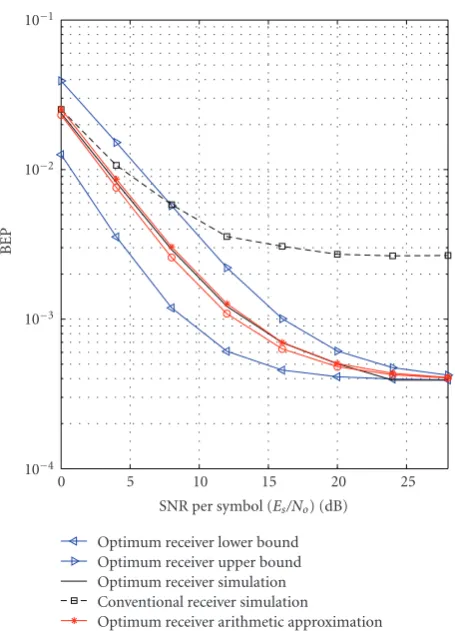
Optimum receiver simulation Conventional receiver simulation Optimum receiver lower bound Optimum receiver upper bound
Optimum receiver arithmetic approximation Optimum receiver geometric approximation
Figure1: Case1: BEP results for the conventional and the optimum SBS receivers, 2Tx and 2Rx Alamouti’s code with QPSK modula-tion,fdTb=0.1, channels variances of 0.5 and 5, respectively.
denote, respectively, the geometric and arithmetic means of all (v2
on/Vn)’s and (1/Vn)’s. Following the same steps as
above, the approximations of the probability are given by
Pα(e)≈
10−4 10−3 10−2 10−1
BEP
0 5 10 15 20 25
SNR per symbol (Es/No) (dB)
Optimum receiver lower bound Optimum receiver upper bound Optimum receiver simulation Conventional receiver simulation
Optimum receiver arithmetic approximation Optimum receiver geometric approximation
Figure 2: Case 1: BEP results for the conventional and the optimum SBS receivers, 2Tx and 2Rx Alamouti’s code with QPSK modulation, fdTb = 0.1, channel variances are 0.9 and 9,
respectively.
Since we omitted the block indexthere, the BEP results obtained above are based on thetth block. The average BEP for all the blocks can be calculated by averaging over theLf
blocks within two adjacent pilot blocks.
5. Numerical Examples
In the numerical examples, we consider a vehicular com-munication system with 2 transmit and 2 receive antennas. The Alamouti’s code is applied with QPSK modulation. As we mentioned in Section 2, since the channels are block-wise constant, we use the block fade rate fdTb for the BEP
computation and simulation. Pilot blocks are inserted after every 9 data blocks, and the 4 nearest pilot blocks are used to estimate the channel using PSAM.
InFigure 1, we consider Case 1, where the variances of the channel gains related to the first and second receive antennas are 0.5 and 5, respectively. The block fade rate is set to 0.1. The simulation results show that our optimum receiver provides a large performance gain compared to the conventional receiver. The irreducible error floor caused by the channel fading is also greatly reduced by the optimum receiver.
10−5 10−4 10−3 10−2 10−1
BEP
0 5 10 15 20 25
SNR per symbol (Es/No) (dB)
Optimum receiver simulation Conventional receiver simulation Optimum receiver lower bound Optimum receiver upper bound
Optimum receiver arithmetic approximation Optimum receiver geometric approximation
Figure 3: Case 1: BEP results for the conventional and the optimum SBS receivers, 2Tx and 2Rx Alamouti’s code with QPSK modulation, fdTb = 0.06, channel variances are 0.5 and 5,
respectively.
The analytical lower (41) and upper (42) bounds in Figure 1show the same trend as the exact BEP curve, such that they decrease in parallel with the increase of SNR. The three curves converge in the high SNR region. Furthermore, both the geometric (46) and arithmetic (47) approximations can closely approximate the exact BEP performance in all SNR regions, with the latter being a closer approximation, the difference being no larger than 0.5 dB.
In Figures 2 and 3, we change the channel variances and the block fade rate, and similar observations can be made. Notice that in Case1, the performance gain enjoyed by the optimum SBS receiver comes with little overhead, as it only requires linear processing of the received signal and the estimated channel matrices.
10−4 10−3 10−2 10−1 100
BEP
0 5 10 15 20 25
SNR per symbol (Es/No) (dB)
Optimum receiver simulation Conventional SBS receiver simulation
σ2
o1:σo22=9, 1 σ2
o1:σo22=5, 1 σ2
o1:σo22=2, 1
Figure 4: Case2: BEP results for the conventional SBS and the optimum receivers, 2Tx and 2Rx Alamouti’s code with QPSK modulation,fdTb=0.1.
also greater. However, since the optimum decoder has a higher decoding complexity ofM2, compared with the linear decoding complexity ofMfor the conventional SBS decoder, it is possible to tradeoffbetween the performance and the complexity. The simulation results show that if the ratio of the channel variances is smaller than 2 : 1, the conventional SBS decoder can be safely applied.
6. Conclusion
This paper considers OSTBC in a vehicular environment, where the channels are non-identical and the CSI is not perfect. It is shown that the conventional SBS decoder is not optimum in this situation. Two typical cases are considered for the case of non-identical channels with channel estimation.
In Case1, where the non-identical channels are associ-ated with a common receive antenna, the optimum decoder is derived. We show that this optimum decoder can be simplified to an SBS decoder, under the condition that the received signal and the estimated channel matrices are properly weighted. In Case 2, where the non-identical channels are associated with a common transmit antenna, we also derive the optimum decoder. But it is shown that no matter how the receiver structure is designed, the optimum decoder cannot be simplified to a SBS decoder.
The performance of the optimum decoder is also inves-tigated. The upper/lower bounds and close approximations of the BEP performance are obtained for Case1. Both the analytical and the simulation results show that our optimum decoder substantially outperforms the conventional SBS decoder.
References
[1] G. Moniak, M. Berbineau, and J. F. Pardonche, “Robust and high data rate transmissions for security between a bus and a control center,” in Proceedings of the 60th IEEE Vehicular Technology Conference (VTC ’04), vol. 2, pp. 1377–1381, Los Angeles, Calif, USA, September 2004.
[2] S. Biswas, R. Tatchikou, and F. Dion, “Vehicle-to-vehicle wireless communication protocols for enhancing highway traffic safety,”IEEE Communications Magazine, vol. 44, no. 1, pp. 74–82, 2006.
[3] W. Xiang, P. Richardson, and J. Guo, “Introduction and pre-liminary experimental results of wireless access for vehicular environments (WAVE) systems,” in Proceedings of the 3rd Annual International Conference on Mobile and Ubiquitous Systems: Networking and Services (MOBIQW ’06), pp. 1–8, San Jose, Calif, USA, July 2006.
[4] S. Eichler, “Performance evaluation of the IEEE 802.11p WAVE communication standard,” inProceedings of the 66th IEEE Vehicular Technology Conference (VTC ’07), pp. 2199– 2203, Baltimore, Md, USA, September-October 2007. [5] M. Wellens, B. Westphal, and P. Mahonen, “Performance
eval-uation of IEEE 802.11-based WLANs in vehicular scenarios,” inProceedings of the 65th IEEE Vehicular Technology Conference (VTC ’07), pp. 1167–1171, Dublin, Ireland, April 2007. [6] V. Tarokh, H. Jafarkhani, and A. R. Calderbank, “Space-time
block codes from orthogonal designs,”IEEE Transactions on Information Theory, vol. 45, no. 5, pp. 1456–1467, 1999. [7] S. M. Alamouti, “A simple transmit diversity technique for
wireless communications,”IEEE Journal on Selected Areas in Communications, vol. 16, no. 8, pp. 1451–1458, 1998. [8] C. Gao, A. M. Haimovich, and D. Lao, “Bit error probability
for space-time block code with coherent and differential detection,” inProceedings of the 56th IEEE Vehicular Technology Conference (VTC ’02), vol. 1, pp. 410–414, Vancouver, Canada, September 2002.
[9] G. R. Mohammad-Khani, V. Meghdadi, J. P. Cances, and L. Azizi, “Maximum likelihood decoding rules for STBC generalized framework for detection and derivation of accu-rate upperbounds,” inProceedings of the IEEE International Conference on Communications (ICC ’04), vol. 5, pp. 2578– 2583, Paris, France, June 2004.
[10] C. Shan, P. Y. Kam, and A. Nallanathan, “Theoretical perfor-mance of space-time block coded systems with channel esti-mation,” inProceedings of the IEEE Global Telecommunications Conference (GLOBECOM ’04), vol. 6, pp. 3666–3670, Dallas, Tex, USA, November-December 2004.
[11] M. Dohler, M. Hussain, A. Desai, and H. Aghvami, “Perfor-mance of distributed space-time block codes,” inProceedings of the 59th IEEE Vehicular Technology Conference (VTC ’04), vol. 2, pp. 742–746, Milan, Italy, May 2004.
[12] G. Scutari and S. Barbarossa, “Distributed space-time coding for regenerative relay networks,”IEEE Transactions on Wireless Communications, vol. 4, no. 5, pp. 2387–2399, 2005.
estimation,” inProceedings of the IEEE International Conference on Communications (ICC ’05), vol. 1, pp. 583–587, Seoul, Korea, May 2005.
[14] A. Maaref and S. Aissa, “Performance analysis of orthog-onal space-time block codes in spatially correlated MIMO Nakagami fading channels,” IEEE Transactions on Wireless Communications, vol. 5, no. 4, pp. 807–817, 2006.
[15] I.-M. Kim, “Exact BER analysis of OSTBCs in spatially corre-lated MIMO channels,”IEEE Transactions on Communications, vol. 54, no. 8, pp. 1365–1373, 2006.
[16] W. Li, H. Zhang, and T. A. Gulliver, “Capacity and error probability analysis of orthogonal space-time block codes over correlated Nakagami fading channels,”IEEE Transactions on Wireless Communications, vol. 5, no. 9, pp. 2408–2412, 2006. [17] J. He and P. Y. Kam, “On the performance of
orthogo-nal space-time block codes over independent, nonidentical Rayleigh/Ricean fading channels,” inProceedings of the IEEE Global Telecommunications Conference (GLOBECOM ’06), pp. 1–5, San Francisco, Calif, USA, November-December 2006. [18] M. Tao and P. Y. Kam, “Analysis of differential orthogonal
space-time block codes over semi-identical MIMO fading channels,”IEEE Transactions on Communications, vol. 55, no. 2, pp. 282–291, 2007.
[19] V. Tarokh, H. Jafarkhani, and A. R. Calderbank, “Space-time block coding for wireless communications: performance results,” IEEE Journal on Selected Areas in Communications, vol. 17, no. 3, pp. 451–460, 1999.
[20] G. Ganesan and P. Stoica, “Space-time block codes: a max-imum SNR approach,” IEEE Transactions on Information Theory, vol. 47, no. 4, pp. 1650–1656, 2001.
[21] W. C. Jakes,Microwave Mobile Communication, John Wiley & Sons, New York, NY, USA, 1974.
[22] J. K. Cavers, “An analysis of pilot symbol assisted modulation for Rayleigh fading channels,”IEEE Transactions on Vehicular Technology, vol. 40, no. 4, pp. 686–693, 1991.
[23] P. Y. Kam, “Optimal detection of digital data over the nonselective Rayleigh fading channel with diversity reception,” IEEE Transactions on Communications, vol. 39, no. 2, pp. 214– 219, 1991.