R E S E A R C H
Open Access
Joint measure matrix and channel
estimation for millimeter-wave massive
MIMO with hybrid precoding
Shufeng Li
1*, Baoxin Su
1, Libiao Jin
1*, Mingyu Cai
1and Hongda Wu
2Abstract
Millimeter-wave (mmWave) massive multiple-input multiple-output (MIMO) with hybrid precoding is a promising technology for future 5G wireless communications. Channel estimation for the millimeter-wave (mmWave) MIMO systems with hybrid precoding can be performed by estimating the path directions of the channel and corresponding path gains. This paper considers joint measure matrix and channel estimation for a massive MIMO system. By exploiting the sparsity of a massive MIMO system, a channel estimation scheme based on a Toeplitz-structured measure matrix and complete complementary sequence (CC-S) is proposed. Moreover, analytic studies show that the measurement matrix based on CC-S yields either optimal performance or feasibility in practice than an independent identically distributed Gaussian matrix. The performance of the scheme is shown with numerical examples.
Keywords:Measurement matrix, Channel estimation, Hybrid precoding millimeter-wave, Massive MIMO
1 Introduction
Millimeter-wave (mmWave) communication has been recognized as a promising technology for future 5G wire-less communications due to the abundant frequency spectrum resource in a mmWave band [1]. However, the severe signal propagation loss compared with conven-tional microwave frequencies makes this band just useful for indoor scenarios. Fortunately, the combination of mmWave with short wavelength and massive multiple-input multiple-output (MIMO) array compensate path loss and provide a high degree of spatial freedom to sub-stantially enhance the system’s throughput, spectral effi-ciency, which makes cellular communication on mmWave band practical [2, 3]. Unfortunately, the mismatch be-tween the number of expensive radio frequency (RF) chain and the large number of antenna makes the conventional full digital precoding impractical. To reduce the overall hardware cost and power consumption, a hybrid analog-digital precoding scheme is proposed, which means that analog precoding is realized by using phase shifters or
switches in the RF domain and the digital precoding is im-plemented in the baseband domain as in conventional MIMO [4–6].
For mmWave massive MIMO system with hybrid precod-ing, accurate channel state information (CSI) estimation is indispensable to achieve better system performance. Due to the spatial sparsity in mmWave channel, traditional channel model based on rich scattering is not practical, while the mmWave channel with a limited number of scattering path can be modeled as a parametric form in terms of the path angles of arrival/departure (AoAs/AoDs) and the corre-sponding path gains. As a result, the mmWave channel esti-mation problem can be solved by estimating the path direction (AoAs/AoDs) and path gains instead of estimating the MIMO channel matrix [7,8].
The construction of orthogonal training sequence of a massive MIMO system is analyzed; by constructing a well orthogonal pilot sequence, channel estimation and interference cancelation can be carried out by using autocorrelation and cross-correlation. Although the or-thogonal pilot sequence has good channel estimation performance, since the pilot overhead increases with the number of antennas in the massive MIMO system, the orthogonality of the pilot cannot be satisfied due to the limited time-frequency resources. Therefore, the
non-© The Author(s). 2019Open AccessThis article is distributed under the terms of the Creative Commons Attribution 4.0 International License (http://creativecommons.org/licenses/by/4.0/), which permits unrestricted use, distribution, and reproduction in any medium, provided you give appropriate credit to the original author(s) and the source, provide a link to the Creative Commons license, and indicate if changes were made.
* Correspondence:[email protected];[email protected]
1School of Information and Communication Engineering, Communication
orthogonal pilot has become a research hotspot. In multi-cell large-scale MIMO systems, when the training time slot is small enough, the proposed non-orthogonal pilot can obtain the effect of approximating the orthog-onal pilot, while the orthogorthog-onal pilot is unachievable when the training time slot is small enough [9]. Non-orthogonal pilot is applied to solve the collision detec-tion capacity problem in large-scale connecdetec-tion scenar-ios, and the channel estimation performance is improved [10]. Li proposed that when the pilot signal is sufficiently long, the Procrustes criterion can be used to reconstruct mutually orthogonal pilot signals; but when the signal is not long enough, the optimal pilot sequence can be re-constructed by the Procrustes criterion and additional block matrix method [11].
In addition to the study of the non-orthogonal pilot, compressed sensing has been extensively studied for massive MIMO system estimation. The application of this theory benefits from the sparsity of the impulse re-sponse of the wireless communication system in the delay domain. Research shows that the traditional method of linearly reconstructing channel state based on training sequences is suitable for multipath channel environments with a large number of paths. The phys-ical environment and simulation analysis results show that the wireless channel in many actual situations pre-sents a sparse multipath structure, which can be solved by the method of compressed sensing. In [12], a distrib-uted compressed sensing method is used to solve the sparse channel estimation problem of the MIMO-OFDM system. Channel estimation performance and system effectiveness are improved by optimizing pilot settings and using compressed sensing. The channel estimation and precoding problems in mmWave com-munication systems are resolved in mmWave commu-nication with the idea of compression sensing [13]. In addition to the typical channel sparsity, mmWave com-munication also has the problem of angle spread, which presents a low-rank structure. In summary, the actual wireless channel presents sparsity or approximate sparsity, for the future mmWave communication sys-tems, the characteristics of sparsity can be even directly used to complete the design of the signal processing algorithm.
The current measurement matrix is nearly all based on the Gaussian random matrix. However, compared with the Gaussian random matrix, the Toeplitz structure measurement matrix has lower generation complexity under the premise of satisfying the finite isometric char-acteristics of the compressed sensing theory [14]. In addition, in terms of channel estimation performance, the Toeplitz structure sensing matrix proposed in this paper can achieve nearly the same effect as the Gaussian random matrix.
In this paper, we adopt the measurement matrix based on CC-S to implement the channel estimation in a massive MIMO system. Specifically, the main contribu-tions of this paper are as follows:
a) Based on the recursive method, we propose the construction algorithm of CC-S.
b) We break through the conventional measurement matrix based on the Gaussian random matrix and propose the idea of using the Toeplitz structure measurement matrix based on CC-S.
c) Based on the classical massive MIMO scheme, we propose the new massive MIMO system with hybrid precoding. In this way, the complexity can be reduced.
The remainder of this paper is listed as follows. Sec-tion 2 describes the measurement matrix construcSec-tion method based on CC-S. The next section describes the massive MIMO channel estimation algorithm based on CC-S. Section 4 analyzes the performance of the Gauss-ian random matrix and CC-S. And Section 6 concludes the work.
2 Methods
The implementation framework of compressed sensing theory includes signal sparse representation, sensing matrix design, and recovery algorithm design. In a massive MIMO system based on compressed sensing, the design of the measurement matrix is important. Therefore, a new deterministic Toeplitz structure sensing matrix based on the characteristics of CC-S is developed. At the same time, it is proved by theoretical analysis that CC-S satisfies the Spark characteristics. In addition, in terms of channel esti-mation performance, the orthogonal matching pursuit (OMP) algorithm using CC-S as a measurement matrix is developed. The simulation results show that the Toeplitz structure sensing matrix based on CC-S proposed in this paper can achieve nearly the same effect as the Gaussian random matrix.
3 Measurement matrix construction method based on CC-S
3.1 A construction method of CC-S sets
Given two length-N complex-valued sequences a (or {at},
i.e.,at= {a0,a1,⋯,aN−1}) andb(or {bt}), their aperiodic
cor-relation function of positive time shiftτis defined as:
ψðat;bt;τÞ ¼
( XN−1−τ
t¼0
atðbtþτÞ; 0≤τ≤ðN−1Þ
0 τ≥N
ð1Þ
ψðat;bt;τÞ ¼
( XN−1þτ
t¼0
at−τð Þbt ; ð1−NÞ≤τ<0
0 τ≤−N
ð2Þ
When a≠b, the above is called aperiodic cross-correlation function(ACCF); otherwise, it is called aperi-odic auto-correlation function (AACF). For simplicity, we denoteψ(a;τ) to represent the AACF ofa
Definition 1:.A pair of codes (a,b) is said to be a pair of complementary sequence if they satisfy:
ψða;τÞ þψðb;τÞ ¼Cδ τð Þ ð3Þ
where Cis a positive constant and whose value is the sum of the length ofaand b, andδ(τ) is the Kronecker delta function.
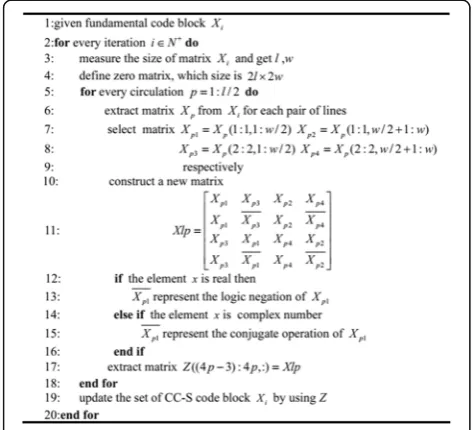
C(K, M, N) is a family of CC-S and is named CC-S sets, which containsKCC-S with each size isM×Nand denoted as C(k), k∈{0, 1,⋯,K−1}. For each CC-S set C(k),Melement sequencesck
m with the same code length N are contained, m∈{0, 1,⋯,M−1}. Hence,C(k)can be unfolded as aM×Nmatrix (Fig.1).
CðkÞ¼ cð0kÞ cð1kÞ
⋮
cðMkÞ−1
2 6 6 6 4
3 7 7 7
5¼
c0ðk;0Þ c0ðk;1Þ ⋯ cð0k;NÞ−1 c1ðk;0Þ c1ðk;1Þ ⋯ cð1k;NÞ−1
⋮ ⋮ ⋱ ⋮
cðMkÞ−1;0 cðMkÞ−1;1 ⋯ cðMkÞ−1;N−1
2 6 6 6 4
3 7 7 7 5
where cðmk;Þn is the specific CC-S with bipolar value and cðmk;Þn∈f1;−1g, while m∈{0, 1,⋯,M−1}, n∈{0, 1,⋯,N− 1}, andk∈{0, 1,⋯,K−1}.
The correlation properties of CC-S are characterized by the complementary aperiodic correlation function, which
is calculated as the sum of the aperiodic correlation func-tions of all element codes with the same delayτ.
3.2 Design standard of measurement matrix
We have known that in compressed sensing, the signal is first represented as a sparse form. A signal x of di-mension N can be represented in the form of another vector under a set of orthogonal basis vectors fakgNk¼1, and the vector K is sparse. After signal sparseness, the measurement matrix must be designed. By using the ob-servation matrix for data processing, we can get a low-dimensional observation vector y with dimension M(M≪N):
y¼Φx¼ΦAS¼ΘS ð4Þ
where Φ represents the measurement matrix with di-mension M×N, Θ=ΦAis the observation matrix, and
yis the observed low-dimensional vector.
In (4), since the dimension of the Θ matrix is mea-sured as M×N, when we get the result ofx, the above equation is an underdetermined equation, and the num-ber of equations is much smaller than the numnum-ber of un-knowns, it is very difficult to solve directly. If the dimension of the observed sample y and the sparsity of the original signal in the transform domain can satisfy M>K, the observation matrix Θsatisfies certain condi-tions, and the process of sparse vector restoration can be regarded as solving the optimalℓ0-norm problem by the measured valuey, which can be expressed as:
^
S¼argmink kS 0 s:t:ΘS¼y ð5Þ
In the case where the signal S is obtained, if the pos-ition of the K non-zero elements in S is known, the equation of the originalM×Ncan be converted into the equation ofM×Kto solve. If the value ofKnon-zero el-ements inScan be obtained, the original signalx can be recovered by the following formula:
x¼X
N
k¼1
aksk¼AS ð6Þ
In this process, the solution with the coefficientM×K equation is not unique, but the entire compression re-covery process needs to be guaranteed to be unique, so the requirements forΘare imposed. The literature [15] proposes that Θ needs to meet the restricted isometry property (RIP) condition to complete the reconstruction of the sparse signal.
Definition 2: RIP condition: For any vector set c∈
ℝ∣T∣ and constant δ
K∈(0, 1), if the following formula
1−δK
ð Þk kc 2
2≤kΘTck22≤ð1þδKÞk kc 22 ð7Þ
where T⊂{1,⋯,N}, ∣T∣ ≤K, and ΘT are
sub-matrices of dimensionK×∣T∣formed by indexT indi-cation of the measurement matrixΘ.
In general, for a K-sparse signal S (the position of K non-zero elements is unknown), the sufficient condition for reconstructing the signal S fromy by Eq. (5) is that the arbitrary vector set c and the constant δ2K∈(0, 1)
satisfy the following formula, that is, satisfy the 2Korder RIP condition:
1−δ2K
ð Þk kc 2
2≤kΘTck22≤ð1þδ2KÞk kc 22 ð8Þ
whereT⊂{1,⋯,N},∣T∣ ≤2K.
In the construction of the measurement matrix, the 2K -order RIP conditions are more difficult to satisfy. The lit-erature [16] pointed out that the measurement matrix sat-isfying the RIP condition is equivalent to the uncorrelation between the observation matrixΦ and the orthogonal basisA. In other words, it is required that row ϕjin the matrixΦcannot be sparsely represented by
col-umnaiinA, and columnaiinAcannot be sparsely repre-sented by the ϕj in Φ. Since the orthogonal basis A is
fixed, the RIP condition of the measurement matrixΦcan be realized by designing the observation matrixΦ.
Regarding the design of the observation matrix Φ, when the observation matrix Φ is a Gaussian random matrix (the dimension is M×N, and the inner element value satisfies the independent normal distribution of N(0, 1/N)), the measurement matrix Φ can satisfy the RIP condition with a large probability.
In addition, the design types of the observation matrixΦ include a uniform sphere measurement matrix, a local Fourier matrix, a local Hadamard measurement matrix, and a Toeplitz matrix. When the column of the measure-ment matrix Φ presents independent identically distrib-uted (i.i.d.) on the ball Sn−1, and when the number of measurements M≥OðK lnðNÞÞ, the probability of suc-cessfully reconstructing the signal is large, and the meas-urement matrix Φ is referred to as a uniform sphere measurement matrix. The local Fourier matrix is a random selection of M rows from the N×N Fourier matrix, and then the regularization of the new matrix is obtained. The advantage is that it can be realized by the fast Fourier transform; the disadvantage is that whether it can satisfy the correlation depends on the nature of the sparse signal. The local Hadamard measurement matrix is obtained by randomly selectingMrows from theN×NFourier matrix. In the content of research on compressed sensing, a Gaussian random matrix is generally used. However, there are application defects in the Gaussian random matrix, because the random characteristics, matrix gen-eration, and storage process require a large amount of
storage space and computational complexity. Based on this, a new Toeplitz observation matrix is proposed in this paper. By applying the excellent correlation proper-ties of complete complementary sequences, a Toeplitz observation matrix based on CC-S is designed. When applied with compressed sensing channel estimation, it can obtain similar channel estimation performance from the traditional Gaussian random matrix, but the meas-urement matrix implementation is less complex.
4 Massive MIMO channel estimation based on CC-S
4.1 System model
Figure 2 shows the structure of mmWave massive MIMO system with hybrid precoding. The base station (BS) with NBS antennas and NBSRF chains communicates with a single mobile station (MS)-equipped NMS
anten-nas and NMS
RF RF chains. The BS and MS communicate viaNSstreams and satisfyNS≤NBSRF≤NBS andNS≤NMSRF≤ NMS. In this paper, we focus on the single-cell downlink transmission. Baseband precoder FBB∈ℂN
BS
RFNS is
followed by RF precoder FRF∈ℂNBSN
BS
RF, while the hybrid
precoder at the transmitter is defined as F¼ FBBFRF
∈ℂNBSNS. The discrete-time transmitted signal is:
x¼Fs ð9Þ
We consider a narrowband block fading channel model in which the received signal is:
r¼HFsþn ð10Þ
wheresis theNS× 1 vector of the transmitted symbol. H
∈ℂNMSNBS represents the mmWave channel matrix
be-tween the BS and MS, and n∈ℂNMS1 is the complex
additive white Gaussian noise (AWGN) corresponding to the MS and follows the distribution CN ð0;σ2nIÞ. At the MS, the combiner is defined as W ¼WRFWBB∈
ℂNSNMS, where W
RF∈ℂNMSN
MS
RF is the RF combiner and
WBB∈ℂN
MS
RFℓNS is the baseband combiner. After being
processed at the receiver, the received signal is:
y¼WHHFsþWHn ð11Þ
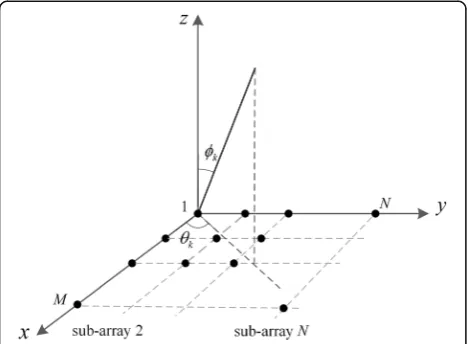
In this paper, a uniform rectangular array (URA) 2D geometry model is considered, where M and N are the element number of antennas in thex−y plane, and the space of adjacent antenna isλ/2, as illustrated in Fig.3.
H¼
ffiffiffiffiffiffiffiffiffiffiffiffiffiffiffiffiffi NBSNMS
ρ
s
XL
ℓ¼1
gℓAR θℓ;R;ϕℓ;R
AHT θℓ;T;ϕℓ;T
ð12Þ
where ρ denotes the average path loss between BS and MS, and gℓ is the complex gain of the ℓth path assumed to be Rayleigh distributed gℓ∼N ð0;PÞ with P the average power gain. The variable ϕℓ, T, ϕℓ,
R∈[0,π] denotes the elevation angles, and θℓ, T, θk, R∈[0, 2π] denotes the azimuth angles corresponding
to the ℓth path. AT(θℓ, T,ϕℓ, T) and AR(θℓ, R,ϕℓ, R)
denote the array response at BS and MS, respectively.
We adopt URAs; hence, the AT(θℓ, T,ϕℓ, T) andAR(θℓ,
R,ϕℓ,R) can be expressed as:
AT θℓ;T;ϕℓ;T
¼ay;T θℓ;T;ϕℓ;T
οax;T θℓ;T;ϕℓ;T
AR θℓ;R;ϕℓ;R
¼ay;R θℓ;R;ϕℓ;R
οax;R θℓ;R;ϕℓ;R
ð13Þ
where
ax;T θℓ;T;ϕℓ;T
¼ 1ffiffiffiffiffi
M
p 1; e−j2πdsinϕℓ;Tcosθℓ;T=λ; ⋯; e−j2πðM−1Þdsinϕℓ;Tcosθℓ;T=λ
h iT
ay;Tθℓ;T;ϕℓ;T
¼ 1ffiffiffiffi
N
p 1; e−j2πdsinϕℓ;Tsinθℓ;T=λ; ⋯; e−j2πðN−1Þdsinϕℓ;Tsinθℓ;T=λT
ð14Þ
They denote the sub-array response in the vertical and horizontal directions at the BS. Similarly,
ax;R θℓ;R;ϕℓ;R
¼ 1ffiffiffiffiffi
M
p 1; e−j2πdsinϕℓ;Rcosθℓ;R=λ; ⋯; e−j2πðM−1Þdsinϕℓ;Rcosθℓ;R=λT
ay;Rθℓ;R;ϕℓ;R
¼ 1ffiffiffiffi
N
p 1; e−j2πdsinϕℓ;Rsinθℓ;R=λ; ⋯; e−j2πðN−1Þdsinϕℓ;Rsinθℓ;R=λT
ð15Þ
They denote the sub-array response in the vertical and horizontal directions at the MS. o denotes the Khatri-Rao product. The channel in (12) is written in a more compact form:
H¼ARΛAHT ð16Þ
where Λ∈ℂL×L is the channel complex gain matrix
with elements
ffiffiffiffiffiffiffiffiffiffiffiffiffi
NBSNMS ρ
q
diag½g1;⋯;gL.
AT¼ ay;T θ1;T;ϕ1;T
ax;Tθ1;T;ϕ1;T
;⋯;ay;Tθℓ;T;ϕℓ;T
ax;T θℓ;T;ϕℓ;T
∈ℂNBSL
AR¼ ay;Rθ1;R;ϕ1;R
ax;Rθ1;R;ϕ1;R
;⋯;ay;Rθℓ;R;ϕℓ;R
ax;Rθℓ;R;ϕℓ;R
∈ℂNMSL
ð17Þ
where ⊗ denotes the Kronecker product. The deriv-ation of Eq. (17) is shown in Appendix.
Fig. 2Illustration of a hybrid analog/digital precoding and combing structure
4.2 Channel estimation algorithm based on CC-S
The mmWave channels have obvious sparsity perform-ance in the angular domain when the number of non-line-of-sight is small. We can transform the frequency domain into a sparse domain in order to apply the com-pressed sensing technology through the following DFT transform matrix:
Hs¼D
BSHDUE ð18Þ
where DBSandDUEare the DFT matrices at the base station and user end, respectively. Hsdenotes the sparse channel matrix in the angle domain. We can obtain the vectorhby vectorizingH:
hs¼vectð Þ ¼Hs D UE
T
DBS
h i
h ð19Þ
h¼vectð ÞH ð20Þ
We can further obtain the received signal as:
y¼WHD
BSHsDUEFsþWHn
¼ D UEFs
T
WHD BS
hsþ~n
¼Φhsþn~
ð21Þ
Our purpose is to accurately estimate the channel in-formation from (21). The sparsity of the massive MIMO channels helps us to use the compressed sensing tech-nology to estimate the channel state with reduced pilot overhead. According to [17], channel H share the same AOA and AOD;Hshas the structured sparsity. Specific-ally, we can use a standard DCS algorithm to estimate the AOA, AOD, and the channel gain information. The aim of this paper is to verify the performance of Toeplitz-type observation matrix based on CC-S.
We will compare the performance difference between the Toeplitz structure measurement matrix based on the complementary code and the Gaussian random matrix under the compressed sensing framework. In this sec-tion, the sparse representation of the signal uses a discrete Fourier basis. The sensing matrix is a Toeplitz structural measurement matrix based on complementary sequences and a Gaussian random matrix. If there is no special explanation, useΦ∈ℝ64 × 256; the signal recovery algorithm adopts the OMP algorithm. The following is a brief description of the OMP core algorithm steps:
1. Input: measurement matrixΦ, observation vectory, sparsityK
2. Output: the coefficient ofxapproximates the vector ^
x
3. Initialization:r0=y, index setΓ0= ,t= 1
4. Loop through steps 1–5:
(a) Step 1: Find the positioni∗corresponding to the maximum value of residualyrand columnφi
product in the observation matrix isit= arg
maxj= 1...N∣ rt= 1,φj ∣.
(b) Step 2: Update the index setΓt=Γt∪{it} and
record the set of reconstructed atomsΦt ¼ ½ Φt−1;φitin the sensing matrix.
(c) Step 3: Calculate^xt ¼argminky−Φt^xk2.
(d) Step 4: Update the residualrt ¼y−Φt^xandt=
t+ 1.
(e) Step 5: Determine ift>Kis satisfied. If it is satisfied, stop iteration; if not, go to step 1.
4.3 Compressed sensing channel estimation under a new observation matrix
In compression sensing, the design of the observation matrix and the signal recovery algorithm are the focus of research. The design of the observation matrix needs to be as practical as possible while meeting the signal re-covery requirements. According to [18], the elements of the measurement matrix should follow an i.i.d. Gaussian distribution in order to get the better performance for spare domain signal recovery. Since the Gaussian ran-dom matrix is almost irrelevant to any sparse signal, the RIP condition can be satisfied with a large probability. However, there are application defects in the Gaussian random matrix. Because of the random characteristics, matrix generation and storage processes require a large amount of storage space and computational complexity.
Bajwa and Haupt et al. proposed the Toeplitz struc-tural observation matrix and the cyclic matrix. The Toe-plitz structural measurement matrix is an ideal choice in many applications, and it mainly includes the following three reasons:
(1) The Gaussian random matrix (i.i.d. measurement matrix) needs to generateOðknÞindependent random variables, which is not desirable when the vector dimension is high. In contrast, the Toeplitz-type measurement matrix only needs to generateO
ðnÞindependent random variables.
(2) During the signal processing process, the i.i.d. measurement matrix needs to be operatedOðknÞ
times when it is“multiplied,”which results in a long time for the acquisition and reconstruction of large-dimensional data. The Toeplitz-type measurement matrix“multiplication”can be realized by fast Fourier transform with a complexity ofOðnlog2ðnÞÞ. (3) The Toeplitz-type measurement matrix can be
ap-plied to specific fields, such as it matches the linear time-varying system, but the i.i.d. measurement matrix does not apply to this kind of scene.
the complementary sequences have excellent cross-correlation properties, the non-cross-correlation conditions of the measurement matrix can be satisfied. At the same time, the Spark characteristics of the matrix are ana-lyzed, and it is proved that it can meet the requirements of the measurement matrix. Subsequently, the Toeplitz-type measurement matrix is applied to the scene of com-pressed sensing MIMO channel estimation. The experi-mental results show that the sensing matrix proposed in this paper can achieve a similar signal recovery effect with the Gaussian random matrix. Thanks to its Toeplitz structure, the new sensing matrix proposed in this sec-tion is more practical.
4.4 Design of Toeplitz structure measurement matrix based on CCs
The measurement matrix needs to meet the RIP condi-tions in order to recover the original signal with a high probability. In the measurement matrix design, the Spark (minimum linear correlation columns) value of the measurement matrix is also the focus of attention. The definition of the Spark value is given below:
Definition 3: The Spark value of the measurement
matrixΦis defined as:
Spð Þ ¼Φ min k kω 0:ω∈ΦNullspℝ
ð22Þ
whereΦNullspℝ is defined as follows:
ΦNullspℝ¼ ω∈ℝN:Φω¼0;ω≠0
ð23Þ
The literature [19] proves that when the Spark value of the measurement matrix Φ satisfies the following conditions, the signal estimation value can be obtained by solving the minimum ℓ0-norm optimization problem of (5).
Spð ÞΦ ≥2K ð24Þ
The traditional i.i.d. Toeplitz matrix has the following form: tion with probability P(a) and the column vector normalization at the same time (the row vector is also normalized). Taking the first M lines constitutes the form of the above-mentioned partial Toeplitz matrix.
The i.i.d. Toeplitz matrix whose element selection obeys the i.i.d distribution with a probability P(a). Due to the element distribution problem, the atom (the col-umn vector of the matrix) in the i.i.d. Toeplitz matrix
can satisfy the correlation requirement. Unlike the trad-itional i.i.d. Toeplitz matrix, the elements of the Toeplitz structure measurement matrix based on complementary sequences proposed in this section are deterministic.
The form of the Toeplitz structure measurement matrix based on complementary sequences is given below: sequences of lengthN, and each element takes a value in the binary domain {1,−1}. As shown in (26), the directly generated Toeplitz structure based on the complemen-tary sequence has a dimension of N× 2N, and the sam-pling rate is 0.5.
Using the complementary sequences, the Toeplitz structural measurement matrix can be constructed by the cyclic structure. When we apply the Toeplitz struc-tural measurement matrix to the compressed sensing signal recovery, we can obtain the performance similar to the Gaussian random matrix. We will theoretically analyze the Toeplitz structural measurement matrix based on complementary codes and analyze its Spark characteristics to demonstrate its feasibility as a meas-urement matrix.
4.5 Analysis of Spark characteristics of new Toeplitz matrix
When the sparseness of the signal satisfies K≤Sp(Φ)/2, the signal estimate can be obtained by solving the mini-mum ℓ0-norm optimization problem of (5). However, it is difficult to calculate the value of matrix Spark. By con-verting the Spark value into the calculated measurement matrix correlation value, it is easier to judge whether the matrix meets the requirements of the compressed sens-ing measurement matrix. Specifically, the range of the matrix Spark value can be determined by calculating the correlation of the measurement matrix. The definition of the correlation of the measurement matrix is given below:
p represents the vector inner
When the correlation of a matrix is given, the follow-ing relationship exists:
Spð ÞΦ ≥1þ1=μð ÞΦ ð28Þ
Then, start with the correlation μ(Φ) to analyze the Spark properties of the Toeplitz structure measurement matrix based on complementary sequences.
Since both sequences faigNi¼−01 and fbigNi¼−01 take value
Bring formula (29) and the formula (30) into formula (27), the correlation value of the matrix can be obtained:
μð Þ ¼Φ max
Calculate the above formula to get two values:
μð Þ ¼Φ max 1f ;0g ð32Þ
The probability of occurrence of {1, 0} two values var-ies greatly:
Pfμð Þ ¼Φ 0g≫Pfμð Þ ¼Φ 1g ð33Þ
From formula (28) and formula (33), the Spark lower bound of the Toeplitz structure measurement matrix of the complementary sequence can be calculated, we have:
Spð ÞΦ ≥1þ 1
μð ÞΦ ¼f∞;2g ð34Þ
Definition 5: When the sparsity of the signal satisfies the following formula, the signal estimate can be ob-tained by solving the minimum ℓ0-norm optimization problem of (5):
K≤Spð ÞΦ =2 ð35Þ
From the above reasoning,Khas two values:
When K = 1, the signal estimate can be obtained by solving the minimum norm optimization problem of (5). When K > 1, in practice, signal reconstruction can be achieved by increasing the number of measurements.
When Kis not limited, but in the actual compression sensing problem, K is a finite constant (K ≪ N) com-pared to the dimension of the original signal vector.
In both cases, the Toeplitz structural measurement matrix based on the complementary code can recover the original signal with high probability. Therefore, through the Spark characteristic analysis, it can be con-cluded that the Toeplitz structural measurement matrix can be applied to the compressed sensing as the meas-urement matrix.
5 Results and discussion
Simulations are carried out based on the data model and ESPRIT algorithm to investigate channel estimation per-formance and computational complexity. ANBS=NMS=
64 half-wavelength pacing URAs at BS and MS is con-sidered. The sparsity K = 8. The number of RF chains NMS
RF ¼NMSRF ¼8 . We consider three independent nar-rowband signals. The directions are generated as θℓ, T= [10 ° 20 ° 30°], ϕℓ, T= [15 ° 25 ° 35°], and θℓ, R= [20 °
30 ° 40°] and ϕℓ, R= [25 ° 35 ° 45°]. For each SNR, 1000
Monte Carlo simulations are implemented. The dimen-sion of the measurement matrix is 64 × 256. The modu-lation type is QPSK. In this paper, to measure AoAs/ AoDs estimation performance, the root mean square error (RMSE) is drawn into and is expressed as:
RMSET ¼
We use normalized mean square error (NMSE) to measure the accuracy of channel estimation, and the NMSE is defined as:
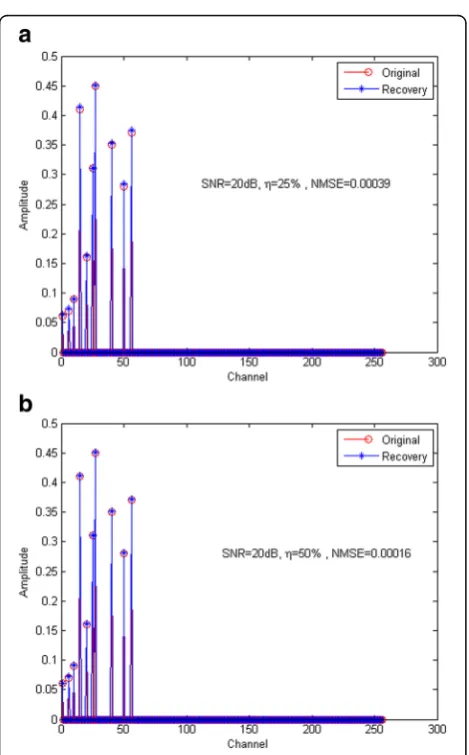
Next, we simulated a scene with noisy signal reconstruc-tion. We simulated the multipath channel and took the 12 paths with the largest channel gain in Fig.5. In this experi-ment, K= 12, the sampling rate is η= 25 % , 50%, and the SNR is set to 20 dB. As can be seen in Fig.5, the Toeplitz structure measurement matrix based on the CC-S can recon-struct the original signal, and the reconrecon-struction error de-creases with the increase of the sampling rate.
In Fig.6, we compared the signal reconstruction perform-ance of the Toeplitz structure measurement matrix based on CC-S under different compression sampling rates and differ-ent SNR. As can be seen in Fig.6, when the sampling rate continues to increase, the performance of signal reconstruc-tion is constantly improving. In the same sampling rate, when the SNR is larger, the effect of compressed-sensing channel estimation becomes better.
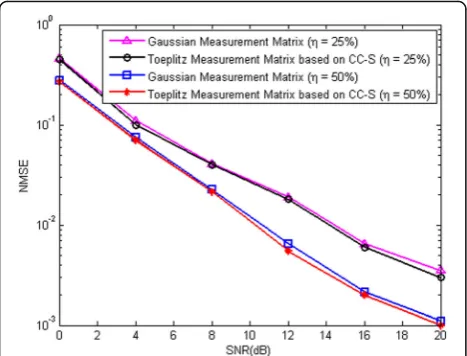
At the last, we compared the signal reconstruction per-formance of the Toeplitz structure measurement matrix based on the complementary sequences and Gaussian ran-dom matrix under the same conditions. As can be seen in Fig. 7, the two matrices achieve approximate signal recon-struction performance regardless of the sampling rate of 25% or 50%. As a PN sequence, the correlation function of CC-S has similar performance with the Gaussian sequence. How-ever, the CC-S can be constructed more easily in practice.
6 Conclusion
Aiming at the measurement matrix design problem, this paper proposes the Toeplitz structure measurement matrix based on CC-S to solve the complexity problem of com-pressed sensing algorithms in a massive MIMO system, and it opens a new direction in the field of measurement matrix construction. Compared with the classical Gaussian random matrix, the proposed measurement matrix can reduce a lot of hardware resources due to the element of CC-S is deter-ministic. At the same time, the Spark characteristics of the Fig. 4AoAs and Aods against SNR
Fig. 5Reconstruction signal of Toeplitz structure measurement
matrix based on CC-S.aThe result withη= 25%.bThe result
measurement matrix based on CC-S are proved. In addition, in terms of channel estimation performance, the Toeplitz structure measurement matrix based on CC-S can obtain nearly equivalent estimation performance with the Gaussian random matrix, but its generation and complexity are lower when applied to the calculation in practice. However, the drawback of the CC-S is that the length is limited. The CC-S solution only exists for some restricted length. There are still many important technologies to be researched in a massive MIMO system, such as codebook design, angle domain channel analysis, and pilot pollution and so on.
7 Appendix
We decompose the URA to a sort of sub-array according to the x axis as a referenced direction. While the array response of the first sub-array is denoted as ax, T(θℓ, T, sponse along the horizontal direction. Besides, Eq. (17) can be also expressed as follows:
AT¼ ax;T θℓ;T;ϕℓ;T
AACF:Aperiodic auto-correlation function; ACCF: Aperiodic cross-correlation function; AOAs: Angles of arrival; AODs: Angles of departure; AWGN: Additive white Gaussian noise; BS: Base station; CC-S: Complete complementary sequence; CSI: Channel state information; i.i.d: Independent identically distributed; MIMO: Multiple-input multiple-output; mmWave: Millimeter-wave; MS: Mobile station; NMSE: Normalized mean square error; OMP: Orthogonal matching pursuit; RF: Radio frequency; RIP: Restricted isometry property; RMSE: Root mean square error; URAs: Uniform rectangular arrays
Acknowledgements
This work was supported by the National Nature Science Funding of China (NSFC): 61401407 and the Fundamental Research Funds for the Central Universities.
Authors’contributions
SL is the main author of the current paper. BS and LJ contributed to the conception and design of the study. MC and HW commented on the work. All authors read and approved the final manuscript.
Funding Not applicable.
Availability of data and materials Not applicable.
Competing interests
The authors declare that they have no competing interests.
Author details
1School of Information and Communication Engineering, Communication
University of China, Beijing 100024, People’s Republic of China.2Department
of Electrical Engineering and Computer Science, York University, Toronto, Canada.
Received: 28 October 2019 Accepted: 18 December 2019
References
1. B. Yang, Z. Yu, J. Lan, et al., Digital beamforming-based massive MIMO
transceiver for 5G millimeter-wave communications. IEEE Transactions on
Microwave Theory and Techniques66(7), 3403–3418 (2018)
2. G. Kwon, N. Kim, H. Park, Millimeter wave SDMA with limited feedback:
RF-only beamforming can outperform hybrid beamforming. IEEE Transactions
on Vehicular Technology68(2), 1534–1548 (2018)
3. A. Ghosh, T.A. Thomas, M.C. Cudak, et al., Millimeter-wave enhanced local area systems: a high-data-rate approach for future wireless networks. IEEE
Journal on Selected Areas in Communications32(6), 1152–1163 (2014)
4. V. Raghavan, S. Subramanian, J. Cezanne, et al., Single-user versus multi-user
precoding for millimeter wave MIMO systems. IEEE Journal on Selected
Areas in Communications35(6), 1387–1401 (2017)
5. A. Alkhateeb, J. Mo, N. Gonzalez-Prelcic, et al., MIMO precoding and
combining solutions for millimeter-wave systems. IEEE Communications
Magazine52(12), 122–131 (2014)
6. R. Méndez-Rial, C. Rusu, N. González-Prelcic, et al., Hybrid MIMO
Architectures for millimeter wave communications: phase shifters or
switches? IEEE Access4, 247–267 (2015)
7. W. Ma, C. Qi, Beamspace channel estimation for millimeter wave massive
MIMO system with hybrid precoding and combining. IEEE Transactions on
Signal Processing66(18), 4839–4853 (2018)
8. J. Lee, G. Gil, Y.H. Lee,Exploiting spatial sparsity for estimating channels of
hybrid MIMO systems in millimeter wave communications. 2014 IEEE Global Communications Conference(2014), pp. 3326–3331
9. H. Wang, W. Zhang, Y. Liu, et al., On design of non-orthogonal pilot signals
for a multi-cell massive MIMO system. IEEE Wireless Communications Letters
4(2), 129–132 (2015)
10. A. Quayum, H. Minn, Y. Kakishima, Non-orthogonal pilot designs for joint
channel estimation and collision detection in grant-free access systems. IEEE
Access6, 55186–55201 (2018)
11. P. Li,Channel estimation and signal reconstruction for massive MIMO with
non-orthogonal pilots(IEEE Conference on Computer Communications
Workshops (INFOCOM WKSHPS), Atlanta, GA, 2017), pp. 349–353
12. X. He, R. Song, W.P. Zhu, Pilot allocation for distributed compressed sensing
based sparse channel estimation in MIMO-OFDM systems. IEEE Transactions
on Vehicular Technology65(5), 2990–3004 (2015)
13. A. Alkhateeb, O. El Ayach, G. Leus, et al., Channel estimation and hybrid
precoding for millimeter wave cellular systems. IEEE Journal of Selected
Topics in Signal Processing8(5), 831–846 (2014)
14. H. Jarvis, U.B. Waheed, R. Gil, et al., Toeplitz compressed sensing matrices
with applications to sparse channel estimation. IEEE Transactions on
Information Theory56(11), 5862–5875 (2010)
15. E. Candes, T. Tao, Decoding by linear programming. IEEE Transactions on
Information Theory51(12), 4203–4215 (2005)
16. E. Candes, J. Romberg, T. Tao, Stable signal recovery from incomplete and
inaccurate measurements. Communications on Pure and Applied Math
59(8), 1207–1223 (2006)
17. Z. Gao, L. Dai, C. Hu, et al., Channel estimation for millimeter-wave massive
MIMO with hybrid precoding over frequency-selective fading channels. IEEE
Communications Letters20(6), 1259–1262 (2016)
18. E. Candès, M. Wakin, An introduction to compressive sampling. IEEE Signal
Processing Magazine25(2), 21–30 (2008)
19. S.T. Xia, X.J. Liu, Y. Jiang, et al., Deterministic constructions of binary
measurement matrices from finite geometry. IEEE Transactions on Signal
Processing63(4), 1017–1029 (2015)
Publisher’s Note