981 | P a g e
PARAMETRIC STUDY ON MECHANICAL &
TRIBOLOGICAL PROPERTIES OF ALUMINIUM
METAL MATRIX COMPOSITES
Prof. Sanketh S
1, Prof. Anand Badiger
2 1Mechanical, Don Bosco Institute of Technology, Bengaluru, (India)
2Mechanical, Dayanand Sagar College of Engineering, Bengaluru, (India)
ABSTRACT
Over the last thirty years composite materials, Plastics & ceramics have been the dominant emerging materials.
The volume & number of applications of composite materials have grown steadily, penetrating & conquering
new markets relentlessly. In view of above fact and understanding the importance of application of Aluminum
Matrix composites, I have carried out work involving formation of Aluminum alloy (Al6061) with Titanium di
boride (TiB2)&Alumina (AL2O3) metal matrix composites. The present study is aimed at evaluating the mechanical & tribological properties of Aluminums 6061 alloy in the presence of Titanium di boride and
alumina reinforcements. The composites are prepared by stir casting technique .They are casted in 0%,3%,6%
&9% weight fractions of reinforcement. They are fabricated & tested to evaluate the various mechanical &
tribological properties.
Keywords: Titanium Di Boride, Aluminum, Stir Casting, Taguchi Analysis
I. INTRODUCTION
A composite is a structural material that consists of two or more combined constituents that are combined at a
macroscopic level and are not soluble in each other. One constituent is called the reinforcing phase and the one
in which it is embedded is called the matrix. In matrix-based structural composites, the matrix serves two
paramount purposes viz., binding the reinforcement phases in place and deforming to distribute the stresses
among the constituent reinforcement materials under an applied force.
Metal Matrix Composites are composed of a metallic matrix (aluminum, magnesium, iron, cobalt, copper) and a
dispersed ceramic (oxides, carbides) or metallic (lead, tungsten, molybdenum) phase. Metal matrix composites
(MMCs), as the name implies, have a metal matrix.
Metal matrix composites (MMCs), as the name implies, have a metal matrix.Metal matrix composites (MMCs)
possess significantly improved properties including high specific strength; specific modulus, damping capacity
and good wear resistance compared to unreinforced alloys. High strength, fracture toughness and stiffness are
offered by metal matrices than those offered by their polymer counterparts. They can withstand elevated
temperature in corrosive environment than polymer composites. Most metals and alloys make good matrices.
However, practically, the choices for low temperature applications are not many. Only light metals are
responsive, with their low density proving an advantage. Titanium, Aluminum and magnesium are the popular
982 | P a g e
II. LITERATURE SURVEY
The superior property of composite materials over the conventional materials has been acknowledged by the
research community. Now a day’s AMC’s are commonly used in automobile, aerospace, ship building industries and nuclear plants etc. In order to understand the nature and morphology of AMC’s and their behavior, the
literature survey has been focused on the mechanical properties and various influencing factors such as volume
fraction, microstructure, homogeneity and isotropy of the matrix and reinforcements as well as the shape, size
and amount of individual
Suresh et al. [1] has faced various challenges in preparation of Aluminum Al6063-Titanium Diboride
composite. In his study, he has discussed the parameters affecting of the TiB2 particles like holding time,
temperature etc. G.Shaikshavali et.al.[2] has investigated the effect of age hardening on tensile characteristics in
MMC’s reinforced with ceramics particulates. A.R.Ravikumar et al.[3] has investigated about the parametric
optimization of squeeze Cast AC2A-Ni coated SiCp composite using Taguchi technique.
S.Rama Rao et al.[4] has investigated that the stir casting processed samples exhibits improved mechanical
properties through various tests.C.Neelima Devi et al.[5] studied the micro-structural aspects of aluminum
Silicon Carbide Metal Matrix Composite. H.C.Anilkumar et al.[6] studied the mechanical properties of fly ash
reinforced aluminum alloy (Al6061) composites.
Antaryamini Mishra et al.[7] performed wear investigations of Al-SiCp-Fly Ash Composites. He also found the
effect of these parameters on co-efficient friction. D.Sujan et al.[8] studied physio-mechanical properties of
Aluminium Metal Matrix Composites reinforced with Al2O3 and Sic.
Zeeshan Ahmad et al.[9] studied tribological and mechanical properties of Aluminium metal matrix composites
manufactured by different routes.
Suryanarayanan.K et al. [10] examined the use of Silicon Carbide Reinforced Metal Matrix Composites for
Aerospace Applications. Muruganandhan.P et al.[11] investigation reveals that the fly ash plays a key role in
enhancing the mechanical properties.
Venkatesh.D et al.[12] studies reveals that increased better mechanical properties along with reduction in weight
and cost.in AMC’s
Sri Prayer et al.[13] investigated& concluded that mechanical properties of Aluminium 6061 reinforced with
SiC and Al2O3.Exhibits better properties on comparison with base alloy.N.Radhika et al.[14] through her study,
she concludes that sliding distance have greater influence on the wear rate.
A.K.Senapati et al. [15] studied the mechanical behavior of Aluminium Matrix Composite reinforced with
untreated and treated Waste Fly Ash.
III. METHODOLOGY
INTRODUCTION
983 | P a g e
IV. EXPERIMENTAL STUDY
Liquid stte fabrication of Metal Matrix Compositesinvolves incorporation of dispersed phase into a molten
matrix metal, followed by its solidification. In order to provide high level of mechanical properties of the
composite, good interfacial bonding (wetting) between the dispersed phase and the liquid matrix should be
obtained.The methods of liquid state fabrication of Metal Matrix Composites are Stir Casting, Compo Casting,
Squeeze Casting, In Situ Casting, and Ultrasonic Assisted Casting.
PROBLEM DEFINITION
MATERIAL SELECTION
COST ESTIMATION
PROCUREMENT OF
MATERIALS
EXPERIMENTAL WORK
TESTING
CONCLUSION
CASTING
FABRICATION
TENSILE TEST
HARDNESS TEST
WEAR TEST
MICROSTRUCTURE
CONCLUSION
ALUMINIUM 6061
ALUMINA NANO
PARTICLE (Al
2O
3)
TITANIUM
984 | P a g e
V. STIR CASTING
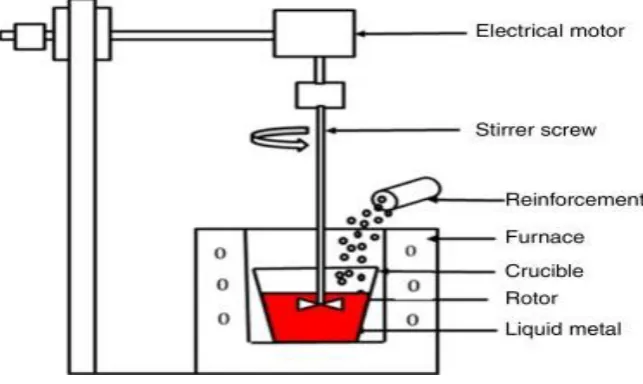
Stir Casting is a liquid state method of composite materials fabrication, in which a dispersed phase (ceramic
particles, short fibers) is mixed with a molten matrix metal by means of mechanical stirring.
Stir casting is characterized by the following features:
Content of the dispersed phase is limited (usually not more than 30 volume %)
The technology is relatively simple and of low cost.
VI. FABRICATION
Amongst different processing techniques discussed earlier in chapter “Processing of aluminium matrix
composites” liquid state process, stir casting is employed for this present work. The major components of the
casting process consist of electrical resistance furnace, ceramic coated chromium steel impeller and permanent
moulds. The power rating of electrical furnace used was 60 kW, 440V and maximum temperature limit was
1000ºC.The mechanical stirrer used for stirring the molten alloy during the preparation of composites was made
of chromium steel blades coated with aluminize to withstand high temperature and to prevent migration of
ferrous ions from the stirrer material into the aluminium alloy melt. The permanent type of mould boxes made
of cast iron used in the fabrication
.
985 | P a g e
The ingots were charged into the furnace for melting. The melting point of aluminium alloy is 660°C. The meltwas superheated to a temperature of 730°C. The temperature was recorded using a chrome-alumel
thermocouple. The molten metal was then degassed using hexachloroethane (C2Cl6) for 5 min. A stainless steel
impeller or stirrer coated with aluminize was used to stir the molten metal and to create a vortex. The aluminize
coating is necessary in order to prevent the migration of ferrous ions from the stirrer material to the melt .The
stirrer was rotated at a speed of 300-500 rpm and a vortex was created in the melt shown in.
The depth of immersion of the impeller was 60 % of the height of the molten metal from the surface of the
melt. Both the reinforcements Al2O3 and Tib2 nano particles were preheated in a furnace were introduced into
the vortex. Stirring was continued until interface interactions between the reinforcement particulates and the
matrix promotes wetting. Then at superheat temperature, poured into the preheated dies at 200°C.Hence by stir
casting process the composite was fabricated successfully.
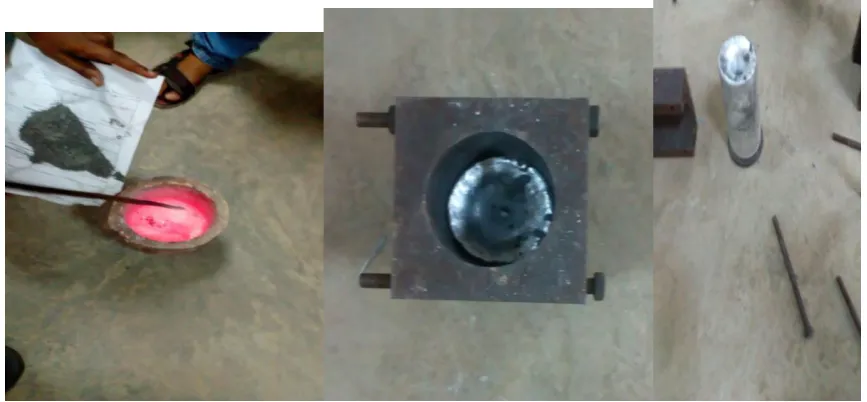
Fig 3: Preparation of INGOTS
V. TEST SPECIMEN
ASTM codes Test Specimen
ASTM E8 Tensile test
ASTM E10 Brinell hardness test
ASTM Scanning Electron Microscopy
986 | P a g e
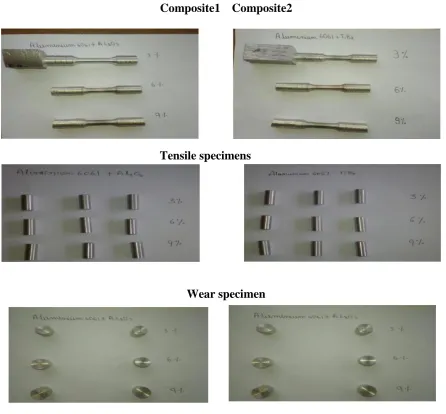
The specimens are as shown in the following figures shown below,
Composite1
Composite2
Tensile specimens
Wear specimen
Hardness specimen
987 | P a g e
VI.TESTING
6.1.Tensile test:
The tension test specimens machined as per ASTM E8M standards were tested at room temperature in a
Universal Testing Machine.
Fig 5: Computerized UTM
Fig 6: ASTM E8 specimen sketch
The mechanical properties such as YS (Yield strength), UTS (Ultimate tensile strength), and % Elongation
(ductility) were obtained from the data acquisition system of the machine.
6.2. Brinell Hardness test
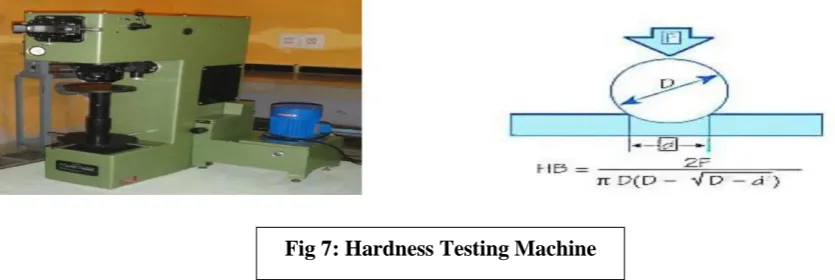
The hardness tests were conducted as per ASTM E10 norms using Brinell hardness tester. Tests were performed
at randomly selected points on the surface by maintaining sufficient spacing between indentations and distance
from the edge of the specimen.
A Brinell hardness result measures the permanent width of indentation produced by a carbide indenter applied to
a test specimen at a given load, for a given length of time. Typically, an indentation is made with a Brinell
hardness testing machine and then measured for indentation diameter in a second step with a specially designed
Brinell microscope or optical system.
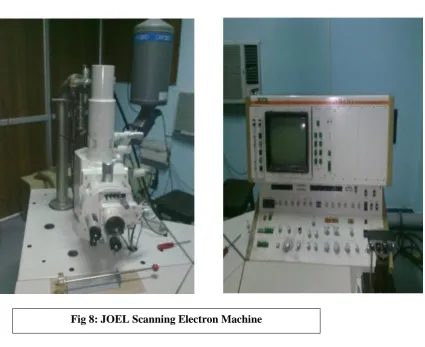
6.3 Scanning Electron Microscope:
In scanning electron microscopy (SEM) an electron beam is focused into a small probe and is raftered across the
surface of a specimen.
Several interactions with the sample that result in the emission of electrons or photons occur as the electrons penetrate the surface.
These emitted particles can be collected with the appropriate detector to yield valuable information about the material.
988 | P a g e
The most immediate result of observation in the scanning electron microscope is that it displays the shape oof the sample. The worn surfaces of as-cast alloy and MMCs were observed through Scanning Electron
Microscope (SEM).
VII. RESULTS
7.1 Microsturucture Test
The samples for microstructure examination were prepared by following standard metallurgical procedures,
etched in etchant prepared using 90 ml water, 4ml of HF, 4ml H2SO4 and 2gm CrO3 and were examined using
Optical Microscope.
AL6061-TIB
2SAMPLES
989 | P a g e
ASCAST AL ALLOY
3% Wt of TiB
26% Wt of TiB
29% Wt of TiB
2AL6061 –AL
2O
3SEM PHOTOGRAPHS
VIII. TENSILE TEST
The tension test specimens machined as per ASTM E8M standards were tested at room temperature in a
Universal Testing Machine. The test results are as follows-
Al6061-TIB2
Specimen
designatio
n
Ultimate
Tensile
strength
(N/mm2)
Yield
stress
(N/mm2)
%
Elongatio
n
A 281.975 249.645 17.6
990 | P a g e
0 100 200 300 400A/P B/Q C/R D/S
Y ie ld s tr e ss in N /m m 2
YIELD STRESS
COMPARISON
Al6061-TiB2 Al6061-Al2O3 0 50 100 150 200 250 300 350 400A/PB/Q C/R D/S
Ten si le Str e n gth in N /m m 2
TENSILE STRENGTH
COMPARISON
Al6061-TiB2 Al6061-Al2O3C 348.495 310.56 12.165
D 361.63 317.24 11.8
AL 6061-AL
20
3991 | P a g e
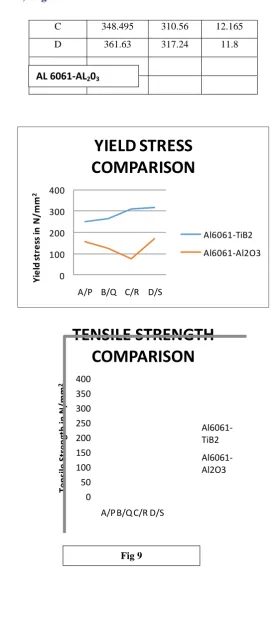
From the graph (Tensile strength), we can understand that the tensile strength values of TiB2 reinforcedcomposite are greater than that of Al2O3 reinforcedcomposite.
From the graph we can see that the yield stress of the Al6061-TiB2 composite is greater than that of
LM20-Al2O3 composite.
IX. HARDNESS TEST
The hardness tests were conducted as per ASTM E10 norms using Brinell hardness tester. Tests were performed
at randomly selected points on the surface by maintaining sufficient spacing between indentations and distance
from the edge of the specimen. The hardness values obtained are as follows-
AL6061-AL2O3
Specimen Designation Hardness values
Reading 1 Reading 2 Reading 3 Average value
A 77.1 76.3 76.3 76.6
B 77.9 77.8 78.7 78.2
C 78.8 78.2 78.2 78.4
D 47.5 47.9 47.5 47.6
AL6061-TIB2
Specimen Designation Hardness values
Reading 1 Reading 2 Reading 3 Reading 4 Average value
A 91 93 92.5 91.9 92.1
B 95 96.21 95.1 94.9 95.3025
C 97.25 98.1 97.9 96 97.3125
D 93.64 93 93.1 93.58 93.33
Specimen designatio n Peak load (KN) Tensile strength
(N/mm2)
Yield
load
(KN)
Yield
stress
(N/mm2)
%
Elongati
on
A 5.28 170.44 4.84 156.24 1.73
B 4.60 149.92 3.88 126.45 2.63
C 2.68 91.99 2.20 75.52 2.90
992 | P a g e
Fig 10From the graph, we can understand that the hardness values of the TiB2 reinforced AMCs are more than that of
Al2O3 reinforced AMCs.
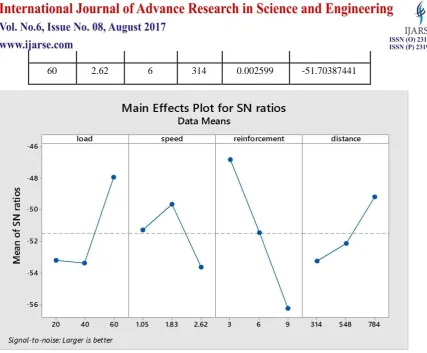
The influence of control parameters such as load, sliding speed and Sic content on wear rate has been evaluated
using S/N ratio response analysis. The control parameter with the strongest influence was determined by the
difference between the maximum and ratios, the more influential was the control parameter minimum value of
the mean of S/N ratios. Higher the difference between the mean of S/N.
Wear test
The wear test is carried out in Pinnon disc machine.
Load speed
Reinforc
ement distance wear rate
20 1.05 3 314 0.003159
20 1.83 6 548 0.002538
20 2.62 9 784 0.001306
40 1.05 6 784 0.002901
40 1.83 9 314 0.001268
40 2.62 3 548 0.002686
60 1.05 9 548 0.00224
60 1.83 3 784 0.01116
60 2.62 6 314 0.002599
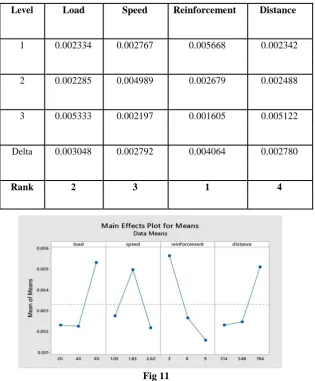
The S/N ratio response analysis, presented in fig 11 shows that among all the factors, reinforcement was the
most influential and significant parameter followed by load, speed and sliding distance. Figure 11 shows the
993 | P a g e
From the analysis of these results, it can be inferred that parameter combination of L = 60 N, S = 1.83 m/s and F= 3% gave the minimum wear rate for the range of parameters tested
.
Level Load Speed Reinforcement Distance
1 0.002334 0.002767 0.005668 0.002342
2 0.002285 0.004989 0.002679 0.002488
3 0.005333 0.002197 0.001605 0.005122
Delta 0.003048 0.002792 0.004064 0.002780
Rank 2 3 1 4
Fig 11
Taguchi Analysis: wear loss versus load, speed, reinforcement, distance
load Speed
reinforceme
nt Distance wear loss SNRA1
20 1.05 3 314 0.003159 -50.00900748
20 1.83 6 548 0.002538 -51.91016764
20 2.62 9 784 0.001306 -57.68113646
40 1.05 6 784 0.002901 -50.74904542
40 1.83 9 314 0.001268 -57.93761493
40 2.62 3 548 0.002686 -51.41787983
60 1.05 9 548 0.00224 -52.99503963
994 | P a g e
60 2.62 6 314 0.002599 -51.70387441
Fig 12
CONCLUSIONS
1. Stir casting method was helpful to produce a good dispersion of Al2O3 and TiB2 particles in the alloy and
very low agglomeration was found.
2. Microstructure and SEM analysis shows the proper distribution of reinforced Nano particles in metal
matrix.
3. The fabrication process used in this study (stir casting) improved the mechanical and tribological property
of the reinforced alloy thus by showing good porosity by microstructure images and better distribution of Al2O3
and TiB2.
4. Test results indicate there is increase in hardness and tensile strength for reinforced composites. Compared
to As Cast alloy. It is also observed further increase in Al2O3 decreases the hardness i.e. for 3% wt alloy.
Optimum hardness was found to be for 9% wt alloy.
5. Specimen D and S i.e. with 9 wt% shows the minimum % elongation than as cast and other specimen;
hence it will be preferred in terms of its tensile strength.
6. It is also found that the variation (increase or decrease) in UTS and % of elongation properties is
not linear which may be attributed to the problem of the dispersion of Al2O3 and TiB2 Nano particles into
matrix material.
7. The concentration of Al2O3 particles increases with increase in content of mass fraction which was
995 | P a g e
elongation decreased. The higher the concentration leads to less slip dislocation and hence the elongationdecreases. To overcome all the drawbacks the different processing techniques can be implemented and the
investigation can be progressed.
8. Hence there is significant research as to be carried out to overcome this problem.
REFERENCES
[1] S.Suresh, N.Shenbaga Vinayaga Moorthi, Aluminium-Titanium Diboride (Al-TiB2) Metal Matrix
Composites:Challenges and Opportunities 38(2012) 89-97
[2] G.Shaikshavali, Dr.E.Venugopal Goud, M.Murali Mohan, Mechanical Properties Of Al6061 Based Metal
Matrix Composites Reinforced With Ceramic Particulates And Effect Of Age Hardening On Its Tensile
Characteristics, International Journal and Engineering Research and General Science, Vol 4, April
2016,ISSN 2091-2730.
[3] A.R.Ravikumar, K.S.Amirthagadeswaram, P.Senthil, The Parametric Optimization Of Squeeze Cast
AC2A-Ni Coated Sicp Composite Using Taguchi Technique, Advances in Material Science and Engineering, Vol
2014, Article ID 160519
[4] S.Rama Rao, G.Padmanabhan, Fabrication And Mechanical Properties Of Aluminium-Boron Carbide
Composites, International Journal of Material and Biomaterials Applications, ISSN 2249-9679,2012.
[5] C.Neelima Devi, N.Selvaraj, V.Mahesh, Micro-Structural Aspects Of Aluminium Silicon Carbide Metal
Matrix Composite, International Journal of Applied Sciences and Engineering Research, Vol.1,No.2,2012,
ISSN 2277-9442.
[6] H.C.Anilkumar, H.S.Hebbar, K.S.Ravishankar, Mechanical Properties Of Fly Ash Reinforced Aluminium
Alloy (Al6061) Composites, International Journal of Mechanical and Materials
Engineering,Vol.6(2011),No.1,41-45.
[7] Antaryami Mishra, Wear Investigations Of Al-Sicp-Fly Ash Composites, International Journal of
Engineering and Technical Research, ISSN: 2321-0869,2016.
[8] D.Sujan, Z.Oo, M.E. Rehman, M.A. Maleque, C.K. Tan, Physio-Mechanical Properties Of Aluminium
Metal Matrix Composites Reinforced With Al2O3 And Sic, International Journal of Chemical, Molecular,
Materials and Metallurgical Engineering, Vol:6, 2012.
[9] Zeeshan Ahmad, Dr.Sabah Khan, Vol 1,A Review Paper On Tribological And Mechanical Properties Of
Aluminium Metal Matrix Composites Manufactured By Different Routes, ISSN 2393-8374, 2014.
[10] Suryanarayanan K, R. Praveen, S.Raghuraman, Silicon Carbide Reinforced Metal Matrix Composites for
Aerospace Applications, ISSN: 2319-8753, Vol.2, 2013
[11] Muruganandhan.P, Dr.Eswaramoorthi.M, Aluminium Composite With Fly Ash-A Review. IOSR Journal of
Mechanical and Civil Engineering, ISSN: 2278-1684,2014
[12] Vengatesh.D, Chandramohan.V, Aluminium Alloy Metal Matrix Composites: Survey Paper, International
Journal of Engineering Research and General Science, Vol-2, ISSN 2091-2730.
[13] Sri Priya R, Yogeshwaram R, Syed Mohammad K, Bharathvaj S, Dr. M.Shanmugaraja, Investigations on
Mechanical Properties Of Aluminium 6061 Reinforced With Sic And Al2O3, International Conference on
996 | P a g e
[14] N.Radhika, R. Subramanian, S. Venkat Prasat, Tribological Behaviour Of Aluminium/Alumina/GraphiteHybrid Metal Matrix Composite Using Taguchi’s Techniques, Journal of Minerals & Materials
Characterization & Engineering, Vol.10, No.5, 2011.
[15] A.K.Senapati, P.C. Mishra, B.C.Routray and R.I.Ganguly, Mechanical Behaviour Of Aluminium Matrix
Composite Reinforced With Untreated And Treated Waste Fly Ash, Indian Journal of Science and