Charmless
B
decays
Aurélien MARTENS1,aon behalf of the LHCb Collaboration
1LPNHE, Université Pierre et Marie Curie, Université Paris Diderot, CNRS/IN2P3, Paris, France.
Abstract. During 2011, LHCb has collected an integrated luminosity of 1.1 fb−1, giving
rise to a large variety of measurements. Amongst these, measurements ofCPviolation in Bdecays play a central role. In particularCPviolation measurements in charmless transitions ofBmesons are of interest since they provide new or improved constraints on new physics contributions. These proceedings concentrate on LHCb results made public in the first half of the year 2012.
1 Introduction
The LHCb detector [1] is a single arm spectrometer designed to accurately measure decay products ofBandDmesons for precision measurements at the LHC. In the following an overview of recent studies in charmless and radiativeBdecays performed by the LHCb collaboration is presented. Other measurements conducted with the LHCb detector are summarized in [2–4]. The commissioning of the detector and the performance reached with the current data are summarized in [5] while prospects for an upgraded LHCb detector are discussed in [6].
Key ingredients for the analyses presented in the following are the ability to trigger on and to disentangle different modes owing to dedicated ring-imaging Cherenkov detectors. Some channels of interest additionally require (or will require on longer term analyses) good tagging capabilities and excellent proper time resolution, that are detailed elsewhere [7]. The data samples used for the analyses presented here are based onppcollision data collected in 2011 at√s=7 TeV correspond to integrated luminosities ranging from 0.35 fb−1to 1.0 fb−1.
2 Two body charmless
B
decays
2.1 General strategy
CPviolation in charmlessBdecays allows to extract information on theCPviolating phases of the Unitarity Triangleβandγ. These measurements are generally sensitive to new physics effects, since the involved processes are characterized by dominant loop contributions. The drawback lies in the numerous diagram topologies that contribute to these decays. Thus the extraction of the weak phases is considered as more complicated than in the Standard Model benchmark measurements of these quantities performed withB0→J/ψK0
S open charm decays.
ae-mail: [email protected]
DOI: 10.1051/
C
Owned by the authors, published by EDP Sciences, 2014
/2014 00 07 0 7
For instance, theB→hh decays are key channels at LHCb to develop this strategy [8]. Tagged time dependent analyses are also targeted to maximally exploit the information contained in these decays.
2.2 First evidence forCPviolation in theB0
s system
Searches for directCPviolation in the flavour specificB0
(s)→Kπdecays are performed using an
inte-grated luminosity of 0.35 fb−1. Small corrections to the rawCPasymmetries, clearly visible by eye on Fig. 1, are introduced to account for detection and production asymmetries. Detection asymmetries, induced by different reconstruction efficiencies and by different cross sections in the interactions of oppositely charged particles with the detector material, are determined by means of large samples of two-bodyDmeson decays. The former contribution amounts to about 0.2% and is further cancelled owing to the ability to flip the magnetic field in LHCb. The latter is dominated by the kaon detection asymmetry and amounts to about 1%. The production asymmetry ofB0 mesons is estimated using B0→ J/ψK∗0 decays, assuming absence ofCPviolation. This asymmetry is further diluted by the
mixing of theB0mesons and the shape of the proper time acceptance. Owing to the fastB0
s
oscilla-tions, the possible presence of aB0
s production asymmetry plays no role. The total correction from
these polluting asymmetries amounts to 1.0±0.2% and−0.7±0.6% respectively in theB0
s andB0
cases.
B0
sandB0CP-violating asymmetries are thus determined to be [9]:
AB0s→Kπ
CP =
BB0
s→K+π−
− BB0
s→K−π+
BB0
s→K+π−
+BB0
s→K−π+
=0.27±0.08 (stat.) ±0.02 (syst.), (1)
ACPB0→Kπ = B
B0→K−π+− BB0→K+π−
BB0→K−π++BB0→K+π− =−0.088±0.011 (stat.) ±0.008 (syst.). (2)
For the first time, an evidence ofCPviolation in theB0
s system is obtained and for the first time at an
hadron collider a directCPasymmetry is observed with a significance exceeding 5σ. The dominating systematics are linked to the modeling of theB invariant mass in theB0
s case and to the polluting
asymmetries in theB0case. Both will be reduced with larger integrated luminosities. These results
are in agreement and more precise with respect to previous measurements made by BABAR [10], BELLE [11] and CDF [12].
2.3 Branching fraction measurements ofB→hhdecays
With 0.37 fb−1, the rare B0 → K+K− andB0
s → π+π− decay modes, dominated by exchange and
penguin annihilation diagrams, are searched for [13]. The first observation forB0
s→π+π−is obtained
and its branching fraction measured to be
BB0s→π+π− = (0.95 +−00..2117(stat.) ±0.13 (syst.))×10−6, (3)
while theB0→K+K−branching fraction is found equal to
BB0→K+K− = (0.11 +−00..0504(stat.) ±0.06 (syst.))×10−6. (4) These measurements allow to assert the size of the pollution coming from these diagrams in the extraction of theCPviolating observables. In the same analysis theB0
s→K−π+branching fraction is
determined,
5 5.2 5.4 5.6 5.8
2
Events / ( 0.02 GeV/c
0 500 1000 1500 2000 2500 3000 )
LHCb
(a)
) 2invariant mass (GeV/c <
/ +
K K</+ invariant mass (GeV/c2)
5 5.2 5.4 5.6 5.8
)
2
Events / ( 0.02 GeV/c
0 500 1000 1500 2000 2500 3000
LHCb
(b)
B AK/ B AK/ B A// B AKK BA3-body Comb. bkg 0 0 0 0 s s 0 50 100 150 200 250 300 350 400 ) 2
Events / ( 0.02 GeV/c
5 5.2 5.4 5.6 5.8 )
2
invariant mass (GeV/c < / + K
LHCb
(c)
0 50 100 150 200 250 300 350 400 ) 2Events / ( 0.02 GeV/c
5 5.2 5.4 5.6 5.8 )
2
invariant mass (GeV/c
+ / < K
LHCb
(d)
Figure 1.TheK+π−(left) andK−π+(right) invariant mass spectra optimized for theB0asymmetry measurement
(top), and for theB0
sasymmetry measurement (bottom), see [9] for details.
with the best precision to date. The ratio of branching fractions of similarΛbdecays is also extracted,
BΛb→ pK−/BΛb→pπ−=0.86±0.08 (stat.) ±0.05 (syst.). (6)
2.4 Time dependentCPviolation measurements ofB→hhdecays
With an updated sample up to 0.69 fb−1, the analysis is sensitive to time dependentCPviolation [14], that is measured by means of opposite side flavour tagging, based on a combination of the electron, muon, kaon and secondary vertex taggers, which exploit the decay products of the otherb-hadron produced in the event [7]. In order to calibrate this algorithm, and to exercise the whole analysis,
B0→K+π−is used as a proxy.
From a simultaneous fit of theKπinvariant mass and the time of flight of the reconstructed B
meson, and assuming theB0
s mixing parameters are perfectly determined by other LHCb
measure-ments [16, 17] andΔΓd =0, the effective tagging efficiency (ortagging power)εD2 =2.3±0.1%,
theB0andB0
sproduction asymmetriesAP(B0)=−0.015±0.013 andAP(B0s)=−0.03±0.06, can be
extracted together withΔmd =0.484±0.019 ps−1andτB =1.509±0.011 ps, where only statistical
uncertainties are quoted. The last two measurements, which provide a cross-check of the analysis, are in good agreement with the world averages [18]. Fig. 2 shows the time dependent mixing asymmetry for events lying in the invariant mass window [5.20,5.32] GeV. The first three quantities are used as input for theB0→π+π−andB0
In order to extract the time dependent violation inB0→ π+π− decays,Δm
d is fixed to the
cen-tral value measured in another LHCb analysis [15] that providesΔmd = 0.499±0.032 (stat.) ±
0.003 (syst.) ps−1, the central value being varied to estimate the related systematic uncertainty. As-sumingΔΓd=0, the direct and mixing inducedCPasymmetries are both extracted together with their
statistical correlation factor:
Adirπ+π.− = 0.11±0.21 (stat.) ±0.03 (syst.), (7)
Amixπ+π.− = −0.56±0.17 (stat.) ±0.03 (syst.), (8)
ρ(Adirπ+π.−,Aπmix+π.−) = 0.34 (stat.). (9)
The dominating sources of (relatively small) systematic uncertainties are the central values used for the input parameters (namelyΔmdand tagging efficiencies) and the model used to parameterize the
decay time (both signal and background). The raw mixing asymmetry together with the result of the fit is shown on Fig. 3 (left).
Time dependentCPviolation is also looked for inB0
s→ K+K−decays by fixingΔms =17.63±
0.11 (stat.) ±0.02 (syst.) ps−1[16] andΓ
s=0.657±0.009 (stat.) ±0.008 (syst.) ps−1[17] to their
respective central values, allowing for a determination ofΔΓs =0.076±0.019 ps−1as a side product
of the analysis, where only statistical uncertainty is quoted. This is in agreement with a previous measurement of the same quantity by another LHCb analysis [17], with similar uncertainty and thus consists in a suitable cross-check. The direct and mixing inducedCPasymmetries are both extracted together with their statistical correlation factor:
AdirK+.K− = 0.02±0.18 (stat.) ±0.04 (syst.), (10)
AmixK+K.− = 0.17±0.18 (stat.) ±0.05 (syst.), (11)
ρ(AdirK+.K−,AKmix+K.−) = 0.10 (stat.), (12)
where the contributions to the systematic uncertainties are again dominated by the uncertainy on the input parameters and the decay time model. The raw mixing asymmetry together with the result of the fit is shown on Fig. 3 (right).
Hence a first measurement of the time dependent asymmetry inB0
s→ K+K−decays is obtained,
as well as an evidence of mixing-inducedCPviolation in the B0 → π+π− decays. This last result
is in agreement with previous determinations but it does not yet reach their precision [10, 19]. This analysis may be improved in the future by means of the addition of the same side tagging algorithms under study at LHCb.
2.5 Effective lifetime measurement of theB0
smeson in theB0s→K+K−decay
A new analysis of the effective lifetime of theB0
s meson in theB0s→ K+K−decay is performed with
1 fb−1. This quantity, sensitive toCPviolation and potential new physics effects, has already been
measured at LHCb [20], but suffers from a lack of knowledge on the decay time acceptance. Thus a strategy aiming at flattening the decay time acceptance at each stage of the analysis, including the trigger, and thus reducing the related systematic uncertainty, is developed [21]. The acceptance of the reconstructedB0
s candidates as a function of the decay time is shown on Fig. 4. The result of the
analysis
τKK=1.468±0.046 (stat.) ±0.006 (syst.) ps, (13)
t (ps)
1 2 3 4 5 6 7 8 9
Raw mixing asymmetry
-0.5 -0.4 -0.3 -0.2 -0.1 0 0.1 0.2 0.3 0.4 0.5
= 7 TeV s Preliminary LHCb
Figure 2.Raw mixing asymmetry in theB0→K+π−signal mass region with the result of the fit overlaid [14].
t [ps]
1 2 3 4 5 6 7 8 9
Raw asymmetry
-0.5 -0.4 -0.3 -0.2 -0.1 0 0.1 0.2 0.3 0.4 0.5
= 7 TeV s Preliminary LHCb
) [ps] s m
6
/
/
) modulo (2 0 (t-t
0 0.05 0.1 0.15 0.2 0.25 0.3 0.35
Raw asymmetry
-0.20 -0.15 -0.10 -0.05 0 0.05 0.10 0.15 0.20
= 7 TeV s Preliminary LHCb
Figure 3.Raw mixing asymmetry in theB0→π+π−andB0
s→K+K−signal mass regions respectively on the left
and right hand side of the figure, with the result of the fit overlaid [14].
(B) [ps]
τ
1 2 3 4 5 6 7 8 9 10
arb. units
0 0.2 0.4 0.6 0.8 1 1.2
Figure 4.Acceptance ofBmesons as a function of the decay time on simulatedB0
s→K+K−signal candidates.
3 Charmless B decays to two vector mesons
Triple product asymmetries are measured in theB0
s → φφ decay. These asymmetries, sensitive to
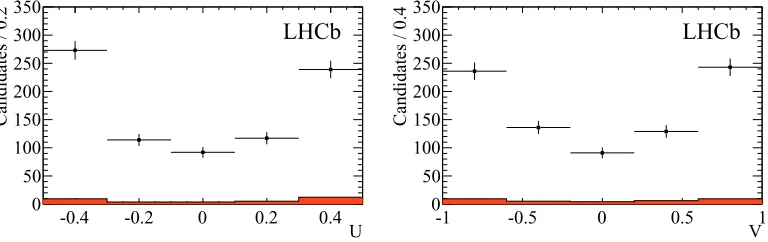
CP-violation under the assumption thatCPT is conserved, are measured with 1 fb−1 together with polarization amplitudes parameters [23], see Fig. 5:
|A0|2 = 0.365±0.022 (stat.) ±0.012 (syst.), (14)
|A⊥|2 = 0.291±0.024 (stat.) ±0.010 (syst.), (15)
cos(δ||) = −0.844±0.068 (stat.) ±0.029 (syst.), (16)
AU =
N(U<0)−N(U>0)
N(U<0)+N(U>0) =−0.055±0.036 (stat.) ±0.018 (syst.), (17)
AV =
N(V<0)−N(V>0)
N(V<0)+N(V>0) = +0.010±0.036 (stat.) ±0.018 (syst.), (18)
whereU = 1
2sin(2Φ),V =sin(εΦ) andε=sign(cosθ1cosθ2),Φbeing the angle between the decay
planes of the twoφmesons and cosθ1,2the helicity angles in the two φmeson decays. Systematic
uncertainties on the triple product asymmetries are dominated by angular and decay time acceptances while the systematic uncertainty on the S wave component additionally contributes significantly in the determination of the polarization amplitudes. This result is in agreement with a previous existing CDF measurement [24]. On the longer term, this channel may also be used for the determination of the mixing phase in theB0
ssystemφs.
U
-0.4 -0.2 0 0.2 0.4
Candidates / 0.2
0 50 100 150 200 250 300 350
LHCb
V
-1 -0.5 0 0.5 1
Candidates / 0.4
0 50 100 150 200 250 300 350
LHCb
Figure 5.Distributions of theU(left) andV(right) observables for theB0
s→φφdata in the mass range 5286.6<
m(B0
s)< 5446 MeV. The distribution for the background is taken from the mass sidebands, normalized to the
same mass range and is shown by the solid histogram [23].
4 Radiative charmless
B
decays
B0→ K∗0γ andB0
s → φγdecays are of interest since they proceed through penguin transitions in
which sizeable new physics effects can be introduced. Recent LHCb measurements are summarized below.
4.1 Ratio of branching fractions measurement
With an integrated luminosity of 0.37 fb−1, theB0→ K∗0γandB0
s → φγdecay modes are
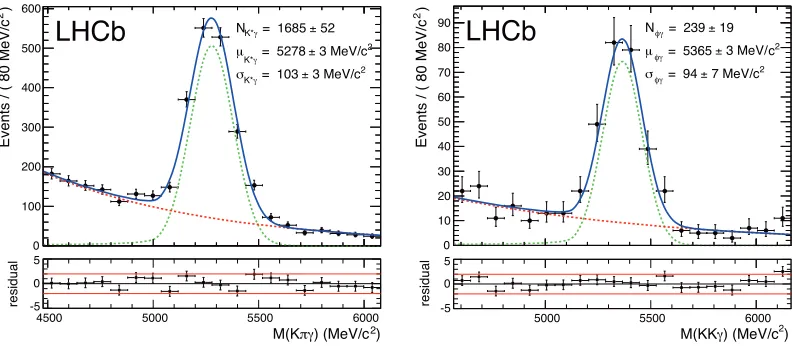
excellent calibration of the calorimeter energy at the level of 1 to 2 %. Approximately 1700 and 240 signal candidates are respectively reconstructed inB0→ K∗0γandB0
s→ φγ, as shown in Fig. 6. In
this analysis the background is simply modeled by a falling exponential in both decay modes. The ratio of branching fractions is thus measured [25]:
BB0→K∗0γ
BB0
s→φγ
= 1.12±0.08 (stat.)+−00..0604(syst.)+−00..0908(fs/fd), (19)
where the ratio of fragmentation fractions is determined by an independent LHCb analysis [26, 27]. The dominating systematic uncertainties come from the calibration of the particle identification effi -ciencies and the model used for the background. This result is in good agreement with the Standard Model that predicts a ratio equal to unity, within 20% of relative uncertainty [28].
2 M(Kπγ) (MeV/c )
Events / ( 80 MeV/c )
0 100 200 300 400 500 600
52
±
= 1685 γ K* N
2 3 MeV/c
±
= 5278 γ K* μ
2 3 MeV/c
±
= 103 γ K* σ
LHCb
4500 5000 5500 6000
residual -5
0 5
2
M(KKγ) (MeV/c2)
0 10 20 30 40 50 60 70 80
90 = 239 ± 19
φγ N
2
= 5365 c
φγ
μ
2 7 MeV/c
±
= 94 φγ
σ
LHCb
5000 5500 6000
residual -5
0 5
Events / ( 80 MeV/c )
2
3 MeV/
±
Figure 6.Result of the fit for theB0→K∗0γ(left) andB0
s→φγ(right). The black points represent the data and
the fit result is represented as a solid line. The signal is fitted with a Crystal Ball function (light dashed line) and the background is described as an exponential (dark dashed line), see [25] for details.
4.2 B0→K∗0γCPasymmetry measurement
Since the modeling of the background under the signal peaks was found to be a limiting systematic uncertainty in the previous analysis, it is refined for theCPviolation measurement. By order of relative importance, the following specific backgrounds are considered: B±,0 → K∗0π±,0γ, B0 → K∗0π0X, B0
s→K∗0γ,Λb→Λ∗γ,B0→K+π−π0andBs0→ K−π+π0. In particular the combinatorial background
yields and shapes in the two flavour final states are left free in the fit, as it can be observed in Fig. 7. The time integratedCPasymmetry
ACP = 0.008±0.017 (stat.) ±0.009 (syst.) (20)
) 2 ) (MeV/c γ + π -M(K ) 2
Events / ( 50 MeV/c
0 100 200 300 400 500 600 1.7)% ± = (0.3 RAW A -1
L dt=1.0 fb
∫
=7 TeV s
LHCb Preliminary
4500 5000 5500 6000
-5 0 5 ) 2 ) (MeV/c γ -π + M(K ) 2
Events / ( 50 MeV/c
0 100 200 300 400 500
600 0 = 5300 ± 100
B + N 0 B N 2 2 MeV/c ± = 5279 γ -π + K μ 2 2 MeV/c ± = 93 γ -π + K σ -1
L dt=1.0 fb
∫
=7 TeV s
LHCb Preliminary
4500 5000 5500 6000
-5 0 5
Figure 7. Simultaneous fitB0→ K∗0γ(left) andB0→ K∗0γ(right). The black points represent the data and
the fit result is represented as a solid blue line. The signal is fitted with a double-sided Crystal Ball function (dashed green line). The generic combinatorial background is modelled with an exponential function (dashed red lines).B±,0→K∗0π±,0γandB0→K∗0π0Xbackgrounds are respectively also shown (dotted black and dashed blue
lines respectively), see [29] for details.
5 Conclusion
In the beginning of 2012 new results on charmless and radiative charmlessBdecays have been ob-tained by LHCb. Time dependentCPviolation in B0
s → K+K− decays is constrained for the first
time. Effective lifetime measurements are pursued in the same decay with various approaches, and most recently using a method that aims at flattening decay time acceptance. World leading measure-ment of the triple product asymmetries inB0
s→ φφis obtained together with a first measurement of
the polarization amplitudes in this decay. World leading measurements of the branching fraction of theB0
s→ φγdecay is obtained together with a world leading measurement of theCPasymmetry in
B0→K∗0γ.
All these measurements, obtained with at most 1 fb−1 of integrated luminosity, are compatible with Standard Model predictions. Further results are expected to appear especially with three body and two vector meson charmlessBdecays.
Aknowledgements
I would like to thank the organizers for their hospitality and the chance to visit one of the most beautiful, and laden with history, places in the Mediterranean basin.
References
[1] Alves, A. Augusto Jr and others, LHCb Collaboration, JINST3, (2008) S08005 [2] Lopez March N., these proceedings
[5] Egede U., these proceedings [6] Hopchev P., these proceedings
[7] Aaij, R and others, LHCb Collaboration, Eur. Phys. J.C72, (2012) 2022 [8] Adeva, B. and others, LHCb Collaboration, arXivhep-ex, (2009) 0912.4179 [9] Aaij, R and others, LHCb Collaboration, Phys. Rev. Lett.108, (2012) 201061 [10] Aubert, B. and others, BaBar Collaboration, arXivhep-ex, (2008) 0807.4226 [11] Chang, P., on behalf the Belle Collaboration, PoSEPS-HEP2011, (2011) 140 [12] Aaltonen, T. and others, CDF Collaboration, Phys. Rev. Lett106, (2011) 181802 [13] Aaij, R. and others, LHCb Collaboration, arXivhep-ex, (2012) 1206.2794 [14] LHCb Collaboration, LHCb-CONF-2012-007
[15] LHCb Collaboration, LHCb-CONF-2011-010
[16] Aaij, R. and others, LHCb Collaboration, Phys. Lett.B709, (2012) 177 [17] Aaij, R. and others, LHCb Collaboration, arXivhep-ex, (2011) 1112.3183
[18] Amhis, Y. and others, Heavy Flavour Averaging Group, arXivhep-ex, (2012) 1207.1158 [19] Ishino, H. and others, Belle Collaboration, Phys. Rev. Lett.98, (2007) 211801
[20] Aaij, R. and others, LHCb Collaboration, Phys. Lett.B707, (2012) 349 [21] LHCb Collaboration, LHCb-CONF-2012-001
[22] Fleischer, R. and Knegjens, R., Eur. Phys. J.C71, (2011) 1532
[23] Aaij, R. and others, LHCb Collaboration, arXivhep-ex, (2012) 1204.2813 [24] Aaltonen, T. and others, CDF Collaboration, Phys. Rev. Lett.107, (2011) 261802 [25] Aaij, R. and others, LHCb Collaboration, arXivhep-ex, (2012) 1202.6267 [26] Aaij, R. and others, LHCb Collaboration, Phys. Rev. Lett.107, (2011) 211801 [27] Aaij, R. and others, LHCb Collaboration, Phys. Rev.D85, (2012) 032008 [28] Ali, A. and Pecjak, B. D. and Greub, C., Eur. Phys. J.C55, (2008) 577 [29] LHCb Collaboration, LHCb-CONF-2012-004
![Figure 1. The K+π− (left) and K−π+ (right) invariant mass spectra optimized for the B0 asymmetry measurement(top), and for the B0s asymmetry measurement (bottom), see [9] for details.](https://thumb-us.123doks.com/thumbv2/123dok_us/8204017.1370401/3.482.42.439.87.348/invariant-spectra-optimized-asymmetry-measurement-asymmetry-measurement-details.webp)
![Figure 2. Raw mixing asymmetry in the B0 → K+π− signal mass region with the result of the fit overlaid [14].](https://thumb-us.123doks.com/thumbv2/123dok_us/8204017.1370401/5.482.144.321.465.604/figure-raw-mixing-asymmetry-signal-region-result-overlaid.webp)