An Attack Bound for Small Multiplicative Inverse of
ϕ(N
) mod
e
ϕ(N
ϕ(N
) mod
) mod
e
e
with a Composed Prime Sum
p
+
q
Using
Sublattice Based Techniques
P. Anuradha Kameswari, L. Jyotsna
Department of Mathematics, Andhra University, Visakhapatnam - 530003, Andhra Pradesh, India. [email protected], [email protected]
Abstract
In this paper, we gave an attack on RSA whenϕ(N) has small multiplicative inverse moduloeand the prime sum p+q is of the form p+q = 2nk0+k1 where n is a given positive integer andk0 and k1 are two suitably small unknown integers using sublattice reduction techniques and Coppersmith’s methods for finding small roots of modular polynomial equations. When we compare this method with an approach using lattice based techniques, this procedure slightly improves the bound and reduces the lattice dimension.
Key words:RSA, Cryptanalysis, Lattices, LLL algorithm, Coppersmith’s method.
2010 Mathematics Subject Classification: 11T71, 94A60.
1
Introduction
RSA Cryptosystem is the first public key cryptosystem invented by Ronald Rivest, Adi Shamir and Leonard
Adalman in 1977 where the encryption and decryption are based on the fact that if N =pq, is the modulus
for RSA,p, qdistinct primes, if 1≤e≤ϕ(N) with (e, ϕ(N)) = 1 andd, the multiplicative inverse ofemodulo
ϕ(N), then med = mmodN, for any message m, an integer inZN. The security of this system depends on
the difficulty of finding factors of a composite positive integer, that is product of two large primes. In 1990, M.J.Wiener [20] was the first one to describe a cryptanalytic attack on the use of short RSA deciphering
ex-ponentd. This attack is based on continued fraction algorithm which finds the fraction t
d, wheret =
ed−1
ϕ(n) in
a polynomial time when d is less than N0.25 for N = pq and q < p < 2q. Using lattice reduction approach
based on the Coppersmith techniques [7] for finding small solutions of modular bivariate integer polynomial
equations, D. Boneh and G. Durfee [4] improved the wiener result fromN0.25 toN0.292 in 2000 and J. Bl¨omer
and A. May [5] has given an RSA attack for d less than N0.29 in 2001, that requires lattices of dimension
smaller than the approach by Boneh and Durfee. In 2006, E. Jochemsz and A. May [10], described a strategy for finding small modular and integer roots of multivariate polynomial using lattice-based Coppersmith tech-niques and by implementing this strategy they gave a new attack on an RSA variant called common prime RSA.
In our paper [2], first we described an attack on RSA when ϕ(N) has small multiplicative inverse k of
moduloe, the public encryption exponent by using lattice and sublattice based techniques. Let N =pq, q <
p < 2q, p−q = Nβ and e = Nα > p+q. As (e, ϕ(N)) = 1, there exist unique r, s such that (p−1)r ≡
1(mod e) and (q−1)s≡1(mode). Fork=rs(mod e),kϕ(N)≡1(mode) and defineg(x, y) =x(y+B)−1
where B =N+ 1−
2√N
. Then the pair (x0, y0) = (k,−((p+q)−2
√
N
)) is a solution for the modular
polynomial equation g(x, y)≡0(mod e). Now applying the lattice based techniques given by Boneh-Durfee in
[4] usingx, yshifts and using onlyxshifts to the above modular polynomial equation, we get the attack bounds
for δ, |k| ≤Nδ are δ < 3α+β−2
√
β(3α+β)
3 and δ <
α−β
2 respectively. Also we improved the bound forδ up to
α−√αβ by implementing the sublattice based techniques given by Boneh and Durfee in [4] under the condition
δ > α−β(1 +α) and improved the bound for δ up toδ < 2α−6β+2
√
α2−αβ+4β2
5 by implementing the
sublat-tice based techniques with lower dimension given by J. Bl¨omer and A. May in [5], this bound is slightly less
than the above bound but this method requires lattices of smaller dimension than the above method. All these
attack bounds are depending on the prime differencep−q=Nβandα−√αβis the maximum upper bound forδ.
Later we described that, for β ≈0.5, the maximum bound for δmay be improved if the prime sum p+q
is in the form of the composed sum p+q= 2nk
0+k1 where n is a given positive integer and k0 and k1 are
two suitably small unknown integers. Define the polynomial congruencef(x, y, z) ≡0(mode) for f(x, y, z) =
(
(N+ 1)x+xy+ (2n)xz−1 if|k
0| ≤ |k1|
2n0x(N+ 1) +xy+ 2n0xz−2n0 if|k
1| ≤ |k0|
where 2n0 is an inverse of 2n mode. By using lattice based
techniques to the above polynomial congruence, the attack bound for δ is such that δ < 1
2α−
1
2γ1+
1
16γ2−
1 16
p
48(α−γ1)γ2+ 33γ22whereNγ1,Nγ2 are the upper bounds for max{|k0|,|k1|}, min{|k0|,|k1|}respectively.
Now in this paper we slightly improved the above bound by using the sub-lattice based techniques given
by J. Bl¨omer, A. May in [5] to the above polynomial congruence and this method requires lattice of smaller
dimension than the above method.
2
Preliminaries
In this section we state basic results on lattices, described briefly lattice basis reduction, Coppersmith’s method and Howgrave-Graham theorem that are based on lattice reduction techniques are described.
Definition 1. Let b1, b2, ..., bn ∈ Rm be a set of linearly independent vectors. The lattice L generated by
b1, b2, ..., bn is the set of linear combinations ofb1, b2, ..., bn with coefficients inZ.
A basis for L is any set of independent vectors that generates L. Thedimension of Lis the number of
vectors in a basis forL.
Remark 1. IfLis a full rank lattice, meansn=mthen the determinant ofLis equal to the determinant of
then×nmatrix whose rows are the basis vectorsb1, b2, ..., bn.
In 1982, A. K. Lenstra, H. W. Lenstra, Jr. and L. Lovasz [11] invented the LLL lattice based reduction algorithm to reduce a basis and to solve the shortest vector problem in polynomial time. The general result on the size of individual LLL-reduced basis vectors is given in the following Theorem.
Theorem 1. LetLbe a lattice andb1, b2, ..., bn be an LLL-reduction basis of L. Then
kb1k≤kb2k≤...kbik≤2 n(n−1)
4(n+1−i)det(L)n+11−i
for all 1≤i≤n[12].
An important application of lattice reduction found by Coppersmith in 1996 [7] is finding small roots of low-degree polynomial equations. This includes modular univariate polynomial equations and bivariate integer equations. In 1997 Howgrave-Graham [8] reformulated Coppersmith’s techniques and proposed a result which
shows that if the coefficients of h(x, y) are sufficiently small, then the equality h(x0, y0) = 0 holds not only
modulo N, but also over integers. The generalization of Howgrave-Graham result in terms of the Euclidean
norm of a polynomial h(x1, x2, ..., xn) = Pai1...inx
i1
1...xinn is defined by the Euclidean norm of its coefficient
vector i.e.,||h(x1, x2, ..., xn)||=
q Pa2
i1...in given as follows:
Theorem 2. (Howgrave-Graham): Let h(x1, x2, ..., xn) ∈ Z[x1, x2, ..., xn] be an integer polynomial that
consists of at mostω monomials. Suppose that
1. hx(0)1 , x(0)2 , ..., x(0)n
≡0 modemfor some m where |x(0)1 |< X1,|x
(0)
2 |< X2. . .|x
(0)
n |< Xn, and
2. ||h(x1X1, x2X2, ..., xnXn)||< e
m √
ω.
Thenh(x1, x2, ..., xn) = 0 holds over the integers.
Resultant of two polynomials:
The resultant of two polynomialsf(x1, x2, . . . , xn) andg(x1, x2, . . . , xn) with respect to the variablexifor some
1 ≤i ≤ n, is defined as the determinant of Sylvester matrix off(x1, x2, . . . , xn) and g(x1, x2, . . . , xn) when
considered as polynomials in the single indeterminatexi, for some 1≤i≤n.
Remark 2. The resultant of two polynomials is non-zero if and only if the polynomials are algebraically
independent .
Remark 3. Ifx(0)1 , x(0)2 , . . . , x(0)n
is a common solution of algebraically independent polynomialsf1, f2, . . . , fm
form≥n, then these polynomials yieldg1, g2, . . . , gn−1 resultants in n−1 variables and continuing so on the
resultants yield a polynomial t(xi) in one variable with xi = x
(0)
i for some i is a solution of t(xi). Note the
polynomials considered to compute resultants are always assumed to be algebraically independent.
3
An Attack Bound Using Sublattice Reduction Techniques
In this section, an attack bound for a small multiplicative inverse k of ϕ(N) modulo e when the prime sum
p+q is of the formp+q= 2nk
0+k1, where nis a given positive integer andk0 andk1 are two suitably small
unknown integers using sublattice reduction techniques is described.
In our paper [2], we proposed an attack on RSA whenϕ(N) has small multiplicative inverse modulo eand
the prime sump+qis of the formp+q= 2nk0+k1, wherenis a given positive integer andk0 andk1 are two
suitably small unknown integers using lattice reduction techniques.
For 2n0 is an inverse of 2n mode, define f(x, y, z)=
(
(N+ 1)x+xy+ (2n)xz−1 if|k
0| ≤ |k1|
2n0x(N+ 1) +xy+ 2n0xz−2n0 if|k1| ≤ |k0|.
If|k0| ≤ |k1|, then (k,−k1,−k0) is a solution and if|k1| ≤ |k0|then (k,−k0,−k1) is a solution for the modular
polynomial equationf(x, y, z)≡0(mod e).
Now define the setMk = S
0≤j≤t
{xi1yi2zi3+t|xi1yi2zi3is a monomial of fmand xi1yi2zi3
lk is a monomial offm−k},
wherel is a leading monomial off and define the shift polynomials as
gk,i1,i2,i3(x, y, z) =
xi1yi2zi3
lk (f
0(x, y, z))kem−k, fork= 0, ..., m, xi1yi2zi3∈M
k\Mk+1
andf0=a−l1f modefor the coefficiental ofl. For 0 ≤k≤m, divide the above shift polynomials according
tot= 0 andt≥1. Then for t= 0, the shift polynomialsg(x, y, z) are
g(x, y, z) = (
zi3(f(x, y, z))kem−k, fori
1=i2=k, i3= 0
xi1−kzi3(f(x, y, z))kem−k, fork≤m−1, i
1=k+ 1, ..., m, i2=k, i3= 0, ...,(i1−i2).
and fort≥1, the shift polynomialsh(x, y, z) are
h(x, y, z) = (
zi3(f(x, y, z))kem−k, fori
1=i2=k, i3= 1, ..., t
xi1−kzi3(f(x, y, z))kem−k, fork≤m−1, i
1=k+ 1, ..., m, i2=k, i3= (i1−i2) + 1, ...,(i1−i2) +t.
LetL be the lattice spanned by the coefficient vectorsg(xX, yY, zZ) and h(xX, yY, zZ) shifts with dimension
(16m3+m2+11
6m+ 1) +
1
2(m
2+m)t+ (m+ 1)t
[2]. LetM be the matrix ofLwith each row is the coefficients
of the shift polynomial
g-shifts
em, xem, xzem, x2em, x2zem, x2z2em, ..., xmem, xmzem, ..., xmzmem,
f em−1, xf em−1, xzf em−1, ..., xm−1f em−1, xm−1zf em−1, ..., xm−1zm−1f em−1,
.. .
fm−1e, xfm−1e, xzfm−1e,
fm,
h-shifts
zem, ...ztem, xz2em, ..., xz1+tem, ..., xmzm+1em, ..., xmzm+tem,
zf em−1, ...ztf em−1, xz2f em−1, ..., xz1+tf em−1, ..., xm−1zmf em−1, ..., xm−1z(m−1)+tf em−1,
.. .
zfm−1e, ..., ztfm−1e, xz2fm−1e, ..., xz1+tfm−1e,
zfm, ..., ztfm
and each column is the coefficients of each variable (in shift polynomials)
(first (16m3+m2+11
6m+ 1) columns)
1, x, xz, x2, x2z, x2z2, ..., xm, xmz, ..., xmzm,
xy, x2y, x2yz, x3y, x3yz, x3yz2, ..., xmy, xmyz, ..., xmyzm−1,
.. .
xm−1ym−1, xmym−1, xmym−1z,
xmym,
(remaining 12(m2+m)t+ (m+ 1)tcolumns)
z, ..., zt, xz2, ..., xz1+t, ..., xmzm+1, ..., xmzm+t,
xyz, ..., xyzt, x2yz2, ..., x2yz1+t, ..., xmyzm, ..., xmyz(m−1)+t,
.. .
xm−1ym−1z, ..., xm−1ym−1zt, xmym−1z2, ..., xmym−1z1+t,
xmymz, ..., xmymzt.
g-shifts
em, Xem, XZem, X2em, X2Zem, X2Z2em, ..., Xmem, XmZem, ..., XmZmem,
XY em−1, X2Y em−1, X2Y Zem−1, ..., XmY em−1, XmY Zem−1, ..., XmY Zm−1em−1,
.. .
Xm−1Ym−1e, XmYm−1e, XmYm−1Ze,
XmYm,
h-shifts
Zem, ..., Ztem, XZ2em, ..., XZ1+tem, ..., XmZm+1em, ..., XmZm+tem,
XY Zem−1, ..., XY Ztem−1, X2Y Z2em−1, ..., X2Y Z1+tem−1, ..., XmY Zmem−1, ..., XmY Z(m−1)+tem−1,
.. .
Xm−1Ym−1Ze, ..., Xm−1Ym−1Zte, XmYm−1Z2e, ..., XmYm−1Z1+te,
XmYmZ, ..., XmYmZt.
Note that the matrixM is lower triangular matrix. Therefore, the determinant is
det(L) =en(e)Xn(X)Yn(Y)Zn(Z)
= (((1/8)m4+ (3/4)m3+ (11/8)m2+ (3/4)m) + ((1/6)(2m3+ 3m2+m)t+ (1/2)(m2+m)t))+
(((1/8)m4+ (3/4)m3+ (11/8)m2+ (3/4)m) + ((1/6)(2m3+ 3m2+m)t+ (1/2)(m2+m)t))+
(((1/24)m4+ (1/4)m3+ (11/24)m2+ (1/4)m) + ((1/6)(m3−m)t+ (1/2)(m2+m)t))+
(((1/24)m4+ (1/4)m3+ (11/24)m2+ (1/4)m)+
((1/4)(m2+m)t2+ (1/2)(m+ 1)t2+ (1/12)(2m3+ 9m2+ 7m)t+ (1/2)(m+ 1)t))
where n(e), n(X), n(Y) and n(Z) are denotes the number of e’s, X’s, Y’s and Z’s in all diagonal elements
respectively.
LetNδ,Nγ1 and Nγ2 be the upper bounds for X, max{k
0, k1} and min{k0, k1} respectively, then the bound
forδin which the generalized Howgrave-Graham result holds given in the following theorem.
Theorem 3. [2] Let N = pq be an RSA modulus with q < p < 2q. Let e = Nα, X = Nδ, Y = Nγ1,
Z =Nγ2 and k be the multiplicative inverse of ϕ(N) moduloe. Suppose the prime sum p+q is of the form
p+q= 2nk
0+k1, for a known positive integern and for|k| ≤X,max{|k0|,|k1|} ≤Y and min{|k0|,|k1|} ≤Z
one can factorN in polynomial time if
δ < 1
2α−
1
2γ1+
1
16γ2−
1 16
q
48(α−γ1)γ2+ 33γ22. (1)
To improve this bound in a lower dimension than the above dimension, first we construct a sublatticeSL of
Land after that we apply the sublattice based techniques to the lattice SL given by J. Bl¨omer, A. May in [5],
and are described in the following sections.
3.1
Construction of a sublattice
S
S
S
Lof
L
The construction of a sublatticeSL ofLin order to improve the bound for δis given in the following.
• First remove some rows inM corresponding tog-shifts, are such that
em, xem, xzem, ..., xm−1em, ..., xm−1zm−1em,
f em−1, xf em−1, xzf em−1, ..., xm−2f em−1, ..., xm−2zm−2f em−1,
.. .
fm−2e2, xfm−2e2, xzfm−2e2,
fm−1e.
Therefore the remaining rows in M corresponding tog-shifts are
xmem, xmzem, ..., xmzmem,
xm−1f em−1, ..., xm−1zm−1f em−1,
.. .
xfm−1e, xzfm−1e,
fm,
and its correspondingg-shifts can be written as
gs(x, y, z) =xl1zl2(f(x, y, z))kem−k fork= 0, ..., m, l1=m−k, l2= 0, ..., l1.
• Now remove some rows inM corresponding toh-shifts are
zem, ..., ztem, ..., xm−1zmem, ..., xm−1z(m−1)+tem,
zf em−1, ..., ztf em−1, ..., xm−2zm−1f em−1, ..., xm−2z(m−2)+tf em−1,
.. .
zfm−2e2, ..., ztfm−2e2, xz2fm−2e2, ..., xz1+tfm−2e2,
zfm−1e, ..., ztfm−1e.
Therefore the remaining rows in M corresponding toh-shifts are
xmzm+1em, ..., xmzm+tem,
xm−1zmf em−1, ..., xm−1z(m−1)+tf em−1,
.. .
xz2fm−1e, ..., xzt+1fm−1e,
zfm, ..., ztfm, and its correspondingh-shifts can be written as
hs(x, y, z) =xl1zl2(f(x, y, z))kem−k fork= 0, ..., m, l1=m−k, l2=l1+ 1, ..., l1+t.
Now letSLbe the sub-lattice ofLspanned by the coefficients of the vectorsgs(xX, yY, zZ) andhs(xX, yY, zZ)
shifts andMs be the matrix of the latticeSL.
Note that the matrixMsis not square. So apply the sublattice based techniques to the basis ofSL or the rows
of Ms to get a square matrix. Using that square matrix, the attack bound can be found and is given in the
following section.
3.2
Applying sub-lattice based techniques to get an attack bound
In [5], J. Blomer, A. May proposed a method to find an attack bound for low deciphering exponent in a smaller dimension than the approach by Boneh and Durfee’s attack in [4]. Apply their method based on sublattice
reduction techniques to our latticeSL to get an attack bound and is described in the following.
In order to apply the Howgrave-Graham’s theorem by using Theorem 1, we need three short vectors in SL
as our polynomial consists three variables. But note thatMsis not a square matrix. So, first construct a square
matrixMsl by removing some columns inMs, which are small linear combination of non-removing columns in
Ms. Then the short vector inMsl lead to short reconstruction vector inSL.
Construction of a square sub-matrixMsl ofMs.
Columns in M and Ms are same and each column in M is nothing but the coefficients of a variable, which
is a leading monomial of the polynomial g or h-shifts. The first (16m3 +m2+ 11
6m+ 1) and remaining
1
2(m
2+m)t+ (m+ 1)t
columns are corresponding to the leading monomial of the polynomialsgandh-shifts
respectively. Therefore,
1. the first (16m3+m2+11
6m+1) columns are the coefficients of the each variablex
i1yi2zi3fori
1=i2=k, i3=
0 and i1 =k+ 1, ..., m, i2 = k, i3 = 0, ...,(i1−i2) and remaining 12(m2+m)t+ (m+ 1)t columns are
the coefficients of the each variable xi1yi2zi3 fori
1=i2=k, i3= 1, ..., tandi1=k+ 1, ..., m, i2=k, i3=
(i1−i2) + 1, ...,(i1−i2) +t. So the variablexi1yi2zi3 corresponds a column in first (16m3+m2+116m+ 1)
columns if i1 ≥ i2+i3 and corresponds a column in remaining 12(m2+m)t+ (m+ 1)t
columns if
i1< i2+i3.
2. As 1, x, xy, xz are the monomials of f, the set of all monomials of fm for m ≥ 0 is {xi1yi2zi3;i
1 =
0, ..., m, i2 = 0, ..., i1, i3 = 0, ..., i1 −i2}. Therefore, the coefficient of the variable xi1yi2zi3 in fm is
non-zero if and only ifi3≤i1−i2, i.e.,i1≥i2+i3.
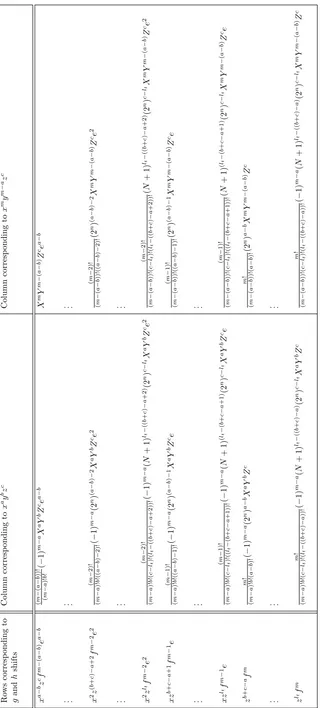
Remove columns in Mscorresponding to the coefficients of the variable xaybzc for all 0≤a≤m−1 and
note that every such column ism(m−−(aa−)!bb)!· 1
Xm−aYm−a multiple of a non-removed column, corresponding to the
coefficients ofxmym−(a−b)zc and is proved in the following theorem.
Theorem 4. Each column inMscorresponding to the coefficients of the variablexaybzc, a leading monomial
of the polynomial g or h-shifts, for all 0 ≤a ≤ m−1 ism(m−−(aa−)!bb)!· 1
Xm−aYm−a multiple of a non-removed
column, represents the coefficients of the variablexmym−(a−b)zc.
Proof. For n= 0, ..., m, k1 =m−n, k2 = 0, ..., k1 , the gs-shifts xk1zk2fnek1 corresponds first (16m
3+m2+
11
remaining rows inMs. We prove this theorem in two cases.
Case(i): Any column in first (16m3+m2 +11
6m+ 1) columns of Ms. i.e., a column corresponding
coeffi-cients of a variablexaybzc witha≥b+c, from the above analysis in (1).
Given that 0 ≤ a ≤ m−1. From the above analysis in (1) and (2), the coefficient of xaybzc is non-zero
in gs-shiftsxk1zk2fnek1 if and only ifa≥k1, b≤m−k1, c≥k2 anda−k1≥b+ (c−k2). Ask1≥k2,k2≥0
and a−k1 ≥b+ (c−k2), max{0, k1−(a−(b+c))} ≤k2 ≤min{k1, c} and also as a−k1< b+ (c−k2) for
k1> a−b,k1 is such that 0≤k1≤a−b.
Therefore, the coefficient ofxaybzcis non-zero ings-shiftsxk1zk2fnek1if and only ifa≥k1, b≤m−k1, c≥k2
andk1= 0, ..., a−b, k2= max{0, k1−(a−(b+c))}, ...,min{k1, c}.
Similarly we can prove that, the coefficient of xaybzc is non-zero in h
s-shifts xk1zk2fnek1 if and only if
a≥k1, b≤m−k1, c≥k2andk1= 0, ..., c, k2=k1+1, ...,min{c, k1+t}using the inequalitiesk1+1≤k2≤k1+t,
a≥b+cand analysis in (1) and (2), and say min{c, k1+t}=lt
The formula for finding a coefficient of a variablexl1yl2zl3= (1)n−l1xl1−(l2+l3)(xz)l3(xy)l2 forl
1≤n−1 infn
is
n!
(n−l1)!(l1−(l2+l3))!l2!l3!)
(−1)n−l1(N+ 1)l1−(l2+l3)(2n)l3
and coefficient ofxaybzc in xk1yk2fnek1 is nothing but a coefficient ofxa−k1ybzc−k2 infn.
Note that a column corresponding to a variable xmym−azc is in the non-removing columns in M
s and
co-efficient ofxmym−azc is zero for k
1> a−b in gs-shifts ,k1 > cin hs-shifts. The columns corresponding to a
variablexaybzc and a variablexmym−azc only with non-zero terms is depicted in Table 1.
Therefore, from Table 1 the result holds in this case.
Case(ii): Any column in remaining 12(m2+m)t+ (m+ 1)t
columns of Ms, i.e.,a column corresponding
coefficients of a variablexaybzc witha < b+c, from the above analysis in (1).
The coefficient of xaybzc is non-zero in gs-shifts xk1zk2fnek1 if and only if a ≥ k1, b ≤ m−k1, c ≥ k2,
a−k1≥b+ (c−k2) and note for a < b+c,a−k1< b+ (c−k2) as k1 ≥k2 in gs-shifts. So the coefficient of
xaybzc is zero in all rows corresponding togs-shifts.
The coefficient of xaybzc is non-zero in h
s-shifts xk1zk2fnek1 if and only if a ≥ k1, b ≤ m−k1, c ≥ k2 and
a−k1 ≥b+ (c−k2). For k1 > a−b, a−k1 < b+ (c−k2) and from the inequalities k1+ 1≤k2 ≤k1+t,
a−k1 ≥ b+ (c−k2), we have the coefficient of xaybzc is non-zero in hs-shifts xk1zk2fnek1 if and only if
a≥ k1, b ≤m−k1, c≥k2 and k1 = 0, ..., a−b, k2 = max{k1+ 1, k1+ (b+c)−a}, ...,min{c, k1+t}. Take
lt= min{c, k1+t}.
Note that coefficient of xmym−azc is zero in all g
s-shifts as a > c and for k1 > a−b in hs-shifts. The
columns corresponding to a variablexaybzc and a variablexmym−azc only with non-zero terms is depicted in
Table 2. Therefore, from Table 2 the result holds in this case.
Ro ws corresp onding to g and h shifts Column corresp onding to x ay bz c Column corresp onding to x my m − az c x a − bz cf m − ( a − b )e a − b ( m − ( a − b ))! ( m − a )! b ! ( − 1) m − aX aY bZ ce a − b X m Y m − ( a − b )Z ce a − b x a − b − 1z c − 1f m − ( a − b − 1)e a − b − 1 ( m − ( a − b )+1)! ( m − a )! b ! ( − 1) m − a2 nX aY bZ ce a − b − 1 ( m − ( a − b )+1)! ( m − ( a − b ))! 2 nX mY m − ( a − b )Z ce a − b − 1 x a − b − 1z cf m − ( a − b − 1)e a − b − 1 ( m − ( a − b )+1)! ( m − a )! b ! ( − 1) m − a( N + 1) X aY bZ ce a − b − 1 ( m − ( a − b )+1)! ( m − ( a − b ))! ( N + 1) X m Y m − ( a − b )Z ce a − b − 1 . . . . . . . . . x a − b − ( c − 1)z f m − (( a − b ) − ( c − 1)) e a − b − ( c − 1) ( m − ( a − b )+( c − 1))! ( m − a )! b !( c − 1)! ( − 1) m − a(2 n) c − 1X aY bZ ce a − b − ( c − 1) ( m − ( a − b )+( c − 1))! ( m − ( a − b ))!( c − 1)! (2 n) c − 1X m Y m − ( a − b )Z ce a − b − ( c − 1) . . . . . . . . . x a − b − ( c − 1)z cf m − (( a − b ) − ( c − 1)) e a − b − ( c − 1) ( m − ( a − b )+( c − 1))! ( m − a )! b !( c − 1)! ( − 1) m − a( N + 1) c − 1X aY bZ ce a − b − ( c − 1) ( m − ( a − b )+( c − 1))! ( m − ( a − b ))!( c − 1)! ( N + 1) c − 1X mY m − ( a − b )Z ce a − b − ( c − 1) x a − b − cf m − ( a − b )+ ce a − ( b + c ) ( m − ( a − b )+ c )! ( m − a )! b ! c ! ( − 1) m − a(2 n) cX aY bZ ce a − b − c ( m − ( a − b )+ c )! ( m − ( a − b ))! c ! (2 n) cX mY m − ( a − b )Z ce a − b − c . . . . . . . . . x a − b − cz cf m − ( a − b )+ ce a − ( b + c ) ( m − ( a − b )+ c )! ( m − a )! b ! c ! ( − 1) m − a( N + 1) cX aY bZ ce a − b − c ( m − ( a − b )+ c )! ( m − ( a − b ))! c ! ( N + 1) cX mY m − ( a − b )Z ce a − b − c . . . . . . . . . f m m ! ( m − a )! b ! c !( a − ( b + c ))! ( − 1) m − a( N + 1) ( a − ( b + c ))(2 n) cX aY bZ c m ! ( m − ( a − b ))! c !( a − ( b + c ))! ( N + 1) a − ( b + c )(2 n) cX m Y m − ( a − b )Z c x c − 1z cf m − ( c − 1) e c − 1 ( m − ( c − 1))! ( m − a )! b !( a − ( b + c )+1)! ( − 1) m − a( N + 1) a − ( b + c )+1 X aY bZ ce c − 1 ( m − ( c − 1))! ( m − ( a − b ))!( a − ( b + c )+1)! ( N + 1) a − ( b + c )+1 X m Y m − ( a − b )Z ce c − 1 . . . . . . . . . xz 2f m − 1e ( m − 1)! ( m − a )! b !( c − 2)!( a − ( b + c )+1)! ( − 1) m − a( N + 1) a − ( b + c )+1 (2 n) c − 2X aY bZ ce ( m − 1)! ( m − ( a − b ))!( c − 2)!( a − ( b + c )+1)! ( N + 1) a − ( b + c )+1 (2 n) c − 2X mY m − ( a − b )Z ce . . . . . . . . . xz
ltf
m − 1e ( m − 1)! ( m − a )! b !( c − lt )!( a − ( b + c )+ lt − 1)! ( − 1) m − a( N + 1) a − ( b + c )+ lt − 1(2 n) c −
ltX
aY bZ ce ( m − 1)! ( m − ( a − b )!( c − lt )!( a − ( b + c )+ lt − 1)! ( N + 1) a − ( b + c )+ lt − 1(2 n) c −
ltX
m Y m − ( a − b )Z ce z f m m ! ( m − a )! b !( c − 1)!( a − ( b + c )+1)! ( − 1) m − a( N + 1) a − ( b + c )+1 (2 n) c − 1X aY bZ c m ! ( m − ( a − b ))!( c − 1)!( a − ( b + c )+1)! ( N + 1) a − ( b + c )+1 (2 n) c − 1X mY m − ( a − b )Z c . . . . . . . . . z
ltf
m m ! ( m − a )! b !( c − lt )!( a − ( b + c )+ lt )! ( − 1) m − a( N + 1) a − ( b + c )+
lt(2
n)
c
−
ltX
aY bZ c m ! ( m − ( a − b ))!( c − lt )!( a − ( b + c )+ lt )! ( − 1) m − a( N + 1) a − ( b + c )+
lt(2
n)
c
−
ltX
mY m − ( a − b )Z c T able 1: A col umn in first (
Ro ws corresp onding to Column corresp onding to x ay bz c Column corresp onding to x m y m − az c g and h shifts x a − bz cf m − ( a − b )e a − b ( m − ( a − b ))! ( m − a )! b ! ( − 1) m − aX aY bZ ce a − b X m Y m − ( a − b )Z ce a − b . . . . . . . . . x 2z ( b + c ) − a +2 f m − 2e 2 ( m − 2)! ( m − a )! b !(( a − b ) − 2)! ( − 1) m − a(2 n) ( a − b ) − 2X aY bZ ce 2 ( m − 2)! ( m − ( a − b ))!(( a − b ) − 2)! (2 n) ( a − b ) − 2X m Y m − ( a − b )Z ce 2 . . . . . . . . . x 2z
ltf
m − 2e 2 ( m − 2)! ( m − a )! b !( c − lt )!( lt − (( b + c ) − a +2))! ( − 1) m − a( N + 1) lt − (( b + c ) − a +2) (2 n) c −
ltX
aY bZ ce 2 ( m − 2)! ( m − ( a − b ))!( c − lt )!( lt − (( b + c ) − a +2))! ( N + 1) lt − (( b + c ) − a +2) (2 n) c −
ltX
m Y m − ( a − b )Z ce 2 xz b + c − a +1 f m − 1e ( m − 1)! ( m − a )! b !(( a − b ) − 1)! ( − 1) m − a(2 n) ( a − b ) − 1X aY bZ ce ( m − 1)! ( m − ( a − b ))!(( a − b ) − 1)! (2 n) ( a − b ) − 1X m Y m − ( a − b )Z ce . . . . . . . . . xz
ltf
m − 1e ( m − 1)! ( m − a )! b !( c − lt )!(( lt − ( b + c − a +1))! ( − 1) m − a( N + 1) ( lt − ( b + c − a +1) (2 n) c −
ltX
aY bZ ce ( m − 1)! ( m − ( a − b ))!( c − lt )!(( lt − ( b + c − a +1))! ( N + 1) ( lt − ( b + c − a +1) (2 n) c −
ltX
m Y m − ( a − b )Z ce z b + c − af m m ! ( m − a )! b !( a − b )! ( − 1) m − a(2 n) a − bX aY bZ c m ! ( m − ( a − b ))!( a − b )! (2 n) a − bX m Y m − ( a − b )Z c . . . . . . . . . z
ltf
m m ! ( m − a )! b !( c − lt )!( lt − (( b + c ) − a ))! ( − 1) m − a( N + 1) lt − (( b + c ) − a )(2 n) c −
ltX
aY bZ c m ! ( m − ( a − b ))!( c − lt )!( lt − (( b + c ) − a ))! ( − 1) m − a( N + 1) lt − (( b + c ) − a )(2 n) c −
ltX
m Y m − ( a − b )Z c T able 2: A co lumn in the last
1 (2
m 2 + m ) t + ( m + 1) t columns of M s and a column corresp onding to co efficien ts of a v ariable x m y m − a z c only with non-zero terms.
From the above theorem, all columns corresponding to a variablexaybzcfor all 0≤a≤m−1 are depending
on a non-removed column, corresponding to a variable xmym−(a−b)zc in M
s. Let Msl be a matrix formed by
removing all above columns from the matrixMs andSl be a lattice spanned by rows of Msl. Then the short
vector inSllead to short reconstruction vector inSL, i.e., ifu= P
b∈B
cbbis a short vector inSlthen this lead to
a short vector ¯u= P
b∈B¯
cbb(same coefficientscb) inSL whereB and ¯B are the basis for SlandSLrespectively.
As we removed all depending columns inMsto form a matrixMsl, apply the lattice based techniques toSl
instead ofSL to get an attack bound and this lattice reduction techniques gives a required short vectors inSL
for a given bound.
The matrix Msl is lower triangular with rows same as in Ms and each column corresponding to coefficients
of one of the variables ( leading monomials ofgs andhs-shifts)
gs-shift
xm, xmz, ..., xmzm,
xmy, ..., xmyzm−1,
.. .
xmym−1, xmym−1z,
xmym,
hs-shift
xmzm+1, ..., xmzm+t,
xmyzm, ..., xmyz(m−1)+t,
.. .
xmym−1z2, ..., xmym−1z1+t,
xmymz, .., xmymzt.
ThereforeSlis a lattice spanned by coefficient vectors of the shift polynomialsgsl(xX, yY, zZ) andhsl(xX, yY, zZ)
where
gsl(x, y, z) =xl1zl2fnel1 forn= 0, ..., m, l1=m−n, l2= 0, ..., l1 and
hsl(x, y, z) =xl1zl2fnel1 forn= 0, ..., m, l1=m−n, l2=l1+ 1, ..., l1+t.
Since Sl is full-rank lattice, detSl = detMsl = en(e)Xn(X)Yn(Y)Zn(Z) where n(e), n(X), n(Y), n(Z) are
denotes the number of e0s, X0s, Y0s, Z0s in all the diagonal elements ofMsl respectively. Asxnyn is a leading
monomial offn with coefficient 1, we have
n(e) =
m
X
n=0
X
l1=m−n
l1
X
l2=0
l1+
m
X
n=0
X
l1=m−n
l1+t
X
l2=l1+1
l1
= (1/3)m3+m2+ (1/2)(m2+m)t+ (2/3)m,
n(X) =
m
X
n=0
X
l1=m−n
l1
X
l2=0
n+l1+
m
X
n=0
X
l1=m−n
l1+t
X
l2=l1+1
n+l1
= (1/2)m3+ (3/2)m2+ (m2+m)t+m,
n(Y) =
m
X
n=0
X
l1=m−n
l1
X
l2=0
n+
m
X
n=0
X
l1=m−n
l1+t
X
l2=l1+1
n
= (1/6)m3+ (1/2)m2+ (1/2)(m2+m)t+ (1/3)m,
n(Z) =
m
X
n=0
X
l1=m−n
l1
X
l2=0
l2+
m
X
n=0
X
l1=m−n
l1+t
X
l2=l1+1
l2
= (1/6)m3+ (1/2)(m+ 1)t2+ (1/2)m2+ (1/2)(m2+ 2m+ 1)t+ (1/3)m
and dim(Sl) =ω=
m
X
n=0
X
l1=m−n
l1
X
l2=0
1 +
m
X
n=0
X
l1=m−n
l1+t
X
l2=l1+1
1
Taket=τ m, then for sufficiently largem, the exponentsn(e), n(X), n(Y), n(Z) and the dimensionω reduce to
ω=
1
2 +τ
m2+o(m),
n(e) =
1
3 +
1
2τ
m3+o(m2),
n(X) =
1
2 +τ
m3+o(m2),
n(Y) =
1
6 +
1
2τ
m3+ (m2),
n(Z) =
1
6 +
1
2τ+
1
2τ
2
m3+o(m2).
Applying the LLL algorithm to the basis vectors of the latticeSl, i.e., coefficient vectors of the shift polynomials,
we get a LLL-reduced basis say{v1, v2, ..., vω} and from the Theorem 1 we have
||v1|| ≤ ||v2|| ≤ ||v3|| ≤2 ω(ω−1)
4(ω−2) det(S
l)
1
ω−2.
In order to apply the generalization of Howgrave-Graham result in Theorem 2, we need the following inequality
2
ω(ω−1)
4(ω−2) det(S
l)
1
ω−2 < e m
√
ω.
from this, we deduce
det(Sl)<
1
2ω(
ω−1) 4(ω−2)√ω
ω−2e
m(ω−2)< 1
2ω(
ω−1) 4(ω−2)√ω
ω−2e
mω.
As the dimensionωis not depending on the public encryption exponente, 1
2 ω(ω−1) 4(ω−2)√ω
!ω−2 is a fixed constant,
so we need the inequality det(Sl)< emω,i.e.,en(e)Xn(X)Yn(Y)Zn(Z)< emω.
Substitute all values and taking logarithms, neglecting the lower order terms and after simplifying by m3
we get
(−1−3τ)α+ (3 + 6τ)δ+ (1 + 3τ)γ1+ (1 + 3τ+ 3τ2)γ2<0.
The left hand side inequality is minimized at τ = α−(2δ+γ1+γ2)
2γ2 and putting this value in the above inequality
we get
δ < 1
2α−
1
2γ1−
1 6
q
6(α−γ1)γ2+ 3γ22.
From the first three short vectors v1, v2 and v3 in LLL reduced basis of a basis B in Sl we consider three
polynomialsg1(x, y, z), g2(x, y, z) andg3(x, y, z) overZsuch thatg1(x0, y0, z0) =g2(x0, y0, z0) =g3(x0, y0, z0) =
0. These short vectors v1, v2 andv3 lead to a short vector ¯v1,v¯2 and ¯v3 respectively and ¯g1(x, y, z),g¯2(x, y, z)
and ¯g3(x, y, z) its corresponding polynomials. Apply the same analysis in paper [2] to the above polynomials to
get the factorspandqof RSA modulusN.
Theorem 5. LetN =pq be an RSA modulus withq < p <2q. Lete=Nα, X =Nδ, Y =Nγ1, Z=Nγ2 and
kbe the multiplicative inverse ofϕ(N) moduloe. Suppose the prime sump+qis of the formp+q= 2nk0+k1,
for a known positive integernand for|k| ≤X,max{|k0|,|k1|} ≤Y and min{|k0|,|k1|} ≤Z one can factorN in
polynomial time if
δ < 1
2α−
1
2γ1−
1 6
q
6(α−γ1)γ2+ 3γ22. (2)
Proof. Follows from the above argument and the LLL lattice basis reduction algorithm operates in polynomial
time [11].
Note that for any given primes pandq withq < p <2q, we can always find a positive integernsuch that
p+q= 2nk0+k1 where 0≤ |k0|,|k1| ≤≈0.25. A typical example is 2n≈ √32N0.25as p+q < √32N0.5 [14]. So
takeγ1 andγ2in the range (0,0.25).
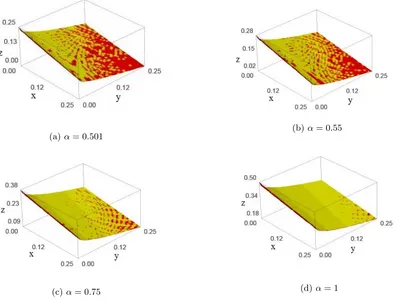
LetδL and δsl be the bounds for δin inequalities (1) and (2) respectively. Then note thatδsl is slightly larger
thanδLand is depicted in Figure 1 forα= 0.51,0.55,0.750 and 1.
(a)α= 0.501
(b)α= 0.55
(c)α= 0.75 (d)α= 1
Figure 1: The region ofδsl andδL forα= 0.501,0.55,0.75,1.
In the Figure 1, x, y, z-axis represents γ1, γ2, bound for δ respectively and yellow, red regions represents
δsl,δL receptively. From this figure, it is noted that the yellow region is slightly above the red region, i.e., δsl
is slightly grater thanδL and this improvement increases when the values ofαincreases.
As the dimension ofLis (1/6)m3+ (1/2)m2(t+ 2) + (1/6)m(9t+ 11) + (t+ 1) fort=α−(2δ+γ1+γ2)
3γ2
m[2]
and Sl is (1/2)m2+ (m+ 1)t+ (3/2)m+ 1 fort =
α−(2δ+γ
1+γ2)
2γ2
m, note the dimension of Sl is (1/6)m3+
(1/3)t(m2−1) + (1/2)m2+ (1/3)m, fort=α−(2δ+γ1+γ2)
2γ2
smaller than the dimension ofL.
4
Conclusion
In this paper, an another attack bound for k, a small multiplicative inverse ofϕ(N) moduloe is given when
the prime sump+qis of the formp+q= 2nk0+k1 wherenis a given positive integer andk0andk1 are two
suitably small unknown integers using sublattice reduction techniques and Coppersmith’s methods for finding small roots of modular polynomial equations. This attack bound is slightly larger than the bound, in the approach using lattice based techniques and requires lattice of smaller dimension than the approach given by using lattice based techniques.
References
[1] P. Anuradha Kameswari and L. Jyotsna,“Cryptanalysis of RSA with Small Multiplicative Inverse of(p−1)
or (q−1) Modulo e”, Journal of Global Research in Mathematical Archives, 5(5), May 2018, 72-81, ISSN:
2320-5822.
[2] P. Anuradha Kameswari and L. Jyotsna,“Cryptanalysis of RSA with Small Multiplicative Inverse of ϕ(N)
Moduloeand with a Composed Prime Sump+q”, International Journal of Mathematics And its Applications
6(1-C)(May 2018), 515-526, ISSN: 2347-1557.
[3] Boneh, D.“Twenty Years of Attacks on the RSA Cryptosystem”, Notices Amer. Math. Soc. 46 (2), 203-213,
[4] Boneh, D., Durfee, G.“Cryptanalysis of RSA with private key d less thanN0.292”, Advances in Cryptology
Eurocrypt99, Lecture Notes in Computer Science Vol.1592, Springer-Verlag, pp. 111 (1999)).
[5] J. Blomer, A. May, “Low Secret Exponent RSA Revisited”, Cryptography and Lattice Conference (CaLC
2001), Lecture Notes in Computer Science Volume 2146, SpringerVerlag, pp. 419, 2001.
[6] D. Burton,“Elementary Number Theory”, Sixth edition, Mc Graw Hill, New York, 2007.
[7] Coppersmith, D. “Small solutions to polynomial equations, and low exponent RSA vulnerabilities”. Journal
of Cryptology, 10(4), pp. 233260 (1997).
[8] Howgrave-Graham, N. “Finding small roots of univariate modular equations revisited”, In Cryptography
and Coding, LNCS 1355, pp. 131142, Springer-Verlag (1997).
[9] PA Kameswari, L Jyotsna, “Extending Wiener’s Extension to RSA-Like Cryptosystems over Elliptic
Curves”, British Journal of Mathematics & Computer Science 14 (1), 1-8.
[10] Jochemsz, E., May, A. “A strategy for finding roots of multivariate polynomials with new applications in
attacking RSA variants”, in: ASIACRYPT 2006, LNCS, vol. 4284, 2006, pp. 267-282, Springer-Verlag.
[11] Lenstra, A.K., Lenstra, H.W., Lovasz,L. “Factoring polynomials with rational coefficients, Mathematische
Annalen”, Vol. 261, pp. 513534, 1982.
[12] May, A.: “New RSA Vulnerabilities Using Lattice Reduction Methods”,. PhD thesis, University of
Pader-born (2003). Available at http://wwwcs.upb.de/cs/ag-bloemer/personen/alex/publikationen/
[13] Neal Kobliz,“A Course in Number Theory and Cryprography” ISBN 3-578071-8, SPIN 10893308.
[14] Nitaj, A.: Another generalization of Wieners attack on RSA, In: Vaudenay, S. (ed.) Africacrypt 2008.
LNCS, vol. 5023, pp. 174190. Springer, Heidelberg (2008).
[15] K. H. Rosen,“ Elemetary Number Theory and Its Applications”, Addison-Wesley, Reading Mass, 1984.
[16] Subhamoy Maitra and Santanu Sarkar,“ RSA Cryptanalysis with Increased Bounds on the Secret
Ex-ponent using Less Lattice Dimension”,. Cryptology ePrint Archive: Report 2008/315, Available at
http://eprint.iacr.org/2008/315.
[17] Subhamoy Maitra and Santanu Sarkar, “Revivting Wiener’s Attack - New Weak Keys in RSA”,
http://eprint.iacr.org/2005/228.pdf.
[18] H. -M. Sun, M. -E. Wu and Y. -H. Chen. “Estimating the prime-factors of an RSA modulus and an
extension of the Wiener attack”. ACNS 2007, LNCS 4521, pp. 116128, 2007.
[19] B. de Weger, “ Cryptanalysis of RSA with Small Prime Difference”, Applicable Algebra in Engineering,
Communication and Computing, 13(1);17-28,2002.
[20] M. Wiener,“ Cryptanalysis of Short RSA Secret Exponents”, IEEE Transactions on Information Theory,
36(3)-553-558, 1990.