University of South Carolina
Scholar Commons
Theses and Dissertations
2015
Processing of Garden-Path Sentences Containing
Silent and Filled Pauses in Stuttered Speech:
Evidence From a Comprehensive Study
Elena Galkina
University of South Carolina - Columbia
Follow this and additional works at:https://scholarcommons.sc.edu/etd
Part of theLinguistics Commons
This Open Access Thesis is brought to you by Scholar Commons. It has been accepted for inclusion in Theses and Dissertations by an authorized administrator of Scholar Commons. For more information, please [email protected].
Recommended Citation
P
ROCESSING OFG
ARDEN-P
ATHS
ENTENCESC
ONTAININGS
ILENT ANDF
ILLEDP
AUSES INS
TUTTEREDS
PEECH:
E
VIDENCE FROM AC
OMPREHENSIVES
TUDYby
Elena Galkina
Diploma of Specialist
Southwest State University, Russia, 2012
Submitted in Partial Fulfillment of the Requirements
For the Degree of Master of Arts in
Linguistics
College of Arts and Sciences
University of South Carolina
2015
Accepted by:
Stanley Dubinsky, Co-Director of Thesis
Robin Morris, Co-Director of Thesis
A
BSTRACTDisfluency is common in spontaneous speech. Self-correction is a type of
disfluency that consists of reparandum, filler, and repair (Levelt, 1989). Little is known
about the processing of self-corrections in a normally disfluent speech, and even less is
known about its processing in atypically disfluent speech (e.g. speech in patients with
autism spectrum disorder, hearing impaired, patients with brain damage, and stuttered
speech; see: Lake, Humphreys, & Cardy, 2011; Lind, Hickson, & Erber, 2004; Plexico et
al., 2010; Rossi et al., 2011; Yairi, Gintautas, & Avent, 1981).
This study focuses on self-correction disfluencies in garden-path sentences and
employs a behavioral data collection method to investigate how disfluencies are
processed as they are heard. This experiment examines spoken language comprehension
by measuring accuracy and response time to comprehension questions. The data was
gathered and analyzed.
Two experimental conditions were presented where in the first one normal
speakers listened to typically disfluent speech, and in the second one normal speakers
listened to atypically disfluent stuttered speech. The information about the speakers in the
recorded stimuli was kept from the listeners.
Fillers, such as uh and um are common in stuttered speech because of their helpful
the hypothesis of this study was that the fillers and pauses made by people who stutter
affect the dynamics of processing, particularly in garden-path sentences. Namely, the
accuracy rate for the comprehensive questions was predicted to be lower for the
garden-path filled pause sentences, particularly for atypical speaker condition. Reaction time was
predicted to be longer for the same condition. The analysis revealed an accuracy measure
dependence on the speaker condition but no significant time correlation.
This study provides significant information about how normal speakers’
comprehension is affected by disfluency such as pauses in general, and how speech
impairment, such as stuttering, affects the processing of filled and silent pause
T
ABLE OFC
ONTENTSABSTRACT ... iii
LIST OF FIGURES……….vi
LIST OF ABBREVIATIONS ... vii
CHAPTER 1:LITERATURE REVIEW………1
CHAPTER 2:BEHAVIORAL EXPERIMENT ...15
2.1METHODS ...15
2.2ANALYSIS ...20
2.3 DISCUSSION...23
REFERENCES ...34
APPENDIX A–TABLE A.LIST 1:TYPICAL DISFLUENT SPEECH ...41
APPENDIX B–TABLE B.LIST 2:ATYPICAL DISFLUENT SPEECH ...44
APPENDIX C–POST-VERB STIMULI INFORMATION ...47
L
IST OFF
IGURESFigure 1.1 Parts of self-correction ...2
Figure 2.1 Interaction plot for incorrect yes responses ...23
Figure 2.2 While the cat attacked-uh uh-the dog barked loudly. Uh uh as a word...25
Figure 2.3 While the cat attacked-uh uh-the dog barked loudly. Uh uh as a signal ...26
L
IST OFA
BBREVIATIONSFP ... Filled Pause
GP ... Garden-Path
SP ... Silent Pause
GPFP ... Garden-Path Filled Pause
GPSP ... Garden-Path Silent Pause
PWNS ... People Who do Not Stutter
CHAPTER
1
L
ITERATURER
EVIEWDisfluency is a common process occurring in spontaneous speech, and is defined as
“phenomena that interrupt the flow of speech and do not add propositional content to an
utterance” (Fox Tree, 1995, p. 709). An approximate rate of disfluencies in spontaneous
speech (without silent hesitations) is 6 words per 100 (Fox Tree, 1995). A disfluency is a
break or interruption of the fluent flow of the speech. There are several types of
disfluencies: (1) filled pauses (FPs); (2) silent pauses (SPs); (3) repetitions; (4)
self-corrections; (5) false starts.
(1) I went to the movie…uh…to the bar.
(2) I went to the movie….to the bar.
(3) I went to …I went to the movie.
(4) I went to the movie…I mean, to the bar.
(5) I went to the, I saw “Interstellar.”
According to Levelt (1989), disfluent speech is a problem for listeners who have
to work on disfluency processing in order to understand utterances. This work includes
identifying reparandum, which is a part of the utterance that contains fluent speech until
the interruption site or the edit interval where the speaker stops speaking fluently; it often
begins at the interruption site and ends with the onset of the repair. The edit interval,
follows a pause in the speech, and may include a filler, such as uh or um, typically with a
long vowel duration, or just remain a silent pause (Shriberg, 2001). The repair may or
may not retrace material from reparandum (Brennan & Schober, 2001). The repair
interval is a part of the utterance that occurs immediately after the edit interval, and
simultaneously with the repair (Levelt, 1983; Nakatani & Hirshberg, 1994).
According to Levelt (1983) all disfluencies can be regarded as one major type - a
self-correction disfluency, which can be depicted in the following scheme:
Figure 1.1 Parts of self-correction
This figure is an example of a sentence that contains disfluency. The first part of it
is the fluent speech Move to the red, which is the original delivery (Levelt, 1983).
Reparandum, the word to be repaired, is a part of the original delivery, therefore, is a part
of the fluent speech. Uh is a filler, that is a filled pause disfluency. Blue is a repair, the
word that replaces red. After the repair the speaker continues his fluent speech with dot.
Levelt named this part of the utterance a resumed delivery. Self-corrections in speech are
common. Bortfeld et al. (2001) report 1.94 “restarts” per 100 words across a series of
dialogue tasks (p. 134). “Restarts” require the listener to disregard the already spoken
information, and any predictions made based on that information, in order to understand
Levelt (1983) differentiates between two types of self-corrections. There are
covert repairs that are made to inner speech, and overt repairs that consist of the
reparandum, the edit material, that is fillers, and the repair. Results from the studies on
speech of healthy speakers show that fillers such as uh and um occur more often at the
beginning of utterances and constituents, and increase in frequency in the case of the
upcoming material is longer and more complex (Maclay & Osgood, 1959; Oviatt, 1995;
Shriberg, 1996). In the utterance, the repair replaces the reparandum (Corley, 2010). The
repair may be preceded by a repetition of all or part of the pre-reparandum utterance
(Nakatani & Hirschberg, 1994); or it is given contrastive stress, compared to the
reparandum (Howell & Young, 1991; Levelt & Cutler, 1983).
According to Levelt (1983), self-corrections generally employ single-word
reparandum-repair pairs. Additionally, in a self-correction, speakers usually suspend their
utterance only after they have planned some components of the repair, leading them to
continue speaking beyond the error and requiring speakers to backtrack, that is when
making a repair speakers return to the point of (or before the point of) the reparandum.
(Seyfeddinipur, Kita, & Indefrey, 2008). Due to the tendency to continue speaking until
the repair is planned, speakers usually do not interrupt themselves at the point of the
reparandum.
A study by Brennan and Schober (2001) investigated interruptions and found that
mid-word interruptions with fillers (Move to the yel- uh, purple square) were easier for
listeners to process than between-word interruptions (Move to the yellow- purple square).
Their experiment showed that listeners who heard less misleading information before the
allowed for more time after the interruption site to dismiss the misleading information.
Listeners responded fastest to words preceded by a mid-word interruption with a filler.
The phonological form of the filler was not responsible for the faster responses and
higher accuracy rates, but the extra time during the production of the filler and before the
repair affected the results. This conclusion was supported in the experiment in which
utterances included silent break pauses of equal length as fillers. Therefore, the length of
the pause, not the content (filled or silent) was a significant measure. The earlier the
speaker interrupts a reparandum, that is the word to be repaired, the better for the listener
because this gives him/her extra time to terminate the unintended part of the message
regardless of wether the pause after the interruption if filled of silent (Brennan &
Schober, 2001).
All speech disfluencies are regarded as “noise” and considered to be difficult to
perceive even when they do not convey any linguistic information, and simply
represented by extended silent breaks (Brennan & Schober, 2001). This fact may be the
reason why any radio and written media tend to eliminate disfluencies from the spoken
and written discourse (Fox Tree, 2001). However, research shows that disfluencies can
actually help the listener comprehend what was being said (Brennan & Schober, 2001;
Fox Tree, 2001; Arnold et al., 2003, 2004; Collard at al., 2008; Corley et al., 2007;
Ferreira et al., 2004; Fox Tree & Schrock, 1999; Howell & Young, 1991). Disfluencies in
a spontaneous utterance delay the onset of the following word. Listeners evaluate
utterances that contain self-corrections as more comprehensible when the repairs are
preceded by pauses (Howell & Young, 1991). The results obtained from Howell and
upcoming words. Different filled pauses can represent different lengths of delay, and can
heighten attention for upcoming speech, so that attention can be distributed in various
ways that are appropriate to the specific filled pause that occurs (Corley & Hartsuiker,
2011).
The delays in a spontaneous speech might make the comprehender’s segmentation
task easier due to the fact that sounds that cause a delay are likely not to be the property
of the same word, such as yellow-purple, a reparandum-repair pair, which phonological
properties are completely different. Another possibility is that delays help top-down
processes: the more time passes, the more time there is to make top-down predictions
about the next word. Finally, it may be the case that attention builds up over the course of
any delay (Corley & Hartsuiker, 2011).
Corley and Hartsuiker’s (2011) findings are different from a similar study by Fox
Tree (2001), which showed an uh-advantage, but no um-advantage in a word-prediction
task. This result was based on the assumption that uh and um signal contrastive
differences in delay (Clark & Fox Tree, 2002). Corley and Hartsuiker’s study found an
effect from the um filler as well. Their explanation of Fox Tree’s (2001) results was that
the ums were preceded and followed by lengthy silent pauses, which were left in the
“fluent” control stimuli. Corley and Hartsuiker came to two possible conclusions: delay
helps word recognition because it allows time for top-down processes to affect
recognition processes, and delay does not affect the mechanism of word recognition
itself, but rather manipulates attention that affects recognition. Any delay in speech will
Besides filled pauses such as uh and um, silent pauses is a similar type of
disfluencies; it is an unfilled, in other words, empty pause. Silences in a spontaneous
speech can be used for different reasons: as a rhetorical tool or to maintain the prosodic
structure. Additionally, silences can reflect difficulty in planning or retrieving upcoming
words (Goldman-Eisler, 1958 a, b; Kircher et al., 2004; Maclay & Osgood, 1959). Silent
pauses occur in circumstances similar to filled pauses, disrupting the temporal flow of
speech, and delaying the onset of subsequent information. Silent pauses disfluencies
impose difficulty for listeners’ processing and recall of the linguistic material they
interrupt (MacGregor, Corley, & Donaldson, 2010).
Still little is known about the processing of disfluencies in a normally fluent
speech, and even less is known about their processing in atypically fluent speech (Lake,
Humphreys, & Cardy, 2011; Lind, Hickson, & Erber, 2004; Plexico et al., 2010; Rossi et
al., 2011; Yairi, Gintautas, & Avent, 1981).
According to Levelt (1989) and Postma (2000), a communication disorder such as
stuttering involves a linguistic planning impairment, an impairment of the mechanisms
that monitor planning of an utterance. Due to the phonological impairment, people who
stutter (PWS) tend to produce multiple phonological speech errors internally, which are
corrected by the self-monitor mechanism. The editing interval, which contains the
interruption and restart, results in disfluencies and the type of disfluency depends on the
moment of interruption (Lickley et al., 2005).
Repetition is another characteristic of a stuttered speech. Repetitions typically
occur in similar linguistic situations to disfluencies, such as er, and may reflect similar
facilitative effect when participants are asked to monitor for subsequent words (Fox Tree,
2001; Fox Tree & Schrock, 1999), whereas repetitions appear to have little effect on
processing (Fox Tree, 1995; MacGregor et al., 2009). MacGregor et al. (2009) suggest
that repetitions and ers may involve similar post-disfluency processes that occur as
listeners continue fluent processing after an interruption.
A number of studies investigated the influence of stuttering on listeners’ ability to
recall information. Sander (1965) was the first to confirm that what listeners remember
when listening to stuttered speech can be influenced by what they are instructed to focus
on. If listeners are told to focus on actual stuttering, they will recall fewer details about a
story. Hulit (1976) examined whether the type of disfluency (part-word repetitions and
prolongations) as well as the information load of a word that contained stuttering
influenced listeners’ comprehension. Listeners who heard the story that contained
repetitions and sound prolongations on less important words showed the poorest recall,
whereas producing sound prolongations on more important words heightened
comprehenders’ attention to the disfluent words. Therefore, listeners’ attention seems to
be affected by the information load of the stuttered word than the type of stuttering.
Additionally, Panico and Healey (2009) noted that the information load of the stuttered
word influences listener’s attention more than the type of produced stuttering.
Various studies investigated how listeners comprehend stuttered speech based on
the severity of the disorder. Following and comprehending an utterance produced by a
speaker with mild stuttering is easier for a listener (Healey, 2010). Cyprus et al.’s (1984)
study provided evidence that mild stuttering might have an insignificant influence on
effort to follow the speech when the stuttering rate increases. In Cyprus et al.’s
experiment when listeners were not explicitly told to focus on the content of the spoken
information but simply to listen and comprehend, the results were different form Hulit
(1976). The results showed poor recall on words with high content information produced
by PWS severely compared to no stuttering condition. Listeners’ recall ability was not
affected by mild stuttering. The data from Cyprus et al.’s study show that listeners can
comprehend the message of a story even if they cannot remember specific details about it
due to the severity of the stuttering (Panico & Healey, 2009).
Another study by Franken et al. (1997) compared pre-treatment and
post-treatment speech and found that the PWS were rated lower in the communicative
suitability than the control speakers, but the stuttered speech was rated as more
acceptable after treatment than before treatment in all communication contexts.
Fillers, such as uh, improve performance in a word-identification task (Fox Tree,
2001), perhaps because attention to what follows is heightened (Collard et al., 2008; Fox
Tree, 2001). They affect the ease with which words are integrated into their contexts
(Corley, MacGregor, & Donaldson, 2007), and influence the parsing of garden-path
sentences (Bailey & Ferreira, 2003, 2007). Listeners are more likely to remember words
that occur immediately post-disfluency (Collard et al., 2008; Corley et al., 2007).
Speakers are rated as less confident in their answers to general knowledge questions if
their responses are preceded by fillers (Brennan & Williams, 1995; Smith & Clark, 1993;
Swerts & Krahmer, 2005).
Bailey and Ferreira (2003), Ferreira and Bailey (2004), Ferreira and Henderson
syntactic parsing, and that listeners might use the presence of these fillers to help resolve
a garden-path sentence. Additionally, they hypothesized that filler can function as a
signal for the listeners, who tend to assume that fillers precede a more syntactically
difficult constituent. Fillers also seem to direct attention to subsequent material,
facilitating the material’s recall (Fraundorf & Watson, 2011). Ferreira and Henderson
(1991) suggested that the extra material (such as modifiers) increase the amount of time
that the incorrect parsing is maintained. This fact implies the commitment of the parser to
an initial interpretation and makes the revision difficult. Bailey and Ferreira (2003)
continued research in the same direction and found evidence that filled pause disfluencies
have an influence on syntactic analysis. Filled pauses cause the parser to linger on a
current interpretation of the sentence and, consequently, increase the amount of time
required to process it. Therefore, filled pauses show an effect similar to lexical
information. In filled pause conditions, listeners were more likely to place a phrase
boundary correctly in an ambiguous structure (such as garden-path sentence) when the
position of a filled pause was consistent with a phrase boundary, and less likely to make a
correct decision when the position of the filled pause was inconsistent with the phrase
boundary. This suggests that Bailey and Ferreira treat filled pauses as an extension (e. g.
a modifier) of the first (incorrectly analyzed) phrase because they claim that
comprehenders build the structure of the sentence incrementally as they hear the
sentence. Additionally, Bailer and Ferreira underline two hypotheses for the explanation
of how the parser processes pause disfluencies. According to the first one, the speechlike
hypothesis, the comprehender deals with all speechlike sounds similarly, in other words
pause disfluency would be parsed as a part of the subordinate clause. According to
another view, the signaling hypothesis, the initial parsing depends on the comprehender’s
use of any type of cue in the utterance to help him parse the structure correctly. That is, if
the comprehender uses pause disfluency as a cue to a phrase boundary, then the
occurrence of a pause before a noun phrase, which could be interpreted as both the
subject of a main clause and the object of a subordinate clause, would cause the
comprehender to eliminate the possibility of initial incorrect parsing, that is the
assignment of the noun phrase to the subordinate clause. In other words, Bailey and
Ferreira suggest that if the position of the pause is consistent with a clause boundary, the
parser would interpret the sentence correctly.
According to the garden-path model (Ferreira & Clifton, 1986; Frazier, 1978), the
system of human language processing initially generates one syntactic interpretation
without consideration of context. Once an interpretation has been chosen, other
information is used to evaluate its plausibility. Ferreira, Bailey, and Ferraro (2002)
illustrated a garden-path model statement with the following example of an ambiguous
sentence Mary saw the man with the binoculars. Here, the comprehender could initially
understand the sentence to mean that Mary used the binoculars as an instrument.
However, if the comprehender would later change his interpretation and state that the
man had the binoculars, the initial parsing would be revised. In more complex
garden-path sentences that contain two verb phrases (main and subordinate clauses), such as
While Anna dressed the baby played in the crib, the initial misinterpretation lingered and
caused parsers to process the baby as both the subject of played and the object of dressed.
Lau and Ferreira (2005) stated that certain prosodic features act as signals that the
parser should implement Overlay, which is a process that occurs when the parser
encounters a lexical item, with which he generates associated elementary tree, then
searches for a substitution site in a current structure, and includes the elementary tree into
that structure. Intonational cues may guide the process of aligning the two syntactic trees.
The Overlay occurs when the parser cannot find a substitution site for a newly generated
elementary tree. The notion of Overlay procedure implies that the parser must firstly
recognize he has encountered a disfluency involving a reparandum and a repair, secondly
he must find the point at which the reparandum began, and then get rid of the reparandum
material from the ongoing parse and replace it with the corrected material. Ferreira, Lau,
and Bailey (2004), and Lau and Ferreira (2005) found evidence for a particular model of
disfluency processing for ambiguous sequences, in which the reparandum must be
reprocessed when a word is encountered that cannot be fit in the ongoing analysis. To
illustrate this process a sentence, such as You should put drop the ball can be used, where
the simultaneous presence of a reparandum put and a repair drop means that the sentence
has two verbs, and, therefore, can be perceived as ungrammatical by the comprehender.
The repair, or the second verb initiates syntactic reanalysis similar to the one that has
been observed for garden-path sentences.
Ferreira, Bailey, and Ferraro (2002) stated that when the parser encounters a
problem, he only engages in the minimum necessary processes to create an interpretation
of the sentence. This language processing system’s phenomenon is called “good-enough”
comprehender employs minimum processing abilities by attaching the first most plausible
word put to what was previously said.
“Good-enough” parsing can be specifically implemented to study garden-path
(GP) sentences. Ferreira, Christianson, and Hollingworth (2001) observed that in GP
sentences listeners show signs of reanalysis processes and succeed in obtaining a subject
for the main clause. However, this reanalysis is generally incomplete, and, therefore,
often an interpretation of the subordinate clause. They provide the following example:
While the man hunted the deer ran into the woods. A question Did the man hunt the
deer? to the subordinate clause would probe the comprehension of the GP. If listeners
succeed in a full syntactic reanalysis they would answer no to the comprehension
question. If they responded yes to comprehension question, that would be the evidence
for an incomplete reanalysis and the wrong assignment of the thematic roles in the
sentence structure (the deer as the object of the subordinate clause).
This idea corresponds with Fodor and Inoue’s (1998) principle Attach Anyway
and Adjust. In the Attach Anyway part the parser is prompted to attach an incoming
element regardless of whether it fits into the current structure. At this moment the parser
ignores the ungrammaticality of the sentence that he recently processed. The Adjust
function attempts to resolves the ungrammaticality in a minimal fashion, so the
adjustment may result in yet another conflict elsewhere in the syntactic tree. If an
optionally transitive verb is present, the parser assumes a number of argument positions,
so a post-verbal noun phrase is changed to the verb’s theme. This notion is referred to as
Bailey and Ferreira (2003) showed that a disfluency that adds no propositional
content to a sentence, such as the filled pause, uh, can elicit the head noun position effect,
which is a phenomenon that has been previously examined with postnominal modifiers
(Ferreira & Henderson, 1991). The modifiers that occur before the ambiguous noun
flower (the beautiful flower, the red and beautiful flower) did not significantly affect the
comprehension, whereas the modifiers that occur postnominally (the flower that was red)
affected the comprehension and evoked the head noun potion effect. Bailey and Ferreira
claimed that the head noun position effect is generated both when people experience
disfluencies and when they experience modifying words in the same position. They
underlined this statement as the first evidence that disfluencies systematically influence
the operation of the parser. They claimed that the comprehender experiences more
difficulties revising the incorrect structure when disfluencies occur in a location which
causes the comprehender to remain committed to the wrong analysis longer.
Additionally, both disfluencies and modifiers delay the onset of the disambiguating word
in a structure where disfluencies and modifiers occur postnominally (Ferreira &
Henderson, 1991).
In another experiment, Bailey and Ferreira replaced the disfluencies with
environmental sounds, such as a ringing telephone, meowing, or sneezing. They found
that if disfluencies are in positions that make them helpful cues in interpreting the correct
structure, the parsers judge the sentences as grammatical more often than sentences with
no disfluencies. They also found that the parser was sensitive only to the presence of an
might be able to predict the structure when any interruption occurs, regardless of the
actual content of that interruption (Bailey & Ferreira, 2003).
An important innovation of the present study is the extension of current theories
of spoken language comprehensions to typical disfluencies processed in the context of
typical speech as well as in the context of atypically disfluent speech. Additionally, this
study will provide significant information about how the speech of individuals with
communication disorders, such as stuttering, is processed by healthy individuals. The
ultimate goal of this research is to understand the processes that underlie the
comprehension of stuttered speech in order to improve the effectiveness of
CHAPTER 2
B
EHAVIORALE
XPERIMENT2.1 METHODS
Participants
40 participants were recruited from the student body of the University of South
Carolina-Columbia. These participants were native speakers of English, with normal
hearing, and no reported history of speech disfluency. They participated in the study for a
credit in a psychology class.
Stimuli
The study used a between-subjects design to allow us to compare how listeners
interpret the speech of PWS versus PWNS (Hanulíková et al., 2012). Based on the
previous research, the traditional approach to creating stimuli for disfluency experiments
is to use constructed examples (Arnold, Fagnano, & Tanenhaus, 2003; Arnold et al.,
2007; Ferreira & Bailey, 2004; MacGregor, Corley, & Donaldson, 2010). This method
provides stimuli that sound natural and have the linguistic properties needed to test a
particular hypothesis. For this study, the constructed stimuli approach was used both with
PWNS and PWS. That is, the stimuli were not taken from a corpus of spontaneous speech
but constructed specifically for the purpose of the experiment.
1) garden-path filled pause (GPFP) - garden-path sentence containing a filled pause
uh uh before the disambiguating verb
While the cat attacked the dog uh uh barked loudly;
2) garden-path silent pause (GPSP) - garden-path sentence containing a silent break
before the disambiguating verb
As the audience watched the dogs [silent pause] barked at the judges;
3) filler - non-garden-path (non-GP) sentence that did not contain a pause
As the man arrived the poodle barked loudly.
Each list contained 90 sentences: 30 GPSP, 30 GPFP, and 30 non-garden-path
fillers. Sentence structure and lexical content was similar between all conditions. All 90
sentences included a subordinate clause followed by a main clause. In the 60 garden-path
sentences the verb in a subordinate clause was transitive. Identical verbs were used in all
conditions (GPFP, GPSP, non-GP-filler). However, the post-verb information differed
across the conditions and was mostly represented by a prepositional phrase. For
additional information on post-verb information across conditions see Appendix 1, 2,
3.The sentence stimuli were spoken and recorded for two conditions non-stuttered
(typically disfluent speech) and stuttered (atypically disfluent speech).
The typical disfluent stimuli were taken from a published study by Maxfield et al.
(2009). Detailed information about the characteristics of the garden-path stimuli and
fillers in the fluent condition is available in Maxfield et al. (2009).
Comprehension questions
There was a comprehension question in the middle of the computer screen after
phrase (NP), particularly whether the second NP was processed as object/theme of the
subordinate clause, or as subject/agent of the main clause.
However, comprehension questions to fillers, which were used to diffuse
participants’ attention, tested only the main clause of the sentence. The responses to
fillers were not examined in the post-experimental data analysis. As for the tested
conditions, for example, in GPFP and GPSP the question about the subordinate clause
was Did the cat attack the dog? The correct response to this type of question was no in all
cases. In the filler sentence, the comprehension question was based on the main clause,
such as Did the poodle bark loudly? or Did the poodle bark quietly? The comprehension
questions for the fillers were made so that both lists included an equal number of yes and
no correct responses (15 yes and 15 no responses in each list).
Recordings
There were two lists in this experiment. Each participant heard the stimuli from
only one list. List 1 examined how healthy listeners comprehend normally disfluent
speech containing filled and silent pauses produced by a speaker who had undergone
speech treatment for stuttering. List 2 investigated how healthy listeners comprehend
atypically disfluent speech from a speaker who had undergone speech treatment but
stutters.
Speaker
All stimuli conditions (non-stuttering and stuttering) were obtained from one
person with an established history of developmental stuttering that has persisted into
adulthood but who has been recruited to participate in a reputable stuttering treatment
record the stimuli because of his ability to control stuttering, which was acquired during
the speech treatment sessions. Therefore, he was able to record non-stuttering and
stuttering stimuli. The Lidcombe Behavioral Data Language of Stuttering (Teesson,
Packman, & Onslow, 2003) was used to analyze the samples of stuttered speech. The
recorded stimuli from the selected speaker were analyzed for the intensity, duration, and
pitch. The information regarding the specific qualities of the recorded stuttered speech
stimuli is important because it shows the features of a typical PWS.
Fillers
The same speaker created the fillers for both lists. 10% of the filler sentences
include items spoken with speech Controls OFF (the speaker did not use his acquired
ability to control stuttering), both to maintain ecological validity (it is difficult for a
speaker to speak with Controls ON flawlessly for a long period of time) and to give
listeners implicit evidence that the utterances they are listening to were spoken by a
person with a speech disorder. Thirty non-GP fillers will be included in each list.
Comprehension questions to fillers will probe only the main clause.
Experimental design
The study employed comprehension questions after each trial. This approach is
useful in investigating how listeners parse garden-path sentences, whether they interpret
the sentences correctly or not. This method is employed in Christianson et al.’s (2001)
study, where the participants were less likely to answer questions about subordinate
clauses correctly than questions about main clauses. For instance, regarding the
garden-path sentence, While the cat attacked the dog barked loudly, the correct answer to the
comprehender is required to revise his initial assignment of the cat as the object/theme of
the subordinate clause. For the subordinate clause question, Did the cat attack the dog?,
in which the correct answer is no, the comprehender is required to revise and dismiss the
original interpretation of the dog as the object/theme.
The study attempted to find out how garden-path sentences containing
disfluencies, such as filled and silent pauses produced by PWS are processed by PWNS.
In a syntactically ambiguous sentence, listeners initially have a stronger commitment to
the ultimately incorrect analysis than to the correct analysis. When disambiguating
material is encountered, the commitment shifts. Using comprehension questions, we
collected behavioral data on the frequency of incorrect yes-responses to questions about
ambiguous regions in garden-path sentences. Additionally, we measured the response
times in order to find which conditions evoked more processing difficulties.
Following standard practice in psycholinguistics, each sentence was seen only
once per list, but across items all conditions of the experiment were represented.
Sentences were assigned to conditions using a Latin-square procedure.
Procedure
Participants were tested individually in a quiet room. Before the experiment began
participants were asked to sign two consent forms. They were informed that they were
participating in an experiment on sentence comprehension. Participants were not told
any information about the speaker. Each participant read the instruction for the
experiment on a computer screen. The command, Press the Space bar to hear the next
sentence, was presented on the screen before each trial. After each sentence had played a
the ambiguous region from the sentence. It took less than 30 min for each participant to
complete the experiment.
2.2 ANALYSIS
We analyzed participants’ responses and the time it took them to answer each
question. The data was examined using the general linear model. Separate analyses for
the between-subjects factor Speaker Type (typical disfluent vs. atypical disfluent) was
employed. Planned comparisons and post-hoc contrasts were used where appropriate to
compare individual condition means. Accuracy rates for sentence type (GPSP, GPFP)
were analyzed as within-subjects factors.
We predicted that listeners would be less accurate when replying to
comprehension questions about subordinate clauses in the garden-path filled pause
condition compared to garden-path silent pause condition in a typically disfluent speech.
This result would have been evident that listeners processed filled pause disfluencies as
words, and, therefore, the initial parsing of the garden-path lingered on an initial
interpretation. Listeners are typically more likely to place sentence boundaries in
accordance with pause placement. In the experimental conditions the filled pause
disfluencies occurred before the disambiguating verbs, therefore, it was where the clause
boundary would have been placed by the listener. Answering the comprehension
questions about GPFP sentences would take longer than GPSP sentences due to the
amount of time that the incorrect parsing was maintained, and later revised.
We predicted that in the atypically disfluent speech across the same conditions
there would be even fewer incorrect yes responses to subordinate clause questions, which
disfluent (in our case stuttered) speech. If this prediction was true, it would be evident
that normal listeners processed disfluencies of stuttered speech (such as, t t t table) as
words similar to filled pause disfluencies (uh uh).
However, if the results would have shown that the performance across GPFP and
GPSP did not differ, it would tell us that both garden-path conditions were processed in
the same way, that is, filled and silent pause disfluencies appearing in a same positions in
ambiguous sentences were used similarly by the parser: he would place a clause
boundary when either type of pauses occurred. Another possibility was that pauses
helped parsing by heightening attention for the upcoming information (Corley &
Hartsuiker, 2011).
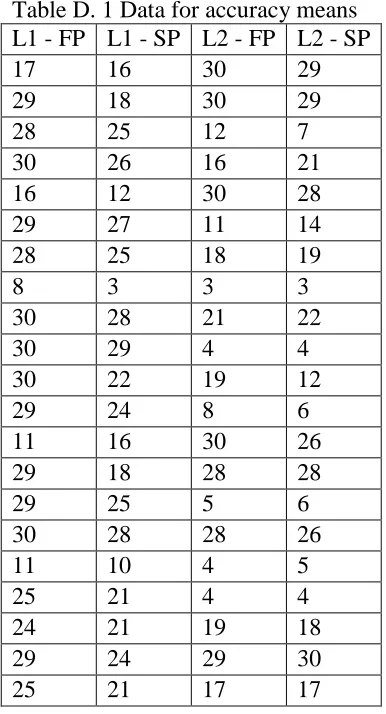
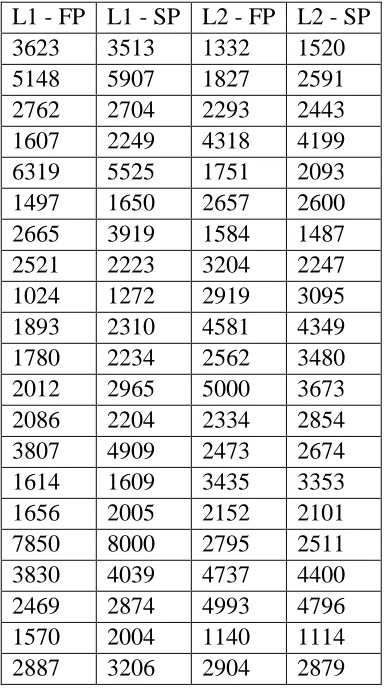
The first step in the analysis was to combine the data into the Table D. 1 and D.2
(see Appendix D). The table shows the results obtained from 40 participants: 20 in each
speaker condition (typical disfluent vs. atypical disfluent). Table D.1 shows the mean of
incorrect yes responses (possible number of incorrect responses is 30) for L1 – FP
(typical disfluent speech with filled pauses), L1 – SP (typical disfluent speech with silent
pauses), L2 – FP (atypical disfluent speech with filled pauses), L2 – SP (atypical
disfluent speech with silent pauses) for each of the 20 participants with a total incorrect
yes responses mean in the last line of the table. The table D.2 contains the means of the
response times for the same conditions L1-FP, L1-SP, L2-FP, and L2-SP. Based on the
preliminary observations we can conclude that the mean for the incorrect yes responses is
higher for filled pause typical disfluent speech condition than for the silent pause typical
disfluent speech condition. The difference between two types of pauses (filled vs. silent)
for incorrect yes responses between two speaker conditions (typical disfluent vs. atypical
disfluent) is significant, and might be an evidence for processing difficulties. The
difference in means for the response times across conditions does not seem to be
significant. A slightly longer response time is observed for the silent pause condition in
the atypical disfluent speech.
In the data analysis for the number of incorrect yes responses as a dependent
variable we found a difference between typical disfluent vs. atypical disfluent speaker
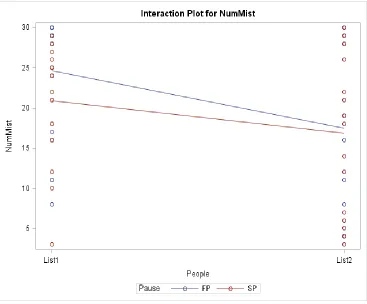
type (F (3;79)=3.25; p<0.0263). There were more incorrect yes responses in both filled
pause and silent pause conditions in the typical disfluent speaker condition (F(3;79)=7.97;
p<0.006) (see Figure 2.1 for the difference between two types of people). However, we
did not find a difference in two pause (filled vs. silent) conditions in the incorrect yes
responses analysis for either speaker conditions (p<0.2818). This result also means that
there is no evidence for the interaction people*pause (p<0.4370). In the analysis with
response time as a dependent variable we found no significant differences between two
types typical disfluent vs. atypical disfluent speaker conditions (p<0.6406). No difference
Figure 2.1 Interaction plot for incorrect yes responses
Due to the fact that some interaction between two speaker conditions (typical disfluet vs.
atypical disfluent) was found, we performed a one-tail t-test. The result of the t-test
showed that the difference between the two types of pauses (filled vs. silent) in the
typical disfluent speaker condition is insignificant (p<0.9448), as well as the difference
between filled and silent pauses in the atypical disfluent speaker condition (p<0.5726).
2.3 DISCUSSION
Disfluencies are common in spoken language. Among the various types of
disfluencies this research was focused on filled and silent pause disfluencies. Two
contradictory views can be proposed: disfluencies either help the comprehender to
process what was being said, or hinder the process of comprehension. The disfluency
a comprehender even without filled or silent pauses. Based on the results of this
experiment, we can conclude that disfluencies, such as filled and silent pauses, create
significant processing difficulties for a comprehender/parser of the sentence.
Christianson et al. (2001) claimed that according to the principle of the “late
closure” (p. 369), when syntax of a sentence permits, the incoming material is attached
inside the clause or phrase currently being processed. In a typical garden-path sentence
While the cat attacked the dog barked loudly, this principle holds that the dog would be
attached to the subordinated clause While the cat attacked by the parser. Based on this
assumption and the principle of late closure, we can suggest that the filled pause uh uh is
being attached to the subordinate clause.
Garden-path sentences are either successfully reanalyzed or not. When a
comprehender encounters a garden-path sentence, he selects one of the two possible
interpretations of it, one of which will always be incorrect. If the initial interpretation is
in accordance with the disambiguating verb (barked), the comprehender processed the
sentence correctly.
In our sentence While the cat attacked [uh uh] the dog [uh uh] barked loudly two
possible placements of the filled pause uh uh can be proposed, before the noun phrase
and after the noun phrase. In the first condition the filled pause occurs in accordance with
the clause boundary. This fact makes it an explicit cue for the parser to judge the noun
phrase the dog as a subject of the main clause barked loudly. In this case the pause,
functioning as a phonological cue, operates to parser’s advantage, and eliminates a
possibility of attaching the noun phrase to the previous sentence’s material. However, in
CP1
qp
CP2 C TP
ei rp
C TP DP T VP While ei 4 4
DP T VP the dog barked loudly 4 2 the cat V ?
attacked uh uh
Figure 2.2 While the cat attacked - uh uh - the dog barked loudly. Uh uh as a word
In the parsing represented in the Figure 2.2, While the cat attacked is a
subordinate clause, the dog barked loudly is a main clause, and the filled pause uh uh is
attached to the subordinate clause’s verb phrase. This syntactic structure suggests that the
filled pause uh uh is processed as a word, taking the syntactic object and the semantic
theme of the verb attacked in the subordinate clause. As soon as the parser hears the
interruption, he attaches it to what was previously said, thinking it is a word due to its
phonological properties, places a clause boundary, and then continues with a new clause
the dog barked loudly. This interpretation is compatible with the speechlike hypothesis
CP1
qp
CP2 C TP
ei ei
C TP ? TP
While ei uh uh ei DP T VP DP T VP
4 t 4 4 the cat V the dog barked loudly
attacked
Figure 2.3 While the cat attacked - uh uh - the dog barked loudly. Uh uh as a signal for upcoming information
Figure 2.3 is different from Figure 2.2 in a sense that the filled pause uh uh is
attached to the main clause. An explanation to this might be that the parser when
encountering a filler uh uh, understands it as a signal that the first syntactic clause is
completed, and the filled pause signals the beginning of a new clause.
In our experiment the filled pause uh uh is placed postnominally, after the noun
phrase. The phonological cue would function in the opposite way, and prompt the
comprehender to place the clause boundary incorrectly, leading to a false initial parsing.
The comprehender will assign the dog the object role of the subordinate clause while the
cat attacked. The position of the pause disfluency appears to play a crucial role in the
CP1
qp
CP2 C TP
ei tp
C’ ? T VP
ei uh uh 4 While TP barked loudly
ri DP T VP
4 ei the cat V DP
attacked 4
the dog
Figure 2.4 While the cat attacked the dog - uh uh - barked loudly. Uh uh after a noun
The syntactic structure represented in the Figure 2.4, shows the filled pause uh uh
attached to the main clause barked loudly. In this condition, the parser simultaneously
with hearing the filled pause uh uh closes the clause boundary for the previous clause,
and processes uh uh as a word, interprets it as the beginning of the second clause, and
assigns it a potential subject role. If the comprehender would not interpret the filled pause
as the word, he would judge the sentence ungrammatical.
If the initial interpretation does not correlate with the disambiguating verb, the
comprehender must reconsider that interpretation. The manipulations with garden-path
sentences in this experiment involved inserting the information in a specific place in a
sentence, so that the dog would most likely be assigned the object role of attacked. These
manipulations in a syntactic structure of the sentences would prompt the listeners to parse
the sentence in a garden-path manner first, and then attempt a reanalysis. In order to
investigate whether the listeners performed a reanalysis of the garden-path sentences, we
attack the dog?). The significant mean for the incorrect yes responses is the evidence of
participants’ interpretations of the second noun phrase as the theme of the subordinate
clause, instead of the object of the main clause the dog barked loudly. These
interpretations are evident of the failure to fully reanalyze the initial syntactic parsing,
and therefore, the failure to interpret the sentence correctly. The significant number of
participants were almost always wrong in answering the comprehension questions about
the subordinate clause, which means that they never attempted a reanalysis.
Bailey and Ferreira (2003) suggested that filled pauses influence syntactic
parsing. Such as, in a sentence, filled pauses fill the time and make the sentence longer,
therefore, increasing the amount of time the comprehender stays on the current
interpretation. This means that if the interpretation is wrong, the listener will take longer
to evaluate and reconsider the current interpretation, and to create a new correct
interpretation of the sentence. Bailey and Ferreira’s experiments on filled pauses in
ambiguous garden-path sentences showed that when filled pauses occurred in
postnominal positions they were more likely to be judged ungrammatical by
comprehenders compared to the sentences with filled pauses in prenominal positions. We
can apply this assumption to our experiment, in which the garden-path sentences had both
filled and silent pauses in postnominal positions (While the can attacked the dog uh uh
barked loudly). The fact that all disfluencies occurred postnominally might be the reason
for the wrong thematic role assignments by the parser. However, in our experiment we
did not perform the grammaticality judgement task, so we cannot conclude that the
listeners judged the garden-path sentences ungrammatical; they could have been
According to another claim by Bailey and Ferreira (2003), filled pauses are more
likely to occur in certain positions in the sentence, namely clause boundaries. In this case,
disfluencies can either facilitate or hinder the syntactic parsing. Comprehenders are more
likely to place a clause boundary at the occurrence of the filled pause. Therefore, if the
filled pause is placed prenominally, that is where the clause boundary will be assigned by
the parser. This scenario will facilitate the comprehension process, and prompt the
listener to process the sentence correctly. However, in our experiment all the pauses were
placed postnominally, making the comprehender assign the clause boundary in
accordance with the pause, prompting to initial wrong assignment of thematic roles (the
dog as the theme of attacked), lingering on the incorrect interpretation, and in most cases
failing to ever reanalyze, and obtain a correct interpretation.
Multiple studies found evidence that as a word is encountered in a sentence, it is
immediately interpreted with other words that came before it (Altman & Kamide, 1999;
Marslen-Wilson & Welsh, 1978; Sedivy et al. 1999; Traxler, Bybee, & Pickering, 1997).
This again can be applied to filled pauses: as pauses are encountered they are attached to
the previous material. Another important conclusion that Bailey and Ferreira (2003) made
is that disfluencies affect syntactic parsing in the same way as words do. Both disfluncies
and modifiers delay the onset of the disambiguating word in the postominal condition
(Ferreira & Henderson, 1998). Consequentially, the wrong analysis of the second noun
phrase lingers.
Bailey and Ferreira (2003) replaced filled pause disfluencies with environmental
noises, and found that the grammaticality judgement was consistent with a position of the
This result means that, although, environmental noises are not representations of speech,
they function in the same way as filled pause disfluencies or words. Initially, we regarded
both filled and silent pause disfluencies as “noise”. Therefore, both disfluency conditions
can have the same effect on parser: while silent pauses are not a property of actual speech
they can elicit the same effect in processing depending on where they are placed in a
sentence. Although, environmental sounds, filled pauses and silent pause are different in
nature, they interrupt the flow of the speech and create a delay between the ambiguous
noun and the disambiguating verb. Therefore, filled and silent pauses function similarly
in a process of clause boundary assignment by the parser. This conclusion is supported in
our study by the fact that no significant difference was found between accuracy means
and response time means for both types of pauses in the statistical analysis.
The important innovation of our experiment is the extension of spoken language
processing of normal speech (typical disfluent speech) theories to spoken language
processing of atypical disfluent speech, namely speech produced by people with
communication disorders, such as stuttering. This study examined how normal speakers
comprehend the garden-path sentences with disfluencies produced by PWS, and found a
difference in the measure of incorrect yes responses to comprehension questions about
the subordinate clause between two speaker conditions (typical vs. atypical). The overall
mean for incorrect yes responses is lower for atypical disfluent speech. This result is
different from our prediction that the stuttered speech would evoke more processing
difficulties due to the larger amount of interruptions, and general negative listeners’
attitude to stuttering. A possible explanation to this result can be that the comprehenders’
effort to understand what was being said due to the significant number of various
interruptions and self-corrections contained in the stuttered speech. All disfluencies in the
stuttered speech might function as signals for upcoming sentence information that bears
higher information load because PWS tend to produce stuttering-like disfluencies before
the more difficult information. When the comprehender processes a GP, he uses
disfluencies as signals that help him to parse the sentence. Based on the nature of
experimental stimuli in the atypical disfluent speaker condition, the interruptions
different from filled pauses uh uh occurred only in the subordinate clause. Therefore,
when the listener was parsing the sentence, he would process the first stuttering-like
disfluency from the subordinate clause as a word, and would attach it to the first verb
phrase (as in the Figure 2.2). And he would interpret the second disfluency, the filled
pause uh uh, or the silent break, as a clause boundary, and attach it to the main clause (as
in the Figure 2.3). Another possible explanation is that due to the significant number of
interruptions, the comprehender becomes accustomed to the disfluencies, and does not
process filled or silent pause disfluencies as any different type from stuttering
disfluencies. This can be supported by the hypothesis that comprehension system filters
disfluencies, and simply does not process them. Listeners could not remember where the
disfluencies in spontaneous speech occurred (Lickley, 1995; Lickley & Bard, 1996),
listeners could prosodically locate the disruption even when the disfluency had been
digitally removed (Fox Tree, 1995; Fox Tree, 2001; Levelt, 1984). The behavioral study
analysis did not show differences between processing of filled and silent pauses, which
suggests for a current conclusion that there are in fact no significant processing
processed any differently from filled and silent pause disfluencies. However, a different
type of experiment, such as electroencephalogram (EEG), can be beneficial. By effecting
the amplitude of the N400 effect (N400 is part of the normal brain response to words and
other meaningful stimuli) with the stimuli containing FP and SP from atypical speech, we
could obtain the results how the brain processes these disfluencies. Such as, wether filled
pauses are processes differently from silent pauses, and stuttering-like disfluencies. N400
effect can show whether the spoken utterance was judged as grammatical (was
understood by the listener), or whether the comprehension failed.
The overall analysis for response time measure did not show any significant
results. However, there are noticeable correlations (Appendix D) between subjects’
responses across speaker conditions, such as, some of the participants took significantly
longer to answer a comprehension question to stimuli in a typical disfluent speaker
condition, some of the participants, on the other hand, took longer to answer
comprehension questions to stimuli in atypical disfluent speaker condition, and a number
of participants did not show a difference. A slightly longer response time was observed
for the silent pause condition in the atypical disfluent speech, which might mean that
silent pauses are different from other disfluent types of interruptions that occur in the
stuttered speech, whereas filled pauses are more similar to stuttered speech disfluencies,
in a sense that they are words.
The possible disadvantage of this experiment is that it uses constructed stimuli
approach instead of employing stimuli from a spoken language corpus, or recording
natural speech. Another disadvantage is that all the stimuli contained filled and silent
experiment we could create stimuli with disfluencies both postnominally and
prenominally. Another disadvantage is that all the comprehension questions to stimuli
were questions to the subordinate clauses, and all required a correct no response. This
made the experiment have 75 correct no responses and 15 correct yes responses (to
fillers) in each speaker condition (total 90 sentences in each). This fact could be
significant for listeners’ comprehension, who could have developed a tendency to answer
equally to the same type of questions. To improve this, and make the number of incorrect
yes/no responses equal, we could create comprehension questions to the main clauses that
R
EFERENCESAltmann, G. T. M., & Kamide, Y. (1999). Incremental interpretation at verbs: Restricting the domain of subsequent reference. Cognition, 73, 247-264.
Arnold, J. E., Fagnano, M., & Tanenhaus, M. K. (2003). Disfluencies signal theee, um, new information. Journal of Psycholinguistic Research, 32(1), 25-36.
Arnold, J. E., Hudson, C. L., & Tanenhaus, M. K. (2007). If you say thee uh you are describing something hard: The on-line attribution of disfluency during reference comprehension. Journal of Experimental Psychology: Learning, Memory, and Cognition, 33(5), 914-930.
Arnold, J. E., Tanenhaus, M. K., Altmann, R. J., & Fagnano, M. (2004). The old and thee, uh, new: Disfluency and reference resolution. Psychological Science, 15(9), 578-582.
Bailey, K. G. D., & Ferreira, F. (2003). Disfluencies affect the parsing of garden-path sentences. Journal of Memory and Language, 49, 183-200.
Bailey, K.G. D., & Ferreira, F. (2007). The processing of filled pause disfluencies in the visual world. In R. P. G. van Gompel, M. H. Fischer, W. S. Murray, & R. L. Hill (Eds.), Eye movements: A window on mind and brain (pp. 487-503). The
Netherlands: Elsevier.
Bortfeld, H., Leon, S. D., Bloom, J. E., Schober, M. F., & Brennan, S. E. (2001). Disfluency rates in conversation: Effects of age, relationship, topic, role, and gender. Language and Speech, 44(2), 123–147.
Brennan, S. E., & Williams, M. (1995). The feeling of another’s knowing: Prosody and filled pauses as cues to listeners about the metacognitive states of speakers.
Journal of Memory and Language, 34, 383-398.
Christianson, K., Hollingworth, A., Halliwell, J. F., & Ferreira, F. (2001). Thematic roles assigned along the garden path linger. Cognitive Psychology, 42(4), 368-407.
Clark, H. H., & Fox Tree, J. E. (2002). Using uh and um in spontaneous speaking.
Cognition, 84, 73–111.
Collard, P., Corley, M., MacGregor, L. J., & Donaldson, D. I. (2008). Attention orienting effects of hesitations in speech: Evidence from ERPs. Journal of Experimental Psychology: Learning, Memory, and Cognition, 34(3), 696-702.
Corley, M. (2010). Making predictions from speech with repairs: Evidence from eye movements. Language and Cognitive Processes, 25, 706-727.
Corley, M., & Hartsuiker, R. (2011). Why um helps auditory word recognition: the temporal delay hypothesis. PLoS One, 6(5), e19792.
10.1371/journal.pone.0019792
Corley M., MacGregor L. J., & Donaldson D. I. (2007). It’s the way that you, er, say it: Hesitations in speech affect language comprehension. Cognition, 105, 658-668.
Cyprus, S., Hezel, R. T., Rossi, D., & Adams, M. R. (1984). Effects of simulated stuttering on listener recall. Journal of Fluency Disorders, 17, 191-197.
Ferreira, F., & Bailey, K. (2004). Disfluencies and human language comprehension.
TRENDS in Cognitive Sciences, 8(5), 231-237.
Ferreira, F., Bailey, K. G. D., & Ferraro, V. (2002). Good-enough representations in language comprehension. Current directions in psychological science, 11(1), 11-15.
Ferreira, F., Christianson, K., & Hollingworth, A. (2001). Misinterpretations of garden-path sentences: Implications for models of sentence processing and reanalysis.
Journal of Psycholinguistic Research, 30(1), 3-20.
Ferreira, F., & Clifton, C.J. (1986). The independence of syntactic processing. Journal of Memory and Language, 25, 348-368.
Ferreira, F., & Henderson, J. M. (1998). Syntactic reanalysis, thematic processing, and sentence comprehension. In J. D. Fodor, & F. Ferreira (Eds.), Reanalysis in sentence processing (pp. 73-100). Dordrecht: Kluwer Academic Publishers.
Ferreira, F., Lau, E. F., & Bailey, K.G.D. (2004). Disfluencies, language comprehension, and tree adjoining grammars. Cognitive Science, 28, 721–749.
Fodor, J. D., & Inoue, A. (1998) Attach anyway. In J. D. Fodor and F. Ferreira (Eds.),
Reanalysis in sentence processing. Dordrecht: Kluwer Academic Publishers.
Fox Tree, J. E. (1995). The effects of false starts and repetitions on the processing of subsequent words in spontaneous speech. Journal of Memory and Language, 34,
709-738.
Fox Tree, J. E. (2001). Listeners’ uses of um and uh in speech comprehension. Memory and Cognition, 29, 320–326.
Fox Tree, J. E., & Schrock, J.C. (1999). Discourse markers in spontaneous speech: Oh what a difference an oh makes. Journal of Memory and Language, 40, 280–295.
Franken, M.-C., van Bezooijen, R., & Boves, L. (1997). Stuttering and communicative suitability of speech. Journal of Speech, Language, and Hearing Research, 40, 83-94.
Frazier, L. (1978). On comprehending sentences: Syntactic parsing strategies.
Unpublished doctoral dissertation, University of Connecticut, USA.
Frazier, L., & Fodor, J. D. (1978). The sausage machine: A new two-stage parsing model.
Cognition, 6, 291-325.
Fraundorf, S. H., & Watson, D. G. (2011). The disfluent discourse: Effects of filled pauses on recall. Journal of memory and language, 65(2), 161-175.
Goldman-Eisler, F. (1958a). Speech production and the predictability of words in context. Quarterly Journal of Experimental Psychology, 10(2), 96-106.
Hanulíková, A., van Alphen, P. M., van Goch, M. M., & Weber, A. (2012). When one person's mistake is another’s standard usage: The effect of foreign accent on syntactic processing. Journal of Cognitive Neuroscience, 24(4), 878-887.
Healey, E. C. (2010). What the literature tells us about listeners’ reactions to stuttering: Implications for the clinical management of stuttering. Seminars in Speech and Language, 31(4), 227-235.
Howell, P., & Young, K. (1991). The use of prosody in highlighting alterations in repairs from unrestricted speech. Quarterly Journal of Experimental Psychology, 43A,
733–758.
Hulit, L. M. (1976). Effects of nonfluencies on comprehension. Perceptual and Motor Skills, 42, 1119-1122.
Kircher, T. T. J., Brammer, M. J., Levelt, W., Bartelsa, M., & McGuire, P. K. (2004). Pausing for thought: Engagement of left temporal cortex during pauses in speech.
NeuroImage, 21(1), 84–90.
Lake, J. K., Humphreys, K. R., & Cardy, S. (2011). Listener vs. speaker-oriented aspects of speech: Studying the disfluencies of individuals with autism spectrum
disorders. Psychonomic Bulletin Review, 18, 135-140.
Lau, E. F., & Ferreira, F. (2005). Lingering effects of disfluent material on
comprehension of garden path sentences. Language and Cognitive Processes, 20(5), 633–666.
Levelt, W. J. M. (1983). Monitoring and self-repair in speech. Cognition, 14, 41-104.
Levelt, W. J. M. (1984). Spontaneous self-repairs in speech: Processes and
representations. In M. P. R. van den Broecke, & A. Cohen (Eds.), Proceedings of the tenth international congress of phonetic science (pp. 105-117). Foris:
Dordrecht.
Levelt, W., & Cutler A. (1983). Prosodic marking in speech repair. Journal of Semantics, 2(2), 205-217.
Lickley, R. J. (1995). Missing disfluencies. In Proceedings of International Congress of Phonetic Sciences, 4, 192-195. Stockholm.
Lickley, R. J., & Bard, E. G. (1996). On not recognizing disfluencies in dialogue. In
Proceedings of the International Conference on Spoken Language Processing,
1876-1880.
Lickley, R. J., Hartsuiker, R. J., Corley, M., Russell, M., & Nelson, R. (2005). Judgment of disfluency in people who stutter and people who do not stutter: Results from magnitude estimation. Language and Speech, 48(3), 299-312.
Lind, C., Hickson, L., & Erber, N. P. (2004). Conversation repair and acquired hearing impairment: A preliminary quantitative clinical study [online]. The Australian and New Zealand Journal of Audiology, 26(1), 40-52.
MacGregor, L. J., Corley, M., & Donaldson, D. I. (2009). Not all disfluencies are are equal: The effects of disfluent repetitions on language comprehension. Brain and Language, 111(1), 36–45.
MacGregor, L. J., Corley, M., & Donaldson, D. I. (2010). Listening to the sound of silence: Investigating the consequences of disfluent silent pauses in speech for listeners. Neuropsychologia, 48(14), 3982–3992.
Maclay, H., & Osgood, C. (1959). Hesitation phenomena in spontaneous English speech.
Word, 15, 19-44.
Marslen-Wilson, W. D., & Welsh, A. (1978). Processing interactions during word recognition in continuous speech. Cognitive Psychology, 10, 29-63.
Maxfield, N. D., Lyon, J. M., & Silliman, E. R. (2009). Disfluencies along the garden path: Brain electrophysiological evidence of disrupted sentence processing. Brain and Language, 111, 86-100.
Mirman, D., Dixon, J. A., & Magnuson, J. S. (2008). Statistical and computational models of the visual world paradigm: Growth curves and individual differences.
Journal of Memory and Language, 59(4), 475–494.
Nakatani, C., & Hirschberg, J. A. (1994). Corpus-based study of repair cues in