Copyright 0 1986 by the Genetics Society of America
A GENETIC ANALYSIS OF PRIMARY PRODUCTS OF
BACTERIOPHAGE LAMBDA RECOMBINATION
OLIVIER H U I S M A N AND MAURICE S. FOX Massachusetts Institute of Technology, Cambridge, Massachusetts 02139
Manuscript received July 27, 1985 Revised copy accepted October 28, 1985
ABSTRACT
Primary products of bacteriophage lambda recombination that display heter- ozygosity as a consequence of the presence of regions of heteroduplex DNA are rare in standard X crosses. Phage manifesting heterozygosity at a given allele are evident when recombinants, emerging from a cross, are selected for an exchange in a neighboring interval. We show that the abundance of such heterozygotes can be increased 10- to 20-fold by selection on an E. coli indicator that is defective in methyl-directed mismatch repair ( m u t L ) . Thus, the activity of the methyl-directed mismatch repair system is, at least in part, responsible for the low frequency of detectably heterozygous phage emerging from a standard cross. In a mutL indicator, many primary products of recombination are replicated without the intervention of mismatch repair.-The products of a six-factor phage cross have been plated on a m u t L indicator allowing visual detection of those phage products heterozygous for one of the allelic pairs, cI. By genetic analysis, we show that the heteroduplex regions of these primary products of recombination are on the average about 4 kb in length and can include as much as half of the lambda genome.
ENETIC recombination can be accounted for as the consequence of a
G
breakage and joining reaction in which homologous components of pa- rental DNA molecules are traded. Genetic observations, as well as characteri- zation of the primary DNA products of recombination, have demonstrated the presence of DNA with heteroduplex structure. (For review, seeFox
1978; RADDING 1982.) These heteroduplex structures are regions of the DNA duplex in which the two strands are derived from different parents. They may be present in a sequence that is flanked at both ends by DNA derived from only one of the parents(Fox
and ALLEN 1964) or is flanked at the two ends byDNA heteroduplex derived from different parents (STAHL et al. 1974), i . e . , either parental or recombinant for makers outside the heteroduplex region.
Recombinants can result from two distinct processes. Those involving distant markers would be the consequence of the breakage and joining reaction. T h e other process, reflecting excision and repair of base-pair mismatches present in the heteroduplex region, can give rise to recombination between closely linked markers. It is this latter process that made it difficult to use genetic criteria to characterize the primary products of exchange between DNA mol-
410 0. HUISMAN AND M. S. FOX
ecules. The products of bacteriophage lambda recombination, derived from crosses carried out in E, coli under conditions severely restricting DNA syn- thesis, have been shown to harbor extensive regions of heteroduplex DNA
(WHITE and Fox 1974; Russo 1973). Nevertheless, efforts to display the pres- ence of heteroduplex regions formed under conditions permissive for DNA replication have generally failed (KELLENBERGER, ZICHICHI and EPSTEIN 1962). Only when selecting for recombinants has it been possible to show the occa- sional presence of heterozygosity at a neighboring locus (RUSSO, STAHL and
STAHL 1970).
We describe here a new approach to the detection of intermediates in re- combination that permits analysis of primary products of bacteriophage lambda recombination, including assessment of the extent of heteroduplex DNA pres- ent in these products. This approach was suggested by the observation that lambda DNA isolated from ordinary phage lysates is incompletely methylated at the adenine sites of GATC sequences (LACKS and GREENBERC 1977; PIK-
KULA et al. 1983). T h e very efficient methyl-directed mismatch repair systems of E. coli acts to correct base-pair mismatches in DNA that is hemimethylated at GATC sites (WAGNER and MESELSON 1976; PIKKULA et al. 1983; FOX and
RAPOSA 1983; Lu, CLARK and MODRICH 1983; WAGNER et al. 1984). Base-pair mismatches present in heteroduplex regions of primary products of lambda recombination would be expected to be subject to such correction. It is thus possible that heteroduplex containing heterozygous products of .phage recom- bination are lost to detection because of the efficient correction of mismatches in the host bacteria that are used as indicators.
In order to examine this possibility, we have assessed the abundance of heterozygotes for a locus close to a genetic interval for which recombinants were selected, when wild-type bacteria or bacteria defective in methyl-directed mismatch repair, mutL (FOX and RAPOSA 1983), are used as indicators. We show that the abundance of heterozygotes is very substantially increased with the mutL indicator.
This observation encouraged us to examine the distribution of heteroduplex lengths in the primary products of lambda recombination. Phage crosses were carried out with parent’s heteroallelic for six markers (point mutations), in- cluding
cI.
T h e progeny were plated without selection on an indicator defective in methyl-directed mismatch repair, mutL. Those plaques derived from phage products displaying heterozygosity for cI, a central marker, were identified by visual inspection as mottled plaques and were analyzed for the presence of heterozygosity for the other alleles contributed by the two parents.PRODUCTS OF LAMBDA RECOMBINATION 41 1 TABLE 1
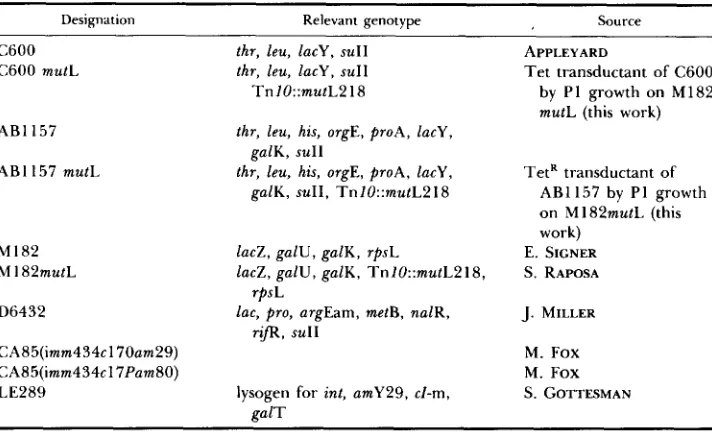
Bacterial strains that were used in this work ~~
Designation Relevant genotype Source
C600 C600 mutL
AB1 157 AB1 157 mutL
MI82 M 182mutL D6432
CAS5(imm434cl70am29) CA85(imm434~17Pam80) LE289
thr, leu, lacy, SUII thr, leu, lacy, suII Tnl0::mutLB 18
thr, leu, his, orgE, proA, lacy, galK, suI1
thr, leu, his, orgE, proA, lacy, galK, suII, Tn1O::mutLPlS
lacZ, galU, galK, rpsL
lacZ, galU, galK, TnlO::mutL218, lac, pro, argEam, metB, nalR,
rpsL rqR, SUlI
lysogen for int, amY29, cl-m,
galT
APPLEYARD
Tet transductant of C600 by P1 growth on M182 mutL (this work)
TetR transductant of AB1157 by P1 growth on M182mutL (this work)
E. SIGNER S. RAPOSA J. MILLER
M. Fox M. Fox S. GOTTESMAN
the heteroduplex regions of matured phage give rise to plaques with a mixture
of the genotypes representing the composition of each of the strands of the heteroduplex.
MATERIALS AND METHODS
Bacterial strains: T h e strains used in this work are listed in Table 1 . Phage strains: hcI6O Oam29 and P a m 8 0 come from the M. Fox collection. T h e XcI60 Oam29 plac5 phage derived from XcI60 Oam29 successively rendered
XcI60 Oam29 plac5 by a cross with Xplac5 and XcI60 Oam29 placZocU108 by a cross with Ximm434 plac5 (M. LICHTEN collection).
T h e hint4 plac5 Pam80 Ram5 was obtained from the cross between hint4 plac5 and
Ximm434 Pam80 Ram5 (M. FOX collection).
Oam29, Pam80 and Ram5 are all amber mutations suppressed with a reasonable efficiency by the bacterial suppressor SUII. lacZocU118 is an ochre mutation in the 2
gene not suppressed by SUII; int4 is a missense mutation.
Media: T h e bacteria were grown in Ay medium (tryptone 10 g/liter, NaCl 5 g/liter, yeast extract 1 g/liter). XyM is Xy medium supplemented with maltose at 4 g/liter.
Phage were plated on Ay medium supplemented with Difco agar ( 1 1 g/liter) with 3
ml of X top agar (6 g/liter).
Ay T T C lac (or XTTC gal) plates contain, in addition, 0 . 5 g/liter of T T C ( 2 , 3 , 5
Triphenyltetrazolium Chloride) and 5 g/liter of lactose (or galactose).
Phages were usually diluted and plaques were resuspended in SMO (NaCI 5.85 g/ liter; Tris-HCI 1 M , pH 7 . 5 , 20 ml/liter) and MgS04 10 mM.
412 0. HUISMAN AND M . S. FOX
of adsorption at 37", the mixture is diluted 100-fold in Ay broth, incubated for 90 min at 37" and a drop of chloroform is added.
Analysis of recombination products of XcI60 Oam29 by XPam80: T h e crosses were carried out in AB1157 and AB1157 mutL strains. T h e total progeny titrated permis- sively on C600(suII) and O+P+ recombinants selected either on the M182 or M I 8 2 mutL strain. T h e genotypes of these recombinants were further analyzed by picking 200 plaques, at random, with a fine platinum wire and streaking them out on an M182
lawn. Streaks that included both clear and turbid plaques were classified as progeny of
phage heterozygous for c(c/c+).
Transfection with artificial heteroduplex DNA molecules: DNA was isolated from XcI60Oam29 placZocU118 and WamSORamS int4 plac5, and heteroduplexes were formed by denaturation and annealing, as described in LICHTEN and FOX (1 983), except that the annealing mixture was incubated for only 1 hr at 37" and was not precipitated with ethanol.
One hundred microliters of such a heteroduplex mixture was diluted in SMO
+
Mg buffer to 1 pg of DNA per milliliter, heated 3 min at 65" to monomerize the DNA molecules, mixed with 200 pI of ice-cold calcium-treated competent cells C600 mutL (MANDEL and HICA 1970) and successively incubated for 15 min in ice and 30 min at 37". Infective centers were plated on Xy agar plates, together with 0.2 ml of a fresh overnight culture of C600. T h e relative abundance of pure c+, pure c o r mixed c+/c infective centers was determined by picking random infective centers and streaking them on a lawn of C600. In the case of mixed c/c+ infective centers, further analysis for the presence of other alleles is described below. T h e genotypes of phage from each of three turbid and three clear plaques from each mixed infective center were charac- terized.Analysis of cI heterozygotes formed in vivo: T h e products of a cross between phages XcI60 Oam29 placZocU 11 8 and Xint4 Pam80 Ram5 plac5 phages in AB1 157 mutL were plated on C600 mutL in order to obtain about 100 plaques per plate. Mottled plaques containing both Xc+ and Xc phage were detected by visual inspection. Each of these mottled plaques was picked and resuspended in 0.5 ml of SMO
+
MgS04 buffer. Aliquots of this ministock were mixed with D6432 (suII) and plated on XyTTC lac plates in order to obtain about 100 plaques per plate. Under these conditions lac- phage make white plaques, and lac+ phage make red plaques. In most of the cases we found predominantly two types of phage in each mottled plaque (hc+ lac' and Xc lac-, o r hc+ lac- and Xc lac- or Xc+ lac+ and Xc lac+). In some cases, in addition to the two predominant genotypes c+ lac+ and c lac-, w e found a few phage with a different genotype. T h e frequency at which these were present (a few percent) makes it likely that they are products of recombination events occurring during formation of the mottled plaque. Thus, we decided to ignore these rare phage and to consider the mottled plaques as derived from a phage particle harboring the two predominant gen- otypes that were further characterized. For each mottled plaque, three of each clear (red o r white) and turbid (red or white) plaques were characterized with respect to the other alleles.T h e Int+ phenotype recognized on the basis of complementation with c+ int4 phage on the LE289 strain plated on T T C Gal (ENQUIST and WEISBERC 1976). In contrast to int-, int+ phage generate red papillae under these conditions.
T h e 0 and the P phenotypes were recognized by testing on CA85 (Ximm434 c17 Oam29) or CA85 (Ximm434 c17 PamSO), where the XOam29 or APam80, respectively, fail to grow.
T h e R character was determined directly by plating on C600. After one night of incubation at 37", the plates were inverted for 15 min on a glass Petri dish containing 1-2 ml of chloroform. T h e plates were then left open for 15 min at room temperature. After this treatment, spot tests with plaques of R+ phage, but not of R- phage, show a marked halo (WHITE and Fox 1975).
PRODUCTS OF LAMBDA RECOMBINATION 413 of some phage recombinant for cl and R to be formed within the mottled plaque, as is the case for the cI-lac interval. The presence of these recombinants could lead us to occasional misclassification. We therefore examined more than three plaques of each clear and turbid phenotype in some cases. An aliquot of the suspended mottled plaque was plated on C600 in order to obtain about 100 plaques per plate, which were tested for the R + and R - phenotype by the chloroform method. As in the case of the lac
marker we found, for the most part, t w o kinds of phages in each mottled plaque (Xc+R-
and Xc R + , or Xc+R- and Xc R - or Xc+R+ and Xc R + ) . T h e occasional presence of phage with other genotypes was assumed to result from plate recombination. We considered a mottled plaque to be the product of a heterozygous phage, with one genotype re- sulting from each of the strands of the heteroduplex.
Our screening detected some mottled plaques containing two types of phages in which all of the markers except one were heterozygous. In those cases, in addition to the three clear and three turbid phages already analyzed, we retested ten of each type for the marker that appeared to be homozygous.
RESULTS
T h e methyl-directed mismatch correction system has been shown to be active in co-repairing all of the mismatches in a 2000-bp stretch of one strand or the other of a heteroduplex formed by annealing single strands of lambda DNA differing by three-point mutations (S. RAPOSA and M. S. Fox, unpublished results). It seemed likely that this kind of repair could be, in part, responsible for the rarity with which heterozygotes are observed among products of lambda recombination. To test this hypothesis we carried out phage crosses with parents differing by only point mutations, Xc 0 - and Xc+P-. T h e products of crosses carried out in a suII mut+ or a suII mutL strain were examined. T h e methyl-directed mismatch correction system is defective in mutL strain (Lu,
CLARK and MODRICH 1983).
If we assume that some of the O + P + recombinants result from formation of a heteroduplex that includes the cI region, these O + P + recombinants could be heterozygous for the cI region and, therefore, could give rise to a mixture of c+ (turbid) and c (clear) progeny (as long as this heterology is not lost by replication o r mismatch correction before packaging). For this kind of cross,
RUSSO, STAHL and STAHL (1970) have reported that 1 % of the recombinants
are mixed for the c character. For crosses in mut+ or mutL hosts, O + P + recom- binants were selected either on mut+ or mutL indicators. T h e frequency of recombination observed in all these cases was between 0.1 and 0.3%.
414 0. HUISMAN AND M. S. FOX
TABLE 2
Xc+/c heterozygotes among O+P+ recombinants
Cross in mutL Cross in mut+
Phage (%) (%)
Selection of O+P+ Mixed c+/c 21 19
recombinants on Pure e+ 52 53
sup', mutL Pure c 27 28
Selection of o + P + Mixed c+/c 2 1
recombinants on Pure e+ 75 74
sup+, mut+ Pure c 23 25
T h e crosses between Xc+P- and Xc 0- were performed under permissive conditions in SUII strains that were deficient (mutL) or proficient (mut+) in the methyl-directed mismatch correcting system. T h e O+P+ recombinants were se- lected in mut+ or mutL indicators, and the infective center composition of 200 random plaques was determined by streaking out on an sup+ mut+ lawn.
R
I , lac int , c O P r
0 10 2 0 3 0 4 0 48.5 k b
FIGURE 1 .-Approximate map of' the appropriate markers on the bacteriophage lambda ge- nome.
tions suggest that many of the recombination products that are detected as 0 +P + recombinants are made just before encapsidation and that c+/c hetero-
zygotes that are present are often corrected in the indicator strain.
We carried out a six-factor cross, heteroallelic for c, plated all of the progeny on a permissive mutL strain and identified by visual inspection those occasional plaques that were mottled, i . e . , included both phage with the c+ and phage with the c genotype. Such plaques were picked, resuspended and analyzed for the presence of the other alleles. Thus, the extent of the heterozygosity could be assessed, and for those products in which both ends of a heterozygous region are evident, the parental or recombinant character of the flanking regions could be determined.
T h e two parental phage used in these crosses label the right half of the lambda genome with point mutations, plac- c 0- and plat+ int- P-R-, respec- tively (Figure 1). In order to assess the efficiency of mismatch repair that persists in the mutL strain for these markers, approximately equal amounts of
DNA isolated from each of the strains were mixed, denatured, annealed and used to transform mutL bacteria. The mixture of the two phage DNA's used (40% of XEac- c 0- and 60% Mac+ in&-c+ P - R - ) would be expected to give rise by random assortment to the formation of 16% of lac- c 0 - homoduplex,
36% lac+ int- c f P-R- homoduplex and 48% of heteroduplex. Analysis of infective centers obtained after transfection of mutL bacteria by this mixture showed that 15% of the infective centers contained only c phage, 39% only c+
phage and 46% were mixed, containing both c and c+ phage. Thirty-one of
PRODUCTS OF LAMBDA RECOMBINATION 415
duplex molecules. This analysis showed 10% correction for the lac+/lac- mis- matches, 16% for int+/int-, 19% for O+/O-, 10% for P + / P - and 16% for R+/ R-. In only one case was there correction of more than one marker, giving rise to a plaque containing O+P- phage. These results show that there is only modest correction for any of these markers in the mutL strains.
These modest levels of correction convinced us that it would be possible to characterize primary products of recombination by this kind of genetic analysis. We carried out a cross between these parental phage in the permissive mutL
host. T h e progeny were plated to give about 100 plaques per plate on the same bacterial strain. Phage c+ makes turbid plaques and phage c makes clear plaques. A phage product whose DNA includes a region of heteroduplex that includes the c region would be expected to give rise to a plaque that is mottled in appearance and includes both c+ and c phage. This allows us, by visual inspection, to identify plaques derived from phage harboring a region of het- eroduplex DNA. Among a total of about 20,000 plaques examined, 112 mot- tled plaques were recognized. T h e genotypes of the phages present in these mottled plaques were analyzed, as described in MATERIALS AND METHODS. Sixty- two plaques contained phage with a complete complement of each of the two sets of parental genotypes, as well as occasional recombinants, probably pro- duced during plaque formation. Such plaques could result from phage particles heteroduplex for the entire marked half of the genome, but cannot be distin- guished from coincident plaques formed by two infective centers occurring at the same site on the plate. We assume that the latter is the most likely origin of these plaques.
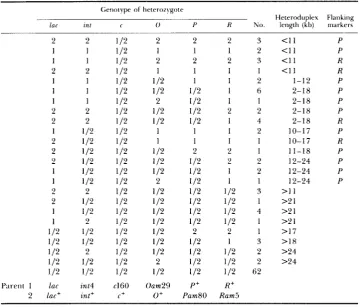
T h e description of the genotypes present in the remaining 50 mixed plaques is displayed in Table 3. Some of the phage products are heterozygous for c only. Others include heterozygosity for various continuous portions of the genetically marked region. A few are homozygous for only one marker, int or 0, and are heterozygous everywhere else. We have included these in Table 3
because they would appear to represent corrected products that were hetero- duplex for the entire lac to R region.
T h e observed array shows that the length of heteroduplex regions is varia- ble. Some are limited to the c region, others include increasing numbers of neighboring markers and some extend over half of the lambda genome. These lengths may be underestimates because, in some cases, terminal markers that had been heterozygous could have been subject to the residual mismatch cor- rection that persists in the mutL strain.
T h e analysis of the 50 mottled plaques also shows a substantial number in which both ends of the heteroduplex region are evident. In 24 cases the genotypes of the termini of the heteroduplex region derive from the same parental phage, and in nine cases the flanking markers are recombinant.
DISCUSSION
416 0. HUISMAN AND M. S. FOX
T A B L E 3
Description of genotypes present in the mixed plaques
Genotype of heterosygote
Heteroduplex Flanking
/ar int C 0 P R No. length (kb) markers
~
2 2
1 1
1 1
2 2
1 1 1 1 1 1
2 2
2 2
1 112
2 112
2 112
2 112 1 1 I 2 1 112
2 2
2 112
1 1 l’2
112 112
112 If2
112 2
112 112
112 112
Pdient 1 lac znt4 2 lac+ znt+
1 2
2 3
1 2
2 3
I 1
1 2
1 6
1 1
2 2
1 4
1 2
1 1
‘L 1
2 2
1 2
1 1
112 3
112 1
112 4
112 1
112 2
112 2
112 6 2
R +
Ram5
2 1
1 3
< I 1 <11 <11 < I 1
1-12 2-18 2-18 2-18 2-18 10-17 10-17 11-18 12-24 12-24 12-24 > I 1 >2 1 >2 1 >2 1 > I 7 > I 8 >24 >24 P P R R P P P P R P R P P P P
duplex DNA. The heterozygosity displayed by such products is, for the most part, lost when progeny phage are plated on an indicator in which the methyl- directed mismatch repair system is functional.
T h e progeny of a cross between Xc Oam29 and P a m 80 are plated on a
sup+ indicator, selecting for 0 +P + recombinants. Individual O+P+ plaques were
tested for the genotype at c. When the selective indicator was proficient for methyl-directed mismatch repair, 1 or 2% of the products were heterozygous for c. When the selective indicator was defective in mismatch repair, mutL, 20% of the products displayed heterozygosity for c. Thus, a substantial fraction of the events that give rise to O+P+ recombinants are followed promptly by encapsidation. T h e heterozygosity present in these products is lost when they are plated on an indicator that is proficient in methyl-directed mismatch repair. I t seems likely that the phage from which these c/c+ plaques arise are O+/
P + on both strands and heteroduplex at c, although it remains possible that
PRODUCTS OF LAMBDA RECOMBINATION 417
would not be likely to be efficient in the recovery of both c alleles and, thus, could lead to an underestimate of the abundance of c/c+ heterozygotes.
T h e abundance of c heterozygotes among the recombinant products provides the basis for examining the structure of the primary products of recombination by assessing the genetic composition of individual phage emerging from a multifactor cross.
We first show that transfection of mutL bacteria with annealed DNA, het- eroduplex for the two parental phage, gives rise to infective centers in which most of the markers present in each of the strands are represented in the plaque made by an infective center. T h e frequency with which individual markers appear homozygous in such products is between 10 and 20%, and infective centers in which two of the markers are homozygous are rarely ob- served.
Among the products of the six-factor cross we detect, by visual inspection, mottled plaques that contain both Xc+ and Xc- phage. From reconstruction experiments (data not shown) it is clear that such visual inspection probably permits detection of less than half of the plaques that, by picking and streaking, could be shown to include both Xc and Xc+ phage. We estimate that perhaps
1 % of the progeny could be heterozygous for c.
Plaques that are mixed for c and c+ would include those in which-the location of two parental infective centers coincided. For more than half of the plaques analyzed (62 of 112), we are not able to distinguish between heterozygosity for all markers and such coincident plaque formation.
Because of this uncertainty, we ignore these infective centers that could .be coincident and focus attention on those products that display homozygosity for at least one of the markers distinguishing the two parents (see Table 3).
Among these 50 infective centers, some are mixed only for c, and the re- mainder are mixed for c and one o r more of the adjacent markers. T h e heteroduplex regions manifesting this heterozygosity appear continuous and extend over variable lengths of the marked portion of the genome. Some of these regions begin within an identifiable interval and extend beyond the marked region, but for a substantial fraction, the two ends of the region of heterozygosity are evident. T h e frequency with which an end occurs within a particular interval roughly reflects the nucleotide distance defining that inter- val, although termini occurring between c and 0 and between 0 and P appear to be overrepresented. A rough estimate, assuming that, given a heteroduplex region including c, the probability of finding a neighboring marker within the heteroduplex falls exponentially with the number of nucleotides separating that marker from c, suggests that the average length of the heteroduplex region would be about 8 kb. Because we are selecting c/c+ heterozygotes, this estimate would reflect on overestimate of heteroduplex lengths that is similar to the overestimate characteristic of the determination of the weight average molec- ular weight. If the lengths were random, their average for all heteroduplexes would be about 4 kb (TANFORD 1961).
418 0. HUISMAN AND M. S. FOX
phage lambda DNA in mut+ bacteria, WILDENBERG and MESELSON (1 975) have inferred a length of heteroduplex formed per exchange of less than or ap- proximately 3000 nucleotides for Rec-mediated recombination. T h e length distribution of the heteroduplex products that we have examined under con- ditions in which both the phage Red and the bacterial Rec functions are intact is in reasonable agreement with their calculated estimate.
Those infective centers, in which both ends of the heteroduplex region are evident, can be classified with respect to whether the two flanking regions that are homoduplex derive from one or both of the parents participating in the exchange, i . e . , parental or reconibinant for outside markers. Although the sample is small, it would appear that most, 24 of 33 of the products, are parental for the outside markers. Here again, we confirm an earlier report by
WILDENBERC and MESELSON (1 975) that recombinants for a closely linked pair of markers are more often parental than recombinant for flanking markers.
T h e HOLLIDAY (1964) model, involving symmetric strand exchange in the formation of recombinants, might be expected to give rise, on resolution of the branch migrating intermediate, to an equal abundance of parental and recombinant structures flanking the region of heteroduplex. On the other hand, the resolution of asymmetric exchange structures suggested by HOTCH-
KISS (1 974) and by MESELSON and RADDING (1 975) might be expected to give rise to products with parental regions flanking the region of heteroduplex.
LITCHEN and Fox (1 984) have suggested a substantial role for asymmetric strand exchange in recombination, and the observations reported here suggest that many of the recombinants occurring late in the lytic cycle of lambda growth may be products of this kind of mechanism.
I t must be acknowledged that this analysis largely ignores the modest residual mismatch correction that remains evident in mutL strains. Correction events at R and lac would lead us to underestimate the length of heteroduplex regions and could lead us to misclassify some of the parental and recombinant prod- ucts.
We return to the question of coincident plaques. A calculation by KELLEN-
BERGER, ZICHICHI and EPSTEIN (1 962) estimates that with 100 plaques per plate the probability of superposition would be which suggests that we should have detected about 20 coincident plaques. It is possible that the heteroduplex regions are sometimes very long, covering all the markers (more than 20 kb) that we can detect. Indeed, in four cases we have found plaques that contain both clear and turbid phages and that are heterozygous for all the parental markers except one. In two cases, plaques were products of phage that were homozygous only for the 0 marker, and in two cases were homozygous only for the int marker. One way to account for these products is to suggest that they result from phage with a heteroduplex region that included all the mark- ers but in which residual mismatch correction had acted at the 0 or int sites. Since we have shown in this work that correction for this 0 or int marker in
mutL is <20%, there could be substantially more of these phage with hetero-
PRODUCTS OF LAMBDA RECOMBINATION 419
to which we underestimate the average heteroduplex length. Whatever the real frequency of very long structures, our results show the presence of a broad distribution of lengths.
This work describes a novel way of characterizing the primary products of recombination under conditions which should not disturb the general process. I t could certainly be used more generally, e.g., to examine the roles of different functions involved in E . coli recombination (RecA, RecBC, RecF, Red, etc.)
(CLARK 1973; SMITH 1 9 8 3 ) , as well as to examine the roles of structural determinants such as chi sites (STAHL 1 9 7 9 ) .
We a r e grateful to S. RAPOSA for her assistance throughout this work. We thank A. LABAN and M. LICHTEN for fruitful discussions and S. GOTTESMAN for providing strains. O.H. was supported by a European Molecular Biology Organization fellowship. This work has been supported by National Institutes of Health grant A105388 t o M.F.
LITERATURE CITED CLARK, A. J., 1973
ENQUIST, L. W. and R. A. WEISBERG, 1976
Recombination deficient mutants of E. coli and other bacteria. Annu. Rev. Genet. 7: 67-86.
T h e red plaque test: a rapid method for identification of excision defective variants of bacteriophage lambda. Virology 72: 147-1 53.
FOX, M. S., 1978 Some features of genetic recombinaiton in procaryotes. Annu. Rev. Genet. 12:
O n the mechanisms of desoxyribonucleate integration in pneu-
Mismatch repair. pp. 333-335. In: Cellular Responses to DNA
47-68.
FOX, M. S. and M. ALLEN, 1964
mococcal transformation. Proc. Natl. Acad. Sci. USA 52: 412-419. FOX, M. S. and S. RAPOSA, 1983
Damage, Edited by E. C. FRIEDBERG and B. A. BRIDGES. Alan R. Liss, New York.
HOLLIDAY, R., 1964 HOTCHKISS, R. D., 1974
KELLENBERGER, G., M. L. ZICHICHI and H. T . EPSTEIN, 1962
A mechanism for gene conversion in fungi. Genet. Res. 5: 282-304. Models of genetic recombination. Annu. Rev. Microbiol. 28: 445-468.
Heterozygosis and recombination of bacteriophage. Virology 17: 44-55.
Diplococcus pneumonzae with respect to DNA methylation. J. Mol. Biol. 114: 153-168. LACKS, S. and B. GREENBERG, 1977 Complementary specificity of restriction endonuclease of
Detection on non-homology-containing heteroduplex mol-
Evidence for inclusion of regions of nonhomology in heteroduplex products of bacteriophage X recombination. Proc. Natl. Acad. Sci. USA 81:
Methyl-directed repair of DNA base-pair mismatches LICHTEN, M. J. and M. S. Fox, 1983
LICHTEN, M. J. and M. S. Fox, 1984 ecules. Nucleic Acids Res. 11: 3959-3971.
7 180-71 84.
Lu, A. L., S. CLARK and P. MODRICH, 1983
in vitro. Proc. Nad. Acad. Sci. USA 8 0 4639-4643.
MANDEL, M. and A. HIGA, 1970 Calcium-dependent bacteriophage DNA infection J. Mol. Biol. 53: 159-162.
MESELSON, M. and C. M. RADDING, 1975 A general model for genetic recombination. Proc. Natl.
Effects of high levels of DNA adenine methylation on methyl-directed mismatch repair in Escherichiu coli.
Genetics 104: 571-582. Acad. Sci. USA 72: 358-361.
420
KAIIDING, C. M., 1982 Homologous pairing and strand exchange in genetic recombination. Annu.
Kusso, V. E. A., 1973 On the physical structure of lambda recombinant DNA. Mol. Gen. Genet. 22: 353-366.
On the transfer of information from old to new chains of DNA duplexes in phage lambda: destruction of heterozygotes. Proc. Natl. Acad. Sci. USA 65: 363-367.
General recombination. In: Lambda I I , Edited by R. W. HENDRIX, J. W. ROBERTS, F. W. STAHL. and R. A. WEISBERG. Cold Spring Harbor Laboratory, Cold Spring Harbor, New York.
0. HUISMAN AND M. S. FOX
Rev. Genet. 16: 405-437.
RUSSO, V. E. A., M. M. STAHL and F. W. STAHL, 1970
SMITH, G . R., 1983
STAHL, F. W., 1979
%I'AHI., F. W . , K . D. MCMILIN, M. M. STAHL, J. M . CRASEMANN and S . LAM, 1974 Special sites in generalized recombination. Annu. Rev. Genet. 13: 7-24
T h e distri- bution of crossovers along unreplicated lambda bacteriophage chromosonies. Genetics 77: 395-408.
TANFORII, C., 1961 Physical chemistry of macromolecules; 147. John Wiley & Sons, New York. U'ACNER, R., C. DOHET, M. JONES, M. P. DOUTRIAUX, F. HUTCHINSON and M. RADMAN,
Involvement of Escherichi coli mismatch repair in DNA replication and recombination. I984
Cold Spring Harbor Symp. Quant. Biol. 4 9 61 1-615.
Natl. Acad. Sci. USA. 73: 4135-4139.
WAGNER, K. J. and M. MESELSON, 1976 Repair tracts in mismatched DNA heteroduplexes. Proc.
WHITE, K. L. and M . S. Fox, 1974 On the inolecular basis of high negative interference. Proc. Natl. Acad. Sci. USA 71: 1544-1548.
WHITE, R. LA. and M. S. FOX, 1975 Genetic heterozygosity in unreplicated bacteriophage lambda recombinants. Genetics 81: 33-50.
WII-DENBERG, J. and M. MESELSON, 1975 Mismatch repair in heteroduplex DNA. Proc. Natl. Acad. Sci. USA 72: 2202-2206.