Body Area Network- A Perspective
Gomita Verma 1, Prof.Moinuddin 2
Apeejay Stya University, Sohna. Gurgaon.INDIA.1 Jamia Hamdard University, New Delhi.INDIA.2
ABSTRACT: Recent technological advances in integrated circuits, wireless communications, and sensing elements of physiological parameters, lead to the development of smart, light weight, low power, multifunctional devices. Consequently a number of these devices can be integrated into a Wireless Body Area Network (WBAN), a new potential and enabling technology for health monitoring. They can provide patients with increased confidence, a better quality of life, and promote healthy behavior and health awareness. Applications of BAN is highly appreciated in thickly populated countries for addressing complex issues and providing better healthcare solutions.
Keywords: Wireless sensor network(WSN), Body area network (BAN), Electrocardiogram (ECG) monitoring system, Tele-health.
I.INTRODUCTION
Due to advancement in technology, a low power networked systems and medical sensors merged as wireless sensor networks (WSNs) in health care. These WSNs carry the promise of drastically improving and expanding the quality of care across wide variety of settings & for different segments of population. When a tiny wireless sensors are strategically placed on/in a patient’s body, create a WBAN. The patient’s equipped with wireless body area network need not be physically present at the physician for their diagnosis, infact these devices communicate through wireless technologies, transmit data from body to a home base station, from where data can be forwarded to a hospital, caregiver, physician, emergency.BAN containing sensor nodes in close proximity to a patient’s body monitors vital signs, providing real time feedback to allow many patient diagnostics procedures using continuous monitoring of chronic diseases, or progress of recovery from an illness. The biosensor based approach to medical care makes it more efficient by decreasing the response time, and reducing the heterogeneousness of the application. The exact system architecture and number of system tiers depends predominantly on target applications, available infrastructure, type & number of end users. The paper is organized as follows- section II discusses functional levels of WBAN. In section III, design issues has been discussed briefly. Technical challenges has been discussed in section IV. Applications of BAN in section V. Related work has been discussed in section VI. Finally we conclude our work in section VII.
II.ARCHITECTURE OF BAN
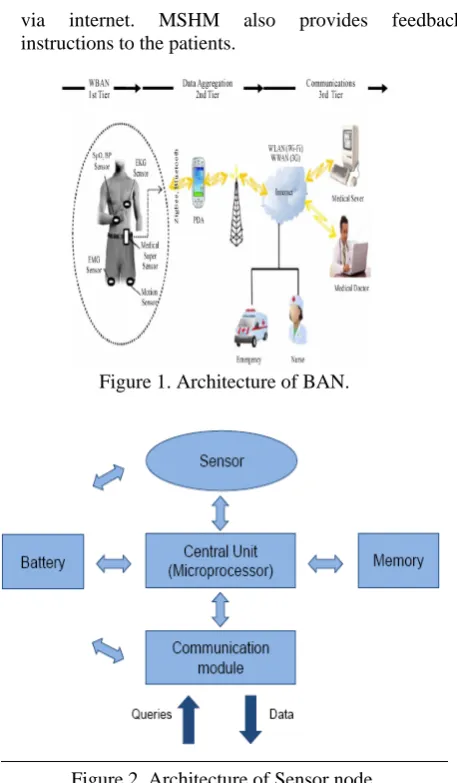
This section describes the system architecture of wearable sensors for remote healthcare monitoring system [6]. The system is composed of three tiers (figure1)-
-Wireless Body Area Network (WBAN). -Personal server.
-Medical server.
2.1 First tier- Here patient is the core of the system. Wearable sensors are attached to the patient’s body forming WBAN to monitor changes in patient’s vital signs closely and provide real time feedback to help maintain an optimal health status. The medical sensors nodes consists of 5 main components (fig.2)—sensors, control units (µc), memory, communication module and power supply. A sophisticated sensor is integrated into WBAN called the SUPER SENSOR, which has more memory, processing and communication capabilities than other body sensors. This SUPER SENSOR samples, collects multiple sensed vital signs by body sensors, filters out all the redundant data thereby reducing large volume of data transmitted by BSN’s, store them temporarily, process and transfer the relevant data to personal server.
2.2 second tier—it is implemented on an Intelligent Personal Digital Assistant (IPDA).It collects physiological vital signs from WBAN, process them & prioritizes the transmission of critical data when there is sudden clinical change in current patient condition and data content. Moreover, IPDA has the capability to perform the task of analyzing the physiological data intelligently & do a local reasoning to determine user’s health status based on data received from SUPER SENSOR and provide feedback through user friendly and interactive graphical user interface. 3G communication is used to connect personal server(PS) and 3 tier.
2.3 Third tier—is called Medical Server for Healthcare Monitoring(MSHM). It receives data from PS and it is situated at medical centers where medical services are provided. It is capable of learning patient specific thresholds & learns from previous treatment records of the patient. MSHM keeps electronic medical records of registered patients, which are accessible by different medical staff, specialists & doctors from their offices in the hospital over the internet. The physician accessing the data through internet, examines it to ensure that patient is within expected health metrics. If received data is out of range or recognize serious health abnormal condition, medical staff in emergency unit can be notified to take necessary actions. However, patient is in the remote area, the doctor will observe physiological data, diagnose it, prescribe necessary treatment and medication. This information will be sent back to the doctor in remote area hospital
via internet. MSHM also provides feedback instructions to the patients.
Figure 1. Architecture of BAN.
Figure 2. Architecture of Sensor node.
III. MOTIVATION AND BACKGROUND
There is a long history of using sensors in medicine and public health [1] [2]. Embedded in a variety of medical instruments for use at hospitals, clinics ,and at homes, sensors provide patients and their healthcare providers insight into physiological and physical health states that are critical to the detection, diagnosis, treatment and management of ailments. Much of modern medicine would simply not be possible nor be cost effective without sensors such as thermometers, blood pressure monitors, glucose
monitors, electrocardiograph (ECG’s), electroencephalographs (EEG’s) and various other forms of
imaging sensors.
Medical sensors combine transducers for detecting electrical, thermal, optical, chemical, genetic & other signals with physiological origin with signal processing algorithms to estimate features indicating persons health status. Sensors that directly measures health state have also found use in medicare. for-example- location and proximity sensing technologies[3] are being used for improving the delivery of patient care and workflow efficiency in hospitals[4], tracking the spread of diseases by public health agencies[5], and monitoring people’s health related behavior & exposure to negative environmental factors such as pollution.
The requirements for a medical sensor network design depends greatly on the specific application and deployment environment. There are certain design issues [8] which are to be considered while designing. These include-
(a) Type of sensor nodes—sensors fall into three categories: First, Physiological sensors which measures ambulatory blood pressure, glucose monitoring, body temperature, blood-oxygen, EEG, ECG, EMG. Second, Biokinetic sensors which measures acceleration and angular rate of rotation derived from human movement. Third, Ambient sensors which measures environmental phenomenon such as humidity, light, sound, level, temperature. (b) Size and weight of sensors—sensors must be light
weight with small form factor. Size & weight of sensors is predominantly determined by size & weight of batteries.
(c) Power source—sensors are to be extremely power efficient. Since sensors are battery operated and are required to last long without any need for maintenance. As frequent battery changes, could hamper user’s acceptance & increase the cost. In addition, for implantable sensors, low power consumption is very important, as these kinds of sensors would ideally be self powered, using energy extracted from the environment.
(d) Sensor node Identification and Association – the node is identified by device ID which is unique for each device, but still there are issues related to a specific task.
(e) Sensor node calibration—there are two types of calibrations: sensor and session calibration. Former is, when a sensor replaces or is newly added to a network, it must be calibrated according to the requirement. It is necessary for sensor preparation. Later, is required immediately prior starting a new monitoring session to calibrate sensor in context of its current environment. (f) Sensor location and mounting—the purpose of
measurement does influence sensor location but sensor attachment is also a critical factor. Since movement of loosely attached sensors create spurious oscillations after abrupt movement and can generate false events or mask real events.
(g) Seamless system configuration—users should be able to assemble a robust ad-hoc network depending on his state of health and be able to use “off-the-shelf” sensors, manufactured by different companies and sold “over-the-counter”. Each sensor should be able to identify itself & declare its operational range.
(h) Intuitive and simple user interface—the end users are not technicians or scientists, so the interface should be simple enough for users to easily understand and handle properly.
(i) Interference—medical sensors have incorporated wireless connections, both for short range such as Bluetooth/zigbee and near field radios to communicate wirelessly to nearby computers, PDA’s or smart phones, and long range such as Wi-Fi or cellular communications, to communicate directly with cloud-computing services.
IV.TECHNICAL CHALLENGES
As BAN technology is still emerging, there are plenty of technical challenges that we must overcome before BAN becomes an effective solution. These challenges include— low power, limited computation, security & interference, material constraints, robustness, continuous operation and regulatory requirements.
• Power challenge—power supply should be small sized, light weight, environment friendly and long lasting[29].
• Computational challenge—sensor networks are self organizing and operate with low power & very little computational capacity. There is a limit on the type & application data that these devices can operate on. So due to limited power as well as memory, computation should also be limited[30].
• Security and interference ----physiological data collected by sensor network is health information, which is of personal nature. It is critical & in the interest of individual to keep this information from being accessed by unauthorized entities. This is referred to as confidentiality, which can be achieved by encrypting data by a key during transmission. Data authenticity is one of the security requirements[28].
• Material constraints— sensors which are to be implanted, their shape, size & material should be harmless to human body. Also chemical reactions with body tissues and disposal of sensors are of extreme importance [39].
• Robustness— whenever sensor devices are deployed in harsh or hostile environments robustness rates of device failure becomes high. Protocol design must therefore have built in mechanism, that the failure of one node should not cause the entire network to cease operation. A possible solution is a distributed network where each sensor node operates autonomously though still cooperates when necessary [30].
• Continuous operation—must be ensured along the lifecycle of the sensor, as it is expected to operate for days, sometimes weeks without operator intervention. Hence it is important to keep the amount of communication to be minimum. It is necessary that those communications which occur for purposes other than actual data communication should be minimized if not possible to eliminate them [28].
• Regulatory requirements—these must always be met. There must be some testimony that these devices will not harm human body. the wireless transmission of data must not harm the surrounding tissues & the chronic functioning and power utilization of these devices must also be non-maligment. Design for safety must be a fundamental feature of biomedical sensor development even at early stages [30].
V. APPLICATIONS OF BAN
Medical applications benefits from wireless sensor networks in many ways. The recent advances in miniaturization of smart biosensors will open up new opportunities for continuous monitoring of patients. Tiny wearable sensors will allow collection of vast amounts of
data automatically, reducing the cost & inconvenience of regular visits to the doctor. The various applications are-
• Cardiovascular diseases—smart sensor nodes that can be installed on the patient in an unobstructive way can prevent a large number of deaths caused by cardiovascular diseases[31,32]. The corresponding medical staff can do treatment preparation in advance as they receive vital information regarding heart rate and irregularities of the heart while monitoring the health status of the patient.
• Cancer detection—now a days one of the biggest threats for human life is cancer. A sensor with the ability to detect nitric oxide can be placed in the suspect locations. These sensors have the ability to differentiate cancerous cells, between different types of cells[34].
• Depression and elderly people monitoring—it is found that adults, most of whom held full time jobs, were serving as informal care givers mostly to an elderly parent. Wireless sensor network can help home bound & elderly people who often feel lonely and depressed by detecting any information for patient abnormal situation and alerting neighbors, family or the nearest hospital [36].
• Glucose level monitoring—Diabetes can yield other complicated diseases like heart disease, stroke, high blood pressure, blindness. A biosensor implanted in the patient could provide a more consistent, accurate, and less invasive method by monitoring glucose levels, transmit the results to a wireless PDA or a fixed terminal, and by injecting insulin automatically when threshold glucose level is reached [35].
• Asthma – A wireless sensor network can help those millions of patients suffering from asthma by having sensor nodes that can sense the allergic agents in the air and report the status continuously to the physician and/or the patient himself [33].
• HipGuard system--- it is developed for patients who are recovering from hip surgery. This system monitors patient’s leg and hip position & rotation. Alarm signals are sent to patient’s wrist unit if position or rotations are false, and hence this system can provide useful real time rehabilitation process [38].
Figure3. HipGuard Pants for hip patient rehabilitation.
• MobiHealth—It aims to provide continuous monitoring to patients outside the hospital environment. MobiHealth targets, improving the quality of life of patients by enabling new value added services in the areas of disease prevention, disease diagnosis, remote assistance, physical state monitoring. Therefore a patient who requires monitoring for short or long periods of time doesn’t have to stay in hospital. With MobiHealth BAN the patient is free to pursue daily life activities [39].
Figure 4. MobiHealth system,monitoring a patient outside hospital environment.
• LifeShirt – it is a comfortable and completely non-invasive “smart garment” that gathers data during patient’s daily routine, providing the most complete remote picture of a patient’s health status. it enables healthcare professionals and researchers to accurately monitor more than 30 vital life-sign functions in the real-world settings where patients live and work[40].
Figure 5. Smart LifeShirt.
• eWatch---is a wearable sensing, notification and computing platform built into a wristwatch and developed for context aware computing research. An eWatch system can sense if the user is in trouble and then query to confirm that it is an emergency. If the user doesnot respond, then the eWatch can use its network abilities to call for help [37].
Figure 6. eWatch computing.
• Artificial Retina—WBAN can also assist blind people. Patients with no vision or limited vision can see at a reasonable level by using retina prosthesis chips implanted within human eye[30].
• Military application-it includes monitoring health, location, temperature and hydration levels.
Other applications include, wearable entertainment systems, navigation support in cars or while walking, wireless cash card i.e for display of recent transactions and checking of balance etc.
VI.RELATED WORK
A number of research projects are exploring medical sensor networks. Most of these projects are concerned with developing wearable medical sensors [9,10,11], while others have developed infrastructures for monitoring individual patients during daily activity [12], at home [13] or at a hospital [14].
Next we present several wireless sensing system prototype developed and deployed to evaluate the efficacy of WSNs in some of healthcare applications.
• Harvard’s Code Blue[15] is a project created to adapt WSNs for use in emergency medical situations. In this project, sensor networks are used to send real-time vital signs from a group of patient’s to emergency medical technicians. Code Blue makes use of the Berkeley MICA mote which contains a microcontroller, local storage area, a low power radio. These motes run on the Tiny OS and have a battery life of approx. 5-6 days while running. The communication is handled over IEEE 802.15.4 standard. A wireless pulse oximeter sensors, wireless ECG sensors and triaxial accelerometer motion sensors have been developed and using these sensors they have demonstrated the formation of ad-hoc networks.
Figure 7. pulse oximeter.
Figure 8. EKG.
Figure 9. Motion capture & EMG.
• Researchers at the MIT Media lab has developed MIThril, a wearable computing platform compatible with both custom and off-the –shelf sensors. The MIThril includes ECG, skin temp., galvanic skin response sensors & they demonstrated step and giant analysis using 3-axis accelerometers, rate gyros, pressure sensors [16].
• Javanov et.al, developed the Activity sensor (ActiS) specifically for WBAN based, wearable computer assisted, rehabilitation applications. They integrated one channel bio-amplifier and 3 accelerometer channels with a low power microcontroller into an intelligent signal processing board that can be used as an extension of a standard sensor platform. Actis consists of standard sensor board platform, Telos from Moteiv [26] and a custom intelligent signal processing module(ISPM). The Telos platform is an ideal fit for this application due to small footprint & open source system software support [17].
• Ko et.al proposed MEDiSN [18], which addresses to improve the monitoring process of hospital patient’s and disaster victims as well as first responders. MEDiSN employs a wireless backbone network of easily deployable relay points(RPs). These RPs are positioned at fixed locations and they self organize into forest rooted at one or more gateways using a variant of the collection tree protocol (CTP) [19] tailored to high data rates. Motes that collect vital signs, known as miTags (Medical Information Tags) fig.10, associate with RPs to send their measurements to the gateway.
Figure10.Medical Information Tag, or miTag- is a Tmote mini-based patient monitor that includes a pulse oximetry sensor with LEDs, buttons and an LCD screen. The miTag is powered using a rechargeable 1200-mAh, 3.7-V Li–Ion battery and external finger tip sensors are used to make the pulse oximetry measurements,
• Georgia Institute of Technology built an Aware Home, as a prototype for an intelligent space. This apace provides a living lab that is capable of gathering information about itself and different activities of inhabitants. The Aware Home combines context aware and ubiquitous sensing, computer-vision-based monitoring & acoustic tracking of everyday activities while remaining transparent to its users.
• CardioNet [24], provides a remote heart monitoring system where ECG signals are transmitted to PDA and then routed to central server by using the cellular network.
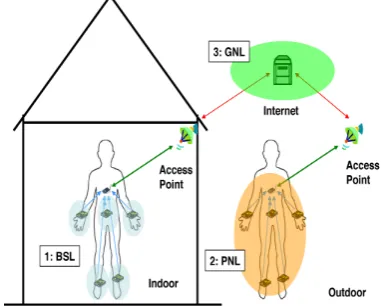
• DexterNet [27] , a heterogeneous body sensor network, is an open source project that makes use of open source library called Signal Processing In Node Environment (SPINE). DexterNet has a three layer architecture that includes body sensor layer (BSL), personal network layer (PSL) and global network layer (GNL). BSL contains two different types of custom sensors. The first is a motion sensor that contains an accelerometer and a gyroscope. Second is a biological sensor that acts as an electrical impedence pneumography (EIP) and ECG & an accelerometer. PNL consists of Nokia N800 tablet that communicates and collects data from different sensors within the BSL. Communication is accomplished over IEEE 802.15.4 and makes use of SPINE API on the node and base station side. Finally Nokia N800 forms a GNL by sending data across internet through Bluetooth, Wi-Fi or other broadband connection. These internet servers then use data collected for high level applications.
Figure 11. Three layer hierarchy of DexterNet system.
• SATIRE [20] is designed to identify a user’s activity based on accelerometers and global positioning system (GPS) sensors integrated into a “smart attire”. SATIRE nodes are based on MICAz [21] platform, measures ace-lerometer data and log it to local flash. These data are transmitted using low power radio, when SHIMMER[22] node is in communication range with base station. Once data are collected at base station, they are processed off-line to characterize user’s activity patterns such as walking, sitting, typing etc. sensor nodes perform aggressive duty cycling to reduce power consumption, extending lifetimes from several days to several weeks.
• University of California San Diego, developed the physical activity and location measurement system (PALMS) [23], which aims at monitoring study subjects in everyday life for long enough periods of time to detect patterns in physical activity and energy expenditure. The information and location are collected in the natural environment of the participants. The system helps answer queries about the energy used by a person during different activities in a day. The synchronized geolocation information permits understanding how physical activity and energy expenditure varies by location and is influenced by environmental factors.
VII.PROPOSED SYSTEM
The proposed Wireless Body Area Sensor Network (WBAN) for healthcare monitoring integrated in to broader multi-tier telemedicine system is illustrated in figure 12.
Figure 12.Proposed healthcare monitoring system.
The lowest level encompasses a set of intelligent physiological sensors; the second level is the personal server(internet enabled PDA, cell-phone or home computer) and the third level encompasses a network of remote healthcare servers & related services (caregivers,physicians, emergency). Each level represents a fairly complex subsystem with a local hierarchy employed to ensure efficiency, portability, security & reduced cost. A WBAN connects independent nodes that are situated in the clothes, on the body or under the skin of a person. The network typically expands over the person’s body monitoring vital signs and a more intelligent node capable of handling advanced signal processing. The nodes are connected through a wireless communication channel. The people can keep a track of their health conditions without frequent visits to their doctor’s. Through internet, physician can retrieve and analyze data & prescribe the required medication, adjust data threshold values and schedule office visits. This cuts healthcare costs & makes better use of physician’s time. However, PS can directly contact Emergency Medical Services, if the user subscribes to this service.
In our study, we will use ECG signal as an example to evaluate its performance in healthcare environment. Various ECG machines as shown in the figures-(i) CARDIOVIT AT-301 from SCHILLER, (ii) Philips C3i Ambulatory Cardiography, (iii) CardioTouch 3000s, (iv) Ge-Mac-400, (v) Philips Page writer TC-50, (vi) Philips Page writer TC-20 below, has been studied and analyzed based on various parameters namely-ECG acquisition, weight, battery capacity, memory, sampling rate. Out of these Ge-Mac 400 is the best. Further, the implementations of software/hardware are being carried out.
(i)
(ii)Philips C3i ambulatory cardiograph
(iii)
(iv)Ge-Mac 400
(v) TC-50
(vi) TC-20
FURURE DIRECTIONS
Driven by user demand and fueled by recent advances in hardware and software, the first generation of WSN’s for healthcare has shown their potential to alter the practice of medicine. We believe that role of WBSN in medicine can be further enlarged and we are expecting to have a feasible and proactive prototype for wearable WBAN system, which could improve the quality of life.
VIII. CONCLUSION
A WBAN of physiological sensors integrated into a telemedical system holds the promise to become a key infrastructure element in remotely supervised, home based rehabilitation. It has the potential to provide a wide range of assistance to patients, medical personnel and society through continuous monitoring in the ambulatory environment, early detection of abnormal condition, supervised restoration and potential knowledge through data mining of all the gathered information. We have described a general system model for the biosensor network, some important issues & challenges that a WBAN can face and its wide use in healthcare applications.
REFERENCES
[1] P.A.Aberg, T. Togawa and F.A.Spelman Eds., Sensors in
Medicine and Healthcare. New York: Wiley 2002.
[2] C.B.Wilson, “Sensors in Medicine,” Western J.Med. ,vol.171, No.5-6, pp.322-325, 1999.
[3] O.A.Khan and R.Skinner, Eds. , Geographic Information Systemand
Healthcare applications. Hershey, PA:IGI global,2002.
[4] E.A.Fry and L.A.Lenert, ”MASCAL:RFID tracking of patients, staff
and equipments to enhance hospital response to mass casualty
events, “ in Proc. AMIA Annu. Symp. , Jan 2005, pp.261-265.
[5] A.Hanjagi, P. Srihari and A.S Rayamane, “A public health care
information system using GIS and GPS: A case study of Shiggaon,”
in GIS for Health and Environment, P.C.Lai and S.H.Mak, Eds. , New York: springer-verlag 2007, pp. 243-255.
[6] Nidhi Gupta, Alok Aggrawal, Narendra kumar, “WearableSensors
for Remote Healthcare Monitoring System,” in International journal
of Engineering Trends and Technology- vol3, issue 1-2012. [7] Pervez Khan, Md. Asdque Hussain, Kyung Supkwak, “Medical
Applications of Wireless Body Area Networks,” International Journal
of Digital Content Technology and its Applications, vol-3, No.3, sep-2009.
[8] Emil Javanov , Aleksander Milenkovic, Chris otto, Piet Cde Grosen,
“A Wireless body area network of intelligent motionsensors for
computer assisted physical rehabilitation,” Journal of
NeuroEngineering and Rehabilitation, 2005.
[9] B. Lo and G.Z.Yang. Key Technical Challenges and Current
Implementations of Body Sensor Networks. In Proc. 2 nd International
Workshop on Body Sensor Networks (BSN 2005), April 2005. [10] G.Z.Yang et al. Body Sensor Network Node.
[11] E.Shih, V. Bychkovsky, D. Curtis and J. Guttag. Demo abstract:
continuous remote medical monitoring. In Proc. Second Annual
International Conference on Embedded Networked Sensor Systems, Nov 2004.
[12] D.K onstantas, V.Jones, R.Bults and Herzog. MobiHealth-
innovative 2.5/3g mobile services and applications for health care. In
Proc. Eleventh IST Mobile and Wireless Telecommunications Summit 2002, Thessaloniki, Greece, June 2002.
[13] E.Dishman. Inventing wellness systems for aging in place. IEEE Computer,37(5), May 2004.
[14] K.V.Laethoven, B.P.Lo, R.King, S.kwan, G.Z.Yang. Medical healthcare monitoring with wearable and implantable sensors. In
proc. Sixth International Conference on Ubiquitous Computing, Tokyo, Japan, Sep 2004.
[15] D.Malan, T.F.Jones, M.Welsh, S. Moulton,” CodeBlue: An ad-hoc
sensor network infracture for emergency medical care,” in proc.
MobiSys/ workshop Appl. Mobile Embedded System, June 2004, pp.12-14.
[16] Pentland S. , Health wear: Medical Technology becomes wearable
in IEEE Computer 37(5). May 2004, 34-41.
[17] Jovanov, A.Milekovic, C.Otto, P.C.de Groen. A wireless body area network of intelligent motion sensor for computer assisted physical rehabilitation.
[18] J.Ko, J.Lim, T.Gao, R.Dustton,N.Destler, Y. Chen, “MEDiSN:
Medical Emergency Detection in Sensor Networks,” ACM Trans,
Embedded Comput. Syst. , vol.10, pp.11:1-11:29, 2010, article 11. [19] O.Gnawali, R.Fonseca, D.Moss & P.Levis,”Collection Tree
Protocol,” in proc. 7th ACM Conf. Embedded Network Sensor
Systems, Berkeley, CA, 2009, pp.1-14.
[20] R.Ganti, P.Jayachandran, T.Abdelzaher & J.Stankovic, ”SATIRE: A
software architecture for smart ATTIRE,” in proc. 4th International
Conference Mobile Syst. Appl. Services, Uppsala, Sweden, June 2006, pp.110-123.
[21] crowbar corporation. MICAz specifications.
[22] J.Ko, C.Lu, M.B.Srivastava, J.A.Stankovic, “wireless sensor
networks for health care,” proc. IEEE, vol 98, No.11, Nov 2010.
[23] K.Patrick,” A tool for geospatial analysis of physical activity:
physical activity location measurement system (PALMS),” NIHGEI
project at the University of California at San Diego, 2007.
[24] ROSE.P.E, Managing Care Through the Air, IEEE Spectrum, Dec 2004, pp. 14-19.
[25] “Sensor Networks for Medical Care”: Technical Report TR-08-05,
Division of Engineering & Applied Sciences, Harvard University,
2005.
[26] Moteiv,TinyOS [http://www.moteiv.com, http://www.tinyos.net] [27] Philip k. ,A.Giani, K.Giani, R.Gravina, C.Wang, P.Yan,
A.Y.Yang,Shankar sastry, S.Wicker, R.Bajcsy,”DexterNet:An open platform for Heterogeneous Body Sensor Networks & Its Applications”.
[28] Sriram Cherukuri,Krishna K Venkatasubramanian & Sandeep K Gupta,”A Biometric based approach for securing communication
wireless networks of Biosensors implanted inhuman body”, proc. of
2003 International Conference on Parallel Processing Workshops (ICPPW’03) 1530-2016/03 $17.00 © IEEE.
[29] B.Krishnamachari, Networking Wireless Sensors: Cambridge University Press,2006.
[30] L.Schwiebert, S.K.S Gupta and J. Weinmann, ”ResearchChallenges
in Wireless Networks of Biomedical Sensors,” in 7th Annual
International Conference on Mobile Computing and Networking, Rome, Italy,2001,pp.151-165.
[31] J.L.Lin, H.C.Liu, Y.T.Tai, Y.Y.Chen, F.S.Jaw,”The Development of
Wireless Sensor Network for ECG Monitoring,” in 28th Annual
International Conference of the IEEE Engineering in Medicine and Biology Society, New York, USA, 2006, pp.3513-3516.
[32]. S.A.Taylor and H.Sharif, ”Wearable Patient MonitoringApplication
(ECG) using Wireless Sensor Networks,” in 28th Annual
International Conference of the IEEE, Engineering in Medicine and Biology Society, New York, USA, 2006, pp.5977-5980.
[33] J.Kolbe, W.Fergursson, J.Garret,”Rapid Onset Asthma: asevere but
uncommon manifestation,” Thorax, vol.53, pp.241-247, April 1998.
[34] National Center for Health Statistics,
URL:http://www.cdc.gov/nchs/Default.htm. accessed in June 2009. [35] Y.J.Zhao, A. Davidson, J.Bain, S.Q.Li, Q.Wang, Q.Lin,”A MEMS
Viscometric Glucose Monitoring Device,” in 13th International
Conference on Solid State Sensors, Actuators & Microsystems, Transducers. 2005, pp.1816-1819.
[36] S.Dagtas, Y.Netchetoi, H.Wu, “An Integrated Wireless Sensing and Mobile Processing Architecture for Assisted Living and Health care
Applications,” in 1st ACM SIGMOBILE International Workshop on
Systems and Networking Support for Healthcare and Assisted Living Environments, San Juan, Puerto Rico, 2007, pp.70-72.
[37] U.Maurer, A.Rowe, A.Smailagic, D.P.S, “eWatch: A Wearable and
Notification Platform”, in International Workshop on Wearable and
Implantable Body Sensor Networks, Cambridge, USA, 2006. [38] Mikael Soini, J.Nummela, P.O, Leena.U, Lauri.S, ”Wearable Body
Area Network for Hip Rehabilitation System” Ubiquitous Computing
and Communication Journal.
[39] Paulo. Neves, M.Stachyra, J.Rodrigues, “Application of Wireless
Sensor Networks to Healthcare Promotion” Journal of
Communication.
[40] LifeShirt from VivoMetrics, www.vivometrics.com/lifeshirt/about-lifeshirt, accessed in April 2009.