10.15662/ijareeie.2014.0309010
Copyright to IJAREEIE www.ijareeie.com 11763
Performance Evaluation of Wavelet Packet
Based CDMA and HHT Based
MC-CDMA System
Rajni Jainwal
1, Virendra K.Verma
21M.Tech Scholar, Dept of ECE, Sanghvi Institute of Technology, RGPV University, India 2 Asst. Professor, Dept of ECE, Sanghvi Institute of Technology, RGPV University, India
ABSTRACT:The main aim of this paper is to investigate the performance of multi-carrier code division multiple access (MC-CDMA) technique, which has gain much attention due to its high frequency spectrum efficiency and high data rate transmission and makes the wireless communication more reliable and efficient. MC-CDMA technique is the combination of both orthogonal frequency division multiplexing (OFDM) and code division multiple access (CDMA), which found to be very effective to mitigate the effect of fading channels and to improve the system performance.
In this paper, we investigate the performance of conventional MC-CDMA system, orthogonal wavelet packet based MC-CDMA system (WP-MC-CDMA), and Huang Hilbert Transformation (HHT) based MC-CDMA system. However, the conventional MC-CDMA has already been discussed in the literature, and used as a benchmark for other two schemes. In addition, the orthogonal wavelet packet based MC-CDMA technique is designed with a set of wavelet packets and used as the modulation waveforms in a multicarrier CDMA system. The WP-MC-CDMA shows their superiority over conventional MC-CDMA in terms of bit error rate (BER), and helps to mitigate the effects of interference and channel fading. Moreover, we also investigate the performance of Huang Hilbert Transformation based MC-CDMA. This scheme outperforms than that of other two techniques. This is due to Huang Hilbert Transformation based MC-CDMA is based on the knowledge of the instantaneous channel state information and instantaneous imperfect channel estimates. Therefore, by the knowledge of their instantaneous channel gains, it shows their superiority over of conventional MC-CDMA and WP-MC-CDMA in terms of spectral efficiency and data rate transmission. Furthermore, we also present the comparison all three techniques in terms of BER. Finally, our numerical and simulation results validate our proposed theoretical findings.
KEYWORDS: Hilbert Huang Transform Based CDMA, Bit Error Rate (BER), OFDM, CDMA, WP
MC-CDMA.
I.INTRODUCTION
domain. The CDMA basic transmitter structure is similar to the OFDM, the main difference being that the MC-CDMA transmits the same symbol in parallel through a lot of subcarriers, whereas OFDM transmits different symbols Moreover, a new technique known as orthogonal wavelet packet based MC-CDMA system (WP-MC-CDMA) has also been presented in literature [2]. In particular, a specialized wavelet packet waveform set, i.e., the waveform generated from a full binary wavelet packet tree is used as a modulation waveform in a multicarrier CDMA system. To deal with this technique, an efficient receiver is designed which utilizes the time domain localization property of the wavelet packets. In this design multipath signals within one chip period are combined in the time domain to achieve time– domain diversity in such a manner so that it can achieve the same performance as conventional RAKE receiver achieved, where each RAKE finger uses a wavelet packet transform to demodulate the corresponding path of the multicarrier signal in the time–domain rather than the frequency domain. The demodulated signal is then de-spread using the corresponding spreading code [3]. WP-MC-CDMA is much efficient and reliable technique than that of conventional MC-CDMA because need of guard intervals in WP-MC-CDMA is eliminated by using wavelet packet time diversity modulation (FMT) [3], [4]. As such, in wireless application the spectra of each sub carrier in wavelet -packet approach are overlapped, and resulting in more efficient use of the spectrum. In other words, the orthogonality of the transmitted waveforms is achieved not by either cyclic prefix or non-overlapping sub channels, but rather by making use of the unique simultaneous time and frequency localization properties of the WP-MC-CDMA which are not achievable by the conventional MC-CDMA.
In the light of preceding discussion, the impact of instantaneous channel condition or channel gain is more noticeable than that of statistical condition of channels as in conventional MC-CDMA and WP-MC-CDMA. To fulfill this gap and to further enhance the system performance a Huang Hilbert Transform (HHT) based MC-CDMA is analyzed. To best of my knowledge, this technique is not discussed and analyzed so far. It is more challenging problem because of its increased dynamics and involved complications.
This paper presents analyze the performance of wavelet packet based MC CDMA, HHT based MC-CDMA and a comparison is also made with its benchmark technique known as conventional MC-CDMA under Rayleigh fading channel. We analyze the bit error rate performance of proposed techniques. HHT based MC-CDMA is a time-frequency based analysis which covers non-stationary and nonlinear signal. HHT based MC-CDMA system is based on instantaneous imperfect channel estimates. Thus, by the knowledge of their channel gains or channel information, it can analyze the data more accurately. Hence, it is a more spectral efficient and high data rate transmission. Our results validate the theoretical analysis.This paper is organized as follows: Section II describes the system modeling. Section III describes the Bit Error Rate and finally the simulation results and their discussions are presented in section IV. Finally the section V includes the concluding remark.
II.SYSTEM MODEL AND ASSUMPTIONS
In this section, we present the system model of CDMA scheme. The system consists of CDMA , WP MC-CDMA , HHT based MC-MC-CDMA transmitter and receiver structure.
A.MC-CDMA Trasnmitter
10.15662/ijareeie.2014.0309010
Copyright to IJAREEIE www.ijareeie.com 11765
Fig.2.1 Transmitter of MC-CDMA
B.MC-CDMA Receiver
The receiver picks up the signal r(t), which is then quadrature-mixed down to baseband using cosine and sine waves at the carrier frequency. This also creates signals centered on 2fc, so low-pass filters are used to reject these. The baseband signals are sampled and digitized using analog-to-digital converters (ADCs), and a forward FFT is used to convert back to the frequency domain. This returns N parallel streams, each of which is converted to a binary stream using an appropriate symbol detector. These streams are then re-combined into a serial stream, b(i) , which is an estimate of the original binary stream at the transmitter [12].
Fig.2.2 Diagram of MC-CDMA Receiver
C.Transmitter structure of WP MC-CDMA
10.15662/ijareeie.2014.0309010
Copyright to IJAREEIE www.ijareeie.com 11766
Fig.2.3 Transmitter of WP-MC-CDMA
A series of delayed version of the received signals are detected by single path detectors. In Each single path detector, a DWPT (Digital Wavelet Packet Transform) block is used for demodulation of the signal for the corresponding resolved path. The multi-user interference can be effectively reduced if the desired user spreading code is known, which is assumed true in the following. The DWPT demodulated signal is forwarded to the dispreading part to obtain a detected decision variable for the resolved path [13].
Fig.2.4 Receiver of WP MC CDMA
E.Transmitter using the Hilbert transforms
s(𝑡)
e
-jwctFig.2.5 Transmitterof Hilbert transform using MC-CDMA system
Hilbert transform of x can be thought as the convolution of x (t) with the functionℎ 𝑡 = 1
𝜋𝑡. Because h(t)is not
integrable the integrals defining the convolution do not converge
.
𝑏
𝑘(𝑖)
LPF
ssistant
profess
or,
Dept.
of
ECE,
∑
LPF
LPF
Hilbert
Hilbert
Hilbert
∑
10.15662/ijareeie.2014.0309010
Copyright to IJAREEIE www.ijareeie.com 11767
ℎ 𝑡 =
1
𝜋
ℎ(𝑡)
𝜏 − 𝑡
𝑑𝑡
∞ −∞
F.HHT based MC-CDMA receiever
𝐶
𝑘(𝑀)
𝑟(𝑡)
𝑑
𝑀𝐶
𝑘(2)
𝑒
−𝑗 𝑤𝑐𝑡𝑑
2
𝐶
𝑘(1)
𝑑
1Fig.2.6 Receiver of Hilbert transforms using MC-CDMA system
Therefore, following the similar step after passing the lth subcarrier signal to gain blocks and cancelling the interference term as in wavelet multicarrier CDMA we can numerically calculate the bit error rate. Because the closed form solution is very difficult and is intractable. So, we can numerically calculate the Bit Error Rate(BER).
III.DIFFERENT PARAMETER
1. BIT ERROR RATE
The bit error rate or bit error ratio (BER) is the number of bit errors divided by the total number of transferred bits during a studied time interval. The bit error rate of BPSK in AWGN can be calculated as BER= Error/ total number of bit [14]
.
IV.SIMULATION RESULTS AND DISCUSSION
In this section, we have presented various BER vs. SNR plots. The performance of the MC-CDMA and wavelet packet based MC-CDMA, and HHT based MC-CDMA system
Sampler
LPF
ℎ
𝑀 ∗(−𝑡)
ℎ
2∗(−𝑡)
Sampler
∑
Sampler
ℎ
1 ∗(−𝑡)
Fig. 4.1 BER Vs SNR for Conventional MC-CDMA for different users
Fig.4.1. Shows the bit error rate versus SNR curves for different users of conventional MC-CDMA scheme. It can be observed from the figure that as the number of users increases the bit error rate decreases significantly for broad range of SNR. For example, when the SNR =20 dB, the bit error rate is less than 10-3 (BER <10-3) for K=1, but at the same SNR =20 dB, the bit error rate is equal to 10-3 (BER =10-3) for K=2.
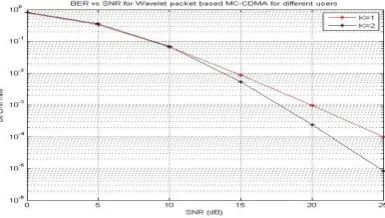
Fig. 4.2 BER Vs SNR for Wavelet packet based MC-CDMA for different users
Fig 4.2.shows the bit error rate versus SNR curves for different users of Wavelet packet based MC-CDMA scheme. It can be noted from the figure that as the number of users increases the bit error rate decreases in the whole range of SNR. Although, for the low SNR region (SNR=0dB ~10dB) the bit error rate performance is almost same as number of users increases. This is because in the low SNR region this scheme does not provide much improvement in the spectral efficiency, and hence shows the similar performance. However, in high SNR region the bit error rate performance increases significantly for different number of users. For example, when the SNR =25 dB, the bit error rate is equal to 10-4 (BER =10-5) for K=1, but at the same SNR =25 dB, the bit error rate is greater than 10-5 (BER >10-5) for K=2.
10.15662/ijareeie.2014.0309010
Copyright to IJAREEIE www.ijareeie.com 11769
Fig 4.3 shows the bit error rate versus SNR curves for different users of HHT based MC-CDMA scheme. It can be noted from the figure that as the number of users increases the bit error rate decreases in the whole range of SNR. For the low SNR region (SNR=0dB ~10dB) the bit error rate performance is greatly improved as the number of users increases compared to wavelet packet based MC-CDMA. . For example, in the low SNR regime when the SNR =10 dB, the bit error rate is greater than 10-2 (BER >10-2) for K=1, but at the same SNR =10 dB, the bit error rate is greater than 10-3 (BER >10-3) for K=2. This is because HHT based MC-CDMA scheme in the low SNR region provides much improvement in the spectral efficiency, and hence outperforms the wavelet packet based MC-CDMA. In the high SNR region the bit error rate performance increases significantly for different number of users. For example, in the high SNR regime when the SNR =25 dB, the bit error rate is greater than 10-5 (BER >10-5) for K=1, but at the same SNR =25 dB, the bit error rate is greater than 10-7 (BER >10-7) for K=2.
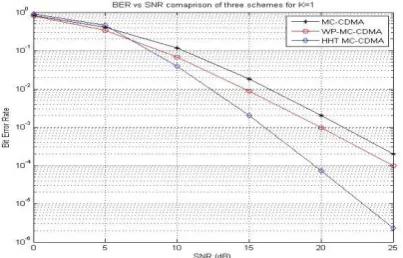
Fig.4.4BERVsSNR comparison of three schemes for k=1
Fig 4.4.shows the bit error rate versus SNR curves comparison for all three schemes for K=1. It can be noted from the figure that for K=1, HHT based MC-CDMA scheme outperforms both conventional MC-CDMA and wavelet packet based CDMA. In the very low SNR region (SNR=0dB ~5dB) the bit error rate performance of HHT based MC-CDMA scheme is slightly poorer compared to other two scheme. This is due to the fact that HHT based MC-MC-CDMA scheme slightly less spectral efficient compared to other two schemes in low SNR. But, as the SNR increases the bit error rate performance of HHT based MC-CDMA scheme increases drastically and outperforms other two schemes. For example, in the high SNR regime when the SNR =25 dB, the bit error rate of conventional MC-CDMA scheme is greater than 10-3 (BER >10-3) and bit error rate of wavelet packet based MC-CDMA scheme is equal to 10-4(BER =10
-4), whereas, the bit error rate of HHT based MC-CDMA scheme is greater than 10-5 (BER >10-5). Thus, it can be
concluded that HHT based MC-CDMA scheme superior to both conventional MC-CDMA and wavelet packet based MC-CDMA.
V.CONCLUSION
In this paper, we investigated the performance of conventional MC-CDMA system, orthogonal wavelet packet based MC-CDMA system (WP-MC-CDMA), and Huang Hilbert Transformation (HHT) based MC-CDMA system. In particular, we have analyzed the performance of orthogonal wavelet packet based MC-CDMA system by designing a set of wavelet packets and used as the modulation waveforms in a multicarrier CDMA system. Moreover, we have also investigated the performance of HHT based MC-CDMA. Numerical and simulation results show that the HHT based MC-CDMA outperforms both WP-MC-CDMA and conventional MC-CDMA in terms of bit error rate (BER), and helps to mitigate the effects of interference and channel fading.
REFERENCES
1. F. Rui, and P.X, “Joint data detection and phase recovery for downlink MC-2D-CDMA systems,” IEEE Transaction on communications, Vol. 57, No. 9, pp. 2782-2789, Sep. 2009.
3. C.Ivan and Andreas Springer, “Combined equalization for uplink MC-CDMA in rayleigh fading channels,” IEEE transactions on Communications, Vol. 53, No, 10, pp. 1609-1614, Oct. 2005.
4. L. Y. Lie, and L. H., “Performance of fractionally spread multicarrier CDMA in AWGN as well as slow and fast Nakagami-m fading channels,” IEEE Transactions on Vehicular Technology, Vol. 54, No. 5, pp. 1817-1827, September 2005.
5. C. Yewen and C. C. Ko, “Performance of a new premulticoded multicarrier DS-CDMA system in Nakagami fading,” IEEE Transactions on Communications, Vol. 55, No. 7, pp. 1363-1372, July 2007.
6. WuZhiqiang, and C.R. N, “FD-MC-CDMA: A frequency –based multiple access architecture for high performance wireless communication,” IEEE Transactions on Vehicular Technology, Vol. 54, No. 4, pp. 1392-1399, July 2005.
7. H. Brandon, and J. S. L, “Multiple-access interface suppression for MC-CDMA by frequency-domain oversampling,” IEEE Transactions on Communications, Vol. 53, No. 4, pp. 677-686, April 2005.
8. W. A. Rabah, and A.H. Al, “Performance analysis of fixed and mobile WiMAX MC-CDMA-based system,” in Proceeding 7th International
Symposium on Wireless Communication Systems,” York, pp. 436-440,September 2010.
9. Z. H. Hongbing and A. R. Lindsay, “Receiver design for wavelet–based multicarrier CDMA communications”, IEEE Transactions on Vehicular Technology, Vol. 54, No. 2, pp. 615-628,April 2005.
10. S. D. Sandberg and T. M. A., “Overlapped discrete multitone modulation for high speed copper wire communications,” IEEE Journal on Selected Areas on Communications, Vol. 13, No. 9, pp. 1571-1585, December 1995.
11. L. Zexian and M.L, “Error probability of interleaved MC-CDMA systems with MRC receiver and correlated Nakagami-m fading channels,” IEEE Transactions on Communications, Vol. 53, No. 6, pp. 919-923, June 2005.
12. S. Paulo and R.D., “Joint turbo equalization and multiuser detection of MC-CDMA signals with low envelope fluctuations,” IEEE Transactions on Vehicular Technology, Vol. 58, No. 5, pp. 2288-2297,June 2005.
13. Yu. Xiangbin, X. Z. and G. Bi, “Performance of an MC-CDMA system based on the complex wavelet packet and pre-equalization technique,” IEE Proc. Communications, Vol. 151, No. 2, pp. 152-156, 2004.
14. M. Christos and E. A, “Two-stage transmitter precoding based on data-driven code-hopping and partial zero forcing beamforming for MC-CDMA communications,” IEEE Transactions on Wireless Communications, Vol. 8, No. 7, July 2009.
15. N.E.H, and Z.S,S.R, “The Empirical Mode Decomposition and Hilbert Spectrum for Nonlinear and Non –Stationary Time Series Analiysis,proc.Roy.Soc.London A,Vol.454,1998,pp.903-995 July 1998..