Smart Metering Device and Automatic Billing
Sonaisha Sondhi 1, Dhruv Solanki 2 , Pavan Andbhorikar 3, Naila Asgar 4
B.E. Student, Department of Computer Engineering, Sinhgad Academy of Engineering College, Pune,
Maharashtra, India1
B.E. Student, Department of Computer Engineering, Sinhgad Academy of Engineering College, Pune,
Maharashtra, India2
B.E. Student, Department of Computer Engineering, Sinhgad Academy of Engineering College, Pune,
Maharashtra, India3
B.E. Student, Department of Computer Engineering, Sinhgad Academy of Engineering College, Pune,
Maharashtra, India4
ABSTRACT: Electricity consumption is still measured using traditional (not smart) electricity meters in most parts of
India. Readings of the meters are noted at the end of each month by a government official who has to roam from one place to another to get these readings. To avoid this effort and to make the number of units consumed available to a customer on demand, we aim to bring a new system into picture. Replacing all these meters with smart meters could be expensive and therefore this paper would focus on studying existing systems and their drawbacks, then on elaborating how a Raspberry Pi, Arduino or just a customized circuit could be used instead, to manage multiple electricity meters at a time and make them work like smart meters.
KEYWORDS: Embedded systems, Smart Electricity Meters.
I. INTRODUCTION
An electricity meter, electric meter is a device that measures the amount of electric energy consumed by a set of electrically powered devices. Electric meters installed at customers' location are used to measure electric energy consumed by utilities the run on electricity, which is the amount of electricity delivered to the customers, to generate bills. Amount consumed is typically calculated in billing units. The generalized unit is the kilowatt hour [kWh]. Bills are generated once each billing period, which is a default of a month in India. When there is a need to save energy during certain periods, meters may measure the maximum use of power in some interval, and a shed period can be decided accordingly. Electric rates can be changed during a day, and thus different prices can be seen in different hours even if the amount of energy used is the same. Recording usage can help one understand which are the peak high-cost periods are and what are the off-peak lower-cost periods. This paper will aim at studying different types of conventional electricity meters and smart electricity meters. We will understand the advantages and disadvantages of each type and justify how the proposed alternative could be a better substitute.
II. LITERATURESURVEY
A. Types of meters
The conventional meters fall into two basic categories, electromechanical and electronic [1]. And then we have smart meters.
I. Electromechanical meters
This is one of the oldest types of electricity meters. These work by counting the revolutions of a non-magnetic and electrically conductive metal disc which rotates at a speed proportional to the amount of power passing through the meter. The number of revolutions of the metal disk is proportional to the energy usage. The voltage coil consumes a small and relatively constant amount of power, generally around two watts. This consumption is not registered on the meter. The current coil also consumes a small amount of power in that is generally up to a few watts at full load [2]. This consumption is registered on the meter. The disc experiences a force from two sets of coils. This in turn produces a two phase induction motor. One coil produces a magnetic flux that is proportional to the voltage and the other produces a magnetic flux proportional to the current. The field of the voltage coil is altered by 90 degrees, using a lag coil. This produces eddy currents on the disk which then produces an effect force on the disc. This force is in proportion to the product of the instantaneous current, voltage and phase angle between them. A permanent magnet exerts an opposing force proportional to the speed of rotation of the disc. Because of the he equilibrium between these two opposing forces, the disc rotates at a speed proportional to the rate of energy usage. This type of meter is used on a single-phase AC supply. For different phases different configurations are used and additional voltage and current coils are required. One revolution of the disk represents the amount of energy that we denote by the symbol Kh which is given in units of watt-hours per revolution. To determine the amount of power consumed at any time one can use the
value of Kh by timing the disc with a stopwatch.
P= (3600 x KH)/t Where:
t = time in seconds taken by the disc to complete one revolution, and P = power in watts.
II. Electronic meters
Electronic meters can transmit readings to remote places. Not only do they measure the amount of electricity used but they also measure parameters like voltages, instantaneous and maximum rate of usage demands, power factor and reactive power used etc. They may support time-of-day billing, which means recording the amount of energy used during on-peak and off-peak hours. Every meter consists of an input of power from a power source, a processing unit (generally a microcontroller) that handles the communication as well, a metering unit that reads the amount consumed and other parts like LCD, communication ports etc.[3] Inputs are then processed using a digital signal processor to calculate the various metering parameters. A big source of errors in the readings of a meter is the drift produced in the preamp and the precision error while measuring a voltage. These parameters vary with temperature. The variation is quite high sometimes as most meters are placed outdoors. Making sure these errors are avoided is a major design issue while making meters. The responsibility of communicating with the outside world and with other modules attached to the meter is given to the processing and communication section. It uses different kind of protocols and encryption methods to provide reliable communication.
III. Smart meter
When the connection is wireless, we have options to choose from. Use cellular networks to communicate, that could be expensive. Or use WiFi which is a cheaper alternative. Low range options like Zigbee [7] and Bluetooth [8] can also be used. Reliable connectivity and communication are critical technological expectations from a good smart meter. Information that is collected from the processing units and needs to be transmitted must be transmitted error free and securely to some central location.
Protocols
The protocol used for two-way communications with a meter is described by the ANSI C12.18, which is an ANSI standard. The C12.18 was written for meter communications via an ANSI Type 2 Optical Port. It also specifies lower-level protocol details. ANSI C12.19 specifies the data tables that will be used. ANSI C12.21 is a modification or an extension of C12.18. It was written for modem instead of optical communications, thus it is better used to perform automatic meter reading. The physical media used to transmit the signals or data are either modulated light, sent with an LED and received with a photodiode, or a pair of wires, usually modulated by EIA-485. The protocol is half-duplex. TCP/IP technology is starting to be widely used as a communication means for smart metering applications. The existence of a universal metering interface would allow easier development, management and mass production of smart meters. Thus we can say best solution is to use an open protocol that is flexible enough to fulfil demands of both the industrial and the home requirements [9].
Data management
The next section that is important for a Smart Meter system is the information technology that integrates the Smart Meter networks with the utility applications, such as billing and outage management. This includes the Meter Data Management system [10]. The other necessity of Smart Meter systems is the proper integration of the system to utility applications. A major part of this is Data management. A Home Area Network (HAN) allows the metering system and home appliances to communicate. This way a smart meter can tell which appliance is specifically using how much electricity.
B. Unit of measurement
Commonly electricity is measure in kilowatt hour [kWh]. A kWh is equal to the amount of energy used by a load of one kilowatt over a period of one hour, or 3,600,000 joules. Some electricity providers use the SI mega-joule. Demand or electricity consumption is normally measured in watts, its average is found for a specific amount of time. Distortion of the electric current by loads is measured in several ways. Power factor is the ratio of resistive (or real) power to volt-amperes. A capacitive load has a leading power factor, and an inductive load has a lagging power factor.
C. Advantages and Disadvantages
Provides real-time data that is useful for reducing power outages
Enables dynamic pricing
Advantages for Users of Electricity
After the electric company has fully installed its advanced metering infrastructure, smart meters offer the following benefits to electricity customers:
Better feedback system
Enable consumers to adjust their habits in order to lower electricity bills
Reduces the number of blackouts and system-wide electricity failures
Advantages for the Environment
Avoids the need for new power plants that produce greenhouse gases
Reduces pollution created by vehicles driven by meter readers
The Disadvantages of Smart Meters are Short Term
While smart meters have accomplished enough, there are challenges that exist. However most of these disadvantages are short term.
Disadvantages for the Electric Companies
The cost in terms of equipment development and production to transition to a new technology and new set of processes
Making a long-term financial commitment to the new software involved
Ensuring the security and privacy
Disadvantages of Smart Meters for Consumers
Accuracy verification is difficult
Protection of privacy of personal data is difficult
Additional installation charges
III. PROPOSEDALTERNATIVE
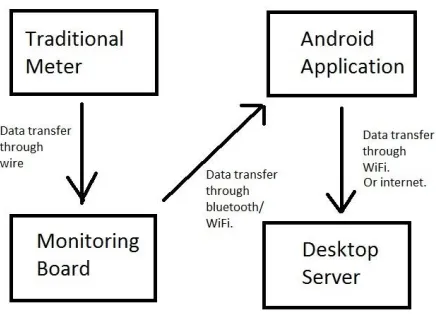
The conventional and smart methods for measuring electricity consumption studied above have a set of drawbacks. The smart meter might be more expensive and difficult to replace every old meter used in India. Thus we will try to build a small device [12] that would connect to the pre-existing meters and would provide the advantages of both conventional and smart meters. The design of the system would consist of an old meter connected to the device through physical cables. The device would read the number of units consumed from the meter and transmit it to the consumer’s mobile phone. From the mobile phone, using internet, the reading will be sent to the electricity provider.
A. Hardware Board
The hardware board will be physically connected to the meters and will read the value of number of units consumed. This value will then be sent to the registered users mobile device when the mobile device and the meter managing board are connected through WiFi. The board will store a list of meter numbers and their respective registered user mobile numbers.
Functions of the board:
1. Stay connected to meter and fetch readings continually. 2. Allow admin to do the following operations:
a. add new meter number and registered mobile number entry.
b. modify old details of pre-existing users on board memory. 3. Match user to correct meter when user tries to connect.
4. Connect to mobile on demand and send data on demand. 5. Transmit reading from board to mobile on specific dates.
B. Android Application software
The android application, after receiving the reading from the board, will create the bill in an image format (format will be inbuilt in the application-application developer can change the bill format if MSEB changes it). Only this image is shown to the user at the end of the month. The actual reading received from the board is encrypted and the bill image, are both sent to MSEB server.
ADVANTAGES DISADVANTAGES
CONVENTIONAL METERS Accurate readings Manual readings
Electricity consumed by
measuring coil adds up to bill
Low fault tolerance
SMART METERS LCD display
Two way communication
Smart management
Security issues with unencrypted communication
Complex communication
infrastructure
Functions of the application:
1. Register new user with mobile number and meter number. 2. Request reading from the monitoring board.
3. Create image of received reading at month end. 4. Send text in the form of reading and image to server. 5. Receive image bill from server and display it.
6. Set reminder for number of electricity units consumed. 7. Redirect to payment mode: e.g. paytm.
C. Server Desktop Application software
The server application will compare the received encrypted message to the received bill image and will authenticate the bill. Once the bill has been authenticated, the user will receive permission to pay the bill. There may be the possibility of implementing Machine Learning on the server application to study the data of electricity consumption from different areas and predict how much electricity might be used in the next month or year in which area.
Functions of the server:
1. Hold database that is required for the whole systems working. 2. Cross checking image and text reading with image processing. 3. Generate bill on server side and send it to user with deadline. 4. Send to mobile a conformation to pay bill before the date. 5. Generate receipt after payment is received and send to user.
IV. CONCLUSION
After considering all the above points that have emerged as a result of thorough research, we may conclude that the need for a monitoring board that can convert multiple traditional meters into smart meters and also manage them well might be a good substitute for Smart Meters. This method may prove to be less time consuming and cost efficient.
ACKNOWLEDGMENT
We would like to sincerely thank our project guide Prof. SN Shelke for being a constant support through the implementation of this project and for showing the same interest in it as we did. We would also like to thank the HOD and the teachers of Computer Department of SAE for the encouragement and guidance.
REFERENCES
1. A Comprehensive Review of Smart Energy Meters in Intelligent Energy Networks Qie Sun, Hailong Li, Zhanyu Ma, Member, IEEE, Chao Wang, Member, IEEE, Javier Campillo, Qi Zhang,Fredrik Wallin, Member, IEEE, and Jun Guo
2. Design and implementation of smart energy meter, V.Preethi, M.Tech, Student Department of ECE Vignan’s Lara Institute of Technology and Science Vadlamudi, Guntur, A.P, G. Harish, Assistant professor Department of ECE, Vignan’s Lara Institute of Technology and Science, Vadlamudi, Guntur, A.P.
3. Data Sheet BL0921 Single Phase Energy Meter
4. Advanced Metering Infrastructure (AMI), Electric power research institute (EPRI)
5. AUTOMATED METER READING (AMR) ELECTRIC METERS INFORMATION SHEET, Morris Bodnar Director, interior B.C. and Yokun district.
6. Smart Electricity Meter Data Intelligence for Future Energy Systems: A Survey. Damminda Alahakoon, Member, IEEE, and Xinghuo Yu, Fellow, IEEE
7. ZigBee-based Home Area Networks Enable Smarter Energy Management, Slicon Labs
8. A Solution Based on Bluetooth Low Energy for Smart Home Energy Management, Mario Collotta * and Giovanni Pau 9. Security in Smart Meters,August 2012,By Meera Balakrishnan
10. Meter data management for smart grid. Gridstream, Landisgry.
11. H. Park, M. Choi, E. Hyunpaik, and N. Kim, “Interoperability model for devices over heterogeneous home networks,” IEEE Trans. Consum. Electron., vol. 55, no. 3, pp. 1185–1191, Aug. 2009.