Volume 2006, Article ID 27848, Pages1–12 DOI 10.1155/ASP/2006/27848
Performance Measure as Feedback Variable
in Image Processing
Danijela Risti´c and Axel Gr ¨aser
Institute of Automation, University of Bremen, Otto-Hahn-Allee NW1, 28359 Bremen, Germany
Received 28 February 2005; Revised 4 September 2005; Accepted 8 November 2005
This paper extends the view of image processing performance measure presenting the use of this measure as an actual value in a feedback structure. The idea behind is that the control loop, which is built in that way, drives the actual feedback value to a given set point. Since the performance measure depends explicitly on the application, the inclusion of feedback structures and choice of appropriate feedback variables are presented on example of optical character recognition in industrial application. Metrics for quantification of performance at different image processing levels are discussed. The issues that those metrics should address from both image processing and control point of view are considered. The performance measures of individual processing algorithms that form a character recognition system are determined with respect to the overall system performance.
Copyright © 2006 Hindawi Publishing Corporation. All rights reserved.
1. INTRODUCTION
Throughout the development of image processing systems, nearly all research has been dedicated to design of new algo-rithms or to improvement of existing ones. In the last years, a significant effort also has been devoted to quantitative per-formance assessment of different image processing methods [1]. In that, image processing algorithms mostly have been considered on their own and developed performance mea-sures have been used to evaluate the effectiveness of individ-ual algorithms or to compare the different image processing algorithms [2,3]. However, in practice an image processing system consists of serial image processing operations com-bined differently depending on the overall goal of the vision system. Depending on application, it can happen that a per-formance measure of an algorithm if considered on its own is not a suitable performance measure if the same algorithm is encapsulated within a larger system. Therefore, it is very important to measure the effectiveness of individual algo-rithm within a vision system. Recently, some results on per-formance measures that provide a step to building vision sys-tems that automatically adjust algorithm parameters at each level of the system to improve overall performance were pub-lished [4,5]. In this paper, such kind of performance measure is considered but throughout the consideration of inclusion of control techniques in standard image processing system. The inclusion of closed-loop control is suggested to over-come the problems of standard open-loop image process-ing. The motivation is the knowledge coming from control
theory, that closed-loop systems have the ability to provide a natural robustness against disturbances and system uncer-tainty [6].
When control techniques are discussed in connection with image processing, they are usually done so in the con-text of anactive visionorvisual servoing systems[7,8] which use the image processing to provide visual feedback informa-tion for closed-loop control. In contrast to active vision and visual servoing, there are only a few publications dealing with the usage of control techniques in image processing [9–11]. The intention of this paper is to give an additional contribu-tion to the topic.
Image acquisition
Pre-processing Segmentation
Feature extraction
Classification and recognition Image data processing
Image understanding (a)
Image acquisition
Pre-processing Segmentation
Feature extraction
Classification and recognition Image data processing
Image understanding
(b)
Figure1: Block diagrams of standard open-loop (a) and closed-loop (b) digital image processing.
Hence, the performance measure of an individual image pro-cessing algorithm is a measure which reflects the quality of the resulted image. This measure must be appropriate not only from the image processing point of view but also from the control point of view. A basic requirement of the control is that the quality of the image has to be measured so that the control variables can be changed to optimize it. It should be possible to calculate it easily from the image and it must be understandable what the image quality actually is.
The paper is organized as follows. The key principle of the inclusion of feedback structures in image processing is given inSection 2. The main emphasis is on the choice of the control and feedback variables. In some applications, illumi-nation condition or camera parameters may be used as con-trol variables that influence the quality of images at different levels of image processing. In applications where this is not possible, only internal image processing variables are avail-able for control. This and other specifics, as well as the benefit of the closed-loop control in image processing, are discussed more detailed inSection 3throughout the demonstration of results achieved for optical character recognition in the auto-motive industry. In this case, our feedback mechanism treats the image acquisition as the essential image processing step, bearing in mind the influence of the quality of original (not-processed) image on the subsequent processing, which is dif-ferent from other published results on feedback structures in image processing [12,14]. Active image acquisition should provide a “good” original (not-processed) image suitable for subsequent processing. In literature there are different treat-ments of the control of image acquisition on its own. For ex-ample, in [15], a feedforward of camera parameters accord-ing to the appropriate quality measure is used to provide an image of good quality. We focus our attention on the illumi-nation condition as another important factor for the success of image acquisition. In contrast to [16] where the active illu-mination is considered as a forward action, in this paper the error-based closed-loop control technique is discussed. Be-sides the image acquisition control, aiming at improvement of the quality of not-processed image and so at providing a basis for the image data processing to be supported by a more
robust input image data, the inclusion of feedback control at the segmentation level of image processing is considered. The goal is to suggest the possible method of the automatic adjustment of the internal image processing variables, based on the classical control techniques, for improvement of the overall image processing performance. The comparison of performance of proposed method of closed-loop parameter adjustment to the performances of two traditional open-loop adaptive segmentation methods is given inSection 4.
Even though the results presented in this paper are en-tirely associated with the acquisition and segmentation levels of image processing and application of the character recogni-tion in industrial environment, it is believed that the applied technique will be equally suitable for both other steps and other applications of image processing.
2. CLOSED-LOOP CONTROL IN IMAGE PROCESSING
A majority of image processing applications concern the ob-ject recognition and typically consist of three subsequent parts: image acquisition, image data processing, and image understanding, as it is shown inFigure 1(a).
regardless of the requirements of the following steps. The in-troduction of feedback and control strategies at all levels of image processing applications as proposed inFigure 1(b)will lead to higher robustness and reliability of the image process-ing system [13,18].
It is possible to include two types of closed-loops in a standard image processing system. The first one can be named image acquisition closed-loop. Here the information from all subsequent stages of image processing may be used as feedback to control acquisition conditions (solid lines in Figure 1(b)). The aim is to provide a “good” image for the subsequent processing steps from preprocessing, through the segmentation and feature extraction to the classification. As it will be shown in the following section, the image acquisi-tion closed-loop may cancel the need for the tradiacquisi-tional pre-processing techniques and so can be considered as a new im-age processing method.
The second type of closed-loop can be realized as the feedback between the quality of the image, representing the input of a higher processing level, and the parameters of im-age processing at lower level as represented with dashed lines inFigure 1(b). This closed-loop adjusts parameters of the ap-plied processing algorithm according to requirements of the subsequent image processing step and so can be named pa-rameters adjustment closed-loop. Hence, in contrast to image acquisition closed-loop, this can be treated as alocal feedback at the related stage of image processing.
The closed-loop control in image processing differs sig-nificantly from the usual industrial control, especially con-cerning the choice of the actuator and the controlled vari-ables. Generally, the actuator variables are those that directly influence the image characteristics. Hence, for the image quisition closed-loop, depending on the application, the ac-tuator variables can be camera’s parameters or the illumina-tion condiillumina-tion. For the second type of closed-loop, the actua-tor variables are parameters of applied processing algorithms (e.g., coefficients and size of a smoothing filter at preprocess-ing level, threshold or parameters and size of filter masks for point, line, and edge detection at segmentation level, etc.). However, the choice of the controlled variable is not a trivial problem. This variable has to be appropriate from the con-trol as well as from the image processing point of view as it was explained inSection 1. From the image processing point of view, a feedback variable must be an appropriate measure of image quality.
The problem of identifying which image data are good and which are bad has become a serious issue in the vision community [15]. To answer the question “what is the image of good quality?” is quite a difficult problem. The image qual-ity obviously depends on the interpretation of the context. If the image of a “top model” is considered, a good image may hide some details like, for example, no perfect skin. For a sur-gical endoscope a good image is one showing the organ of interest in all details clearly for human interpretation. How-ever, in the machine vision context it must be kept in mind that “what human being can easily see is not at all simple for a machine” [19]. Therefore, one of the main problems in the implementation of automated visual inspection systems
is to understand the way in which the machine “sees” and the conditions that have to be created for it to perform its task at its best. Since the correct image understanding highly depends on the result of the object recognition and classifica-tion, which represent the last of sequentially arranged image processing steps, it turns out thata “good” image is one on which the subsequent steps work well. If we consider the per-formance measure of image processing at a particular level as a measure of the quality of the corresponding image, then the performance of active acquisition may be a measure that re-flects how good contrast of the original image is. The perfor-mance of algorithm at the segmentation level measures cor-rectness of segmentation of the image areas corresponding to objects of interest, and so forth.
In the following, the principle of the choice of the control and controlled variable in image processing is presented for the case of character recognition in industrial environment. The authors are of the opinion that even though this choice is application dependent, once a pair of controlled and actuator variable is found the framework for the inclusion of proven error-based control techniques in different image processing applications is provided.
3. FEEDBACK CONTROL FOR IMPROVEMENT OF CHARACTER RECOGNITION IN
INDUSTRIAL APPLICATIONS
3.1. The problem
Automated reading of human-readable characters, known as optical character recognition (OCR) [20] is one of the most demanding tasks for computer vision systems since it has to deal with different problems like wide range of fonts, confus-ing characters such as B and 8, or unevenly spaced charac-ters. Besides the mentioned common problems concerning the nature of text information to be recognized in various industrial applications ranging from the pharmaceutical in-dustry to the automotive inin-dustry, there are numerous spe-cific challenging conditions that should be met. In the au-tomotive industry, that represents one of the most frequent and important application area of the OCR, there is a great variety of identification marks on different materials to be detected. Some of them are shown inFigure 2.
Printed Scratched Embossed Needle-stamped
Figure2: Different types of identification codes on metallic surfaces to be detected.
Image acquisition
Original image
Image data processing Segmentation
of text areas
Characters binarization
Binary edge-detected
image
Classification and recognition
Figure3: OCR system with included feedback control.
on them, in variable illumination conditions was performed [10]. The variable illumination was accomplished by vary-ing the position of the point light source. This simple light-ing arrangement fulfills the requirements for the detection of scratched or embossed characters. The scratched and em-bossed marks of work pieces, representing surface deforma-tions, are required in many production processes as durable markings, resistant to subsequent processing steps. Because of their three-dimensional structure, characters created this way are often difficult to illuminate, to segment and, con-sequently, to detect. The using of directional front lighting is a good way to visualize surface deformations [19] since the characters appear bright in contrast due to the reflec-tion from the characters edges. However, in case of a heav-ily textured surface such as it is created by certain machin-ing methods or caused by pollution, the whole surface may appear bright since it contains a lot of microscopic defor-mations. The problem is also that depending on the qual-ity of the marking process, the depth of the characters can vary demanding a different illumination even for the same characters due to different reflection conditions. Hence, to find the optimal position of the light source is of major sig-nificance for characters detection. The determination of the light source position or the appropriate combination of mul-tiple lighting elements by the vision engineer in an iterative process [16] is time-consuming. By choosing the appropri-ate controlled variable and the closed-loop control strappropri-ategy for image acquisition, the adjustment of the parameters of the illumination setup can be done automatically for diff er-ent types of characters and surfaces. The suggested image ac-quisition closed-loop is illustrated inFigure 3as the feedback between the quality of the original (not-processed) image and the illumination conditions as a crucial factor for the im-age acquisition.
As shown inFigure 3, alike to most other OCR systems [20] we consider the classical structure, but only as the skele-ton. Hence, the system is in two major sections: image ac-quisition and image data processing. Processing consists of usual steps: segmentation of characters to be recognized,
Figure 4: Control goal: “good” original image (top), recognized characters in corresponding binary edge-detected image (down).
their binarization, and finally classification and recognition. The novel difference in our configuration in comparison to other traditional systems lies in the inclusion of two con-trol loops. Besides the above-mentioned image acquisition closed-loop, the local feedback at the segmentation level was introduced. This closed-loop was realized as the feedback between the quality of binary edge-detected image and the threshold value as a parameter determining the success of the characters binarization.
Red plate Missing image information
Black plate Broken characters
Gray plate Heavy noised characters
Figure5: Original image of metallic plate with 26 scratched characters on it (left). Recognized characters in binary edge-detected image (right).
as it will be shown, the measures of effectiveness of individ-ual control-loops are determined considering the number of correctly recognized characters which is the overall OCR sys-tem performance.
3.2. Image acquisition closed-loop
As it was said above, the control goal of the image acquisi-tion closed-loop is to give the not-processed image of good quality. To find the measure of the image quality that could be used as feedback variable, some image types, represent-ing the undesired cases for OCR relative to the illumination conditions, were first investigated (Figure 5).
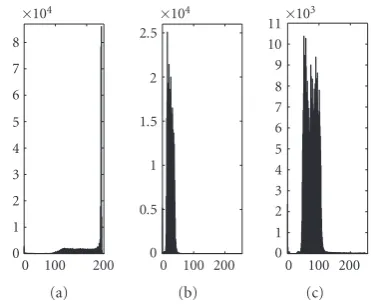
The red, black, and gray plates with scratched characters on them, of 5 mm and 4 mm height and 0.5 mm width, were imaged in identical illumination conditions. Due to the dif-ferent light reflection from the plates, the acquired images resulted in a too bright, too dark, and low-contrast image, respectively as shown inFigure 5. The first two images are obviously of so bad quality that even for the human being it is difficult to recognize characters on them. On the first sight, the third image is a “good” one since a human being can rec-ognize characters on it. However, the corresponding image histogram (Figure 6(c)) is too narrow indicating the very low contrast of the edges of characters. Hence, the correspond-ing binary edge-detected image as well as binary images of the first two acquired images are of poor quality. The charac-ters on them are broken, heavy noised, or simply there are no characters due to the lost image information during the im-age acquisition. Consequently, the result of character recog-nition is quite weak and unreliable. Since lost image
informa-×104
8 7 6 5 4 3 2 1 0
0 100 200 (a)
×104
2.5 2 1.5 1 0.5 0
0 100 200 (b)
×103
11 10 9 8 7 6 5 4 3 2 1 0
0 100 200 (c)
Figure6: Gray-level histograms of the bright (a), dark (b), and low-contrast (c) images shown inFigure 5.
tion cannot be restored, it turns out that the image suitable for character recognition must contain the maximum infor-mation.
In the classical information theory, the measure of the average information generated by the source is the entropy [21]. Considering an image as a source with independent pixels, the entropy is defined as the information content of the image and is given by the following formula:
H= −N
−1
i=0
Table1: Division of gray-level scale into three areas.
Gray-value areas 1 (dark) 2 (middle) 3 (light)
Gray values 0· · ·35 36· · ·179 180· · ·255
where
(i) piis the probability of occurrence of pixel valuei:
pi=total number of pixels in the imagenumber of pixels with gray-leveli ; (2)
(ii)N is the number of pixel values (gray levels). For the usual case of an 8-bit integer image N = 256 when, according to (1), theoretical maximum entropy is 8 [bits/pixel].
The definition of the image entropy (1), also known as the entropy of one-dimensional (1D) histogram or 1D en-tropy, indicates the maximal entropy as the best measure of the image quality. Even though it is correct for some image processing applications [15], for the character recognition it is not the case. Maximal entropy corresponds to the case of all gray values equally distributed over the image pixels. That means that the image can contain too bright or dark spots which, as seen inFigure 5, cover the characters to be recog-nized. In order to avoid dark or light spots in an image, caus-ing the loss of information on characters, the majority of im-age information should be contained in the gray levels from the middle part of the gray-level scale. However, the image using only the gray levels from the middle area, according to example shown in Figures5and6(c), is of low-contrast and so not suitable for the OCR.
All previous discussions indicate thatto have an image of high contrast, suitable for further character recognition, the im-age histogram must be stretched over the whole gray-level scale, but the maximum of information must be carried by gray levels from the middle gray-value area.In order to find the measure of the stretch degree of the image histogram, the following division of a gray-level scale to a dark, middle, and light area is suggested as shown inTable 1[10].
A coefficientαis introduced, which represents the rela-tive contribution of the entropy in the middle gray-value area to the total sum of entropies:
α= H2
H1+H2+H3
. (3)
The coefficientαis used as the performance measure of the spread of the image histogram over the gray-level scale. Its reference value is 0.5≤α. The entropies in darkH1,
mid-dleH2, and lightH3areas are determined according to
Hj= − UBj
i=LBj
pilog2pi, j=1, 2, 3, (4)
wherepiis the probability of occurrence of pixel valueiin the jth gray-level area andLBjandUBjare, respectively, lower and upper boundaries of the corresponding gray-value area.
Camera
Object
Distance
Sweep
Tilt
Light source
(a) 0.52
0.51 0.5 0.49 0.48 0.47 0.46 0.45 0.44 0.43 0.42
St
re
tc
h
d
eg
re
e
o
f
the
image
h
ist
o
gr
am
0 20 40 60 80 100 120
Sweep (◦) (b)
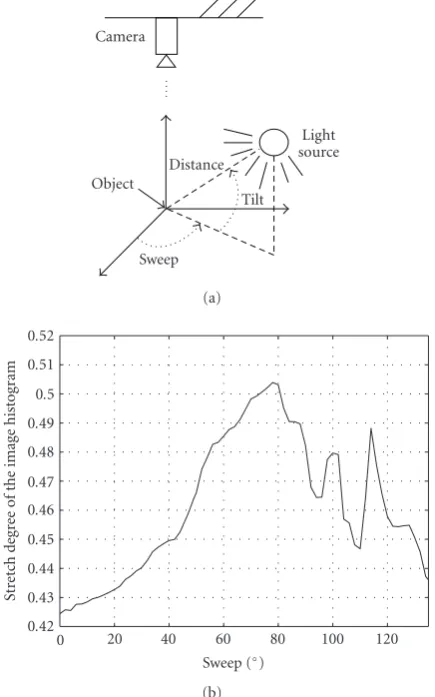
Figure7: Position of the light source with respect to the imaged ob-ject (a). Stretch degree of the image histogram for different sweeps of the light source (b).
The boundaries were determined by testing the changes of the image contrast on a set of images representing the full range of lighting conditions. The idea was to overcome the drawback of one dimensional histogram of not giving any information on spatial distribution of gray levels in an im-age, and consequently to provide information about over-and poor-lighted image areas.
The chosen control variable was a parameter determining the light source position and consequently the light source intensity. More precisely, the sweep of the light source with respect to the imaged object was considered as variable while two other parameters that determine the position of the light source (Figure 7(a)) were kept as constant.
Histogram of the reference
image
0 35 180 255 e(t)
Controller Umax
SlopeKp Ub
Umin
u(t) Object
illumination Object cameraCCD
Histogram of the original
image
0 35 180 255 Measure of the stretch degree of the image histogramα
(a)
Reference image e(t)
Controller Umax
SlopeKp Ub
Umin
u(t) Object
illumination Object
CCD camera
Original object image
Measure of the stretch degree of the image histogramα (b)
Figure8: Image acquisition closed-loop.
maximumofαby changing the illumination condition. Since these basic prerequisites for successful control action to be performed are fulfilled, αwas used as feedback variable in the implemented image acquisition control in our OCR sys-tem. The block diagram of the image acquisition closed-loop, which provides the image of high contrast suitable for subse-quent segmentation and characters binarization, is shown in two forms. The former, shown inFigure 8(a), presents the ef-fect of the implemented control on the image histogram, and the latter inFigure 8(b)explicitly demonstrates the result of control of image quality.
On the first sight the effect of the implemented con-trol technique in image acquisition is the same as of the traditional image preprocessing technique known as con-trast stretching [22]. The novel difference is that in contrast to the traditional case the implemented control technique changes, also, the contour of the histogram and so provides the avoidance of the saturated image case when the classical contrast stretching fails. The traditional contrast stretching makes the overlighted image areas larger which degrades the image quality in applications when larger bandwidth of gray levels is needed. Hence, the suggested control-based method can be regarded as a new image processing method.
Once the image of good contrast is achieved, the second feedback at the segmentation level of OCR system, which will be described in the next section, is initialized. By the on-line maintaining of the achieved good quality of not-processed image, the input image of the segmentation level can be treated as the image of constant quality. The benefit is that the process of binarization of characters to be detected may be considered as deterministic process.
3.3. Threshold adjustment closed-loop
Image segmentation is a key step in character recognition [20,23]. If the characters to be detected are not correctly
segmented from the background, it is not possible to extract accurately the characters features needed for the classifica-tion and character recogniclassifica-tion. Since the weak features lead to weak character recognition, it is of crucial importance to achieve the reliable segmentation of the text to be detected.
Original object image
r +
− e
Controller u(t) Threshold
Edge-detected
image
Binary edge-detected image
y(t)
Two-dimensional entropy of text area
Figure9: Threshold adjustment closed-loop.
processing system often gives poor character recognition results. There are publications that treat the adaptation of threshold value but mostly in open-loop and time-consuming iterative process [24, 25]. The suggestion is to apply the proven error-based control techniques in the im-plemented closed-loop shown inFigure 9.
Since the threshold value is the parameter which di-rectly influences the quality of binary edge-detected image, it was considered as the control signal in the implemented closed-loop. The more compact are black pixels that form the characters to be recognized, the binary edge-detected im-age is of better quality. Hence, the measure of connectivity of black pixels in segmented text area was naturally imposed as controlled variable.
We introduce the two-dimensional (2D) entropy as a measure of connectivity of black pixels forming the characters to be detected. It is defined by the following for-mula:
S= −
8
i=0
p(0,i)log2p(0,i), (5)
where p(0,i) is the probability of occurrence of a pair (0,i)
representing the black pixel surrounded with i black pix-els (i takes values from 0 to 8 while considering the 8-neighborhood):
p(0,i)=
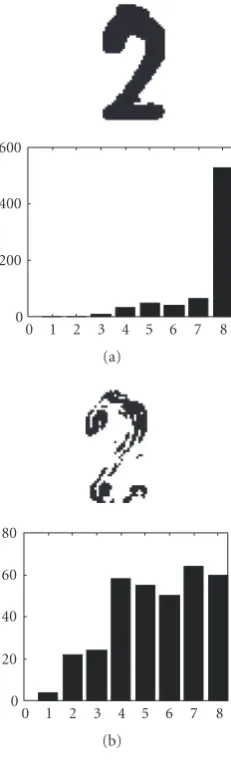
number of black pixels surrounded withiblack pixels number of black pixels in the image . (6) Figures10(a)and10(b)show, respectively, the images of the “good” numerical character “2” and the “broken” one to-gether with the corresponding histograms of distribution of pairs (0,i) found in the characters images.
As it is obvious, the histogram of the “full” character is very narrow in contrast to the histogram of the “broken” character. This is the expected result since the number of dif-ferent pairs (0,i) in the image of “good” character is smaller than in the image of “noised” character, but the probabil-ity of occurrence of found pairs (0,i) is larger. It is known that random variableXwith a large probability of being ob-served has a very small degree of information −logp(X) [21]. Hence, according to (5), the 2D entropy of a “good” character, formed of connected black pixels, is supposed to be quite smaller than the 2D entropy of a “broken” or “noised”
600
400
200
0
0 1 2 3 4 5 6 7 8 (a)
80 60 40 20 0
0 1 2 3 4 5 6 7 8 (b)
Figure 10: “Full” (a) and “broken” (b) numerical character “2” with the corresponding histograms of distribution of pairs (0,i).
character. The results of 1.4147 and 2.698 for the 2D entropy of shown “full” and “broken” character “2,” respectively, con-firm the previous statement. This provides a basis for the use of 2D entropy as a measure of the quality of a binary image containing the characters to be detected.
The case considered here assumes the black characters on white background, but the same measure can be used in the opposite case since the introduced 2D entropy is in gen-eral the measure of the connectivity of pixels representing the characters to be detected. In other words, the introduced metric (5) is a performance of the thresholding stage of im-age segmentation.
Figure 11shows the changing of the 2D entropy of text area in binary edge-detected imageSwith changing of the threshold value.
2.85 2.8 2.75 2.7 2.65 2.6 2.55 2.5 2.45
2D
ent
rop
y
o
f
te
xt
ar
ea
in
b
inar
y
image
10 20 30 40 50 60 70 80 Threshold
2.6 2.575 2.55 2.525 2.5 2.475 2.45
2D
ent
rop
y
o
f
te
xt
ar
ea
in
b
inar
y
image
25 30 35 40 45
Threshold
Figure11: 2D entropy of text area in binary image versus threshold value.
achieve theglobal minimumofSby changing the threshold value at binarization stage of image segmentation. The satis-fied basic prerequisites for successful control action to be per-formed prove the pair “threshold—2D entropy of text area” as a good pair “actuator variable—feedback variable” in the implemented threshold adjustment closed-loop.
The response of the threshold adjustment closed-loop and consequently of the overall character recognition sys-tem, in the experiment of imaging of a metallic plate with scratched characters on it, is presented inFigure 12.
The achieved result shows that the implemented im-age acquisition closed-loop rejected the disturbances before they influenced the primary control object, that is, the binary edge-detected image. In the threshold adjustment closed-loop, the number of black pixels in text area was gradually increased so that characters were gradually “filled up” as shown in Figure 12for the case of numerical char-acters 0, 1, 2, and 3. The reliable character recognition was achieved after the fifth cycle of implemented threshold adap-tation closed-loop.
4. COMPARISON OF THE THRESHOLDING PERFORMANCES
In this section, the performance of proposed closed-loop control-based thresholding method is compared with the performances of two traditional adaptive thresholding meth-ods: 1D entropy-based thresholding and 2D entropy-based thresholding [24,25]. In contrast to our method which uses feedback information on quality of binary image to ad-just the threshold, those two methods present “forward ac-tions.” The 1D entropy, that is 2D entropy, of the background and foreground of the gray-level image to be thresholded (in our system edge-detected image) is calculated. Then the threshold which corresponds to the maximum of the sum of background and foreground entropies is determined as ex-plained in more details in the following.
4.1. 1D entropy-based thresholding
A few widely-used thresholding methods are based on the concept of 1D entropy defined inSection 3.2[25]. Accord-ing to [26], the threshold valuetodivides the gray-level scale of the 1D histogram of the image to be segmented into two areas. One corresponds to image background and the other corresponds to image foreground, that is, to objects to be seg-mented. In an image the foreground area (objects) may con-sist of bright pixels on the dark background as in our case of edge-detected images. Then the 1D entropies of the back-groundHband foregroundHf regions of an 8-bit image are, respectively, defined as
Hb= − to
i=0
pilog2pi, (7)
Hf = − 255
i=to+1
pilog2pi, (8)
wherepiin (7) is the probability of occurrence of pixel value iin background areai =0,. . .,to, andpiin (8) is the prob-ability of occurrence of pixel valueiin foreground areai = to+ 1,. . ., 255.
The thresholdtowhich will provide optimal result of im-age binarization is the one maximizing the sum of the en-tropies (7) and (8). Threshold determined this way is sup-posed to yield a binary image with the maximum informa-tion on segmented objects.
4.2. 2D entropy-based thresholding
(a) Recognized characters after the first cycle
(b) Intermediate result
(c) Recognized characters after the fifth cycle
Figure12: Character recognition result achieved with the OCR sys-tem with implemented closed-loops.
the pixel of gray-levelisurrounded with neighborhood pixels with average gray-valuea. The entropy of the 2D histogram of an 8-bit gray-level image is defined as follows:
H= −
255
i=0 255
a=0
pialog2pia, (9)
wherepiais the probability of occurrence of the pair (i,a)
pia=total number of pairs in the imagenumber of pairs (i,a) . (10)
As in the case of 1D entropy-based thresholding here the 2D entropies of the background and foreground of a gray-level image supposed to have bright objects on the dark back-ground are calculated as
Hb= − to
i=0 ao
a=0
pialog2pia, (11)
Hf = − 255
i=to+1 255
a=ao+1
pialog2pia, (12)
wherepiain (11) is the probability of occurrence of the pair (i,a) in background area whilepiain (12) is the probability of its occurrence in foreground area.
100 90 80 70 60 50 40 30 20
Thr
eshold
0 20 40 60 80 100 120
Sweep (◦) 1D entropy
2D entropy Closed-loop
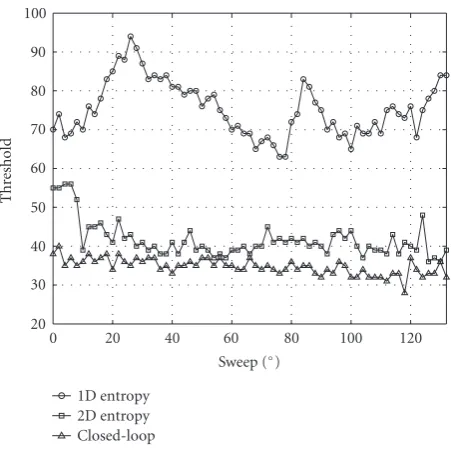
Figure13: Threshold values for the images, corresponding to dif-ferent sweeps of the light source, obtained using three adaptive methods.
The algorithm then searches for the values i = to and
a=aothat maximizes the sum of the background and
fore-ground 2D entropies (11) and (12). This is where the thresh-old is located.
Bearing in mind that a binary image is an image of only two-pixel values, the suggested 2D entropy of the binary im-age (5) can be treated as the special case of the 2D entropy of a gray-level image (9).
4.3. Experimental results
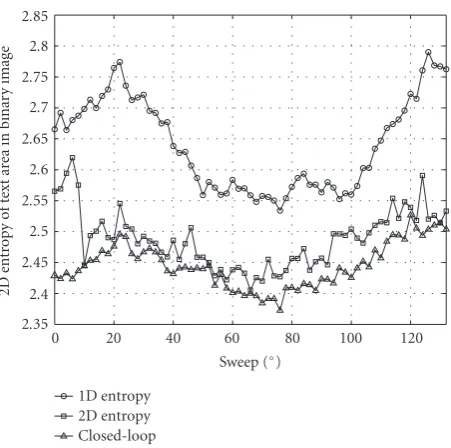
The binarization of 72 images of metallic plates with scratched characters on them, captured for the different sweeps of the light source with respect to the imaged ob-ject, was performed using the two above described tradi-tional adaptive thresholding methods and the closed-loop control-based thresholding method proposed in this paper. The optimal thresholds resulted from all three methods can be seen inFigure 13.
Figure 14shows the 2D entropy of text area in binary images corresponding to images captured in different illu-mination conditions. The edge-detected image of each orig-inal image was binarized three times using the threshold values determined according to three previously described methods. The binarization results were compared using the 2D entropy of text area in binary image as the performance criteria.
2.85 2.8 2.75 2.7 2.65 2.6 2.55 2.5 2.45 2.4 2.35
2D
ent
rop
y
o
f
te
xt
ar
ea
in
b
inar
y
image
0 20 40 60 80 100 120
Sweep (◦) 1D entropy
2D entropy Closed-loop
Figure14: 2D entropy of binary images, corresponding to different
sweeps of the light source, obtained using three thresholding meth-ods.
and 4 correspond to the original image captured for the sweep 78◦ of the light source with respect to the imaged object. That image is the output of the implemented im-age acquisition closed-loop explained inSection 3.2. Binary image shown in Figure 15(a)is obtained using the thresh-old value 63 determined by 1D entropy-based threshthresh-olding method.Figure 15(b)corresponds to threshold 42 that max-imizes the 2D entropy of edge-detected image as explained in Section 4.2. The method proposed in this paper resulted in the threshold value 34 which yielded the lowest 2D entropy of the text area and so the best recognition result as shown in Figure 15(c).
5. CONCLUSIONS
In this paper the performance measure of image process-ing has been considered through the consideration of the inclusion of closed-loop control in standard open-loop im-age processing system. The idea behind the incorporation of classical control techniques in a standard image process-ing is to improve its robustness and reliability. The specifics and benefit of inclusion of feedback control at different lev-els of an image processing system have been demonstrated through the results achieved for recognition of 3D characters on metallic surfaces which represents a standard industrial image processing application. The inclusion of image acqui-sition closed-loop and the closed-loop at image segmenta-tion level of character recognisegmenta-tion system has been consid-ered. The main emphasis is on the choice of the actuator and controlled variable. It has been shown that appropriate measures of the image quality can be considered as the feed-back variables in included closed-loops at particular image processing levels. The measures of image quality,
represent-(a)
(b)
(c)
Figure15: Character recognition result achieved with the OCR sys-tem with thresholding based on 1D entropy (a), 2D entropy (b), and closed-loop (c).
ing the performance measure of corresponding closed-loop image processing, have been determined with respect to the overall system performance. It has been shown that the per-formance measure should be appropriate from both the im-age processing and control point of view.
The choice of controlled and actuator variables while in-cluding the feedback control in image processing strongly de-pends on the image processing application and is not always straightforward due to the availability of a large number of variables that can be treated as measures of the quality of im-ages but which are not all appropriate as feedback variables in closed-loop control. This fact differentiates the most con-trol in image processing from the classical industrial concon-trol. However, once a pair of controlled and actuator variables is found for the specific application, the framework for the in-clusion of proven error-based control methods is provided.
REFERENCES
[1] S. Bailey, M. Forshaw, and M. Hodgetts, “A methodology for goal oriented image processing-performance evaluation,” in Workshop on Performance Characterisation and Benchmarking of Vision Systems, Canary Islands, Spain, January 1999. [2] L. Wenyin, J. Zhai, D. Dori, and T. Long, “A system for
per-formance evaluation of arc segmentation algorithms,” in Pro-cedings of 3rd Workshop on Empirical Evaluation Methods in Computer Vision (CVPR ’01), Kauai, Hawaii, USA, December 2001.
[3] J. C. McCall and M. M. Trivedi, “Performance evaluation of a vision based lane tracker designed for driver assistance sys-tems,” Tech. Rep., Computer Vision Robotics Research Labo-ratory, University of California , San Diego, Calif, USA, De-cember 2004.
[4] P. L. Palmer, H. Dabis, and J. Kittler, “A performance measure for boundary detection algorithms,”Computer Vision and Im-age Understanding, vol. 63, no. 3, pp. 476–494, 1996.
[5] M. Mirmehdi, P. L. Palmer, and J. Kittler, “Optimising the complete image feature extraction chain,” inProceedings of the 3rd Asian Conference on Computer Vision (ACCV ’98), vol. 2, pp. 307–314, Hong Kong, January 1997.
[6] K. Ogata,Modern Control Engineering, Prentice-Hall, London, UK, 2002.
[7] P. Corke,Visual Control of Robots: High Performance Visual Servoing, Research Studies Press, Taunton, UK; Wiley, New York, NY, USA, 1996.
[8] B. J¨ahne, H. Haußecker, and P. Geißler, Eds., Handbook of Computer Vision and Applications-Vol.3. Systems and Applica-tions, Academic Press, London, UK, 1999.
[9] D. Nair, L. Wenzel, A. Barp, and A. Siddiqi, “Control strategies and image processing,” inProceedings of the 7th International Symposium on Signal Processing and Its Applications (ISSPA ’03), pp. 557–560, Paris, France, July 2003.
[10] A. Gr¨aser, O. Ivlev, and D. Risti´c, “First experiences with feed-back structures in image processing,” inProcedings of 24th Colloquium of Automation, pp. 98–109, Salzhausen, Germany, 2002.
[11] D. Kriegman, G. D. Hager, and A. S. Morse, Eds.,The Con-fluence of Vision and Control, Springer, New York, NY, USA, 1998.
[12] M. Mirmehdi, P. L. Palmer, J. Kittler, and H. Dabis, “Feedback control strategies for object recognition,”IEEE Transactions on Image Processing, vol. 8, no. 8, pp. 1084–1101, 1999.
[13] D. Risti´c, I. Volosyak, and A. Gr¨aser, “Feedback Control in Image Processing,”atp international-automation technology in practice, no. 1, pp. 61–70, 2005.
[14] J. Peng and B. Bhanu, “Closed-loop object recognition using reinforcement learning,”IEEE Transactions on Pattern Analysis and Machine Intelligence, vol. 20, no. 2, pp. 139–154, 1998. [15] J. A. Marchant, “Testing a measure of image quality for
acqui-sition,”Image and Vision Computing, vol. 20, no. 7, pp. 449– 458, 2002.
[16] J. J. Racky and M. Pandit, “Active Illumination for the segmen-tation of surface deformations,” inInternational Conference on Image Processing (ICIP ’99), vol. 1, Kobe, Japan, October 1999. [17] B. J¨ahne,Practical Handbook on Image Processing for Scientific
Applications, CRC Press LLC, Boca Raton, Fla, USA, 1997. [18] I. Volosyak, O. Kouzmitcheva, D. Risti´c, and A. Gr¨aser,
“Im-provement of visual perceptual capabilities by feedback struc-tures for robotic system FRIEND,”IEEE Transactions on Sys-tems, Man, and Cybernetics—Part C, vol. 35, no. 1, pp. 66–74, 2005.
[19] C. Demant, B. Streicher-Abel, P. Waszkewitz, and M. Strick, Industrial Image Processing-Visual Quality Control in Manu-facturing, Springer, Berlin, Germany, 1999.
[20] S. Mori, H. Nishida, and H. Yamada,Optical Character Recog-nition, John Wiley & Sons, New York, 1999.
[21] H. Maitre and J. Zinn-Justin, “Entropy, information and im-age,” in Progress in Picture Processing, pp. 81–115, Springer, North Holland, Amsterdam, 1996.
[22] R. C. Gonzalez and R. E. Woods, Digital Image Processing, Prentice-Hall, Englewood Cliffs, NJ, USA, 2002.
[23] C. A. Rahman, W. Badawy, and A. Radmanesh, “A real time ve-hicle’s license plate recognition system,” inProceedings of IEEE Conference on Advanced Video and Signal Based Surveillance, pp. 163–166, Miami, Fla, USA, July 2003.
[24] A. S. Abutaleb, “Automatic thresholding of gray-level pictures using two-dimensional entropy,” Computer Vision, Graphics and Image Processing, vol. 47, no. 1, pp. 22–32, 1989.
[25] M. Sezgin and B. Sankur, “Survey over image thresholding techniques and quantitative performance evaluation,”Journal of Electronic Imaging, vol. 13, no. 1, pp. 146–165, 2004. [26] D. W. R. Paulus and J. Hornegger, Pattern Recognition
and Image Processing in C++, F. Vieweg & Sohn, Braun-schweig/Wiesbaden, Germany, 1995.
Danijela Risti´creceived the M.S. degree in automatic control and robotics from the Faculty of Mechanical Engineering, Univer-sity of Niˇs, Serbia, in 1998. Since Novem-ber 2002, she has been a Ph.D. candidate at the Institute of Automation, University of Bremen, Germany. Her current research in-terest is feedback control in image process-ing.
Axel Gr¨aserreceived the Diploma in elec-trical engineering from the University of Karlsruhe, Germany, in 1976, and the Ph.D. degree in control theory from the TH Darmstadt, Germany, in 1982. From 1982 to 1990, he was the Head of the Control and Software Department at Lippke GmbH, Germany. From 1990 to 1994, he was a Pro-fessor of control systems, process automa-tion, and real-time systems at the University