From Analysis to Modeling of Engagement as Sequences of Multimodal
Behaviors
Soumia Dermouche, Catherine Pelachaud
CNRS UMR 7222, ISIR, Sorbonne Universit´es4 Place Jussieu Paris, France
{dermouche, pelachaud}@isir.upmc.fr
Abstract
In this paper, we present an approach to endow an Embodied Conversational Agent with engagement capabilities. We relied on a corpus of expert-novice interactions. Two types of manual annotation were conducted: non-verbal signals such as gestures, head movements and smiles; engagement level of both expert and novice during the interaction. Then, we used a temporal sequence mining algorithm to extract non-verbal sequences eliciting variation of engagement perception. Our aim is to apply these findings in human-agent interaction to analyze user’s engagement level and to control agent’s behavior. The novelty of this study is to consider explicitly engagement as sequence of multimodal behaviors.
Keywords:Engagement, Non-verbal behavior, ECA, Temporal Sequence Mining, Human-agent interaction
1.
Introduction
Embodied Conversational Agents (ECA) are virtual charac-ters that can interact with a user. Today, ECAs are increas-ingly being integrated in our everyday life, for example, for training, social coaching, and science teaching (Graesser et al., 2007). Our work is part of the H2020 European project ARIA-VALUSPA (Valstar et al., 2016) that aims to build an ECA able to play the role of an expert and to share its domain knowledge with a novice user. In this project, we focus on an important aspect of human-agent interaction, namely, engagement that ensures the interaction to go on. A survey of engagement definition in human-agent interaction is given in (Glas and Pelachaud, 2015). Engagement can be defined as: “the value that a participant in an interaction attributes to the goal of being together with the other par-ticipant(s) and of continuing the interaction”(Poggi, 2007). Engagement is also defined as “the process by which par-ticipants involved in an interaction start, maintain and ter-minate an interaction” (Sidner et al., 2005). Engagement is not measured from single cues, but rather from several cues that arise over a certain time window (Peters et al., 2005). The goal of this work is twofold: (1) user’s engagement detection: the ECA should be able to detect, in real time, the engagement level of the user. (2) ECA’s engagement modeling: the ECA should adapt its behavior in order to maintain the desired level of engagement during the inter-action. Specifically, this work investigates what are the multimodal behaviors that participate to a change of per-ception of the engagement level in a human-agent interac-tion. For this, we rely on sequence mining algorithms to associate user’s and agent’s non-verbal behaviors with dif-ferent engagement levels.
Several works focused on associating verbal and non-verbal behaviors with engagement in human-agent interaction, but most of them are limited to few signals such as smiling and head nod (Allwood and Cerrato, 2003; Castellano et al., 2009). In our work, we consider a set of non-verbal modal-ities (gesture, head movement and directions, smiling, etc.) jointly with their temporal synchronization (order, starting
time and duration).
Our study is performed on the NoXi dataset, a corpus of expert-novice interaction (Cafaro et al., 2017), that we have manually annotated according to the engagement levels of both expert and novice. The use of sequence mining al-lowed us discovering relevant patterns for different engage-ment levels.
2.
Related Works
During the last decades, engagement modeling has gained increasing attention due to the growing number of con-versational agents and the important role that engagement plays in human-agent interaction. Engagement can be ex-pressed by both verbal and non-verbal behaviors. En-gagement can be directly linked, for example, to prosodic features (Yu et al., 2004) and verbal alignment behav-iors (Pickering and Garrod, 2004).
Other studies have reported that smiling (Castellano et al., 2009) and head nod can provide information about the par-ticipant’s engagement (Allwood and Cerrato, 2003). Gaze is also an important cue of engagement level (Sidner et al., 2003; Peters et al., 2005; Nakano, Yukiko I. and Ishii, 2010), for example, looking at the speaking partner can be interpreted as a cue of engagement, while looking around the room may indicate the intention to disengage. More-over, a correlation has been found between engagement and several body postures (Mota and Picard, 2003; Sanghvi et al., 2011). In short, engagement can be conveyed by multi-modal behaviors (Sidner et al., 2003).
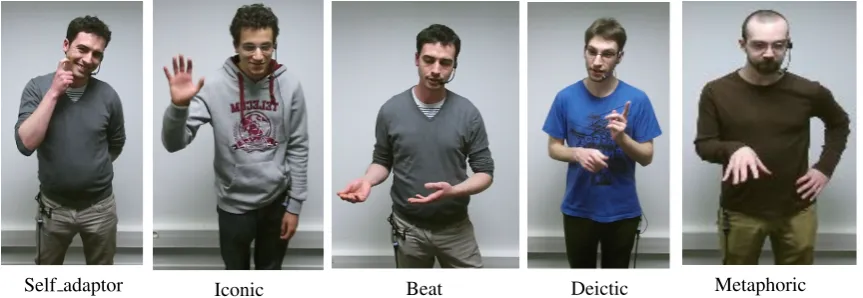
Self adaptor Iconic Beat Deictic Metaphoric
Figure 1: Examples of rest gestures.
example is that Arabs gaze (gaze and speech are the main social signals used to evaluate engagement (Sidner et al., 2010)) much longer and more directly at their partners than do Americans (Matsumoto, 2006).
3.
Multimodal Corpus Representation
In this section, we present the NoXi corpus, as well as the tool we have used for annotation (NOVA). We also present our annotation scheme for the non-verbal behavior and en-gagement.3.1.
NoXi
This work is part of the H2020 project ARIA-VALUSPA (Valstar et al., 2016) (Artificial Retrieval of In-formation Assistants - Virtual Agents with Linguistic Un-derstanding, Social skills and Personalized Aspects). In this project, a database of multilingual natural dyadic interac-tions, named NoXi (Cafaro et al., 2017), has been collected. NoXi is publicly available through a web interface1. NoXi provides spontaneous interactions that involve an expert and a novice discussing about a given topic (e.g.; sports, politics, videogames, travels, music, etc.). The dataset con-tains over 25 hours of dyadic interactions spoken in mul-tiple languages (mainly English, French, and German). In this work, we use the French part of NoXi database which is composed of 21 sessions. The total duration of all these sessions is 7 hours and 25 minutes.
3.2.
NOVA
In the context of the ARIA-VALUSPA project, a graphical tool named NOVA (Baur et al., 2015) has been developed to review and annotate the recorded data2. NOVA allows exploring richer data such as skeleton or face streams and by proposing various annotation schema (discrete or con-tinuous). We use NOVA as annotation tool.
3.3.
Manual Annotations of NoXi Corpus
Table 1 summarizes the multimodal behaviors that we man-ually annotated by adapting the MUMIN multimodal cod-ing scheme (Allwood et al., 2007). We use a discrete an-notation scheme to label body behavior (e.g., gesture, gaze
1
https://noxi.aria-agent.eu/ 2https://github.com/hcmlab/nova
direction and head movement) and continuous scale for en-gagement annotation. The manual annotations that we have realized on NoXi corpus will be publicly available through a Web interface3.
• Conversation states
We annotate four conversation states: both interlocu-tors speak (BOTH), expert speaks (EXPERT), novice speaks (NOVICE) or no one speaks (NONE).
• Facial display
For facial behavior, we considered: gaze, head move-ment/direction, smile, and eyebrow movement.
• Gesture
Based on the taxonomies proposed by McNeill (1992), we annotate five categories of gestures: iconics, metaphorics, deictics, beats, and adaptors defined as follows:
1. Iconics: describe concretely the object that the discourse is presenting.
2. Metaphorics: in contrary to iconic gestures, these gestures illustrate the speech in an abstract way.
3. Deictics: point to a location in space, for exam-ple, an object a place or a concrete direction),
4. Beats: do not include semantic information, they are characterized by their simplicity and receptiv-ity.
5. Adaptors: serve to satisfy bodily needs like scratching.
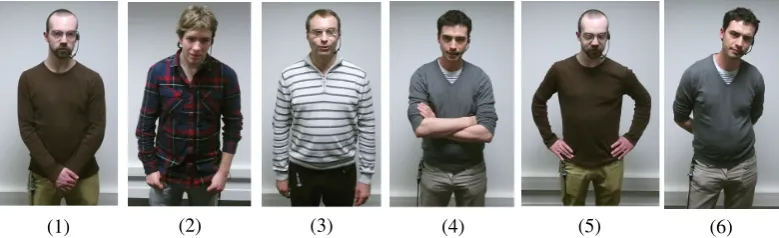
Examples of different types of gestures are showed in Figure 1. We also include hand rest positions that can indicate communicator’s status and attitude (Allwood et al., 2007). We consider several positions (see Fig-ure 2): arms crossed, hands together, hands in pock-ets, hands behind back, akimbo (hands on hips), along body (arms are stretched down along the body) etc.
• Engagement
Based on Poggi’s definition of engagement, we have continuously annotated the engagement of both expert
(1) (2) (3) (4) (5) (6)
[image:3.595.64.540.250.387.2]Figure 2: Examples of rest poses: (1) hands crosseddown, (2) hand inpocket, (3) hand along, (4) hands crossed, (5) hands onhips, (6) hands behaind.
Table 1: Annotation scheme for the non-verbal behaviors and engagement annotations in NoXi. Tier (modality) Labels
Conversation states NONE — EXPERT — NOVICE— BOTH
Head movements NOD — SHAKE
Head direction FORWARD — BACK — UPWARDS — DOWNWARDS — SIDEWAYS — SIDE TILT
Smiles SMILE
Eyebrow movements RAISED — FROWN
Gaze direction TOWARDS INTERLOCUTOR — UP — DOWN — SIDEWAYS — OTHER
Gestures ICONIC — METAPHORIC — DEICTIC — BEAT — ADAPTOR
Hand rest positions ARMS CROSSED — HANDS TOGETHER — HANDS IN POCKETS —
HANDS BEHIND BACK — AKIMBO — ALONG BODY
Engagement STRONGLY DISENGAGED ... STRONGLY ENGAGED
and novice. To reduce complexity and facilitate the task of continuous annotation, we have defined five levels to annotate changes in the perception of engage-ment: strongly disengaged, partially disengaged, neu-tral, partially engaged, strongly engaged. In order to avoid content biases from the verbal behavior when annotating engagement, we have filtered it out, for both expert and novice by applying a Pass Hann Band Filter. In this way, the speech kept the prosodic infor-mation without intelligibility of its verbal content.
4.
Corpus Analysis
In this section, we present an analysis of the manual an-notation. Each single modality (gesture, rest positions, en-gagement, etc.) has been annotated by one annotator. The inter-annotator agreement (Cohen’s Kappa) is greater than 0.5 for all modalities which means that there is a high level of agreement between annotators. Because of space limi-tation, we only present results about gesture and rest hand positions.
[image:3.595.307.538.536.685.2]• Gesture
Table 2 shows the number of gestures produced by the expert and the novice. As it can be seen, the expert produces 4 times more gestures (1223) than the novice (293). During the interaction, the expert controls the discussion topic: he holds the floor and he produces more gestures to explain and illustrate his topic. Ges-tures were mainly either iconics or metaphorics. These gesture types contribute to the perception of higher level of competence according to (Maricchiolo et al., 2009).
• Rest arms and hand positions
The number of arms positions produced by the expert is much more important than that of the novice (cf. Ta-ble 3). This can be explained as the novice is mainly a listener and keeps his rest position much longer (mean duration 32.2 seconds) than the expert (mean duration 10.7 seconds).
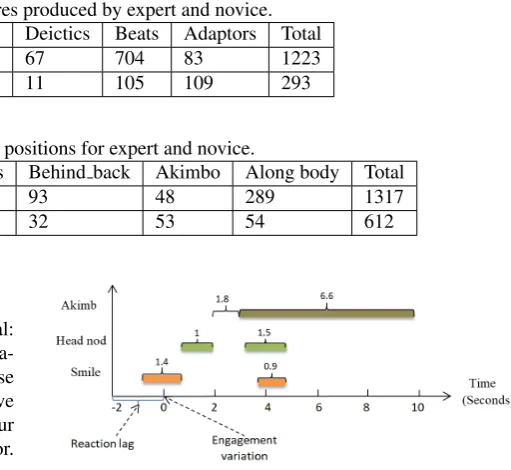
Table 2: Number of gestures produced by expert and novice. Iconics Metaphorics Deictics Beats Adaptors Total
Expert 211 158 67 704 83 1223
[image:4.595.280.536.78.313.2]Novice 49 19 11 105 109 293
Table 3: Number of rest positions for expert and novice.
Crossed Together In pockets Behind back Akimbo Along body Total
Expert 212 486 189 93 48 289 1317
Novice 82 177 214 32 53 54 612
5.
Sequence-based Engagement Modeling
Human behaviors are naturally multimodal and sequential: we interact with each other through multiple communica-tion channels (speech, gaze, gesture, etc.). Moreover, these behaviors are temporally coordinated: what behavior we will display next depends, among other phenomena, on our behavior at the present moment and on the other’s behavior. The goal of the present study is to understand how those behaviors are coordinated at critical moments, the sequen-tial patterns they exhibit and their association with different engagement levels. To capture both sequentiality and tem-porality, we rely on temporal sequence mining, a data min-ing technique that considers the temporal information like starting time and the duration of signals, a key element in behavior modeling. The ECA should display behaviors at the right moment with the right duration in order to convey a given level of engagement.
A range of temporal sequence mining algorithms exist like HCApriori (Dermouche and Pelachaud, 2016), QTIPrefixSpan (Guyet and Quiniou, 2011) and PESMiner (Ruan et al., 2014). In this work, we rely on HCApriori because it demonstrated a superiority over the state-of-the-art in terms of pattern extraction accuracy and running time (Dermouche and Pelachaud, 2016). In order to prepare a sequence database for HCApriori, we have segmented the non-verbal behaviors based on engagement variations (cf. Figure 3). We took into account the reaction lag of annotators in the continuous annotations by shifting back 2 seconds each of the annotations, as recommended in (Mariooryad and Busso, 2013). For each engagement level, we consider the sequence of non-verbal signals that simultaneously appeared with this level (cf. Figure 3). Thus, we build five datasets of non-verbal signal sequences representing the five engagement levels. Table 4 summarizes the number of sequences we obtain for each engagement level for expert and novice. Finally, we have applied HCApriori to extract temporal patterns (frequent sub-sequences) of nonverbal signals expressing the five engagement levels.
Figure 4 shows a pattern extracted with HCApriori algo-rithm representing a strong engagement level. This pat-tern can be interpreted as follows: 0.9 second before the annotator perceives a strong engagement level, the expert smiles to the novice for 1.4 seconds while nodding his head. Then he produces an akimbo gesture (hands on hips) mean-while he nods and continues smiling. Smiling and head nod have already been reported as being engagement
indi-Figure 4: Pattern example representing a strong engage-ment level.
cators (Castellano et al., 2009; Allwood and Cerrato, 2003). Table 5 gives two examples of extracted patterns (P1,P2)
for each engagement levels of expert. The starting and the duration of each signal are respectively given between two parentheses. While head nod has been reported as a cue of engagement in several works, our approach associates it with a partial disagreement if it is preceded by a frown and associates it with a strong engagement if it coincides only with a smile. This indicates that the perception of non-verbal signal may change with respect to the signals occurring before and after it.
In Table 6, we compute the percentage of some non-verbal signals that occurred in the patterns of expert for the five engagement levels. Here are some conclusions that we can draw from this table:
• Smile signal occurred in about 66% of the patterns representing a strongly engaged level. Within this level of engagement, the mean starting time of smile is -0.05 seconds, this means that 0.05 seconds before the perception a strong engagement, the expert smiles. In other words, the perception of strong engagement is triggered by the expert’s smile. On the other hand, for the partially disengaged level, the mean starting time of smile is 1.5 seconds: smile is produced 1.5 seconds after the perception of a partial engagement.
• Adaptor gestures and frown were also more frequently present in patterns characterizing a strongly disen-gaged level with a percentage of 25% and 33% respec-tively.
Table 4: Number of sequences of each engagement level for both expert and novice.
Strongly disengaged Partially disengaged Neutral Partially engaged Strongly engaged Total
Expert 48 373 373 561 126 1481
Novice 116 432 509 558 64 1679
Table 5: Some examples of extracted patterns for the five engagement levels. Engaged level Pattern example
Strongly disengaged P1= Eyebrow down (2, 1.48),P2= Adaptor(4.08, 2.12)
Partially disengaged P1=Eyebrow down(-1.6, 5) Head nod(5.1, 2.7), P2=Arms crossed(-1.68, 4.12)
Eye-browUp (-1.36, 2.64)
Neutral P1=Along body(-1.04, 9.5) Beat(0.37, 3.5), P2= Beat(-1.4, 2.28) Smile (1.56, 1)
Nod(2.52,1.72)
Partially engaged P1=Metaphoric (-1.8, 1.75) Iconic(-0.3,2.5),P2=Iconic(-1.25,2.22) Iconic(2,5)
Strongly engaged P1=Smile(-0.76, 3.64) Head nod (0.24, 0.36), cross (-1.14, 13.77),P2= Smile(-1.08,1.36)
[image:5.595.63.530.299.364.2]Smile (1.64,1.4)
Table 6: Percentage of some non-verbal signals that occurred in the patterns of expert for the five engagement levels. Strongly disengaged Partially disengaged Neutral Partially engaged Strongly engaged
Smile 0% 4% 16% 20% 66%
Eyebrowdown 33% 20% 25% 18% 8%
Nod 33% 20% 22% 24% 25%
Adaptor 25% 10% 11% 3% 0%
perception of non-verbal signal change according to its context. For example, nodding while smiling and performing an adaptor gesture was associated with a partial disengaged level.
6.
Conclusion
In this paper, we presented a sequence-mining based ap-proach toward engagement modeling from a corpus of expert-novice interactions. Sequence mining allowed us to extract relevant patterns associated to five engagement lev-els. While a part of our results perfectly supports previous works, some of our findings are complementary to the cur-rent state-of-the-art. This demonstrates that temporal char-acteristics, like starting time and duration of behaviors, are essential to studying engagement.
Our future purpose is to apply sequence mining results in human-agent interaction: (1) using expert patterns to model the desired engagement level of an ECA during the interac-tion. (2) Exploiting the patterns representing novice en-gagement for interpreting user’s non-verbal behaviors in real-time and associate it with different engagement vari-ations for allowing the agent to react accordingly.
7.
Acknowledgements
Funded by European Union Horizon 2020 research and in-novation programme, grant agreement No 645378.
8.
Bibliographical References
Allwood, J. and Cerrato, L. (2003). A study of gestu-ral feedback expressions. InFirst Nordic Symposium on Multimodal Communication, pages 7–22.
Allwood, J., Cerrato, L., Jokinen, K., Navarretta, C., and Paggio, P. (2007). The MUMIN annotation scheme for
feedback, turn management and sequencing. Interna-tional Journal of Language Resources and Evaluation, pages 1–18.
Baur, T., Mehlmann, G., Damian, I., Lingenfelser, F., Wag-ner, J., Lugrin, B., Andr´e, E., and Gebhard, P. (2015). Context-Aware Automated Analysis and Annotation of Social Human–Agent Interactions. ACM Transactions on Interactive Intelligent Systems, 5(2):1–33.
Cafaro, A., Wagner, J., Baur, T., Dermouche, S., Torres, M. T., Pelachaud, C., Andr, E., and Valstar, M. (2017). The NoXi Database : Multimodal Recordings of Me-diated Novice-Expert Interactions. InICMI’17,, pages 350–359, Glasgow, Scotland. ACM.
Castellano, G., Pereira, A., Leite, I., Paiva, A., and McOwan, P. W. (2009). Detecting user engagement with a robot companion using task and social interaction-based features. Proceedings of the 2009 international conference on Multimodal interfaces - ICMI-MLMI ’09, (January 2009):119.
Dermouche, S. and Pelachaud, C. (2016). Sequence-based multimodal behavior modeling for social agents. In
Proceedings of the 18th ACM International Conference on Multimodal Interaction - ICMI 2016, pages 29–36, Tokyo, Japan. ACM.
Glas, N. and Pelachaud, C. (2015). Definitions of engage-ment in human-agent interaction. In2015 International Conference on Affective Computing and Intelligent Inter-action, ACII 2015, pages 944–949.
patterns from interval-based sequences. InInternational Joint Conference on Artificial Intelligence (IJCAI 2011), pages 1306–1311.
Ivaldi, S., Lefort, S., Peters, J., Chetouani, M., Provasi, J., and Zibetti, E. (2017). Towards Engagement Models that Consider Individual Factors in HRI : On the Relation of Extroversion and Negative Attitude Towards Robots to Gaze and Speech During a Human ˆa Robot Assem-bly Task Experiments with the iCub humanoid. Interna-tional Journal of Social Robotics, 9(1):63–86.
Maricchiolo, F., Gnisci, A., Bonaiuto, M., and Ficca, G. (2009). Effects of different types of hand gestures in per-suasive speech on receivers’ evaluations. Language and Cognitive Processes, 24(2):239–266.
Mariooryad, S. and Busso, C. (2013). Analysis and Com-pensation of the Reaction Lag of Evaluators in Continu-ous Emotional Annotations. In2013 Humaine Associa-tion Conference on Affective Computing and Intelligent Interaction (ACII 2013), pages 85–90.
Matsumoto, D. (2006). Culture and nonverbal behavior.
Handbook of nonverbal communication, pages 219–236. McNeill, D. (1992).Hand and mind: What gestures reveal
about thought. Uni- versity of Chicago press.
Mota, S. and Picard, R. W. (2003). Automated Posture Analysis for Detecting Learner’s Interest Level. IEEE Computer Society Conference on Computer Vision and Pattern Recognition Workshops, 5:1–6.
Nakano, Yukiko I. and Ishii, R. (2010). Estimating User’s Engagement from Eye-gaze Behaviors in Human-agent Conversations. InThe 5th International Conference on Intelligent User Interfaces, pages 139—-148. ACM. Peters, C., Pelachaud, C., Bevacqua, E., Mancini, M., and
Poggi, I. (2005). Engagement Capabilities for ECAs.
AAMAS’05 workshop Creating Bonds with ECAs. Pickering, M. J. and Garrod, S. (2004). Toward a
mecha-nistic psychology of dialogue.The Behavioral and brain sciences, 27(2):169–190; discussion 190–226.
Poggi, I. (2007). Mind, Hands, Face and Body: A Goal and Belief View of Multimodal Communication.
Ruan, G., Zhang, H., and Plale, B. (2014). Parallel and Quantitative Sequential Pattern Mining for Large-scale Interval-based Temporal Data. In 2014 IEEE Interna-tional Conference on Big Data (BigData 2014), pages 32–39.
Sanghvi, J., Castellano, G., Leite, I., Pereira, A., McOwan, P. W., and Paiva, A. (2011). Automatic analysis of affec-tive postures and body motion to detect engagement with a game companion. Proceedings of the 6th international conference on Human-robot interaction - HRI ’11, page 305.
Sidner, C. L., Lee, C., and Lesh, N. (2003). Engagement by Looking: Behaviours for Robots when Collaborating with People. Proceedings of DiaBruck (the 7th Work-shop on Semantics and Pragmatics of Dialogue), pages 123–130.
Sidner, C. L., Lee, C., Kidd, C. D., Lesh, N., and Rich, C. (2005). Explorations in engagement for humans and robots. Artificial Intelligence, 166(1-2):140–164. Sidner, C. R., Ponsleur, B., Holroyd, A., and L., C.
(2010). Recognizing engagement in human-robot in-teraction. 5th ACM/IEEE International Conference on Human-Robot Interaction (HRI), pages 375–382. Valstar, M., Baur, T., and Wagner, J. (2016). Ask Alice: An
Artificial Retrieval of Information Agent. In ICMI’17, pages 419–420.
Yu, C., Aoki, P. M., and Woodruff, A. (2004). Detecting User Engagement in Everyday Conversations. Science, page 4.