755
ENERGY CONSUMPTION IN MOBILE AD HOC NETWORK:
CHALLENGES AND SOLUTIONS
1HASAN AWNI SHAKIR, 2RAVIECHANDREN MUNIYANDI, 3ZULKARNAIN MD. ALI
Center for Cyber Security, Faculty of Information Science and Technology, Universiti Kebangsaan Malaysia, 43600 UKM Bangi, Selangor, Malaysia E-mail: 1[email protected], 2[email protected], 3[email protected]
ABSTRACT
The composition of a Mobile Ad-hoc Network (MANET) is made without any fixed infrastructure. This is presently one of the most attractive researches with regards to wireless communication. MANET is a distributed mobile nodes autonomous collection which has every node working in the form of a source and a sink that is capable of relaying packets for other nodes. Dynamic network topology and the nature of the distributed network, together with multi-hop communication, limited bandwidth, and limited energy constraints are all major features of a MANET. Taking the limitations of the nodes’ battery into consideration, the nodes’ energy and the network’s lifetime are crucial problems that confront MANETs. Thus, providing communication requires that an effective routing technology allows node to establish communication in real time. Such routing technique must have the ability of minimizing the energy costs and computation overload on mobile host and traffic overhead on network. MANET energy is reviewed in this paper.
Keywords: MANET, Routing Protocol, Energy Consumption, Wireless Communication
1. INTRODUCTION
Wireless network possesses valuable attributes such as ease of installation, cost-effectiveness, and reliability. Therefore, it has been employed in a wide range of applications. Wireless network is also independent of the fixed infrastructure of cable networks such as cellular telephone networks, Wi-Fi, satellite communication, and other applications[1]. The mobile usage is expected to increase by approximately 50% annually. In 2022, it should account for nearly 3% of all mobile data traces [2]. Social networks are expected to increase by 38% annually over the next 6 years. However, their relative shares in trafficking will decrease from 13% in 2016 to approximately 11% in 2022. The other classes of application have annual growth rates ranging from 19% to 34%. Thus, the number of these classes decreases as a proportion of general trafficking. Currently, MANET is the new wireless communication paradigm for mobile host [3].
2. ARCHITECTURE OF MANET
MANET is a self-sustaining network that requires less infrastructure than those wirelessly connected mobile devices [4]. Each device redirects traffic that has nothing to do with its own usage. In
other words, it functions as a router. The main challenge in constructing MANET is to permanently keep the required information for proper traffic.
756 has been directed towards MANET due to its self-configuration and self-maintenance capabilities. Due to its flexibility, MANET is used extensively when a supporting infrastructure is unavailable or when the deployment is unfeasible [9].
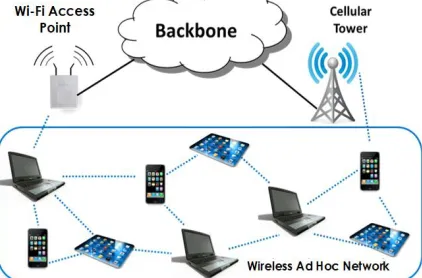
[image:2.612.92.303.306.445.2]Mobile nodes can handle routing functionality in MANET. Due to its wireless nature, nodes can be deployed anywhere within a defined network [10]. The robust and efficient operations of mobile nodes are made possible by using MANET as shown in Figure 1. Furthermore, a node can restructure its topology when it moves from one place to another. Nodes can enter and leave a network depending on its feasibility [11]. The nodes in MANET are mobile in nature; thus, a dynamic topology is normally used. Each participating node transfers packets to other nodes.
Figure 1: Structure Of Wireless Networks (Fan Wu 2012)
3. MANET APPLICATIONS
MANET offers more advantages than traditional networks. As a result, it is widely used in different domains due to its unique characteristics. Furthermore, given its simple infrastructure, MANET can be built anywhere upon establishing connectivity between all nodes. Nodes can join or leave a network depending on specific requirements and situations. MANET can be applied in the following manners [12].
Military battlefield: MANET is used to transfer information among soldiers, vehicles, and military headquarters. It can be deployed in terrains to provide the movement information of enemies.
Collaborative: Several wireless environments require collaborative computing that be assessed outside office.
Local level: Ad hoc networks are able to autonomously link both instant and temporary multimedia networks directly using notebook computers in order to
share information among participants in a conference or classroom. Other example of local-level application is home network where direct communication happens between devices.
Personal area network and Bluetooth: In a personal area network, nodes are associated with a specific person. Short-range network such as Bluetooth can be used to transfer files or data between paired devices. Any nearby devices with Bluetooth can be connected as well.
Commercial sector: When catastrophic event occurs, emergency and rescue operations should be conducted rapidly and efficiently. Ad hoc networks are used in emergency or rescue operations for relief efforts. These networks can also be used as preventive measures in various situations such as fire incidents, floods, or earthquakes. Emergency rescue operations must be conducted when a non-existent or damaged communication infrastructure is required and the rapid deployment of a communication network is necessary. Figures 1 and 2 summarize the applications of MANET.
Figure 2: Real-Time Applications Of MANET
4. ROUTING PROTOCOLS OF MANET
MANET uses a dynamic topology because mobile nodes change their locations continuously depending on the requirements. When a node moves, a MANET automatically reconfigures its network with its new neighbors. MANET is a self-organizing and self-configuring network. The nodes engage themselves in multi-hop transfer using a wireless random-access channel and cooperate intimately with one another. Each node in a network plays a dual role of host and router.
757 limited transmission range. When a packet from one node needs to be transferred to another node that is out of the transmission range of the source node, the routing procedures should be followed. Thus, the packet can be routed through the best path and delivered to its destination. In wireless communication, a base station can reach all of its mobile nodes without broadcasting. In ad hoc networks, however, nodes will communicate with adjacent nodes or with nodes within its transmission range. Nodes send data to its peers. These data will be relayed to other nodes until their destinations are reached. Problems related to dynamic topology arise due to unpredictable changes in connectivity.
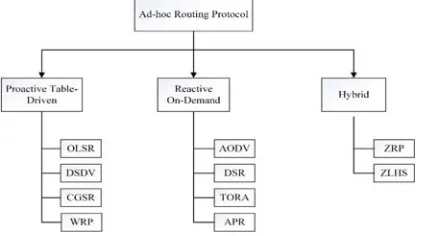
Routing protocols in MANETs are classified in different manners. They can be classified based on routing strategy and network structure as described comprehensively in Figure 3. Routing protocols are classified into table-driven and source-initiated protocols based on routing strategy. Meanwhile, they are classified into hierarchical routing, flat routing, and geographical position-assisted routing based on network infrastructure[13].
Figure 3: Classification Of Routing Protocols In MANET[14]
4.1 Proactive routing protocols
Similar to wired routing protocols, proactive routing protocols record the routes for all destinations in a network [15]. In this type of protocol, routing information will be mentioned in the routing table at each node. The routes for all destinations are computed prior to the protocol with a complete knowledge of the topology, and thus, the states of the link are maintained. Furthermore, all nodes will disseminate the routing information to all their adjacent nodes regardless of whether these nodes need the information or not. Nodes flood all routing information throughout the operating time, which is similar to the process in other link state routing protocols used by wired routers in a core network[16]. In this case, each node maintains
knowledge of the entire topology of the network with a cost per link.
A proactive protocol is also considered a table-based routing protocol. It can be subdivided according to how routing tables are built, maintained, and updated. Existing proactive routing protocols include the optimized link state protocol (OLSR), the destination-sequenced distance vector (DSDV), and global state routing (GSR).
Proactive routing has decreased latency because the route is already available. When the source must send packets to the destination, which immediately selected in the routing table[17]. When the packet arrives at the node, it will be forwarded efficiently by looking at the routing table
.
Every packet in proactive routing performs the full lookup of the routing table, which consumes considerable power because of the high CPU cycles required for the task[18].
4.2 Reactive routing protocols
Non-proactive protocols calculate the route to their destination and continuously update the routing table regardless of the need for certain route, whereas reactive protocols find routes only when necessary[19]. Reactive protocols do not retain routing information or activities on network nodes if no communication occurs. If the source node should transfer data to the destination, then only the path is discovered.
A considerable reduction in routing load, which is a key motivation behind the design of on-demand protocols, is achieved. Low bandwidth wireless links suffer from significant performance effect because of a high routing load[20].
The route needs to be discovered when necessary, and thus, a considerable finite latency occurs in this process. Therefore, the introduction of latency into reactive routing protocols is a major drawback, particularly when a source node contains data that should be transmitted without delay[21].
5. ROUTE DISCOVERY
[image:3.612.90.301.383.501.2]758 one If the entry is not utilized within a specified time frame, the route timer associated with each route entry would be cleared.
The direct route entry for the destination is used when it is opted by the source for transmitting data packet to the destination. Upon creating the direct route entry, it sends the RREP along its defined route to the destination node. RREP is sent along its defined route; thus, only the symmetric link is allowed in AODV as the RREP packet follows the reverse path of the route request packet as indicated earlier. Therefore, the RREP is sent to the source node in the hop-by-hop manner[23].
[image:4.612.315.516.206.312.2]The path used for transmitting data packets is used upon receiving the RREP from the source node. If multiple RREPs are received, the source node would select the path with the highest number of sequences and the lowest number of jumps. The RREP is then established and kept in the routing table. Active route is defined as the route recently used by a node for sending data packets. Therefore, a route is considered active when there are periodic movements of data packets between the source and the destination. For each node, it maintains the one entry per destination criterion in the corresponding routing table. The routing discovery process is highlighted in Figure 4.
Figure 4: Routing Discovery Process
6. MOBILITY MODELS IN MANET
Many mobility models have been proposed for mobile wireless networks. Mobility models are used to describe the movement patterns of mobile nodes. Popular models used in MANET such as random walk and mobility models are briefly described in this section. These mobility models were used by Zhou et al.
6.1 Random walk Model
Two main types of mobility models have been implemented in previous site management studies. A flow model can derive the average hourly rate of border crossings from a given area.
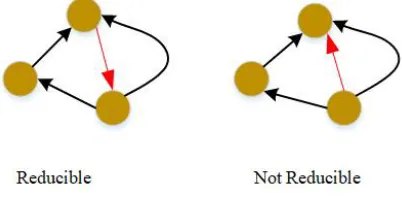
However, it is challenging to apply this model to modem-based network architectures. Most of the random walk models for the dynamic location zone strategy are designed for static time only. Several standard surveys have reported that the incidence of personal and social trips (non-mobile trips) is over 75% and it is centered in the original or office area. The path between nodes cannot be reduced [24] as shown in Figure 5.
Figure 5: Random walk model 6.2 Random way point mobility model
The direction and speed needed to reach a destination are determined randomly and independently by the mobile nodes. There are many methods available for navigating points randomly. For example, the random walk model is one of these methods. This process has low memory mobility, and the information regarding the pre-determined state of the decision is not considered in the future. For each new time interval t, each node determines its new direction Ɵ (t) from the uniform random number ranging from 0 to 2. Figure 6 illustrates the principle of mobility model. The procedures are described in the following:
Step 1: A node randomly selects a destination in the network domain.
Step 2: The node moves to the destination with a random speed ranging from 0 to Vmax.
Step 3; After reaching the destination, the node stops for a period determined by the “pause time T” parameter.
[image:4.612.92.297.425.528.2]Steps (1-3) are repeated until the simulation is complete.
[image:4.612.315.525.587.701.2]759
6.3 Reference point group mobility (RPGM) model
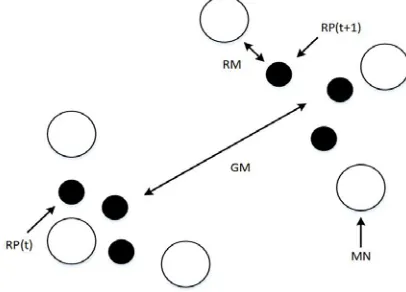
RPGM is an alternative method used to simulate the group behavior. A group consisting of multiple nodes is led by a logical center/group leader that controls the velocity and direction of each node. The roles of group leader and member are shown in Figure 7 In general, these nodes are randomly distributed around the reference point. The navigation model of each node is unique. The reference point that propels the nodes towards the group is then added. At every moment, the velocity and direction of each node are randomly derived from the group leader.
Hence, this generic group movement method can be used to create a variety of models for different navigations such as those encountered in warfare and disaster. Figure 7 shows how the mobility model works:
Step 1: Movement towards the logical center of a group.
Step 2: GM: motion vector group Step 3: RM: Random motion vector
[image:5.612.93.296.396.542.2]Step 4: The random movement of an individual node is determined by the random coordinate.
Figure 7: RGPM Process
7. MANET-BASED ENERGY COST
MANET-based energy cost saving measures are designed based on bio-inspired algorithm such as ACO algorithm. This algorithm is inspired from the specific self-organized behavior observed in ant colonies.
The oldest protocol based on ACO is AntNet. It is the oldest protocol based on ACO; it is commonly used in routing algorithms designed for wired networks. In addition, AntNet operates in real-time; therefore, it is able to smooth the traffic changes in a network via mobile agents for active
path sampling and an ad hoc network (AntHocNet) consisting of proactive and reactive components. While configuring the reactive route, some routes are established between the source and the destination. During the communication session, existing routes are tested rigorously and new routes are established.
For MANETs, ACO routing calculation exhibits insightful characteristics because this process functions in a completely dispersed manner and supplies several routes. AntHocNet is a hyper interway calculation that utilizes several concepts of ACO-based routing in MANETs. This algorithm uses FANT to discover a route and BANT to set up paths from the source node to the target. The approach for route protocols in ad hoc and detector wireless coverage with evolutionary programming, neural network, PSO, and ACO genetic programming. In [25], the authors have developed a flexible and energetic routing algorithm for MANET using ACO with network delay evaluation. Sing et al. [26] introduced the ACO-based routing algorithm in MANET. The design of this algorithm is similar to those of other routing techniques. It involves three stages: route detection, path servicing, and path malfunction management.
7.1 Ant Colony-based Energy control Routing (ACECR) Protocol
The searching efficiency of ACO algorithm has been studied theoretically. ACO stems from the artificial ant concept, whereby ants are analogous to the packages in MANETs. In ACO routing algorithms, the content of the pheromone is used to select the best path of a given network. It can be used to transmit data stochastically. Data from one destination can be spread across multiple paths, with more data are transferred to higher quality paths for load balancing purpose. ACO routing algorithms are efficient because of their proactive and iterative behaviors [27]. These types of algorithms can reduce variabilities and errors in networks by choosing a reliable path that has performed well for a while.
760 Figure 8 shows two possible routes for food hunting of ants. The lower path is shorter than the upper path; thus, the ants would take this path to reach the food. The ants would use this path to return to their nest as well. After a certain time, the concentration of pheromone on the shorter path will be higher than that on the longer route; hence, the shorter path will be identified and all ants will select this path to reach their nest. This behavior can be used to find the shortest route in MANETs[29]. In particular, the dynamic component of this method allows high adaptation in MANET topology because the existence of links in these networks is not guaranteed and the link changes frequently.
Figure 8: All the ants will take shortest path after the search time
ACO-based routing in MANET consists of two routing phases, i.e.:
A forward ant (FANT) is a small packet that transmits a unique sequence number from a source node to all neighboring nodes. FANT is used to set the pheromone value of the source node. A node that receives FANT for the first time would store information such as the destination address, the next hop, and the pheromone value in the routing table. The pheromone value is calculated from the number of hops required for a FANT packet to reach the source node. FANT is consistently transmitted by the intermediate nodes to the neighboring nodes until the corresponding destination is reached. Upon reaching its destination, the information stored in FANT is extracted and the FANT is destroyed subsequently.
Then, a backward ant (BANT) is created by the destination node and it is transmitted to the source node via the intermediate nodes. A BANT has the same function as FANT whereby it preserves the pheromone value of the destination node. Upon reaching the source node, the BANT is destroyed and the route is established.
7.2 Energy-aware ant-based routing (EAAR)
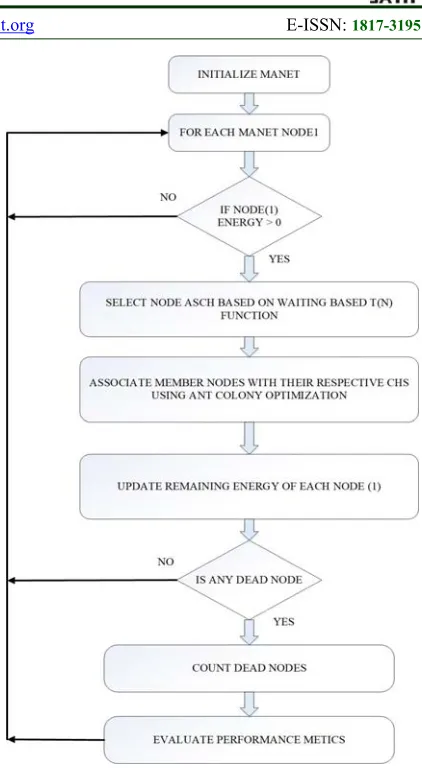
The oriented vector protocol EAAR is related to several factors such as the energy consumed when sending a packet and the remaining battery card of the node. The duration of the contract battery can be increased by limiting the repeated use of one or the entire contract. The remaining minimum power of the battery is used by the lowest node, and the number of hops from the route is adopted as the parameter for path detection. The power consumption of the nodes can be balanced in the network, and the lifetime of the network can be extended. Figure 9 illustrates the process of the EAAR mechanism.
Figure 9 EAAR Process 7.3 Ad hoc on-demand multipath distance vector (AOMDV)
[image:6.612.91.303.274.338.2]AOMDV is based on the concept of distance vector that uses the hop-by-hop routing approach. The ring-free paths are calculated using AOMDV. The calculation of several tracks requires more computational overhead. It uses AODV control packets with additional fields in the packet headers. In this study, the mechanism used by AOMDV should be emphasized to ensure that the property is underscored[30]. Disjointed roads are likely to fail independently. Therefore, two (or more) paths can be node-disjointed or link-disjointed as shown in Figure 10.
[image:6.612.313.523.595.683.2]761
8. ACECR ZHOU ET AL. (2016)
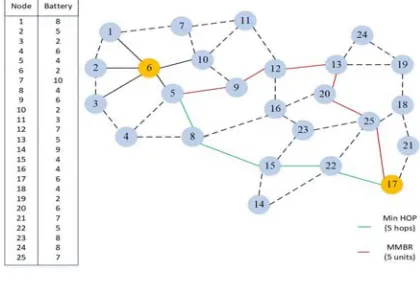
A mobility model is used to represent the transient node motion pattern properties such as location, velocity and acceleration in MANETs. It can be used to describe their locations, velocities and accelerations over time as well. The mobility model is one of the most important factors in evaluating the performance of a routing protocol in MANET. Note, the use of N node energy is limited to MANET. In order to extend the network lifetime, the routing protocols in MANET should be optimized. Zhou et al. (2016) have proposed the ACECR protocol to find the optimal route using ACO. The route function in ACECR protocol depends not only on the number of jumps (between the nodes and the energy of the node), but also on the mean and the minimum route energies of the roads. The performance of our ACECR routing protocols in terms of packet delivery ratio, end-to-end delay, and route load ratio has been evaluated in many different mobility models as shown in Figure 11.
[image:7.612.310.521.66.455.2]ACECR is a new technique used to enhance the energy consumption originally proposed by Zhou et al. (2016). The mechanism of ACECR is dependent on the indirect communication between particles.
Figure 11: Proposed method of Zhou et al. (2016)
Table 1: Related Works Conducted Between 2009 And 2018 On The Relevant Proposed Methods And Their Weaknesses.
Authors/Year Description Results Weakness
(Zhou et al., 2016) using the positive nature of ACO to find an optimal route in MANET so, they proposed ACECR to extend lifetime of network
The equation of pheromone calculated only by route with a average energy higher than other average path. so, the energy consumed at sending Fant and Bant will consume the energy and affects the lifetime of the network because node with lower power in route it will be die.
(Vallikannu, George, & Srivatsa, 2015)
They proposed ALEEP_with_ACO, a new ant colony based algorithm that uses the location of the nodes and energy aware metrics to increase the efficiency of routing.
The energy consumption causes MEMBER does not guarantee that total energy consumed on a road will be minimized.
(Singh et al., 2014)
They proposed an Innovative ACO based Routing Algorithm (ANTALG) when considering a random selection of source and destination nodes and exchanges the Ants (agents) with one another. Pheromone also provide positive feedback on promising pathways.
762
(Yuste, Triviño, & Casilari, 2013)
They Developed a fuzzy logic control system to determine the stability of a route in forwarding messages
The complexity and the computational cost causes the system Implements fuzzy type-2 logic, which has a 3D membership function (complexity of the setting)
(Patel et al. 2013) They present a swarming agent based intelligent algorithm using a hybrid Ant Colony Optimization (ACO)/ Particle Swarm Optimization (PSO) technique to optimize the multicast tree.
This method does not operate directly on the multicast tree. This weakness makes it impossible to eliminate the constraints of conventional multicast routing algorithms. Hence, there arises a need to proceed further and do more amount of work in searching paths and integrating the multicast trees. (Reshmi &
Murugan, 2012) They Implemented of a fuzzy logic to dynamically assign IP addresses to MANET nodes to increase QoS.
The calculation of other causes, such as packets downloaded by node, is due to black or gray holes depending on the confidence value.
(Xia, Jia, Ju, &
Zhu, 2011) They Introduced a reliable management system that consists of two subsystem: a subjective trust evaluation and a trusted routing model.
The complexity of a system is established based on two levels of confidence assessment. Fuzzy dynamic programming is implemented instead of fuzzy logic.
(Juang et al. 2010) This chapter studies the combination of PSO and ACO for FSs design
This chapter studies the combination of PSO and ACO for FSs design. One problem of PSO in FS design is that its performance is affected by initial particle positions, which are usually randomly generated in a continuous search space. A poor initialization may result in poor performance. Searching in the discrete-space domain by ACO helps to find good solutions. However, the search constraint in a discrete-space domain restricts learning accuracy. The motivation on the combination of ACO and PSO is to compensate the aforementioned weakness of each method in FS design problems.
(Singh et al. 2014) They Developed an algorithm based on fuzzy logic to detect self-woven and misleading WLAN nodes using IEEE 802.11
The algorithm is a small-scale simulation with only eight nodes
9. DISCUSSION
The first issue of MANETs lies in the mobility of the nodes, that is, the nodes can move randomly and independently in any direction and speed. Such movement means that the topology of information needs to be updated frequently to facilitate routing to reach the final destination. The consequence is that there is less packet delivery ratio, which is likely to affect the Quality of Service (QoS). Secondly, MANETs suffer from power exhaustion because many nodes use batteries as their source. The usual routing protocols do not put energy of nodes into consideration while selecting routes. Additionally, using the same route for long periods of time results into partitioning of the network, an issue that could compromise the security of MANETs. On the same note, the issue
of power exhaustion has a far-reaching effect on the lifetime of the network.
763
9. CONCLUSION
MANET is a wireless links created network of mobile nodes that is self-organizing and self-discovering, as well as self-constructing. It is a challenge to define routing mechanism for MANET as a result of its dynamic topology and complex nature. The unfamiliarity of the node with its topology makes the idea of using current protocols created for infrastructure networks with the MANET unworkable. It has been noticed during this study that proposals have been made for a lot of routing techniques, but every one of them has its own limitations. The cost of Energy
and routing protocols falling under this study’s review either observe table driven or on demand method for routing. Every method possesses its own attributes and is adoptable to a precise environment and these protocols selection are dependent on how suitable they are to the MANET applications.
ACKNOWLEDGMENT
This study was supported by the Ministry of Education, Government of Malaysia under the fundamental research grant: FRGS/1/2015/ICT04/UKM/02/3
REFERENCES:
[1] Zasad, M.R. and J. Uddin, Study and Performance Comparison of MANET Routing Protocols: TORA, LDR and ZRP. 2010.
[2] Gupta, R., et al. Routing in mobile Ad-Hoc networks using social tie strengths and mobility plans. in Wireless Communications and Networking Conference (WCNC), 2017 IEEE. 2017. IEEE.
[3] Vallikannu, R., A. George, and S. Srivatsa, Autonomous localization based energy saving mechanism in indoor MANETs using ACO. Journal of Discrete Algorithms, 2015. 33: p. 19-30.
[4] Loo, J., J.L. Mauri, and J.H. Ortiz, Mobile ad hoc networks: current status and future trends. 2016: CRC Press.
[5] Abdali, A.T.A.N. and R.C. Muniyandi, Optimized Model for Energy Aware Location Aided Routing Protocol in MANET.
International Journal of Applied Engineering Research, 2017. 12(14): p. 4631-4637. [6] Elkhani, N. and R. Chandren Muniyandi, A
Multiple Core Execution for Multiobjective Binary Particle Swarm Optimization Feature Selection Method with the Kernel P System Framework. Journal of Optimization, 2017. 2017.
[7] Patel, K.S. and J. Shah. Study the Effect of Packet Drop Attack in AODV Routing and MANET and Detection of Such Node in MANET. in Proceedings of International Conference on ICT for Sustainable Development. 2016. Springer.
[8] Hassan, M.H. and R.C. Muniyandi, An Improved Hybrid Technique for Energy and
Delay Routing in Mobile Ad-Hoc Networks. International Journal of Applied Engineering Research, 2017. 12(1): p. 134-139.
[9] Narsimha, V., Comparison of Routing Protocols in Mobile Ad Hoc Networks.
Global Journal of Advanced Engineering
Technologies, 2012.
[10] Lacuesta, R., et al., Study and Performance of Mobile Ad Hoc Routing Protocols. Mobile Ad Hoc Networks: Current Status and Future Trends, 2016: p. 71.
[11] Shakir, H.A., R.C. Muniyandi, and Z.M. Ali, Enhancement of Energy Control Routing Protocol for Mobile Ad hoc Network Based on Hybrid Particle Swarm Optimization with Ant Colony-based Energy Control Routing.
Indonesian Journal of Electrical Engineering and Computer Science, 2017. 8(2): p. 308-314.
[12] Jain, S. and N. Hemrajani, Detection and mitigation techniques of black hole attack in MANET: An Overview. International Journal of Science and Research (IJSR), India Online ISSN, 2013. 2319: p. 7064. [13] Kumaravel, A. and M. Chandrasekaran, A
complete study on power aware routing protocol for mobile adhoc network. IOSR Journal of Electrical and Electronics Engineering, 2014. 1(1): p. 71-5.
[14] Bai, Y., Mai, Y., & Wang, N. (2017). Performance comparison and evaluation of the proactive and reactive routing protocols for MANETs. Paper presented at the Wireless
Telecommunications Symposium (WTS),
2017.
764 based security evaluation and intrusion prevention. Paper presented at the Internet Technology and Secured Transactions (ICITST), 2011 International Conference for. [16] Rajasekar, S., & Subramani, A. (2016). A
Review on Routing Protocols for Mobile Adhoc Networks. i-manager's Journal on Mobile Applications and Technologies, 3(1), 39.
[17] Al-Khaleefa, A., et al., Optimized Authentication for Wireless Body Area Network. Journal of Telecommunication, Electronic and Computer Engineering (JTEC), 2018. 10(2): p. 137-142.
[18] Sarkar, S. and R. Datta, Mobility-aware route selection technique for mobile ad hoc networks. IET Wireless Sensor Systems, 2017. 7(3): p. 55-64.
[19] Mahmood, T., et al., Gossip based routing protocol design for ad hoc networks.
International Journal of Computer Science Issues(IJCSI), 2012. 9(1).
[20] Patel, M.K., M.R. Kabat, and C.R. Tripathy, A hybrid ACO/PSO based algorithm for QoS multicast routing problem. Ain Shams Engineering Journal, 2014. 5(1): p. 113-120. [21] Zhou, J., et al., Ant colony-based energy
control routing protocol for mobile ad hoc networks under different node mobility models. EURASIP Journal on Wireless
Communications and Networking, 2016.
2016(1): p. 105.
[22] Zhao, Z., et al., Multipath Routing Algorithm Based on Ant Colony Optimization and Energy Awareness.
Wireless Personal Communications, 2017.
94(4): p. 2937-2948.
[23] Kaur, A., et al. Suitability of Ant Colony Optimization as an application to MANET. in the Proceedings of National Conference on Current Research Trends in Cloud
Computing and Big Data, Jaipur National
University, Jaipur. 2015.
[24] Azwar, H., Performance analysis of AODV, DSR, OLSR and DSDV Routing Protocols using NS2 Simulator. International Journal of Technology and Research, 2017. 5(3). [25] Singh, G., N. Kumar, and A.K. Verma,
Antalg: An innovative ACO based routing algorithm for MANETs. Journal of Network
and Computer Applications, 2014. 45: p.
151-167.
[26] Yuste, A.J., A. Trivino, and E. Casilari, Type-2 fuzzy decision support system to optimise MANET integration into infrastructure-based wireless systems. Expert Systems with Applications, 2013. 40(7): p. 2552-2567.
[27] Reshmi, T. and K. Murugan. Trust based dynamic distributed IP addressing protocol for MANETs using fuzzy rule sets. in Information and Communication Technologies (WICT), 2012 World Congress on. 2012. IEEE.
[28] Xia, H., et al. A subjective trust management model with multiple decision factors for MANET based on AHP and fuzzy logic rules. in Green Computing and Communications (GreenCom), 2011 IEEE/ACM International Conference on. 2011. IEEE.
[29] Juang, C.-F., Combination of Particle Swarm and Ant Colony Optimization Algorithms for Fuzzy Systems Design, in Fuzzy Systems. 2010, InTech.