http://dx.doi.org/10.4236/me.2015.66071
Transfer Pricing-Based Money Laundering
in Barter Trade
Dexiang Mei, Xiaojun Li
School of Economics and Management, Southwest Jiaotong University, Chengdu, China Email: [email protected]
Received 25 May 2015; accepted 23 June 2015; published 26 June 2015
Copyright © 2015 by authors and Scientific Research Publishing Inc.
This work is licensed under the Creative Commons Attribution International License (CC BY). http://creativecommons.org/licenses/by/4.0/
Abstract
Barter trade attracts money launderers by its flexible contract, payment term of reciprocal letters of credit, and convenient capital flight and tax evasion. As far as fair value and invoiced value of the transacted goods are concerned, transfer price-based money laundering in barter trade is done by the means of deflated import-inflated export, inflated import-deflated export, deflated import-deflated export, and inflated import-inflated export, where the money laundered can be measured by capital flight, income tax evasion, import duty evasion, and VAT refund evasion in each case. So we should reinforce transaction supervision, promote intelligence exchange, perfect relative regulations, and improve anti-money laundering awareness and capabilities.
Keywords
Barter Trade, Transfer Pricing, Money Laundering, Anti-Money Laundering
1. Introduction
pric-ing-based [4] was one of the main ways to trade-based money laundering and will be continued, and also, trans-fer pricing will usually be an important part of those transactions [5]. As in the United States and other countries trade, the transfer pricing-based behavior is very common [6].
Barter trade is considered the world’s oldest form of exchange [7]; as one of the specific forms of internation-al trade, it mainly refers that according to both parties’ needs, and without money as well as the third party, they directly exchange goods or services, the value of which is agreed by both parties. Due to the promotion of e-commerce, modern barter trade develops rapidly; 80% of the world’s top 500 enterprises have set up a special department of barter trade and various kinds of transactions of barter trade account for more than 30% of the to-tal in the world [8]. With the increasing popularity of money laundering and terrorist financing in the field of trade [9], barter trade is full of temptation without unity of trading platform, trading rules, trading settlement, trading regulation, the credit guarantee system, etc., but does not cause regulatory’ attention. Besides, the aca-demic research is almost blank. Therefore, this paper intends to analyze inducement and mechanism of transfer pricing-based money laundering in barter trade, build model to measure the scale of money laundering [10], and then put forward regulatory proposals.
2. Inducement Analysis of Money Laundering in Barter Trade
International trade can make the source of illegal property more blurred, and also make illegal transfer of legiti-mate property smooth, thus becoming the preferred route for cross-border money laundering. Its allure lies in the complexity of the transaction procedures, temporal span, wide-range involved, participators more, trade financ-ing system varied, the multiplicity of applicable law as well as the imperfections of international judicial assis-tance system of jointly combat transnational money laundering crime.
In addition to the general causes of trade-based money laundering above, barter trade, due to the characteris-tics of the contract, payment particularity and convenience of capital flight and tax evasion etc, is full of tempta-tion to money launderers.
1) The flexibility of barter trade contract
Barter trade contract is the main basis for customs supervision, export rebates, contract cancellation. Owing to the flexibility of closing time, trade objects, transaction amount and payment in barter trade, the two sides are not as restricted as those in cash trade by international conventions. Frequent changes and long-period imple-mentation of contract, along with its tough periodic verification also increase the regulatory difficulty to customs, tax department, SAFE and other functional departments. These features of barter trade contracts have deter-mined that barter trade is more likely to be used to conceal and disguise the nature of capital and its sources so as to transfer and embezzle capital illegally, which is the main damage of money laundering in trade area [4].
2) Payments of reciprocal letters of credit
The general method of payment in international barter trade is reciprocal letters of credit, that is, both parties signed barter contract in advance, committing to each other within a certain period to buy a certain number of equal-value or substantially equal-value goods according to denominated currency, being applicants and benefi-ciaries of letters of credit each other. They can barter simultaneously or successively. Besides, issuing date, spe-cific terms, documentation requirements and negotiation conditions may vary. The characteristics of letters of credit make it vulnerable to money laundering [11]. Reciprocal letters of credit in barter trade is more complex than general trade credit, once used for money laundering, and it will become more unobserved and deceptive.
3) Added and more concealed methods of capital flight
Capital flight based on transfer pricing-based, especially exports low-price and imports high-cost artificially, is one of the main forms of cross-border trade based money laundering [12] [13]. In international trade, export with undervalued invoices, import with overvalued invoices, exporting something for nothing or valuables such as paintings, antiques, arts and crafts and importing something valueless are commonly used to transfer transna-tional capital [14]. Here, the high or low price, relative to the normal value of the product—the external market import prices (IP) and export prices (EP) referred, is artificially inflated or deflated. Having import-export busi-nesses, both sides in barter trade can use transfer pricing to achieve the purpose of capital flight more effectively. That is to say, in the ways of capital flight based on transfer pricing, barter trade makes it more efficient, con-cealed and seem more reasonable than the average to transfer the same amount of capital.
Suppose A and B are the two sides of barter trade, A plans to transfer a certain amount of money, IPA
+ , IPA
− ,
A
EP+, EPA
−
and IPB
+ , IPB
− , EPB
+ , EPB
−
ex-port price and low exex-port price of enterprises A and B based on transfer pricing. PA and PBrepresent external
comparable uncontrolled price (ECUP) of A and B. For A, IPA PB IPA
−< < +
, EPA PA EPA
−< < +
. Similarly, for B,
B A B
IP−<P <IP+, EPB PB EPB
−< < +
. In general trade, the enterprise A adopts low-price export strategy to sell goods A, the amount of capital flight is represented by PA EPA
−
− . While in barter trade, if enterprise A exports goods A at low price and imports goods B at high cost, the factual amount of capital flight will be:
A B A A
IP+−P +P −EP−. Obviously, barter trade can lead to more large-scale capital flight because of the superposi-tion of bidirecsuperposi-tional general trade.
4) More tax space for money laundering
Barter trade is often accompanied by corporate tax evasion and corruption, which hinders the implementation of national tax policy and fiscal policy [15], and tax crimes a reviewed as one of the top three sources of laun-dered money [16]. According to China’s import and export tax policy, imported goods are charged with specific tariffs, furthermore, some of the goods are imposed to VAT. While in order to encourage enterprises to export, the country correspondingly establishes export rebate (exemption) system based on value-added tax and con-sumption tax system. For barter traders with dual identity—importers and exporters, of which criminals can achieve the dual purpose of tax evasion and defrauding export tax rebates, mainly by mutual agreement to un-derestimate the value of goods in import linkage, thus evading import duties, to deliberately overestimate the value of goods in export linkage and thus defrauding more export tax rebates. As for the corporate income tax evasion, criminals can take general- trade transfer pricing methods [17] [18].
In addition, the various preferential policies state and local governments introduced to encourage bilateral barter trade provide convenience for criminals to launder money through barter trade to some extent.
3. Money Laundering Process Based on Transfer Pricing in Barter Trade
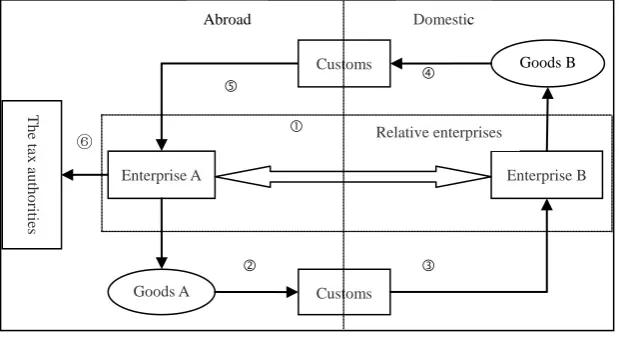
The basic process of barter trade has been shown inFigure 1. First, domestic enterprise A and foreign enterprise B sign barter contract, then A exports goods to B, simultaneously or subsequently A imports goods from B, fi-nally, the domestic enterprise A applies to local tax authorities for export rebate (enterprise B may also have a similar operation, which depends on the laws of the country they may be).
In money laundering process of general trade based on transfer pricing, if the amount of the invoice is higher than that in fair market, importers can transfer value to exporters, because exporters accept more payment than the importers to sell on the open market. For under invoicing of export, exporters can transfer value to importers. In extreme cases, manipulating invoice price in export trade can result in not receiving payments after export (selling something for nothing) and exporting empty outbox (selling nothing for something). For importers, it is zero-cost import (paying nothing for something) and whopping price import (paying something for nothing).
It is believed that transfer pricing-based money laundering in barter trade mainly uses “reasonable” valuation to achieve capital flight and tax evasion. Similar to general trade, still assume that the parties are relative enter-prises in barter trade [17], that they have some relationships of interest alliance such as price-fixing cartel, profit sharing, strategic cooperation and so on, may even have the same actual controllers.
T
h
e tax
au
th
o
rities
Enterprise A Enterprise B
⑥
Goods A Customs
Goods B Customs
Abroad Domestic
[image:3.595.159.469.536.707.2]Relative enterprises
According to barter goods value, the methods of transfer pricing-based money laundering in barter mainly in-clude “deflated import-inflated export”, “inflated import-deflated export”, “deflated import-deflated export” and “inflated import-inflated export”. Here, “inflated” and “deflated” are relative—the actual value of goods (fair value) relative to the nominal value of goods (invoice value).
“Deflated import-inflated export” refers to barter traders over estimating the value of exported goods, unde-restimating the value of imported goods, in order to transfer the value of domestic enterprise A. Similar to the low-priced imports of general trade, the extreme case that domestic enterprise A does not send the goods as sti-pulated in the contract to B after receiving the goods from overseas enterprise B is shown in Figure 1, the lack of the procedure ② and ③. At this point, enterprise A proceeds unilateral import in the name of barter trade. There may be no equivalent traded goods in real trades, or fake and shoddy goods with no value, or only a small amount of goods in conformity with the contract cheating the customs, for the sake of study convenience, as-sume export value of enterprise A is zero.
“Inflated import-deflated export” means that barter traders underestimate the value of exported goods and overestimate the value of imported goods to transfer the value of overseas enterprise B (capital flight). The ex-treme case is that domestic enterprise A sends goods to foreign enterprise B in accordance with the contract, but B does not delivery correspondingly, which has been shown inFigure 1, the steps of ④ and ⑤ do not exist, al-so this is a unilateral export trade behavior essentially in the name of barter trade. Only the two sides of barter deliberately agree on enterprise B not delivery or enterprise A not receiving, it’s enough to achieve the purpose of value transfer through the one-way flow of physical goods.
Similarly, “deflated import-deflated export” indicates both barter traders underestimate the value of export and import goods; consequently the invoice value of goods is higher than the actual value, and vice versa.
4. The Scale Measurement of Transfer Pricing-Based Money Laundering in Barter
Trade
Money laundering based on transfer pricing (Vml) is equal to the sum of capital flight (Vcf) and tax evasion(Vte).
Tax evasion is mainly composed of business income tax evasion (Vie) and import tariff evasion (Vde) [16]-[18].
The following analysis will also consider the factors of fraudulent VAT export tax rebate (Vvat), but does not take
the effect of preferential policies related to barter trade into account. So the equation of Vml is:
ml cf ie de vat
V =V +V +V +V (1) Supposing that domestic enterprise A barters with foreign enterprise B. The variables of Iinf, Einf, Idef and Edef
respectively indicate that enterprises choose different transfer pricing-based strategies such as inflated import, inflated export, deflated import and deflated export. The letter α refers to the business income tax rate, the letter β is for the import tariff rates and the letter δ is for VAT export tax rebate rate.
1) Deflated import-inflated export
In the case where launderers take the “deflated import-inflated export” pricing combination strategy (Idef −
Einf), domestic enterprise A intends to evade tariffs and defraud export tax rebates, no capital flight. Enterprise A
imports goods from enterprise B at a price of IPA−, lower than the external, less payment with the amount of
(
PB IPA)
β−
− . Exporting to enterprise B at a price of EPA+, higher than external, enterprise A can defraud export tax rebate with the amount of
(
EPA PA)
δ+−
. Thus, for A:
(
)
(
)
0, 0, ,
cf ie de B A vat A A
V = V = V = P −IP− β V = EP+−P δ
By the definition above and formula 1, the follow equation can be obtained:
(
) (
)
ml B A A A
V = P −IP− β+ EP+−P δ (2)
The extreme case of “deflated import-export inflated” is “only-in-no-out”, in which essentially enterprises are engaged in the import businesses in the name of general trade. At this point, the scale of money laundering is similar to that of low-price imports in general trade, which aims to evade import tariffs and fraud export rebate to some extent, but money laundering in barter trade is significantly more efficient and faster than that in general trade.
The term of “inflated import-export deflated” implies that enterprises take the pricing strategy combination of high cost and low price, noted as: Iinf −Edef. In order to effectively reduce the tax burden, the importer at the
time of purchasing goods always reports lower prices in general case. Although the pricing strategy combination of “high-in-low-out” is seemingly less rational, it can cause capital flight and evade income tax. And then, the scale of money laundering of domestic enterprise A is depicted as:
(
) (
)
(
) (
)
(
) (
) (
) (
)
(
) (
)
(
)
, , 0, 0
1
cf A B A A ie A B A A de vat
ml A B A A A B A A
A B A A
V IP P P EP V IP P P EP V V
V IP P P EP IP P P EP
IP P P EP
α α α α α + − + − + − + − + − = − + − = − + − = = = − + − + − + − = − + − + (3)
The extreme case of “only-out-no-in” is that enterprise A exports to its overseas partner B to transfer capital, in order to make pricing seem more reasonable, A most likely exports goods at the external market price of PA,
the scale of money laundering is set by:
ml cf A
V =V =P (4) 3) Deflated import-export deflated
Money launderers take the pricing strategy combination of low cost and low price, noted as: Edef− Edef. For
domestic enterprise A, it can evade tax and business income tax, besides, If EPA PA IPA PB
−− > −−
, the money launderer can achieve the purpose of capital flight. The scale of money laundering of domestic enterprise A is depicted as:
(
)
,(
)
, 0ie A A de B A vat
V = P −EP− α V = P −IP− β V =
a) When EPA PA IPA PB
−− > −−
, Vcf EPA PA IPA PB
− −
= − − − , there is,
(
)
(
) (
)
ml A A A B A A B A
V = EP−−P − IP−−P + P −EP− α+ P −IP− β (5) b) When EPA PA IPA PB
−− ≤ −−
, Vcf = 0, there is,
(
) (
)
ml A A B A
V = P −EP− α+ P −IP− β (6)
4) Inflated import-export inflated
Opposite to the strategy of deflated import-export inflated, the term of inflated import-export inflated means the pricing strategy combination of high-cost import and high-price export, denoted as: Idef−Edef. At this time,
the main purpose of money laundering is the realization of capital flight, the export tax rebate as well. Domestic enterprise A exports at a higher price of EPA
+
than the external market export price of PA and imports at the
price of IPA
+
, higher than the external market import price of PB. If EPA PA IPA PB
+− < +−
, domestic enterprise A can transfer money to overseas enterprise B. Therefore, the scale of money laundering can be expressed as:
(
)
0, 0,
ie de vat A A
V = V = V = EP+−P δ
when EPA PA IPA PB
+− < +−
, Vcf IPA PB EPA PA
+ +
= − − − , there is,
(
)
(
)
ml A B A A A A
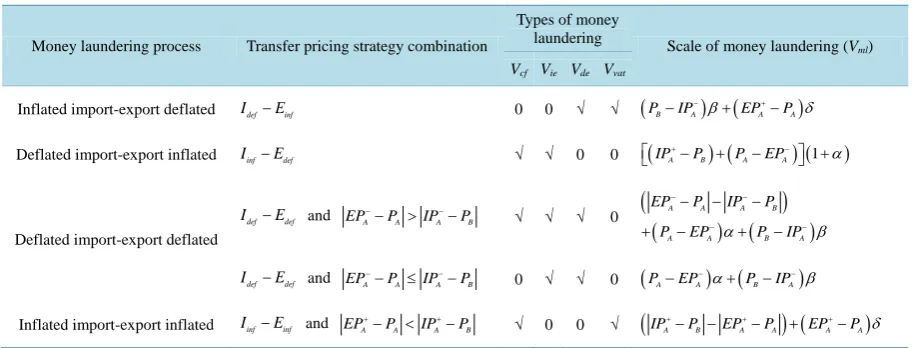
V = IP+−P − EP+−P + EP+−P δ (7) To sum up, the scale of transfer pricing-based money laundering in barter trade can be summarized in Table 1.
5. The Methods against Trade-Based Money Laundering
Table 1. The scale of transfer pricing-based money laundering in barter trade.
Money laundering process Transfer pricing strategy combination
Types of money
laundering Scale of money laundering (V
ml)
Vcf Vie Vde Vvat
Inflated import-export deflated Idef−Einf 0 0 √ √
(
PB IPA) (
β EPA PA)
δ− +
− + −
Deflated import-export inflated Iinf−Edef √ √ 0 0
(
IPA PB) (
PA EPA)
(1 α)+ −
− + − +
Deflated import-export deflated
def def
I −E and EPA PA IPA PB
−− > −−
√ √ √ 0
(
)
(
) (
)
A A A B
A A B A
EP P IP P
P EP α P IP β
− −
− −
− − −
+ − + −
def def
I −E and EPA PA IPA PB
−− ≤ −−
0 √ √ 0
(
PA EPA) (
α PB IPA)
β− −
− + −
Inflated import-export inflated Iinf−Einf and EPA PA IPA PB
+− < +−
√ 0 0 √
(
IPA PB EPA PA)
(
EPA PA)
δ+− − +− + +−
As one of the specific forms of trade-based money laundering, money laundering in barter trade has great concealment and deception. Customs, SAFE, tax department, business sector, financial and other related trade departments should cooperate closely, to be effective to curb. Starting from the big background of against trade-based money laundering (TBML), below, a few key points are put forward for the relevant departments and anti-money laundering regulatory agencies.
The first thing is to intensify the business regulation. Zdanowicz (2009) [12] points out, based on the trade data statistical analysis of country, products and customs sorted out, we can measure the risk index of United States on each country, trade products and import-export customs. Against “money laundering and terrorist fi-nancing based on trade”, FATF/OECD (2008) [19] proposes some guidelines with the purpose of improving the relevant institutions’ ability of collecting and effectively using domestic and international trade data, so that they can detect and investigate money laundering and terrorist financing through trade systems with risk-based ap-proach. Referenced by the risk-based idea of anti-money laundering, the countries, products, customs, even Im-port and exIm-port enterprises should be strictly monitored, especially strengthening the audit about pricing prin-ciples in barter trade.
Second, to strengthen the construction of Trade Transparency Unit (TTU) [6], which is the best solution to eliminate the trade information sharing barriers among trade-related administrations—but not limited to customs. “Transparency” means the “accessibility”, “timeliness”, “relevance” and “high quality” of trade data. That is to say, not only can the high-quality trade data be obtained by trade-related administrations and financial informa-tion centers, but also the trade data held by a certain organizainforma-tion can be attained when other instituinforma-tions need to master the information to perform their duties, all trade data are to be shared to all affiliates, including trade-related departments and financial information center, etc. Trade partner countries and regional customs should establish a real-time information sharing and information exchange mechanism, regular or irregular trade data comparison analysis, to identify the abnormal situation in time and transfer suspicious clues to the financial information center and the public security department. It can promote the anti-money laundering work in the field of trade through effective operations of TTU.
Third, a sophisticated regulation system should be established. For enterprises engaged in barter trade, busi-ness sector shall establish enterprise information database, to prevent criminals setting up shell companies for money laundering; the customs should strengthen registration of the contract for record, at any time to master the change of enterprise business, timely to verify the completed contracts; ministries of commerce should assist the customs monitor trading processes, timely to find suspicious information; banking sectors should pay close attention to generated or incidental exchange settlement under barter trade contract, timely to report suspicious spots; foreign exchange administration departments should intensify the tracking of foreign exchange payment in barter trade and then timely identify suspicious foreign exchange capital flows; public security and judicial departments should improve the level of international policing cooperation and the ability of criminal judicial assistance, jointly to combat transnational activities of money laundering.
areas, expert team to cover the trade, finance, financial, accounting, tax, law, information technology, data min-ing and analysis, international political relations, foreign language and other fields. It is necessary to construct platform for experts team, to establish money laundering talent selection mechanism and talent reserve cultiva-tion system that are compatible with the current work of anti-money laundering, and vigorously to cultivate a number of legal experts, data analysis experts, regulatory experts and case investigation experts, Specially pay-ing attention to choospay-ing excellent talents from the existpay-ing professional talent team to proceed cross-major and interdisciplinary training, creating an aggressive, passionate and compound anti-money laundering expert team with high political consciousness, superior professional quality, wide coverage of professions.
Finally, constantly to improve cognition ability and awareness of the various kinds of money laundering ac-tivities in the international trade field. Through a series of education, propaganda, training and seminars, in-creasing trade-related authorities like customs, SAFE, business sector, tax department, ministry of commerce, the CBRC and law enforcement authorities, etc. as well as financial information center cognition level of trade- based money laundering (TBML) prepensely, systematically and orderly, to deepen the understanding of TBML and terrorist financing, be sensitive and vigilant to trade money laundering trick, value anti-money laundering work, strengthen participation willingness and self-discipline, consciously resist and report all kinds of alleged money laundering trades and terrorist financing behaviors, ultimately to prompt the compliance culture to be a part of the organizational culture.
6. Conclusion
TBML is emerging; it is even a new creation in the field of barter trade and the methods, types, process and mechanism of TBML have yet to be acquainted, and then we can identify effectively the models of suspicious transactions.
References
[1] Simser, J. (2013) Money Laundering: Emerging Threats and Trends. Journal of Money Laundering Control, 16, 41-54.
http://dx.doi.org/10.1108/13685201311286841
[2] Gao, Z. (2007) The Dialysis Suspicious Money Laundering Activities in International Trade. Financial Science, 3, 112-117.
[3] Rodriguez, J.R. (2014) Identifying the Red Flags of Trade-Based Money Laundering in Order to Mitigate Risk. UMI Dissertations Publishing, 1571584.
[4] Gao, Z. (2009) Transfer Pricing, Money Laundering and Capital Flight: A Perspective of Their Interrelations. Econo-mist, 11, 79-84.
[5] Lucas, B. (2014) Transfer pricing and the WTO. Journal of World Trade, 48, 59-80.
[6] Pak, S.J., Zanakis, S.H. and Zdanowicz, J.S. (2003) Detecting Abnormal Pricing in International Trade: The Greece- U.S. Case. Interfaces, 33, 54-65.http://dx.doi.org/10.1287/inte.33.2.54.14473
[7] Oliver, P. and Mpinganjira, M. (2011) Barter Trading: An Empirical Investigation of Management Practices. African
Journal of Business Management, 5, 12256-12263.
[8] Tao, H. (2007) Speeding up the Development of Modern Barter Trade in China. Journal of Beijing Technology and
Business University (Social Science), 22, 1-5.
[9] FATF/OECD (2006) Trade Based Money Laundering.
http://www.fatf-gafi.org/topics/methodsandtrends/documents/trade-basedmoneylaundering.html
[10] Harvey, J. (2004) Compliance and Reporting Issues Arising for Financial Institutions from Money Laundering Regula-tions: A Preliminary Cost Benefit Study. Journal of Money Laundering Control, 7, 333-346.
http://dx.doi.org/10.1108/13685200410810047
[11] Gao, Z. (2008) Analysis of Money Laundering Credit-Based in International Trade. Economist, 2, 102-107.
[12] Zdanowicz, J. (2009) Trade-Based Money Laundering and Terrorist Financing. Review of Law & Economics, 5, 855- 878. http://dx.doi.org/10.2202/1555-5879.1419
[13] De Boyrie, M.E., Nelson, J.A. and Pak, S.J. (2007) Capital Movement through Trade Misinvoicing: The Case of Africa.
Journal of Financial Crime, 14, 474-489. http://dx.doi.org/10.1108/13590790710828181
[14] Kumar, B.V. (2003) The Prevention of Money Laundering in India. Journal of Money Laundering Control, 7, 158-169.
[15] Lindberg, D.L. (2002) The Use of Barter Hampers Implementation of International Accounting Standards and Contri-butes to Financial Woes in the Russian Federation. Russian and East European Finance and Trade, 38, 5-17.
[16] Schlenther, B. (2014) Is the South African Effort toward Reducing Money Laundering Optimal? Journal of Money
Laundering Control, 17, 17-33. http://dx.doi.org/10.1108/JMLC-07-2013-0025
[17] Gao, Z.-A. and Weng, L.-F. (2006) Transfer Price-Based Money Laundering in International Trade. Proceedings of
2006 13th International Conference on Management Science and Engineering, Lille, 5-7 October 2006, 1128-1132.
[18] Gao, Z. (2008) Transfer Price-Based Money Laundering: A Transit Trader’s Perspective. Proceedings of 2008
Interna-tional Conference on Wireless Communications, Networking and Mobile Computing, Dalian, 12-14 October 2008, 1-5.
http://dx.doi.org/10.1109/wicom.2008.2395
[19] FATF/OECD. Best Practices Paper on Trade Based Money Laundering.