http://dx.doi.org/10.4236/health.2015.711171
How to cite this paper: Nath, D.C. and Patowari, B. (2015) Comparison of Survey Sampling Methods for Estimation of Vac-cination Coverage in an Urban Setup of Assam, India. Health, 7, 1578-1590. http://dx.doi.org/10.4236/health.2015.711171
Comparison of Survey Sampling Methods for
Estimation of Vaccination Coverage in an
Urban Setup of Assam, India
Dilip C. Nath*, Bhushita PatowariDepartment of Statistics, Gauhati University, Guwahati, India
Received 29 September 2015; accepted 20 November 2015; published 23 November 2015
Copyright © 2015 by authors and Scientific Research Publishing Inc.
This work is licensed under the Creative Commons Attribution International License (CC BY). http://creativecommons.org/licenses/by/4.0/
Abstract
Background: Immunization averts a large number of children in each year. The burden of vaccine preventable diseases remains high in developing countries compared to developed countries. To overcome from this burden different types of immunization programs have been implemented. For better immunization coverage in developing countries, considerable progress is to be made to improve the knowledge and awareness regarding importance of vaccines. In this study a compara-tive study of immunization coverage under two sampling methods has been performed. Methods: In this study variance and design effect of proportion of children vaccinated against different types of vaccines (BCG, OPV, DPT, Hepatitis B, Hib, Measles and MMR) are estimated under two stage (30 × 30) cluster and systematic sampling for comparison of these two survey sampling me-thods. Also the homogeneity of clusters has been tested by using chi-square test. Results: It is ob-served that BCG, OPV and DPT vaccination coverage is more than 90% whereas Hepatitis B, Measles, Hib and MMR vaccination coverage is between 50% - 64% only. Here systematic random sampling is more complicated than two stage (30 × 30) cluster sampling. Also the result shows that the clusters are homogeneous with respect to proportion of children vaccinated. Conclusion: There is no significant difference between the two survey methodologies regarding the point es-timation of vaccination coverage but eses-timation of variances of vaccination coverage is less in two stage (30 × 30) cluster sampling than that of the systematic sampling. Also the clusters are homo-geneous. Very less improvement has been observed in case of fully vaccination coverage than the previous study. From the study it can be said that two stage (30 × 30) cluster sampling will be pre-ferred to systematic sampling and simple random sampling method.
Keywords
Vaccine Coverage, Cluster Sampling, Systematic Sampling, Design Effect, Marascuilo Procedure
1. Introduction
World Health Organization (WHO) recommends that all children should receive one dose of Bacillis Calmette- Guerin Vaccine (BCG), three doses of diphtheria-tetanus-pertusis vaccine (DPT), three doses of either oral polio vaccine (OPV) or inactivated polio vaccine (IPV), three doses of hepatitis B vaccine, and one dose of a measles virus-containing vaccine (MVCV), either anti-measles alone or in combination with other antigens. It also re-commends three doses of vaccine against infection with Haemophilus influenza type b (Hib). To boost immuni-ty at older ages, additional immunizations are recommended for healthcare workers, travelers, high-risk groups and people in areas where the risk of specific vaccine-preventable diseases is high [1]. The important role played by the WHO’s EPI (Expanded Programme on Immunization) Cluster Survey in the success of national immuni-zation programme efforts in many countries is widely recognized. The programme monitoring capability pro-vided through the conduct of periodic cluster surveys has been especially important in developing country set-tings, where administrative records are often incomplete [2]. Together with EPI sampling other survey sampling has been compared in different studies [3]-[5]. According to WHO coverage of BCG vaccine is 87%, DPT3 vaccine is 72% and OPV3 vaccine is 70% in 2011 [6]. In a study Phukan et al. reported that the children of As-sam in the North-East Region of India have consistently evidenced low rates for routine childhood immuniza-tions. About 62.2% of the children were fully immunized [7]. Children are considered fully immunized if they receive one dose of BCG, three doses of OPV and DPT each and one dose of measles vaccine before reaching one year of age.
In this study estimates of vaccination coverage have been compared using design effect and variance of esti-mated proportion of children vaccinated against BCG, OPV, DPT, Hepatitis B, Hib, Measles and MMR (measles mumps rubella) vaccines under two stage (30 × 30) cluster sampling and systematic random sampling.
2. Methods
The data that has been used in this study is taken from a survey “Comparison of Two Survey Methodologies to Estimate Total Vaccination Coverage” sponsored by Indian Council of Medical Research (ICMR), New Delhi. It has been collected during the period from January to October, 2011 using following sampling techniques.
Two stage (30 × 30) cluster sampling: In this method the population needs to be divided into a complete set of non-overlapping subpopulations, usually defined by geographic or political boundaries. These subpopulations are called clusters. In the first stage, 30 of these clusters are sampled with probability proportionate to the size (PPS) of the population in the cluster. Sampling with probability proportionate to size allows the larger clusters to have a greater chance of being selected. The clusters are sampled without replacement. In the second stage of sampling, thirty subjects are selected within each cluster. Although the sampling unit is the individual subject, the sampling is conducted on the household level. Cluster sampling is often a practical approach to surveys be-cause it samples by groups (clusters) of elements rather than by individual elements. It simplifies the task of constructing sampling frames, and it reduces the survey costs [8]. The advantages of two stage (30 × 30) cluster sampling over other designs are same as cluster sampling. A sampling frame listing all elements in the popula-tion may be impossible or costly to obtain, whereas to obtain a list of all clusters may be easy. Also the cost of obtaining data may be inflated by travel cost if the sampled elements are spread over a large geographic area.
Systematic random sampling: Systematic sampling is a random method of sampling in which only the first unit is selected with the help of random numbers and the rest get selected automatically according to some pre-designed pattern. If the population size N = nk, where n is the sample size and k is an integer, and a random number less than or equal to k be selected and every kth unit thereafter. This procedure is linear systematic sam-pling. When N ≠ nk then every kth unit be included in a circular manner till the whole list is exhausted, it is called circular systematic sampling. Systematic sampling is commonly used as an alternative to simple random sampling (SRS) because of its simplicity. It selects every kth element after a random start (between 1 and k). Its procedural tasks are simple, and the process can easily be checked, whereas it is difficult to verify SRS by ex-amining the results. It is often used in the final stage of multistage sampling when the fieldworker is instructed to select a predetermined proportion of units from the listing of dwellings in a street block. The systematic sam-pling procedure assigns each element in a population the same probability of being selected [8].
household, which is defined as the one whose front door is closest to the one just visited. Where there are bylane in a particular lane survey procedure is carried out in that place according to the serial household number in that bylane. This process continues until all 30 eligible subjects are found. The subjects are chosen by selecting a household and for more than one eligible subject (children from 6 months to 5 years of age) in a household all are selected.
After completing the 1st sampling method (that is two stage (30 × 30) cluster sampling) in a ward, 2nd sam-pling method (systematic random samsam-pling) is carried out in same ward. In this samsam-pling technique a random number is selected from random number table on the basis of the number of household in a lane where the sur-vey was carried out in case of two stage (30 × 30) cluster sampling and this became the first sampling unit (household) of the systematic random sampling. After that each household is selected at an interval of 10 household and continuing the process until the 30 sampling units are not completed. Here the interval of house-hold is taken as 10 so that the interval is neither too small nor too large. If we take the interval too small then we should get so many repetitions of the samples from two stage (30 × 30) cluster sampling which results same sampling unit in the 2nd sampling method (systematic sampling) and if we take the interval too large then there should not be any similarity between the two sampling methodologies as the larger interval will cover larger area and both the sampling techniques would take different places.
3. Statistical Analysis
Analysis has been carried out in the following two sections.
3.1. Section A
Here, variance of proportion of vaccination coverage and design effect of the same has been estimated. Let, P = proportion of children who are vaccinated
Since same number of children has sampled per cluster, estimate of P
( )
Pˆ is given by30
1 ˆ n i
i p P n = =
=
∑
(1)where pi = the proportion of surveyed children in i th
cluster
n = the number of clusters
Then approximate estimated variance of Pˆc under cluster sampling [4] is given by
( ) (
)
2(
)
1 ˆ ˆ ˆ 1 n c i i
v P p P n n
=
=
∑
− − (2)Again the estimated variance of ˆsyP under systematic sampling [9] is
( )
ˆ(
1 ˆ)
ˆ ˆ 1 sy p p N n v P N n − −
= − (3)
An approximate 95% confidence interval on P can be obtained by using
( )
ˆ 1.96 ˆ
P± v P (4)
The design effect may be estimated as
(
)
( )
ˆ esimated proportion under specified sampling ˆ
ˆ s v
deff
v P
= (5)
where
( ) ( )
(
30)
1
ˆ ˆ ˆ
ˆ s 1 ni i 1
v P =P −P
∑
== n − (6)is the estimated variance under simple random sampling [4].
( )
( )
ˆ ˆ ˆ ˆ c sy v P deff v P= (7)
3.2. Section B
In this section homogeneity of clusters have been tested by using chi-square test. That is to test equality of pro-portion of children vaccinated in each clusters. The test procedure is carried out taking Hepatitis B (at birth) vaccine (two stage (30 × 30) cluster sampling).
The null hypothesis is that there are no significant differences among the proportions of children vaccinated against Hepatitis B (at birth) in each clusters.
H0: P1=P2==P30
Against the alternative that all the proportions are not equal. H1: Not all Pj’s are equal (where j=1, 2,, 30)
The test statistic is
(
)
22 o e
e
f f
f
χ =
∑
− (8)where
fo= observed frequency in a particular cell of a 2 × 30contingency table
fe= expected frequency in a particular cell if the null hypothesis is true
If the null hypothesis is true the proportions are all equal across the population. And rejecting the null hypo-thesis only allows to reach the conclusion that all proportions are not equal. But the test statistics does not give any information about proportions that differ. To identify the differences between proportions we will rely on a multiple comparison procedure. The Marascuilo procedure [10] enables us to make comparisons between all pairs of groups. In this procedure the absolute value of the pairwise difference between sample proportions has to be computed. The absolute values of these differences are the test statistics. For each pairwise comparison a critical value is computed as follows:
(
)
(
)
2 , 1
1
1 j j
i i ij k i j p p p p CV n n α χ − − −
= + (9)
where α = level of significance, k = number of clusters
To compare each of test statistics with the corresponding critical value a specific pair is significantly different if the absolute difference in the sample proportion pi−pj is greater than its critical range.
4. Results
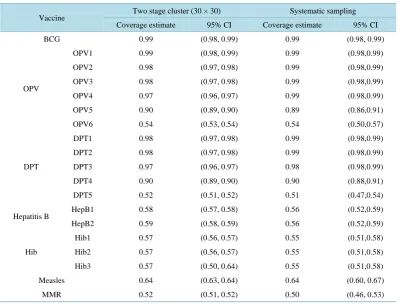
Table 1 gives estimated coverage of BCG (at birth), OPV (OPV1 at birth, OPV2 at 6 weeks, OPV3 at 10 weeks, OPV4 at 14 weeks, OPV5 at 15 - 18 months and OPV6 at 5 years), DPT (DPT1 at 6 weeks, DPT2 at 10 weeks, DPT3 at 14 weeks, DPT4 at 15 - 18 months and DPT5 at 5 years), Hepatitis B (HepB1 at birth and HepB2 at 6 weeks), Hib (Hib1 at 6 weeks, Hib2 at 10 weeks and Hib3 at 14 weeks), Measles (at 9 months) and MMR (at 15 - 18 months) vaccine with 95% confidence intervals under two stage cluster and systematic sampling. Coverage of BCG vaccine is 99%, OPV and DPT vaccine coverage is more than 90% except for OPV6 and DPT5. But coverage of Hepatitis B, Hib, Measles and MMR vaccines are only between 50% - 64%. Though the individual vaccination coverage is high for BCG, OPV and DPT vaccine but fully vaccination coverage is only 63.52%. Both the survey methods have given point estimates of vaccination coverage with less difference.
Table 1. Estimated coverage of vaccines under two stage cluster (30 × 30) and systematic sampling.
Vaccine Two stage cluster (30 × 30) Systematic sampling Coverage estimate 95% CI Coverage estimate 95% CI
BCG 0.99 (0.98, 0.99) 0.99 (0.98, 0.99)
OPV
OPV1 0.99 (0.98, 0.99) 0.99 (0.98,0.99)
OPV2 0.98 (0.97, 0.98) 0.99 (0.98,0.99)
OPV3 0.98 (0.97, 0.98) 0.99 (0.98,0.99)
OPV4 0.97 (0.96, 0.97) 0.99 (0.98,0.99)
OPV5 0.90 (0.89, 0.90) 0.89 (0.86,0.91)
OPV6 0.54 (0.53, 0.54) 0.54 (0.50,0.57)
DPT
DPT1 0.98 (0.97, 0.98) 0.99 (0.98,0.99)
DPT2 0.98 (0.97, 0.98) 0.99 (0.98,0.99)
DPT3 0.97 (0.96, 0.97) 0.98 (0.98,0.99)
DPT4 0.90 (0.89, 0.90) 0.90 (0.88,0.91)
DPT5 0.52 (0.51, 0.52) 0.51 (0.47,0.54)
Hepatitis B HepB1 0.58 (0.57, 0.58) 0.56 (0.52,0.59)
HepB2 0.59 (0.58, 0.59) 0.56 (0.52,0.59)
Hib
Hib1 0.57 (0.56, 0.57) 0.55 (0.51,0.58)
Hib2 0.57 (0.56, 0.57) 0.55 (0.51,0.58)
Hib3 0.57 (0.50, 0.64) 0.55 (0.51,0.58)
Measles 0.64 (0.63, 0.64) 0.64 (0.60, 0.67)
[image:5.595.103.519.111.712.2]MMR 0.52 (0.51, 0.52) 0.50 (0.46, 0.53)
Table 2. Estimated variance of proportion of vaccination coverage
( )
Pˆ .Vaccines Methodology
Two stage cluster (30 × 30) Systematic sampling
BCG 9.2009 × 10−09 2.44173 × 10−06
OPV
OPV1 1.1947 × 10−08 4.87257 × 10−06
OPV2 3.2958 × 10−08 9.70164 × 10−06
OPV3 3.2134 × 10−08 1.32949 × 10−05
OPV4 1.2785 × 10−07 1.56768 × 10−05
OPV5 5.4684 × 10−06 2.29435 × 10−04
OPV6 6.0007 × 10−07 1.06516 × 10−04
OPV7 9.5874 × 10−07 2.73425 × 10−04
DPT
DPT1 3.2958 × 10−08 9.70164 × 10−06
DPT2 6.4818 × 10−08 1.20999 × 10−05
DPT3 9.4344 × 10−08 1.32949 × 10−05
DPT4 6.4134 × 10−07 1.03118 × 10−04
DPT5 9.8328 × 10−07 2.75069 × 10−04
Hepatitis B HepB1 1.1741 × 10
−06 2.7177 × 10−04
HepB2 1.1741 × 10−06 2.71907 × 10−04
Hib
Hib1 1.2841 × 10−06 2.72553 × 10−04
Hib2 1.2814 × 10−06 2.72303 × 10−04
Hib3 1.305 × 10−06 2.72429 × 10−04
Measles 1.6381 × 10−06 2.53068 × 10−04
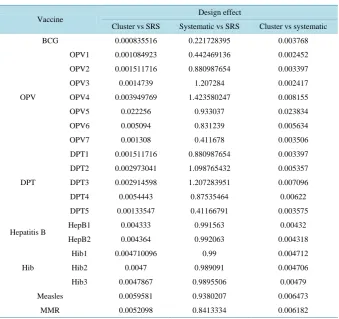
Table 3 represents estimates of design effect of proportion of children vaccinated against different types of vaccines. Design effect estimates are calculated for two stage cluster sampling vs simple random sampling, sys-tematic sampling vs simple random sampling and cluster sampling vs syssys-tematic sampling. It is seen that design effect estimates are high in systematic sampling vs simple random sampling rather than the two stage cluster sampling vs simple random sampling and cluster sampling vs systematic sampling for all the vaccines consi-dered here.
To study the homogeneity of clusters chi-square test has been performed. Here calculated value of
χ
2 is 116.68 with 29 d.f. and p value is 0.00 that is the test statistic is significant and we reject the null hypothesis and concluded that the proportions of children vaccinated against Hepatitis B (at birth) are not equal. Let us start with computing all the proportions of children vaccinated against Hepatitis B (at birth) (given in Table 4).Table 3. Estimates of design effect of proportion of children vaccinated.
Vaccine Design effect
Cluster vs SRS Systematic vs SRS Cluster vs systematic
BCG 0.000835516 0.221728395 0.003768
OPV
OPV1 0.001084923 0.442469136 0.002452
OPV2 0.001511716 0.880987654 0.003397
OPV3 0.0014739 1.207284 0.002417
OPV4 0.003949769 1.423580247 0.008155
OPV5 0.022256 0.933037 0.023834
OPV6 0.005094 0.831239 0.005634
OPV7 0.001308 0.411678 0.003506
DPT
DPT1 0.001511716 0.880987654 0.003397
DPT2 0.002973041 1.098765432 0.005357
DPT3 0.002914598 1.207283951 0.007096
DPT4 0.0054443 0.87535464 0.00622
DPT5 0.00133547 0.41166791 0.003575
Hepatitis B HepB1 0.004333 0.991563 0.00432
HepB2 0.004364 0.992063 0.004318
Hib
Hib1 0.004710096 0.99 0.004712
Hib2 0.0047 0.989091 0.004706
Hib3 0.0047867 0.9895506 0.00479
Measles 0.0059581 0.9380207 0.006473
[image:6.595.143.483.573.717.2]MMR 0.0052098 0.8413334 0.006182
Table 4. Estimated proportions of children vaccinated against Hepatitis B (at birth).
Sl. No. Ward No. Estimated proportions
1 2 p1 0.17
2 4 p2 0.70
3 5 p3 0.23
4 11 p4 0.93
5 12 p5 0.53
6 15 p6 0.60
7 17 p7 0.47
8 18 p8 0.70
Continued
10 25 p10 0.67
11 26 p11 0.63
12 33 p12 0.73
13 35 p13 0.40
14 36 p14 0.63
15 37 p15 0.63
16 38 p16 0.43
17 40 p17 0.53
18 42 p18 0.73
19 43 p19 0.67
20 46 p20 0.53
21 47 p21 0.57
22 48 p22 0.60
23 50 p23 0.80
24 51 p24 0.63
25 53 p25 0.67
26 54 p26 0.63
27 55 p27 0.37
28 57 p28 0.70
29 59 p29 0.57
30 60 p30 0.83
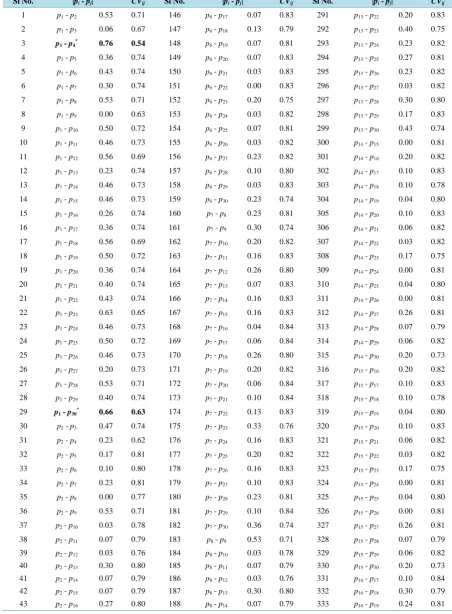
It is seen that Hepatitis B (at birth) vaccine coverage is higher for ward number 11 (p4 = 0.93) than all other wards. After that pi−pj and CVij are computed and compared each of test statistics with the correspond-ing critical value CVij (given in Table 5).
Results are significant only for proportion of Hepatitis B (at birth) vaccine coverage for ward number 1 vs ward number 4 (p1 vs p4), ward number 1 vs ward number 30 (p1 vs p30), ward number 3 vs ward number 4 (p3 vs p4), ward number 4 vs ward number 9 (p4 vs p9) and ward number 9 vs ward number 30 (p9 vs
30
p ). That is these proportions are not equal. Out of 435 pairs of proportions of vaccination coverage only 5 pairs of proportions are unequal.
5. Discussion
Table 5.Pairwise Comparison of test statistics (|pi- pj|) and critical values (CVij).
Sl No. |pi - pj| CVij Sl No. |pi - pj| CVij Sl No. |pi - pj| CVij
1 p1 - p2 0.53 0.71 146 p6 - p17 0.07 0.83 291 p13 - p22 0.20 0.83
2 p1 - p3 0.06 0.67 147 p6 - p18 0.13 0.79 292 p13 - p23 0.40 0.75
3 p1 - p4* 0.76 0.54 148 p6 - p19 0.07 0.81 293 p13 - p24 0.23 0.82
4 p1 - p5 0.36 0.74 149 p6 - p20 0.07 0.83 294 p13 - p25 0.27 0.81
5 p1 - p6 0.43 0.74 150 p6 - p21 0.03 0.83 295 p13 - p26 0.23 0.82
6 p1 - p7 0.30 0.74 151 p6 - p22 0.00 0.83 296 p13 - p27 0.03 0.82
7 p1 - p8 0.53 0.71 152 p6 - p23 0.20 0.75 297 p13 - p28 0.30 0.80
8 p1 - p9 0.00 0.63 153 p6 - p24 0.03 0.82 298 p13 - p29 0.17 0.83
9 p1 - p10 0.50 0.72 154 p6 - p25 0.07 0.81 299 p13 - p30 0.43 0.74
10 p1 - p11 0.46 0.73 155 p6 - p26 0.03 0.82 300 p14 - p15 0.00 0.81
11 p1 - p12 0.56 0.69 156 p6 - p27 0.23 0.82 301 p14 - p16 0.20 0.82
12 p1 - p13 0.23 0.74 157 p6 - p28 0.10 0.80 302 p14 - p17 0.10 0.83
13 p1 - p14 0.46 0.73 158 p6 - p29 0.03 0.83 303 p14 - p18 0.10 0.78
14 p1 - p15 0.46 0.73 159 p6 - p30 0.23 0.74 304 p14 - p19 0.04 0.80
15 p1 - p16 0.26 0.74 160 p7 - p8 0.23 0.81 305 p14 - p20 0.10 0.83
16 p1 - p17 0.36 0.74 161 p7 - p9 0.30 0.74 306 p14 - p21 0.06 0.82
17 p1 - p18 0.56 0.69 162 p7 - p10 0.20 0.82 307 p14 - p22 0.03 0.82
18 p1 - p19 0.50 0.72 163 p7 - p11 0.16 0.83 308 p14 - p23 0.17 0.75
19 p1 - p20 0.36 0.74 164 p7 - p12 0.26 0.80 309 p14 - p24 0.00 0.81
20 p1 - p21 0.40 0.74 165 p7 - p13 0.07 0.83 310 p14 - p25 0.04 0.80
21 p1 - p22 0.43 0.74 166 p7 - p14 0.16 0.83 311 p14 - p26 0.00 0.81
22 p1 - p23 0.63 0.65 167 p7 - p15 0.16 0.83 312 p14 - p27 0.26 0.81
23 p1 - p24 0.46 0.73 168 p7 - p16 0.04 0.84 313 p14 - p28 0.07 0.79
24 p1 - p25 0.50 0.72 169 p7 - p17 0.06 0.84 314 p14 - p29 0.06 0.82
25 p1 - p26 0.46 0.73 170 p7 - p18 0.26 0.80 315 p14 - p30 0.20 0.73
26 p1 - p27 0.20 0.73 171 p7 - p19 0.20 0.82 316 p15 - p16 0.20 0.82
27 p1 - p28 0.53 0.71 172 p7 - p20 0.06 0.84 317 p15 - p17 0.10 0.83
28 p1 - p29 0.40 0.74 173 p7 - p21 0.10 0.84 318 p15 - p18 0.10 0.78
29 p1 - p30* 0.66 0.63 174 p7 - p22 0.13 0.83 319 p15 - p19 0.04 0.80
30 p2 - p3 0.47 0.74 175 p7 - p23 0.33 0.76 320 p15 - p20 0.10 0.83
31 p2 - p4 0.23 0.62 176 p7 - p24 0.16 0.83 321 p15 - p21 0.06 0.82
32 p2 - p5 0.17 0.81 177 p7 - p25 0.20 0.82 322 p15 - p22 0.03 0.82
33 p2 - p6 0.10 0.80 178 p7 - p26 0.16 0.83 323 p15 - p23 0.17 0.75
34 p2 - p7 0.23 0.81 179 p7 - p27 0.10 0.83 324 p15 - p24 0.00 0.81
35 p2 - p8 0.00 0.77 180 p7 - p28 0.23 0.81 325 p15 - p25 0.04 0.80
36 p2 - p9 0.53 0.71 181 p7 - p29 0.10 0.84 326 p15 - p26 0.00 0.81
37 p2 - p10 0.03 0.78 182 p7 - p30 0.36 0.74 327 p15 - p27 0.26 0.81
38 p2 - p11 0.07 0.79 183 p8 - p9 0.53 0.71 328 p15 - p28 0.07 0.79
39 p2 - p12 0.03 0.76 184 p8 - p10 0.03 0.78 329 p15 - p29 0.06 0.82
40 p2 - p13 0.30 0.80 185 p8 - p11 0.07 0.79 330 p15 - p30 0.20 0.73
41 p2 - p14 0.07 0.79 186 p8 - p12 0.03 0.76 331 p16 - p17 0.10 0.84
42 p2 - p15 0.07 0.79 187 p8 - p13 0.30 0.80 332 p16 - p18 0.30 0.79
Continued
44 p2 - p17 0.17 0.81 189 p8 - p15 0.07 0.79 334 p16 - p20 0.10 0.84
45 p2 - p18 0.03 0.76 190 p8 - p16 0.27 0.80 335 p16 - p21 0.14 0.83
46 p2 - p19 0.03 0.78 191 p8 - p17 0.17 0.81 336 p16 - p22 0.17 0.83
47 p2 - p20 0.17 0.81 192 p8 - p18 0.03 0.76 337 p16 - p23 0.37 0.76
48 p2 - p21 0.13 0.80 193 p8 - p19 0.03 0.78 338 p16 - p24 0.20 0.82
49 p2 - p22 0.10 0.80 194 p8 - p20 0.17 0.81 339 p16 - p25 0.24 0.81
50 p2 - p23 0.10 0.72 195 p8 - p21 0.13 0.80 340 p16 - p26 0.20 0.82
51 p2 - p24 0.07 0.79 196 p8 - p22 0.10 0.80 341 p16 - p27 0.06 0.82
52 p2 - p25 0.03 0.78 197 p8 - p23 0.10 0.72 342 p16 - p28 0.27 0.80
53 p2 - p26 0.07 0.79 198 p8 - p24 0.07 0.79 343 p16 - p29 0.14 0.83
54 p2 - p27 0.33 0.79 199 p8 - p25 0.03 0.78 344 p16 - p30 0.40 0.74
55 p2 - p28 0.00 0.77 200 p8 - p26 0.07 0.79 345 p17 - p18 0.20 0.80
56 p2 - p29 0.13 0.80 201 p8 - p27 0.33 0.79 346 p17 - p19 0.14 0.82
57 p2 - p30 0.13 0.71 202 p8 - p28 0.00 0.77 347 p17 - p20 0.00 0.84
58 p3 - p4* 0.70 0.59 203 p8 - p29 0.13 0.80 348 p17 - p21 0.04 0.84
59 p3 - p5 0.30 0.78 204 p8 - p30 0.13 0.71 349 p17 - p22 0.07 0.83
60 p3 - p6 0.37 0.77 205 p9 - p10 0.50 0.72 350 p17 - p23 0.27 0.76
61 p3 - p7 0.24 0.78 206 p9 - p11 0.46 0.73 351 p17 - p24 0.10 0.83
62 p3 - p8 0.47 0.74 207 p9 - p12 0.56 0.69 352 p17 - p25 0.14 0.82
63 p3 - p9 0.06 0.67 208 p9 - p13 0.23 0.74 353 p17 - p26 0.10 0.83
64 p3 - p10 0.44 0.75 209 p9 - p14 0.46 0.73 354 p17 - p27 0.16 0.83
65 p3 - p11 0.40 0.76 210 p9 - p15 0.46 0.73 355 p17 - p28 0.17 0.81
66 p3 - p12 0.50 0.73 211 p9 - p16 0.26 0.74 356 p17 - p29 0.04 0.84
67 p3 - p13 0.17 0.77 212 p9 - p17 0.36 0.74 357 p17 - p30 0.30 0.74
68 p3 - p14 0.40 0.76 213 p9 - p18 0.56 0.69 358 p18 - p19 0.06 0.77
69 p3 - p15 0.40 0.76 214 p9 - p19 0.50 0.72 359 p18 - p20 0.20 0.80
70 p3 - p16 0.20 0.77 215 p9 - p20 0.36 0.74 360 p18 - p21 0.16 0.79
71 p3 - p17 0.30 0.78 216 p9 - p21 0.40 0.74 361 p18 - p22 0.13 0.79
72 p3 - p18 0.50 0.73 217 p9 - p22 0.43 0.74 362 p18 - p23 0.07 0.71
73 p3 - p19 0.44 0.75 218 p9 - p23 0.63 0.65 363 p18 - p24 0.10 0.78
74 p3 - p20 0.30 0.78 219 p9 - p24 0.46 0.73 364 p18 - p25 0.06 0.77
75 p3 - p21 0.34 0.77 220 p9 - p25 0.50 0.72 365 p18 - p26 0.10 0.78
76 p3 - p22 0.37 0.77 221 p9 - p26 0.46 0.73 366 p18 - p27 0.36 0.78
77 p3 - p23 0.57 0.69 222 p9 - p27 0.20 0.73 367 p18 - p28 0.03 0.76
78 p3 - p24 0.40 0.76 223 p9 - p28 0.53 0.71 368 p18 - p29 0.16 0.79
79 p3 - p25 0.44 0.75 224 p9 - p29 0.40 0.74 369 p18 - p30 0.10 0.69
80 p3 - p26 0.40 0.76 225 p9 - p30* 0.66 0.63 370 p19 - p20 0.14 0.82
81 p3 - p27 0.14 0.76 226 p10 - p11 0.04 0.80 371 p19 - p21 0.10 0.81
82 p3 - p28 0.47 0.74 227 p10 - p12 0.06 0.77 372 p19 - p22 0.07 0.81
83 p3 - p29 0.34 0.77 228 p10 - p13 0.27 0.81 373 p19 - p23 0.13 0.74
84 p3 - p30 0.60 0.67 229 p10 - p14 0.04 0.80 374 p19 - p24 0.04 0.80
85 p4 - Pp 0.40 0.67 230 p10 - p15 0.04 0.80 375 p19 - p25 0.00 0.79
86 p4 - p6 0.33 0.66 231 p10 - p16 0.24 0.81 376 p19 - p26 0.04 0.80
Continued
88 p4 - p8 0.23 0.62 233 p10 - p18 0.06 0.77 378 p19 - p28 0.03 0.78
89 p4 - p9* 0.76 0.54 234 p10 - p19 0.00 0.79 379 p19 - p29 0.10 0.81
90 p4 - p10 0.26 0.64 235 p10 - p20 0.14 0.82 380 p19 - p30 0.16 0.72
91 p4 - p11 0.30 0.65 236 p10 - p21 0.10 0.81 381 p20 - p21 0.04 0.84
92 p4 - p12 0.20 0.61 237 p10 - p22 0.07 0.81 382 p20 - p22 0.07 0.83
93 p4 - p13 0.53 0.66 238 p10 - p23 0.13 0.74 383 p20 - p23 0.27 0.76
94 p4 - p14 0.30 0.65 239 p10 - p24 0.04 0.80 384 p20 - p24 0.10 0.83
95 p4 - p15 0.30 0.65 240 p10 - p25 0.00 0.79 385 p20 - p25 0.14 0.82
96 p4 - p16 0.50 0.66 241 p10 - p26 0.04 0.80 386 p20 - p26 0.10 0.83
97 p4 - p17 0.40 0.67 242 p10 - p27 0.30 0.80 387 p20 - p27 0.16 0.83
98 p4 - p18 0.20 0.61 243 p10 - p28 0.03 0.78 388 p20 - p28 0.17 0.81
99 p4 - p19 0.26 0.64 244 p10 - p29 0.10 0.81 389 p20 - p29 0.04 0.84
100 p4 - p20 0.40 0.67 245 p10 - p30 0.16 0.72 390 p20 - p30 0.30 0.74
101 p4 - p21 0.36 0.66 246 p11 - p12 0.10 0.78 391 p21 - p22 0.03 0.83
102 p4 - p22 0.33 0.66 247 p11 - p13 0.23 0.82 392 p21 - p23 0.23 0.76
103 p4 - p23 0.13 0.57 248 p11 - p14 0.00 0.81 393 p21 - p24 0.06 0.82
104 p4 - p24 0.30 0.65 249 p11 - p15 0.00 0.81 394 p21 - p25 0.10 0.81
105 p4 - p25 0.26 0.64 250 p11 - p16 0.20 0.82 395 p21 - p26 0.06 0.82
106 p4 - p26 0.30 0.65 251 p11 - p17 0.10 0.83 396 p21 - p27 0.20 0.82
107 p4 - p27 0.56 0.65 252 p11 - p18 0.10 0.78 397 p21 - p28 0.13 0.80
108 p4 - p28 0.23 0.62 253 p11 - p19 0.04 0.80 398 p21 - p29 0.00 0.83
109 p4 - p29 0.36 0.66 254 p11 - p20 0.10 0.83 399 p21 - p30 0.26 0.74
110 p4 - p30 0.10 0.54 255 p11 - p21 0.06 0.82 400 p22 - p23 0.20 0.75
111 p5 - p6 0.07 0.83 256 p11 - p22 0.03 0.82 401 p22 - p24 0.03 0.82
112 p5 - p7 0.06 0.84 257 p11 - p23 0.17 0.75 402 p22 - p25 0.07 0.81
113 p5 - p8 0.17 0.81 258 p11 - p24 0.00 0.81 403 p22 - p26 0.03 0.82
114 p5 - p9 0.36 0.74 259 p11 - p25 0.04 0.80 404 p22 - p27 0.23 0.82
115 p5 - p10 0.14 0.82 260 p11 - p26 0.00 0.81 405 p22 - p28 0.10 0.80
116 p5 - p11 0.10 0.83 261 p11 - p27 0.26 0.81 406 p22 - p29 0.03 0.83
117 p5 - p12 0.20 0.80 262 p11 - p28 0.07 0.79 407 p22 - p30 0.23 0.74
118 p5 - p13 0.13 0.83 263 p11 - p29 0.06 0.82 408 p23 - p24 0.17 0.75
119 p5 - p14 0.10 0.83 264 p11 - p30 0.20 0.73 409 p23 - p25 0.13 0.74
120 p5 - p15 0.10 0.83 265 p12 - p13 0.33 0.79 410 p23 - p26 0.17 0.75
121 p5 - p16 0.10 0.84 266 p12 - p14 0.10 0.78 411 p23 - p27 0.43 0.75
122 p5 - p17 0.00 0.84 267 p12 - p15 0.10 0.78 412 p23 - p28 0.10 0.72
123 p5 - p18 0.20 0.80 268 p12 - p16 0.30 0.79 413 p23 - p29 0.23 0.76
124 p5 - p19 0.14 0.82 269 p12 - p17 0.20 0.80 414 p23 - p30 0.03 0.65
125 p5 - p20 0.00 0.84 270 p12 - p18 0.00 0.75 415 p24 - p25 0.04 0.80
126 p5 - p21 0.04 0.84 271 p12 - p19 0.06 0.77 416 p24 - p26 0.00 0.81
127 p5 - p22 0.07 0.83 272 p12 - p20 0.20 0.80 417 p24 - p27 0.26 0.81
128 p5 - p23 0.27 0.76 273 p12 - p21 0.16 0.79 418 p24 - p28 0.07 0.79
129 p5 - p24 0.10 0.83 274 p12 - p22 0.13 0.79 419 p24 - p29 0.06 0.82
130 p5 - p25 0.14 0.82 275 p12 - p23 0.07 0.71 420 p24 - p30 0.20 0.73
Continued
132 p5 - p27 0.16 0.83 277 p12 - p25 0.06 0.77 422 p25 - p27 0.30 0.80
133 p5 - p28 0.17 0.81 278 p12 - p26 0.10 0.78 423 p25 - p28 0.03 0.78
134 p5 - p29 0.04 0.84 279 p12 - p27 0.36 0.78 424 p25 - p29 0.10 0.81
135 p5 - p30 0.30 0.74 280 p12 - p28 0.03 0.76 425 p25 - p30 0.16 0.72
136 p6 - p7 0.13 0.83 281 p12 - p29 0.16 0.79 426 p26 - p27 0.26 0.81
137 p6 - p8 0.10 0.80 282 p12 - p30 0.10 0.69 427 p26 - p28 0.07 0.79
138 p6 - p9 0.43 0.74 283 p13 - p14 0.23 0.82 428 p26 - p29 0.06 0.82
139 p6 - p10 0.07 0.81 284 p13 - p15 0.23 0.82 429 p26 - p30 0.20 0.73
140 p6 - p11 0.03 0.82 285 p13 - p16 0.03 0.83 430 p27 - p28 0.33 0.79
141 p6 - p12 0.13 0.79 286 p13 - p17 0.13 0.83 431 p27 - p29 0.20 0.82
142 p6 - p13 0.20 0.83 287 p13 - p18 0.33 0.79 432 p27 - p30 0.46 0.73
143 p6 - p14 0.03 0.82 288 p13 - p19 0.27 0.81 433 p28 - p29 0.13 0.80
144 p6 - p15 0.03 0.82 289 p13 - p20 0.13 0.83 434 p28 - p30 0.13 0.71
145 p6 - p16 0.17 0.83 290 p13 - p21 0.17 0.83 435 p29 - p30 0.26 0.74
*Significant pair.
In an Urban Area of Meerut 93.25% of children in community were found to be completely immunized, 5.25% partially immunized an only 1.5% non-immunized [15]. In a study Jain et al. mentioned that 28.9% of children aged 12 - 23 months were fully immunized with BCG, 3 DPT, 3 OPV and Measles vaccines; around 26.5% had not received even a single vaccine and 44.5% were found partially immunized. Around 55.95% of the eligible children were vaccinated for BCG and measles 43.6%. Though nearly 66.8% were covered with first dose of DPT and OPV but about 33.2% children dropped out of the third dose of DPT and OPV for various reasons [16]. In an another study in Gujarat coverage for BCG, OPV3, DPT3 & Measles were 92.04%, 85.23%, 83.71% & 82.20% respectively. Although the vaccination coverage shows higher coverage than previous studies, it is still below the minimum targets set as national goal [17]. Immunization status of children and mothers in the nor-theastern states (except Assam) was evaluated in comparison with data at the national level using a WHO 30-cluster survey methodology. The proportion of children receiving all the vaccinations like BCG, DPT, OPV, measles in north-eastern states were about 51.9% as against 63.3% achieved at the all India level [18]. In this current study it has been observed that the fully vaccination coverage in the study population is not so high; it is almost same with the previous study reported by Phukan et al. [7] with a difference of 1.32% only. The differ-ences between the two survey methods in case of point estimate are not significant and interval estimates has given better estimates in two stage (30 × 30) cluster sampling. Two stage (30 × 30) cluster sampling has given better estimate of variance and design effect of vaccination coverage and design effects are less in two stage cluster sampling vs simple random sampling and cluster sampling vs systematic sampling rather than systematic sampling vs simple random sampling. It has been observed that the clusters are homogeneous (since only 5 pairs of proportions are significant).
6. Conclusion
The finding of the present study revealed that there are no significant differences between the point estimates obtained under two sampling schemes. But there are differences between estimated variance of proportion of children vaccinated in two sampling methods. Also in case of interval estimation two stage (30 × 30) cluster sampling has given better intervals than that of under systematic sampling. Vaccination coverage is high for BCG, OPV and DPT vaccine but it is low for Measles, Hepatitis B, Hib and MMR vaccine and the later doses of OPV and DPT vaccine. Finally the two stage cluster (30 × 30) sampling is more consistent than the systematic sampling as well as simple random sampling for this study population.
Acknowledgements
Conflict of Interest
None.
References
[1] Burton, A., Monasch, R., Lautenbach, B., Gacic-Dobo, M., Neill, M., Karimov, R., Wolfson, L., Jones, G. and Bir-mingham, M. (2009) WHO and UNICEF Estimates of National Infant Immunization Coverage: Methods and Process.
Bulletin of the World Health Organization, 87, 535-541. http://dx.doi.org/10.2471/BLT.08.053819
[2] Turner, A.G., Magnani, R.J. and Shuaib, M. (1996) A Not Quite as Quick Bit Much Cleaner Alternative to the Ex-panded Programme on Immunization (EPI) Cluster Survey Design. International Journal of Epidemiology, 25, 198- 203. http://dx.doi.org/10.1093/ije/25.1.198
[3] Luman, E.T., Worku, A., Berhane, Y., Martin, R. and Cairns, L. (2007) Comparison of Two Survey Methodologies to Assess Vaccination Coverage. International Journal of Epidemiology, 36, 633-641.
http://dx.doi.org/10.1093/ije/dym025
[4] Milligan, P., Njie, A. and Benneu, S. (2004) Comparison of Two Cluster Sampling Methods for Health Surveys in De-veloping Countries. International Journal of Epidemiology, 33, 469-476. http://dx.doi.org/10.1093/ije/dyh096
[5] Nath, D.C. and Patowari, B. (2014) Estimation and Comparison of Immunization Coverage under Different Sampling Methods for Health Surveys. International Journal of Population Research, 2014, Article ID: 850479.
http://dx.doi.org/10.1155/2014/850479
[6] WHO-SEARO EPI Fact Sheet India, 2011.
http://www.searo.who.int/entity/immunization/data/india_epi_factsheet_2011.pdf?ua=1
[7] Phukan, R.K., Barman, M.P. and Mahanta, J. (2009) Factor Associated with Immunization Coverage of Children in Assam, India: Over the First Year of Life. Journal of Tropical Pediatrics, 55, 249-252.
http://dx.doi.org/10.1093/tropej/fmn025
[8] Lee, E.S. and Forthofer, R.N. (2006) Analyzing Complex Survey Data. 2nd Edition, Sage Publications, Thousand Oaks.
[9] Levy, P.S. and Lemeshow, S. (2008) Sampling of Populations: Methods and Applications. 4th Edition, John Wiley & Sons, Hoboken. http://dx.doi.org/10.1002/9780470374597
[10] The Marascuillo Procedure. www.itl.nist.gov/div898/handbook/prc/section4/prc474.htm
[11] Katz, J., Yoon, S.S., Brendel, K. and West Jr., K.P. (1997) Sampling Designs for Xerophthalmia Prevalence Surveys.
International Journal of Epidemiology, 26, 1041-1048. http://dx.doi.org/10.1093/ije/26.5.1041
[12] Brogan, D., Flagg, E.W., Deming, M. and Waldman, R. (1994) Increasing the Accuracy of the Expanded Programme on Immunization’s Cluster Survey Design. Annals of Epidemiology, 4, 302-311.
http://dx.doi.org/10.1016/1047-2797(94)90086-8
[13] Rahman, M. and Obaida-Nasrin, S. (2010) Factors Affecting Acceptance of Complete Immunization Coverage of Children under Five Years in Rural Bangladesh. Salud Pública de México, 52, 134-140.
http://dx.doi.org/10.1590/S0036-36342010000200005
[14] Chhabra, P., Nair, P., Gupta, A., Sandhir, M. and Kannan, A.T. (2007) Immunization in Urbanized Villages of Delhi.
Indian Journal of Pediatrics, 74, 131-134. http://dx.doi.org/10.1007/s12098-007-0004-3
[15] Chopra, H., Singh, A.K., Singh, J.V., Bhatnagar, M., Garg, S.K. and Bajpai, S.K. (2006-2007) Status of Routine Im-munization in an Urban Area of Meerut. Indian Journal of Community Health, 18(2)-19(1), 19-22.
[16] Jain, S.K., Chawla, U., Gupta, N., Gupta, R.S., Venkatesh, S. and Lal, S. (2006) Child Survival and Safe Motherhood Program in Rajasthan. Indian Journal of Pediatrics, 73, 43-47. http://dx.doi.org/10.1007/BF02758259
[17] Sheth, J.K., Trivedi, K.N., Mehta, J.B. and Oza, U.N. (2012) Assessment of Vaccine Coverage by 30 Cluster Sampling Technique in Rural Gandhinagar. Gujarat National Journal of Community Medicine, 3, 496-501.
Abbreviations
BCG: Bacillis Calmette-Guerin; OPV: Oral Polio Vaccine;
DPT: Diphtheria-Tetanus-Pertusis; MMR: Measles Mumps Rubella; Hib: Haemophilus influenza type b; WHO: World Health Organization;