Longevity Study of Plant Extracts and their
Antifungal Activity under Different Storage Condition
Ahmed. Abdulhakeem Al-Sammarraie
Department of Biology, College of Education , University of Samarra, Samarra, Iraq DOI: 10.29322/IJSRP.8.6.2018.p7860
http://dx.doi.org/10.29322/IJSRP.8.6.2018.p7860
Abstract- Five Ethanol extracts(concentrations 3000 ppm) of
Cerbera odollam L.(Pong-pong), Capsicum frutescence L.(Chili), Azadirachta indica L. (Neem), Cymbopogon nardus L. (Lemon grass), Zingiber officinale L. (Ginger), Andrographis paniculata L . (Green chirayta), Curcuma longa L. (Turmeric), Syzygyum aromaticum L. (Cloves), Murraya koenigii L. (Curry leaf), Swietenia macrophyllai L. (Mahogani), were tested for their anti-fungal activity for green mold, black rot and brown rot . Longevity of crude plant extracts was studied depending on their anti-fungi activity under different storage conditions (Refrigerator, Room conditions, and Outside) for four weeks. Longevity study showed the fresh extract solution for all plants under study gave best effectiveness of crude plant extracts stored under different conditions. Longevity study of fresh plant extracts under different condition recorded high inhibition in PDA medium for 3 weeks when stored at 4oC, 1 week when stored at 25 oC, and less than 1 week (3days) when samples were kept outside at ±32oC. Future studies to increase the longevity of plant extracts mainly for pong-pong could be investigated.
Index Terms- Antifungal , Plant extract, Longevity, Storage condition
I. INTRODUCTION
edicinal plant and aromatic plant are an accessible, affordable and culturally appropriate source of primary health care for more than 80% of world's population. Plant secondary metabolites have been a fertile area of chemical investigation for many years, driving the development of both analytical chemistry and of new synthetic reaction and methodologies. Metabolites which are produced routes other than the normal metabolic pathways, mostly after the phase of active growth and under conditions of deficiency and the biological significance of many secondary metabolites is not exactly known
(Al.Samarrai et al.,2012). Medicinal plant have a complex and highly variable mixtures of constituents that belong to groups such as Terpenoids, Phenolic, Glycosides, Alkaloids and Sterols (Levitt 1990). The impact of environmental factors influence the composition of medicinal plant and quality such as temperature, relative humidity, and light levels can effect on the longevity of bio compounds under different environmental stress (Doughari et al., 2007).
Scientific studies also suggest that plants form secondary metabolites when under stress conditions and competition (Schippmann et al., 2002). This have been proven in cases where there is pathogenic infection, browsing by herbivores or allelopathy. Monoculture conditions may not trigger the production of secondary metabolites due to lack of stress conditions usually experienced in natural environments. There is limited understanding of how the environmental stress conditions affect the biological activity of plants. Although much work has been done on the influence of environmental factors on the activity of chemicals the influence of environmental factors on biological activity of plant extracts that depends on a multiplicity of chemical compounds has not been widely studied. In many, if not most cases however, the biological activity is a result of interaction between different compounds in a plant. It therefore makes more sense to investigate the effects of cultivation under environment stress on biological activity of medicinal plants. The overall aim of this study to evaluate activity of plant extracts under different storage environment condition and their impact on anti-fungi activity.
II. MATERALIS AND METHODS 2..1 Selection of Plants
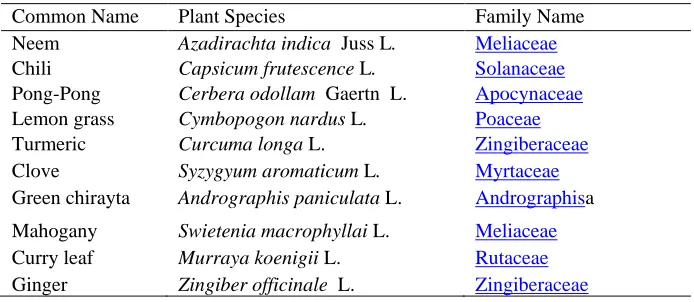
Plants which were selected for current study are listed in the Table 1 below.
Table 3.1 Plant species under study in experiments
Common Name Plant Species Family Name
Neem Azadirachta indica Juss L. Meliaceae
Chili Capsicum frutescence L. Solanaceae
Pong-Pong Cerbera odollam Gaertn L. Apocynaceae Lemon grass Cymbopogon nardus L. Poaceae
Turmeric Curcuma longa L. Zingiberaceae
Clove Syzygyum aromaticum L. Myrtaceae
Green chirayta Andrographis paniculata L. Andrographisa
Mahogany Swietenia macrophyllai L. Meliaceae
Curry leaf Murraya koenigii L. Rutaceae
Ginger Zingiber officinale L. Zingiberaceae
The present study engaged a modification of Ruch’s method (2001). Fifty gram (50g) powder obtained from the oven-dried samples of each plant obtained from the oven dried samples was put into 1000ml glass beaker and treated by drenching with 500ml of the selected solvent. After the treatment the beakers were covered with aluminum foil and transferred into a water bath (60 oC) and shaken for 5-6 hours to get uniform homogenous solutions. Following these treatments, the samples were left overnight in the lab at ±27OC, and later filtered through two layers of cheese-cloth gauze and Whatman No.2 filter paper. The filtrates were subjected to evaporation using a rotary evaporator at 60oC to remove the solvent. The dark spongy materials were dried in an oven at 37oC for two days. The dried material was collected and stored in small sterilized screw-capped glass bottles and kept in the refrigerator at 4oC for later use.
2.2 Preparing Concentrations of Crude Plant Extracts
Based on earlier work reported by (Francisco et al., 2010) concentration of plant extracts (3000ppm) were selected for the present study to determine the optimal antifungal concentration of the extracts. To prepare the samples, dimethyl sulfoxide (DMSO) was mixed with spongy material in the ratio of 1:1 to dissolve polar and non-polar compounds from the material (Kolayli, 2003). The homogenous solutions of the plant extracts, obtained after the DMSO treatment and manual stirring in 10 ml test tubes for 5 minutes, were used to prepare the above concentrations .
Samples were stored under three storage conditions to study the impact of temperature, humidity on the anti-fungi activity of the plant extracts. The three different conditions were: the refrigerator (temperature: 4OC; humidity 85-90%), room (temperature: 25±2OC; humidity 65-75%) and outside under shade (temperature: 32±2OC; humidity 80-90%). Several small-scale fruit farmers often sell their grown or fruits bought from super-market at open-air markets in the evening so the outside shade treatment was selected keeping in view of this condition. The extracts under different condition were assayed for their antifungal activity weekly for a period at 4 weeks. Using the Completely Randomized Design (RBD) with three replicates the samples test of antifungal activity.
2.3 Statistical analysis
The experimental data was subjected to one-way analysis of variance (ANOVA). Significant differences between mean values
were determined using Duncan’s Multiple Range test (P≤ 0.05) following ANOVA statistical analysis, which were performed using
SPSS version 24- 2016 (SPSS Inc., Chicago, USA).
III. RESULT AND DISCUSSION
Efficacy stored plant extracts on fungal inhibition zone under different condition (cool, room and outside) was studied. The percentages of fungal inhibition zone were calculated 7, 14, 21 and 28 days after contact with the extraction solutions. Tables 1, 2 and 3 results showed significant differences between the solutions that were stored at 4oC, 27oC and 30±2oC respectively. When the solutions were stored at 4oC, the most effective percentages of fungal inhibition zone in some plant extracts solutions remained high until the fourth evaluation carried out after three weeks. The solutions that were stored at 27oC were remained effective until the next bioassay while solutions that were stored at 30oC mostly lost their effectiveness after storing for a short time.
significant differences among bioassays when comparing the first bioassay immediately after the preparation, with subsequent bioassays
Table .1 Percentages of fungal inhibition zones (%) against Penicillium digitutum, Aspergillus niger and Fusarium sp for 10 crude plant extracts stored at 4OC and 85-90% (fridge) for four weeks.
Alphabets different in the same column show significant
difference using Duncan’s Multiple Range test (P≤ 0.05) and
average was calculated from three replicates.
Storage plant extracts at 4oC could decrease the rate of biological reactions because the low temperature inhibitions bioactivity for plant extracts such as oxidation and microbial growth. This may explain the effectiveness of plant extracts stored under refrigerator condition. Result of the current study agreed with what previous studies (Fernando et al., 2004; Wang et al., 1996) that storage cool condition had better quality for the longest storage while those stored at a higher temperature had
higher aroma compounds and antioxidant capacity contents, and effect on the total anthocyanin content.
The average percentages of tested plant extracts stored in flasks at 15OC are shown in Table 4.5. Under this condition, the effectiveness decreased rapidly with time. Plant extracts from Pong-pong, Chili and Neem were effect in their antifungal activity for first and second weeks and declined after the third evaluation. Lemon grass, Ginger and Green chirayta stayed active until their next bioassay for second week , while the other tested crude plant extracts failed quickly in the first bioassay after first Week .
*Crude plant extracts under study
P1 P2 P3 P4 P5 P6 P7 P8 P9 P10
Time storage Penicillium digitatum
Fresh(control) 100 a 93 a 85.2 a 85.2 a 84.6 a 77.7 a 50 a 47.7a 47.7 a 43.3 a
Week 1 90b 85b 85a 80b 80b 75a 48.9a 45.5a 46.6a 42.7 a
Week2 80c 76.6c 79.7b 70c 73.3c 69.6b 20b 24.4b 25b 20b
Week3 76.6d 74.4c 70c 70c 65.8d 60.4c 0c 0c 0c 0c
Week4 30e 21.3d 25d 15.6d 10e 10d 0c 0c 0c 0c
Aspergillus niger
Fresh(control) 96.6 a 94.3a 86a 83a 81a 79a 52a 49a 48.7a 44.4a
Week 1 87.7b 83.3b 84a 85a 79a 77a 44b 46.6b 47.4a 46.6a
Week2 81.1 c 77.3c 75.3b 76b 70.4b 69.4b 25.5c 23.4c 24b 25.6b
Week3 75.5 d 70.7d 70.1c 69c 68.4c 63.7c 0d 0d 0c 0c
Week4 22.6e 20.1e 17.4d 10d 10d 10d 0d 0d 0c 0c
Fusarium Sp
Fresh(control) 90.1a 90a 83a 80a 83a 81a 49a 48a 50a 44a
Week 1 83b 80b 70.4b 68.8b 71.2b 73.3b 45.6b 46.4a 45.4b 45.3a
Week 2 76.6c 70c 65c 61.3c 63.3c 60c 10c 15b 10.7c 13.8b
Week3 69.6d 62.2d 62.4c 60c 60.3c 60c 0d 0c 0d 0c
Week 20e 17.2e 12.4d 10d 11.5d 12.1d 0d 0c 0d 0c
*P1. Cerbera odollam L. (Pong-pong), P2. Capsicum frutescence L. (Chili), P3. Azadirachta indica L. (Neem), P4. Cymbopogon nardus L. (Lemon grass), P5.
Zingiber officinale L. (Ginger), P6. Andrographis paniculata L. (Green chirayta), P.7 Curcuma longa L. (Turmeric), P.8 Syzygyum aromaticum L. (Cloves), P.9
Table.2 Percentage of fungal inhibition zone (%) against Penicillium digitutum, Aspergillus niger and Fusarium Sp for 10 crude plant extracts stored at 15 OC and 65-70 % RH (Room conditions) for four weeks.
Statistical analysis (P ≤ 0.05) shows significant difference
between pong- pong and the other plants in the study. Also, Chili and Neem were shown to be statistical different from other plants. Furthermore, the result showed significant difference between extracts from Lemon grass, Ginger and Green chirayta with those from Turmeric, Cloves, Curry leaf and Mahogani. Similarly, the first bioassay (W1) immediately after the preparation differed significantly from subsequent bioassays (W2, W3 and W4).
In the current study, it is unlikely that the plant extracts antifungal compounds kept in glass flask were volatilized at 15 °C. Instead, the primary reason for antimicrobial activity loss appeared to be due to compound instability at moderately high temperatures. Compounds in stored plant extract might suffer series of changes due instability of the temperature and humidity during storage at room condition, which affect the bioactivity of the extracts. Storage conditions can change their biological activity such as anthocyanins, polyphenolics and phenolics compounds of stored solutions. The instability of the biocompound in the plant extracts was observed in the present study and this observation is supported by contemporary studies (Harbant et al., 2012; Kader et al., 2002; Rossi et al., 2003;
Barbara et al., 2005; Skrede et al., 2000). The mean percentages of fungal inhibition zone in tested crude plant extract solutions stored at 30±2 oC are shown in the Table.3. P1-P5 (Pong-pong, Chili, Neem, Lemon grass and Ginger) treatment showed significant anti-fungal activity for the 1st week when compared with P6-P10 (Green chirayta, Turmeric, Cloves, Curry leaf and Mahogani) .However, Pong-pong kept the effective for 2 weeks. Extraction remained effective under these conditions until the first bioassay during the first week.
The best was pong-pong, though it remained active until the second evaluation after two weeks. Chili, Neem and L. grass lost significant effectiveness during the first test after first week, and they lost their total effectiveness. The effectiveness of the other plants decreased rapidly after the preparation of the solution. The
ANOVA (P ≤ 0.05) shows significant differences between Pong
-pong and all other plants. Chili, Neem, Green chirayta, Lemon grass and Ginger showed significant differences with Turmeric, Cloves, Curry leaf and Mahogani. Also, there are obvious differences that appear between the first evaluation immediately after preparation and all the following tests that not showed significant differences among them.
*Crude plant extracts under study
P1 P2 P3 P4 P5 P6 P7 P8 P9 P10
Time storage Penicillium digitatum
Fresh(control) 93.4a 91.5a 85.7a 85.7a 84.8a 77.9a 53a 49.7a 46.7a 47.5a Week 1 89.5b 82.1b 80.2b 77.4b 16.2b 13.4b 5b 8.9b 9.7b 10b
Week 2 77.5c 30c 31.3c 26.7c 0c 0c 0c 0c 0c 0c
Week 3 17.6d 0d 0d 0d 0c 0c 0c 0c 0c 0c
Week 4 0e 0d 0d 0d 0c 0c 0c 0c 0c 0c
Aspergillus niger
Fresh(control) 90a 88a 84.5a 82.5a 82.5a 75.8a 47.5a 47a 48.4a 51.5a Week 1 88b 87.7a 84b 83.3a 13.8b 13.7b 7.3b 11.5b 11.5b 13b
Week 2 73c 25b 26.7c 23.6b 0c 0c 0c 0c 0c 0c
Week 3 19.2d 5c 0d 0c 0c 0c 0c 0c 0c 0c
Week 4 0e 0d 0d 0c 0c 0c 0c 0c 0c 0c
Fusarium Sp
Fresh(control) 88.8a 90.2a 87a 80 a 79.4a 80.4a 47a 48a 49.9a 50a
Week 1 88.8a 80b 80b 76.4b 17b 13.5b 16.8b 13.4b 13.5b 12.5b
Week 2 72.2b 27c 19.3c 21.1c 0c 0c 5c 0c 6c 0c
Week 3 22.1c 5d 0d 0d 0c 0c 0c 0c 0c 0c
Table.3 Efficacy of fungal inhibition zone (%) against Penicillium digitutum, Aspergillus niger and Fusarium sp for 10 crude plant extracts stored at 30±2 OC and 75-80% RH (Out side storage) for four weeks
The effectiveness of tested plant extracts was affected significantly by periods of storage. The fresh extract for all plants demonstrated the best effectiveness under different storage temperature. Most plant extracts were effective for one week after the preparation of the solutions, after which, the efficacy of plant extracts differed depending on the storage condition. Temperature enhances the rate of degradation of ingredients due to the increase in kinetic energy. Moisture content amplifies the rate of decomposition and makes the product susceptible to hydrolysis. In the case of herbal crude material or extract, temperature also facilitates the growth of microbes, which not only deteriorates the constituents but may produce toxic substances (Harbant et al., 2012; Pratibha et al, 2011). Also this study suggests that products made from this plant ought to be stored at 4oC and 80-90 RH % relative humidity and change conditions must be avoided during storage process. This deduction corroborates the earlier results (Hussain et al., 2009). Furthermore, the studies observed that fresh plant materials show a very good activity in all the assays, though the activity decreases during the preservation of the plant material at different temperature and humidity conditions. Literature studies of plant extracts indicate that most of the biological activities are due to their richness in compounds (saponins). These compounds are not very stable and their percentage reduces due change (temperature and humidity) environmental conditions (Phrompittayarat et al., 2008). These results confirm the effect of storage conditions on the performance of botanical when compared with fresh samples.
IV. CONCULATION
Longevity study of fresh plant extracts solution for all plants under study gave best effectiveness of crude plant extracts
stored and the activity decreases during the preservation of the plant extracts at different temperature and humidity conditions. Storage cool condition had better quality for the longest storage from those stored at a higher temperature.
REFERENCES
[1] Al-Samarrai, Ghassan .F. Harbant, Singh, and Muhammad S. (2012). Improve Postharvest Quality Of Fresh Fruit Citrus With Plant Extracts International Of Agriculture Science And Resarch, 4 (2): 53-62
[2] Barbara, M. S., Eerdman, J. W., and Mary, A. L. (2005). Effects of food processing on blueberry antiproliferation and antioxidant activity. J. Food Sci. 70: 389-394.
[3] Doughari JH, El-mahmood AM, Manzara S (2007). Studies on the antibacterial activity of root extracts of Carica papaya L. Afri. J. Microbiol. Res. 037- 041.Available online (http://www.academicjournals.org/ajmr) [4] Fernando, A., Shiow, Y., and Wang, C. Y. (2004). Effect of storage
temperatures on antioxidant capacity and aroma compounds in strawberry fruit. Lwt- Food Science and Technology, 37 (7): 687- 695.
[5] Francisco, D. H., Francisco Castillo-Reyes, G., Raul. R. (2010). Lippia graveolens and Carya illinoensis Organic Extracts and there in vitro Effect against Rhizoctonia Solani Kuhn. American Journal of Agricultural and Biological Sciences, 5(3): 380-384.
[6] Harbant ,S., Ghassan.F.Al-Samarrai., and Mohammad .S. (2012). Exploitation Of Natural Products As An Alternative Strategy To Control Postharvest Fungal Rotting Of Citrus. International Journal Of Scientific And Research Publication, 2 (3): 108- 112.
[7] Harbant ,S., Ghassan.F.Al-Samarrai., and Mohammad .S.. (2012). Performance of Botanical To Control Post-Harvest Fungi In Citrus. International Journal of Scientific And Engineering Research (IJSER), 3(4): 1- 4.
[8] Hussain, K., .Ismail, Z., Sadikun, A., and Ibrahim, P. (2009). Evaluation of extracts of Piper sarmentosum for accelerated stability by metabolic fingerprint profiling. Pharmacog.Res.1, (4):185-191.
[9] Kader, F., Irmouli, M., Nicolas, J. P., and Metche, M. (2002). Involvement of blueberry peroxidase in the mechanisms of anthocyanin degradation in blueberry juice. Journal of Food Scienc, 67, (3):910-915.
*Crude plant extracts under study
P1 P2 P3 P4 P5 P6 P7 P8 P9 P10
Time storage Penicillium digitatum
Fresh(control) 95a 94.7 a 88a 85.4a 80a 78.4a 51.2a 50.4a 50a 48.8a Week 1 88.7b 83.4b 81.4b 80b 78.9a 76.1b 10b 10.4b 11.4b 11.3b
Week 2 86.7b 81.3c 80.6 b 22.6c 20b 15dc 0c 0c 0c 0c
Week 3 18.2 c 15d 13.5c 0d 0c 0d 0c 0c 0c 0c
Week 4 6.5d 5.5e 3.9d 0d 0c 0d 0c 0c 0c 0c
Aspergillus niger
Fresh(control) 93.6a 90 a 90a 87.1a 80.2a 80a 50a 54a 47.7a 48.8a
Week 1 87.7b 83.3b 84b 85b 79b 77b 20b 12.4b 15.3b 15b
Week 2 82.2c 81.4c 79.6c 25.3c 20c 10c 0c 0c 0c 0c
Week 3 16.1d 15d 15d 0d 0d 0d 0c 0c 0c 0c
Week 4 5e 8.2e 5.7e 0d 0d 0d 0c 0c 0c 0c
Fusarium Sp
Fresh(control) 91a 90a 86a 83.7a 77.8a 77 a 49.2a 46.8ea 48.2a 49.7a Week 1 83 b 80b 70.4c 73.3b 71.2b 68.8b 15b 41.2b 51.1b 15b
Week 2 79c 78.2c 77.3b 22c 15c 10c 0c 0c 0c 0c
Week 3 20d 13.6d 15d 0d 0d 0d 0c 0c 0c 0c
[10] Kolayli S, Küçük M, Duran C, Candan F, Dinçer B (2003). Chemical and antioxidant properties of Laurocerasus officinalis Roem. (cherry laurel) fruit grown in the black sea region. J. Agric. Food Chem. 51:7489-7494. [11] Phrompittayarat, W., Wittaya-areekul, S., Jetiyanon, K., Putalun, W.,
Tanaka, H. and Ingkaninan K. (2008). Stability studies of Saponins in Bacopa monnieri dried ethanolic extracts. Planta Med. 74: 1756-1763. [12] Pratibha, S., Hema, N., Hemalata, M., and Anagha, C. (2011). Effect of
storage conditions on free radical scavenging activities of crude plant material of Piper longum. Journal of Phytology, 3(6): 23-27.
[13] Rossi, M., Giussani, E., Morelli, R., Lo Scalzo, R., and Nani, R. C. (2003). Torreggiani, D. Effect of fruit blanching on phenolics and radical scavenging activity of high bush blueberry juice. Food Res. Int., 36: 999-1005.
[14] Ruch, B. (2001). Processing of neem for plant protection simple and sophisticated standardized extracts. Abstracts of the .Work shop, Neem and Pheromones, University of Uberaba, Brazil, March 29-30 Augusts, P.499.
[15] Schippmann, U., J.D. Leaman and A.B. Cunningham: Impact of cultivation and gathering of medicinal plants on biodiversity: Global trends and issues, Inter-Departmental Working Group on Biological Diversity for Food and Agriculture, Rome (2002).
[16] Skrede, G., Wrolstad, R. E., Durst, R. W. (2000). Changes in anthocyanins and polyphenolics during juice processing of highbush blueberries (Vaccinium corymbosum L.). J. Food. Sci., 65: 357-364.
[17] Wang, G., Cao, R.L. (1996). Total antioxidant capacity of fruits, Journal of Agricultural and Food Chemistry, 44:701-705.
AUTHORS