2016 International Conference on Electronic Information Technology and Intellectualization (ICEITI 2016) ISBN: 978-1-60595-364-9
Research on the PCB Micro-drill Detection
Based on the DNA Algorithm
Dukun Ding
ABSTRACT
A new vision detection method has been researched in this paper, which is applied to the PCB micro-drill under 0.1mm. Firstly, the detection platform is setup, and the micro-drill image can be obtained in real time. On this basis, the DNA algorithm has been deeply studied. The threshold segmentation method based on DNA algorithm has been designed, and applied to the PCB micro-drill detection. The final experimental results show that, compared with the traditional Otsu method, the DNA segmentation method can obtain more information, which is very helpful for the PCB micro-drill detection later on.
INTRODUCTION
With the development of the information industry, the electronic production, such as the numerical camera, the I-phone and so on, will become lighter, thinner, shorter and smaller. This will bring a huge challenge to the hole machining process on the PCB (Printed Circuit Board), which has play a great role on the quality of the PCB. To the hole machining process, the laser and mechanical drill are the two common methods. Compared with the traditional drill machining, the laser machining is more efficient, but the production cost is very expensive. So the traditional drilling is still widely used in the micro-hole the through hole and the deep hole machining.
The micro-drills, which is used in hole machining on the PCB, are very consuming. It is reported that, there were 7 hundred million micro-drills consuming in 2005. In 2006 the number increased up to 8 hundred million. And in next few years, the demand of micro-drill will continue to increase. The manufacture of micro-drill is very profitable. According to statistics, the cost of drilling is up to 30% or 40% in the
_______________________
PCB manufacture. The quality of drilling is directly determined by the status of micro-drills. Therefore, it is very important to test the micro-drills’ production status. On the other hand, there are many production parameters affecting the final quality of micro-drill, which is said that the numbers of the important parameters are up to more than 20.
However, the test of micro-drills is still done by human nowadays. It is low efficiency and very time consuming. In recent years, the machine vision technique has been quickly developed, which has many merits, such as non-contact, acquiring more information and so on. The machine vision has become a promising method in the PCB micro-drill testing. Mach vision in Taiwan has developed the Point Gauge, which used the high resolution CCD and can obtain clearer micro-drill images. The device can detect the faults less than 1.5um and can be used to detect the following faults, which are the offset, gap, overlap, hooking, layback, chip, taper, flare and so on. You and Huang in Longhua University of Science and Technology have made a deep research on the image enhance technology and applying to the micro-drill detection. However, there is less research work on the PCB micro-drill vision detection inland. It is only reported that the professor Li Di the South China University of technology made some research on the automatic optics system using in the drills’ detection[1-7].
In this paper, the vision detection method applied to PCB micro-drills has been deeply researched. The experimental system has been setup. And a new detection method based on the DNA algorithm has been proposed.
SET UP OF THE EXPERIMENTAL SYSTEM
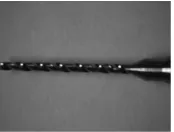
[image:2.612.256.342.502.577.2]The experimental system mainly includes the step motors, the x, y, z lead rails, the control computer, the high resolution ratio machine vision, the motion control card, and so on. The vision sensor is a 800 million pixels CMOS sensor, which equipped with a bi-tele centric lens. The sensor’s resolution ratio is up to 2μm. The simplified image capture system is shown in figure 1.
THE PCB MICRO-DRILL DETECTION BASED ON THE DNA ALGORITHM
Noise Reduction Process
[image:3.612.260.347.174.240.2]To remove the noise of the image, a median filter with 3×3 neighborhoods is applied to process the image, which is shown in Figure 2. From the figure, we can found that the noise of the image is greatly lowered.
Figure 2. 0.05mm micro-drill after media filter.
PCB Micro-drill Detection Based on DNA Algorithm
In 1994, professor Aldeman published an article about DNA calculation in the journal of Science, which starts a new era of DNA calculation. In recent years, DNA algorithm has been deeply researched and widely used in the field of control, optimum design and so on [7]. The detail operation process of DNA computing can be divided into the following steps[8-9].
STEP 1:DETERMINE CODING AND DECODING METHOD
The DNA individual, which stands for the image grey level, is coded by the quaternary system, which are 0 stands for thymine T, 1 stands for cytosine C, 2 stands for adenine A, 3 stands for guanine G. The total code numbers are 3. And the DNA individual can be decoded by the following expression.
0
0 1 1 2 2 3
34 4 4 4
a a a a
y (1)
Where y is the grey value of image, ai is the binary number at i position in the DNA individual.
SETP 2: SETUP OF FITNESS FUNCTION
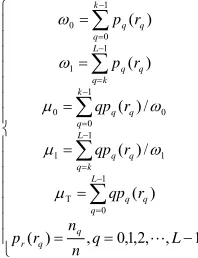
Suppose the threshold k is chosen. C0 is a group of pixel, whose gray level are [0,1,…,k-1]. And C1 is another group of pixel, whose gray level are [k, k+1,…,L-1]. Then the fitness function can be determined as follow [7].
1 1 T 2
2 T 0 0
2 ( ) ( )
Where the parameters of the expression are: 1 , , 2 , 1 , 0 , ) ( ) ( / ) ( / ) ( ) ( ) ( 1 0 T 1 1 1 1 0 0 0 1 1 1 0 0 L q n n r p r qp r qp r qp r p r p q q r L q q q L k q q q k q q q L k q q q k q q q (3)
STEP 3: DNA OPERATION
The DNA algorithm include the following main operation. a. Selection and duplication
The operation are caught out to choose several pairs of chromosome chains from the groups so that the individuals, whose fitness is much better, have more chance to produce their descendant. And excellent genetic information can be passed down to the next generation. The duplication principle is:
N i d f d f N round g N i i i
i ), 1,2,
) ( ) ( ( 1
(4)Where gi is the duplication numbers of the i individual, N is the total chromosome numbers, f (di) is the individual’s fitness.
b. Recombination
In this operation, two DNA chains exchange their nucleotides at a certain position through the crossover operation. So the better DNA individual may be generated. The operation principle is shown in Figure 3.
Figure 3. Recombination operation of DNA pair.
c. DNA Variation
[image:4.612.189.288.70.199.2]d. DNA Inversion
The process of this operation is that several DNA individuals are selected from the DNA groups. Then randomly choose two units of the individual and reverse their position, hoping to receive a better individual. The operation is shown in Figure 5.
Figure 5. Inversion operation of DNA.
EXPERIMENTAL
In order to test the researched algorithm, several images captured by the experimental system, have been processed by the DNA algorithm. The CCD captured the image at the time interval of 40ms. The final experimental result is shown in figure 6. From the experimental results, we can found that, compared with the traditional Otsu detection algorithm, the DNA algorithm can obtain more information, such as the drill’s angle, the width of the cutting edge, and so on. The information is very useful for the detection of the drill.
(a) Image processed by otsu (b) Image processed by DNA Figure 6. Images processed by otsu and DNA.
CONCLUSION
In this paper, the PCB micro-drill detection method has been deeply researched. A new algorithm based on the DNA were designed and applied to obtain the optimal value for the segmentation of the images. Compared with the traditional otsu method, the DNA algorithm can obtain more information, which is very useful for the detection of the PCB micro-drill’ s parameters.
ACKNOWLEDMENT
The researched work is supported by Guangdong Province one new NC generation mechanical product innovation application and demonstration project (No.
2013B011301003), Dongguan university-industry cooperation project(No.
REFERENCES
1. Chen Hanquan, Shi Hongyan. High Precision 3D Modeling of PCB Micro Drill Bit [J]. Tool Engineering, 2010(11): 40-42.
2. Luo Yin. Reserch on the precision detection technology for PCB micro drill geometry parameters 3. of the based on machine vision [D]. University of Electronic Science and Technology of China
Master Dissertation, 2009.
4. Zhang Wujie, Li Di, Ye Feng. Automatic Optical Inspection of Mini-Drill Blade Based on Computer Vision Technology [J]. Journal of South China University of Technology (Natural Science Edition), 2006, 34(11): 54-59.
5. Chen Haibin, Fu Lian yu, Luo Chunfeng. The Trends of PCB Drill Technology [J]. Metallization and Plating, 2008(8): 34-37.
6. Hu Songli. Machine Vision Based Precise Detection of Pcb Micro—drill's Geometry Parameters [D]. Shanghai Jiao Tong University Master Dissertation, 2009.
7. He Peizhao. Research on Automatic Grinding and Testing PCB Micro-drilling Technology [D]. South China University of Technology Master Dissertation, 2011.
8. Hu Songli, Xu Liming, Xu Kaizhou, etal. Adaptive Contour Corner Detection of Micro-drill' s First Facet [J]. Journal of Shanghai Jiaotong University, 2009, 43(5): 825-833.
9. Duan Haibin, Zhang Xiangyin, Xu Chunfang. Bio-inspired Computing [M]. Beijing: Science press, 2010: 107-127.