ILLUMINATION NORMALIZATION USING LOCAL GRAPH
STRUCTURE
1HOUSAM KHALIFA BASHIER, 2LIEW TZE HUI, 3MOHD FIKRI AZLI ABDULLAH,
4IBRAHIM YUSOF, 5 MD SHOHEL SAYEED, 6AFIZAN AZMAN,7 SITI ZAINAB IBRAHIM
Faculty of Information Science & Technology, Multimedia University, Jalan Ayer Keroh Lama,75450,Melaka, Malaysia
E-mail: [email protected], 2
[email protected],
3[email protected],
4[email protected],
5[email protected],
6
[email protected],
7[email protected]
ABSTRACT
The problem associated with Illumination variation is one of the major problems in image processing, pattern recognition, medical image, etc; hence there is a need to handle and deal with such variations. This paper presents a novel and efficient algorithm for images illumination correction call local graph structure (LGS). LGS features are derived from a general definition of texture in a local graph neighborhood. The idea of LGS comes from a dominating set for a graph of the image. The experiments results on ORL face database images demonstrated the effectiveness of the proposed method. The new LGS method can be stabilized more quickly and obtain higher correct rate compare to local binary pattern (LBP). Finally, LGS is simple and can be easily applied in many fields, such as image processing, pattern recognition, medical image as preprocessing
Keywords:Local Graph Structure, Feature Extraction, Pattern Recognition, Illumination Variation, Local
Binary Pattern, Texture Classification.
1.
INTRODUCTIONIn recent years, Biometrics gained renewed attention and essentially based on the development of pattern recognition systems. To verify a person’s identity, biometrics uses a wide range of technologies to measure and analyze his or her physiological characteristics, these characteristics features are directly extracted from measuring some part of the body. Currently biometrics technologies have been developed and being applied in security applications and everyday law enforcement, a range of technologies have been used by biometrics, optical sensors or electronic, for instance, scanning devices and cameras are used to capture images, recording sound, or measuring people’s characteristics. Face recognition has a significant improvement over other biometric measurements; it is a natural, nonintrusive and straightforward. As such, it became a tool of choice for a lot of security applications. With the development of cheaper and higher quality imaging technologies, face images can be easily obtained with good images quality and good technology to utilize advanced,
Comparison between Local Graph Structure and Local Binary Pattern are carried out with experimental results based on ORL Face database and our database in 6. Finally, in Section 7, conclusions are drawn.
2.
ILLUMINATION NORMALIZATIONThe problem associated with Illumination variation is one of the major problems in image processing, face recognition, medical image, etc. e.g. the appearance or perceptions of faces are significantly affected by factor of illumination, together with pose variation [3][4]. Faces can vary markedly in illumination direction and rotation in-depth, and these cause occlusions and varied appearances. Changing the illumination orientation consequently produced large image variation as have been reported by [5]. Their work was comparing images of several faces portrayed with similar or diverse lighting directions. Many representations of these faces were used: grey-scale faces, faces filtered with Gabor functions, 1st and 2nd derivatives of the grey-scale faces and edge maps. Varying illumination directions for all representations were considered to contribute in larger image differences than in adjusting the identity of the face. Quite a lot of methods have been proposed in the last years for solving the variable illumination problem in face recognition contexts. The approaches to solve these illumination problems can be roughly classified into three main categories: i) Face Modeling ii) Normalization ii) Pre-processing, and Invariant Features Extraction. The drawback of the face modeling approaches is the requirement of images for building the linear subspaces. Additionally, the secularity difficulty and the fact that human faces are not perfect, Lambertian surfaces are ignored by these models [6]. For normalization and pre-processing techniques, several image pre-processing algorithms are introduced to compensate and normalize illumination. Most of these algorithms do not need any training or modeling steps, knowledge of three dimensional face models or reflective surface models. Numerous methods and techniques have been presented in the previous study deal with illumination normalization. Two popular methods among these techniques are Local Binary Pattern (LBP) and Gabor wavelets. In this paper, a novel illumination normalization method called Local Graph Structure (LGS) for face recognition is proposed. LGS is applied to the image, which can efficiently and successfully get rid of the effect of uneven illumination. Then the produced images, which are insensitive to
illumination variations, are used for face recognition using different methods, such as Principal Component Analysis, Independent Component Analysis[7][8].
3.
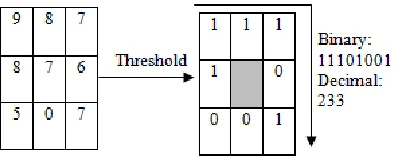
LOCAL BINARY PATTERN [image:2.612.321.518.339.420.2]Local Binary Pattern (LBP) operator was introduced by Ojala et al. [9]. The LBP operator is a non-parametric 3x3 matrix kernels which summarizes the local special structure of an image. LBP works with the eight neighbors of a pixel, using the value of this center pixel as a threshold. If a neighbor pixel has a higher gray value than the center pixel (or the same gray value) then a one is assigned to that pixel, else it gets a zero. The LBP code for the center pixel is then produced by concatenating the eight ones or zeros to a binary code figure 1.
Figure 1: The Original LBP Operator.
To produce the LBP for pixel (xc, yc) a binomial
weight 2p is assigned to each sign s(gp − gc). These
binomial weights are summed:
1
0
( ,
)
(
)2 .
p
p
c c p c
p
LBP x y
s g
g
−
=
=
∑
−
(1)Where
p
=
8.
p
=
0,1, 2,...7.
LBP operator has been extended to use neighborhoods of different sizes [10]. In this case a circle is made with radius from the center pixel. Sampling points on the edge of this circle are taken and compared with the value of the center pixel. To get the values of all sampling points in the neighborhood for any radius and any number of pixels, bilinear interpolating is used.
4.
LOCAL GRAPH STRUCTUREThe domination number γ (G) is the number of vertices in a smallest dominating set for G[11].
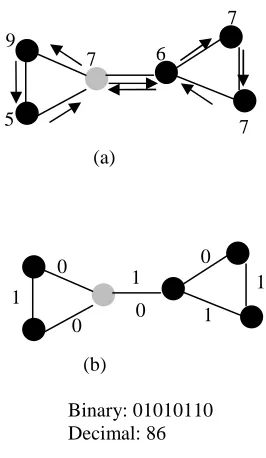
LGS works with the six neighbours of a pixel, by choosing the target pixel C as a threshold, then we start by moving anti clockwise at the left region of the target pixel C,If a neighbor pixel has a higher gray value than the target pixel (or the same gray value) then assign a binary value equal to 1on the edge connecting the two vertices, else we assign a value equal to 0. After finish on the left region of graph we stop at the target pixel C and then we move in a horizontal way (clockwise) to the right region of the graph and we apply the same process till we get back to the target pixel C.
(a)
(b)
[image:3.612.128.261.272.501.2]Binary: 01010110 Decimal: 86
Figure 2: Local Graph Structure (A. Direction, B. Binary).
To produce the LGS for pixel (xd, yd) a binomial
weight 2p is assigned to each sign s(gd – gn). These
binomial weights are summed:
7
(
,
)
(
)2
0
p
LGS x
y
s g
g
d
d
d
n
K
=
∑
−
=
(2)
where
1
0
( )
0
0
x
s x
x
≥
=
<
Where
p
=
7.
p
=
7, 6,...0.
5.
EXPERIMENTS AND RESULTSLocal graph structure (LGS) have proved to be useful in a variety of image processing and pattern recognition tasks. The basic idea is illustrated in Fig. 3: A decimal representation is obtained by taking the binary sequence as a binary number between 0 and 255. For a pixel, LGS not only accounts for its relative relationship with its neighbours but also the relationship between the pixels that form the local graph of the target pixel C , while discarding the information of amplitude, and this makes the resulting LGS values very insensitive to illumination intensities. The 8-bit binary series with binomial weights consequently result in 256 different patterns in total for the pixel representation.
In the initial work of face processing using LGS, can be seen in Fig 4, is an example of new generated image from original image Fig. 3 using LGS, a histogram of the LGSs for original image and a new generated one are illustrated in Fig 5 and Fig 6 consequently, histogram of LGSs image representing the distribution of 256 patterns across the face image. The advantage of LGS; Firstly it is a local measure, so LGS in a certain region will not be affected by the illumination conditions in other regions. Secondly it is a relative measure, and is invariant to any monotonic transformation such as shifting, scaling, or logarithm of the pixel-values. Therefore it can be invariant to a certain range of illumination changes.
Fig. 3 Example Of An Original Image
Fig. 4 Example Of New Generated Image From Original Image Using LGS.
1 0
7 9
5
7 6
7
C
1 1
0 0
1
0
0 20 40 60 80 100 120
[image:4.612.93.534.68.387.2]0 50 100 150 200 250
Fig. 5 Histogram Of An Original Image
0 50 100 150 200 250 300
0 50 100 150 200 250
Fig. 6 Histogram Of New Generated Image Using LGS.
We test our method using the public ORL face database. The database consists of 400 faces from 40 persons. The faces were captured with the subjects in a straight, frontal position against a dark identical background, and with acceptance for some sloping and regular change of up to 20 degrees. Image variations of five individuals in the database are illustrated in Fig7.
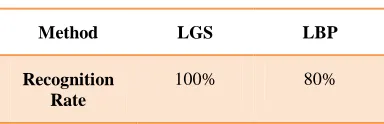
[image:4.612.104.252.242.391.2]To assess the performance of the three proposed LGS method on face recognition. 5 subjects have taken for our experiments, 8 images for training and the remaining 2 images for testing, first both methods LGS and LBP were applied to find the histograms for the entire training set, for testing, the histogram of test image is calculated and then find the between the training images histograms and histogram of test image by applying the correlation functions which it compares two histograms. The recognition rates obtained with LGS and LBP are shown in Table 1. The results show that the LGS methods work well with the compare with LBP, which means that LGS is robust with respect to variations of illumination. We believe that the main explanation for the better performance of the local graph structure over other texture descriptors, it takes in consideration the relationship between the pixels that form the local graph of the target pixel C and consideration tolerance to monotonic gray-scale changes.
Table I Recognition Rate
Method LGS LBP
Recognition Rate
100% 80%
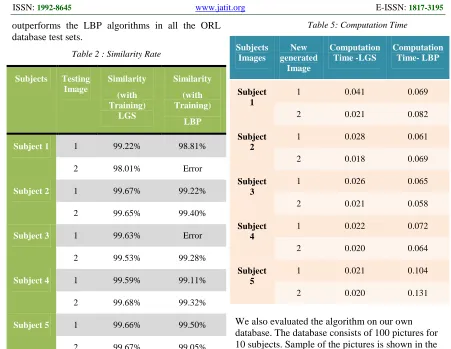
[image:4.612.308.500.627.689.2]outperforms the LBP algorithms in all the ORL database test sets.
Table 2 : Similarity Rate
Subjects Testing Image
Similarity
(with Training)
LGS
Similarity
(with Training)
LBP
Subject 1 1 99.22% 98.81%
2 98.01% Error
Subject 2 1 99.67% 99.22%
2 99.65% 99.40%
Subject 3 1 99.63% Error
2 99.53% 99.28%
Subject 4 1 99.59% 99.11%
2 99.68% 99.32%
Subject 5 1 99.66% 99.50%
2 99.67% 99.05%
Additional advantage of LGS is the computational efficiency compare to LBP as can be seen in table 3, from the table we can observe that LGS method beside simplicity is quit fast so that it can be easily applied in many fields, such as image processing, pattern recognition, medical image as pre-processing step.
TABLE 3: Overall Recognition RATE
LGS
Recognition Rate
Overall
93.75%
Max Recognition
99.87%
[image:5.612.78.529.74.423.2]Min Recognition
98.01%
Table 5: Computation Time
Subjects Images
New generated
Image
Computation Time -LGS
Computation Time- LBP
Subject 1
1 0.041 0.069
2 0.021 0.082
Subject 2
1 0.028 0.061
2 0.018 0.069
Subject 3
1 0.026 0.065
2 0.021 0.058
Subject 4
1 0.022 0.072
2 0.020 0.064
Subject 5
1 0.021 0.104
2 0.020 0.131
We also evaluated the algorithm on our own database. The database consists of 100 pictures for 10 subjects. Sample of the pictures is shown in the below figure. Table 4 shows the overall
performance.
Fig. 7 Database Sample
Table 4: Recognition Rate On Our Database
LGS
Result
Error Rate
5%
Recognition Rate
95%
6.
CONCLUSIONstructure are derived from a general definition of texture in a local graph neighborhood. The advantages of LGS over other local methods it’s invariant to illumination changes, computational efficiency, and fast so that it can be easily applied in real-time system. LGS assigns weight for target pixels by considering not only the relationship of one pixel to its neighbors but also the relationship between the pixels that form the local graph of the target pixel; this feature is unique to LGS and lead to improve the image appearance and subsequently the recognition performance. This is especially applicable for faces from which the photos are taken under different lighting conditions. Important regions for feature extraction are those with the eyes and the mouth as you can see in figure. LGS can easily be combined with other methods such as Principal Component Analysis, Linear Discriminant Analysis and Independent Component Analysis, and can easily kernelized by using different kernels functions.
REFRENCES:
[1] P. J. Phillips , P. Grother , R. Michaels , D. Blackburn , E. Tabassi and M. Bone Facial Recognition Vendor Test 2002: Evaluation report, 2003.
[2] R. Gross, J. Shi, and J. Cohn, Quo vadis face recognition? In Third Workshop on Empirical Evaluation Methods in Computer Vision. , 2001.
[3] R. Gross, S. Baker, I. Matthews, T. Kanade, Face Recognition Across Pose and Illumination, Chapter 9, Handbook of Face Recognition, Stan Z. Li and Anil K. Jain (Eds.), Springer-Verlag, 2004.
[4] D. Shin, H.-S, Lee, D. kim, Illumination-robust face recognition using ridge regressive bilinear models, Pattern Recognition Letters, vol. 29, 49–58, 2008.
[5] Adini, Y. Moses, and S. Ullman,(1995). Face recognition: the problem of compensating for changes in illumination direction (Report No. CS93-21). The Weizmann Institute of Science. [6] J. Ruiz-del-Solar, and J. Quinteros,
Illumination Compensation and Normalization in Eigenspace-based Face Recognition: A comparative study of different pre-processing approaches. Pattern Recognition Letters, 29(14), pp. 1966-1979,2008.
[7] C. K. Chui, An Introduction to Wavelets. Academic Press, Boston, 1992.
[8] D. Liu, K.M Lam, L.S. Shen, “Optimal sampling of Gabor features for face recognition”, Pattern Recognition Lett. 25 (2), 267–276,2004.
[9] T. Ojala, M. Pietik¨ainen and D. Harwood. “A comparative study of texture measures with classification based on feature distributions”, Pattern Recognition vol. 29, 1996.
[10]T. Ojala, M. Pietikäinen, and T. Mäenpää, Multiresolution Gray-scale and Rotation Invariant Texture Classification with Local Binary Patterns. IEEE Trans. Pattern Analysis and Machine Intelligence 24(7): pp. 971-987, 2002.