REQUIREMENTS AND CHALLENGES IN BODY SENSOR
NETWORKS: A SURVEY
VAHID AYATOLLAHITAFTI1,*, MD ASRI NGADI2, AND JOHAN BIN MOHAMAD SHARIF3 1,2,3
Department of Computing, UNIVERSITI TEKNOLOGI MALAYSIA,
UTM SKUDAI, JOHOR, MALAYSIA.
Email: 1,* [email protected], [email protected], [email protected]
ABSTRACT
Recent advances in wireless sensor networks have provided many opportunities for researchers on wireless networks around the body such as Body Area Network (BAN) or Body Sensor Network (BSN). A BSN allows health monitoring of patients whereby caregivers receive feedback from them without disrupting their normal activities. This monitoring requires the employment of the low-power sensor nodes implanted in or worn on the human body. This paper presents a discussion of BSNs, communication standards and their characteristics. Energy, quality of service and routing are among the crucial requirements and challenges facing BSNs which are studied. The paper also provides an investigation of many existing solutions and technologies for the challenges and requirements at physical, MAC, network, transport, and application layers. Finally, some open research issues and challenges for each layer are discussed to be addressed in further research.
Keywords: BSN, energy, QoS, routing.
1. INTRODUCTION
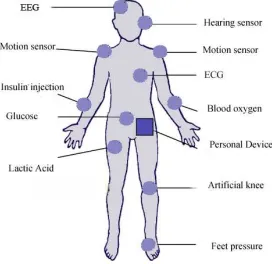
[image:1.595.335.471.434.566.2]With growing the aging population and increasing costs of healthcare systems, there has been considerable motivation around human’s body to improve the quality of life, made feasible by developing miniaturized, intelligent, low-power and autonomous sensor nodes. A BSN is a radio frequency (RF)-based wireless technology that connects nodes with sensing or actuating abilities in a body of human. A sensor node gathers data, processes them and then sends them wirelessly. The components of a sensor are: a power device, a processor, memory unit and a receiver or transceiver. These devices can be for example Electrocardiography (ECG), blood pressure, hearing, respiratory, positioning, motion, artificial knee, Electroencephalograph (EEG), and temperature as shown in Figure 1. These heterogeneous devices require different frequency rates and different transmission rates [1, 2].
Figure 1: An Example Of Sensors On The Body
Body Area Network (BAN) communications architecture is divided into three components: Tier-1, Tier-2, and Tier-3 communication design. They are included intra-BAN, inter-BAN, and beyond-BAN respectively [1]. There are some challenges and requirements in body sensor networks such as energy, QoS, security, routing, reliability, mobility and privacy. Energy, QoS and routing are the most important challenges in BANs [3, 4].
and challenges, network layer communications and BAN applications. Latre et al. [5] discussed about researches on physical, MAC and network layers around the body. Some challenges and issues at physical and data link layers were provided in [1]. In this paper, Chen et al. presented a comparative study of some radio technologies. Darwish et al. [4] provided a study of security, energy and scalability in the wearable and implantable sensor networks. Channel characteristics, routing and security were studied in [6]. Authors in [7-9] also surveyed BSNs and their challenges in the different aspects. Although aforementioned researches surveyed and studied challenges and issues in BSNs, there are a need for surveying the most important challenges and requirements namely energy, QoS and routing at different layers of protocol stack as well as proposed solutions, mechanisms and protocols.
This paper aims at surveying the challenges and issues in body sensor networks at different layers that need to be addressed. In addition, we continue addressing the proposed solutions and mechanisms for the current issues at different layers.
The remainder of this paper is organized as follows. Section 2 surveys communication protocols and standards that are used in BSNs. Section 3 overviews requirements and challenges in BSNs. Next, Section 4 presents requirements and challenges in Open Systems Interconnection (OSI) model as well as existing solutions, technologies and mechanisms. In this section, energy, routing and QoS are discussed at physical, MAC, network, transport and application layers. After that, some open research issues are identified in section 5. Finally, section 6 concludes the paper.
2. COMMUNICATION PROTOCOLS
A body sensor node includes the physiological signal and the radio frequency. Some standards are used for communicating that is explained as follows.
Bluetooth over IEEE 802.15.1. The IEEE 802.15.1
is the preliminary for the Bluetooth technology in wireless communication. Bluetooth is a wireless technology that is used for short range communication and small nodes with low energy consumption. Wireless LAN uses 2.4 GHz frequency band as Bluetooth [7, 10]. Bluetooth Low Energy technology provides a data rate above 1 Mb/s. This technology uses fewer channels for multiple nodes and synchronization is in milliseconds range.
Zigbee over IEEE 802.15.4. For solving some
medical monitoring inconvenience, Zigbee wireless communications has been proposed. Multiple physiological sensors are proposed to identify a developed WSN architecture[11]. ZigBee supports star, cluster tree, and mesh topologies [12]. ZigBee technology has some advantages such as good security, low cost, low power consumption and short delay, and it has some disadvantages such as low data rate, limited QoS, coexistence with ISM band technologies [13, 14]. QoS can be improved in BSNs using a packet prioritization scheme and a QoS-aware packet scheduler [15]. Two modes are provided by Zigbee: beacon enabled and non-beacon enabled mode. Medical sensor networking can use Zigbee in non-beacon mode. Beacon mode is used with more limitation on data rate [16, 17].
UWB over IEEE 802.15.6. IEEE 802.15.6 has been
established by IEEE for the WBAN standardization. The standard is used to optimization of low-power nodes in real-time and non-real-time applications. Any wireless technology that has a bandwidth exceeding 500 MHZ is referred to UWB [18-20].
Other standards. Some standards for WBANs such
as Insteon, Z-Wave, ANT, RuBee, and RFID are also used. Insteon and Z-Wave use mesh topology for home applications. Z-Wave uses the 2.4 GHz ISM band and Insteon uses power lines and the 900 MHz band. ANT is a communication technology in which protocol stack is simple and power consumption is low. RuBee works in 130 KHZ and RFID in 900 MHZ frequency band. They are very similar in terms of application scenarios, battery life, and frequency bands [21].
3. REQUIREMENTS AND CHALLENGES IN BSNS
Major challenges and requirements in BSNs are energy, QoS and routing. These are described as follows.
3.1 Energy
In BSNs, when real-time monitoring does not require, sensor nodes should put into a low power standby mode. In case that extra energy is needed, energy scavenging is used. The heat and vibrations of body can provide more energy [25].
3.2 QoS
QoS is considered and interpreted in different ways. QoS definitions are related to the applications. Depending on the application, QoS can be characterized by reliability, availability, robustness, timeliness, and security. Some QoS parameters can be used to measure the degree of supporting these services, such as throughput, jitter, delay, and packet loss rate [26, 27]. QoS requirement in different OSI layers are described as follows [28].
Application layer: detection probability, system lifetime, response time, data reliability, data novelty and data resolution.
Transport layer: Latency, bandwidth, real-time traffic, cost and reliability.
Network layer: congestion probability, path latency, topology change, routing robustness, routing maintenance and energy efficiency.
MAC layer: Transmission reliability, energy efficiency and throughput.
PHY layer: Physical capabilities impose resource constraints on the QoS requirements of other layers.
3.3 Routing
Routing in BSNs can be categorized in five groups which are described as follows [29, 30].
Thermal aware routing: In this routing, nodes have weight. Some nodes have high temperature and others have lower temperature. To reduce heating in nodes, some algorithms can be used [31]. The Specific Absorption Rate (SAR) is power absorbed per unit mass of the tissue.
DTN routing: Delay-Tolerant Networking (DTN) is a mechanism that is used in heterogeneous networks without continues connectivity. DTNs routing are classified to flooding strategy and forwarding strategy. In flooding strategies, multiple copies of a packet are sent to other nodes. In forwarding based strategy, the packets send to next node using information about network topology [32-34].
Cluster based routing: In this kind of algorithms, routing is done by node clustering techniques. Each
cluster has a cluster head which aggregates data from the cluster and send them to the sink node. The LEACH (Low Energy Adaptive Clustering Hierarchy) randomly selects the nodes as a cluster head [34]. In other methods, energy can be considered for cluster head selections [35].
Cross layer routing: This routing is a way to improve interaction between the protocols by merging some layers from the protocol stack. One approach in cross layering is modular method that has some advantages such as avoiding duplication of functionality and supporting heterogeneity [3, 5].
QoS-aware routing: This strategy is related to the applications and their QoS requirements. Because real-time and non-real time applications play a big role in BSNs, QoS-aware routing strategies are very important [36].
4. REQUIREMENTS AND CHALLENGES IN OSI MODEL
Energy, QoS and routing are the most important challenges and requirements in BSNs that here are investigated at different layers of OSI network model.
4.1 Physical Layer
Energy and QoS are two challenges in the physical layer of BSNs, which are described in the following sections.
4.1.1 Energy
At physical layer, energy can be conserved with different ways. Energy harvesting is one solution to conserve the energy. Energy harvesting systems has been compared in [37]. In [38], using a discrete-time Markov chain, an energy harvesting model was proposed at each sensor, and the relationship between sensor rate and sensor lifetime was examined. Another energy harvesting was used in [39] for transmission strategies related to packet error probability.
In [40], a system-level mechanism to power consumption was proposed. The mechanism combined aspects based on the optimization of power and application.
Body channel communication (BCC) reduces energy consumption of a transceiver to 0.5nJ/b. In[42], an adaptive frequency hopping plan applied. In [43], a Low power on-body communication was introduced. A direct-coupled interface was proposed to avoid any intentional ground electrode.
4.1.2 QoS
An adaptive fault-tolerant communication scheme for BSNs, namely AFTCS, adopts a channel bandwidth reservation strategy to establish reliable data transmission. To fulfill the reliability requirements of sensors, a fault-tolerant priority was employed to adjust the channel bandwidth allocation [44].
Bui et al. [45] studied signal processing mechanisms. A framework for QoS regulation based on optimization principles was presented.
4.2 Mac layer
Energy, QoS, and routing are three challenges in MAC layer of BSNs, which are described in the following sections.
4.2.1 Energy
Carrier Sense Multiple Access/Collision Avoidance (CSMA/CA) is a contention-based MAC protocol in which nodes compete for the channel. If the channel is not free, the nodes postpone data communication until the channel gets free. CSMA/CA protocol encounters heavy collision problem, therefore Time Division Multiple Access (TDMA) protocol can be used. In TDMA protocol, the channel is divided into slots of time with fixed or variable duration. Also other energy-efficient methods such as Low-power Listening (LPL) and scheduled-contention can be used [46-48].
TRAMA [49], S-MAC [50], PMAC [51] and DMAC [52] proposed to reduce the energy. These protocols are related to scheduled-contention mechanisms.
Low-Power Listening (LPL) approaches can be used in such protocols such as X-MAC[53] and SCP-MAC [54] uses channel polling to check if there are any necessities to wake up nodes. SCP-MAC [54] used a planned channel polling, enabling ultra-low duty cycles. Some protocols such as FLAMA [55] and HEED[56] are TDMA-based. H-MAC [57] also is TDMA-based protocol designed for BSNs, with exploiting heartbeat information to perform time synchronization. In
[58], a novel energy MAC protocol for in-vivo BSNs related to TDMA was proposed.
In [59], a power consumption design and Distributed Queuing Medium Access Control (DQ-MAC) protocol was presented. With a cross-layer scheduling mechanism, body sensors were able to demand a “collision-free” time slot.
BAN-MAC [60] is an ultra-low-power method that can work in BANs with star topology. This protocol can work with Zigbee. Parameters can be adjusted in BAN-MAC dynamically to earn energy conservation. Authors in [61] Introduced radio polices related to energy into a DQ-MAC protocol and evaluated the load of network and the packet size. In [62], the IEEE 802.15.4 constraints were tested, and an energy-aware radio polices was introduced.
4.2.2 QoS
BodyQoS, a QoS based BSN, addresses three challenges. First, BodyQoS adopts an asymmetric architecture. Second, a virtual MAC is used in BodyQoS to make it radio agnostic. Third, BodyQoS applies an adaptive resource scheduling strategy during of channel impairment. In [63], an architecture for BodyQoS proposed in which all three above-mentioned challenges were taken into consideration.
4.2.3 Routing
Although routing is a concept at the network layer, a number of cross layer protocols have been developed that operate at MAC layer and network layer. In [64], Wireless Autonomous Spanning tree Protocol (WASP), a cross layer protocol, was proposed. In this protocol, time slots are designated to the sensor nodes for sending data. CICADA is a low energy protocol designed for body area networks. In this protocol, a spanning tree is established and slots are assigned to the nodes. Each node informs its children about the slot assignment [65]. In [66], a data forwarding method with on-demand listening was proposed. According to the link quality, the data can forward to the destination. If the nodes have weak connectivity, multi-hop gossiping can use for packet forwarding. A multi-hop gradient based routing method for BAN was presented in [67].
4.3 Network layer
4.3.1 Energy
Packet size optimization is a method at network layer for energy consumption. In [68], the hop-length extension mechanism used to improve this parameter.
Also joint packet size optimization can improve energy consumption in BSNs. Author in [69] used both BSN and WiFi network to optimize the packets’ payload sizes using their packet delivery ratios.
Improving energy consumption in communications and optimization of transmission energy in a path is another method. In [70], a data-centering routing mechanism was used to improve communication energy.
In [71], an energy-efficient cost-effective protocol was presented for multi-hop BANs. This protocol utilizes relay position and data routing problem to increase network lifetime.
4.3.2 QoS
Because BSNs have severe constraints on packet priorities, banwidth, power and delay, guaranteed QoS for users is very important. In [36], a cross-layer routing service framework with QoS support was proposed.
QoS can be considered in data-centric routing protocols. In [72], a data-centric multi-objective QoS-Aware routing protocol, called DMQoS was proposed.
4.3.3 Routing
Many thermal routing protocols are used in BSNs. Thermal-Aware Routing Algorithm (TARA) is the first thermal-aware routing in BSNs [73]. In this protocol, when a node receives a packet for sending, it selects next node with minimal temperature. In [74], two thermal aware routing protocols , Least Temperature Routing (LTR) and Adaptive Least Temperature Routing (ALTR), were presented. In LTR, A node sends the packet to the neighbor with the lowest temperature. In ALTR, a node forwards the packet to the neighbor with the lowest temperature. Another protocol is Least Total-Route Temperature (LTRT) that was presented in [75, 76]. The protocol uses single source shortest path algorithm for the routing with the least temperature from the source to the destination. Hotspot preventing routing (HPR) is a thermal routing that was presented in [77]. In HPR, the packet sends to the next node. Lightweight Rendezvous Routing (LRR) was proposed in [78]. In LRR, BSN is divided into clusters. Every cluster has a broker and some publishers and subscribers.
In [79], a threshold based multi-hop routing protocol was proposed in which temperature of the nodes are considered.
Some DTN routing strategies in BSNs were proposed. In [80], On-body Store and Flood Routing (OBSFR) was proposed. In this routing, multiple copies of a packet send to neighbor nodes which are not visited by the packet in partitioned networks. Probabilistic routing with postural link costs (PRPLC) and Distance vector routing with postural link costs (DVRPLC) were two DTN strategies that were proposed in[81]. In PRPLC strategy, every node has a link likelihood factor that is degree of connectivity between nodes. In DVRPLC strategy, nodes have link likelihood and link cost factor. Another strategy is Probabilistic Routing with MultiScale Postural Locality (PRMPL) which was proposed in[82]. In this strategy, when a link is connected, postural link cost is maximum and when the link is not connected postural link cost starts to decrease until zero after a period of time.
In [83], Hybrid Indirect Transmissions (HIT), a cluster based routing mechanism was proposed. This routing allowed nodes to parallel and multi-hop sending.
WASP [84] and CICADA [65] were two cross-layer protocols that were designed for MAC and network layers. Routing in these protocols was done using the spanning tree and time slots. Some routing protocols are QoS-aware. A data-centric multi-objective QoS-Aware routing protocol, was proposed in [72]. The protocol facilitated the system to achieve customized QoS services. In [85], different routing protocols based on their effect on the QoS by using Constant Bit Rate (CBR) application in Zigbee-based network were investigated. A QoS reinforcement learning based routing protocol was proposed in [86]. A QoS-aware energy-efficient routing algorithm related to configuration management was proposed in [87]. In this method, when a node is disconnected from its parent in the tree because of body movement, another parent node is selected for data sending related to the QoS parameters. A bandwidth allocation method for QoS-aware routing was proposed in [88]. This scheme optimizes the bandwidth and energy efficiency of the nodes.
4.4 Transport and Application Layers
Energy and QoS are two challenges in transport and application layers of BSNs, which are described in the following sections.
4.4.1 Energy
In [90], a multi-objective optimization methodology was presented for self-organizing. Using genetic algorithm optimization,
application-specific requirements and energy-conservation characteristics are considered.
4.4.2 QoS
[image:6.595.100.496.298.636.2]For QoS supporting in application layer , an XML-based service can be integrated with priority setting algorithm, and per-hop-behavior definition [91].
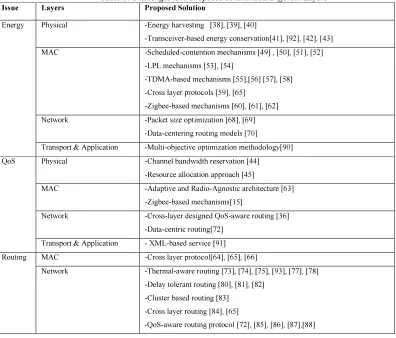
Table 1. Challenges And Proposed Solutions At Different Layers
Issue Layers Proposed Solution
Energy Physical -Energy harvesting [38], [39], [40]
-Transceiver-based energy conservation[41], [92], [42], [43]
MAC -Scheduled-contention mechanisms [49] , [50], [51], [52]
-LPL mechanisms [53], [54]
-TDMA-based mechanisms [55],[56] [57], [58]
-Cross layer protocols [59], [65]
-Zigbee-based mechanisms [60], [61], [62]
Network -Packet size optimization [68], [69]
-Data-centering routing models [70]
Transport & Application -Multi-objective optimization methodology[90]
QoS Physical -Channel bandwidth reservation [44]
-Resource allocation approach [45]
MAC -Adaptive and Radio-Agnostic architecture [63]
-Zigbee-based mechanisms[15]
Network -Cross-layer designed QoS-aware routing [36]
-Data-centric routing[72]
Transport & Application - XML-based service [91]
Routing MAC -Cross layer protocol[64], [65], [66]
Network -Thermal-aware routing [73], [74], [75], [93], [77], [78]
-Delay tolerant routing [80], [81], [82]
-Cluster based routing [83]
-Cross layer routing [84], [65]
-QoS-aware routing protocol [72], [85], [86], [87],[88]
5. OPEN RESEARCH ISSUES
There have been some challenges and proposed solutions for different layers. Table 1 shows each challenge with categorized solutions at the each layer of OSI.
Many challenges and open research issues exist in different layers of BSNs that need to be considered. In this section, open issues in physical, MAC,
network, transport and application layers are presented.
5.1 Physical Layer
Using body movement and body heat can be useful for energy scavenging. Remote battery recharging and wireless energy transmission can also be other methods for energy harvesting as researchers in MIT proposed [94]. Generating electricity from sugar is another candidate to solve power scavenging issue.
5.2 MAC Layer
Optimization of MAC duty cycles for power consumption can reduce frame delays and influence on QoS objective. Network coding for a TDMA-based protocols can improve reliability [95]. Network coding for contention-based and LPL-based protocols can be investigated in future researches.
5.3 Network Layer
Heat of an implanted sensor can damage the surrounding tissues. Some thermal-aware routing protocols have been developed for this issue, but other parameters such as delay and packet loss also should be considered with temperature in this kind of protocols because delay and reliability are important for some applications that use implanted sensors.
In some applications such as ECG and EEG monitoring, real time information is earned and in others such as heart rate, blood pressure, body temperature, glucose monitoring, respiration and PH-level monitoring, non-real time information is earned [96]. Even though some sensors are non-real time, reliability is important; for example respiration and PH-level monitoring. Therefore, QoS-aware routing protocols play a big role for QoS requirements.
5.4 Transport and Application Layer
Even though QoS usually varies from application to application, there are some common problems between applications which are related to major areas of body sensor networks. Therefore, finding common problems between different applications on the body can improve energy consumption as well as has better QoS support. Mobile agent systems are being currently developed at application layer in BSNs. A mobile agent platform has been designed and implemented in [97]. Multi-agents have been used for real-time applications and prescription services in health care systems [98]. Mobile agent systems for QoS support in real time applications need to be developed. Also congestion in BSNs and healthcare
systems is a challenging task which needs to more consideration. A healthcare-aware congestion avoidance and control protocol was proposed in [99].
6. CONCLUSIONS
Given the importance of healthcare monitoring specially aging population, studying the challenges and requirements around the body is required to develop existing solutions, technologies and mechanisms on the BSNs. In this paper, we reviewed communication protocols. We studied the requirements and challenges in BSNs such as energy, QoS and routing. We reviewed challenges and requirements at physical, MAC, network, transport and application layers and surveyed some solutions and mechanisms for every challenge at each layer. Finally, we discussed open issues in BSNs at different layers related to energy, QoS and routing challenges that need to be taken into account in future research.
REFERENCES
[1] M. Chen, S. Gonzalez, A. Vasilakos, H. Cao, and V. C. M. Leung, "Body area networks: a survey," Mobile Networks and Applications, vol. 16, pp. 171-193, 2011.
[2] X. Lai, Q. Liu, X. Wei, W. Wang, G. Zhou, and G. Han, "A Survey of Body Sensor Networks,"
Sensors, vol. 13, pp. 5406-5447, 2013.
[3] S. Ullah, H. Higgins, B. Braem, B. Latre, C. Blondia, I. Moerman, et al., "A comprehensive survey of wireless body area networks," Journal
of Medical Systems, pp. 1-30, 2010.
[4] A. Darwish and A. E. Hassanien, "Wearable and implantable wireless sensor network solutions for healthcare monitoring," Sensors, vol. 11, pp. 5561-5595, 2011.
[5] B. Latré, B. Braem, I. Moerman, C. Blondia, and P. Demeester, "A survey on wireless body area networks," Wireless Networks, vol. 17, pp. 1-18, 2011.
[6] K. Baskaran, "A Survey on Futuristic Health Care System: WBANs," Procedia Engineering, vol. 30, pp. 889-896, 2012.
[8] B. H. Calhoun, J. Lach, J. Stankovic, D. D. Wentzloff, K. Whitehouse, A. T. Barth, et al., "Body Sensor Networks: A Holistic Approach from Silicon to Users," Proceedings of the Ieee, pp. 1-16, 2012.
[9] V. Shnayder, B. Chen, K. Lorincz, T. R. F. Fulford-Jones, and M. Welsh, "Sensor networks for medical care," 2005, pp. 314-314.
[10] J. S. Lee, Y. W. Su, and C. C. Shen, "A comparative study of wireless protocols: Bluetooth, UWB, ZigBee, and Wi-Fi," in Industrial Electronics Society. IECON 2007.
33rd Annual Conference of the IEEE, 2007, pp.
46-51.
[11] C. Ding, X. Wu, and Z. Lv, "Design and implementation of the ZigBee-based body sensor network system," in Wireless
Communications, Networking and Mobile
Computing. WiCom'09. 5th International
Conference on, 2009, pp. 1-4.
[12] P. Baronti, P. Pillai, V. W. C. Chook, S. Chessa, A. Gotta, and Y. F. Hu, "Wireless sensor networks: A survey on the state of the art and the 802.15. 4 and ZigBee standards," Computer
communications, vol. 30, pp. 1655-1695, 2007.
[13] M. Patel and J. Wang, "Applications, challenges, and prospective in emerging body area networking technologies," Wireless
Communications, IEEE, vol. 17, pp. 80-88,
2010.
[14] J. S. Choi and M. C. Zhou, "Performance analysis of ZigBee-based body sensor networks," in Systems Man and Cybernetics (SMC), 2010 IEEE International Conference on, 2010, pp. 2427-2433.
[15] J. J. Garcia and T. Falck, "Quality of service for IEEE 802.15. 4-based wireless body sensor networks," in Pervasive Computing Technologies for Healthcare. PervasiveHealth 2009. 3rd International Conference on, 2009, pp. 1-6.
[16] N. F. Timmons and W. G. Scanlon, "Analysis of the performance of IEEE 802.15. 4 for medical sensor body area networking," in Sensor and ad hoc communications and networks. IEEE SECON 2004. First Annual IEEE
Communications Society Conference on, 2004,
pp. 16-24.
[17] A. Willig, N. Karowski, and J. H. Hauer, "Passive discovery of IEEE 802.15. 4-based body sensor networks," Ad Hoc Networks, vol. 8, pp. 742-754, 2010.
[18] K. S. Kwak, S. Ullah, and N. Ullah, "An overview of IEEE 802.15. 6 standard," in Applied Sciences in Biomedical and Communication Technologies (ISABEL), 2010 3rd International Symposium on, 2010, pp. 1-6.
[19] H. Cao, V. Leung, C. Chow, and H. Chan, "Enabling technologies for wireless body area networks: A survey and outlook," Communications Magazine, IEEE, vol. 47, pp. 84-93, 2009.
[20] M. Li and M. Zhuang, "An overview of Physical layers on wireless body area network," in Anti-Counterfeiting, Security and Identification (ASID), 2012 International Conference on, 2012, pp. 1-5.
[21] C. Liolios, C. Doukas, G. Fourlas, and I. Maglogiannis, "An overview of body sensor networks in enabling pervasive healthcare and assistive environments," in Proceedings of the 3rd International Conference on PErvasive
Technologies Related to Assistive
Environments, 2010, p. 43.
[22] M. Shilpa and M. Jyoteesh, "Energy Efficient Control Strategies in Heterogeneous Wireless Sensor Networks: A Survey," International
Journal of Computer Applications, vol. 14, pp.
31-37, 2011.
[23] G. Anastasi, M. Conti, M. Di Francesco, and A. Passarella, "Energy conservation in wireless sensor networks: A survey," Ad Hoc Networks, vol. 7, pp. 537-568, 2009.
[24] W. K. G. Seah, Z. A. Eu, and H. P. Tan, "Wireless sensor networks powered by ambient energy harvesting (WSN-HEAP)-Survey and challenges," in Wireless Communication, Vehicular Technology, Information Theory and Aerospace & Electronic Systems Technology.
Wireless VITAE 2009. 1st International
Conference on 2009, pp. 1-5.
[25] Y. Hovakeemian, K. Naik, and A. Nayak, "A survey on dependability in Body Area Networks," in Medical Information & Communication Technology (ISMICT), 2011
5th International Symposium on, 2011, pp.
10-14.
[26] F. Xia, "QoS challenges and opportunities in wireless sensor/actuator networks," Sensors, vol. 8, pp. 1099-1110, Feb 2008.
Industrial & Embedded Systems-FeT'2007, 2007.
[28] M. Ameen, A. Nessa, and K. S. Kwak, "QoS issues with focus on wireless body area networks," in Convergence and Hybrid
Information Technology. ICCIT'08. Third
International Conference on, 2008, pp.
801-807.
[29] H. Ben Elhadj, L. Chaari, and L. Kamoun, "A Survey of Routing Protocols in Wireless Body Area Networks for Healthcare Applications," International Journal of E-Health and Medical
Communications (IJEHMC), vol. 3, pp. 1-18,
2012.
[30] S. Movassaghi, M. Abolhasan, and J. Lipman, "A Review of Routing Protocols in Wireless Body Area Networks," Journal of Networks, vol. 8, pp. 559-575, 2013.
[31] C. H. W. Oey and S. Moh, "A Survey on temperature-aware routing protocols in wireless body sensor networks," Sensors, vol. 13, pp. 9860-9877, 2013.
[32] E. Jones and P. Ward, "Routing strategies for delay-tolerant networks," Submitted to ACM
Computer Communication Review (CCR), 2006.
[33] A. Abraham and S. Jebapriya, "Routing strategies in Delay Tolerant Networks: A Survey," International Journal of Computer
Applications, vol. 42, pp. 44-48, 2012.
[34] P. Honeine, F. Mourad, M. Kallas, H. Snoussi, H. Amoud, and C. Francis, "Wireless sensor networks in biomedical: Body area networks,"
in Systems, Signal Processing and their
Applications (WOSSPA), 2011 7th International
Workshop on, 2011, pp. 388-391.
[35] S. K. Singh, M. Singh, and D. Singh, "A survey of Energy-Efficient Hierarchical Cluster-based Routing in Wireless Sensor Networks," International Journal of Advanced Networking
and Application (IJANA, vol. 2, pp. 570-580,
2010.
[36] X. Liang and I. Balasingham, "A QoS-aware Routing Service Framework for Biomedical Sensor Networks," in Wireless Communication Systems. ISWCS 2007. 4th International
Symposium on, 2007, pp. 342-345.
[37] J. M. Gilbert and F. Balouchi, "Comparison of energy harvesting systems for wireless sensor networks," International Journal of Automation
and Computing, vol. 5, pp. 334-347, 2008.
[38] Y. He, W. Zhu, and L. Guan, "Optimal Resource Allocation for Pervasive Health Monitoring Systems with Body Sensor Networks," Ieee Transactions on Mobile
Computing, vol. 10, pp. 1558-1575, 2011.
[39] A. Seyedi and B. Sikdar, "Energy efficient transmission strategies for body sensor networks with energy harvesting,"
Communications, IEEE Transactions on, vol.
58, pp. 2116-2126, 2010.
[40] J. Penders, V. Pop, L. Caballero, J. van de Molengraft, R. van Schaijk, R. Vullers, et al., "Power optimization in body sensor networks: The case of an autonomous wireless EMG sensor powered by PV-cells," 2010, pp. 2017-2020.
[41] J. Bae, L. Yan, and H. J. Yoo, "A low energy injection-locked FSK transceiver with frequency-to-amplitude conversion for body sensor applications," Solid-State Circuits, IEEE
Journal of, vol. 46, pp. 928-937, 2011.
[42] H. J. Yoo, N. Cho, and J. Yoo, "Low energy wearable body-sensor-network," in Engineering in Medicine and Biology Society. EMBC 2009.
Annual International Conference of the IEEE,
2009, pp. 3209-3212.
[43] H. J. Yoo, S. J. Song, N. Cho, and H. J. Kim, "Low energy on-body communication for BSN," in 4th International Workshop on Wearable and Implantable Body Sensor
Networks (BSN 2007), 2007, pp. 15-20.
[44] G. Wu, J. Ren, F. Xia, and Z. Xu, "An adaptive fault-tolerant communication scheme for body sensor networks," Sensors, vol. 10, pp. 9590-9608, 2010.
[45] F. M. Bui and D. Hatzinakos, "Quality of service regulation in secure body area networks: system modeling and adaptation methods," EURASIP Journal on Wireless Communications
and Networking, vol. 2011, p. 3, 2011.
[46] S. Ullah, P. Khan, N. Ullah, S. Saleem, H. Higgins, and K. S. Kwak, "A review of wireless body area networks for medical applications,"
Arxiv preprint arXiv:1001.0831, 2010.
[47] S. Ullah, B. Shen, S. Riazul Islam, P. Khan, S. Saleem, and K. Sup Kwak, "A study of MAC protocols for WBANs," Sensors, vol. 10, pp. 128-145, 2009.
Ad hoc, Sensor & Ubiquitous Computing, vol. 3, 2012.
[49] V. Rajendran, K. Obraczka, and J. J. Garcia-Luna-Aceves, "Energy-efficient, collision-free medium access control for wireless sensor networks," Wireless Networks, vol. 12, pp. 63-78, 2006.
[50] W. Ye, J. Heidemann, and D. Estrin, "An energy-efficient MAC protocol for wireless sensor networks," 2002, pp. 1567-1576 vol. 3.
[51] N. P. Khan and C. Boncelet, "PMAC: Energy efficient medium access control protocol for wireless sensor networks," in Military Communications Conference. MILCOM 2006. IEEE, 2006, pp. 1-5.
[52] G. Lu, B. Krishnamachari, and C. S. Raghavendra, "An adaptive energy-efficient and low-latency MAC for tree-based data gathering in sensor networks," Wireless communications
and mobile computing, vol. 7, pp. 863-875,
2007.
[53] M. Buettner, G. V. Yee, E. Anderson, and R. Han, "X-MAC: a short preamble MAC protocol for duty-cycled wireless sensor networks," in Proceedings of the 4th international conference
on Embedded networked sensor systems, 2006,
pp. 307-320.
[54] W. Ye and J. Heidemann, "SCP-MAC: Reaching Ultra-Low Duty Cycles," 2005.
[55] V. Rajendran, J. Garcia-Luna-Aveces, and K. Obraczka, "Energy-efficient, application-aware medium access for sensor networks," in Mobile Adhoc and Sensor Systems Conference. IEEE
International Conference on, 2005, pp. 8
pp.-630.
[56] O. Younis and S. Fahmy, "HEED: a hybrid, energy-efficient, distributed clustering approach for ad hoc sensor networks," Mobile
Computing, IEEE Transactions on, vol. 3, pp.
366-379, 2004.
[57] H. Li and J. Tan, "Heartbeat-driven medium-access control for body sensor networks," Information Technology in Biomedicine, IEEE
Transactions on, vol. 14, pp. 44-51, 2010.
[58] L. Lin, K. J. Wong, A. Kumar, S. L. Tan, and S. J. Phee, "An energy efficient MAC protocol for mobile in-vivo body sensor networks," in Ubiquitous and Future Networks (ICUFN),
Third International Conference on, 2011, pp.
95-100.
[59] B. Otal, L. Alonso, and C. Verikoukis, "Highly reliable energy-saving MAC for wireless body sensor networks in healthcare systems," Selected Areas in Communications, IEEE
Journal on, vol. 27, pp. 553-565, 2009.
[60] H. Li and J. Tan, "An ultra-low-power medium access control protocol for body sensor network," in Engineering in Medicine and Biology Society. IEEE-EMBS 2005. 27th
Annual International Conference of the, 2005,
pp. 2451-2454.
[61] B. reOtal, L. Alonso, and C. Verikoukis, "Design and analysis of an energy-saving distributed MAC mechanism for wireless body sensor networks," EURASIP Journal on
Wireless Communications and Networking, vol.
2010, p. 10, 2010.
[62] B. Otal, L. Alonso, and C. Verikoukis, "Energy-efficiency analysis of a distributed queuing medium access control protocol for biomedical wireless sensor networks in saturation conditions," Sensors, vol. 11, pp. 1277-1296, 2011.
[63] G. Zhou, J. Lu, C. Y. Wan, M. D. Yarvis, and J. A. Stankovic, "Bodyqos: Adaptive and radio-agnostic qos for body sensor networks," in INFOCOM 2008. The 27th Conference on
Computer Communications. IEEE, 2008, pp.
565-573.
[64] B. Braem, B. Latre, I. Moerman, C. Blondia, and P. Demeester, "The wireless autonomous spanning tree protocol for multihop wireless body area networks," in Mobile and Ubiquitous Systems: Networking & Services, 2006 Third
Annual International Conference on, 2006, pp.
1-8.
[65] B. Latre, B. Braem, I. Moerman, C. Blondia, E. Reusens, W. Joseph, et al., "A low-delay protocol for multihop wireless body area networks," in Mobile and Ubiquitous Systems: Networking & Services. MobiQuitous 2007.
Fourth Annual International Conference on,
2007, pp. 1-8.
[66] M. Nabi, M. Geilen, and T. Basten, "On-demand data forwarding for automatic adaptation of data propagation in WBANs," in Sensor, Mesh and Ad Hoc Communications and Networks (SECON), 9th Annual IEEE
Communications Society Conference on, 2012,
[67] S. Ivanov, D. Botvich, and S. Balasubramaniam, "Cooperative wireless sensor environments supporting body area networks," Consumer Electronics, IEEE Transactions on, vol. 58, pp. 284-292, 2012.
[68] M. C. Domingo, "Packet Size Optimization for Improving the Energy Efficiency in Body Sensor Networks," ETRI Journal, vol. 33, pp. 299-309, 2011.
[69] Y. Li, X. Qi, Z. Ren, G. Zhou, D. Xiao, and S. Deng, "Energy modeling and optimization through joint packet size analysis of BSN and WiFi networks," in Performance Computing and Communications Conference (IPCCC),
IEEE 30th International, 2011, pp. 1-8.
[70] H. Ghasemzadeh and R. Jafari, "Data aggregation in body sensor networks: A power optimization technique for collaborative signal processing," in Sensor Mesh and Ad Hoc Communications and Networks (SECON), 2010 7th Annual IEEE Communications Society
Conference on, 2010, pp. 1-9.
[71] J. Elias, "Optimal design of energy-efficient and cost-effective wireless body area networks," Ad
Hoc Networks, vol. 13, pp. 560-574, 2014.
[72] M. A. Razzaque, C. S. Hong, and S. Lee, "Data-centric multiobjective QoS-aware routing protocol for body sensor networks," Sensors, vol. 11, pp. 917-937, 2011.
[73] Q. Tang, N. Tummala, S. Gupta, and L. Schwiebert, "TARA: thermal-aware routing algorithm for implanted sensor networks,"
Distributed Computing in Sensor Systems, pp.
467-467, 2005.
[74] A. Bag and M. A. Bassiouni, "Energy efficient thermal aware routing algorithms for embedded biomedical sensor networks," in Mobile Adhoc
and Sensor Systems (MASS), IEEE
International Conference on, 2006, pp.
604-609.
[75] D. Takahashi, Y. Xiao, F. Hu, J. Chen, and Y. Sun, "Temperature-aware routing for telemedicine applications in embedded biomedical sensor networks," EURASIP Journal on Wireless Communications and Networking, vol. 2008, p. 26, 2008.
[76] D. Takahashi, Y. Xiao, and F. Hu, "LTRT: Least total-route temperature routing for embedded biomedical sensor networks," 2007, pp. 641-645.
[77] A. Bag and M. A. Bassiouni, "Hotspot Preventing Routing Algorithm for Delay-Sensitive Biomedical Sensor Networks," in Portable Information Devices. PORTABLE07.
IEEE International Conference on, 2007, pp.
1-5.
[78] R. Kamal, M. O. Rahman, and C. S. Hong, "A lightweight temperature scheduling routing algorithm for an implanted sensor network," in ICT Convergence (ICTC), International
Conference on, 2011, pp. 396-400.
[79] N. Javaid, Z. Abbas, M. Fareed, Z. Khan, and N. Alrajeh, "M-ATTEMPT: A new energy-efficient routing protocol for wireless body area sensor networks," Procedia Computer Science, vol. 19, pp. 224-231, 2013.
[80] M. Quwaider and S. Biswas, "On-body packet routing algorithms for body sensor networks,"
in Networks and Communications.
NETCOM'09. First International Conference on, 2009, pp. 171-177.
[81] M. Quwaider and S. Biswas, "DTN routing in body sensor networks with dynamic postural partitioning," Ad Hoc Networks, vol. 8, pp. 824-841, 2010.
[82] M. Quwaider, M. Taghizadeh, and S. Biswas, "Modeling on-body DTN packet routing delay in the presence of postural disconnections," EURASIP Journal on Wireless Communications
and Networking, vol. 2011, p. 3, 2011.
[83] M. Moh, B. J. Culpepper, L. Dung, T. S. Moh, T. Hamada, and C. F. Su, "On data gathering protocols for in-body biomedical sensor networks," in Global Telecommunications
Conference. GLOBECOM'05. IEEE, 2005, pp. 6
pp.-2996.
[84] B. Braem, B. Latre, I. Moerman, C. Blondia, and P. Demeester, "The wireless autonomous spanning tree protocol for multihop wireless body area networks," in Mobile and Ubiquitous Systems: Networking & Services, Third Annual
International Conference on, 2006, pp. 1-8.
[85] K. Gurjit and A. Kiran, "Qos Measurement of Zigbee Home Automation Network using Various Routing Protocols," International
Journal of Computer Applications, vol. 13, pp.
30-35, 2011.
First International Symposium on, 2008, pp. 1-5.
[87] S. H. Seo, S. Gopalan, S. M. Chun, K. J. Seok, J. W. Nah, and J. T. Park, "An energy-efficient configuration management for multi-hop wireless body area networks," in Broadband Network and Multimedia Technology
(IC-BNMT), 2010 3rd IEEE International
Conference on, 2010, pp. 1235-1239.
[88] N. Ababneh, N. Timmons, and J. Morrison, "An adaptive bandwidth allocation scheme for data streaming over body area networks,"
Wired/Wireless Internet Communication, pp.
90-101, 2012.
[89] G. R. Tsouri, A. Prieto, and N. Argade, "On Increasing Network Lifetime in Body Area Networks Using Global Routing with Energy Consumption Balancing," Sensors, vol. 12, pp. 13088-13108, 2012.
[90] M. Yong, Y. Yu, W. Yan, L. Huludao, L. Ling, and L. Gang, "Optimization design of coal mine wireless body sensor network based on Genetic Algorithm," in Networks Security, Wireless
Communications and Trusted Computing.
NSWCTC'09. International Conference on,
2009, pp. 366-369.
[91] S. Jiang, Y. Xue, A. Giani, and R. Bajcsy, "Providing QoS support for wireless remote healthcare system," in Multimedia and Expo.
ICME 2009. IEEE International Conference on,
2009, pp. 1692-1695.
[92] A. Weder, "An Energy Model of the Ultra-Low-Power Transceiver nRF24L01 for Wireless Body Sensor Networks," in Computational
Intelligence, Communication Systems and
Networks (CICSyN), Second International
Conference on, 2010, pp. 118-123.
[93] D. Takahashi, Y. Xiao, and F. Hu, "Ltrt: Least total-route temperature routing for embedded biomedical sensor networks," in Global
Telecommunications Conference.
GLOBECOM'07. IEEE, 2007, pp. 641-645.
[94] A. Kurs, A. Karalis, R. Moffatt, J. D. Joannopoulos, P. Fisher, and M. Soljačić, "Wireless power transfer via strongly coupled magnetic resonances," science, vol. 317, pp. 83-86, 2007.
[95] S. Marinkovic and E. Popovici, "Network coding for efficient error recovery in wireless sensor networks for medical applications," in
Emerging Network Intelligence, First
International Conference on, 2009, pp. 15-20.
[96] Z. A. Khan, S. Sivakumar, W. Phillips, and B. Robertson, "A QoS-aware Routing Protocol for Reliability Sensitive Data in Hospital Body Area Networks," Procedia Computer Science, vol. 19, pp. 171-179, 2013.
[97] F. Aiello, G. Fortino, R. Gravina, and A. Guerrieri, "A Java-based agent platform for programming wireless sensor networks," The
Computer Journal, vol. 54, pp. 439-454, 2011.
[98] M. Gund, S. Andhalkar, D. Patil, and V. Wadhai, "An Intelligent Architecture for Multi-Agent Based m-Health Care System," International Journal of Computer Trends and
Technology, 2011.
[99] A. A. Rezaee, M. H. Yaghmaee, A. M. Rahmani, and A. H. Mohajerzadeh, "HOCA: Healthcare Aware Optimized Congestion Avoidance and control protocol for wireless sensor networks," Journal of Network and
Computer Applications, vol. 37, pp. 216-228,