ISSN: 1992-8645 www.jatit.org E-ISSN: 1817-3195
THE DESIGN AND DEVELOPMENT OF PEER-TO-PEER
BASED MOBILE APPLICATION FOR PETTY TRADING
1ISKANDAR ISHAK, 2FATIMAH SIDI, 3NOR FAZLIDA MOHD SANI, 4LILLY SURIANI
AFFENDEY, 5AHMAD ALAUDDIN ARIFFIN, 6RAEDI FIZUWAN MAZLI
1,2,3,4Department of Computer Science, Faculty of Computer Science and Information Technology,
Universiti Putra Malaysia, Malaysia 5,6
Department of Communication Technology and Networking, Faculty of Computer Science and Information Technology, Universiti Putra Malaysia, Malaysia
E-mail: [email protected], [email protected],[email protected],[email protected], 5
[email protected],[email protected]
ABSTRACT
Recent popularity of mobile devices such as smart phones and tablets have increase the usage of these devices including by petty traders. This paper presents a prototype mobile phone application designed and developed to enhance the business activities for petty traders especially in open markets such as night markets. The proposed application consists of three major component for petty trading activities: i) Trader Searching Component, ii) Trader-Customer Communication Component, and iii) Trader Pamphlet Distributor. Provided that both the trader and customer have installed the application on their phones the application will provide real-time information to the customer regarding nearest available traders doing their businesses at a particular trading place visited by the customer. It has to be noted that the application is based on decentralized peer-to-peer architecture in which there is no centralized party managing all the data.
Keywords: Mobile Application, Peer-to-peer, Ubiquitous computing, Petty Trading, Commerce
1. INTRODUCTION
Mobile devices such as smart phones and tablets
have become an important part in human lives.Their function has changed from just a
communication device into a more important role such as personal organizer, reminder, entertainment and information resources. The improvement of the technology for these devices of late in terms of processing power, storage and size, have made them to be more attractive to customers and also businesses. Another attractive feature of the mobile devices are the mobile applications. Through these applications, users can do many things through their devices such as taking and editing photos or videos, communicating through real-time video, performing tasks such as desktop publishing, blogging, and many more.
Mobile applications have been used in many areas such as in health [1, 2], education [3, 4] and business [5, 6, 7, 8]. The Internet phenomenon also includes the usage of social media such as Facebook and Twitter that can be used to promote
businesses to the masses [7,8]. Since the prices of mobile devices are getting cheaper, it also attracts small business owners including petty traders to use it as part of their business activities. Although they would not have the ability to develop or to own such sophisticated mobile application due to constraints such as cost and technical ability, these traders may be able to take the opportunities to improve their business with a cheap and simple application.
Journal of Theoretical and Applied Information Technology 31st August 2013. Vol. 54 No.3
© 2005 - 2013 JATIT & LLS. All rights reserved.
ISSN: 1992-8645 www.jatit.org E-ISSN: 1817-3195
Another type of petty trading is called as "night market", and it is the very common type of petty trading in Malaysia. [9] defines night market as "temporarily weekly event that usually took place at available open spaces and on roads or parking lots that would be temporarily closed down to allow its operation."
Despite the ability to promote their business online, the social media lacks the ability promote the traders' business to unknown customer or first time visitor of the marketplace. Another real issues faced by the traders is due to the dynamism of petty trading. These petty traders may not be trading at the same location over a period of time, unlike physical shop owner where their business location is fixed. As a result, their availability on a particular market cannot be dependent and thus, it will be hard for the traders to build a good relationship with the customers. As an example; Trader T may do their business at market X today and tomorrow but may not be present at the same location the day after because they may have to move to another location or may have ended their tenure which is usually on a weekly or monthly basis. Therefore, in order to get the most recent information regarding the presence of the trader on the marketplace in an ad-hoc manner is more suitable.
Another possible and common approach regarding this issue could be a web-based system to manage and maintain the data regarding the trader. Again, due to the dynamism of petty trading, web-based system approach could be a handful to manage. Furthermore, the implementation of such system would mean that there should be a centralized party responsible to manage the system, and thus, additional cost could be implied to the trader; remember that petty traders have such minimum cost, and thus, adding their cost just for a web-based system are unlikely to be an option for them.
2. LITERATURE REVIEW
In this section we review the literatures that focuses on the usage of mobile phones in trading. The literatures shows the different ways of applying mobile technology on different types of trading.
Approach by [10] focuses on the uses of intelligent agents for electronic trading. It incorporates micro-agents for specific local task which uses colored Petri nets to keep track its local context of the agents' conversations. The agents uses the peer-to-peer based JXTA technology to interact with other peers in multiple platforms.
An approach in [6] focuses on the grouping peers with similar interest in an e-commerce environment. Based on these groupings, users can easily search goods or services in which these can also be advertised throughout the network. The highlight of this approach is that it involves a novel creation of similar interest group based on the level of interest.
A combination of web and mobile technology to support trading activities that focuses on the trading of agriculture-based products has been done in [11]. The system eliminates the middlemen role in determining the prices of the farmers' products. Six major markets in India have been chosen to be used as pilot markets. Market price of products from these markets will be provided on the system and will be analyzed by market analysts. Based on these analysis, a relevant market price will be shared on mobile devices by the users involved in the trading especially the farmers.
In [8], an Android application is developed to empower smallholder involves in food trading. The application has a dashboard component to list out local food prices, trading volumes and weather conditions. It also provides the smallholders a virtual marketplace where they can perform their trade online. Smallholders and famers also provided with chatting feature and they can update their information regarding their trading of farming based on social-network like architecture.
3. MOTIVATION
Journal of Theoretical and Applied Information Technology 31st August 2013. Vol. 54 No.3
© 2005 - 2013 JATIT & LLS. All rights reserved.
ISSN: 1992-8645 www.jatit.org E-ISSN: 1817-3195
Another problem for the trader is that, the location of their market place could be different at one day and changed to the other location on another day. This is due to the fact that the marketplace is not on contractual basis but rather based on bookings and traders may only want to do their business within a fixed period of time. Organizers could also ask them to move from their initial location without any reason or warning and this will make the visitors hard to find them.
Apart from the problem of the traders, visitors also have their own problem when dealing with petty trading. Visitors do not have any platform to get any information regarding the traders and the items or services they offer in the marketplace. One of the problem for the visitors is that they could not spend more time to search for the things that they want [12].
Therefore, the proposed mobile application will try to enhance for both, the traders and visitors experience in petty trading. One of the possible outcome of the proposed application is that it can offer the traders a platform to promote their business to the visitors where it can provide the visitor real-time data of the trader's availability on the market. Traders will be able to spread their trade information through communication channel that will provide them a medium to send their trade information such as digital flyers straight to the visitor's smart phones.
Another possible outcome of the proposed application is that visitors can get first-hand information regarding available traders during the time they visit the market. This can help the users to choose the trader that they want to deal with. By providing them a communication channel with the trader, trader can receive digital flyers sent by the trader. Having this, customer can reduce their time to search the item that they want and thus improve their shopping time in the market.
4. DESIGN
Due to the dynamic nature rather than fixed approach in the petty trader market, our proposed approach focuses on the use of a more decentralized approach rather than centralized. Based on the problem of the petty trading where trader can participate at one time and leave it at another time of selling describe the dynamicity of petty trading. Although the management of the market may have to record the traders' detail for record purpose, it
should involve the increase of administrative overhead to maintain the traders record as it can be done separately. So we use the peer-to-peer based approach in which it is based on peer connectivity and scanning of devices present during trading time. This is due to the fact that the petty trading such as "downtowns" or "uptowns" market in Malaysia is dynamic in terms of trader participations. Thus, ad-hoc approach to let the visitor have the latest information of the available traders during trading time is very crucial.
[image:3.612.312.520.395.567.2]We proposed an ad-hoc peer-to-peer based mobile application that can be used by traders as well as visitors to improve their experience in petty trading. The application only requires a simple information regarding the trader's business for them to project their business to the visitors who could be their next potential customers. Meanwhile visitors need to download and install the application prior to their visit to the trading place, and once they are there, the mobile application will scan through and list the traders on their mobile devices without having to sign in on to a system that could take up their data usage over their mobile broadband account.
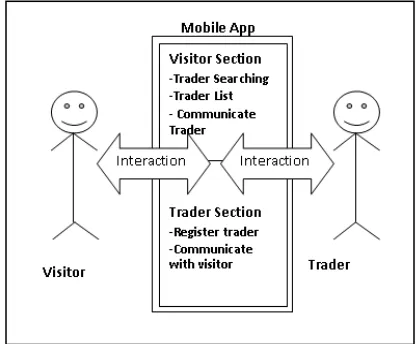
Figure 1: General Architecture of the P2P Mobile Application for Petty Trading
4.1 General Architecture
In general, the proposed application is shown in Figure 1. The application is comprised of two components, namely, Trader Searching Component and Communication Channel Component.
Journal of Theoretical and Applied Information Technology 31st August 2013. Vol. 54 No.3
© 2005 - 2013 JATIT & LLS. All rights reserved.
ISSN: 1992-8645 www.jatit.org E-ISSN: 1817-3195
[image:4.612.312.519.100.377.2]install the application and register their information on the app. The trader's information will appear in the list of traders and can be searchable by the same application installed in other user's phone. Through this component the application can assist market visitor to search traders who have also installed the same application. In the searching function, the application will scan all the available users over some limited distance and list of traders will appear in the application. Figure 2 describe the process of trader searching available in the proposed application.
Figure 2: Process Flow For Searching Available Trader
4.1.2 Trader-Customer Communication Channel
The Trader-Customer Communication Channel enables customer to engage communication with the available trader. First, the application will scan through available trader. Then the customer will select any trader from the given list to initiate chatting channel. A request will be send the selected trader to open the communication channel. The process flow for this component shown in Figure 3.
Figure 3: Process Flow For Communicating Available Trader
4.1.3 Trader Pamphlet Distributor
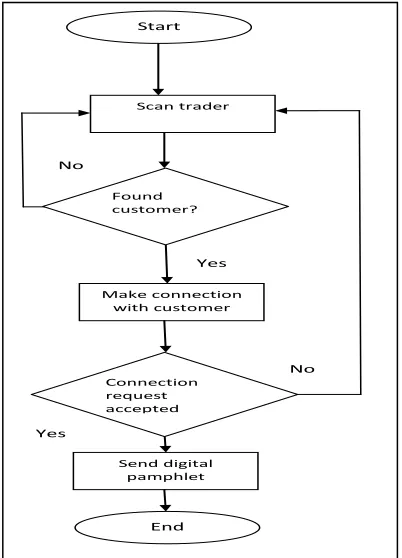
The Trader Pamphlet Distributor is a component in the proposed mobile application that enables trader to send their digital pamphlet to their customer. Prior to the submission of the digital pamphlet, the component enables trader to search through available customers on their phone based on the similar concept in the Trader Searching component. The trader can select any customer from the list, and send to them the digital pamphlet that the trader has design and created in JPEG or PNG format. The process flow for this component is shown in Figure 4.
5. IMPLEMENTATION
The application is designed and programmed as an Android Mobile Application written in Java. We
use the Eclipse Integrated Development
Environment (IDE) in conjunction with Android Software Development Kit (SDK) as development tools and uses the Galaxy Nexus tablet, Samsung SIII and Galaxy Note 2 for testing purposes.
Figure 5 shows the home interface of the proposed application. It shows 3 buttons for all the functions available in our proposed mobile application (the
Visitor/Customer Start Trader
Found trader?
List trader
End
Scan trader
No
Yes
Start
Found trader?
Make connection with trader
End Scan trader
Connection request accepted
Chat with trader No
No Yes
[image:4.612.91.295.237.487.2]ISSN: 1992-8645 www.jatit.org E-ISSN: 1817-3195
[image:5.612.313.521.82.278.2]fourth button is the About button that shows a text description about the application). Figure 6, 7 and 8 shows the searching interface where the user will scan available trader through the application. The application will detect traders who have the same application installed in their devices. This approach is based on the P2P Wi-Fi Technology available on the Android API.
Figure 4: Process flow for searching available trader
Figure 9 shows the interface for the chatting component in the application. This component is only available for chatting with users over 15 meter in range around them. This is where the customer can engage communication with the traders and get as many information as they can before they proceed to visit the trader. From this component also, customer can do bargaining with the traders before they come to the trader's place.
[image:5.612.94.295.208.487.2]Figure 5: Home screen for the proposed application
Figure 6: Interface for Trader Searching
Figure 7: The app is searching for available trader
Start
Make connection with customer
End Scan trader
Connection request accepted
Send digital pamphlet No
No Yes
Yes
[image:5.612.313.520.297.471.2] [image:5.612.315.519.499.683.2]Journal of Theoretical and Applied Information Technology 31st August 2013. Vol. 54 No.3
© 2005 - 2013 JATIT & LLS. All rights reserved.
[image:6.612.88.522.70.281.2]ISSN: 1992-8645 www.jatit.org E-ISSN: 1817-3195
Figure 8: List Of Available Trader
Figure 9: Chatting Interface For Customer And Trader
This will reduce the time for the customers to go to each and every trader's stall to get the best price of a particular products.
Figure 10 and 11 shows the interface of the Trader Pamphlet Distributor component. Through this component the traders are able to send digital pamphlets or flyers to the customers. For this component, trader select a customer by refereeing to the list of available customer. Then the trader will request for establishing connection with the intended customer. Once the selected customer agreed to engaged a communication, the trader can send his or her digital pamphlet.
6. CONCLUSION
In this paper we proposed a peer-to-peer based mobile application for petty trader. The proposed
[image:6.612.91.294.297.476.2]application is to improve the petty trading experience for the traders as well as the customer.
Figure 10: Trader Can Select Customer To Send Digital Pamphlet
Figure 11: Customer Receives Digital Pamphlet From
Trader
Through this application, customer can see the list of traders on their mobile devices in an ad-hoc manner. There is no need for formal registration as the application can detect the nearest trader who are present during the time of the customers visit.
[image:6.612.314.520.309.508.2]ISSN: 1992-8645 www.jatit.org E-ISSN: 1817-3195
mobile devices. In general the proposed application is based on peer-to-peer technology in which it fits well with the ad-hoc nature of the dynamic structure and availability of traders and customers in petty trading activities.
The disadvantage of this application is that, the information that can be shared by the trader is so limited in which the traders' information can only be based on the machine name given by the trader. Lack of centralized mechanism such as database application to store larger information reduces the application's potential in dealing with detail information for the traders.
ACKNOWLEDGEMENTS
This work was supported by Universiti Putra Malaysia under the Research University Grant Scheme (Project No. 05-02-12-2150RU)
REFERENCES:
[1] S. Mougiakakou, I. Kouris, A. Vazeou, D. Koutsouris, "Mobile Technology to Empower People with Diabetes Mellitus Design and Development of a Mobile Application". Proceedings of the 9th International Conference on Information Technology and Applications in Biomedicine, 2009 (ITAB
2009), IEEE, pp. 1-4. DOI:
10.1109/ITAB.2009.5394344.
[2] A. Khambati, J. Grundy, J. Warren, J. Hosking, "Model-driven Development of Mobile Personal Health Care Applications", Proceedings of 23rd IEEE International Conference on Automated Software Engineering, 2008 (ASE 2008), pp. 467-470. [3] C. P. Chen, H. S. Kuo, C. Y. Chen, "The
Development and Application of a Mobile Learning System for Carrying out Elementary School Social Class Activities - An Example of Pingtung Matzu Culture", Proceedings of the 8th IEEE International Conference on Advanced Learning Technologies, 2008, pp. 860-863.
[4] E. Garcia, A. Garcia, A. Garcia-Cabot, L. de-Marcos, J. R. Hilera, "Development of an application for mobile devices to record learner interactions with web-based learning objects". Proceedings of the 12th International Conference on Advanced Learning Technologies, pp. 240-241, 2012.
[5] R. Boateng, "Mobile Phones and Micro-Trading Activities – Conceptualizing The Link", Info: The Journal for Policy, Regulation and Strategy, Vol. 13, No.5, 2011, pp. 48-62.
[6] F. Musau, G. Wang, , M. B. Abdullahi, "Group Formation with neighbor similarity trust in P2P E-commerce", Proceedings of the 2011 IEEE 10th International Conference on Trust, Security and Privacy in Computing and
Communications (TrustCom 2011), pp.
835-840, November 16-18, 2011, Changsha, China.
[7] D. Carmichael, D. Cleave , "How effective is social media advertising? A study of
Facebook Social
Advertisements," Proceedings of International
Conference For Internet Technology And
Secured Transactions, 2012, pp. 226-229, 10-12 Dec. 2010-12.
[8] J. J.,Henriques, B. E. Kock, "Empowering Smallholders and Local Food Markets with Smartphones and Social Networks", Proceedings of the IEEE Global Humanitarian Technology Conference (GHTC), pp. 181-185, 21-24 October 2012, Seattle, Washington, USA. [9] Z. Khalilah, A. Sue, "Elasticity: rediscovering
the night market as an itinerant
urban space". Proceedings of the 1st
International Conference on Sustainable
Architecture & Urban Design, 2010, pp. 464-479
[10] M. Purvis, M. Nowostawski, S. Cranefield, M. Oliveira, "Multi-agent Interaction Technology for Peer-to-Peer Computing in Electronic Trading Environments", Proceedings of the Second International Workshop on Agents and Peer-to-Peer Computing, 2005, pp. 150-161. [11] N. Anandaraja, N. Sriram, C. Kathiresan, S.
Sebastian, E. Vadivel, "Web cum Mobile based Dynamic Market Information Support for Agri-Horti Produces: Linking the Farmers with Market", Proceedings of International Conference for Internet Technology and
Secured Transactions, 2009 (ICITST 2009),
(pp. 1-6).
[12] N. K. Ishak, K. A. Aziz, A. Ahmad, "Dynamism of a night market", Journal of Case Research in Business and Economic,
2012, pp. 1-15. Retrieved from