© 2016, IRJET | Impact Factor value: 4.45 | ISO 9001:2008 Certified Journal | Page 1
Pretreatment of Reactive Dye from Textile Wastewater by Coagulation
Technology
Siti Norsita Mohd Rawi
1, Zularisam Ab Wahid
1*, Mohd Nasrullah
1, Nor Wahidatul Azura Zainon
Najib
21
Faculty of Engineering Technology, Universiti Malaysia Pahang, Lebuhraya Tun Razak, 26300 Kuantan, Pahang,
Malaysia
1*
Professor, Faculty of Engineering Technology, Universiti Malaysia Pahang, Lebuhraya Tun Razak, 26300
Kuantan, Pahang, Malaysia
2
School of Environmental Engineering, Kompleks Pengajian Jejawi 3, 02600 Arau, Perlis, Malaysia
---***---Abstract -
A physicochemical treatment was applied tostudy on removal of commercially used reactive dye and investigate the effectiveness of coagulation-flocculation from textile wastewater. Three types of coagulants were used like aluminium sulphate (alum), polyaluminium chloride (PAC), and magnesium chloride (MgCl2). Polyelectrolyte, Koaret PA 3230 was used as the coagulant aid. The coagulant dosage between 400 ppm to 5,000 ppm was studied using jar test. The changes of pH, types and dosage of coagulant, and the addition of coagulant aid on the percentage removal and the concentration of the dyes were determined through colour point. The results show that up to 90% colour removal for reactive dye could be achieved using alum of concentration 6,000 ppm and pH 2.4. Meanwhile, 99 % colour removal could be achieved using MgCl2with concentration of 4,000 ppm and pH 10.4, whereas 100% colour removal could be achieved using PAC with concentration of 2,000 ppm and pH 4.1. Among the coagulants used, PAC was the most effective coagulant in treating each dye, with the colour removal up to 100% at the dosage of 800 ppm. The flocs settling time for the treatment with MgCl2 was shorter than the treatment with PAC and the treatment with Alum was longer than the treatment with MgCl2 and PAC. This result can contribute some knowledge on the use of effective coagulants in treating textile industrial wastewater.
Key Words: (reactive dye, coagulation-flocculation,
colour removal, textile industrial wastewater,)…
1.INTRODUCTION
Dyestuff wastewater from textile industry has been the target of considerable attention in the field of wastewater treatment, not only because of its toxicity, but only because of its visibility. Every year, it is estimated that 280,000 tons of textile dyes are discharged in the textile industry (Jin et al.). In recent years, the textile industries grow rapidly, particularly in Asia. Hence, the use of synthetic complex organic dyes as a colouring materials in dyeing and finishing process also show a significant increment (Talarposhti,
© 2016, IRJET | Impact Factor value: 4.45 | ISO 9001:2008 Certified Journal | Page 2
efficient and simple to operate (Kadam et al.). However, asmost of the dyestuffs are designed to withstand environmental conditions such a slight, pH effect and microbial attack (Thanneeru). Therefore, the aim of this research is to determine the effectiveness of coagulation-flocculation method for the removal of colour from textile wastewater using three different types of coagulants. The study focuses on the effect of pH, coagulant dosage and settling time to obtain the optimum condition of the highest removal of colour reactive dye. The proper determination of coagulant type and dosage will not only improve the water characteristics, but also can decrease the settling time and cost involved.
2. DETAILS EXPERIMENTAL
2.1. Materials and Procedures
Textile wastewater samples were collected from an equalization tank of textile treatment plant of a dye mill in Kuantan, Pahang, Malaysia. The reactive dyes contained in the textile wastewater were Remazol Black B (RBB), Remazol Brilliant Blue R (RBBR), and Remazol Brilliant Red F3B (RBRF3B). The structures of these reactive dyes are shown in Figure 1 (a), (b), and (c).
Figure 1: The structure of reactive dye (a) Remazol Black B (b)Remazol Brilliant Blue and (c) Remazol Brilliant Red F3B 9
Aluminium sulphate (Alum), polyaluminium chloride (PAC) and magnesium chloride (MgCl2) were used as the
coagulants, whereas polyelectrolyte, Koaret PA 3230 of commercial grade, was used as the coagulant aid. Sodium hydroxide (NaOH, reagent grade) was used as the pH adjusting agent in the coagulation-flocculation process. Distilled water was used to prepare all the dye solutions, coagulants and coagulant aid solutions. The experimental work involved treatment of reactive dye conducted in the
Environmental Engineering Laboratory, Department of Civil Engineering, Universiti Malaysia Pahang, Malaysia. The first part involved the treatment of 150 mL reactive dye with 3,000 ppm to 7,000 ppm of alum, 1,000 ppm to 5,000 ppm of MgCl2, and 500 ppm to 4,000 ppm of PAC respectively. Jar test was conducted to determine the effects of solution pH, types of coagulant, coagulant dosage and coagulant aid dosage on colour removal. A six-paddle stirrer with six beakers were used to conduct the jar test. Each beaker contained 150 mL of the prepared dye solution. NaOH was added to adjust the pH of solution for a period of 1 min at 60-65 rpm. The initial pH for the solutions was measured using a pH meter (ORION 410). Then, the coagulant was added to the beakers and the samples were mixed at 60-65 rpm for 3 min and followed by the addition of polyelectrolyte as the coagulant aid. When the solution height reached half of the beaker and the formed flocs were allowed to settle, the respective settling time was recorded. The final pH for the dye solution was measured using a pH meter and the supernatant was taken for analysis.
The concentrations of dye solutions were measured at a wavelength corresponding to the maximum absorbance (גmax) by means of a UV visible spectrophotometer (Shimadzu). The percentage of colour removal was calculated by comparing the absorbance value of the supernatant to the standard curve obtained by a known dye concentration. The dye concentrations were determined through colour point (Pt/Co) measurement using spectrophotometer (HACH DR 2000).
3. RESULTS AND DISCUSSION
[image:2.595.38.285.427.604.2]The effectiveness of various coagulation-flocculation treatments for reducing colour in reactive dyes solution was studied. A matrix variable was developed, in which the amount of coagulant and coagulant aid dosages were varied and applied to each 150 mL reactive dye solution. The results for the treatment of raw textile wastewater are summarized in Table 1.
Table -1: Treatment of industrial textile wastewater with Alum, MgCl2 and PAC
Coagulant Dosage, ppm pH % Removal Colour
3000 5 49
4000 4.7 63
Alum 5000 4.3 75
6000 2.4 90
7000 4 89
400 5.5 59
600 5.6 63
© 2016, IRJET | Impact Factor value: 4.45 | ISO 9001:2008 Certified Journal | Page 3
800 4.5 98
1000 4.3 99
2000 4.1 100
1000 11.6 25
MgCl2 2000 10.1 90
3000 10.6 97
4000 10.4 99
5000 10.3 97
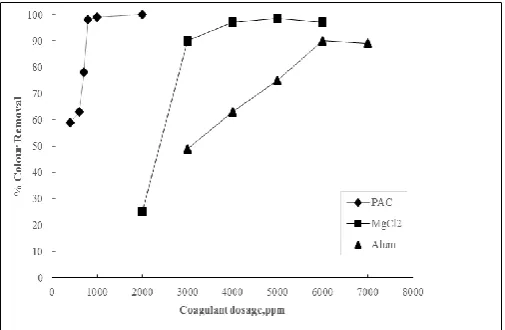
[image:3.595.36.289.326.491.2]Once the dosage passed the 4,000 ppm peak, the percentages of colour removal were reduced because during this stage, the dye solution had been removed and had already achieved the optimal dosage. Hence, the suitable dosage of alum to achieve > 90% for colour removal is between the dosages of 3,000 to 5,000 ppm.
Figure 2: Colour removal of different dosages of coagulants
The percentage removal of dye increased tremendously from 25% to 62% when the concentration of MgCl2 concentration
increased from 1,000 ppm to 2,000 ppm, and the percentage removal continued to increase up to 97% when 3,000 ppm of MgCl2 was used. According to Figure 2, the percentage of
colour removed by alum at optimum condition increased as the dosage was increased from 1,000 to 6,000 ppm, achieving a maximum of 78.5% removal. However, the percentage of colour removal decreased with the increase of dosage to 7,000 ppm. This may be due to the restabilization of dye particles by excess alum hydrolysis species (Wong, Teng, and Nik Norulaini). Further increase in the MgCl2 dosage could
only increase the percentage removal of dye slightly. The percentage of colour removal of reactive dye achieved>100% at the dosage 2,000 ppm of PAC. The percentage removal of dye increased tremendously from 59% to 78% as the dosage of PAC increased from 400 ppm to 700 ppm. Further increase in the PAC dosage could only increase the percentage removal of dye slightly, and it did not provide a significant increase in the percentage removal. For treatment with PAC and alum, the highest percentage of
colour percentage was achieved when 800 ppm PAC was used, and further increase in the PAC dosage decreased the percentage of colour removal. The treatment of PAC on the dispersed dye also showed a similar trend in the percentage of colour removal as in alum. Further increase in the coagulant dosage after the optimal dosage did not increase the percentage of colour removal as all dyes had been removed at this stage. Excessive coagulant would result in the formation of excessive flocs, which in turn would prolong the settling time. For reactive dye, the same phenomenon occurred in the treatment with PAC and alum. After the highest percentage of colour removal was achieved when 800 ppm of PAC was used, further increase in the PAC dosage decreased the percentage removal of colour.
It can be seen that MgCl2 and PAC achieved higher colour
removal than at low dosage. However, the difference in colour removal efficiency became small with increasing coagulant dosage. Among the coagulants used, PAC was the most effective coagulant in treating each dye with the colour removal up to 100% at the dosage of 800 ppm. PAC was more effective than MgCl2 and alum, as >99% colour removal was
attained using smaller quantity of the coagulant.
3.2 The Effect of Coagulant Dosage on Settling Time
The flocs settling time of different types of coagulants were investigated, and the results are shown in Figure 3. Settling time is very important to the study in order to identify whether the dosage of coagulant used works effectively with the least time required to settle the particles inside the wastewater. The result showed that the flocs settling time increased as the coagulant dosage increased. The flocs settling time for the treatment with PAC was longer than the settling time for the treatment with alum and MgCl2. Thesettling time for PAC dosage of 600 ppm, alum dosage of 5,000 ppm and MgCl2 dosage of 5,000 ppm were 420 s, 435 s
[image:3.595.308.561.603.742.2]and 495 s, respectively. PAC dosage of 800 ppm with the removal of 98% had settling time of 352 s. Although higher dosages of PAC gave >98% removal, the settling time was more than 500 s, which is not preferable in the wastewater treatment plant as it would increase the size of the settling tank.
© 2016, IRJET | Impact Factor value: 4.45 | ISO 9001:2008 Certified Journal | Page 4
The settling time for the treatment usingMgCl2 did not exceed500 s for the coagulant dosages studied. The longest settling time (495 s) of the treatment occurred when 5,000 ppm of MgCl2 was used. The flocs formed in the treatment with
MgCl2werelarger and easier to settle compared to flocs
formed in the treatment with PAC. The size of the flocs formed using MgCl2 was observed to be much bigger than
those formed using alum and PAC. It was observed that for alum dosage of 6,000 mg/L, the removal of 90 dye had settling time of 330 s. The increase of alum dosages led to lower removal (69%), with the settling time exceeded 500 s. Even though alum possessed the lower settling time among other coagulants, the percentage of removal was not as effective as PAC. Therefore, PAC had the most effective percentage of removal and also the lower settling time, which is preferable in the wastewater treatment plant (Abu Hassan, Tan, and Zainon Noor) also conducted an investigation of reactive dye, and discovered that as the dye concentration increased, the time required to achieve identical color removal also increased. Excessive coagulant would result in forming of too much flocs, which prolong the flocs settling time.
3.3 The Effect of Coagulant Aid on Settling Time
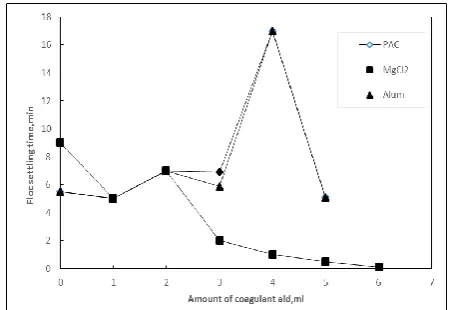
Polyelectrolyte, Koaret PA 3230 was used as a coagulant aid to build a bridge between colloidal particles to form into larger flocs and easier to settle. The optimal pH was kept constant for each dye solution. Figure 4shows that the colloidal particles formed into large flocs without coagulant aid for alum, which gave a settling time of 295s. A significant improvement occurred when the dosage of coagulant aid increased to 5.0 mL but the flocs settling time would increase the settling time if 4.0 mL alum was used. In the case of MgCl2,
the use of 1.0 mL coagulant aid reduced the settling time to 280 s. The coagulant also needed 4.0 mL of coagulant aid in order to reduce the flocs settling time to less than 50 s. For MgCl2, the addition of 4.0 mL of coagulation aid gave a
significant improvement when the flocs settling time decreased from 100 s in 3.0 mL of coagulation to 55 s in 4.0 mL of coagulation aid.
From the figure, there was an increase in flocs settling time of about 980 s when 4.0 mL of coagulant aid was used for 600 ppm dosage of alum and 800 ppm dosage of PAC. A significant improvement did not occur for further increase of the dosage. In this case, the addition of 2.0 mL coagulant aid reduced the flocs settling time from 258 s to 128 s, but the flocs settling time increased when 5.0 mL of coagulant was added to dye solution. It was observed that the MgCl2 without
addition of coagulant aid gave higher flocs settling time of 540 s compared to alum and PAC, which gave much lower flocs settling time of 295 s. By using MgCl2, shorter flocs
settling time was achieved compared to alum and PAC due to the larger size and weight of the flocs formed in the treatment with MgCl2, which made the flocs easier to settle compared to
flocs formed in the treatment with PAC. The flocs settling time using MgCl2 was reduced with the increasing amount of
coagulant aid. In case of alum and PAC, with the use of additional coagulant aid produced heavy flocs with good
[image:4.595.320.545.154.309.2]settling time velocity. It was found that the coagulation of alum and PAC with additional coagulant aid was better than that of MgCl2.
Figure 4: The effect of the amount of coagulation aid on flocs settling time
3.4 The Effect on pH
pH effect is practically important in treating dye containing wastewater, since acidic dyeing conditions can lead to acidic discharge wastewater. The percentage of colour removal for reactive dye wastewater is greatly affected by the pH solution with alum and MgCl2 as shown in Figure 5. The results of pH
effects for PAC are expressed in relative to the removal of reactive dye wastewater as shown in Figure 5. The adsorption of the dye solution was barely effected by pH changes and also reduced moderately at alkaline region. The explanation for the negligible effect of pH is probably associated with the electrostatic interactions.
The maximum pH range for MgCl2 was in the range of 10.0 to
12.0. The removal of dye increased tremendously in the range of 25% to 62% when the MgCl2 concentration increased from
1,000 ppm to 2,000 ppm, and it continued to increase for further addition of MgCl2. The result obtained for the
treatment using MgCl2 is in agreement with those of Wong et
© 2016, IRJET | Impact Factor value: 4.45 | ISO 9001:2008 Certified Journal | Page 5
Figure 5: The effects of pH of reactive dye wastewater withPAC, MgCl2 and Alum in the range of 1,000 to 5,000 mg/L
The result obtained for PAC treatment is in agreement with Zonoozi et al., (2008), who studied on the effect of coagulant dosage on dye removal efficiency. Different amounts of PAC and alum were added into the dye-containing solutions. Dye concentration was kept constant at 100 mg/L and pH was adjusted to 4 and 5 (optimum pH) for PAC and alum, respectively. Alum and PAC were more effective in a lower pH range but MgCl2 was more effective in a higher pH range. For
MgCl2, the colour removal was more effective in the alkaline
pH range compared to alum and PAC that were more effective in the acidic range.
The figure above shows that alum was soluble in the pH range from 6.0 to 6.3 but consequently, the coagulation at this pH range converted most of the added alum to solid flocs particles and minimized residual soluble. Alum was more effective in a lower pH range and it fell in the range of 2.0 to 5.0. It is advantageous for coagulation with alum in this pH region for sweep flocs coagulation in order to minimize the residual of aluminium. Furthermore, it helps to utilize a greater fraction of dissolved positively aluminium charged compared to higher pH coagulation. The removal of dye increased tremendously in the pH range of 2.4 to 4.3 when the concentration increased from 5,000 ppm to 6,000 ppm. Coagulation below pH 7 means that this highly charged aluminium would be available to destabilize particles by charge neutralization and react with negatively charged colloids.
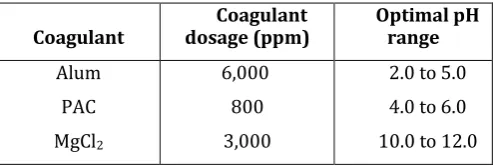
For the three types of coagulants, the effect on pH adsorption varied as shown in Table 2. Reactive dyes are strongly acidic, thus considerable changes in charge properties are not expected even over a wide range of pH. However, in addition to those electrostatic interactions, other interacting forces are required to explain the different adsorption pattern of this reactive dye. In this case, the removal of dyes at high pH may be caused by competing hydroxide anions. It was found that the lower removal of reactive dye at alkaline pH was caused by the presence of excess OH-, which competes with the dye
[image:5.595.46.285.78.255.2]anion.
[image:5.595.310.557.272.355.2]Table 2 shows that the optimum pH ranges of the PAC treatment are broader than that of the alum treatment. This is in agreement with the result of Aguilar et al., (2005). Therefore, the PAC treatment is less sensitive to pH compared to the alum treatment. This is due to the pre-polymerized species that are partially hydrolyzed and already present in the PAC solution. Hence, the PAC treatment is relatively less sensitive to pH (Aguilar et al.). Table 2 also shows that different ratios of disperse dye to reactive dye in the mixed dye solutions do not have any influence on the optimum pH range for any of the three coagulants studied.
Table 2: Optimal pH range for different coagulants
Coagulant dosage (ppm) Coagulant Optimal pH range Alum
PAC MgCl2
6,000 800 3,000
2.0 to 5.0 4.0 to 6.0 10.0 to 12.0
3. CONCLUSIONS
Up to 90 %, up to 99% and 100% colour removal of reactive die were achieved using alum of concentration 6,000 ppm at pH 2.4, MgCl2 of concentration 4,000 ppm at pH 10.4 and PAC of concentration 2,000 ppm at pH 4.1, respectively. Among the coagulants used, PAC was the most effective coagulant in dye treatment with the colour removal up to 100% at the dosage of 800 ppm. The flocs settling time for the treatment with MgCl2 was shorter. In addition, the flocs
settling time for the treatment with MgCl2 was shorter than
that of PAC, and the flocs settling time for the treatment with alum was longer than of MgCl2 and PAC.
ACKNOWLEDGEMENT
The authors wish to thank the Environmental Engineering laboratory, Faculty of Civil and Earth Resources staff and technicians for their analytical support and also financial support from Universiti Malaysia Pahang, Malaysia.
REFERENCES
[1] Abu Hassan, Mohd Ariffin, Pei Li Tan, and Zainura Zainon Noor. “Coagulation and Flocculation Treatment of Wastewater in Textile Industry Using Chitosan.” Journal of Chemical and Natural Resources Engineering, 4.1 (2009): 43–53. Print.
© 2016, IRJET | Impact Factor value: 4.45 | ISO 9001:2008 Certified Journal | Page 6
[3] Asouhidou, Despoina D. et al. “Sorption of Reactive Dyesfrom Aqueous Solutions by Ordered Hexagonal and Disordered Mesoporous Carbons.” Microporous and Mesoporous Materials 117.1-2 (2009): 257–267. [4] Bangash, Fazlullah Khan, and Abdul Manaf. “Dyes
Removal from Aqueous Solution Using Wood Activated Charcoal of Bombax Cieba Tree.” Journal of chinese chemical society 52 (2005): 489–494. Print.
[5] Jin, Xian-Chun et al. “Decolorization of a Dye Industry Effluent by Aspergillus Fumigatus XC6.” Applied Microbiology and Biotechnology 74.1 (2007): 239–243. [6] Kadam, Avinash A et al. “Zinc Chloride as a Coagulant for Textile Dyes and Treatment of Generated Dye Sludge under the Solid State Fermentation: Hybrid Treatment Strategy.” Bioresource technology 176 (2015): 38–46. Web. 4 Aug. 2015.
[7] Lazaridis, N. K., T. D. Karapantsios, and D. Georgantas. “Kinetic Analysis for the Removal of a Reactive Dye from Aqueous Solution onto Hydrotalcite by Adsorption.” Water Research 37.12 (2003): 3023–3033.
[8] Nordin, Norazzizi et al. “Textile Industries Wastewater Treatment by Electrochemical Oxidation Technique Using Metal Plate.” International Journal of Electrochemical Science 8 (2013): 11403–11415. Print. [9] Saranraj, P. “Bacterial Biodegradation and Decolourization of Toxic Textile Azo Dyes.” African Journal of Microbiology Research 7.30 (2013): 3885– 3890.
[10] Talarposhti, A.Mahdavi, T. Donnelly, and G.K. Anderson. “Colour Removal from a Simulated Dye Wastewater Using a Two-Phase Anaerobic Packed Bed Reactor.” Water Research 35.2 (2001): 425–432.
[11] Thanneeru, Saketh. “Color Removal from Dye and Sugar Wastewater Using Coagulation and Microfiltration Process.” N. p., 2014. Print.
[12] Wong, Pei Wen, Tjoon Tow Teng, and Nik Abdul Rahman Nik Norulaini. “Efficiency of the Coagulation-Flocculation Method for the Treatment of Dye Mixtures Containing Disperse and Reactive Dye.” Water Quality Research Journal of Canada 42.1 (2007): 54–62. Print. [13] Zonoozi, Maryam Hasani et al. “Removal Of Acid Red 398