Synthesis, characterisation and biological evaluation of
N
-(ferrocenyl)naphthoyl amino acid esters as anticancer agents†
´
Aine Mooney,
a,bAlan J. Corry,
aCliodhna N´ı Ruairc,
aThamir Mahgoub,
bDermot O’Sullivan,
bNorma
O’Donovan,
bJohn Crown,
b,cSunil Varughese,
dSylvia M. Draper,
dDilip K. Rai
eand Peter T. M. Kenny*
a,bReceived 27th April 2010, Accepted 19th June 2010
First published as an Advance Article on the web 3rd August 2010 DOI: 10.1039/c0dt00377h
A series ofN-(ferrocenyl)naphthoyl amino acid esters5–18has been prepared by coupling ferrocenyl naphthoic acids3–4toa-amino acids and linear amino acids in the presence of
N-(3-dimethylaminopropyl)-N¢-ethylcarbodiimide hydrochloride (EDC) and 1-hydroxybenzotriazole (HOBt). The compounds were fully characterised by a range of NMR spectroscopic techniques, UV-Vis spectroscopy, mass spectrometry and cyclic voltammetry. X-ray crystallographic studies of the
intermediate compounds1–2were also performed. Biological evaluation of the intermediates1–2and
N-(ferrocenyl)naphthoyl amino acid esters5–18was performed in the H1299 non-small cell lung cancer (NSCLC) cell line and the Sk-Mel-28 metastatic melanoma cell line. The intermediates1–2failed to produce an effect in either cell line. Compounds5–18exhibited a strong anti-proliferative effect in the H1299 cell line, whilst the Sk-Mel-28 cells were slightly more resistant to these compounds.
N-(6-ferrocenyl-2-naphthoyl)-g-aminobutyric acid ethyl ester17shows a particularly high activity in both the H1299 cell line (IC50=0.62±0.07mM) and the Sk-Mel-28 cell line (IC50=1.41±0.04mM).
Introduction
Organometallic compounds are versatile species due to the range of both structure and bonding modes that are accessible. As a consequence, they have been incorporated in a wide variety of materials that have diverse applications. One such application is the development of new medicinal agents that exhibit novel modes of action.1 Ferrocene, the archetypal metallocene, has
shown great promise in the area of medicinal organometallic chemistry.2 Unique properties such as aromaticity, stability, low
toxicity and redox activity recommend ferrocene for incorporation in drug molecules.3 In particular, the reversible redox properties
of ferrocene have been strongly associated with its biological activity.4 Ferrocenyl compounds have shown potential as both
antibacterial5 and antifungal agents6 however the main focus
of research has been centred on antimalarial7 and anticancer
drugs.8–12A notable example is that of ferrocifen, an
organometal-lic analogue of the selective estrogen receptor modulator (SERM) tamoxifen, and its derivatives.13
Amino acids and peptides play diverse roles in biological systems. Over the past number of years, we have prepared N -ferrocenoyl and N-ferrocenyl amino acid and peptide deriva-tives and explored their potential applications.14–23 Preliminary
in vitrotoxicity testing revealed theN-(ferrocenyl)benzoyl peptide
aSchool of Chemical Sciences, Dublin City University, Glasnevin, Dublin 9,
Ireland
bNational Institute for Cellular Biotechnology, Dublin City University,
Glasnevin, Dublin 9, Ireland
cDept. Of Medical Oncology, St. Vincent’s University Hospital, Dublin 4,
Ireland
dSchool of Chemistry, University of Dublin, Trinity College, Dublin 2, Ireland eAshtown Food Research Centre, Ashtown, Dublin 15, Ireland. E-mail:
[email protected]; Fax: +353 1 7005503; Tel: +353 1 7005689
† CCDC reference numbers 718596 and 775339. For crystallographic data in CIF or other electronic format see DOI: 10.1039/c0dt00377h
derivatives to be potential anticancer agents.24This discovery has
provided the basis for more in-depth studies which have used rational drug design to explore the structure–activity relationship (SAR).25,26
The N-(ferrocenyl)benzoyl peptide derivatives are composed of three key moieties, namely, (i) an electroactive core, (ii) a conjugated aromatic linker, (iii) an amino acid or peptide derivative that can interact with other molecules via hydrogen bonds. The conjugated linker offers extended conjugation to the
p-electrons of the ferrocene rings, lowering the redox potential and making these derivatives easier to oxidise to the ferricenium species. Ferricenium salts known to inhibit tumour growth were shown to produce hydroxyl radicals (HO∑) under physiological
conditions, leading to oxidative damage to DNA.27It is plausible
that the anticancer activity of these compounds is due, at least in part, to their low redox potentials, which are within the range of biologically accessible potentials. The peptide chain is also considered to be essential for activity.26
We have shown in a previous study that replacing the conjugated linker ofN-(ferrocenyl)benzoyl dipeptide esters with a naphthoyl linker leads to on average a three-fold improvement in anti-proliferative effect in the H1299 non-small cell lung cancer (NSCLC) cell line.29 These N-(ferrocenyl)naphthoyl dipeptide
esters all show a stronger anti-proliferative effect in this cell line than carboplatin. The most promising of these compounds isN -(6-ferrocenyl-2-naphthoyl)-glycine-L-alanine ethyl ester (IC50=1.3±
0.1mM), which displays anin vitroanticancer activity comparable with cisplatin (IC50 = 1.5 ± 0.1 mM). We have now extended
our SAR study to include N-(ferrocenyl)naphthoyl amino acid esters, containing botha-amino acids (glycine,L-alanine,L-leucine
and L-phenylalanine) and ‘linear’ amino acids (b-alanine, g -aminobutyric acid andd-amino-n-valeric acid).
To date, the biological evaluation ofN-(ferrocenyl)benzoyl and
N-(ferrocenyl)naphthoyl derivatives has focussed on determining
Downloaded by Trinity College Dublin on 08 August 2011
Chart 1
their anti-proliferative effect in the H1299 NSCLC cell line. This is due to the fact that lung cancer is the leading cause of cancer mortality both worldwide and in Europe, with approximately 75–85% of all lung cancer cases being NSCLC.29 We have now
expanded ourin vitrotoxicity testing to include the Sk-Mel-28 malignant melanoma cell line. European national cancer registries have shown a rising incidence of melanoma during the past two decades.30 Most localised melanoma can be effectively treated
early by wide localised excision, however, patients with advanced disease such as those with distant metastasis have a poor prognosis, with a 1 year survival rate of less than 5%. The poor prognosis is due at least in part, to the fact that metastatic melanoma is notoriously resistant to cytotoxic chemotherapy.31 More
effi-cacious novel chemotherapeutic drugs are urgently required to improve the prognosis for malignant melanoma patients. Thus, we report the synthesis, characterisation and biological evaluation of the N-(ferrocenyl)naphthoyl a-amino acid esters 5–12 and
N-(ferrocenyl)naphthoyl linear amino acid esters13–18in lung cancer (non-small cell) and melanoma cell lines (Chart 1).
Results and discussion
Synthesis
The synthetic sequence towards the N-(ferrocenyl)naphthoyl amino acid esters5–18is outlined in Scheme 1. Starting from the appropriate methyl aminonaphthalene-2-carboxylate, the inter-mediate compounds1–4were prepared as previously reported.28
The ferrocenylnaphthalene units were appended to the freeN -terminal amino acid ethyl esters of glycine,L-alanine,L-leucine, L-phenylalanine,b-alanine,g-aminobutyric acid andd -amino-n-valeric acid under solution-phase peptide coupling conditions to furnish compounds5–18. Thus, a solution of ferrocenylnaphtha-lene carboxylic acid in dichloromethane at 0◦C was treated with
N-(3-dimethylaminopropyl)-N¢-ethylcarbodiimide hydrochloride (EDC), 1-hydroxybenzotriazole (HOBt) and triethylamine (Et3N)
prior to the addition of the required amino acid ethyl ester (Scheme 1). Compounds5–18were purified by column chromatog-raphy with a gradient mixture of hexane and ethyl acetate as mobile phase in yields of 32–83% and all gave spectroscopic and analytical data in accordance with the proposed structures.
Characterisation
Full characterisation of compounds5–18was achieved by stan-dard spectroscopic techniques: 1H NMR, 13C NMR, IR, UV,
and MS. All proton and carbon chemical shifts were explicitly assigned for5–18using various NMR spectroscopic techniques including DEPT 135 and 1H–13C COSY (HMQC). In the 1H
and13C NMR spectra obtained for 5–18, there was a notable
difference in the chemical shift of the ferrocenyl peaks when the substitution pattern around the central naphthoyl linker was altered. The greatest difference is observed for theorthocarbons of the substituted (h5-C
5H4) ring, which are shifted downfield
from approximatelyd66.6 for theN-(6-ferrocenyl-2-naphthoyl) derivatives 9–12 and 16–18, to approximately d 68.9 for the
Downloaded by Trinity College Dublin on 08 August 2011
Scheme 1 Synthesis ofN-(ferrocenyl)naphthoyl amino acid esters5–18: (i) NaNO2, HCl, 5◦C; (ii) NaOH/MeOH, HCl; (iii) EDC, HOBt, Et3N, amino
acid ethyl ester.
N-(3-ferrocenyl-2-naphthoyl) derivatives5–8and13–15. In con-trast, theortho(h5-C
5H4) protons of5–8and13–15(d4.71–4.83)
are more shielded than theortho(h5-C
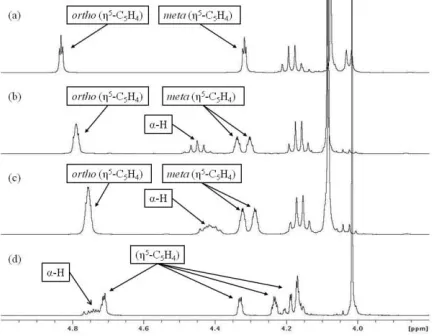
5H4) protons of9–12and 16–18(d4.94–4.96). The1H NMR spectra of6–8, showed signal
multiplicities for either some or all of the characteristic peaks that are observed for a mono-substituted ferrocene moiety (Fig. 1). The1H NMR spectra of6and7indicate that themeta(h5-C
5H4)
protons are magnetically inequivalent and in the case of8, all four protons of the (h5-C
5H4) ring are magnetically inequivalent. The 13C NMR spectra of6–8also reflect these observations: in the case
of6and7there are three distinct peaks betweend68.5 andd68.1. For8, individual resonances are observed atd68.9,d68.8,d68.3 andd68.1.
Fig. 1 Ferrocenyl (3.8–5.0 ppm) region of the1H NMR (25◦C, 400 MHz,
DMSO-d6) spectra of (a)5; (b)6; (c)7; (d)8.
The UV-visible spectra of 5–18 are all characterised by an absorbance centred at 450 nm due to metal to ligand charge transfer (MLCT) transitions. For compounds 9–12and16–18, there is also an intense absorbance at 375 nm, which is assigned to aptop* transition of the aromatic spacer group. However, in the case of5–8and13–15, theptop* transition of the naphthoyl group is too weak to be observed (Fig. 2). This indicates that for theN -(3-ferrocenyl-2-naphthoyl) derivatives, only minimalp conjugation is occurring between the ferrocene and naphthalene units. The UV-visible spectra of5–18remain the same after several weeks in solution (ethanol and acetonitrile), thus indicating that the
N-(ferrocenyl)naphthoyl amino acid esters are stable over long periods of time.
Fig. 2 UV-visible spectra of 15 (dashed line) and 18 (solid line) in acetonitrile (0.2 mM).
X-ray crystallographic studies
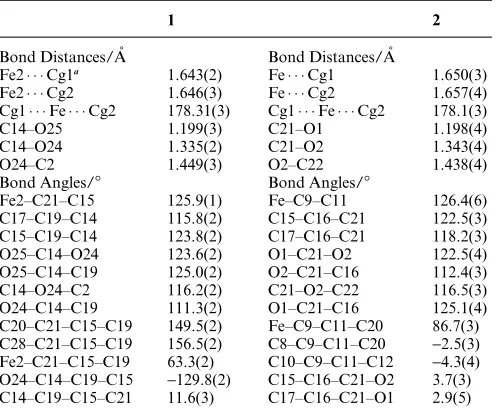
[image:3.595.57.548.55.174.2]The intermediates 1 and 2 have been characterised by single-crystal X-ray single-crystallographic studies. Crystallographic data and structural refinement parameters are given in Table 1. Some pertinent bond lengths and bond angles are listed in Table 2. Fig. 3 shows the molecular structures and asymmetric unit of
1, which crystallises in the monoclinic space group P21/c with
one molecule in the asymmetric unit. The principal dimensions are carboxylate ester C O 1.199(3) A, C–O 1.335(2)˚ A, O–˚ CH3 1.449(3) A and O˚ C–O 123.6(2)◦. The cyclopentadienyl
rings of the ferrocene unit (Cp1 and Cp2) are almost eclipsed with C1n◊ ◊ ◊Cg1◊ ◊ ◊Cg2◊ ◊ ◊C2n torsion angles (n= 1–5) in the
-0.7(42) to 1.3(3)◦ range. Cg1 and Cg2 are the centroids of the (h5-C
5H4) and (h5-C5H5) rings, respectively. Cg1 and Cg2 are
equidistant from the iron core, with Fe◊ ◊ ◊Cg1/Cg2 distances of 1.643(3)/1.646(2), respectively, while the Cg1◊ ◊ ◊Fe◊ ◊ ◊Cg2 angle is almost linear at 178.3(3)◦. Compound 2crystallises in the monoclinic space group P21/n with one molecule in the
asymmetric unit: the molecular structure is depicted in Fig. 4. The principal dimensions are carboxylate ester C O 1.198(4) ˚A, C–O 1.343(4) ˚A, O–CH31.438(4) ˚A and O C–O 122.5(4)◦. In
the case of2, the cyclopentadienyl rings of the ferrocene unit (Cp1 and Cp2) are slightly staggered with C1n◊ ◊ ◊Cg1◊ ◊ ◊Cg2◊ ◊ ◊C2n torsion angles (n = 1–5) in the -12.2(4) to -14.9(2)◦ range. Centroids Cg1 and Cg2 are equidistant from the iron core, with
Downloaded by Trinity College Dublin on 08 August 2011
[image:3.595.323.537.217.388.2] [image:3.595.58.276.376.544.2]Table 1 Crystallographic data for intermediates1and2
1 2
Empirical Formula C22H18O2Fe C22H18O2Fe
M/g mol-1 370.21 370.21
Crystal system Monoclinic Monoclinic
Space group P21/c P21/n
a/ ˚A 13.9797(15) 14.7851(17)
b/ ˚A 8.7249(9) 6.1301(7)
c/ ˚A 13.9843(15) 18.161(2)
b(◦) 103.111(2) 92.273(3)
V/ ˚A3 1661.2(3) 1644.8(3)
Z 4 4
T/K 273 298
Dc/g cm-3 1.480 1.495
m/mm-1 0.920 0.929
F000 768 768
Crystal dimensions/mm 0.25¥0.18¥0.13 0.27¥0.19¥0.13
Max. and min. transmission 0.8898 – 0.8027 0.8888 – 0.7876
Reflections collected/unique 17252/2927 9115/2883
FinalRindices [I>2sI] R1=0.0285 wR2=0.0796 R1=0.0469 wR2=0.1146
Rindices [all data] R1=0.0314 wR2=0.0819 R1=0.0627 wR2=0.1220
[image:4.595.39.557.71.287.2]Goodness of fit 1.018 1.02
Table 2 Representative bond lengths ( ˚A) and angles (◦)
1 2
Bond Distances/ ˚A Bond Distances/ ˚A
Fe2◊ ◊ ◊Cg1a 1.643(2) Fe◊ ◊ ◊Cg1 1.650(3)
Fe2◊ ◊ ◊Cg2 1.646(3) Fe◊ ◊ ◊Cg2 1.657(4)
Cg1◊ ◊ ◊Fe◊ ◊ ◊Cg2 178.31(3) Cg1◊ ◊ ◊Fe◊ ◊ ◊Cg2 178.1(3)
C14–O25 1.199(3) C21–O1 1.198(4)
C14–O24 1.335(2) C21–O2 1.343(4)
O24–C2 1.449(3) O2–C22 1.438(4)
Bond Angles/◦ Bond Angles/◦
Fe2–C21–C15 125.9(1) Fe–C9–C11 126.4(6)
C17–C19–C14 115.8(2) C15–C16–C21 122.5(3)
C15–C19–C14 123.8(2) C17–C16–C21 118.2(3)
O25–C14–O24 123.6(2) O1–C21–O2 122.5(4)
O25–C14–C19 125.0(2) O2–C21–C16 112.4(3)
C14–O24–C2 116.2(2) C21–O2–C22 116.5(3)
O24–C14–C19 111.3(2) O1–C21–C16 125.1(4)
C20–C21–C15–C19 149.5(2) Fe–C9–C11–C20 86.7(3) C28–C21–C15–C19 156.5(2) C8–C9–C11–C20 -2.5(3) Fe2–C21–C15–C19 63.3(2) C10–C9–C11–C12 -4.3(4) O24–C14–C19–C15 -129.8(2) C15–C16–C21–O2 3.7(3) C14–C19–C15–C21 11.6(3) C17–C16–C21–O1 2.9(5)
aCg1 and Cg2 are the centroids of the (h5-C
5H4) and (h5-C5H5) rings,
respectively.
Fe◊ ◊ ◊Cg1/Cg2 distances of 1.650(3)/1.657(4), respectively, while the Cg1◊ ◊ ◊Fe◊ ◊ ◊Cg2 angle is almost linear at 178.1(3)◦.
In 1the C10H6 ring and the four-atom O C–O–CH3 plane
are oriented at 54.45(12)◦ and the C10H6/(h5-C5H4) rings at
28.27(15)◦; whereas the angle between the (h5-C
5H4) ring and
the O C–O–CH3plane is 68.87(4)◦. This data demonstrates the
existence of a large distortion in the molecule, which is evident in Fig. 3. Steric hindrance has forced the atoms of this molecule to adopt this strained conformation in the solid state, resulting in a loss of co-planarity of the conjugating groups. This is supported by the torsion angles for the O25–C14–C19–C15 bonds and C20– C21–C15–C19 bonds which were calculated to be 54.2(3) and 149.5(2)◦, respectively. In contrast, the C10H6ring and the
four-atom O C–O–CH3plane of2are oriented at 4.45(15)◦and the
C10H6/(h5-C5H4) rings at 3.13(16)◦; whereas the angle between the
Fig. 3 Molecular drawing of1using ORTEP: displacement ellipsoids are drawn at 50% probability level.
Fig. 4 Molecular drawing of2using ORTEP: displacement ellipsoids are drawn at the 50% probability level.
(h5-C
5H4) ring and the O C–O–CH3plane is 1.97(5)◦. Calculated
torsion angles in 2between the O1–C21–C16–C17 bonds and C10–C9–C11–C12 bonds are minimal at 2.9(5)◦ and-4.3(5)◦, respectively. Thus, the conjugating groups in this molecule lie almost completely within the same plane in the solid state (Fig. 4). A similar observation has been reported for thepara-substituted ferrocenyl methyl benzoate.17
Electrochemical studies
The redox properties of theN-(ferrocenyl)naphthoyl amino acid esters 5–18 were investigated by cyclic voltammetry (CV) in
Downloaded by Trinity College Dublin on 08 August 2011
[image:4.595.43.291.312.516.2] [image:4.595.313.543.473.556.2]Table 3 Cyclic voltammetry data for compounds 5–18in acetonitrile (1 mM compound, 0.1 M TBAPvs. Ag|AgCl. Scan rate=100 mV s-1)
Compound Epa/V Epc/V E◦¢vs. Fc/Fc+/mVa Ia/Icb
5 0.502 0.429 13 1.03
6 0.492 0.429 8 1.06
7 0.502 0.435 16 1.09
8 0.495 0.430 10 0.99
9 0.540 0.449 42 1.23
10 0.528 0.461 42 1.06
11 0.527 0.462 42 1.04
12 0.534 0.463 46 1.04
13 0.482 0.417 24 1.02
14 0.489 0.420 29 1.01
15 0.486 0.419 27 1.03
16 0.521 0.445 63 1.03
17 0.518 0.448 58 1.01
18 0.518 0.449 58 1.03
aE◦¢refers to the formal potential and is calculated by taking the mean of the peak potentials for the anodic (a) and the cathodic wave (c).bI
aandIc
refer to the maximum peak currents of the anodic and the cathodic waves, respectively.
acetonitrile solution. Compounds5–18were all found to exhibit a one electron, reversible redox process similar to ferrocene, under the same conditions. The key features of their redox behaviour are summarised in Table 3. The peak current ratios (Ia/Ic) are in the
0.99–1.23 range, deviating from the ideal value of 1.0; ferrocene itself exhibits a current ratio of 1.05, under the same conditions. TheE◦¢(oxidation potential) values for5–8and13–15were in the range of 8–29 mV, whilst9–12and16–18showed values in the 42–63 mV rangeversusthe ferrocene/ferricenium redox couple (Fc/Fc+). The observedE◦¢values are in line with those reported
previously for theN-(ferrocenyl)naphthoyl dipeptide esters.28The
naphthoyl linker of theN-(6-ferrocenyl-2-naphthoyl) amino acid and dipeptide esters provides extended conjugation to the p -electrons of the Cp rings making initial oxidation of the iron centre easier, relative toN-ferrocenoyl dipeptide esters. In the case of theN-(3-ferrocenyl-2-naphthoyl) amino acid and dipeptide esters, only minimal conjugation can occur between the ferrocene and naphthalene units, due to steric restrictions imposed by theortho
relationship of the two substituents on the naphthyl ring. These conclusions are supported by observations made in both the UV-visible study of these derivatives and the X-ray crystallographic study of the intermediates1and2.
Biological evaluation
TheN-(ferrocenyl)naphthoyl amino acid esters5–18have been prepared as part of an ongoing SAR study. Since the precise biological target of theN-(ferrocenyl)naphthoyl dipeptide esters has not yet been identified, the best approach is to synthesise a library of compounds in order to identify the molecular features which are favourable and those which are detrimental to the biological activity. Thus, thein vitro anti-proliferative effect of
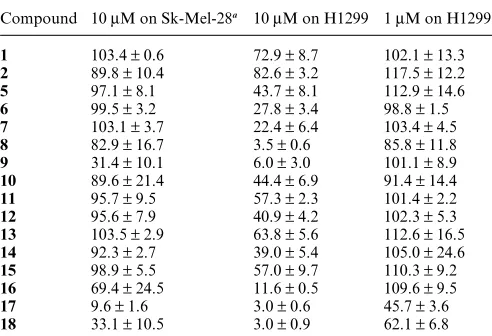
5–18was studied at a concentration of 10mM in the Sk-Mel-28 metastatic melanoma cell line and the H1299 non-small cell lung cancer (NSCLC) cell line. The results of this biological study are reported in Table 4 and are expressed as % cell growth relative to the untreated controls; the values determined for the intermediates
[image:5.595.306.552.81.249.2]1and2have also been included for comparison. On the whole,
Table 4 Effect on the growth of melanoma (Sk-Mel-28) and NSCLC (H1299) cells
Compound 10mM on Sk-Mel-28a 10mM on H1299 1mM on H1299
1 103.4±0.6 72.9±8.7 102.1±13.3
2 89.8±10.4 82.6±3.2 117.5±12.2
5 97.1±8.1 43.7±8.1 112.9±14.6
6 99.5±3.2 27.8±3.4 98.8±1.5
7 103.1±3.7 22.4±6.4 103.4±4.5
8 82.9±16.7 3.5±0.6 85.8±11.8
9 31.4±10.1 6.0±3.0 101.1±8.9
10 89.6±21.4 44.4±6.9 91.4±14.4
11 95.7±9.5 57.3±2.3 101.4±2.2
12 95.6±7.9 40.9±4.2 102.3±5.3
13 103.5±2.9 63.8±5.6 112.6±16.5
14 92.3±2.7 39.0±5.4 105.0±24.6
15 98.9±5.5 57.0±9.7 110.3±9.2
16 69.4±24.5 11.6±0.5 109.6±9.5
17 9.6±1.6 3.0±0.6 45.7±3.6 18 33.1±10.5 3.0±0.9 62.1±6.8
aThe results are expressed relative to the growth of control cells (cells without added compounds, set at 100%) and represent the average of three independent experiments.
the H1299 cell line showed a much greater sensitivity to these compounds than the Sk-Mel-28 cell line. Consequently, thein vitro
anti-proliferative effect of5–18was also studied at a concentration of 1mM in the H1299 cell line.
As expected, the intermediates 1 and 2 showed almost no anti-proliferative effect in either cell line (Table 4). This has also been reported to be the case for theN-(ferrocenyl)benzoyl peptide esters.25Thus, these results demonstrate conclusively that
all three moieties are required for in vitro activity. In the Sk-Mel-28 cell line, compounds 5–8 and10–15 did not have any noticeable effect on cell proliferation. Only theN -(6-ferrocenyl-2-naphthoyl) derivatives9and16–18showed an inhibitory effect on Sk-Mel-28 cell growth: theb-alanine derivative16had a weak anti-proliferative effect (~30% inhibition), the glycine derivative
9 and the d-amino-n-valeric acid derivative 18 had a signifi-cant anti-proliferative effect (~70%), whilst theg-aminobutyric acid derivative 17 displayed a strong anti-proliferative effect (90%).
Compounds 5–18 were shown to exert a significant, if not strong anti-proliferative effect in the H1299 cell line, when tested at the higher concentration of 10 mM. The effect of compounds5–12 on H1299 cell proliferation follows a distinct pattern that correlates with the structure of these derivatives. For5–8, the anti-proliferative effect increases as the side chain of the a-amino acid side chain is enlarged, adding steric bulk. Thus, theL-phenylalanine derivative8showed the greatest anti-proliferative effect (~96%). In contrast, the anti-proliferative effect of compounds 9–12 declines as the side chain of the a-amino acid is extended.N-(6-ferrocenyl-2-naphthoyl)-glycine ethyl ester
9displayed a stronger anti-proliferative effect (~94%) than 10– 12. Compounds13–15showed a weaker anti-proliferative effect in the H1299 cell line than5–8, however, these compounds still achieved an appreciable level of cell growth inhibition (30–60%). Of these compounds, theg-aminobutyric acid derivative14showed the strongest anti-proliferative effect (~60%). On the other hand, compounds16–18showed a stronger anti-proliferative effect in
Downloaded by Trinity College Dublin on 08 August 2011
the H1299 cell line than10–12; cell growth was inhibited by at least 89%. Compounds17and18showed a similarly strong anti-proliferative effect (~97%) however,17 was the only compound that inhibited H1299 cell growth by more than 50% at the lower concentration of 1mM.
The IC50 values for N-(6-ferrocenyl-2-naphthoyl)-g
-aminobutyric acid ethyl ester 17 were determined in both cell lines, since this compound has been identified as the most active member of this group of compounds. In the H1299 cell line, compound17 shows an IC50 value of 0.62 ± 0.07 mM; it
is two times more potent than both cisplatin (1.5 ± 0.1 mM) and N-(6-ferrocenyl-2-naphthoyl)-glycine-L-alanine ethyl ester
(1.3±0.1mM), the most active derivative reported previously.28
In the Sk-Mel-28 cell line, compound17displays an IC50 value
of 1.41±0.04mM. This is an extremely encouraging finding as metastatic melanoma is notoriously resistant to chemotherapeutic agents.
These results demonstrate that although theN -(3-ferrocenyl-2-naphthoyl) amino acid esters show good anticancer activity in the H1299 cell line, their effect in the Sk-Mel-28 cell line is weaker. For these derivatives, the anti-proliferative effect is greatest when chirala-amino acids with bulky side chains are employed. This improvement in biological activity for7 and8 is not yet fully understood however, it is possible that the conformation adopted by7and8as a result of steric hindrance, alters the molecular properties in a way that is beneficial to the activity. In comparison, theN-(6-ferrocenyl-2-naphthoyl) amino acid esters show a greater anticancer activity in both the H1299 cell line and Sk-Mel-28 cell line. However, substitution at thea-carbon of the amino acid is not beneficial to the biological activity of theN -(6-ferrocenyl-2-naphthoyl) amino acid esters. The achiral amino acid derivatives
9 and16–18, which are devoid of steric bulk, show a greater anti-proliferative effect. These four derivatives form a homologous series, since they differ only by the number of methylene groups (n=1–4) between the amide and ester functionalities. The weakest anti-proliferative effect is observed whenn=2, in the case of the
b-alanine derivative16, whilst the greatest anti-proliferative effect is observed whenn=3, in the case of the g-aminobutyric acid derivative 17. In comparison to N -(6-ferrocenyl-2-naphthoyl)-glycine-L-alanine ethyl ester, the increased potency of 17 may be a consequence of an increase in lipophilicity or the con-formational flexibility afforded by the g-aminobutyric acid moiety.
With regard to the mode of action of these novel derivatives, we have previously postulated that the low redox potential of these compounds should facilitate the catalytic generation of reactive oxygenated species (ROS), under physiological conditions, leading to oxidative damage to DNA. This is possible via a Fenton-type reaction, in which hydroxyl radicals are generated from the superoxide dismutation product, hydrogen peroxide. Pre-liminary studies performed with N -(6-ferrocenyl-2-naphthoyl)-glycine-L-alanine ethyl ester indicate the formation of oxidative lesions typical of Fenton-reaction mediated oxidative damage to DNA. For these studies, DNA was incubated with N -(6-ferrocenyl-2-naphthoyl)-glycine-L-alanine ethyl ester and
hydro-gen peroxide, and 8-oxo-7,8-dihydroguanine, a key biomarker for oxidatively damaged DNA, was generated in a similar way to classical Fenton-mediated oxidative damage to DNA. These findings are extremely encouraging and a more comprehensive
study into the mode of action of these derivatives is currently in progress.
Conclusion
A series of N-(ferrocenyl)naphthoyl amino acid esters 5–18
has been prepared and characterised. These novel compounds have been subjected to in vitro biological evaluation to assess their potential as anticancer agents for the treatment of lung cancer and malignant melanoma.N
-(6-ferrocenyl-2-naphthoyl)-g-aminobutyric acid ethyl ester17has been identified as having a potent effect on cell proliferation in both the H1299 NSCLC cell line (IC50 = 0.62±0.07mM) and the Sk-Mel-28 melanoma
cell line (IC50 =1.41 ±0.04 mM). This represents a substantial
improvement in the anticancer activity with respect to the N -(ferrocenyl)naphthoyl dipeptide esters and in addition, demon-strates that the biological activity of these novel compounds is not restricted to only one form of cancer. Further investigations with regard to both the structure–activity relationship and mode of action of these promising anticancer agents are underway.
Experimental
General remarks
All chemicals were purchased from Sigma-Aldrich, Fluorochem Limited or Tokyo Chemical Industry UK Limited; and used as received. Commercial grade reagents were used without further purification. When necessary, all solvents were purified and dried prior to use. Riedel-Ha¨en silica gel was used for thin layer and column chromatography. Melting points were determined using either a Griffin melting point apparatus or a Stuart melting point (SMP3) apparatus and are uncorrected. Optical rotation measurements were made on a Perkin Elmer 343 Polarimeter and are quoted in units of 10-1 deg cm2 g-1. Infrared spectra
were recorded on either a Perkin Elmer GX FT-IR or a Perkin Elmer 100 FT-IR with ATR. UV-Vis spectra were recorded on a Hewlett Packard 8452 A diode array UV-Vis spectrophotometer.
1H and13C NMR spectra were recorded in deuterated solvents
on a Bruker Avance 400 NMR. The1H and13C NMR chemical
shifts are reported in ppm (parts per million). The residual solvent peaks have been used as an internal reference. All coupling constants (J) are quoted in Hz. The abbreviations for the peak multiplicities are as follows: s (singlet), d (doublet), dd (doublet of doublets), t (triplet), q (quartet), qt (quintet), m (multiplet) and br (broad). Electrospray ionisation mass spectra were performed on a Micromass LCT mass spectrometer or a Br ¨uker Daltonics Esquire-LC ion trap mass spectrometer. Elemental analysis was carried out by the microanalytical laboratory at University College Dublin.
General procedure for the synthesis of the intermediates 1–4
Methyl 3-ferrocenylnaphthalene-2-carboxylate (1). Concen-trated hydrochloric acid (4 mL) was added with intermittent cooling to a solution of methyl 3-aminonaphthalene-2-carboxylate (2.62 g, 11 mmol) in 15 mL of water. A solution of sodium nitrite (0.9 g, 13 mmol) in 15 mL of water was then added slowly to this mixture with stirring, keeping the temperature below 5◦C to furnish a pale brown/yellow solution. The resulting diazo salt
Downloaded by Trinity College Dublin on 08 August 2011
was added to a solution of ferrocene (2.42 g, 13 mmol) in diethyl ether (90 mL) and allowed to react for 18 h. The reaction was then washed with water, the ether layer was dried over MgSO4
and the solvent was removedin vacuoto yield the crude product. The crude product was purified using column chromatography
{eluant 3 : 2 petroleum ether (40–60◦C): diethyl ether}to obtain an orange/red solid (1.23 g, 30%), mp 119–120◦C; [Found: C, 71.35; H, 4.9%; M+∑
, 370.4. C22H18O2Fe requires: C, 71.4; H,
4.9%; M+∑
, 370.4];lmax(EtOH)/nm 440 (e/dm3mol-1cm-1574); nmax(KBr)/cm-11720, 1494, 1201;dH(400 MHz; DMSO-d
6) 8.40
(1H, s, ArH), 8.07 (1H, s, ArH), 8.05 (1H, d,J8.0, ArH), 7.97 (1H, d,J8.0, ArH), 7.61 (1H, t,J8.0, ArH), 7.54 (1H, t,J8.0, ArH), 4.59{2H, t,J1.6,orthoon (h5-C
5H4)}, 4.35{2H, t,J1.6,
metaon (h5-C
5H4)}, 4.10 (5H, s,h5-C5H5), 3.77 (3H, s, –OCH3); dC(100 MHz; DMSO-d6) 169.4 (C O), 134.2 (Cq), 133.5 (Cq),
130.4 (Cq), 130.3 (Cq), 129.2, 128.1, 128.0, 127.9, 127.5, 126.4,
85.0 (Cipso h5-C5H4), 69.6 (h5-C5H5), 68.9 (Cortho h5-C5H4), 68.3
(Cmetah5-C5H4), 52.2 (–OCH3).
Methyl 6-ferrocenylnaphthalene-2-carboxylate (2). Concen-trated hydrochloric acid (4 mL) was added with intermittent cooling to a solution of methyl 6-aminonaphthalene-2-carboxylate (2.7 g, 11.5 mmol) in 15 mL of water. A solution of sodium nitrite (1.0 g, 14.5 mmol) in 15 mL of water was then added slowly to this mixture with stirring, keeping the temperature below 5◦C furnishing a pale brown/yellow solution. The resulting diazo salt was added to a solution of ferrocene (2.8 g, 14.5 mmol) in diethyl ether (90 mL) and allowed to react for 18 h. The reaction mixture was then washed with water, the ether layer was dried over MgSO4,
and the solvent removed in vacuo to yield the crude product. The crude product was purified using column chromatography
{eluant 3 : 2 petroleum ether (40–60◦C): diethyl ether}to obtain a red solid (0.88 g, 21%), mp 158–159◦C; [Found: C, 71.6; H, 5.2%; M+∑
, 370.4. C22H18O2Fe requires: C, 71.4; H, 4.9%; M+ ∑
, 370.2];lmax(EtOH)/nm 380 (e/dm3mol-1cm-13 211), 455 (1 523); nmax(KBr)/cm-11708, 1494, 1450, 1219;dH(400 MHz; DMSO-d
6)
8.58 (1H, s, ArH), 8.09 (1H, s, ArH), 8.07 (1H, d,J8.8, ArH), 7.93–7.98 (2H, m, ArH), 7.85 (1H, dd,J1.6 and 8.8, ArH), 4.99
{2H, t,J1.6,orthoon (h5-C
5H4)}, 4.47{2H, t,J1.6,metaon (h5
-C5H4)}, 4.05 (5H, s,h5-C5H5), 3.92 (3H, s, –OCH3);dC(100 MHz;
DMSO-d6) 166.4 (C O), 140.0 (Cq), 135.4 (Cq), 130.6 (Cq), 130.4,
129.2, 127.8, 126.1, 125.8 (Cq), 125.1, 122.7, 83.7 (Cipsoh5-C5H4),
69.6 (Cmeta h5-C5H4), 69.5 (h5-C5H5), 66.8 (Cortho h5-C5H4), 52.2
(–OCH3).
3-Ferrocenylnaphthalene-2-carboxylic acid (3). Sodium hy-droxide (0.1 g, 2.5 mmol) was added to methyl 3-ferrocenylnaphthalene-2-carboxylate (0.92 g, 2.5 mmol) in a 1 : 1 mixture of water–methanol and was refluxed for 12 h. Concentrated HCl was added until pH 2 was reached. The solution was allowed to cool and filtered to obtain an orange/brown solid (0.81 g, 92%), mp (decomp.) at 145 ◦C; lmax(EtOH)/nm 445 (e/dm3mol-1cm-1568);nmax(KBr)/cm-13430, 1698;dH(400 MHz;
DMSO-d6) 12.8 (1H, br.s, –COOH), 8.33 (1H, s, ArH), 8.00 (1H,
d,J8.0, ArH), 7.99 (1H, s, ArH), 7.95 (1H, d,J8.0, ArH), 7.57 (1H, t,J8.0, ArH), 7.52 (1H, t,J8.0, ArH), 4.70{2H, t,J1.6,
orthoon (h5-C
5H4)}, 4.34{2H, t,J1.6,metaon (h5-C5H4)}, 4.10
(5H, s,h5-C
5H5);dC(100 MHz; DMSO-d6) 170.8 (C O), 134.3
(Cq), 133.9 (Cq), 133.1 (Cq), 130.5 (Cq), 128.8, 127.9, 127.4, 127.0,
126.1, 85.2 (Cipso h5-C5H4), 69.6 (h5-C5H5), 69.1 (Cmeta h5-C5H4),
68.2 (Corthoh5-C5H4);m/z(ESI) 356.4 (M+ ∑. C
21H16O2Fe requires
356.2).
6-Ferrocenylnaphthalene-2-carboxylic acid (4). Sodium hy-droxide (0.08 g, 2.0 mmol) was added to methyl 6-ferrocenylnaphthalene-2-carboxylate (0.70 g, 1.9 mmol) in a 1 : 1 mixture of water–methanol and was refluxed for 12 h. Concen-trated HCl was added until pH 2 was reached. The solution was allowed to cool and filtered to obtain an orange solid (0.63 g, 93%), mp (decomp.) at 205◦C;lmax(EtOH)/nm 375 (e/dm3mol-1cm-1
2 635), 450 (1 296); nmax(KBr)/cm-1 3435, 1682; dH(400 MHz;
DMSO-d6) 12.8 (1H, br.s, –COOH), 8.57 (1H, s, ArH), 8.07 (1H, s,
ArH), 8.03 (1H, d,J8.4, ArH), 7.94 (2H, s, ArH), 7.83 (1H, dd,
J 1.6 and 8.4, ArH), 4.97{2H, t, J 1.6,ortho on (h5-C 5H4)},
4.45{2H, t, J 1.6,meta on (h5-C
5H4)}, 4.04 (5H, s,h5-C5H5); dC(100 MHz; DMSO-d6) 167.5 (C O), 139.7 (Cq), 135.3 (Cq),
130.6 (Cq), 130.4, 129.1, 127.6, 127.0 (Cq), 125.9, 125.5, 122.7, 83.8
(Cipso h5-C5H4), 69.6 (Cmeta h5-C5H4), 69.5 (h5-C5H5), 66.7 (Cortho h5-C
5H4);m/z(ESI) 356.4 (M+ ∑. C
21H16O2Fe requires 356.2).
General procedure for the synthesis ofN-(ferrocenyl)naphthoyl amino acid ethyl esters 5–18
N-(3-ferrocenyl-2-naphthoyl)-glycine ethyl ester (5). Glycine ethyl ester hydrochloride (0.17 g, 1.2 mmol) was added to a solution of 3-ferrocenylnaphthalene-2-carboxylic acid (0.43 g, 1.2 mmol), 1-hydroxybenzotriazole (0.22 g, 1.6 mmol), triethylamine (0.5 mL) and N-(3-dimethylaminopropyl)-N¢ -ethylcarbodiimide hydrochloride (0.3 g, 1.6 mmol) in 50 mL of dichloromethane at 0◦C. After 30 min, the solution was raised to room temperature and the reaction was allowed to proceed for 48 h. The reaction mixture was then washed with water. The dichloromethane layer was dried over MgSO4 and the solvent
was removed in vacuo. The product was purified by column chromatography (eluant 1 : 1 hexane–ethyl acetate-100% ethyl acetate) to give the title compound as an orange solid5(0.44 g, 83%), mp 105–106◦C;E◦¢/mV, 13vs. Fc/Fc+; [Found: C, 67.7;
H, 5.5; N, 3.25%; M+∑, 441.4. C
25H23NO3Fe requires: C, 68.0; H,
5.25; N, 3.2%; M+∑, 441.3];lmax(EtOH)/nm 450 (e/dm3mol-1cm-1
466);nmax(KBr)/cm-13296, 1736, 1647, 1544, 1191;dH(400 MHz;
DMSO-d6) 8.98 (1H, t,J6.0, –CONH–), 8.35 (1H, s, ArH), 8.01
(1H, d,J8.0, ArH), 7.93 (1H, d,J8.0, ArH), 7.82 (1H, s, ArH), 7.56 (1H, t,J8.0, ArH), 7.52 (1H, t,J8.0, ArH), 4.83{2H, t,J
1.6,orthoon (h5-C
5H4)}, 4.32{2H, t,J1.6,metaon (h5-C5H4)},
4.18 (2H, q,J7.2, –OCH2CH3), 4.07 (5H, s,h5-C5H5), 4.03 (2H, d,
J6.0, –NHCH2–), 1.27 (3H, t,J7.2, –OCH2CH3);dC(100 MHz;
DMSO-d6) 170.1 (C O), 169.8 (C O), 134.6 (Cq), 134.3 (Cq),
133.0 (Cq), 130.4 (Cq), 128.1, 127.7, 127.4, 127.1, 126.8, 126.1, 84.1
(Cipsoh5-C5H4), 69.6 (h5-C5H5), 68.9 (Corthoh5-C5H4), 68.3(Cmetah5
-C5H4), 60.6 (–OCH2–,-ve DEPT), 41.1 (–NHCH2–,-ve DEPT),
14.1 (–OCH2CH3).
N-(3-ferrocenyl-2-naphthoyl)-L-alanine ethyl ester (6). The
synthesis followed that of 5 using the following reagents: 3-ferrocenylnaphthalene-2-carboxylic acid (0.36 g, 1.0 mmol), 1-hydroxybenzotriazole (0.14 g, 1.0 mmol), triethylamine (0.5 mL),
N-(3-dimethylaminopropyl)-N¢-ethylcarbodiimide hydrochloride (0.22 g, 1.0 mmol) andL-alanine ethyl ester hydrochloride (0.19 g, 1.2 mmol). The product was purified by column chromatography (eluant 1 : 1 hexane–ethyl acetate-100% ethyl acetate) to give the
Downloaded by Trinity College Dublin on 08 August 2011
title compound as an orange solid (0.24 g, 95%), mp 49◦C; [a]20 D
+13 (c0.01 in EtOH);E◦¢/mV 8vs. Fc/Fc+; [Found: C, 68.8; H,
5.8; N, 3.3%; M+∑, 455.5. C
26H25NO3Fe requires: C, 68.6; H, 5.5;
N, 3.1%; M+∑, 455.3];lmax(EtOH)/nm 450 (e/dm3mol-1cm-1512); nmax(KBr)/cm-13288, 1734, 1647, 1544, 1494, 1200;dH(400 MHz;
DMSO-d6) 8.94 (1H, d,J7.2, –CONH–), 8.34 (1H, s, ArH), 8.00
(1H, d,J8.0, ArH), 7.93 (1H, d,J8.0, ArH), 7.80 (1H, s, ArH), 7.50–7.58 (2H, m, ArH), 4.78–4.80{2H, m,orthoon (h5-C
5H4)},
4.45 (1H, qt,J 7.2, –NHCH–), 4.33–4.35{1H, m,metaon (h5
-C5H4)}, 4.29–4.31{1H, m,metaon (h5-C5H4)}, 4.16 (2H, q,J7.2,
–OCH2CH3), 4.09 (5H, s,h5-C5H5), 1.38 (3H, d,J 7.2, –CH3),
1.27 (3H, t,J7.2, –OCH2CH3);dC(100 MHz; DMSO-d6) 172.5
(C O), 169.3 (C O), 134.7 (Cq), 134.3 (Cq), 132.9 (Cq), 130.4
(Cq), 128.2, 127.7, 127.4, 127.1, 126.8, 126.1, 84.3 (Cipsoh5-C5H4),
69.5 (h5-C
5H5), 68.5 (Cortho h5-C5H4), 68.3 (Cmeta h5-C5H4), 68.2
(Cmeta h5-C5H4), 60.6 (–OCH2–,-ve DEPT), 48.0 (a-C), 16.7 (–
CH3), 14.1 (–OCH2CH3).
N-(3-ferrocenyl-2-naphthoyl)-L-leucine ethyl ester (7). The synthesis followed that of 5 using the following reagents: 3-ferrocenylnaphthalene-2-carboxylic acid (0.36 g, 1.0 mmol), 1-hydroxybenzotriazole (0.22 g, 1.7 mmol), triethylamine (0.5 mL),
N-(3-dimethylaminopropyl)-N¢-ethylcarbodiimide hydrochloride (0.29 g, 1.5 mmol) andL-leucine ethyl ester hydrochloride (0.23 g,
1.2 mmol). The product was purified by column chromatography (eluant 1 : 1 hexane–ethyl acetate-100% ethyl acetate) to give the title compound as an orange solid (0.16 g, 32%), mp 75–76◦C; [a]20
D+6 (c0.01 in EtOH);E◦¢/mV 16vs. Fc/Fc
+;lmax(EtOH)/nm
445 (e/dm3 mol-1 cm-1 627); nmax(KBr)/cm-1 3322, 1735, 1649,
1544, 1494, 1209;dH(400 MHz; DMSO-d6) 8.87 (1H, d,J 7.6,
–CONH–), 8.36 (1H, s, ArH), 8.01 (1H, d,J8.0, ArH), 7.94 (1H, d,J8.0, ArH), 7.74 (1H, s, ArH), 7.50–7.58 (2H, m, ArH), 4.75– 4.76{2H, m,orthoon (h5-C
5H4)}, 4.39–4.44 (1H, m, –NHCH–),
4.32–4.33{1H, m,metaon (h5-C
5H4)}, 4.28–4.29{1H, m,metaon
(h5-C
5H4)}, 4.16 (2H, q,J7.2, –OCH2CH3), 4.08 (5H, s,h5-C5H5),
1.65–1.76 (2H, m, –CH2CH–), 1.50–1.58 (1H, m, –CH2CH–),
1.26 (3H, t,J7.2, –OCH2CH3), 0.91–0.94{6H, m, –CH(CH3)2}; dC(100 MHz; DMSO-d6) 172.5 (C O), 169.7 (C O), 134.9 (Cq),
134.2 (Cq), 132.9 (Cq), 130.4 (Cq), 128.2, 127.7, 127.4, 127.1,
126.5, 126.1, 84.3 (Cipso h5-C5H4), 69.5 (h5-C5H5), 68.4 (Corthoh5
-C5H4), 68.2 (Cmetah5-C5H4), 68.1 (Cmetah5-C5H4), 60.5 (–OCH2–, -ve DEPT), 50.8 (a-C), 39.4 (–CH2–,-ve DEPT), 24.3 (–CH–),
22.9 (–CH3), 21.2 (–CH3), 14.1(–OCH2CH3);m/z(ESI) 498.1714
([M+H]+. C
29H32NO3Fe requires 498.1732).
N-(3-ferrocenyl-2-naphthoyl)-L-phenylalanine ethyl ester (8).
The synthesis followed that of 5using the following reagents: 3-ferrocenylnaphthalene-2-carboxylic acid (0.36 g, 1.0 mmol), 1-hydroxybenzotriazole (0.22 g, 1.7 mmol), triethylamine (0.5 mL),
N-(3-dimethylaminopropyl)-N¢-ethylcarbodiimide hydrochloride (0.29 g, 1.5 mmol) andL-phenylalanine ethyl ester hydrochloride
(0.24 g, 1.0 mmol). The product was purified by column chro-matography (eluant 1 : 1 hexane–ethyl acetate-100% ethyl acetate) to give the title compound as an orange solid (0.21 g, 40%), mp 48–49◦C; [a]20
D -24 (c 0.01 in EtOH); E◦¢/mV 10 vs. Fc/Fc +;
(Found: C, 72.15; H, 5.7; N, 2.6. C32H29NO3Fe requires: C, 72.3;
H, 5.5; N, 2.6%);lmax(EtOH)/nm 450 (e/dm3 mol-1 cm-1582); nmax(KBr)/cm-13342, 1734, 1645, 1544, 1494, 1193;dH(400 MHz;
DMSO-d6) 9.01 (1H, d,J8.0, –CONH–), 8.29 (1H, s, ArH), 7.98
(1H, d,J8.0, ArH), 7.82 (1H, d,J8.0, ArH), 7.49–7.57 (2H, m,
ArH), 7.47 (1H, s, ArH), 7.34–7.43 (5H, m, –CH2Ph), 4.71–4.75
{2H, m, –NHCH–, (h5-C
5H4)}, 4.32–4.34 {1H, m, (h5-C5H4)},
4.22–4.24 {1H, m, (h5-C
5H4)}, 4.15–4.21{3H, m, –OCH2CH3,
(h5-C
5H4)}, 4.01 (5H, s,h5-C5H5), 3.22 (1H, dd,J7.6 and 13.6,
–CH2Ph), 3.01 (1H, dd,J7.6 and 13.6, –CH2Ph), 1.25 (3H, t,J
7.2, –OCH2CH3);dC(100 MHz; DMSO-d6) 171.5 (C O), 169.4
(C O), 137.5 (Cq), 134.7 (Cq), 134.3 (Cq), 132.9 (Cq), 130.3 (Cq),
129.3, 128.3, 128.1, 127.5, 127.4, 127.1, 126.6, 126.5, 126.1, 83.9 (Cipso h5-C5H4), 69.5 (h5-C5H5), 68.9 (h5-C5H4), 68.8 (h5-C5H4),
68.3 (h5-C
5H4), 68.1 (h5-C5H4), 60.7 (–OCH2–,-ve DEPT), 53.7
(a-C), 36.4 (–CH2Ph,-ve DEPT), 14.1 (–OCH2CH3);m/z(ESI)
532.1572 ([M+H]+. C
32H30NO3Fe requires 532.1575).
N-(6-ferrocenyl-2-naphthoyl)-glycine ethyl ester (9). The syn-thesis followed that of 5 using the following reagents: 6-ferrocenylnaphthalene-2-carboxylic acid (0.37 g, 1.0 mmol), 1-hydroxybenzotriazole (0.2 g, 1.5 mmol), triethylamine (0.5 mL),
N-(3-dimethylaminopropyl)-N¢-ethylcarbodiimide hydrochloride (0.3 g, 1.6 mmol) and glycine ethyl ester hydrochloride (0.1 g, 0.7 mmol). The product was purified by column chromatography (eluant 1 : 1 hexane: ethyl acetate-100% ethyl acetate) to give the title compound as an orange solid (0.19 g, 62%), mp 114–115◦C;
E◦¢/mV 42vs. Fc/Fc+; [Found: C, 67.8; H, 5.4; N, 3.15; M+∑
, 441.4. C25H23NO3Fe requires: C, 68.0; H, 5.25; N, 3.2%; M+∑,
441.3];lmax(EtOH)/nm 375 (e/dm3mol-1cm-12 683), 450 (1 149); nmax(KBr)/cm-13306, 1745, 1638, 1545, 1494, 1215;dH(400 MHz;
DMSO-d6) 9.08 (1H, t,J6.0, –CONH–), 8.44 (1H, s, ArH), 8.07
(1H, s, ArH), 7.97 (1H, d,J8.8, ArH), 7.94 (1H, d,J8.4, ArH), 7.92 (1H, dd,J1.6 and 8.4, ArH), 7.83 (1H, dd,J1.6 and 8.8, ArH), 4.96{2H, t,J1.6,orthoon (h5-C
5H4)}, 4.45{2H, t,J1.6,
metaon (h5-C
5H4)}, 4.15 (2H, q,J7.2, –OCH2CH3), 4.04–4.07
(7H, m, –NHCH2–,h5-C5H5), 1.22 (3H, t, J 7.2, –OCH2CH3); dC(100 MHz; DMSO-d6): 169.9 (C O), 166.7 (C O), 138.9 (Cq),
134.6 (Cq), 130.6 (Cq), 130.1 (Cq), 128.8, 127.6, 127.5, 125.9, 124.3,
122.7, 84.0 (Cipsoh5-C5H4), 69.5 (h5-C5H5), 69.4 (Cmetah5-C5H4),
66.6 (Corthoh5-C5H4), 60.5 (–OCH2–,-ve DEPT), 41.4 (–NHCH2–, -ve DEPT), 14.1 (–OCH2CH3).
N-(6-ferrocenyl-2-naphthoyl)-L-alanine ethyl ester (10). The synthesis followed that of 5 using the following reagents: 6-ferrocenylnaphthalene-2-carboxylic acid (0.37 g, 1.0 mmol), 1-hydroxybenzotriazole (0.2 g, 1.5 mmol), triethylamine (0.5 mL),
N-(3-dimethylaminopropyl)-N¢-ethylcarbodiimide hydrochloride (0.29 g, 1.5 mmol) andL-alanine ethyl ester hydrochloride (0.14 g,
0.9 mmol). The product was purified by column chromatography (eluant 1 : 1 hexane: ethyl acetate-100% ethyl acetate) to give the title compound as an orange solid (0.34 g, 83.3%), mp 57–58◦C; [a]20
D +32 (c0.01 in EtOH);E◦¢/mV 42vs. Fc/Fc
+; (Found: C,
68.1; H, 5.8; N, 2.95. C26H25NO3Fe requires: C, 68.6; H, 5.5; N,
3.1%);lmax(EtOH)/nm 375 (e/dm3mol-1cm-13 636), 450 (1 614); nmax(KBr)/cm-13442, 1734, 1638, 1542, 1494, 1204;dH(400 MHz;
DMSO-d6) 8.96 (1H, d, J 7.2, –CONH–), 8.51 (1H, s, ArH),
8.12 (1H, s, ArH), 8.02 (1H, d,J8.8, ArH), 7.99–8.00 (2H, m, ArH), 7.88 (1H, dd, J 1.6 and 8.8, ArH), 5.01 {2H, t, J 2.0,
orthoon (h5-C
5H4)}, 4.57 (1H, qt,J7.2, –NHCH–), 4.50{2H,
t, J 2.0,meta on (h5-C
5H4)}, 4.19 (2H, q,J 7.2, –OCH2CH3),
4.10 (5H, s,h5-C
5H5), 1.51 (3H, d,J 7.2, –CH3), 1.27 (3H, t,J
7.2, –OCH2CH3);dC(100 MHz; DMSO-d6) 172.7 (C O), 166.4
(C O), 138.9 (Cq), 134.6 (Cq), 130.6 (Cq), 130.1 (Cq), 128.7, 127.6,
127.4, 126.0, 124.6, 122.7, 84.0 (Cipsoh5-C5H4), 69.5 (h5-C5H5), 69.4
Downloaded by Trinity College Dublin on 08 August 2011
(Cmetah5-C5H4), 66.6 (Corthoh5-C5H4), 60.4 (–OCH2–,-ve DEPT),
48.5 (a-C), 16.7 (–CH3), 14.1 (–OCH2CH3);m/z(ESI) 456.1265
([M+H]+. C
26H26NO3Fe requires 456.1262).
N-(6-ferrocenyl-2-naphthoyl)-L-leucine ethyl ester (11). The
synthesis followed that of 5 using the following reagents: 6-ferrocenylnaphthalene-2-carboxylic acid (0.30 g, 0.9 mmol), 1-hydroxybenzotriazole (0.14 g, 1.0 mmol), triethylamine (0.5 mL),
N-(3-dimethylaminopropyl)-N¢-ethylcarbodiimide hydrochloride (0.21 g, 1.1 mmol) andL-leucine ethyl ester hydrochloride (0.2 g, 1.0 mmol). The product was purified by column chromatography (eluant 1 : 1 hexane: ethyl acetate-100% ethyl acetate) to give the title compound as an orange solid (0.14 g, 33.3%), mp 109◦C; [a]20
D +12 (c0.01 in EtOH);E
◦¢/mV 42vs. Fc/Fc+; (Found: C,
70.35; H, 6.7; N, 2.6. C29H31NO3Fe requires: C, 70.0; H, 6.3; N,
2.8%);lmax(EtOH)/nm 375 (e/dm3mol-1cm-13 256), 450 (1 395); nmax(KBr)/cm-13437, 1733, 1638, 1544, 1493, 1200;dH(400 MHz;
DMSO-d6) 8.82 (1H, d,J7.6, –CONH–), 8.45 (1H, s, ArH), 8.06
(1H, s, ArH), 7.97 (1H, d,J8.4, ArH), 7.93 (2H, s, ArH), 7.83 (1H, dd,J1.6 and 8.4, ArH), 4.96{2H, t,J1.6,orthoon (h5-C
5H4)},
4.52–4.57 (1H, m, –NHCH–), 4.45{2H, t,J 1.6,meta on (h5
-C5H4)}, 4.09–4.17 (2H, m, –OCH2CH3), 4.05 (5H, s, h5-C5H5),
1.73–1.88 (2H, m, –CH2CH–), 1.58–1.65 (1H, m, –CH2CH–),
1.21 (3H, t,J7.2, –OCH2CH3), 0.96{3H, d,J6.4, –CH(CH3)2},
0.91{3H, d,J6.4, –CH(CH3)2};dC(100 MHz; DMSO-d6) 172.7
(C O), 166.7 (C O), 138.9 (Cq), 134.6 (Cq), 130.6 (Cq), 130.2
(Cq), 128.7, 127.6, 127.3, 125.9, 124.6, 122.7, 84.0 (Cipsoh5-C5H4),
69.5 (h5-C
5H5), 69.4 (Cmeta h5-C5H4), 66.6 (Cortho h5-C5H4), 60.4
(–OCH2–,-ve DEPT), 51.1 (a-C), 39.3 (–CH2–,-ve DEPT), 24.5
(–CH–), 22.9 (–CH3), 21.2 (–CH3), 14.1 (–OCH2CH3);m/z(ESI)
498.1712 ([M+H]+. C
29H32NO3Fe requires 498.1732).
N-(6-ferrocenyl-2-naphthoyl)-L-phenylalanine ethyl ester (12).
The synthesis followed that of 5using the following reagents: 6-ferrocenylnaphthalene-2-carboxylic acid (0.30 g, 0.9 mmol), 1-hydroxybenzotriazole (0.14 g, 1.0 mmol), triethylamine (0.5 mL),
N-(3-dimethylaminopropyl)-N¢-ethylcarbodiimide hydrochloride (0.21 g, 1.1 mmol) and L-phenylalanine ethyl ester
hydrochlo-ride (0.26 g, 1.1 mmol). The product was purified by column chromatography (eluant 1 : 1 hexane: ethyl acetate-100% ethyl acetate) to give the title compound as an orange solid (0.38 g, 77.8%), mp 151–152◦C; [a]20
D+52 (c0.01 in EtOH);E◦¢/mV 46vs.
Fc/Fc+; (Found: C, 72.3; H, 5.55; N, 2.6. C
32H29NO3Fe requires:
C, 72.3; H, 5.5; N, 2.6%);lmax(EtOH)/nm 375 (e/dm3mol-1cm-1
3 696), 450 (1 582);nmax(KBr)/cm-13435, 1741, 1623, 1544, 1494,
1208;dH(400 MHz; DMSO-d6) 8.95 (1H, d,J7.6, –CONH–), 8.38
(1H, s, ArH), 8.05 (1H, s, ArH), 7.95 (1H, d,J8.4, ArH), 7.92 (1H, d,J8.8, ArH), 7.86 (1H, dd,J1.6 and 8.4, ArH), 7.82 (1H, dd,J1.6 and 8.4, ArH), 7.21–7.35 (5H, m, –CH2Ph), 4.96{2H,
t,J1.6,orthoon (h5–C
5H4)}, 4.68–4.74 (1H, m, –NHCH–), 4.45
{2H, t,J1.6,metaon (h5-C
5H4)}, 4.11 (2H, q,J7.2, –OCH2CH3),
4.05 (5H, s,h5-C
5H5), 3.16–3.19 (2H, m, –CH2Ph), 1.14 (3H, t,J
7.2, –OCH2CH3);dC(100 MHz; DMSO-d6) 171.7 (C O), 166.5
(C O), 138.9 (Cq), 137.7 (Cq), 134.6 (Cq), 130.6 (Cq), 130.1 (Cq),
129.1, 128.7, 128.2, 127.6, 127.4, 126.5, 125.9, 124.5, 122.7, 83.9 (Cipso h5-C5H4), 69.5 (h5-C5H5), 69.4 (Cmetah5-C5H4), 66.6 (Cortho h5-C
5H4), 60.5 (–OCH2–,-ve DEPT), 54.5 (a-C), 36.4 (–CH2Ph, -ve DEPT), 14.0 (–OCH2CH3); m/z (ESI) 532.1552 ([M+H]+.
C32H30NO3Fe requires 532.1575).
N-(3-ferrocenyl-2-naphthoyl)-b-alanine ethyl ester (13). The synthesis followed that of 5 using the following reagents: 3-ferrocenylnaphthalene-2-carboxylic acid (0.37 g, 1 mmol), 1-hydroxybenzotriazole (0.16 g, 1.2 mmol), triethylamine (0.5 mL),
N-(3-dimethylaminopropyl)-N¢-ethylcarbodiimide hydrochloride (0.23 g, 1.2 mmol) andb-alanine ethyl ester hydrochloride (0.15 g, 1 mmol). The product was purified by column chromatography (eluant 1 : 1 hexane: ethyl acetate - 100% ethyl acetate) to give the title compound as an orange solid (0.18 g, 40%), mp 117 ◦C; E◦¢/mV 24 vs. Fc/Fc+; (Found: C, 68.1; H, 5.7;
N, 3.05. C26H25NO3Fe requires: C, 68.6; H, 5.5; N, 3.1%); lmax(CH3CN)/nm 435 (e/dm3 mol-1 cm-1493); nmax/cm-13234,
3064, 1721, 1629, 1557, 1192;dH(400 MHz; DMSO-d6) 8.50 (1H,
t,J5.2, –CONH–), 8.32 (1H, s, ArH), 8.00 (1H, d,J8.0, ArH), 7.89 (1H, d,J 8.0, ArH), 7.73 (1H, s, ArH), 7.49–7.56 (2H, m, ArH), 4.72{2H, s,orthoon (h5-C
5H4)}, 4.33{2H, s,metaon (h5
-C5H4)}, 4.09–4.13 (7H, m, –OCH2CH3,h5-C5H5), 3.44–3.51 (2H,
m, –CH2CH2–), 2.57 (2H, t,J 6.8, –CH2CH2–), 1.23 (3H, t,J
7.2, –OCH2CH3);dC(100 MHz; DMSO-d6) 171.2 (C O), 169.7
(C O), 135.5 (Cq), 134.0 (Cq), 132.8 (Cq), 130.5 (Cq), 128.1,
127.6, 127.4, 126.9, 126.3, 126.0, 84.5 (Cipso h5-C5H4), 69.5 (h5
-C5H5), 68.8 (Corthoh5-C5H4), 68.3 (Cmetah5-C5H4), 60.0 (–OCH2–, -ve DEPT), 35.3 (–CH2CH2–, -ve DEPT), 33.5 (–CH2CH2–, -ve DEPT), 14.1 (–OCH2CH3); m/z (ESI) 456.1268 ([M+H]+.
C26H26NO3Fe requires 456.1262).
N-(3-ferrocenyl-2-naphthoyl)-c-aminobutyric acid ethyl ester (14). The synthesis followed that of 5 using the follow-ing reagents: 3-ferrocenylnaphthalene-2-carboxylic acid (0.37 g, 1 mmol), 1-hydroxybenzotriazole (0.18 g, 1.3 mmol), triethylamine (0.5 mL), N-(3-dimethylaminopropyl)-N¢-ethylcarbodiimide hy-drochloride (0.25 g, 1.3 mmol) and g-aminobutyric acid ethyl ester hydrochloride (0.17 g, 1 mmol). The product was purified by column chromatography (eluant 1 : 1 hexane: ethyl acetate
-100% ethyl acetate) to give the title compound as an orange solid (0.17 g, 36%), mp 104–105◦C;E◦¢/mV 29vs. Fc/Fc+; (Found:
C, 68.8; H, 5.8; N, 2.9. C27H27NO3Fe requires: C, 69.1; H, 5.8; N,
3.0%);lmax(CH3CN)/nm 435 (e/dm3mol-1cm-1294);nmax/cm-1
3307, 3086, 1730, 1628, 1535, 1166;dH(400 MHz; DMSO-d6) 8.40
(1H, t,J 5.6, –CONH–), 8.33 (1H, s, ArH), 7.99 (1H, d,J8.0, ArH), 7.92 (1H, d, J 7.6, ArH), 7.76 (1H, s, ArH), 7.48–7.56 (2H, m, ArH), 4.73{2H, t,J2.0,orthoon (h5-C
5H4)}, 4.32{2H,
t, J 2.0, meta on (h5-C
5H4)}, 4.06–4.11 (7H, m, –OCH2CH3, h5-C
5H5), 3.23 (2H, q, J 5.6, –CH2CH2CH2–), 2.35 (2H, t,
J 7.2, –CH2CH2CH2–), 1.76 (2H, qt, J 7.2, –CH2CH2CH2–),
1.20 (3H, t,J7.2, –OCH2CH3);dC(100 MHz; DMSO-d6) 172.6
(C O), 169.7 (C O), 135.8 (Cq), 133.9 (Cq), 132.8 (Cq), 130.6
(Cq), 128.0, 127.6, 127.3, 126.9, 126.1, 126.0, 84.5 (Cipsoh5-C5H4),
69.5 (h5-C
5H5), 68.8 (Cortho h5-C5H4), 68.2 (Cmeta h5-C5H4), 59.7
(–OCH2–,-ve DEPT), 38.3 (–CH2CH2CH2–, -ve DEPT), 31.0
(–CH2CH2CH2–,-ve DEPT), 24.2 (–CH2CH2CH2–,-ve DEPT),
14.1 (–OCH2CH3);m/z(ESI) 470.1411 ([M+H]+. C27H28NO3Fe
requires 470.1419).
N-(3-ferrocenyl-2-naphthoyl)-d-amino-n-valeric acid ethyl es-ter (15). The synthesis followed that of 5 using the follow-ing reagents: 3-ferrocenylnaphthalene-2-carboxylic acid (0.37 g, 1 mmol), 1-hydroxybenzotriazole (0.16 g, 1.2 mmol), triethylamine (0.5 mL), N-(3-dimethylaminopropyl)-N¢-ethylcarbodiimide hy-drochloride (0.23 g, 1.2 mmol) andd-amino-n-valeric acid ethyl
Downloaded by Trinity College Dublin on 08 August 2011
ester hydrochloride (0.18 g, 1 mmol). The product was purified by column chromatography (eluant 1 : 1 hexane: ethyl acetate
-100% ethyl acetate) to give the title compound as an orange oil (0.17 g, 35%), mp 79◦C;E◦¢/mV 27vs. Fc/Fc+; (Found: C, 69.3;
H, 6.0; N, 2.9. C28H29NO3Fe requires: C, 69.6; H, 6.05; N, 2.9%); lmax(CH3CN)/nm 450 (e/dm3mol
-1cm-1 508);nmax/cm-1 3282,
3093, 1726, 1628, 1638, 1538;dH(400 MHz; DMSO-d6) 8.38 (1H,
t,J5.6, –CONH–), 8.32 (1H, s, ArH), 7.99 (1H, d,J8.0, ArH), 7.91 (1H, d,J 8.0, ArH), 7.74 (1H, s, ArH), 7.48–7.56 (2H, m, ArH), 4.74{2H, t,J1.6,orthoon (h5-C
5H4)}, 4.33{2H, t,J1.6,
meta on (h5-C
5H4)}, 4.05–4.12 (7H, m,h5-C5H5, –OCH2CH3),
3.22 (2H, q, J 5.6, –CH2CH2CH2CH2–), 2.33 (2H, t, J 7.2,
–CH2CH2CH2CH2–), 1.48–1.62 (4H, m, –CH2CH2CH2CH2–),
1.20 (3H, t,J7.2, –OCH2CH3);dC(100 MHz; DMSO-d6) 172.8
(C O), 169.6 (C O), 135.9 (Cq), 133.9 (Cq), 132.8 (Cq), 130.6
(Cq), 127.9, 127.6, 127.3, 126.8, 126.1, 125.9, 84.5 (Cipsoh5-C5H4),
69.5 (h5-C
5H5), 68.8 (Cortho h5-C5H4), 68.2 (Cmeta h5-C5H4), 59.7
(–OCH2–, -ve DEPT), 38.6 (–CH2CH2CH2CH2–, -ve DEPT),
33.2 (–CH2CH2CH2CH2–,-ve DEPT), 28.2 (–CH2CH2CH2CH2–, -ve DEPT), 22.0 (–CH2CH2CH2CH2–, -ve DEPT), 14.1 (–
OCH2CH3);m/z(ESI) 484.1566 ([M+H]+. C28H30NO3Fe requires
484.1575).
N-(6-ferrocenyl-2-naphthoyl)-b-alanine ethyl ester (16). The synthesis followed that of 5 using the following reagents: 6-ferrocenylnaphthalene-2-carboxylic acid (0.37 g, 1 mmol), 1-hydroxybenzotriazole (0.16 g, 1.2 mmol), triethylamine (0.5 mL),
N-(3-dimethylaminopropyl)-N¢-ethylcarbodiimide hydrochloride (0.23 g, 1.2 mmol) andb-alanine ethyl ester hydrochloride (0.15 g, 1 mmol). The product was purified by column chromatography (eluant 1 : 1 hexane: ethyl acetate - 100% ethyl acetate) to give the title compound as an orange solid (0.29 g, 64%), mp 123–124 ◦C; E◦¢/mV 63 vs. Fc/Fc+; (Found: C, 67.8; H,
5.6; N, 3.0. C26H25NO3Fe requires: C, 68.6; H, 5.5; N, 3.1%); lmax(CH3CN)/nm 360 (e/dm3 mol-1 cm-1 2 818), 435 (1 168); nmax/cm-1 3301, 3095, 1733, 1637, 1625, 1538; dH(400 MHz;
DMSO-d6) 8.70 (1H, t,J5.6, –CONH–), 8.38 (1H, s, ArH), 8.05
(1H, s, ArH), 7.88–7.96 (3H, m, ArH), 7.81 (1H, dd,J1.6 and 8.4, ArH), 4.95{2H, t,J 2.0,orthoon (h5-C
5H4)}, 4.44{2H, t,
J2.0,metaon (h5-C
5H4)}, 4.08 (2H, q,J7.2, –OCH2CH3), 4.04
(5H, s,h5-C
5H5), 3.56 (2H, q,J6.8, –CH2CH2–), 2.63 (2H, t,J
6.8, –CH2CH2–), 1.19 (3H, t,J7.2, –OCH2CH3);dC(100 MHz;
DMSO-d6) 171.3 (C O), 166.4 (C O), 138.7 (Cq), 134.5 (Cq),
130.8 (Cq), 130.7 (Cq), 128.7, 127.3, 127.2, 125.9, 124.4, 122.7, 84.0
(Cipsoh5-C5H4), 69.4 (h5-C5H5,Cmetah5-C5H4) 66.6 (Corthoh5-C5H4),
59.9 (–OCH2–,-ve DEPT), 35.6 (–CH2CH2–,-ve DEPT), 33.8 (–
CH2CH2–,-ve DEPT), 14.1 (–OCH2CH3);m/z(ESI) 456.1240
([M+H]+. C
26H26NO3Fe requires 456.1262).
N-(6-ferrocenyl-2-naphthoyl)-c-aminobutyric acid ethyl ester (17). The synthesis followed that of 5 using the follow-ing reagents: 6-ferrocenylnaphthalene-2-carboxylic acid (0.37 g, 1 mmol), 1-hydroxybenzotriazole (0.18 g, 1.3 mmol), triethylamine (0.5 mL), N-(3-dimethylaminopropyl)-N¢-ethylcarbodiimide hy-drochloride (0.25 g, 1.3 mmol) and g-aminobutyric acid ethyl ester hydrochloride (0.17 g, 1 mmol). The product was purified by column chromatography (eluant 1 : 1 hexane: ethyl acetate
-100% ethyl acetate) to give the title compound as an orange solid (0.38 g, 81%), mp 117◦C; E◦¢/mV 58vs. Fc/Fc+; (Found: C,
68.9; H, 5.8; N, 3.0. C27H27NO3Fe requires: C, 69.1; H, 5.8; N,
3.0%); lmax(CH3CN)/nm 335 (e/dm3mol-1cm-1 2 532), 435 (1
038);nmax/cm-1 3397, 3101, 1729, 1706, 1654, 1626, 1527, 1179; dH(400 MHz; DMSO-d6) 8.63 (1H, t,J5.6, –CONH–), 8.39 (1H, s,
ArH), 8.04 (1H, s, ArH), 7.89–7.96 (3H, m, ArH), 7.81 (1H, dd,
J1.6 and 8.4, ArH), 4.94{2H, t,J2.0,orthoon (h5-C
5H4)}, 4.43
{2H, t,J2.0,metaon (h5-C
5H4)}, 4.03–4.08 (7H, m, –OCH2CH3, h5-C
5H5), 3.34 (2H, q,J5.6, –CH2CH2CH2–), 2.39 (2H, t,J7.2,
–CH2CH2CH2–), 1.83 (2H, qt,J7.2, –CH2CH2CH2–), 1.18 (3H, t,
J7.2, –OCH2CH3);dC(100 MHz; DMSO-d6) 172.7 (C O), 166.3
(CvO), 138.7 (Cq), 134.4 (Cq), 131.0 (Cq), 130.7 (Cq), 128.7, 127.3,
127.2, 125.9, 124.5, 122.7, 84.1 (Cipsoh5-C5H4), 69.4 (h5-C5H5,Cmeta h5-C
5H4), 66.6 (Corthoh5-C5H4), 59.8 (–OCH2–,-ve DEPT), 38.6
(–CH2CH2CH2–,-ve DEPT), 31.1 (–CH2CH2CH2–,-ve DEPT),
24.5 (–CH2CH2CH2–,-ve DEPT), 14.1 (–OCH2CH3);m/z(ESI)
470.1417 ([M+H]+. C
27H28NO3Fe requires 470.1419).
N-(6-ferrocenyl-2-naphthoyl)-d-amino-n-valeric acid ethyl es-ter (18). The synthesis followed that of 5 using the follow-ing reagents: 6-ferrocenylnaphthalene-2-carboxylic acid (0.37 g, 1 mmol), 1-hydroxybenzotriazole (0.16 g, 1.2 mmol), triethylamine (0.5 mL), N-(3-dimethylaminopropyl)-N¢-ethylcarbodiimide hy-drochloride (0.23 g, 1.2 mmol) andd-amino-n-valeric acid ethyl ester hydrochloride (0.18 g, 1 mmol). The product was purified by column chromatography (eluant 1 : 1 hexane: ethyl acetate-100% ethyl acetate) to give the title compound as an orange solid (0.22 g, 46%), mp 65–66◦C;E◦¢/mV 58vs. Fc/Fc+; (Found: C, 69.7; H,
6.1; N, 2.9. C28H29NO3Fe requires: C, 69.6; H, 6.05; N, 2.9%); lmax(CH3CN)/nm 370 (e/dm3 mol-1 cm-1 3 204), 450 (1 304); nmax/cm-13321, 3095, 1727, 1634, 1602, 1536, 1157;dH(400 MHz;
DMSO-d6) 8.62 (1H, t, J 5.6, –CONH–), 8.38 (1H, s, –ArH),
8.05 (1H, s, –ArH), 7.86–7.96 (3H, m, –ArH), 7.81 (1H, dd,J
2.0 and 8.0, –ArH), 4.96{2H, t,J1.6,orthoon (h5-C
5H4)}, 4.45
{2H, t,J1.6,metaon (h5-C
5H4)}, 4.02–4.08 (7H, m, –OCH2CH3, h5-C
5H5), 3.31 (2H, m, –CH2CH2CH2CH2–), 2.35 (2H, t,J7.2,
–CH2CH2CH2CH2–), 1.56–1.62 (4H, m, –CH2CH2CH2CH2–),
1.17 (3H, t,J7.2, –OCH2CH3);dC(100 MHz; DMSO-d6) 172.8
(C O), 166.2 (C O), 138.6 (Cq), 134.4 (Cq), 131.1 (Cq), 130.7
(Cq), 128.7, 127.3, 127.1, 125.9, 124.5, 122.7, 84.1 (Cipso h5
-C5H4), 69.4 (h5-C5H5,Cmeta h5-C5H4), 66.6 (Cortho h5-C5H4), 59.7
(–OCH2–, -ve DEPT), 38.8 (–CH2CH2CH2CH2–, -ve DEPT),
33.2 (–CH2CH2CH2CH2–,-ve DEPT), 28.6 (–CH2CH2CH2CH2–, -ve DEPT), 22.0 (–CH2CH2CH2CH2–, -ve DEPT), 14.1 (–
OCH2CH3);m/z(ESI) 484.1553 ([M+H]+. C28H30NO3Fe requires
484.1575).
X-ray crystallographic studies
Single crystals suitable for X-ray analysis for the starting materials
1and2were grown from a hexane–diethyl ether mixture at room temperature. Good-quality single crystals were secured to a thin glass fibre using immersion oil (NVH) and analysis was made with a Bruker SMART APEX CCD area detector and a normal focus Mo-target X-ray tube (l=0.71073 ˚A). The room temperature data were processed using SAINT,32and absorption corrections applied
using SADABS.33The structure solution was carried out by direct
methods, and refinements were performed by full-matrix least-squares onF2using the SHELXTL-PLUS suite of programs.34,35
The non-hydrogen atoms were refined anisotropically, and the hydrogen atoms were fixed using HFIX and refined isotropically.
Downloaded by Trinity College Dublin on 08 August 2011