Open Access
Research
Analysis of air pollution mortality in terms of life expectancy
changes: relation between time series, intervention, and cohort
studies
Ari Rabl*
Address: Ecole des Mines, 60 boul. St.Michel, F-75272 Paris, France
Email: Ari Rabl* - [email protected] * Corresponding author
Abstract
Background: Information on life expectancy change is of great concern for policy makers, as evidenced by the discussions of the so-called "harvesting" issue (i.e. the question being, how large a loss each death corresponds to in the mortality results of time series studies).
Methods: Whereas most epidemiological studies of air pollution mortality have been formulated in terms of mortality risk, this paper shows that a formulation in terms of life expectancy change is mathematically equivalent, but offers several advantages: it automatically takes into account the constraint that everybody dies exactly once, regardless of pollution; it provides a unified framework for time series, intervention studies and cohort studies; and in time series and intervention studies, it yields the life expectancy change directly as a time integral of the observed mortality rate.
Results: Results are presented for life expectancy change in time series studies. Determination of the corresponding total number of attributable deaths (as opposed to the number of observed deaths) is shown to be problematic. The time variation of mortality after a change in exposure is shown to depend on the processes by which the body can repair air pollution damage, in particular on their time constants. Hypothetical results are presented for repair models that are plausible in view of the available intervention studies of air pollution and of smoking cessation. If these repair models can also be assumed for acute effects, the results of cohort studies are compatible with those of time series.
Conclusion: The proposed life expectancy framework provides information on the life expectancy change in time series studies, and it clarifies the relation between the results of time series, intervention, and cohort studies.
Background
There has been much debate about the significance of the mortality impacts (sometimes called "acute mortality") observed in time series (TS) studies, an issue often referred to as harvesting or mortality displacement (see, for exam-ple, the articles by Zeger et al [1] and Schwartz [2]). The
key question is whether the observed deaths have been advanced by only a few days or whether the loss of life expectancy (LE) is much larger. This issue is crucial for the monetary valuation and for policy implications [3,4].
Published: 01 February 2006
Environmental Health: A Global Access Science Source 2006, 5:1 doi:10.1186/1476-069X-5-1
Received: 25 August 2005 Accepted: 01 February 2006
This article is available from: http://www.ehjournal.net/content/5/1/1
© 2006 Rabl; licensee BioMed Central Ltd.
For a new perspective on this issue and on the relation between TS, intervention, and cohort studies, the present paper formulates the analysis directly in terms of LE change, after showing that such a formulation is mathe-matically equivalent to the conventional formulation, in terms of mortality risk. An LE formulation offers several advantages: it automatically accounts for the fact that eve-rybody dies exactly once, regardless of pollution; it pro-vides a unified framework for time series, intervention studies, and cohort studies; and it directly yields a quan-tity of interest to policy makers.
The constraint of fixed total probability of death can be appreciated by comparing an accident that instantly kills individuals in normal health (the LE loss ∆L is equal to the entire remaining LE) with a mortality risk that reduces LE by a short amount of time ∆L. The time dependence of the mortality rates is different. Whereas for an accident, the mortality rate changes only at the moment of the acci-dent, for the risk with the short ∆L the mortality rate increases initially but then decreases (relative to a refer-ence population without the risk) during the ensuing period ∆L, because of the individuals who would have died then, but whose deaths were advanced. The delayed decrease can be called "compensating change". Even though TS studies up until now have not taken this con-straint into account, it has not affected the results. For TS, the compensating change becomes a more or less uniform background as a result of the fluctuations in concentration because there is a wide range of individual ∆L. In cohort studies, the constraint is implicit in the study design, because they observe the net effect of chronic exposure. The constraint is also crucial for understanding the LE change in TS studies (see references 5, 6, for example) and in intervention studies [7-10].
A unified framework for TS and cohort studies has also been recently proposed by Burnett et al [11], who show that both types of studies measure essentially the same risk function. However, these authors do not take into account the time variation of the risk function, due to the compensating change (i.e. that the increased mortality due to a pollution peak now implies a decreased mortality at a later time).
The present paper shows that the mortality fluctuations observed in TS studies are proportional to the instantane-ous time derivative of the life expectancy. They are the result of exposures both in the recent and the distant past, but a strong correlation with the most recent exposure is observed, since the fluctuations due to past exposures tend to average out to zero. The acute LE loss, due to a pol-lution peak, can be calculated by integrating the mortality rate over the observation window of a TS study (typically 1 day) and results are presented for O3 and PM10
(includ-ing studies that have extended the observation window to 60 days). In intervention studies, the (approximately) constant difference between exposures before and after the intervention makes it possible to determine the LE change by integrating the change of the mortality rate over time. Cohort studies [12-14] measure a long term relative risk from which one can calculate [15-18] the ultimate LE gain that can be achieved by a permanent reduction of air pollution; it is equal to the LE change at the end of a suf-ficiently long intervention study.
The determination of deaths that can be attributed to air pollution is also addressed. By contrast to the acute LE loss due to a pollution peak, the corresponding total number of deaths (in the sense of all deaths that are advanced by the peak) cannot be measured by epidemiology. The number of deaths implied by TS studies has usually been calculated by multiplying mortality rate and relative risk increase, but as shown here, that yields only a lower bound. This also prevents the determination of the LE loss per air pollution death.
Unfortunately, the available data are not sufficient to determine all quantities of interest (for example, the rela-tion between the results of TS, intervenrela-tion, and cohort studies, and the contribution of acute mortality to the total LE loss from chronic exposure). Since one needs models for the processes by which the body repairs air pollution damage, the remaining sections of the paper are somewhat speculative. Whereas the phenomenon of repair is well documented by studies of smoking cessation [19-21], less is known about repair of air pollution dam-age [22]. In view of the available information, it is plausi-ble to assume that the LE change due to air pollution is proportional to the time integral of past concentrations weighted by exponential decay factors. Using model parameters suggested by the data, results are plotted for the evolution of mortality after an intervention. They indi-cate that the change in mortality rate is largest soon after the intervention. After a time period longer than the long-est time constant of the repair processes, the mortality rate returns to a level close to the one before the intervention (even though the LE gain is permanent), a consequence of the fact that everybody will die sooner or later.
Methods
A qualitative model for effects of air pollution
Discussions of acute mortality impacts are often phrased in terms of a pool of individuals who are so frail that they succumb to a pollution peak. A large stationary popula-tion always contains many individuals who are so frail that an additional stress imposed by an air pollution peak can advance their death. For example, at any moment, roughly 1% of a stationary population with life expect-ancy 75 years are within the last nine months of their life, and thus extremely frail. Illness can cause temporary epi-sodes of frailty.
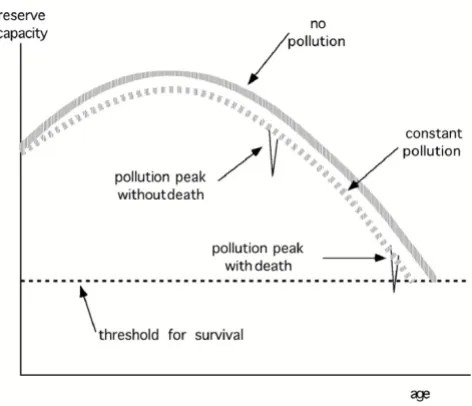
But the fact that pollution-related deaths occur only in the frail pool does not mean that pollution has no effect on the rest of the population. Rather it contributes to reduc-ing the reserve capacity of the body, as illustrated very schematically in Fig. 1, without trying to give a precise def-inition of reserve capacity other than saying that it is inversely related to frailty (Fig. 1 is inspired by a graph in chapter 4 of NRC [23]). A young, healthy body has enough reserve capacity not to feel the relatively slight
reduction due to acute or chronic pollution exposure. But the old or sick may be pushed below the threshold where death occurs. As individuals age, they inevitably move into the pool of the frail. By diminishing the reserve capacity, pollution advances the passage into the frail pool and shortens life expectancy. On average, the inflow to the frail pool equals the outflow. Time series studies measure the effect of pollution fluctuations on the out-flow from this pool, as reflected in the number of deaths per day.
Change of mortality after change of exposure
Fig. 2 shows a qualitative picture of the effect of a reduc-tion of exposure on D, the number of deaths per day in a stationary population. In these graphs, the lower dashed line represents the individuals whose deaths are post-poned and the upper dashed line the postpost-poned deaths when they do occur. The dashed lines are not observable. Only the net effect can be observed, shown by the heavy solid line, which is the sum of these dashed lines. The exposure reduction is temporary in parts a) and b), and permanent in c). In part a), all individuals enjoy the same LE gain ∆L, so the upper dashed line is the mirror image of the lower one, but shifted by ∆L. In part b), there is a distribution of different LE gains; it broadens the upper dashed curve. After the initial drop, the solid line moves above Dref; that is a manifestation of the compensating change mentioned in the introduction. The onset of the compensating change gives a rough indication of ∆L.
Part c) shows the effect of a permanent decrease of expo-sure (for simplicity for the case where all individuals enjoy the same LE gain ∆L). Here the postponed deaths reach a constant asymptotic level. The observable death rate drops at first, but then increases again, gradually reaching the original level, even though the LE gain is permanent. D must eventually return to the original level, because in a stationary population the birth rate is constant and equal to D. Deaths have been postponed, but not avoided. Eventually, a new stationary state is reached, with a longer life expectancy and thus a larger population (for the same birth rate). The mortality rate is the ratio of D and popu-lation size. The latter increases permanently, whereas D returns to the original value.
Relation between age-specific mortality and life expectancy (LE)
To obtain quantitative results, it is helpful to recall some well-known elements of survival analysis. Let µ(x) be the age-specific mortality rate, defined such that someone who has reached age x has a probability µ(x) ∆x of dying between x and x + ∆x (usually one chooses ∆x = 1 yr). The fraction of a birth cohort of initial age x0 that survives to age x is called survival function Sµ(x0, x). As shown in Appendix A [see Additional file 1], it is given by
Sketch of reserve capacity of the body
Figure 1
and the remaining LE of a cohort of age x0 can be calcu-lated as
If µ(x) is given, Sµ(x0, x) and L(x0) are thus uniquely deter-mined. Vice versa, the function L(x) determines µ(x), as shown in Appendix A. Because of the one-to-one relation-ship between µ(x) and life expectancy L(x), the mortality impact of air pollution can be analyzed in terms of a change in mortality rate or in terms of the corresponding LE change ∆L. Here, and throughout the paper, ∆L is the
change per person, averaged over the population or pop-ulation segment under consideration.
Relation between LE change and mortality after intervention
Let us evaluate the change in mortality and LE as a func-tion of time t after a permanent reducfunc-tion of exposure at t = 0, the population having been stationary before the intervention. Here, we look only at the entire population; more detailed equations for the effect on a cohort of a given age are derived in Appendix B [see Additional file 2]. Consider a large stationary population of N individuals and the number of deaths per time, designated by D. It will be convenient to look at D, because its change can be related directly to the postponement of the individual deaths. The population-averaged mortality rate µ (i.e. the average of µ(x) over the age distribution) is the ratio
µ = D/N. (3)
Let µref be the mortality before and µ(t) be the mortality after an intervention that reduces air pollution perma-nently by a constant amount. The relative risk is
RR(t) = µ(t)/µref (4)
and it corresponds to an LE change
∆Lt) = L(t) - Lref. (5)
D and N are functions of the time t after the intervention. D and N before the intervention, designated by Dref and Nref, are independent of time, because the population is stationary. Dref is equal to the birth rate. To find the evolu-tion of D(t) and N(t) after the intervenevolu-tion and the rela-tion between µ(t) and ∆L(t), let us begin by assuming a homogeneous population in the sense that all individuals experience the same LE gain ∆L(t).
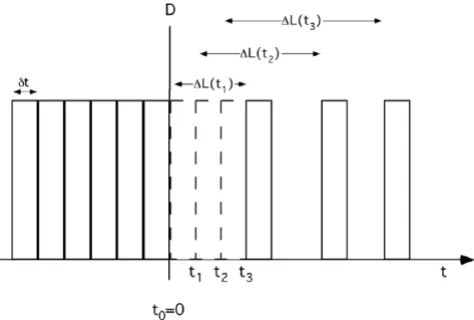
It is helpful to consider small discrete time steps δt and to plot D as a sequence of boxes of width δt, with the height representing the number of deaths during δt (see Fig. 3). Before the intervention, D = Dref = constant and the spac-ing of the boxes is uniform. After the intervention, the deaths occur later. The effect of this postponement of deaths on D can easily be understood by considering the shift of the boxes to the right, as shown in Fig. 3 for t > 0. This results in an increase of the spacing between the boxes, with D(t) being proportional to the density of the boxes.
If the entire gain occurred instantaneously at t = 0, all deaths would be postponed by the same amount; thus the spacing would again be dense and uniform after the first
Sµ(x0, )x exp[ µ(x’) dx’],
0
1
= −
∫
xx( )
L x( 0) S x( 0, )x dx. 2
0
=
∫
x∞ µ( )
Qualitative picture of rate of deaths after an exposure reduc-tion
Figure 2
shift. In reality, the gain ∆L(t) increases gradually with t, and the resulting spacing depends on its rate of change
∆L'(t) = d∆L(t)/dt. (6)
To find the density of boxes, note that between ti + ∆L(ti) and ti+1 + ∆L(ti+1) there is one box. For small δt, this time interval is δt + ∆L'(ti)δt, and the density is 1 box/[δt +
∆L'(ti) δt]. At time t + ∆L(t), the ratio of the density of boxes after and before the intervention is therefore
and since D is proportional to the density one obtains
D(t+∆L(t)) = Dref/(1 + ∆L'(t)) (8)
for t > 0. For a reduction of the exposure, ∆L(t) increases with t, ∆L'(t) is positive and D is less than Dref. For later reference, let us note that Eq.8 also holds for the case where the exposure increases and ∆L'(t) is negative. When the asymptotic gain ∆L∞ has been reached, ∆L'(t) vanishes and D(t) is again equal to the initial value Dref, because the birth rate has remained constant. But the mortality rate µ has decreased permanently, because the population size N has increased in proportion to the LE.
So far, we have assumed that all individuals have identical gains. In reality, there is a distribution of different individ-ual gains. Averaging the quantity 1 + ∆L'(t) over this dis-tribution, the ratio Dref/D(t) is replaced by its average over the individual gains. For the small changes involved in air pollution studies, the average of Dref/D(t) is very close to Dref divided by the average D(t).
The LE gain ∆L(T), after a time T following the interven-tion, can be obtained by integrating the measured data for Dref/D(t+∆L(t)) of Eq.8
since ∆L(0) is of course zero. This is an integral equation, because ∆L appears on both sides. However, in practice one can approximate the result by integrating in steps, obtaining the gain at tk+1 from the one at tk
The ultimate gain ∆L∞ is the limit reached when T →∞; in practice, the finite observation period yields only a lower bound (note that the integrand is positive-definite for a permanent pollution decrease), but a leveling off of the
integrand would indicate that one is getting close to the ultimate gain. The units of ∆L(T) are the same as the ones chosen for t since the integrand is dimensionless. The result is the gain per person averaged over the study pop-ulation.
The mortality µ(t), and hence the relative risk, can be obtained by dividing D(t) by the size of the respective populations according to Eq.3. Since the birthrate is con-stant, the population size N(t) increases with LE, ulti-mately reaching
N∞ = Nref (Lref + ∆L∞)/Lref (11)
when new stationary conditions are established (Lref being the LE before the intervention). Whereas D returns asymp-totically to the initial value, the mortality rate µ is lower because people live longer and the population size has increased.
The exact time dependence of N(t) and µ(t) would require a more detailed calculation, because, during the transition to the new stationary state, different age groups increase differently; but in any case, N(t) is bounded by Nref and N∞. Since the population-average LE gain is short com-pared to Lref (at most a few months compared to about 75 years, see Eq.17 below), the change of the population size is entirely negligible in practice, considering the uncer-tainties of the data, and one can use the approximation
RR(t) = µ(t)/µref ≈ D(t)/Dref. (12)
Since the change in relative risk ∆RR(t) due to typical exposures is small compared to unity, one can further approximate Eq.9, with negligible error, by
Stepwise integration as in Eq.10 can be used, although the
∆L(t) on the right hand side can be neglected if T is rela-tively short, as shown by the example in the following Sec-tion.
To conclude this section, I emphasize that the key result is Eq.9 (or 13), which yields the LE change after an interven-tion as time integral of the observed death rate (or change of relative risk). As written, it is appropriate for the entire population, but with the obvious addition of a label x for age, it also holds for a constant age segment or for a birth cohort of age x, as shown in Appendix B [see Additional file 2].
density at t L t density at t
t
t L t t L t + ∆
< = + ∆ = + ∆
( )
( )
’( ) ’( ) 0
1
1 7
δ
δ δ
∆ = ∆ =
+ ∆ −
( )
∫
∫
L T( ) L t dt’( )
( ( )) ,
0 0 1 9
T T Dref
D t L t dt
∆ = ∆
+ ∆ −
( )
+
∫
+L t( k ) L t )+(k
( ( )) .
1 1 1 10
D
D t L t dt ref
k t
t
k k
∆L T( )≈ − ∆
∫
RR t( + ∆L t dt( )) .( )
13Results
LE change for time series
In the LE framework, the mortality measured by typical TS studies corresponds to an intervention study that lasts only one day. Thus, the LE change is given by Eq.13 with T = 1 day. It represents the acute loss of life immediately after a pollution peak. Let us insert into Eq.13 the relative risk for 10 µg/m3 of PM
10 found in the analysis of the NMMAPS data for 90 cities in the USA, as recently revised to correct for the GAM problem [24]; it is ∆RR(0) = 0.0021 for the GLM version of the analysis (the t = 0 indicates that this is for the first day). The result is
-∆L(1 day) = ∆RR(0) × 1 day = 0.0021 day (14)
for acute mortality, 1 day at 10 µg/m3 PM
10. It would be almost twice as high for the original GAM estimate of
∆RR(0) = 0.0041. The minus sign indicates a loss for a risk increase.
Recently Schwartz [2] and Zeger et al [1] have succeeded in extending the exposure duration up to T = 60 days, measuring, in effect, the average relative risk ∆RRav corre-sponding to the average concentration ∆cav of PM10 during the period T. They find that ∆RRav/∆cav increases with T at least up to 60 days, the longest for which their method could be used. For all-cause mortality, Schwartz found
that ∆RRav/∆cav increased linearly with T and, at 60 days, was about twice that for one day. Fairly similar results have been found in other studies that have extended the observation window [10]. Since ∆RRav is the average from t = 0 to T of the relative risk ∆RR(t) at time t, the result of Schwartz implies that
∆RR(t) = ∆RR(0) (1 + 2 t/60 days). (15)
Inserting this into Eq.13 yields
- ∆L(T) = ∆RR(0) T (1 + T/60 days) (16)
up to 60 days; it increases in linear plus quadratic fashion, reaching 0.0021 × 60 days × 2 = 0.25 days after 2 months. This is the population average LE loss per person. For sen-sitive subgroups, the loss is of course much higher, but at the present time not enough is known about individual sensitivities.
It is interesting to compare these numbers with the ulti-mate LE gain ∆L∞ achievable by a permanent reduction of PM10. That can be calculated on the basis of the cohort studies, such as the one by Pope et al [14], which are essentially steady state comparisons of the effects of differ-ent exposures. Several authors have published such calcu-lations [4,15-18], based on the cohort study of Pope et al [14], with essentially the same result for the same long term relative risk. For example, Rabl [4] found
- ∆L∞ = 92 days (17)
for lifetime exposure at 10 µg/m3 of PM
10. This is much larger than ∆L(1 day) = - 0.0021 days of Eq.14, for two rea-sons: the latter is for a single day of exposure, and it includes only acute effects. The contribution of acute mor-tality to the LE loss from chronic exposure will be addressed in the last section.
For O3, only acute mortality has been measured until now. The meta-analysis by the World Heath Organization [25] provides a ∆RR for all-cause mortality of 0.003 per 10
µg/m3 increase in the daily maximum 8-hour mean O 3. Analogous to Eq.14 the corresponding LE loss is ∆L(1 day)acute = - 0.003 days.
LE loss per death
For acute mortality the LE loss per air pollution death can be obtained by dividing the LE loss of Eq.14 by ∆Ndeaths, the number of acute deaths that are attributable to a pol-lution peak. If one calculates the latter by multiplying the daily mortality by the relative risk, one finds for a peak of one day
∆Ndeaths- = (0.01/365) × 0.0021 = 5.8E-8 (18)
Derivation of rate D of deaths per time after intervention
Figure 3
for 10 µg/m3 PM
10, taking a typical mortality for Europe and North America of µ = 0.01 per yr per person together with ∆RR(0) = 0.0021 (note that ∆Ndeaths-, like ∆L, is nor-malized per person). I have added the subscript - to indi-cate that this is a lower bound because it corresponds to the observed deaths (i.e. the solid black line in Fig. 1). The corresponding upper bound for the loss per death is
∆L(1 day)/death < 100 yr/death (19)
independent of exposure, because both numerator and denominator are proportional to exposure. Since the real loss per death is certainly much smaller, the number of attributable deaths must be much larger than what is observable.
The attributable deaths are all the deaths that have been advanced by pollution (i.e. the thin dashed line in Fig. 1). Unfortunately, that is not known. If everybody's death is advanced somewhat, even if only by an undetectably small amount, ∆Ndeaths would be equal to (0.01/365). If only a fraction fsens of sensitive individuals is affected,
∆Ndeaths+ = (0.01/365) × fsens (20)
independent of exposure, and hence the lower bound is
∆L(1 day)/death > 0.21 yr/fsens (21)
for 10 µg/m3 PM
10, proportional to exposure.
Models for the repair processes
Whereas all the results up to this point follow from the data, the rest of the paper invokes models of the action of pollution damage and is thus more speculative. A model is necessary to estimate how the mortality rate will change during an intervention study, beyond the period for which data are available (60 days for PM10, at most a few days for O3 and SO2).
Let us assume that the LE loss is proportional to the con-centration c of the pollutant. Furthermore, past concentra-tions have less impact now because the body is able to repair some of the damage, an ability well documented in the case of ex-smokers [19-21]. To account for repair, it seems plausible to assume exponential decay for the effect of past exposures. If there is only a single time constant τ one obtains the following model for the LE loss at time t due to a sequence of concentrations {c(t')} between t0 and t
where c(t') is the concentration at time t' and k is a propor-tionality constant. The minus sign is introduced, because concentrations are positive and ∆L is a loss. A more realis-tic model contains several terms with different time con-stants, as described in Appendix C [see Additional file 3]. If the body could not recover, the time constant(s) would be infinite and the LE loss would depend only on the cumulative exposure, not on its distribution over time
Leksell & Rabl [15] reviewed the studies of ex-smokers, especially the one by Doll et al [20], one of the most com-prehensive long term studies of smokers and ex-smokers. They found that the recovery can be approximated quite well by an exponential decay model with two time con-stants: a time constant of 1.5 years with weight 0.3 and one of 13 years with weight 0.7. Similar conclusions can be drawn from the data in USDHHS [19].
Applying time constants from smoking studies to air pol-lution entails uncertainties. For PM, the similarities in pollutant composition and in the nature of the health end points may be close enough for this purpose. Röösli et al [22] have analyzed the two available intervention studies that involve PM10 and found a time constant of 1.1 yr for the Utah steel mill intervention [7] and 9 yr for the inter-vention in Dublin county [9]. These values are consistent with those from smoking if one notes that the duration of the Utah intervention was only about one year, too short to allow the determination of longer time constants, and whereas the change in Dublin was permanent the study period of Clancy et al covered only six years. For other pol-lutants, such as O3 and SO2, the estimation of time con-stants is more problematic.
At this point I use a model with a single time constant, for the purpose of illustration. For a permanent step decrease
∆c of the concentration the LE gain is
∆L(t) = - k ∆c τ [1 - exp(-t/τ)] (23)
with t = time after decrease. The ultimate gain, for t →∞, is
∆L∞ = - k ∆c τ. (24)
One could include an age dependence in ∆L(t) and k, although the available data do not show any significant variation with age [26].
Since some of the repair probably does not begin imme-diately, some of the LE gain is delayed relative to the model of Eq.23. A more realistic model would include a distribution p(λ) of different lags λ between exposure and LE change, replacing Eq.23 by
∆L t( )= − k
∫
c(t’) exp[ (− −t t’)/ ] dt’,( )
tt
0
22
Possible outcomes
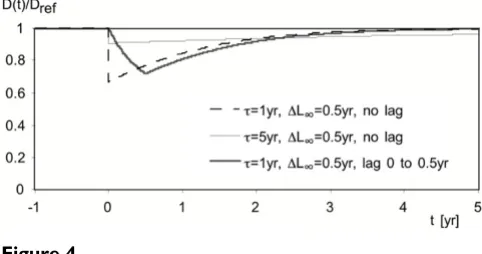
Results are plotted in Fig. 4 for three models. For all of them, D(t) drops to a minimum soon after the interven-tion, but then increases again, becoming almost indistin-guishable from the old values after several time constants. Without lag the initial drop is abrupt and has magnitude
D(0)/Dref = 1/(1 + ∆L'(0)) = 1/(1 - k ∆c) (26)
if no lag, regardless of the number of time constants in the model. With a distribution of lags, the drop is gradual, as shown by the thick gray line in Fig. 4 for which a uniform distribution of lags from 0 to 0.5 yr has been assumed arbitrarily. The area between the curve and the line D(t)/ Dref = 1 is equal to ∆L∞.
Discussion
Relation between time series and cohort studies
Even though the designs of cohort and time series studies are very different, in particular with regard to the account-ing for characteristics of individuals, the results should be consistent to the extent that the end point is comparable. That time series and cohort studies have a common ground has also been shown by Burnett et al [11], formu-lated in terms of relative risk (hazard function). Since the models of the Section Results yield the entire time dependence of the mortality after a change in exposure, they imply a relation between the results of TS and cohort studies.
In these models, the frail pool is implicit: it consists of the individuals who are going to die in the near future and whose deaths would be advanced by a pollution peak to the days following the peak. The LE change in these equa-tions expresses the total effect of pollution on a stationary population, without distinguishing between acute effects from recent exposure and chronic effects from past expo-sure.
If the models are also valid for acute effects, they can be applied to a TS of fluctuations, because it does not matter whether concentrations increase or decrease: the models are linear and the exposure for each new day is added to the previous exposures. The concentrations are always positive, whether increasing or decreasing. The effects are symmetric between increases and decreases. A single peak of duration t is equivalent to the superposition of a per-manent increase and a perper-manent decrease of equal mag-nitude t later. The change in mortality that would be found in a time series during the first day (or days) after a pollution peak is the change during the first day (or days, up to t) in Fig. 4.
As an example, consider the model of Eq.25 with one time constant τ and a distribution p(λ) of lags, applied to the entire population. With the approximations already made in Eq.13 for the relation between ∆RR(t) and ∆L'(t) for short times t one obtains
∆RR(t)/∆c = k P(t) (27)
with
With the TS result of ∆RR(0)/∆c = 2.1E-03 per 10 µg/m3 PM10, Eq.14, this fixes the relation between k and P(t) at t = 1 day
k = 2.1E-03/P(1 day) (29)
per 10 µg/m3 PM
10. On the other hand, combining Eqs.17 and 24 for the LE loss ∆L∞, one obtains
k τ = 0.23 yr (30)
per 10 µg/m3 of PM
10. Assuming τ around 10 yr one finds k = 0.023 per 10 µg/m3. Thus the two estimates of k agree if P(1 day) = 0.0021/0.023 = 0.09 (i.e. if only 9% of the repair begins during the first day). Of course, the epidemi-ological estimates are quite uncertain, and the model for repair is speculative and crude, especially if it contains only one time constant. Nonetheless, it is encouraging that the two estimates of k are compatible.
Contribution of acute mortality to LE loss from chronic exposure
The LE loss of Eq.14 is the acute mortality (i.e. the mortal-ity during the first day of a one-day of exposure). For health impact assessments of pollutants for which only TS results are available, one needs to evaluate the acute impacts of successive one-day exposures. That is not sim-ply the product of the one-day impact times the exposure duration, because past exposures are reduced by the repair capacity of the body. The LE loss of Eq.14 cannot be used directly, because it is for a single peak.
Let us split the LE change of Eq.25 into an acute contribu-tion ∆Lac plus the rest, the acute term being the effect of each day's exposure during that same day. Assuming a one-time constant model for the acute term, one finds, analogous to the derivation of Eq.24, that the cumulative change resulting from an infinite series of one day expo-sures to ∆c is
∆Lac(∞) = - kac∆c τac. (31)
∆L t( )= − ∆ k c τ
∫
d pλ λ( ) [1−exp( (− −t λ τ)/ )].( )
0 25
t
P t( )=
∫
d pλ λ( )exp( (− −t λ τ)/ ).( )
0 28
Since the change ∆L(1 day)= ∆RR(0) × 1 day (see Eq.14) from a single day is entirely due to acute effects, we can set kac equal to k P(t) of Eq.27 and obtain
∆Lac(∞) = ∆L(1 day) × τac/1 day. (32)
For acute effects, a time constant around 1.5 year is plau-sible, because it corresponds to time constants for short term cardiovascular benefits found in smoking cessation studies [21]. That implies ∆Lac(∞) = -0.0021 days × 365 × 1.5 = -1.2 days, a little more than 1% of the total acute + long term ∆L∞ = -92 days of Eq.17.
In previous publications, a different approach to estimate the LE loss due to acute mortality has been used by the ExternE project series [3], namely calculating a number of deaths as product of baseline mortality rate and ∆RR, and multiplying it by assuming 6 months as LE loss per death. Whereas the resulting ratio of acute over total LE loss for PM10 was also about 1%, the method is not correct for sev-eral reasons:
• the total number of attributable deaths is not known, as explained in Section Results;
• the LE loss per death is not known;
• the calculation does not take into account the effect of repair, because it simply multiplies one-day impact by exposure duration.
Thus number of air pollution deaths, which was shown [4] to be meaningless for cohort studies (total air pollu-tion mortality), is meaningless even for acute mortality. The approach of Eq.32 has the advantage of starting from a solid basis, namely the LE loss due to a single pollution
peak; of course, it is also problematic, because it needs to invoke a repair model.
There are question marks about the models that I have assumed, quite apart from the number of time constants and the parameter values. In particular, the triggering of deaths among frail individuals during a pollution peak (via heart attacks that can shorten the life of a few individ-uals by a large amount) is different from the accumulation of damage among the general population (small incre-mental LE loss for many individuals). So the repair model may not be correct for all acute effects, and the symmetry between increases and decreases of exposure may be only approximate. In that case, the model(s) for LE change as function of exposure would have to be modified by an explicit model for the frail pool.
Conclusion
By formulating the analysis of air pollution mortality in terms of LE (life expectancy) rather than mortality risk, one obtains a unified framework for time series studies, intervention studies and cohort studies. TS studies meas-ure the instantaneous time derivative of LE changes due to pollution. One of the advantages of this approach is that it yields as rigorous model-independent result the LE change after a pollution peak or after an intervention as an integral of the observed mortality rates. However, the esti-mation of the number of deaths attributable to air pollu-tion is problematic and so is the LE loss per air pollupollu-tion death.
The relation between the results of the different study types depends on the processes by which the body repairs air pollution damage. Using plausible models for the repair processes, one finds that the mortality rates change most strongly in the initial period after the intervention, thereafter returning to a level close to the original, even though the population has obtained a permanent LE gain. The time scale depends on the time constant(s) of the repair processes. Unfortunately, not enough is known about repair processes at the present time to allow more specific conclusions.
With the assumed repair models, one finds that the results of TS studies are consistent with the ultimate LE change due to a permanent exposure change, as determined by cohort studies. This raises the interesting possibility of using repair models to estimate the LE gain achievable by a permanent reduction in O3 exposure, a pollutant for which a significant effect has been identified so far only by TS and not by cohort studies.
Abbreviations and symbols
c = concentration of pollutant;
Plot of deaths per time D(t), before and after intervention
Figure 4
∆c = concentration change;
D = death rate of population or population segment, absolute number [deaths/time];
Dref = reference death rate of population, in the absence of an intervention [deaths/time];
k = proportionality constant for relation between ∆c and
∆L;
LE = life expectancy;
L = life expectancy;
Lref = reference life expectancy, in the absence of an inter-vention;
L(x0) = remaining life expectancy (survival time);
∆L = change in life expectancy [yr/person], positive for a gain;
∆L(t) = change in life expectancy at time t after a perma-nent decrease of concentration;
∆L∞ = ultimate change in life expectancy (long after a per-manent decrease of concentration);
N = population size;
RR = relative risk;
S(x0, x) = survival function = fraction of birth cohort of initial age x0 that survives to age x;
t = time;
TS = time series
wi = weighting factors of different time constant in repair model;
x = age;
λ = lag time of repair model;
µ = mortality rate = death rate/population size [deaths/ time per person];
µref = reference mortality rate;
τ = time constant of repair model;
Competing interests
The author(s) declares that he has no competing interests.
Additional material
Acknowledgements
This work has been supported in part by the ExternE project series of the European Commission, DG Research. The ideas were stimulated by an examination of the Hong Kong intervention study, especially during a visit to the Dept. of Community Medicine of the University of Hong Kong; I thank the Dept. of Community Medicine for the generous hospitality, where I benefited from discussions with BJ Cowling, AJ Hedley, CM Wong and TQ Thach. I am also grateful for discussions with F. Hurley, B. Festy, P. Goodman, and R. Torfs, and for comments by the referees B. Brunekreef and N. Künzli.
References
1. Zeger SL, Dominici F, Samet JM: Mortality displacement-resist-ant estimates of air pollution effects on mortality. In National morbidity, mortality, and air pollution study, part I: methods and methodo-logical issues Edited by: Samet JM, Dominici F, Zeger SL, Schwartz J, Dockery W. Research report 94. Cambridge, MA: Health Effects Institute; 2000:43-50.
2. Schwartz J: Mortality displacement and long-term exposure effects related to air pollution and mortality. In National mor-bidity, mortality, and air pollution study, part I: methods and methodological issues Edited by: Samet JM, Dominici F, Zeger SL, Schwartz J, Dockery W. Research report 94. Cambridge, MA: Health Effects Institute; 2000:51-60.
3. European Commission Directorate-General XII Science Research and Development: ExternE: externalities of energy. Methodology 1998 Update (EUR 19083); L-2920 Luxembourg; Office for Official Publi-cations of the European Communities. The methodology has been updated recently and updates7: [http://www.externe.info].
4. Rabl A: Interpretation of air pollution mortality: number of deaths or years of life lost? J Air & Waste Manage Assoc 2003,
53:41-50.
5. Samet JM, Dominici F, Curriero FC, Coursac I, Zeger SL: Fine par-ticulate air pollution and mortality in 20 U.S. cities, 1987– 1994. N Engl J Medicine 2000, 343:1742-1749.
6. Stieb DM, Judek S, Burnett RT: Meta-analysis of time-series stud-ies of air pollution and mortality: effects of gases and parti-cles and the influence of cause of death, age, and season. J Air & Waste Manage Assoc 2002, 52:470-484.
7. Pope CA3, Schwartz J, Ransom MR: Daily mortality and PM10 pollution in Utah Valley. Arch Environ Health 1992, 47:211-7.
Additional File 1
Appendix A. Relation between age-specific mortality and life expectancy. Click here for file
[http://www.biomedcentral.com/content/supplementary/1476-069X-5-1-S1.doc]
Additional File 2
Appendix B. Change due to intervention, by age group. Click here for file
[http://www.biomedcentral.com/content/supplementary/1476-069X-5-1-S2.doc]
Additional File 3
Appendix C. Repair model with several time constants. Click here for file
Publish with BioMed Central and every scientist can read your work free of charge
"BioMed Central will be the most significant development for disseminating the results of biomedical researc h in our lifetime."
Sir Paul Nurse, Cancer Research UK
Your research papers will be:
available free of charge to the entire biomedical community
peer reviewed and published immediately upon acceptance
cited in PubMed and archived on PubMed Central
yours — you keep the copyright
Submit your manuscript here:
http://www.biomedcentral.com/info/publishing_adv.asp
BioMedcentral
8. Hedley AJ, Wong CM, Thach TQ, Ma S, Lam TH, Anderson HR: Car-diorespiratory and all-cause mortality after restrictions on sulphur content of fuel in Hong Kong: an intervention study.
Lancet 2002, 360:1646-52.
9. Clancy L, Goodman P, Sinclair H, Dockery DW: Effect of air-pollu-tion control on death rates in Dublin, Ireland: an interven-tion study. Lancet 2002, 360:1210-4.
10. Goodman PG, Dockery DW, Clancy L: Cause specific mortality and the extended effects of particulate pollution and tem-perature exposure. Environ Health Perspect 2004, 112:179-185. 11. Burnett RT, Dewanji A, Dominici F, Goldberg MS, Cohen A, Krewski
D: On the relationship between time series studies, dynamic population studies, and estimating life lost due to short-term exposure to environmental risks. Environ Health Perspect 2003,
111:1170-4.
12. Dockery DW, Pope CA III, Xu Xiping, Spengler JD, Ware JH, Fay ME, Ferris BG, Speizer FE: An association between air pollution and mortality in six US cities. N Engl J Medicine 1993, 329:1753-1759. 13. Abbey DE, Nishino N, McDonnell WF, Burchette RJ, Knutsen SF, Beeson WL, Yang JX: Long-term inhalable particles and other air pollutants related to mortality in nonsmokers. Am J Respir Crit Care Med 1999, 159:373-382.
14. Pope CA, Burnett RT, Thun MJ, Calle EE, Krewski D, Ito K, Thurston GD: Lung cancer, cardiopulmonary mortality, and long term exposure to fine particulate air pollution. J Amer Med Assoc
2002, 287:1132-1141.
15. Leksell L, Rabl A: Air pollution and mortality: quantification and valuation of years of life lost. Risk Analysis 2001, 21:843-857. 16. Brunekreef B: Air pollution and life expectancy: is there a
rela-tion? Occup Environ Med 1997, 54:781-784.
17. Rabl A: Mortality risks of air pollution: the role of exposure-response functions. J Hazard Materials 1998, 61:91-98.
18. Miller BG, Hurley JF: Life table methods for quantitative impact assessments in chronic mortality. J Epidemiol Community Health
2003, 57:200-206.
19. U.S. Department of Health and Human Services: The health benefits of smoking cessation. DHHS Publication 1990 No. (CDC) Washington, DC; 1990:90-8416.
20. Doll R, Peto R, Wheatley K, Gray R, Sutherland I: Mortality in rela-tion to smoking: 40 years' observarela-tions on male British doc-tors. British Med J 1994, 309:901-911.
21. Lightwood JM, Glantz SA: Short-term economic and health ben-efits of smoking cessation: myocardial infarction and stroke.
Circulation 1997, 96:1089-96.
22. Röösli M, Künzli N, Braun-Fahrländer C, Egger M: Years of life lost attributable to air pollution in Switzerland: dynamic expo-sure-response model. Int J Epidemiol in press.
23. National Research Council: Estimating public health benefits of proposed air pollution regulation Washington, DC: National Academy Press; 2002.
24. Health Effects Institute: Revised analyses of time-series studies of air pol-lution and health: revised analyses of the national morbidity, mortality, and air pollution study, part II Cambridge, MA; 2003.
25. Anderson HR, Atkinson RW, Peacock JL, Marston L, Konstantinou K:
Meta-analysis of time-series studies and panel studies of par-ticulate matter (PM) and ozone (O3). Report of a WHO task group. World Health Organization. Geneva; 2003.