Available Online at www.ijpret.com
1
INTERNATIONAL JOURNAL OF PURE AND
APPLIED RESEARCH IN ENGINEERING AND
TECHNOLOGY
A PATH FOR HORIZING YOUR INNOVATIVE WORK
A COMPARATIVE STUDY ON COLOR REMOVAL RATE OF WATER CONTAINING
THE AZO DYE [ACID RED 14, ACID YELLOW 17 AND SUNSET YELLOW FCF]
USING ADVANCED OXIDATION PROCESS IN THE PRESENCE OF MBIRD-11 AS A
CATALYST.
HIMAKSHI VERMA, RAMESH CHAND MEENA
Department of Chemistry, Jai Narain Vyas University, Jodhpur 342001
Accepted Date: 31/01/2014 ; Published Date: 01/03/2014
\
Abstract: In Advance Oxidation Process, Heterogeneous photocatalysis is a significant technology for application in waste water treatment. The present work is focused on the heterogeneous photocatalytic decolorization of non-biodegradable azo dyes. Aqueous solutions of azo dye were treated with MBIR Dowex 11 and decolorization of dye was determined by UV Spectrophotometer. The decolorization of dyes in the aqueous solution follows first order kinetics. The result indicates that Acid Red 14 decolorized more efficiently than Acid Yellow 17 and Sunset Yellow FCF at optimum condition of light intensity, pH, dye concentration and catalyst loading.
Keywords: Advance Oxidation Process; MBIRD-11; Acid red 14; Acid yellow-17; Sunset
Yellow FCF; Heterogeneous photocatalysis; Decolorization.
Corresponding Author: Ms. HIMAKSHI VERMA
Access Online On:
www.ijpret.com
How to Cite This Article:
Himakshi Verma, IJPRET, 2014; Volume 2 (7): 1-9
Available Online at www.ijpret.com
2
INTRODUCTION
Available Online at www.ijpret.com
3
MATERIALS AND METHODS
We prepared Photocatalyst by following materials Dowex 11 Resin 20-50 mesh (Sisco Chemicals, India Mumbai), methylene blue hydrate for Microscopy (Loba Chemicals India). For immobilization we prepare approximately M/1000 concentration solution of methylene blue in double distilled water and add Dowex-11 resin in this solution and shake well. After completing immobilization of methylene blue inside the pores of resin, filter prepared resin from solution, wash this resin by double distilled water twice and used it as Photocatalyst. All the process carried out in dark place. Azo dyes are purchased from Loba chemicals and complete details are given in table-1.
Photochemical degradation experiments were carried out in glass reactor which containing solution of Azo dye and Photocatalyst. Solution of reactor is continuously stirred by magnetic stirrer during the experiment. The solution is illuminated by halogen lamp (Philips, India) above the reactor which emitted irradiation comparable to visible light. The intensity was measured by photometer (IL1400A). The lamp was surrounded with aluminum reflector in order to avoid loss of irradiation and pH of the solution was monitored by Fisher Scientific Acumen 50. The mechanism of the photo degradation process under UV-Visible light illumination involves an electron excitation and generation of very active oxygenated species that attack the dye molecules leading to photodegradation.
Dye Light Radiations Dye*1
Dye*1 ISC Dye*3
Dye*3 + I-R Dye + + I-R (e-)
I-R (e-) + O2 I-R + O2
Dye + OH Dye + + -OH
Dye/Dye+ + OH Products
I-R = Immobilized Resin
The change in dye concentration is observed simply by Shimadzu-1600 UV/Visible
spectrophotometer at λmax. We shuck out 10 ml of solution by pipette at the 10 minute time
Available Online at www.ijpret.com
4
X % = (Ci -Ct / Ci) × 100
Where, Ci and Ct are optical densities of dye solution at initial time and at time t respectively. A
schematic diagram of the set-up can be seen in Fig. 1.
RESULT & DISCUSSION
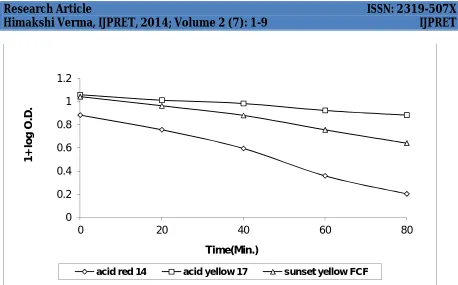
The photocatalytic degradation of Acid red 14, Acid yellow 17 and Sunset yellow FCF was observed at wave length (nm) 514, 400, 480 respectively. The optimum condition was obtained at initial dye concentration 40mg/l, catalyst loading 2gm, light intensity10.4 mWcm-2, pH 7.5 and temperature 303K. Photodegradation efficiency of dyes at optimum conditions is shown in figure-2. The plot of 1+ log O.D. versus exposure time is straight line which indicates that the photocatalytic decolorization of azo dyes follows pseudo first order kinetics (fig-3). The rate constant K for the reaction was determined using expression – rate =K [azo dye], K= 2.303 * slope. The rate constant of dyes are given in table-2.
CONCLUSION
Immobilized Dowex-11 has low cost, high catalytic activity and extended potential for reuse. It can efficiently catalyze the decolorization of Azo dyes Acid red 14, Acid yellow 17 and Sunset yellow FCF in presence of light. The dye Acid Red 14 is decolorized more efficiently as compare to dyes Acid Yellow 17 and Sunset Yellow FCF. The dye Sunset Yellow FCF is decolorized more efficiently as compare to dye Acid Yellow 17. Therefore this technology has very good potential of organic molecule degradation from complex molecule to simpler molecules. Azo dye which pollutes large part of textile effluent can transform in colorless and nontoxic compounds so this catalyst may applicable for industrial purpose for improvement in quality of waste water of textile industries and many others.
ACKNOWLEDGEMENTS
Available Online at www.ijpret.com
5
Table-1 Properties of Azo Dyes
Table-2 Rate constant of Azo dyes
s. no. Azo dye Rate constant
1 Acid red 14 1.86*10-2
2 Acid yellow 17 0.513*10-2
3 Sunset yellow FCF 1.19*10-2
Color index
Acid Red 14 Acid Yellow 17 SunSet Yellow FCF
max (nm) 514 400 480
Mol. Wt. (gm/mol)
502.4 551.29 452.37
Azo group 1 1 1
Type Acidic Acidic Acidic
Available Online at www.ijpret.com
6
Figure 1: Experimental Set-up of Photochemical Reaction Chamber
Figure-2 Removal efficiency of dyes 0
0.2 0.4 0.6 0.8 1 1.2
0 20 40 60 80 100 120
E
ff
ic
ie
n
c
y
Time (min.)
Available Online at www.ijpret.com
7
Figure 3: Kinetic study of Azo dyes Photocatalyst system.
REFERENCE
1. Mehta R, Surana M, Comparative study of photo-degradation of dye Acid Orange -8 by Fenton reagent and Titanium Oxide- A review, Sch. Res. Lib., 4 (1) (2012) 311-319.
2. Stolz A, Basic and applied aspects in the microbial degradation of azo dyes, Appl. Microbial. Boitechnol., 56 (2001) 69.
3. Chung K T, Cerniglia C E, Mutagenicity of azo dyes: structure-activity relationships, Mutat. Res., 277 (1992) 201.
4. Brown M A, De Vito S C, Predicting azo dye toxicity, Crit. Rev. Environ. Sci. Technol., 23 (1993) 249.
5. Neppolian B, Choi H C, Sakthivel S, Arabindoo B, Murugesan V, Solar light induced and TiO2 assisted degradation of textile dye reactive blue 4 Chemosphere, 46 (2002) 1173.
6. Sleiman M, Vildozo D, Ferronato C, Chovelon J M, Photocatalytic degradation of azo dye Metanil Yellow: Optimization and kinetic modeling using a chemometric approach, App. Catal. B: Environ., 77 (2007) 1-11.
0 0.2 0.4 0.6 0.8 1 1.2
0 20 40 60 80
1
+
l
o
g
O
.D
.
Time(Min.)
Available Online at www.ijpret.com
8
7. Tang W Z, An H, UV/TiO2 photocatalytic oxidation of commercial dyes in aqueous solutions, Chemosphere, 31(1995) 4157.
8. Meshko V, Markovska L, Mincheva M, Rodrigues A E, Adsorption of Basic dye on granular activated carbon and natural zeolite, Wat. Res., 35 (2001) 3357.
9. Kuo W S, Ho P H, Solar photocatalytic decolorization of methylene blue in water, Chemosphere, 45(2001) 77.
10.Galindo C, Jacques P, Kalt A, Photooxidation of the phenylazonaphthol AO20 on TIO2: kinetic and mechanistic investigations, Chemosphere, 45 (2001) 997.
11.Cooper P, Removing colour from dye house waste waters - a critical review of technology available, J. Soc. Dyers. Colour. 109 (1993) 97.
12. Patil S S, Shinde V M, Biodegradation studies of aniline and nitrobenzene in aniline plant wastewater by gas chromatography, Environ. Sci. Technol., 15(1988) 1160.
13. More A T, Vira A, Fogel S, Biodegradation of trans-1, 2-dichloroethylene by methane utilizing bacteria in an aquifer simulator, Environ. Sci. Technol., 23 (1989) 403.
14.Venceslau M C, Tom S, Simon J J, Characterization of textile wastewaters- a review, Environ. Technol., 15 (1994) 917.
15.Arslan I, Balcioglou I A, Degradation of commercial reactive dyestuffs by heterogenous and homogenous advanced oxidation processes: a comparative study, Dyes Pigments, 43 (1999) 95.
16. Pagga U, Taeger K, Development of a method for adsorption of dyestuffs on activated sludge, Wat. Res., 28 (1994) 1051.
17. Sheng H L, Chi M L, Treatment of textile waste effluents by ozonation and chemical coagulation, Wat. Res., 28 (12) (1993) 1743.
18. Lin S H, Liu W Y, Continuous treatment of textile water by ozonation and coagulation, J. Environ. Eng, 120 (1994) 437.
19.Strickland F, Perkins S, Decolorization of Continuous Dyeing Wastewater by Ozone, Text. Chem. Color., 5 (1995) 11.
Available Online at www.ijpret.com
9