*
Corresponding author Received December 10, 2012
1 Available online at http://scik.org
Engineering Mathematics Letters, 2 (2013), No. 1, 1-19 ISSN 2049-9337
COMPUTATION OF ONTOLOGY RESEMBLANCE COEFFICIENTS
FOR IMPROVING SEMANTIC INTEROPERABILITY
LAMBRINI SEREMETI1, IOANNIS KOUGIAS2,*
1
Faculty of Science and Technology, Hellenic Open University, Patras, Greece
2
Department of Telecommunication Systems and Networks, Technological Educational Institute of Messolonghi, Greece
Abstract: In open and dynamic environments, where various heterogeneous agents need to communicate, a shared ontology that explicitly and formally describes the whole domain of interest, or an alignment that provides semantically related entities among distinct ontologies, can be employed. The former case is infeasible, because a unique conceptual view of a domain is not widely accepted. Hence, the case, usually adopted, is the latter, where independently developed heterogeneous ontologies exist. A challenging issue is how an agent, charged with the task of carrying out the alignment, should select a suitable execution of matchers, to establish correspondences between ontology entities, in the fastest and most efficient way. A solution to this challenge is to use metrics for estimating the resemblance of a given pair of ontologies. To this end, we propose two metrics, as similarity coefficients, to estimate the lexical or structural resemblance of a given pair of ontologies.
Keywords: ontologies; heterogeneity; ontology alignment; similarity metrics; semantic interoperability.
1. Introduction
The ability to communicate is one of the key capabilities of an agent (whether human,
or machine) within a multi-agent environment. The entities in these smart
environments can maintain their own semantic descriptions by using ontologies, which
are formal knowledge representation models [6]. Unfortunately, the variety of ways
that a domain can be conceptualized, results in the creation of heterogeneous
ontologies with contradicting, or overlapping parts. The heterogeneity, at the ontology
level, can mainly occur because of two reasons: (1) different ontologies could use
different terminologies to describe the same domain of interest, and (2) even if two
ontologies use the same names/labels for their entities, their corresponding structure
can be different. Consequently, in order to achieve successful communication within
such environments, where ontologies are used, it is necessary to bring them into a
mutual agreement, that is, to align them, by establishing semantically related entities
between the two ontologies [3]. Various methods and tools for assisting the process of
ontology alignment have been developed. Based on our experience [9] with small and
medium size ontologies which are characterized by limited hierarchy and not
well-defined terminology, we have observed that the proposed algorithms
(lexical-based, structure-based, constraint-based, instance-based) and strategies
(execution of a single alignment algorithm, a parallel, or a sequential execution of
ontology alignment algorithms) do not perform well in the case of limited hierarchy
structure of the involved ontologies, or absence of constraints, or entity labels being
tightly oriented towards the creator’s view of the domain and not towards a general,
common and agreed-upon vocabulary of the domain.
The usual practice in an alignment problem is to select a suitable alignment tool,
import the ontologies in question and finally accept, or reject some of the suggested
correspondences that the tool has produced. This is significantly far from getting
quickly the best results, because it depends on the selection of the tool, its collection of
matchers (alignment algorithms), their composition in execution (parallel, or
kind of heterogeneity they introduce, etc. So, one of the challenging issues in ontology
alignment in multi-agent environments, when good results in real-time are needed, is to
estimate whether the heterogeneity of the ontologies to be aligned, is mainly lexical, or
structural.
The solution we propose to this challenging issue is to assess the lexical and the
structural similarity of the pair of ontologies to be aligned and depending on these
measures, decide whether to apply a string-based, or a structure-based alignment
algorithm.
The rest of this paper is organized as follows: Sections 2 and 3 briefly introduce related
work in ontology alignment and various similarity metrics that are used by different
matchers, in order to compare entities of a given pair of ontologies from different
perspectives. Section 4 presents the proposed similarity measures as coefficients able
to estimate two ontologies’ resemblance and Section 5 concludes with future work.
2. Related Work on Ontology Alignment
Many researchers have investigated the problem of ontology alignment, mostly by
proposing several ontology alignment tools and matchers (or matching algorithms) [4],
[5], [7], which exploit various types of information in ontologies, that is, entity labels,
taxonomy structures, constraints and entities’ instances. These tools can be classified
into two large categories: those that make use of a single matcher in order to calculate
similarities between ontology entities and those which use a family of parallel or
sequential matchers in composition. In the latter category, the similarity between two
ontology entities is finally computed by a composite method, such as a weighted
aggregation of the similarities obtained by each matcher separately.
A challenging issue while applying these methods consists of deciding whether a
single matcher, or a combination of different matchers, performs better and in what
cases, that is, for which kind of ontologies in question. Hence, given a specific pair
matcher should be used. Based on this consideration, we propose the calculation,
during a pre-alignment step, of two similarity coefficients, which estimate whether the
resemblance of the ontologies in question is mainly lexical, or structural. Then,
depending on their values, an agent who is charged with the task of the alignment
process, can select the execution of suitable matchers, in order to establish
correspondences between ontology entities, in a more effective and efficient way.
3. Related Work on Similarity Metrics
Considerable work has been made on metrics for measuring the degree of similarity
between two entities of the ontologies to be aligned [2], [5], [8]. These metrics are
functions that map a pair of entities of a given pair of ontologies to a value between 0
and 1, and they can be mainly classified into string-based and structure-based metrics.
The purpose of these measures is to have a means to calculate lexical or structural
similarity, respectively, between the entities of the given ontologies.
Our goal in presenting the new measures is to study the resemblance between
ontologies in question, instead of studying the detailed relationship between entities of
the given pair of ontologies, as do the metrics proposed in the literature. Although
these metrics can provide good results regarding the similarity between entities, that is,
at the entities’ level, they are inappropriate at the ontology level. Ontologies used in
multi-agent environments require processing in real-time, so the complexity of the
classical metrics used at the ontology level, should be very low, leading to a fast
estimation of ontologies’ resemblance. As far as we know, such a kind of measures is
used by the RiMOM ontology alignment multi-strategy [10], in order to enhance the
alignment process. In comparison with RiMOM’s metrics, our proposed measures
appear to be more accurate, as we demonstrate later in section 4.
4. Similarity Coefficients
An agent charged with the task of the alignment process must be aware of the
coefficients for ontology resemblance (structural, or lexical). These coefficients are
used during a pre-alignment process, in order to select the suitable family of matchers,
as well as the way of composing them. Their values fall into the range of the closed
interval [0,1] . The first of the similarity coefficients examines the relative structure of
the two ontologies, based on the comparison of the lengths of all paths leading from
the root of each ontology to each of its leaves. The second one, after discovering
concepts with identical labels in both ontologies, considers the relative proximity of
these common concepts, inside each one of the ontologies to be aligned.
4.1 Definition of Similarity Coefficients
We define the Structural Similarity Coefficient, denoted by(O O1, 2), which is a similarity metrics at an ontology level (as opposed to an entity level), with values that
range from 0 to 1 . The Structural Similarity Coefficient describes the similarity
between two ontologies globally (as opposed to local structural similarities between
ontology entities), based on their structural resemblance. In order to compute it, one
has to follow the constructive procedure described below:
4.1.1 Definition of the Structural Similarity Coefficient
Given two ontologies O1andO2, calculate the vectors l1, l2 having as elements the lengths of all the paths from the root of each ontology, to all its leaves, i.e.,
1 11,12,..., ,...1i
l l l l , with l1i length of the path from the root of ontology O1 to its
th
i leaf, i1, 2,..., # leaves of ontology O1
2 21, 22,..., 2j,...
l l l l with l2j length of the path from root of ontology O2 to its
th
j leaf, j1, 2,..., # leaves of ontology O2
greatest dimension and by completing the other vector with leading zeros. Both vectors
a, t, have dimension L.
If | | |li lj|, i j, {1, 2} and i j, then ali, t 0,lj, with the dimension of 0 being equal to Lmin{| |,|l1 l2|}.
Now compute a square LxLmatrixC, with elementscij |aitj|, i j, 1, 2,...,L.
Then, create two new vectors r ands, by appropriately reordering the vectors a
and t, as explained hereafter.
Let us consider two sets B and T with cardinalities equal to L and leti, i,
1, 2,...,
i L, denote their respective elements. Consider the bipartite graph having as
nodes the elements of the sets B and T and containing all possible edges between
respective elements of the two sets. The edge linkingi, to j i j, 1, 2,...,L, has a
weight equal to cij |aitj|. One can then always find a square matrix X with
dimensions LxL having elements xij , ,i j1, 2,...,L , such that the following
relations hold:
1. i 1, 2,...,L,
1
1
L
ij j
x
2. j 1, 2,...,L,
1
1
L
ij i
x
3. i j, 1, 2,..., ,L xij 0
4.
1 1
L L
ij ij
i j
c x
is minimizedIt can be proven that such elements xij, ,i j1, 2,...,L, exist and take either the value
while the jth element of the reordering s is sj tj. The structural similarity
between the two ontologies is finally calculated as the cosine of the angle between the
vectors r and s:
1 1 2 2 2 1 1 . ( , ) || || . || || L i i i L L i i i i r s r s O O
r s r s
. (1)We define the Lexical Similarity Coefficient, at an ontology level, with values ranging
from 0 to 1. In order to calculate the Lexical Similarity Coefficient, we consider two
factors. The first factor is based on the number of concepts/classes having the same
label in both ontologies (inter-ontology factor), while the second one takes into
account the relative proximity that these common concepts have among them, inside
each one of the ontologies (intra-ontology factor).
4.1.2 Definition of the Lexical Similarity Coefficient
Given two ontologies Oi and Oj, ,i j1, 2, i j , with a number of cc pairs of
concepts with the same label, that is, ( 1Oi, 1Oj),
2 2
( Oi, Oj),…,( Oi, Oj)
k k
, ,i j1, 2,
i j , k 1, 2,...,cc, respectively, the Lexical Similarity Coefficient is calculated as:
1
1
max( , )
( , )
max(# , # )
[
]
j i j i O Occ k k
O O
k k k
i j i j O O conceptsofO conceptsofO
, (2)
, 1, 2
i j , i j, where the term
Oik
ranks concept Oi
k
of ontology Oi, by taking
into account how far, in terms of number of edges, the remaining common concepts
,
i
O
p p k
are from concept Oi
k
in ontology Oiand is given by
1 2 1 1 , ,1 1 1 ...
1 1
, ,
... 1 1 1 1 ,
1 1
i i
i i i i
i i
i i
O O
k k
O O O O
k k k k
O O
k m O m k m O m
k k
d n d n
cc cc
d n d n
cc cc
where
1
1 ( 1)sgn[( 1) , ]
i i
O O
k cc d k n
1
, (4)
with , ( 0 1 ) a constant added to the rank of common concept Oi
k
, due to its
lexical similarity to concept Oj, , 1, 2,
k i j i j
and where we define:
1
n to be the 1-neighborhood of concept Oi
k
, containing all common concepts
,
i
O
p p k
, that are within a distance of exactly one edge from Oi
k
in Oi,
2
n to be the 2-neighborhood of concept Oi
k
, containing all common concepts
,
i
O
p p k
, that are within a distance of exactly two edges from Oi
k
in Oi,
…
…
m
n to be the m-neighborhood of concept Oi
k
, containing all common concepts
,
i
O
p p k
, that are within a distance of exactly m edges from Oi
k
in Oi,
nm1
O to be the remote-neighborhood of concept Oi
k
, containing all common
concepts Oi,
p p k
, that are within a distance of more than m edges from Oi
k
in
i O .
Then,
Oi,
, 1, 2,...,k q
d n q m, denotes the number of common concepts Oi,
p p k
that are within a distance of exactly qedges from Oi
k
in Oiand
Oi, ( 1)
k m
d O n
denotes the number of common concepts Oi,
p p k
, within a distance of more than
m edges from Oi
k
in Oi.
1
The signum function is defined as:
1 0
sgn( ) 0 0
1 0
if x
x if x
1
1
2 is a forgetting factor, penalizing more severely the common concepts
,
i
O
p p k
that are more distant from Oi
k
in Oi (in more distant neighborhoods).
4.2 Implementation of Similarity Coefficients
The idea behind the Structural Similarity Coefficient, is to compare the structure of the
two ontologies, based on the minimization of the sum of the absolute values of the
differences between the lengths of all the respective pairs of paths belonging to the two
ontologies; these paths lead from the root of each ontology to each of its leaves.
In order to count the lengths of the paths, we can use a graph traversal algorithm like
DFS (Depth First Search) together with a counter, initialized at zero, augmented by
one each time an edge is found, decreased by one each time that backtracking is
considered and memorized in a stack each time a leaf (no descendants) is encountered.
DFS is effective enough, of complexity (V2) when a representation with adjacency matrices is used and (V E) when a representation with adjacency lists is used,
where V is the number of the graph vertices and E is the number of the graph
edges.
The vectors l1, l2 having as elements the lengths of all the paths of the ontologies thus obtained, may have different dimensions. That is why we add leading zeros to the
vector with the lower dimension, in order to compensate this difference in dimensions
(these zeros can be considered to correspond to the missing paths of one of the
ontologies with respect to the other). The vectors a and t are thus obtained. We
have now established a correspondence between the paths of one of the ontologies and
the respective paths of the second one. In the aim to minimize the sum of the absolute
values of the differences of the lengths of the corresponding pairs of paths, we need to
reorder the vectors a and t into new vectors r and s, respectively.
In order to achieve this, we reformulate the problem, as a linear assignment problem.
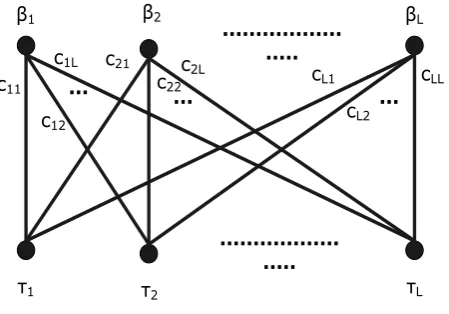
sets B and Tof cardinalityL, as seen in Figure 1. We consider that the edge linking
i
to j, i j, 1, 2,...,L, has a weight equal to cij |aitj| (i.e. the absolute value
of the difference of the lengths of the respective paths).
β1 βL
τ1 τ2 τL
... ... ...
... c11
c12
c1L c21
c22
c2L c
L1
cL2
cLL
... ... ...
β2
Figure 1. The bipartite graph between the elements of the sets Band T
The matrix C corresponds to a weight function C BxT: R. In order to maximize
the resemblance between the structures of the two ontologies, we need to minimize the
sum of the absolute values of the differences of lengths between respective paths, that
is, referring to Figure 1, we need to find a bijectionf B: T, such that the cost function
1 L
ij i
c
is minimized, with f(i)j being the image of i under the bijection f . But,this is the formal definition of the linear assignment problem. The assignment problem
is a special case of the transportation problem, which is a special case of the minimum
cost flow problem, which in turn is a special case of the linear problem. It is thus
possible to solve the minimization problem that we have, by using the simplex
algorithm (very effective in practice, generally taking 2 to 3 times the number of
equality constraints iterations at most and converging in expected polynomial time for
certain distributions of random inputs), or more specialized algorithms, like the
a matrix X with dimensionsLxL, having elements xij, i j, 1, 2,...,L, that minimizes
the objective function 1 1 L L ij ij i j c x
, subject to the following constraints:1. i 1, 2,...,L,
1 1 L ij j x
, that is, each element of the set B is assigned toexactly one element of the set T
2. j 1, 2,...,L,
1 1 L ij i x
, that is, each element of the set T is assigned to exactlyone element of the set B
Both the above mentioned constraints are due to the bijection f that we are
searching.
3. i j, 0,1,..., ,L xij0
The variablesxij , i j, 1, 2,...,L represent the assignment (or not) of i toj ,
, 1, 2,...,
i j L, taking the value 1 if the assignment is done and taking the value 0
otherwise. The vectors r and s are obtained by appropriately reordering the vectors
a and t with the help of the matrixX, which is obtained as the solution of the
simplex algorithm. The matrix X has only one non zero element in each of its rows
and in each of its columns and this non zero element has a value of 1. If for some
1
ij
x , then the ith element of the reordering r is ri ai, while the jth element of
the reordering s is sj tj.
Finally, the structural similarity between the two ontologies is calculated as the cosine
of the angle between the vectors r and s:
1 1 2 2 2 1 1
.
(
,
)
|| || . || ||
L i i i L L i i i ir s
r s
O O
r
s
r
s
As a more time efficient alternative, the reordered vectors r and s can be obtained
by simply sorting the vectors a and t with a Vlog( )V algorithm like quicksort
and then taking pairs of values which are at the same positions in the two sorted
vectors.
The idea behind the Lexical Similarity Coefficient is to initially rank each common
concept in both ontologies, based on the distance, in terms of the number of edges,
between this common concept and all the remaining common concepts, in each
ontology. Then, if a common concept is ranked equally in both ontologies, we assign
the value 1 for this pair of common concepts in the calculation of the Lexical
Similarity Coefficient, else, i.e., if a common concept is ranked differently in both
ontologies, we substract from the value of 1 , an amount which depends on the
difference of rankings.
In order to compute the Lexical Similarity Coefficient, firstly, the concepts/classes of
the two ontologies O1and O2are examined for the presence of same labels. After case normalization, diacritics suppression, blank normalization, link stripping, punctuation
elimination applied to both ontologies, a total string is formed from the labels of all
classes/concepts of ontology O1. Then, each label of classes/concepts of ontology
2
O , is compared to this total string, by using a string matching algorithm, such as the
Boyer-Moore algorithm (( )w , with w the length of the total string in O1).
In this way, corresponding pairs of same labels
1 2
1 1
( O, O ), 1 2
2 2
( O, O ),…,( O1, O2), 1, 2,...,
k k k cc
are established and memorized, with
1 O k
the label of a concept in O1and O2 k
the same label of the corresponding concept in
2 O .
For each label Oi
k
,i1, 2, k1, 2,...,cc , we then count the number of labels
,
i
O
p p k
that are in the 1 , 2 ,..., m neighborhoods of Oi
k
respectively. The remaining labels belong to the remote- neighborhoods O
nm1
in, 1, 2
i
O i . The quantities
Oi,
, 1, 2,..., , 1, 2, 1, 2,...,k q
d n k cc i q m , as well as
, ( 1) ,
1, 2,..., , 1, 2i
O
k m
d O n k cc i , can thus be computed.
Practically, we search for the labels Oi,
p p k
in the 1-neighborhood (parent_of and
children_of Oi
k
) and in the 2-neighborhood (parent_of (parent_of), children_of
(parent_of) and children_of (children_of) Oi
k
). In this special case, the remaining
labels belong to O( )n3 .
( , )
1
i
O k q
d n
cc
denotes the percentage of common labels i,
O p p k
in a distance of
exactlyqedges from Oi
k
, q1, 2,...,m, i.e. in its q-neighborhood in O ii, 1, 2.
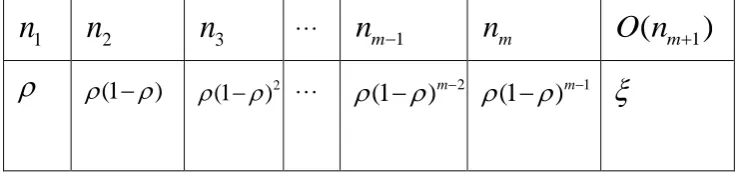
In the ideal case of an infinite number of qneighborhoods, we would like to weight
the percentage of common labels Oi,
p p k
in the nq neighborhood of Oi
k
,
according to Table 1.
Table 1. Assignment of weights in the case of an infinite number of qneighborhoods
1
n
n
2n
3 …n
q …
(1) 2(1 )
… 1
(1 )q
…In practice, we restrain ourselves up to an m-neighborhood. In this case we have the
following assignment of weights of Table 2.
Table 2. Assignment of weights in the case restrained to an m-neighborhood
1
n
n
2n
3 …n
m1n
mO n
(
m1)
(1) 2(1 )
… 2
(1 )m
1(1 )m
We calculate in such a way that the sum of weights equals 1:
2 2 11 1 ... (1 )m (1 )m 1
from which, by using 1 2 ... 1 1
1
m
m
, we deduct that (1 )
m
.
In order to have a decreasing series of weights, we impose (1)m1, which
leads to the choice 1
2
.
In the case where all Oi, p p k
are in the 1-neighborhood of Oi
k
in Oi, it is 1
i
O k
and thus ( Oi) 1
k
. In all other cases, it is 0 Oi 1
k
.
Concerning the complexity of the proposed Similarity Coefficients, the determining
factor, in the case of the Structural Similarity Coefficient, is the complexity of the
algorithm for resolving the assignment problem, while, in the case of the Lexical
Similarity Coefficient, the determining factor is the string matching problem. Since the
existing algorithms for solving these problems are efficient, exhibiting polynomial
running time, they confer polynomial computational complexity to the herein proposed
algorithms.
4.3 Examples of Similarity Coefficients
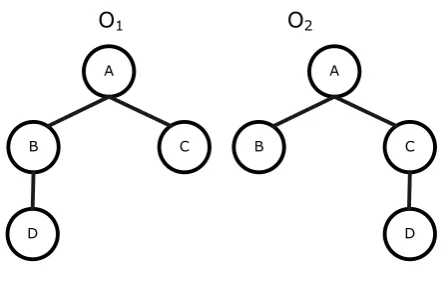
For the ontologies of Figure 2, we compute the Structural Similarity Coefficient as
1 2 2 2 2 2 2 2
2 2 1 1 1 0 5
( , ) 0.9129,
6
2 1 1 2 1 0
O O
which means that they have very similar structure. The corresponding structure
similarity factor used in [10], in order to measure the structural similarity between two
Coefficient depicts more accurately the similarity of structure between the two
ontologies, which becomes apparent when flipping O1 horizontally.
O1 O2
Figure 2. The ontologies of example 1
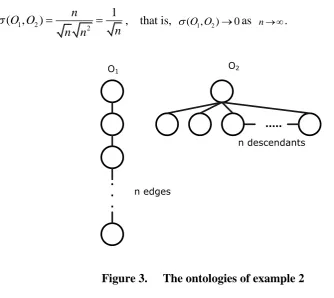
The Structural Similarity Coefficient for the ontologies of Figure 3 is calculated as
1 2 2
1
(O O, ) n
n n n
, that is, (O O1, 2)0as n .
...
O1 O2
. . .
n descendants
n edges
Figure 3. The ontologies of example 2
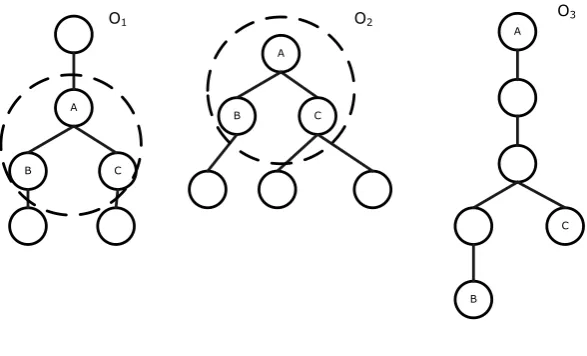
We consider now the ontologies of Figure 4 and compute the Lexical Similarity
Coefficient of pairs O1and O2and O1andO3, respectively, by choosing a0.8 and
0.6
A
B C
A
B C
O1 O2
A
C
B
O3
Figure 4. The ontologies of example 3
The ontologies O1, O2 and O3 have common labels A, B and C . Thus, cc3
and we choose m2, limiting ourselves to 1 , 2 neighborhoods n n1, 2and O
n3 .When computing the Lexical Similarity Coefficient between O1and O2, since each common concept distributes in the same way the remaining common concepts in its
neighborhoods, in both ontologies, it results that
1, 2
1 1 1 0.5 6O O
.
When comparing lexically O1 to O3, it is
AO1 =1,
1 1 0.8 1 0.2 0.6 1 0.2 0.6 0.4 0.8842 2
O O
B C
AO2 BO2 CO2 0.8 1 0.2 0.42 0.832
resulting in
1 3
(1 0.168) (1 0.0588) (1 0.0588)
, 0.4524
6 O O
.
The lexical similarity factor proposed in [10], is computed to be equal to 0.5, for both
pairs of ontologies of the above presented example, taking into account that the three
ontology), but ignoring the fact that interrelations among them are not preserved the
same in O3. In comparison, our Lexical Similarity Coefficient is more accurate. This is justified by the results obtained, where we calculate the lexical similarity between
1
O and O2to be equal to 0.5 (the interrelations among the common concepts A,
Band C are preserved in ontologies O1 and O2), while in the case of the lexical
similarity between O1 and O3, our coefficient is calculated to be less than 0.5, depicting the differences in the interrelations among common concepts in these
ontologies.
The detection of such differences in interrelations among common concepts is essential,
since it restricts the problem of polysemy (words that have multiple senses), occurring
when comparing ontology entities on the basis of their labels. Indeed, intuitively,
groups of common labels in both ontologies, are more probably referring to the same
concepts, while distant distinct common labels, may reflect homonyms and thus name
different concepts.
Another example is depicted in Figure 5, where the ontologies O1 and O2 have four common concepts.
A
B C
D
O1 O2
A
B C
D
Figure 5. The ontologies of example 4
Here, the common concepts Band Cdistribute differently the remaining common
concepts ( A , C and D for B and A , B and D for C ), while A and
ontologies. The result obtained is
O O1, 2
0.9832. In opposition, the LexicalSimilarity Factor proposed in [10] is calculated to have a value of 1 for this pair of
ontologies, thus considering them as identical. The Lexical Similarity that we propose
is still more accurate, having a value of less than 1, due to the differences in
interrelations between the common concepts in the two ontologies. The exact amount
of the difference obtained, can be adjusted by a proper choice for the values of the
weighting coefficients a and .
5. Conclusion and future work
Ontology alignment tools have benefited a lot from the use of lexical and structural
similarity measures, in order to discover semantic correspondences between entities of
different ontologies. Though powerful metrics exist in literature, they have been
developed and purposed for a entities’ level comparison, instead of the herein proposed
metrics, which are suitable for a comparison at the ontology level. The ascertainment
that short size ontologies, as well as the particularities of other ontologies influence
adversely the performance of alignment tools that comprise a family of matchers and
that use metrics which are suitable for large-scale ontologies, motivated the suggestion
of two coefficients, which guide the selection of the right composition of available
matchers, in order for the alignment to be correct and fast.
Future work includes the implementation of these coefficients by using the Alignment
API 4.0 [1]. Then, experiments will be carried out with real-world ontologies and
finally standard metrics, such as precision (the percentage of correctly discovered
alignment in all discovered alignments) and recall (the percentage of correctly
discovered alignments in all correct alignments) will be used, to evaluate the alignment
REFERENCES
[1] J. David, J. Euzenat, F. Scharffe, C. T. dos Santos, The Alignment API 4.0, Semantic Web Journal 2 (2010) 3-10.
[2] D. Dhyani, M. W. Keong, S. Bhowmick, A survey of web metrics, aCM Computing Surveys 34 (2002) 469-503.
[3] M. Ehrig, Ontology Alignment: Bridging the semantic Gap, Springer, 2007.
[4] M. Ehrig, Y. Sure, FOAM – framework for ontology alignment and mapping; Results of the ontology alignment initiative, in: B. Ashpole, M. Ehrig, J. Euzenat, H. Stuckenschmidt (Eds.), CEUR Workshop on Integrating Ontologies Proceedings, 2005, pp. 72-76.
[5] J. Euzenat, P. Shvaiko, Ontology Matching, Springer-Verlag, Heidelberg (DE), 2007.
[6] T. Gruber, Towards Principles for the Design of Ontologies used for Knowledge Sharing, International Journal of Human-Computer Studies 43 (1995) 907-928.
[7] W. Hu, Y. Qu, G. Cheng, Matching large ontologies: A divide-and-conquer approach, Data & Knowledge Engineering 67 (2008) 140-160.
[8] R. Ichise, An analysis of multiple measures for ontology mapping problem, International Journal of Semantic Computing 4 (2010) 103-122.
[9] A. Kameas, L. Seremeti, Ontology-based knowledge management in NGAIEs, in: T. Heinroth, W. Minker (Eds.), Next Generation Intelligent Environments: Ambient Adaptive Systems, Springer, 2011, pp. 85-126.