Vol. 15, No. 1, 2017, 115-121
ISSN: 2279-087X (P), 2279-0888(online) Published on 11 December 2017
www.researchmathsci.org
DOI: http://dx.doi.org/10.22457/apam.v15n1a11
115
Annals of
Split and Non–Split Domination Number in Bipolar
Fuzzy Graphs
A. Prasanna1, C. Gurubaran2 and S. Ismail Mohideen3 Department of Mathematics, Jamal Mohamed College (Autonomous)
Tiruchirappalli, Tamilnadu, India
1
E-mail: [email protected]; 2E-mail: [email protected];
3
E-mail: [email protected]
Received 15 November 2017; accepted 4 December 2017
Abstract. In this paper the concept of split domination and non – split domination in bipolar fuzzy graphs are introduced and investigated some of their properties. Also relationship between connected domination, split domination, strong split domination and non – split domination number in bipolar fuzzy graphs are discussed.
Keywords: Fuzzy graphs, Bipolar Fuzzy Graphs, Domination Number, Size of BFG, Order of BFG
AMS Mathematics Subject Classification (2010): 03E72, 05C72, 05C69
1. Introduction
A fuzzy set, introduced by Zadeh[8], gives the degree of membership of an object in a given set. Zhang [9] initiated the concept of a bipolar fuzzy set as a generalization of a fuzzy set. A bipolar fuzzy set is an extension of fuzzy set whose membership degree range is [−1, 1]. In a bipolar fuzzy set, the membership degree 0 of an element means that the element is irrelevant to the corresponding property, and the membership degree (0, 1] of an element indicates that the element somewhat satisfies the property and the membership degree [−1, 0) of an element indicates that the element somewhat satisfies the implicit counter property. In 2011, Akram [1] introduced the concept of bipolar fuzzy graphs and defined different operations on it. Akram and Dudek [3] introduced the notions of regular bipolar fuzzy graphs.In 2013, Karunambigai, et. al., [4], introduced the concept of domination in bipolar fuzzy graphs.
In this paper, our aim is to introduce the concept of split domination and non – split domination in Bipolar Fuzzy Graphs (BFG). Also we investigate relationship between connected domination, split domination, Strong Split domination and non – split domination in bipolar fuzzy graphs.
2. Preliminaries
A. Prasanna, C. Gurubaran and S. Ismail Mohideen
116
Definition 2.1. Let be a non – empty set. A bipolar fuzzy set in is an object having the form = (, (), ())/ ∈ where : → [0,1] and : → [−1,0] are mappings.
Definition 2.2. A Bipolar fuzzy graph (BFG) is of the form = (, ) where (i) = , , … , such that: → [0,1] and : → [−1,0](ii) ⊂ × where : × → [0,1] and : × → [−1,0] such that
"# =
$", #% ≤ '() *
("), $#%+ and "# =
$", #% ≥ '- *("), $#%+ for all $", #% ∈ .
Definition 2.3. A Bipolar fuzzy graph (BFG), = (, ) is called strong if = '() *("), $#%+ and = '- *("), $#%+ for all $", #% ∈ .
Definition 2.4. A Bipolar fuzzy graph (BFG), = (, ) is called complete if = '() *(
"), $#%+ and = '- *("), $#%+ for all ", #∈ .
Definition 2.5. Let = (, ) be bipolar fuzzy graph (BFG), then the cardinality of G is defined to be || = ∑ *1234(56)1237(56)+ + ∑ 912:
4$5
6,5;%12:7$56,5;%
<
$56,5; %∈= 56∈>
Definition 2.6. Let = (, ) be bipolar fuzzy graph (BFG), then the vertex cardinality of G is defined to be || = ∑56∈>*1234(56)1237(56)+ for all "∈
Definition 2.7. Let = (, ) be bipolar fuzzy graph (BFG), then the edge cardinality of G is defined to be || = ∑$56,5; %∈=9124:$56,5;%12:7$56,5;%< for all $", #% ∈
Definition 2.8. The degree of a vertex in a BFG, = (, ) is defined to be sum of the weights of the strong edges incident at . It is denoted by ?@ ()
Definition 2.9. The minimum degree of is A() = '() ?@ ()| ∈ The maximum degree of is ∆() = '-?@ ()| ∈ .
Definition 2.10. An edge (u, v) is said to be strong edge in BFG, = (, ) if $", #% ≥ (
)C$", #%and
$", #% ≤ (
)C$", #%.
Where ()C$", #% = '- D()E$", #%|F = 1, 2,3 … , )I and ()C$", #% = '() D()E$", #%|F = 1, 2,3 … , )I.
Let " be a vertex in a BFG = (, ), then
117
Definition 2.11. Let = (, ) be a bipolar fuzzy graph, if all the vertices have the same open neighbourhood degree ), then is called n – regular bipolar fuzzy graph.
Definition 2.12. Let = (, ) be a bipolar fuzzy graph, if each vertex of has same close neighbourhooddegree ', then is called a totally regular bipolar fuzzy graph. The closed neighbourhood degree of a vertex is defined by ?QP [] = ?QP () + ()and ?QP [] = ?QP () + ().
Definition 2.13. Two vertices in a BFG, = (, ) are said to be independent if there is no strong edge between them.
A subset R of is said to be independent set if $", #% < ()C$", #% and $", #% > ()C$", #% for all ", #∈ R
An independent set R of BFG = (, ) is said to be maximal independent, if for every vertex ∈ − R the set R ∪ is not independent.
Definition 2.14. A subset V of is called a dominating set in if for every ∈ – V, there exist K ∈ V such that K dominates . A dominating set V of a BFG is said to be minimal dominating set if no proper subset of V is a dominating set. Minimum cardinality among all minimal dominating set is called lower domination number of , and is denoted by ?X (). Maximum cardinality among all minimal dominating set is called upper domination numberof , and is denoted by VX ().
3. Split, non – split and connected domination
Definition 3.1. A dominating set V of a bipolar fuzzy graph is a split dominating set if the induced bipolar fuzzy subgraph〈 – V〉 is disconnected.
Definition 3.2. A dominating set V of a bipolar fuzzy graph = 〈, 〉 is a strong split dominating set if the induced bipolar fuzzy subgraph〈 – V〉 is totally disconnected with atleast two components.
Definition 3.3. The split domination number of a bipolar fuzzy graph is [\() is the minimum bipolar fuzzy cardinality of a split dominating set.
Definition 3.4. The strong split domination number of a bipolar fuzzy graph is [\\() is the minimum bipolar fuzzy cardinality of a strong split dominating set.
Definition 3.5. A dominating set V of a bipolar fuzzy graph is a connected dominating set if the induced bipolar fuzzy subgraph〈 V〉 is connected.
Definition 3.6. The connected domination number of a bipolar fuzzy graph is []() is the minimum bipolar fuzzy cardinality of a connected dominating set.
A. Prasanna, C. Gurubaran and S. Ismail Mohideen
118
Definition 3.8. The non-split domination number of a bipolar fuzzy graph G is γbc(G) is the minimum bipolar fuzzy cardinality of a non-split dominating set.
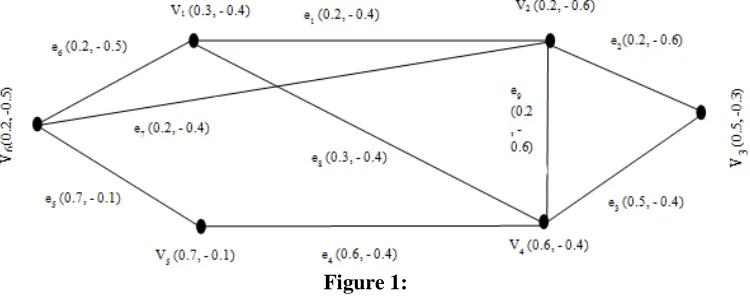
Example 3.9. Consider the Bipolar Fuzzy Graph (BFG), G = (V, E) six vertices and nine edges.
Figure 1:
In BFG,
Split Dominating Set D = v, vf, vg Cardinality of Set |D| = 1.25 Non - Split Dominating Set D = v, vi, vf Cardinality of Set |D| = 1.45 Connected Dominating Set Df = v, v, vi Cardinality of Set |Df| = 1.35
Proposition 3.10. A dominating set D of a bipolar fuzzy graph G is a strong split dominating set iff there exist two bipolar fuzzy vertices vk, vl∈ V – D such that every vk− vl path contains a bipolar fuzzy vertex of D.
Proof:
Figure 2:
〈V – D〉 is a bipolar fuzzy graph of G induced by totally disconnected, hence D is a strong split dominating set of G with strong split domination number γmm(G) we see that there exists vvi∈ V – D such that v – vf path containsv.
Proposition 3.11. A split dominating set D of a Bipolar fuzzy graph G is minimal for each vertex v ∈ D, one of the following three conditions holds
i) There exist u ∈ V – D such N (u) ∩ D = v ii) v is isolated vertex in< V >
119
Proof: Suppose D is minimal and there exist a vertex v ∈ D such that v does not hold any of the above conditions. Then by conditions (i) and (ii) V = V – is a dominating set of . also by (iii), < − V > is split dominating set of , a contradiction.
Proposition 3.12. For any bipolar fuzzy graph G = σ, μs, μtthen γ(G) ≤ γmm(G).
Proof: It’s obviously true by the definitions
Proposition 3.13. For any regular bipolar fuzzy graph the split domination number is
same for all the minimal dominating set.
Proof: By the definition, regular BFG all the vertices have the same vertex cardinality.
This shows that every dominating set which in minimal same domination number in BFG.
Proposition 3.14. In total regular bipolar fuzzy graph γbc(G) = γu(G)
Proposition 3.15. In total regular bipolar fuzzy graph γbc(G) = min D|V|yz∈{I
Proposition 3.16. In a bipolar fuzzy graph both regular and totally regular, then γbc(G)is constant for all minimal dominating set.
Proposition 3.17. If G be a regular bipolar fuzzy graph, where crisp graph G∗ is an odd cycle thenγbc(G) is constant.
Proposition 3.18. For any Bipolar fuzzy graph G with an end vertexγ(G) = γm(G). Furthermore, there exist a γm−set of G containing all vertices adjacent to end vertices.
Proof: Let v be an end vertex of G, then there exist a cut vertex w adjacent to v. Let D be a γm−set of G suppose w ∈ D, then is a γm−set ofG suppose w ∈ V − Dthen v ∈ D and hence (D – v) ∪ w is a γm−set ofG.
Repeating this process for all such cut vertices adjacent to end vertices we obtain a γm−set of G containing all cut vertices adjacent to end vertices.
Proposition 3.19. For any bipolar fuzzy graph (BFG) G = $σ, μs, μt%, γcc(G) ≤ p. ∆(G)/(∆(G) + 1).
Proof: Let D be a split dominating set since D is minimal, by Proposition it follows that for each v ∈ D there exist u ∈ V – D such that 0 < (u, v) = σ(u)⋀σ(v) , v is adjacent to u. which implies that V – D is a dominating set of G.
Thus γ(G) ≤ |V − D| ≤ p − γcc(G)and by,For any BFG, G = $σ, μs, μt% γ(G) ≥ p/(∆(G) + 1)
Henceγcc(G) ≤ p. ∆(G)/(∆(G) + 1).
Definition 3.20. A set of Bipolar fuzzy vertex which cover all the Bipolar fuzzy edges is
A. Prasanna, C. Gurubaran and S. Ismail Mohideen
120
Definition 3.21. A disconnection of a bipolar fuzzy graph G is a vertex set V whose
removal results in a disconnected or a single vertex graph. The weight of V is a defined to ∑ min*μs(v, v)+ , min*μt(v, v)+ / μs(v, v) orμt(v, v), u ∈ V, v ∈ D the vertex connectivity of bipolar fuzzy graph G denoted byΩ(G) is defined to be the minimum weight disconnection inG.
Proposition 3.22. For any BFG G = $σ, μs, μt%, (i) γ(G) ≤ γcc(G) (ii) Ω(G) ≤ γcc(G)
Proof:
(i) and (ii) follows from the definitions of γ(G), γcc(G) and Ω(G)
Proposition 3.23. For any bipolar fuzzy graph (BFG) G = $σ, μs, μt%, γcc(G) ≤ β(G)
Proof: Let D be a maximal independent set of bipolar fuzzy vertex in G, then G has atleast two bipolar fuzzy vertices and every bipolar fuzzy vertex in D is adjacent to some vertex in V – D. this implies that V – D strong split dominating set of G. Thus the Proposition holds.
Proposition 3.24. For any bipolar fuzzy graph (BFG) G = $σ, μs, μt%γc(G) ≤ α(G) Proof: Let S be minimum independent set of vertices in G. Then S has atleast two vertices in G. Then S has atleast two vertices and every vertex in S has effective edge to some vertex in S has effective edge to some vertex in V – S. this shows that V – Sa split dominating set of G. Hence γc(G) ≤ α(G).
Proposition 3.25. For any bipolar fuzzy graph (BFG) G = $σ, μs, μt%γ(G) + γc(G) ≤
2|v|.
Proof: Let D be a minimal dominating set of BFG in G, D contains the vertices with
minimum degree then D be split domination number is same for the minimum degree vertices in G. here domination number and split domination number lesser values of vertex covering and minimum weight of disconnection in G.
β(G) + α(G) ≤ 2|v|
Here |v |denotes the vertex cardinality will be minimum in the set V.
Proposition 3.26. If γcc(G) ≤ γ(G) then for any strong split dominating set
Proof: Since D is minimal, V – D is dominating set of G and furthermore it is strong split
dominating set since <D> is totally disconnected.
4. Conclusion
In this paper we introduced the concept of some domination numbers.Alsorelationship between connected domination and split domination number in bipolar fuzzy graphs are discussed.
REFERENCES
1. M.Akram, Bipolar fuzzy graphs, Information Sciences, 181 (2011) 5548 – 5564. 2. M.Akram, Bipolar fuzzy graphs with applications, Knowledge – Based systems 39
121
3. M.Akram and Wieslaw A. Dudek, Regular bipolar fuzzy graphs, Neural Comput. andApplic., 21 (Suppl 1) (2012) S197 – S205.
4. M.G.Karunambigai, M.Akram, K.Palanivel and S.Sivasankar, Domination in bipolar fuzzy graphs, Proceedings of the international conference on fuzzy systems, FUZZ – IEEE (2013) 1-6.
5. V.Mohanaselvi and S.Sivamani, Paramount domination in bipolar fuzzy graphs, Int. Journal of Sci. Engg. Research, 7(5) (2016) 50 – 52.
6. A.NagoorGani, B.Ahamed, Order and size in fuzzy graphs, Bulletin of Pure and Applied Sciences, 22E (1) (2003) 145 – 148.
7. H.Yang, S.Li, W.Yang and Y.Lu, Notes on bipolar fuzzy graphs, Information Sciences, 242 (2013) 113-121.
8. L.A.Zadeh, Fuzzy sets, Information and Control, 8 (1965) 338-353.
9. W.R.Zhang, Bipolar fuzzy sets and relations: a computational framework for cognitive modeling and multiagent decision analysis, Industrial Fuzzy Control and Intelligent Systems Conference, and the NASA Joint Technology Workshop on Neural Networks and Fuzzy Logic, (1994) 305-309.
10. S.Samanta and M.Pal, Irregular bipolar fuzzy graphs, International Journal of Applications of Fuzzy Sets, 2 (2012) 91-102.
11. S.Samanta and M.Pal, Bipolar fuzzy hypergraphs, International Journal of Fuzzy Logic Systems, 2(1) (2012) 17-28.
12. H.Rashmanlou and M.Pal, Some properties of highly irregular interval valued fuzzy graphs, World Applied Sciences Journal, 27(12) (2013) 1756-1773.
13. S.Samanta and M.Pal, Some more results on bipolar fuzzy sets and bipolar fuzzy intersection graphs, The Journal of Fuzzy Mathematics, 22(2) (2014) 253-262. 14. H.Rashmanlou, S.Samanta, M.Pal, R.A.Borzooei, A study on bipolar fuzzy graphs,
Journal of Intelligent and Fuzzy Systems, 28 (2015) 571-580.
15. H.Rashmanlou, S.Samanta, M.Pal and R.A.Borzooei, Bipolar fuzzy graphs with Categorical properties, The International Journal of Computational Intelligence
Systems, 8(5) (2015) 808-818.
16. H.Rashmanlou, S.Samanta, M.Pal and R.A.Borzooei, Product of bipolar fuzzy graphs and their degree, International Journal of General Systems, 45(1) (2016) 1-14. 17. G.Ghorai and M.Pal, Certain types of product bipolar fuzzy graphs, Intern. J. Applied