Please cite this article as: V. Manoj Kumar, D. Srii Hari Thipesh, Robot Arm Performing Writing through Speech Recognition Using Dynamic Time Warping Algorithm, International Journal of Engineering (IJE), TRANSACTIONS B: Applications Vol. 30, No. 8, (August 2017) 1238-1245
International Journal of Engineering
J o u r n a l H o m e p a g e : w w w . i j e . i rRobot Arm Performing Writing through Speech Recognition Using Dynamic Time
Warping Algorithm
V. Manoj Kumar, D. Srii Hari Thipesh*
Department of Mechanical Engineering, SRM University, Chennai-603203
P A P E R I N F O
Paper history: Received 30 March 2017
Received in revised form 26 June 2017 Accepted 07 July 2017
Keywords:
Dynamic Time Warping
Endpoint Detection, Speech To Text Mel Frequency Cel Cepstrum Link Length
Degree of Freedom RRRR
A B S T R A C T
This paper aims to develop a writing robot by recognizing the speech signal from the user. The robot arm constructed mainly for the disabled people who can’t perform writing on their own. Here, dynamic time warping (DTW) algorithm is used to recognize the speech signal from the user. The action performed by the robot arm in the environment is done by reducing the redundancy which frequently faced by the robot arm with high accuracy in both velocity and position in its own trajectory.
NOMENCLATURE
N Newton Kg-m Kilogram meter
mm millimeter K-Hz Kilo-Hertz
N-m Newton-meter
1. INTRODUCTION1
A robot arm is an electromechanically controlled mechanism, usually programmable, similar to a human arm. Joints connect the links of manipulators allow either rotational motion. The joints of the robotic arm form a kinematic chain. The end of the kinematic chain is called end effector [1-3].
The construction of a robot arm which is capable of performing writing operation by recognizing our voice mainly consists of two parts.
• Speech to text • Text to an action
The communication between two humans is by speech, the natural and efficient method [4-6]. The biggest problems in speech recognition are avoiding
*Corresponding Author’s Email: [email protected] (D. Srii Hari Thipesh)
redundancy problem in robot and how to avoid it too [9].
2. METHODOLOGY
2. 1. Hardware Arms are typically defined by
different parameters like axes, DOF, kinematics, accuracy, motion control and workspace of the robot before it performs writing [10]. An end effector is necessary for actual environmental interaction. End effectors are typically chosen based on the application; some common choices are grippers, sprayers, grinders, welders, etc., Here, it is choosing for performing writing.
The speech signal was given as input from the user using a microphone. A PC sound cord connected to microphone converts the analog signal to the suitable digital signal for processing. Then, the obtained digital signal of the spectrum is compared with preprogrammed signal by record voice of particular set of words, and then we get Fast Fourier Transform of all set of words of Mel’s coefficient value. For, this process we use DTW algorithm [11]. Then, the output text is transferred to the next level [12].
2. 1. 1. Motor Specification Here, we used 11kg
torque servomotor for base and link 1 with specifications given below:
Operating voltage: 4.8-7.2 Volts
Operating speed: 0.18sec/60° for 4.8V (minimum) 0.14sec/60° for 7.2V (maximum) Stall torque: 11kg/cm for 4.8V (minimum)
16kg/cm for 7.2V (maximum) Weight: 56gm
For end effector, we use 9g servomotor with 2.2kg torque with specification given below
Operating voltage: 3.5-6 V
Operating speed: 0.12sec/60° for 4.8V (minimum) 0.10sec/60° for 7.2V (maximum) Stall torque: 1.8kg/cm for 4.8V (minimum)
2.4kg/cm for 7.2V (maximum) Weight: 11gm
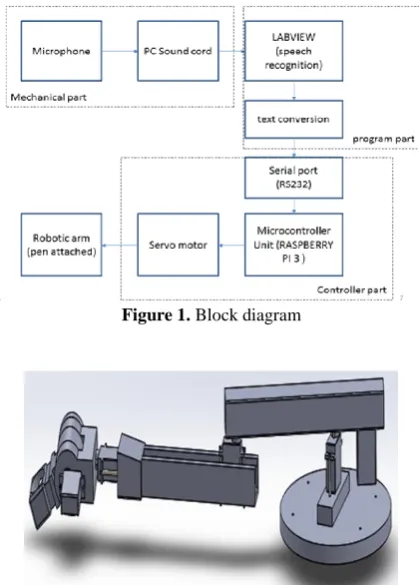
The total process of my project is explained in following block diagram in Figure 1, respectively.
2. 2. CADD Model of the Robot The CADD model
of the robot designed in SOLIDWORKS software is shown in Figure 2.
2. 3. Software The software used for speech to text
is LABVIEW 2016 and dynamic time warping algorithm does it. The programming section makes use of the DTW which is explained in detail as follows.
Figure 1. Block diagram
Figure 2. CADD model of the robotic manipulator
2. 3. 1. Speech Signal When we produce the
speech sounds from our lungs, air flow passes through glottis and then throat and mouth as shown in Figure 3. The speech signal which is excited in three methods depends upon speech signal.
voiced excitation unvoiced excitation transient excitation
A speech signal is characterizing as follows, [13-16]. 1. The bandwidth of the normal speech signal is 4
KHz.
2. A frequency ranges of the periodic signal is between 80Hz and 350Hz.
3. The peak of the spectral distribution of energy at (2n-1) * 500Hz; n=1,2,3, …
By producing sound from our speech production, the outcome will be classified by typical waveform of voiced speech and unvoiced speech shown in Figure 4 respectively.
2. 3. 2. Dynamic Time Warping Algorithm In
signal processing analysis, DTW algorithm is used to measure similarities between two spectral speechsignals which may vary in time, frequency and speed. In a temporal sequence of audio, video and graphics data or any other data to a linear sequence, DTW has been applied [17-20]. A popular application is automatic speech recognition, speaker recognition, and online signature recognition. The 1D DFT was defined as:
10
/ 2 N
n
ej knN
n
yk
(1)for n = 0, 1, 2, …, N–1
where, x = the input sequence, N= the number of elements of x, Y = the transform result.
The frequency resolution, or the frequency spacing between the components of Y, is:
N f
f s
(2)
where, fs is the sampling frequency.
The recognition process of MFCC explained in following block diagram in Figure 5.
3. KINEMATIC ANALYSIS
The kinematic model of the robotic arm is represented by a set of equations which allows estimation of robot’s evolution on its trajectory, determination of its position and orientation and elaboration of possible control strategies. All motions of the robotic arm have divided into translation and rotational components.
Figure 4. Sample waveform of voiced and unvoiced speech
Figure 5. MFCC (Mel Frequency Ceptral Coefficient)
Translation is the displacement of robotic arm’s center. Rotation is concerned with the rotational movement of each joint’s axis [21-23].
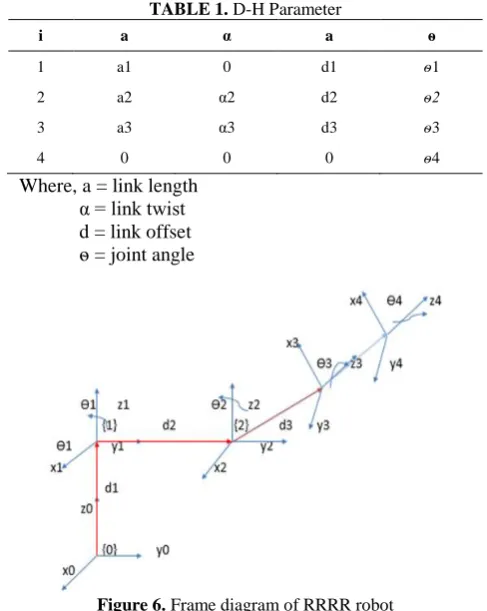
The frame diagram and D-H table for the writing robot of RRRR configuration is shown in Table 1 and Figure 6, respectively.
TABLE 1. D-H Parameter
i a α a ѳ
1 a1 0 d1 ѳ1
2 a2 α2 d2 ѳ2
3 a3 α3 d3 ѳ3
4 0 0 0 ѳ4
Where, a = link length α = link twist d = link offset ѳ = joint angle
Following figures depict the kinematics analysis of the robot with RRRR configuration and the workspace analysis obtained via MATLAB is shown in Figure 7.
3. 1. Force and Torque Calculation 3. 1. 1. Calculation For Link 1
Force Required = Load (In Newton’s) x Acceleration due to gravity
= 2.45 N x 9.81 = 24 N
Torque required = Force x Perpendicular Distance = 24 N x 200 mm
= 4.8 Nm = 0.48 Kg-m
3. 1. 2. Calculation For Link 2
Force Required = Load (In Newton’s) x Acceleration due to gravity = 2.2 N x 9.81
= 22 N
Torque required = Force x Perpendicular Distance = 22 N x 155 mm
= 3.41 Nm = 0.341 Kg-m
3. 1. 3. Calculation for Tool Holder
Force Required = Load (In Newton’s) x Acceleration due to gravity
= 1.6 N x 9.81 = 16 N
Torque required = Force x Perpendicular Distance = 16 N x 80 mm
= 1.76 Nm = 0.176 Kg-m
4. EXPERIMENTAL ANALYSIS
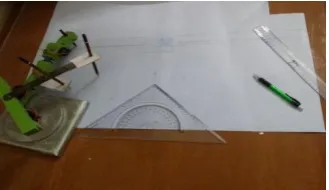
The experimental analysis of speech to text is done by LabVIEW 2016 and letter analysis graph of robot movement in manual are shown in Figure 8. For letter analysis we have to create own template to measure angle as shown in Figure 9.
Figure 7. Kinematic analysis and Workspace analysis
Figure 8. Speech to text in LabVIEW 2016
Figure 9. Template of alphabets from A-Z
The pencil is fix in each link of robot and the robot links are move by method of teach pendant according to template to find the angle of each motor which is shown in Figure 10. By measuring the angles of each motor we can easily control the movement of robot and reduce the redundancy faced by robot.
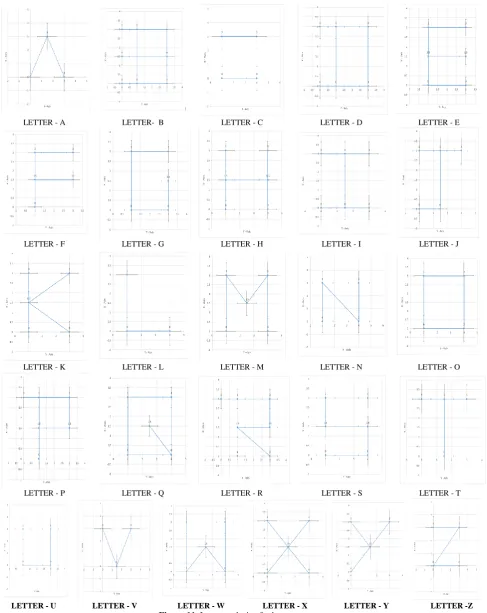
The letter analysis made for each and every letter. Then, we have to plot graph for every letter and analyze the movement of robot and redundancy that faced by robot in movement. The letter analysis of alphabets is shown in Figure 11.
5. IMPLEMENTATION OF ALGORITHM
To control dynamic motion in robot manipulator, it requires the actual production of trajectory and dynamic parameters (e.g., position, velocity, and acceleration) [24-27].
LETTER - A LETTER- B LETTER - C LETTER - D LETTER - E
LETTER - F LETTER - G LETTER - H LETTER - I LETTER - J
LETTER - K LETTER - L LETTER - M LETTER - N LETTER - O
LETTER - P LETTER - Q LETTER - R LETTER - S LETTER - T
LETTER - U LETTER - V LETTER - W LETTER - X LETTER - Y LETTER -Z
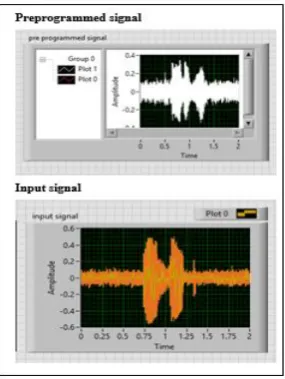
In a mechanical point of view, a robotic arm replicating a human arm is Kinematic redundancy, i.e., a degree of mobility that possesses by its mechanism is higher than that given motion task in Workspace [28]. Kinematic redundancy obtains the avoidance of mechanical limits in robot joints, avoidance of obstacle while performing tasks, avoidance of singularity in motion, fault-tolerant operation, robot dynamics optimization, distribution of joint motions like a human arm, etc., [29-32]. The writing process was performed by receiving the output of spoken word from LabVIEW. By using end pint detection, we compare the both per-programmed signal with input voice signal as shown in Figure 12.
The flow chart of implementing writing process is given in Figure 13.
6. DESIGN CONSIDERATION
The writing robot setup is assembled of a right-handed robotic manipulator as an end effector with pen tip holder as shown in Figure 14 and a microcontroller (Raspberry Pi 3) and a laptop. Human assist the installation, and their role is to change the set of paper, and the signal given to the robotic arm performs writing. The human operator also controls the reset button and is capable of initiating the pre-calibration process if required.
7. RESULTS
By implementing the robotic manipulator in the experimental setup, the following output is obtained. We were working with the proposed aim of constructing the robotic arm write by speech recognition.
Figure 12. Matching preprogrammed and input signal
Waveform
Figure 13. Flow chart for implementation of algorithm
Figure 14. Fabricatied model of robot arm performing writing
task
8. CONCLUSION
A robotic manipulator with the ability of writing is recreational use in robotics, and it also increases interaction between human and robot. Although there are several such robotic manipulators which can write provide to it, this project implies a robotic manipulator who makes use of the Mel Frequency Cepstral Coefficient by DTW algorithm [33-38]. It enables the robotic manipulator to write by recognizing speech with less complexity and to also provide satisfactory results over a flat surface. The robotic manipulator can find applications in the field of automobile automation, printing industry and disable people who can’t be able to write.
The calibration was done with a consuming time in the task, and if the writing surface is disturbed, the calibration won’t work. Moreover, a difficulty is calibrating arbitrarily shaped surfaces that not have constant geometry perfectly. This large snag in this project is to deal in the future.
9. ACKNOWLEDGMENT
We wish to acknowledge our project coordinate Dr.Stalin John M. R and the head of our department Dr.Prabhu. S thank them for their deep interest they have shown in this project and for motivating us to do our best.
10. REFERENCES
1. Duchaine, V., St-Onge, B.M., Gao, D. and Gosselin, C., "Stable and intuitive control of an intelligent assist device", IEEE
Transactions on Haptics, Vol. 5, No. 2, (2012), 148-159.
2. Escobar, F., Díaz, S., Gutiérrez, C., Ledeneva, Y., Hernández, C., Rodríguez, D. and Lemus, R., "Simulation of control of a scara robot actuated by pneumatic artificial muscles using rnapm", Journal of Applied Research and Technology, Vol. 12, No. 5, (2014), 939-946.
3. Ibrahim, B. and Zargoun, A.M., "Modelling and control of scara manipulator", Procedia Computer Science, Vol. 42, No., (2014), 106-113.
4. Furui, S., Kikuchi, T., Shinnaka, Y. and Hori, C., "Speech-to-text and speech-to-speech summarization of spontaneous speech", IEEE Transactions on Speech and Audio Processing, Vol. 12, No. 4, (2004), 401-408.
5. Khilari, M.P. and Bhope, V., "A review on speech to text conversion methods".
6. Stolcke, A., Chen, B., Franco, H., Gadde, V.R.R., Graciarena, M., Hwang, M.-Y., Kirchhoff, K., Mandal, A., Morgan, N. and Lei, X., "Recent innovations in speech-to-text transcription at sri-icsi-uw", IEEE Transactions on Audio, Speech, and
Language Processing, Vol. 14, No. 5, (2006), 1729-1744.
7. Muda, L., Begam, M. and Elamvazuthi, I., "Voice recognition algorithms using mel frequency cepstral coefficient (mfcc) and dynamic time warping (DTW) techniques", arXiv Preprint
arXiv:1003.4083, (2010).
8. Pérez-Marcos, D., Buitrago, J.A. and Velásquez, F.D.G., "Writing through a robot: A proof of concept for a brain– machine interface", Medical Engineering & Physics, Vol. 33, No. 10, (2011), 1314-1317.
9. Potkonjak, V., Popovic, M., Lazarevic, M. and Sinanovic, J., "Redundancy problem in writing: From human to anthropomorphic robot arm", IEEE Transactions on Systems, Man, and Cybernetics, Part B (Cybernetics), Vol. 28, No. 6, (1998), 790-805.
10. Fujioka, H., Kano, H., Nakata, H. and Shinoda, H., "Constructing and reconstructing characters, words, and sentences by synthesizing writing motions", IEEE Transactions on Systems, Man, and Cybernetics-Part A: Systems and
Humans, Vol. 36, No. 4, (2006), 661-670.
11. Mansour, A.H., Salh, G.Z.A. and Mohammed, K.A., "Voice recognition using dynamic time warping and mel-frequency cepstral coefficients algorithms", International Journal of
Computer Applications, Vol. 116, No. 2, (2015).
12. Mouchtaris, A., Van der Spiegel, J. and Mueller, P., "Nonparallel training for voice conversion based on a parameter adaptation approach", IEEE Transactions on Audio, Speech,
and Language Processing, Vol. 14, No. 3, (2006), 952-963.
13. Hu, Y. and Loizou, P.C., "Evaluation of objective quality measures for speech enhancement", IEEE Transactions on
Audio, Speech, and Language Processing, Vol. 16, No. 1,
(2008), 229-238.
14. Turk, O. and Schroder, M., "Evaluation of expressive speech synthesis with voice conversion and copy resynthesis techniques", IEEE Transactions on Audio, Speech, and
Language Processing, Vol. 18, No. 5, (2010), 965-973.
15. Wu, C.-H., Hsia, C.-C., Liu, T.-H. and Wang, J.-F., "Voice conversion using duration-embedded bi-hmms for expressive speech synthesis", IEEE Transactions on Audio, Speech, and
Language Processing, Vol. 14, No. 4, (2006), 1109-1116.
16. Sakoe, H. and Chiba, S., "Dynamic programming algorithm optimization for spoken word recognition", IEEE Transactions on Acoustics, Speech, and Signal Processing, Vol. 26, No. 1, (1978), 43-49.
17. Brown, M. and Rabiner, L., "An adaptive, ordered, graph search technique for dynamic time warping for isolated word recognition", IEEE Transactions on Acoustics, Speech, and
Signal Processing, Vol. 30, No. 4, (1982), 535-544.
18. Khoubrouy, S.A. and Hansen, J.H., "Microphone array processing strategies for distant-based automatic speech recognition", IEEE Signal Processing Letters, Vol. 23, No. 10, (2016), 1344-1348.
19. Ghaffarzadegan, S., Bořil, H. and Hansen, J.H., "Generative modeling of pseudo-whisper for robust whispered speech recognition", IEEE/ACM Transactions on Audio, Speech, and
Language Processing, Vol. 24, No. 10, (2016), 1705-1720.
20. Ma, X., Wang, D. and Tejedor, J., "Similar word model for unfrequent word enhancement in speech recognition",
IEEE/ACM Transactions on Audio, Speech and Language
Processing (TASLP), Vol. 24, No. 10, (2016), 1819-1830.
21. Nair, K.S., "Kinematic modelling and analysis of a 5 axis articulated robot arm model VRT-502", in IEEE Transactions, Mar Baselios College of Engineering and Technology, Thiruvananthapuram, Kerala, India. Vol. 4, (2015).
22. Carlson, J.S., Spensieri, D., Wärmefjord, K., Segeborn, J. and Söderberg, R., "Minimizing dimensional variation and robot traveling time in welding stations", Procedia Cirp, Vol. 23, (2014), 77-82.
24. Lee, S. and Pan, J.C., "Offline tracing and representation of signatures", IEEE Transactions on Systems, Man, and
Cybernetics, Vol. 22, No. 4, (1992), 755-771.
25. Yao, F., Shao, G. and Yi, J., "Extracting the trajectory of writing brush in chinese character calligraphy", Engineering Applications of Artificial Intelligence, Vol. 17, No. 6, (2004), 631-644.
26. Kulvicius, T., Ning, K., Tamosiunaite, M. and Worgötter, F., "Joining movement sequences: Modified dynamic movement primitives for robotics applications exemplified on handwriting",
IEEE Transactions on Robotics, Vol. 28, No. 1, (2012), 145-157.
27. Waarsing, B.J., Nuttin, M., Van Brussel, H. and Corteville, B., "From biological inspiration toward next-generation manipulators: Manipulator control focused on human tasks",
IEEE Transactions on Systems, Man, and Cybernetics, Part C
(Applications and Reviews), Vol. 35, No. 1, (2005), 53-65.
28. Dolinsky, J. and Takagi, H., "Analysis and modeling of naturalness in handwritten characters", IEEE Transactions on
Neural Networks, Vol. 20, No. 10, (2009), 1540-1553.
29. Lee, S. and Pan, J.-J., "Unconstrained handwritten numeral recognition based on radial basis competitive and cooperative networks with spatio-temporal feature representation", IEEE
Transactions on Neural Networks, Vol. 7, No. 2, (1996),
455-474.
30. Nguyen, L.A., Walker, I.D. and Defigueiredo, R., "Dynamic control of flexible, kinematically redundant robot manipulators",
IEEE Transactions on Robotics and Automation, Vol. 8, No.
6, (1992), 759-767.
31. Nisky, I., Hsieh, M.H. and Okamura, A.M., "Uncontrolled manifold analysis of arm joint angle variability during robotic teleoperation and freehand movement of surgeons and novices",
IEEE Transactions on Biomedical Engineering, Vol. 61, No.
12, (2014), 2869-2881.
32. Gomez-Espinosa, A., Lafuente-Ramon, P., Rebollar-Huerta, C., Hernandez-Maldonado, M., Olguin-Callejas, E., Jimenez-Hernandez, H., Rivas-Araiza, E. and Rodriguez-Resendiz, J., "Design and construction of a didactic 3-dof parallel links robot station with a 1-dof gripper", Journal of Applied Research and
Technology, Vol. 12, No. 3, (2014), 435-443.
33. Myers, C. and Rabiner, L., "Connected digit recognition using a level-building dtw algorithm", IEEE Transactions on Acoustics, Speech, and Signal Processing, Vol. 29, No. 3, (1981), 351-363.
34. Nakamura, S., Markov, K., Nakaiwa, H., Kikui, G.-i., Kawai, H., Jitsuhiro, T., Zhang, J.-S., Yamamoto, H., Sumita, E. and Yamamoto, S., "The atr multilingual speech-to-speech translation system", IEEE Transactions on Audio, Speech, and
Language Processing, Vol. 14, No. 2, (2006), 365-376.
35. Qian, Y., Bi, M., Tan, T. and Yu, K., "Very deep convolutional neural networks for noise robust speech recognition",
IEEE/ACM Transactions on Audio, Speech, and Language
Processing, Vol. 24, No. 12, (2016), 2263-2276.
36. Erro, D., Moreno, A. and Bonafonte, A., "Inca algorithm for training voice conversion systems from nonparallel corpora",
IEEE Transactions on Audio, Speech, and Language
Processing, Vol. 18, No. 5, (2010), 944-953.
37. Lee, L.-s., Glass, J., Lee, H.-y. and Chan, C.-a., "Spoken content retrieval—beyond cascading speech recognition with text retrieval", IEEE/ACM Transactions on Audio, Speech, and
Language Processing, Vol. 23, No. 9, (2015), 1389-1420.
38. Lotfazar, A., Eghtesad, M. and Mohseni, M., "Integrator backstepping control of a 5 dof robot manipulator with cascaded dynamics", IJE Trans. B: Appl, Vol. 16, No. 4, (2003), 373-383.
Robot Arm Performing Writing through Speech Recognition Using Dynamic Time
Warping Algorithm
V. Manoj Kumar, D. Srii Hari Thipesh
Department of Mechanical Engineering, SRM University, Chennai-603203
P A P E R I N F O
Paper history: Received 30 March 2017
Received in revised form 26 June 2017 Accepted 07 July 2017
Keywords:
Dynamic Time Warping
Endpoint Detection, Speech To Text Mel Frequency Cel Cepstrum Link Length
Degree of Freedom RRRR
ديكچ ه
نتشون تابر کی هک دراد دصق هلاقم نیا زا هدافتسا اب ار
.دشخبب هعسوت ربراک زا یراتفگ لانگیس ییاسانش تابر یوزاب
ناشدوخ دنناوتیمن هک تسا هدش هتخاس لولعم دارفا یارب اتدمع .دنهد ماجنا ار نتشون لمع
متیروگلا ،اجنیا رد فارحنا
نامز ایوپ
(DTW)
انگیس صیخشت یارب .دوش یم هدافتسا ربراک زا یراتفگ ل
ر یوزاب طسوت هدش ماجنا لمع رد تاب
یفاضا راب شهاک اب تسیز طیحم دوش یم ماجنا
رد تیعقوم و تعرس ود ره رد لااب تقد اب تابور یوزاب اب بلغا هک
دوخ ریسم .دوش یموربور