A Monthly Double-Blind Peer Reviewed (Refereed/Juried) Open Access International e-Journal - Included in the International Serial Directories
Indexed & Listed at:
VOLUME NO.2(2012),ISSUE NO.11(NOVEMBER) ISSN2231-5756
INTERNATIONAL JOURNAL OF RESEARCH IN COMMERCE, IT & MANAGEMENT
CONTENTS
CONTENTS
CONTENTS
CONTENTS
Sr.No.
TITLE & NAME OF THE AUTHOR (S)
Page No. 1. SIGNIFICANCE OF COST MANAGEMENT TECHNIQUES IN DECISION MAKING: AN EMPIRICAL STUDY ON ETHIOPIAN MANUFACTURING
PRIVATE LIMITED COMPANIES (PLCs) DR. FISSEHA GIRMAY TESSEMA
1
2. TECHNICAL EFFICIENCY ANALYSIS AND INFLUENCE OF SUBSIDIES ON THE TECHNICAL EFFICIENCY OF FARMS IN THE SLOVAK REPUBLIC DR. ING. ANDREJ JAHNÁTEK, DR. ING. JANA MIKLOVIČOVÁ & ING. SILVIA MIKLOVIČOVÁ
10
3. A COMPARISON OF DATA MINING TECHNIQUES FOR GOING CONCERN PREDICTION
FEZEH ZAHEDI FARD & MAHDI SALEHI
14
4. DETERMINANTS OF CONSTRAINTS TO LOW PROVISION OF LIVESTOCK INSURANCE IN KENYA: A CASE STUDY OF NAKURU COUNTY THOMAS MOCHOGE MOTINDI, NEBAT GALO MUGENDA & HENRY KIMATHI MUKARIA
20
5. PERCEPTIONS OF ACCOUNTANTS ON FACTORS AFFECTING AUDITOR’S INDEPENDENCE IN NIGERIA AKINYOMI OLADELE JOHN & TASIE, CHUKWUMERIJE
25
6. AN ASSESSMENT OF MARKET SUSTAINABILITY OF PRIVATE SECTOR HOUSING PROJECT FINANCING OPTIONS IN NIGERIA I.S. YESUFU, O.I. BEJIDE, F.E. UWADIA & S.I. YESUFU
30
7. AN EXPLORATORY STUDY ON THE PERCEPTION OF CUSTOMERS TOWARDS THE ROLE OF MOBILE BANKING, AND ITS EFFECT ON QUALITY OF SERVICE DELIVERY, IN THE RWANDAN BANKING INDUSTRY
MACHOGU MORONGE ABIUD, LYNET OKIKO & VICTORIA KADONDI
35
8. BUSINESS PROCESS REENGINEERING AND ORGANIZATIONAL PERFORMANCE
C. S. RAMANIGOPAL, G. PALANIAPPAN, N.HEMALATHA & M. MANICKAM
41
9. CUSTOMER PERCEPTION OF REAL ESTATE SECTOR IN INDIA: A CASE STUDY OF UNORGANISED PROPERTY ADVISORS IN PUNJAB-INDIA DR. JASKARAN SINGH DHILLON & B. J. S. LUBANA
46
10. INNOVATIVE TECHNOLOGY AND PRIVATE SECTOR BANKS: A STUDY OF SELECTED PRIVATE SECTOR BANKS OF ANAND DISTRICT POOJARA J.G. & CHRISTIAN S.R.
51
11. THE PROBLEMS AND PERFORMANCE OF HANDLOOM COOPERATIVE SOCIETIES WITH REFERENCE TO ANDHRA PRADESH INDIA
DR. R. EMMANIEL
54
12. IMPACT OF GENDER AND TASK CONDITIONS ON TEAMS: A STUDY OF INDIAN PROFESSIONALS DEEPIKA TIWARI & AJEYA JHA
58
13. MOTIVATIONAL PREFERENCES OF TEACHERS WORKING IN PRIVATE ENGINEERING INSTITUTIONS IN WESTERN INDIA REGION: AN EXPLORATORY STUDY
DD MUNDHRA & WALLACE JACOB
68
14. CHANNEL MANAGEMENT IN INSURANCE BUSINESS
DR. C BHANU KIRAN & DR. M. MUTYALU NAIDU
74
15. MANAGEMENT INFORMATION SYSTEM APPLIED TO MECHANICAL DEPARTMENT OF AN ENGINEERING COLLEGE
C.G. RAMACHANDRA & DR. T. R. SRINIVAS
78
16. A STUDY ON THE PERCEPTIONS OF EMPLOYEES ON LEADERSHIP CONCEPTS AND CONSTRUCTS IN LIC H. HEMA LAKSHMI, P. R. SIVASANKAR & DASARI.PANDURANGARAO
83
17. TEXTURE FEATURE EXTRACTION
GANESH S. RAGHTATE & DR. S. S. SALANKAR
87
18. INDIAN BANKS: AN IMMENSE DEVELOPING SECTOR PRASHANT VIJAYSING PATIL & DR. DEVENDRASING V. THAKOR
91
19. DEVALUATION OF INDIAN RUPEE & ITS IMPACT ON INDIAN ECONOMY DR. NARENDRA KUMAR BATRA, DHEERAJ GANDHI & BHARAT KUMAR
95
20. SERVICE PRODUCTIVITY: CONCERNS, CHALLENGES, AND RESEARCH DIRECTIONS DR. SUNIL C. D’SOUZA
99
21. A STUDY OF THE MANAGERIAL STYLES OF EXECUTIVES IN THE MANUFACTURING COMPANIES OF PUNJAB DR. NAVPREET SINGH SIDHU
105
22. FINANCIAL LEVERAGE AND IT’S IMPACT ON COST OF CAPITAL AND CAPITAL STRUCTURE SHASHANK JAIN, SHIVANGI GUPTA & HAMENDRA KUMAR PORWAL
112
23. REACH OF INTERNET BANKING DR. A. JAYAKUMAR & G.ANBALAGAN.
118
24. THE PROPOSED GOODS AND SERVICE TAX REGIME: AN ANALYSIS OF THE DIFFERENT MODELS TO SELECT A SUITABLE MODEL FOR INDIA ASHISH TIWARI & VINAYAK GUPTA
122
25. ESTIMATION OF STOCK OPTION PRICES USING BLACK-SCHOLES MODEL DR. S. SARAVANAN & G. PRADEEP KUMAR
130
26. MIS AND MANAGEMENT
DR.PULI.SUBRMANYAM & S.ISMAIL BASHA
137
27. REFORMS IN INDIAN FINANCIAL SYSTEM: A CONCEPTUAL APPROACH PRAVEEN KUMAR SINHA
147
28. NATURAL RUBBER PRODUCTION IN INDIA DR. P. CHENNAKRISHNAN
151
29. QUALITY IMPROVEMENT IN FREE AND OPEN SOURCE SOFTWARE PROJECTS DR. SHAIK MAHABOOB BASHA
157
30. ICT & PRODUCTIVITY AND GROWTH BUSINESS: NEW RESULTS BASED ON INTERNATIONAL MICRODATA VAHID RANGRIZ
160
CHIEF PATRON
CHIEF PATRON
CHIEF PATRON
CHIEF PATRON
PROF. K. K. AGGARWAL
Chancellor, Lingaya’s University, Delhi
Founder Vice-Chancellor, Guru Gobind Singh Indraprastha University, Delhi
Ex. Pro Vice-Chancellor, Guru Jambheshwar University, Hisar
FOUNDER
FOUNDER
FOUNDER
FOUNDER PATRON
PATRON
PATRON
PATRON
LATE SH. RAM BHAJAN AGGARWAL
Former State Minister for Home & Tourism, Government of Haryana
Former Vice-President, Dadri Education Society, Charkhi Dadri
Former President, Chinar Syntex Ltd. (Textile Mills), Bhiwani
CO
CO
CO
CO----ORDINATOR
ORDINATOR
ORDINATOR
ORDINATOR
AMITA
Faculty, Government M. S., Mohali
ADVISORS
ADVISORS
ADVISORS
ADVISORS
DR. PRIYA RANJAN TRIVEDI
Chancellor, The Global Open University, Nagaland
PROF. M. S. SENAM RAJU
Director A. C. D., School of Management Studies, I.G.N.O.U., New Delhi
PROF. M. N. SHARMA
Chairman, M.B.A., Haryana College of Technology & Management, Kaithal
PROF. S. L. MAHANDRU
Principal (Retd.), Maharaja Agrasen College, Jagadhri
EDITOR
EDITOR
EDITOR
EDITOR
PROF. R. K. SHARMA
Professor, Bharti Vidyapeeth University Institute of Management & Research, New Delhi
CO
CO
CO
CO----EDITOR
EDITOR
EDITOR
EDITOR
DR. BHAVET
Faculty, M. M. Institute of Management, Maharishi Markandeshwar University, Mullana, Ambala, Haryana
EDITORIAL
EDITORIAL
EDITORIAL
EDITORIAL ADVISORY BOARD
ADVISORY BOARD
ADVISORY BOARD
ADVISORY BOARD
DR. RAJESH MODI
Faculty, Yanbu Industrial College, Kingdom of Saudi Arabia
PROF. SANJIV MITTAL
University School of Management Studies, Guru Gobind Singh I. P. University, Delhi
PROF. ANIL K. SAINI
Chairperson (CRC), Guru Gobind Singh I. P. University, Delhi
DR. SAMBHAVNA
Faculty, I.I.T.M., Delhi
DR. MOHENDER KUMAR GUPTA
VOLUME NO.2(2012),ISSUE NO.11(NOVEMBER) ISSN2231-5756
INTERNATIONAL JOURNAL OF RESEARCH IN COMMERCE, IT & MANAGEMENT
DR. SHIVAKUMAR DEENE
Asst. Professor, Dept. of Commerce, School of Business Studies, Central University of Karnataka, Gulbarga
DR. MOHITA
Faculty, Yamuna Institute of Engineering & Technology, Village Gadholi, P. O. Gadhola, Yamunanagar
ASSOCIATE EDITORS
ASSOCIATE EDITORS
ASSOCIATE EDITORS
ASSOCIATE EDITORS
PROF. NAWAB ALI KHAN
Department of Commerce, Aligarh Muslim University, Aligarh, U.P.
PROF. ABHAY BANSAL
Head, Department of Information Technology, Amity School of Engineering & Technology, Amity University, Noida
PROF. A. SURYANARAYANA
Department of Business Management, Osmania University, Hyderabad
DR. SAMBHAV GARG
Faculty, M. M. Institute of Management, Maharishi Markandeshwar University, Mullana, Ambala, Haryana
PROF. V. SELVAM
SSL, VIT University, Vellore
DR. PARDEEP AHLAWAT
Associate Professor, Institute of Management Studies & Research, Maharshi Dayanand University, Rohtak
DR. S. TABASSUM SULTANA
Associate Professor, Department of Business Management, Matrusri Institute of P.G. Studies, Hyderabad
SURJEET SINGH
Asst. Professor, Department of Computer Science, G. M. N. (P.G.) College, Ambala Cantt.
TECHNICAL ADVISOR
TECHNICAL ADVISOR
TECHNICAL ADVISOR
TECHNICAL ADVISOR
AMITA
Faculty, Government H. S., Mohali
DR. MOHITA
Faculty, Yamuna Institute of Engineering & Technology, Village Gadholi, P. O. Gadhola, Yamunanagar
FINANCIAL ADVISORS
FINANCIAL ADVISORS
FINANCIAL ADVISORS
FINANCIAL ADVISORS
DICKIN GOYAL
Advocate & Tax Adviser, Panchkula
NEENA
Investment Consultant, Chambaghat, Solan, Himachal Pradesh
LEGAL
LEGAL
LEGAL
LEGAL ADVISORS
ADVISORS
ADVISORS
ADVISORS
JITENDER S. CHAHAL
Advocate, Punjab & Haryana High Court, Chandigarh U.T.
CHANDER BHUSHAN SHARMA
Advocate & Consultant, District Courts, Yamunanagar at Jagadhri
SUPERINTENDENT
SUPERINTENDENT
SUPERINTENDENT
SUPERINTENDENT
SURENDER KUMAR POONIA
CALL FOR MANUSCRIPTS
CALL FOR MANUSCRIPTS
CALL FOR MANUSCRIPTS
CALL FOR MANUSCRIPTS
Weinvite unpublished novel, original, empirical and high quality research work pertaining to recent developments & practices in the area of Computer, Business, Finance, Marketing, Human Resource Management, General Management, Banking, Insurance, Corporate Governance and emerging paradigms in allied subjects like Accounting Education; Accounting Information Systems; Accounting Theory & Practice; Auditing; Behavioral Accounting; Behavioral Economics; Corporate Finance; Cost Accounting; Econometrics; Economic Development; Economic History; Financial Institutions & Markets; Financial Services; Fiscal Policy; Government & Non Profit Accounting; Industrial Organization; International Economics & Trade; International Finance; Macro Economics; Micro Economics; Monetary Policy; Portfolio & Security Analysis; Public Policy Economics; Real Estate; Regional Economics; Tax Accounting; Advertising & Promotion Management; Business Education; Management Information Systems (MIS); Business Law, Public Responsibility & Ethics; Communication; Direct Marketing; E-Commerce; Global Business; Health Care Administration; Labor Relations & Human Resource Management; Marketing Research; Marketing Theory & Applications; Non-Profit Organizations; Office Administration/Management; Operations Research/Statistics; Organizational Behavior & Theory; Organizational Development; Production/Operations; Public Administration; Purchasing/Materials Management; Retailing; Sales/Selling; Services; Small Business Entrepreneurship; Strategic Management Policy; Technology/Innovation; Tourism, Hospitality & Leisure; Transportation/Physical Distribution; Algorithms; Artificial Intelligence; Compilers & Translation; Computer Aided Design (CAD); Computer Aided Manufacturing; Computer Graphics; Computer Organization & Architecture; Database Structures & Systems; Digital Logic; Discrete Structures; Internet; Management Information Systems; Modeling & Simulation; Multimedia; Neural Systems/Neural Networks; Numerical Analysis/Scientific Computing; Object Oriented Programming; Operating Systems; Programming Languages; Robotics; Symbolic & Formal Logic and Web Design. The above mentioned tracks are only indicative, and not exhaustive.
Anybody can submit the soft copy of his/her manuscript anytime in M.S. Word format after preparing the same as per our submission guidelines duly available on our website under the heading guidelines for submission, at the email address: [email protected].
GUIDELINES FOR SUBM
GUIDELINES FOR SUBM
GUIDELINES FOR SUBM
GUIDELINES FOR SUBMISSION OF MANUSCRIPT
ISSION OF MANUSCRIPT
ISSION OF MANUSCRIPT
ISSION OF MANUSCRIPT
1. COVERING LETTER FOR SUBMISSION:
DATED: _____________ THE EDITOR
IJRCM
Subject: SUBMISSION OF MANUSCRIPT IN THE AREA OF .
(e.g. Finance/Marketing/HRM/General Management/Economics/Psychology/Law/Computer/IT/Engineering/Mathematics/other, please specify)
DEAR SIR/MADAM
Please find my submission of manuscript entitled ‘___________________________________________’ for possible publication in your journals.
I hereby affirm that the contents of this manuscript are original. Furthermore, it has neither been published elsewhere in any language fully or partly, nor is it under review for publication elsewhere.
I affirm that all the author (s) have seen and agreed to the submitted version of the manuscript and their inclusion of name (s) as co-author (s).
Also, if my/our manuscript is accepted, I/We agree to comply with the formalities as given on the website of the journal & you are free to publish our contribution in any of your journals.
NAME OF CORRESPONDING AUTHOR: Designation:
Affiliation with full address, contact numbers & Pin Code: Residential address with Pin Code:
Mobile Number (s): Landline Number (s): E-mail Address: Alternate E-mail Address:
NOTES:
a) The whole manuscript is required to be in ONE MS WORD FILE only (pdf. version is liable to be rejected without any consideration), which will start from the covering letter, inside the manuscript.
b) The sender is required to mention the following in the SUBJECT COLUMN of the mail:
New Manuscript for Review in the area of (Finance/Marketing/HRM/General Management/Economics/Psychology/Law/Computer/IT/ Engineering/Mathematics/other, please specify)
c) There is no need to give any text in the body of mail, except the cases where the author wishes to give any specific message w.r.t. to the manuscript. d) The total size of the file containing the manuscript is required to be below 500 KB.
e) Abstract alone will not be considered for review, and the author is required to submit the complete manuscript in the first instance.
f) The journal gives acknowledgement w.r.t. the receipt of every email and in case of non-receipt of acknowledgment from the journal, w.r.t. the submission of manuscript, within two days of submission, the corresponding author is required to demand for the same by sending separate mail to the journal.
2. MANUSCRIPT TITLE: The title of the paper should be in a 12 point Calibri Font. It should be bold typed, centered and fully capitalised.
3. AUTHOR NAME (S) & AFFILIATIONS: The author (s) full name, designation, affiliation (s), address, mobile/landline numbers, and email/alternate email address should be in italic & 11-point Calibri Font. It must be centered underneath the title.
VOLUME NO.2(2012),ISSUE NO.11(NOVEMBER) ISSN2231-5756
INTERNATIONAL JOURNAL OF RESEARCH IN COMMERCE, IT & MANAGEMENT
5. KEYWORDS: Abstract must be followed by a list of keywords, subject to the maximum of five. These should be arranged in alphabetic order separated bycommas and full stops at the end.
6. MANUSCRIPT: Manuscript must be in BRITISH ENGLISH prepared on a standard A4 size PORTRAIT SETTING PAPER. It must be prepared on a single space and single column with 1” margin set for top, bottom, left and right. It should be typed in 8 point Calibri Font with page numbers at the bottom and centre of every page. It should be free from grammatical, spelling and punctuation errors and must be thoroughly edited.
7. HEADINGS: All the headings should be in a 10 point Calibri Font. These must be bold-faced, aligned left and fully capitalised. Leave a blank line before each heading.
8. SUB-HEADINGS: All the sub-headings should be in a 8 point Calibri Font. These must be bold-faced, aligned left and fully capitalised.
9. MAIN TEXT: The main text should follow the following sequence:
INTRODUCTION
REVIEW OF LITERATURE
NEED/IMPORTANCE OF THE STUDY
STATEMENT OF THE PROBLEM
OBJECTIVES
HYPOTHESES
RESEARCH METHODOLOGY
RESULTS & DISCUSSION
FINDINGS
RECOMMENDATIONS/SUGGESTIONS
CONCLUSIONS
SCOPE FOR FURTHER RESEARCH
ACKNOWLEDGMENTS
REFERENCES
APPENDIX/ANNEXURE
It should be in a 8 point Calibri Font, single spaced and justified. The manuscript should preferably not exceed 5000 WORDS.
10. FIGURES & TABLES: These should be simple, crystal clear, centered, separately numbered & self explained, and titles must be above the table/figure. Sources of data should be mentioned below the table/figure. It should be ensured that the tables/figures are referred to from the main text.
11. EQUATIONS: These should be consecutively numbered in parentheses, horizontally centered with equation number placed at the right.
12. REFERENCES: The list of all references should be alphabetically arranged. The author (s) should mention only the actually utilised references in the preparation of manuscript and they are supposed to follow Harvard Style of Referencing. The author (s) are supposed to follow the references as per the following:
•
All works cited in the text (including sources for tables and figures) should be listed alphabetically.•
Use (ed.) for one editor, and (ed.s) for multiple editors.•
When listing two or more works by one author, use --- (20xx), such as after Kohl (1997), use --- (2001), etc, in chronologically ascending order.•
Indicate (opening and closing) page numbers for articles in journals and for chapters in books.•
The title of books and journals should be in italics. Double quotation marks are used for titles of journal articles, book chapters, dissertations, reports, working papers, unpublished material, etc.•
For titles in a language other than English, provide an English translation in parentheses.•
The location of endnotes within the text should be indicated by superscript numbers.PLEASE USE THE FOLLOWING FOR STYLE AND PUNCTUATION IN REFERENCES: BOOKS
•
Bowersox, Donald J., Closs, David J., (1996), "Logistical Management." Tata McGraw, Hill, New Delhi.•
Hunker, H.L. and A.J. Wright (1963), "Factors of Industrial Location in Ohio" Ohio State University, Nigeria. CONTRIBUTIONS TO BOOKS•
Sharma T., Kwatra, G. (2008) Effectiveness of Social Advertising: A Study of Selected Campaigns, Corporate Social Responsibility, Edited by David Crowther & Nicholas Capaldi, Ashgate Research Companion to Corporate Social Responsibility, Chapter 15, pp 287-303.JOURNAL AND OTHER ARTICLES
•
Schemenner, R.W., Huber, J.C. and Cook, R.L. (1987), "Geographic Differences and the Location of New Manufacturing Facilities," Journal of Urban Economics, Vol. 21, No. 1, pp. 83-104.CONFERENCE PAPERS
•
Garg, Sambhav (2011): "Business Ethics" Paper presented at the Annual International Conference for the All India Management Association, New Delhi, India, 19–22 June.UNPUBLISHED DISSERTATIONS AND THESES
•
Kumar S. (2011): "Customer Value: A Comparative Study of Rural and Urban Customers," Thesis, Kurukshetra University, Kurukshetra. ONLINE RESOURCES•
Always indicate the date that the source was accessed, as online resources are frequently updated or removed. WEBSITESA COMPARISON OF DATA MINING TECHNIQUES FOR GOING CONCERN PREDICTION
FEZEH ZAHEDI FARD
STUDENT
DEPARTMENT OF ACCOUNTING
NEYSHABUR BRANCH
ISLAMIC AZAD UNIVERSITY
NEYSHABUR
MAHDI SALEHI
ASST. PROFESSOR
DEPARTMENT OF ACCOUNTING
FERDOWSI UNIVERSITY
MASHHAD
ABSTRACT
Going concern is one of the fundamental concepts concerning auditing and accounting. Since financial statements contain a potentially large volume of diversified information, sometimes firm’s going concern status evaluation is a complex and critical process and the complexity of this issue has led to development of numerous models for going concern prediction (GCP). In this paper we proposed a novel approach using Imperialistic Competition Algorithm (ICA). In addition, we have presented more advanced data mining techniques, like Adaptive Network Based Fuzzy Inference Systems (ANFIS) and Support Vector Data Description (SVDD) for GCP. For this purpose, after data collection we have selected the final variables from among of 42 variables based on feature selection method using stepwise discriminant analysis (SDA). In the second stage we have applied 10-fold cross-validation to find out the optimal model. Results of three models statistically have been compared by McNemar test. Our empirical experiment indicates that ICA is more efficient than ANFIS and SVDD, but ANFIS does not significantly differ from SVDD. The ICA model reached 99.85 and 99.33 percent accuracy rates so as to training and hold-out data.
KEYWORDS
Going concern prediction, Feature selection, Imperialistic competition algorithm (ICA), Adaptive Network Based Fuzzy Inference Systems (ANFIS), Support Vector Data Description (SVDD).
INTRODUCTION
ver the four decades, going concern prediction (GCP) has become an important research in finance areas. In general, the objective of GCP is to develop models that can extract novel knowledge from previous observations and appraise corporate status. Two major factors that are effective in GCP area are: significant predictor variables and the classifier used in developing the prediction model (Lin, Liang, & Chen, 2011). In this study, we have selected effective financial futures by prior studies and stepwise discriminant analysis (SDA). On the other hand, research methodologies used in GCP are divided into two categories: statistical methods and data mining techniques. The first group comprises methods like univariate analysis, multivariate discriminant analysis (MDA) and logistic regression (logit). Nowadays statistical methods because of the restrictive assumptions such as linearity, normal distributed independent variables and functional relations among them are less used today. These assumptions are not often compatible with real-world applications. In recent years, data mining, a novel field of intelligent data analysis established and developed and began to appear and grow promptly in the background of abundant data and poor information. During the last years, data mining plays a key role in financial area. These techniques do not have restrictive assumptions like statistical methods. There are many techniques that can be employed in prediction of financial status of firms (for example, see: Li & Miu, 2010; Mokhatab Rafiei &et al., 2011; Sun & Li, 2011; Harada & Kageyama, 2011; Chen, 2012; Hsieh & et al., 2012; Sun et al., 2011; Tsai & Cheng, 2012; Xiao & et al., 2012) . In this paper we have applied three models for GCP using Imperialistic Competition Algorithm (ICA), Adaptive Network Based Fuzzy Inference Systems (ANFIS) and Support Vector Data Description (SVDD). The survey results are useful for following people: 1. Auditors - they can exert these models in the final stages of the audit engagement, as a quality control device or as a benchmark. 2. Managers - they can keep track of firm’s performance and these models will help them to identify important trends. 3. Investors, potential clients and stakeholders – these models can be evaluated risk of his loan and apprised viability of companies.
The reminder of this paper organized as follows. Section 2 introduces models of this study. Section 3 contains data and method of future selection. Section 4 presents the results of estimated models and the last section is conclusion.
PREDICTION MODELS
IMPERIALIST COMPETITIVE ALGORITHM (ICA)
Imperialist Competitive Algorithm (ICA) is a recent global search meta-heuristic that applies imperialism and imperialistic competition process as a source of inspiration. ICA considers the imperialism as a level of human’s social evolution. ICA by mathematically modeling presents an algorithm for solving problems of optimization. Since its inception this new algorithm has been extensively adopted by researchers for solving various optimization tasks. This method can be applied to design optimal layout for factories, intelligent recommender systems and so on. ICA has divided countries into two categories: imperialist states and colonies. The main part of this algorithm is imperialistic competition and hopefully makes the colonies to converge to the global minimum of the cost function (Atashpaz-Gargari & Lucas, 2008). In Fig. 1, the stages of implementation of this algorithm are described.
VOLUME NO.2(2012),ISSUE NO.11(NOVEMBER) ISSN2231-5756
INTERNATIONAL JOURNAL OF RESEARCH IN COMMERCE, IT & MANAGEMENT
FIG.1: OVERVIEW OF IMPERIALISTIC COMPETITION ALGORITHMADAPTIVE NETWORK BASED FUZZY INFERENCE SYSTEMS
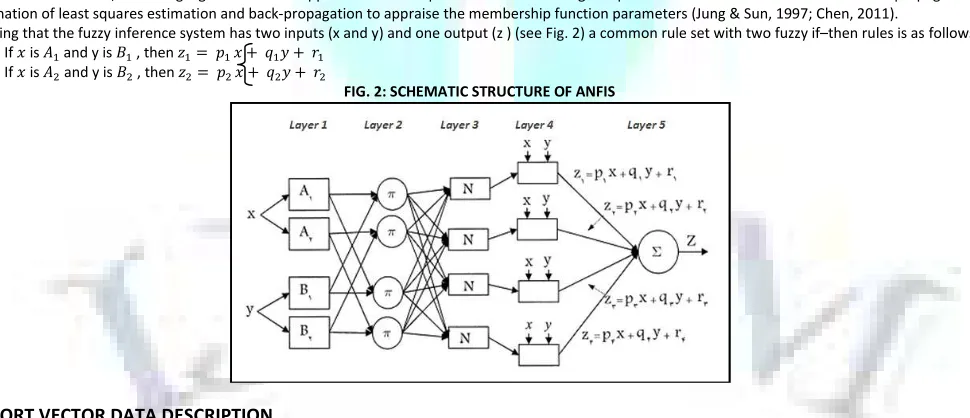
ANFIS is a multi-layer adaptive network-based fuzzy inference system proposed by Jang (1993). This method resembles to a fuzzy inference system except that it uses back-propagation for minimizing errors. ANFIS operates in a manner similar to both artificial neural networks and fuzzy logic. In both of them, by the input membership function the input goes through the input layer and by the output membership function the output is displayed in output layer. Due fuzzy logic applies neural networks, a learning algorithm can be applied to alter the parameters until finding an optimal solution. So ANFIS uses either back-propagation or a combination of least squares estimation and back-propagation to appraise the membership function parameters (Jung & Sun, 1997; Chen, 2011).
Assuming that the fuzzy inference system has two inputs (x and y) and one output (z ) (see Fig. 2) a common rule set with two fuzzy if–then rules is as follows : Rule 1: If is and y is , then = + +
Rule 2: If is and y is , then = + +
FIG. 2: SCHEMATIC STRUCTURE OF ANFIS
SUPPORT VECTOR DATA DESCRIPTION
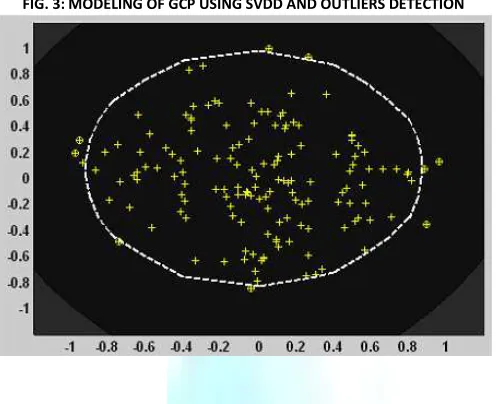
FIG. 3: MODELING OF GCP USING SVDD AND OUTLIERS DETECTION
RESEARCH DESIGN
DATA COLLECTION
The data set of this research consisted of 146 Iranian manufacturing companies. All of these companies were or still are listed on the Tehran Stock Exchange (TSE). 73 companies went bankrupt under paragraph 141 of Iran Trade Law1 between 2001 and 2011. We applied “matched” companies and the number of
bankrupt companies is equal to number of going concern companies (non-bankrupt) (like Min & Lee, 2005; Etemadi& et al., 2009; Chaudhuri & De, 2011; Chen, 2011; Andrés & et al, 2012; Brezigar-Masten & Masten, 2012; Olson et al., 2012). Due to low number of companies, we could not match two groups by industries completely together. Also size of the firms has been considered as a potential explanatory variable in feature selection steps.
FEATURE SELECTION
By reviewing research literature in the field of financial forecasting status of firm, it is characterized that the most of the researchers selected a limited set of variables recommended by prior studies (including financial and non-financial indicators).This problem often leads to reduce generalization of model (Naes & Mevik, 2001). Feature selection boosts the prediction performance of the predictors and prepares faster and more cost-effective predictors, and provides a better understanding of the underlying process that is stemmed from the data. Moreover, reducing the number of irrelevant or redundant variables reduces the running time of a learning algorithm. There are many advantages of feature selection such as reducing the measurement, facilitating data visualization and understandable data and storage requirements such as: reducing times of training and utilization and etc (Guyon & Elisseeff, 2003; Ashoori & Mohammadi, 2011). Accordingly, the variables selected in this research are based on a combination of all feature selection techniques and experiments. In addition there is no reliable published relevant data about cash flow statement before 2008 and that's why our candidate financial variables do not include indicators directly related with cash flows.
This study applied a three stages process for future selection. In the first stage, The 42 variables applied in this study as shown in Table 1, were chosen after reviewing the financial and accounting literature dealing with financial status prediction models in Iran. In the next stage, we applied T-test at a significant level of 0.05 and according to this experiment; variables that potentially had the ability of predicting going concern in the model were selected. In the final stage, stepwise discriminant analysis (SDA) selected optimal variables. We have chosen SDA because it is a dominant method in researches conducted in the accounting field (e.g.: Chen & Shemerda, 1981; Taffler, 1982; Altman, 1993; Alici, 1996;).
With significant level set at the 0.05 level, the discriminant stepwise procedure selected 4 variables for t-1 from the 42 candidate variables for the models which could best differentiate the going concern of firms from the non-going concern firms. These selected financial ratios are: Total liabilities to total assets ( ) , Retained earnings to total assets ( ), Operational income to sales ( ) and Net income to total assets ( ).
1
VOLUME NO.2(2012),ISSUE NO.11(NOVEMBER) ISSN2231-5756
INTERNATIONAL JOURNAL OF RESEARCH IN COMMERCE, IT & MANAGEMENT
TABLE 1: VARIABLES USED IN THE RESEARCHNo. Predictor variable name Financial ratios Means of group 1 Means of group 2 Sig level
X1 Earnings before interest & taxes/ Total assets EBIT/TA 0.18 0.05 0.00
X2 Long term debt/Shareholders’ equity LTD/SE 0.20 0.56 0.06
X3 Retained earnings/Stock capital RE/SC 0.65 0.02 0.00
X4 Marked value of equity /Total liabilities MVE/TL 1.40 0.66 0.00
X5 Marked value of equity /Shareholders’ equity MVE/SE 2.42 2.57 0.22
X6 Marked value of equity /Total assets MVE/TA 0.77 0.48 0.00
X7 Cash /Total assets Ca/TA 0.05 0.03 0.00
X8 Log (total assets) Size 5.25 5.23 0.83
X9 Total liabilities/Total assets TL/TA* 0.67 0.80 0.00
X10 Current liabilities/Shareholders’ equity CL/SE 2.27 4.76 0.00
X11 Current liabilities/Total liabilities CL/TL 0.86 0.85 0.94
X12 (Cash+Short term investments)/Current liabilities (Ca+STI)/CL 0.11 0.05 0.00
X13 (Receivables+Inventory)/Total assets (R+Inv)/TA 0.57 0.57 0.88
X14 Receivables/Sales R/S 0.53 0.40 0.10
X15 Receivables/Inventory R/Inv 1.18 1.00 0.93
X16 Shareholders’ equity/Total liabilities SE/TL 0.63 0.32 0.00
X17 Shareholders’ equity/Total assets SE/TA 0.35 0.22 0.00
X18 Current assets/Current liabilities CA/CL 1.31 1.07 0.00
X19 Quick assets/Current liabilities QA/CL 0.70 0.57 0.00
X20 Quick assets/Current assets QA/TA 0.37 0.36 0.73
X21 Fixed assets/(Shareholders’ equity+Long term debt) FA/(SE+LTD) 0.60 0.91 0.01
X22 Fixed assets/Total assets FA/TA 0.22 0.24 0.63
X23 Current assets/Total assets CA/TA 0.70 0.68 0.66
X24 Cash/ Current liabilities Ca/CL 0.09 0.04 0.00
X25 Interest expenses/Gross profit IE/GP -0.02 -1.21 0.48
X26 Sales/Cash S/Ca 35.30 44.80 0.11
X27 Sales/Total assets S/TA 0.93 0.70 0.00
X28 Working capital/Total assets WC/TA 0.13 0.00 0.00
X29 Paid in capital/Shareholders’ equity PIC/SE 0.53 0.86 0.00
X30 Sales/Working capital S/WC 2.87 1.73 0.96
X31 Retained earnings/Total assets RE/TA* 0.08 -0.03 0.00
X32 Net income/Shareholders’ equity NI/SE 0.42 -0.03 0.00
X33 Net income/Sales NI/S 0.16 -0.02 0.00
X34 Net income/Total assets NI/TA* 0.13 0.00 0.00
X35 Sales/Current assets S/CA 1.34 1.07 0.00
X36 Operational income/Sales OI/S* 0.20 0.06 0.00
X37 Operational income/Total assets OI/TA 0.17 0.03 0.00
X38 Earnings before interest & taxes/ Interest expenses EBIT/IE -5.21 -0.45 0.05
X39 Earnings before interest & taxes/Sales EBIT/S 0.52 0.10 0.00
X40 Gross profit /Sales GP/S 0.27 0.15 0.00
X41 Sales/Shareholders’ equity S/SE 3.32 4.68 0.05
X42 Sales/Fixed assets S/FA 6.29 6.44 0.33
*Final variables selected by SDA.
Group 1: going concern firms & Group2: non-going concern firms
RESULTS
PREDICTIVE RESULTS
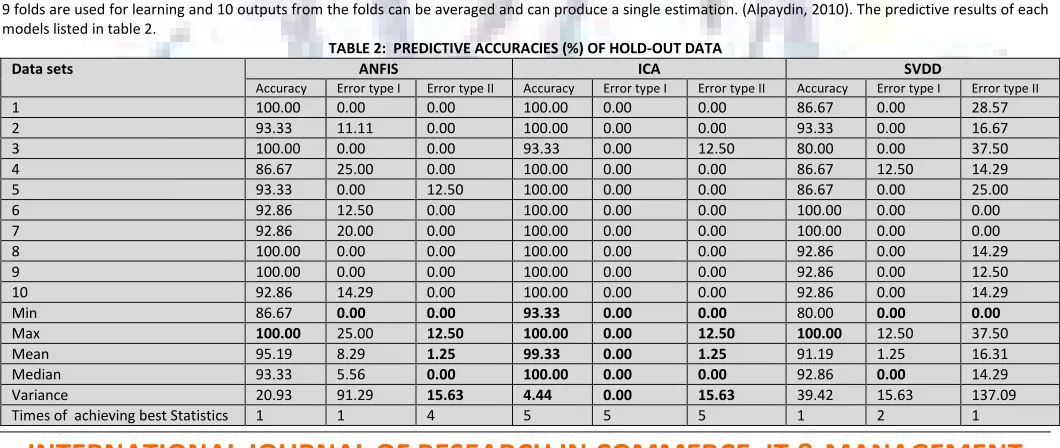
The three models of ICA, ANFIS and SVDD that were constructed based on optimal feature set selected by SDA using 10-fold cross-validation. This method splits the data into two subdivisions: a training set and test set. Quality of the prediction assessed on the test set. In 10-fold cross-validation the data is firstly partitioned into10. Then, 10 iterations of training and test are done such that in each iteration a different fold of the data is held-out for validating while the rest 9 folds are used for learning and 10 outputs from the folds can be averaged and can produce a single estimation. (Alpaydin, 2010). The predictive results of each models listed in table 2.
TABLE 2: PREDICTIVE ACCURACIES (%) OF HOLD-OUT DATA
Data sets ANFIS ICA SVDD
Accuracy Error type I Error type II Accuracy Error type I Error type II Accuracy Error type I Error type II
1 100.00 0.00 0.00 100.00 0.00 0.00 86.67 0.00 28.57
2 93.33 11.11 0.00 100.00 0.00 0.00 93.33 0.00 16.67
3 100.00 0.00 0.00 93.33 0.00 12.50 80.00 0.00 37.50
4 86.67 25.00 0.00 100.00 0.00 0.00 86.67 12.50 14.29
5 93.33 0.00 12.50 100.00 0.00 0.00 86.67 0.00 25.00
6 92.86 12.50 0.00 100.00 0.00 0.00 100.00 0.00 0.00
7 92.86 20.00 0.00 100.00 0.00 0.00 100.00 0.00 0.00
8 100.00 0.00 0.00 100.00 0.00 0.00 92.86 0.00 14.29
9 100.00 0.00 0.00 100.00 0.00 0.00 92.86 0.00 12.50
10 92.86 14.29 0.00 100.00 0.00 0.00 92.86 0.00 14.29
Min 86.67 0.00 0.00 93.33 0.00 0.00 80.00 0.00 0.00
Max 100.00 25.00 12.50 100.00 0.00 12.50 100.00 12.50 37.50
Mean 95.19 8.29 1.25 99.33 0.00 1.25 91.19 1.25 16.31
Median 93.33 5.56 0.00 100.00 0.00 0.00 92.86 0.00 14.29
Variance 20.93 91.29 15.63 4.44 0.00 15.63 39.42 15.63 137.09
FIG. 4. THE MAP OF MIN, MAX AND MEAN ACCUR OF THE THREE METHODS
RESEARCH HYPOTHESES TEST
Determine which of the models that are more applicable than others in GCP, we make the following three hypotheses: : There is no significant difference between the two methods of ICA and ANFIS for GCP of Tehran listed companies. : There is no significant difference between the two methods of ICA and SVDD for GCP of Tehran listed companies. : There is no significant difference between the two methods of ANFIS and SVDD for GCP of Tehran listed companies.
To test the research hypothesis, we applied a nonparametric test. McNemar test examine whether or not the classification performance of each pair of methods is significantly different from other methods (see table 4
From Table 3, we can be understood that ICA outperforms ANFIS on the mean accuracy. The significance level on the hypothesis shows that there is significant difference between ICA and ANFIS. Thus, the hypothesis of
are used to predicting going concern of Tehran listed firms. The second hypothesis is interpreted in the same way. From table outperformed by SVDD on the mean accuracy. McNemar test shows that there is no significant difference between ANFIS and SVDD
t statistic , p value.
DISCUSSION AND CONCLUSION
This study demonstrated feasibility of using ICA, ANFIS and SVDD to GCP from view o
This paper considered a set of financial and non-financial futures that include 42 variables proposed in prior literature dealing with predicting of financial status in Iran and applied SDA to identify potential futures for entry into the GCP model and eventually four financial ratios were chosen and cons
based on selected variables. What results can be understood from this research show that ICA >ANFIS>SVDD from th tests show that ICA model has achieved 99.33 and 99.85 percent accuracy rates respectively for training and hold been issued for evaluation of going concern and from 1988 to
entity (Bellovary & et al., 2007), seems proposed models of this study would be useful in this regard.
REFERENCES
1. Alici, Y. (1996), "Neural networks in corporate failure prediction: The UK experience," Working Paper, University of Exeter, Exeter. 2. Alpaydin, E., (2010), "Introduction to machine learning," Cambridge, Mass, MIT Press.
3. Altman, E.I. (1993), "Corporate Financial Distress and Bankruptcy: A Complet Wiley & Sons.
4. Andrés, J., Landajo, M. and Lorca, P. (2012), "Bankruptcy prediction models based on multinorm analysis: An alternative to ac Based Systems, doi: 10.1016/j.knosys. 2011.11.005.
5. Ashoori, S. and Mohammadi, S. (2011), "Compare failure prediction models based on feature selection technique: empirical case Computer Science, Vol. 3, pp. 568–573.
6. Atashpaz-Gargari, Esmaeil and Lucas, Carl (2007): "Imperialist competitive algorithm: An algorithm for optimization inspired by imperialistic competition”, Paper presented at IEEE Congress on Evolutionary Computation, Singapur, 25
7. Brezigar-Masten, A. and Masten, I. (2012), "CART doi:10.1016/j.eswa.2012.02.125.
8. Chaudhuri, A. and De, K. (2011), "Fuzzy Support Vector Machine for bankruptcy prediction," Applied Soft Com
9. Chen, J.H. (2012), "Developing SFNN models to predict financial distress of construction companies," Expert Systems with Appl 827. 0 20 40 60 80 100 120 Min Max
TABLE 3: RESULTS OF SIGNIFICANCE TEST BETWEEN EAC
Methods ICA
ANFIS 2.058 (0.040
ICA -
TABLE 4 : RESULT OF
Methods ANFIS ICA
TABLE 5: RESULT OF M
Methods ICA SVDD
TABLE 6: RESULT OF M
Methods ANFIS SVDD
, MAX AND MEAN ACCURACY FIG. 5. THE MAP OF MIN, MAX AND MEAN OF DIFF OF THE THREE METHODS TYPES OF ERRORS
hich of the models that are more applicable than others in GCP, we make the following three hypotheses: : There is no significant difference between the two methods of ICA and ANFIS for GCP of Tehran listed companies.
difference between the two methods of ICA and SVDD for GCP of Tehran listed companies. : There is no significant difference between the two methods of ANFIS and SVDD for GCP of Tehran listed companies.
nparametric test. McNemar test examine whether or not the classification performance of each pair of methods is significantly different from other methods (see table 4-6). Results of McNemar test are presented in Table 3.
d that ICA outperforms ANFIS on the mean accuracy. The significance level on the hypothesis shows that there is significant difference between ICA and ANFIS. Thus, the hypothesis of is rejected by the result. It means that ICA outperforms ANFIS significantly in statistic when they are used to predicting going concern of Tehran listed firms. The second hypothesis is interpreted in the same way. From table
outperformed by SVDD on the mean accuracy. McNemar test shows that there is no significant difference between ANFIS and SVDD
This study demonstrated feasibility of using ICA, ANFIS and SVDD to GCP from view of significance test and predictive accuracy with data collected from Iran. financial futures that include 42 variables proposed in prior literature dealing with predicting of financial status lied SDA to identify potential futures for entry into the GCP model and eventually four financial ratios were chosen and cons
based on selected variables. What results can be understood from this research show that ICA >ANFIS>SVDD from the view of mean accuracy. The empirical tests show that ICA model has achieved 99.33 and 99.85 percent accuracy rates respectively for training and hold-out data. Since 1988 no guidelines have not been issued for evaluation of going concern and from 1988 to today, SAS No.59 is authoritative guidance available for investigation of going concern status of an entity (Bellovary & et al., 2007), seems proposed models of this study would be useful in this regard.
orporate failure prediction: The UK experience," Working Paper, University of Exeter, Exeter. Alpaydin, E., (2010), "Introduction to machine learning," Cambridge, Mass, MIT Press.
Altman, E.I. (1993), "Corporate Financial Distress and Bankruptcy: A Complete Guide to Predicting & Avoiding Distress and Profiting from Bankruptcy," John
Andrés, J., Landajo, M. and Lorca, P. (2012), "Bankruptcy prediction models based on multinorm analysis: An alternative to ac ems, doi: 10.1016/j.knosys. 2011.11.005.
Ashoori, S. and Mohammadi, S. (2011), "Compare failure prediction models based on feature selection technique: empirical case
(2007): "Imperialist competitive algorithm: An algorithm for optimization inspired by imperialistic competition”, Paper presented at IEEE Congress on Evolutionary Computation, Singapur, 25-28 Sept.
n, I. (2012), "CART-based selection of bankruptcy predictors for the logit model," Expert Systems with Applications,
Chaudhuri, A. and De, K. (2011), "Fuzzy Support Vector Machine for bankruptcy prediction," Applied Soft Computing, Vol. 11, pp. 2472 Chen, J.H. (2012), "Developing SFNN models to predict financial distress of construction companies," Expert Systems with Appl
Mean Anfis ICA SVDD 0 2 4 6 8 10 12 14 16 18
Mean Type I Type II
NCE TEST BETWEEN EACH PAIR OF MODELS
SVDD )
TABLE 4 : RESULT OF MCNEMAR TEST OF ANFIS AND ICA
Mean accuracy Signicance test on difference Hypothesis 95.19 Significant at the level of 5% Reject 99.33
TABLE 5: RESULT OF MCNEMAR TEST OF CART AND ICA
Mean accuracy Signicance test on difference Hypothesis 99.33 Significant at the level of 5% Reject 91.19
TABLE 6: RESULT OF MCNEMAR TEST OF ANFIS AND SVDD
Mean accuracy Signicance test on difference Hypothesis
95.19 No significance Accept
91.19
MAX AND MEAN OF DIFFERENT OF ERRORS
nparametric test. McNemar test examine whether or not the classification performance of each pair of methods
d that ICA outperforms ANFIS on the mean accuracy. The significance level on the hypothesis shows that there is significant is rejected by the result. It means that ICA outperforms ANFIS significantly in statistic when they are used to predicting going concern of Tehran listed firms. The second hypothesis is interpreted in the same way. From table 5, we can find that ANFIS is outperformed by SVDD on the mean accuracy. McNemar test shows that there is no significant difference between ANFIS and SVDD and is accepted.
f significance test and predictive accuracy with data collected from Iran. financial futures that include 42 variables proposed in prior literature dealing with predicting of financial status lied SDA to identify potential futures for entry into the GCP model and eventually four financial ratios were chosen and constructed GCP models e view of mean accuracy. The empirical out data. Since 1988 no guidelines have not today, SAS No.59 is authoritative guidance available for investigation of going concern status of an
orporate failure prediction: The UK experience," Working Paper, University of Exeter, Exeter.
e Guide to Predicting & Avoiding Distress and Profiting from Bankruptcy," John
Andrés, J., Landajo, M. and Lorca, P. (2012), "Bankruptcy prediction models based on multinorm analysis: An alternative to accounting ratios," Knowledge
Ashoori, S. and Mohammadi, S. (2011), "Compare failure prediction models based on feature selection technique: empirical case from Iran," Procedia
(2007): "Imperialist competitive algorithm: An algorithm for optimization inspired by imperialistic competition”,
based selection of bankruptcy predictors for the logit model," Expert Systems with Applications,
puting, Vol. 11, pp. 2472–2486.
Chen, J.H. (2012), "Developing SFNN models to predict financial distress of construction companies," Expert Systems with Applications, Vol. 39, pp. 823– Type II
Anfis
ICA
SVDD
VOLUME NO.2(2012),ISSUE NO.11(NOVEMBER) ISSN2231-5756
INTERNATIONAL JOURNAL OF RESEARCH IN COMMERCE, IT & MANAGEMENT
10. Chen, K.H. and Shimerda, T.A. (1981), "An empirical analysis of useful financial ratios," Financial Management, Vol. spring, pp. 51–60.
11. Chen, M.Y. (2011), "Predicting corporate financial distress based on integration of decision tree classification and logistic regression," Expert Systems with Applications, Vol. 38, pp. 11261–11272.
12. Etemadi, H., Anvary Rostamy, A.A. and Farajzadeh Dehkordi, H. (2009), "A genetic programming model for bankruptcy prediction: Empirical evidence from Iran," Expert Systems with Applications, Vol. 36, pp. 3199–3207.
13. Gorgani, M.E., Moradi, M. and SadoghiYazdi, H. (2010), "An Empirical Modeling of Companies Using Support Vector Data Description," International Journal of Trade, Economics and Finance, Vol. 1, No. 2, pp. 221-224.
14. Guyon, I. and Elisseeff, A. (2003), "An introduction to variable and feature selection," Journal of Machine Learning Research, Vol. 3, pp. 1157–1182. 15. Harada, N. and Kageyama, N. (2011), "Bankruptcy dynamics in Japan," Japan and the World Economy, Vol. 23, pp. 119–128.
16. Hsieh, T.J., Hsiao, H.F. and Yeh, W.C. (2012), "Mining financial distress trend data using penalty guided support vector machines based on hybrid of particle swarm optimization and artificial bee colony algorithm," Neurocomputing, Vol. 82, pp. 196–206.
17. Jang, J.S.R. (1993), "ANFIS: adaptive-network-based fuzzy inference system," IEEE Transactions on Systems, Man, and Cybernetics, Vol. 23, pp. 665-685. 18. Jang, J.S.R. and C.T. Sun (1997), "Neuro-Fuzzy and Soft Computing: A Computational Approach to Learning and Machine Intelligence," Prentice Hall,
Englewood Cliffs.
19. Leon Li, M.Y. and Miu, P. (2010), "A hybrid bankruptcy prediction model with dynamic loadings on accounting-ratio-based and market-based information: A binary quantile regression approach," Journal of Empirical Finance, Vol. 17, pp. 818– 833.
20. Lin, F., Liang , D. and Chen, E. (2011), "Financial ratio selection for business crisis prediction," Expert Systems With Applications, Vol. 38, pp. 15094-15102. 21. Min, J.H., & Lee, Y.C. (2005), "Bankruptcy prediction using support vector machine with optimal choice of kernel function parameters," Expert Systems with
Applications, Vol. 28, pp. 603–614.
22. Mokhatab Rafiei, F., Manzari, S.M. and Bostanian, S. (2011), "Financial health prediction models using artificial neural networks, genetic algorithm and multivariate discriminant analysis: Iranian evidence," Expert Systems with Applications, Vol. 38, pp. 10210–10217.
23. Naes, T. and Mevik, B.H. (2001), "Understanding the collinearity problem in regression and discrimnant analysis," Journal of Chemometrics, Vol. 15, No. 4, pp. 413–426.
24. Olson, D.L., Delen, D. and Meng, Y. (2012), "Comparative analysis of data mining methods for bankruptcy prediction," Decision Support Systems , Vol. 52, pp. 464 – 473
25. Sun, J. and Li, H. (2011), "Dynamic financial distress prediction using instance selection for the disposal of concept drift," Expert Systems with Applications, Vol. 38, pp. 2566–2576.
26. Sun, J., He, K. Y., & Li, H. (2011), "SFFS-PC-NN optimized by genetic algorithm for dynamic prediction of financial distress with longitudinal data streams," Knowledge-Based Systems, Vol. 24, pp. 1013–1023.
27. Taffler, R. (1982), "Forecasting company failure in the UK using discriminant analysis and financial ratio data," Journal of the Royal Statistical Society, Series A, Vol. 145, pp. 342–358.
28. Tax, D. and Duin, R. (2004), "Support Vector Data Description," Machine Learning, Vol. 54, pp. 45–66.
29. Tsai, C.F. and Cheng, K.C. (2012), "Simple instance selection for bankruptcy prediction," Knowledge-Based Systems, Vol. 27, pp. 333–342.
REQUEST FOR FEEDBACK
Dear Readers
At the very outset, International Journal of Research in Commerce, IT and Management (IJRCM)
acknowledges & appreciates your efforts in showing interest in our present issue under your kind perusal.
I would like to request you to supply your critical comments and suggestions about the material published
in this issue as well as on the journal as a whole, on our E-mail i.e.
for further
improvements in the interest of research.
If you have any queries please feel free to contact us on our E-mail
.
I am sure that your feedback and deliberations would make future issues better – a result of our joint
effort.
Looking forward an appropriate consideration.
With sincere regards
Thanking you profoundly
Academically yours
Sd/-
VOLUME NO.2(2012),ISSUE NO.11(NOVEMBER) ISSN2231-5756