A b s t r a c t. Better growing conditions are achieved in greenhouses by maintaining a higher internal ambient as compared with external ambient temperature. A computer-based control and monitoring system which provides visualization, control and coordination of temperature and humidity in a greenhouse was recently developed. To validate the system performance, a number of experiments were carried out during the autumn of 2003. In this paper, one of the experimental results conducted from 10 to 12 a.m. on December 7, 2003, in the city of Karaj, is presented and discussed. The system was tested for two modes of operation: the uncontrolled mode of operation and the controlled mode. Four sensors, three for temperature measurements and one for relative humidity measurements, were installed inside and outside. During the first hour and a half the system was tested as a data-acquisition system,ie, only data from the sensors were recorded and monitored on the screen with no operation of fans, sprayer and other installed environmental systems in the greenhouse. For the last 20 min of the experiment, inside air temperature was controlled by the system. The result on temperature measurements shows that external ambient temperature, Tout, is always less than the inside temperature. This is attributed to the solar radiation entering the greenhouse through transparent plastic and being trapped there. We also observed fluctuations on temperature profile inside the greenhouse. This is caused by natural conditions such as surface evaporation within the greenhouse, solar radiation, external ambient temperature and rapid weather changes during the time of the experiment. It was also found that the rate of change of temperature increase in the upper part, Tup,ienear plastic cover, is higher than that of the plants height, Tmid. This rise in vertical temperature gradient is partly due to the different amount of solar incident radiation being received at the locations of sensors. This trend proves the effectiveness of our polytube system, a re-circulating fan with an attached perforated polyethylene tube, in guiding the air toward the plant root zone. For the last 20 min of the experiment, the controller was put into action. The overall per-formance of the system in maintaining the temperature within
a given range, around the set point, is found to be satisfactory. The time constant of the fan and heater combination was short, about 10 min, in reaching the desired set point temperature.
K e y w o r d s: greenhouse, temperature, humidity, data acquisition system
INTRODUCTION
Fundamental to the success of modern agribusiness are efficient production management, high productivity and improved product quality. The cost of growing a crop in greenhouses is greater than growing it in the field. Hence, for greenhouses to remain competitive, they have to be able to reduce the cost of production and to increase crop yields. Energy costs typically account for 15 to 40% of plant production costs (Takakuraet al., 1971). The efficiency of plant production in greenhouses depends significantly on the adjustment of optimal climate growth conditions to achieve high yield at low expense, good quality and low environmental load. To bring this about it is necessary to employ new and improved approaches to greenhouse environment control since traditional techniques can no longer be relied upon to meet these demands. Several components such as air temperature, relative humidity and CO2 concentration must be controlled optimally given
certain criteria through heating, ventilation and CO2
injection (Kimbal, 1986).
Greenhouse environment control considerations provide an introduction to the many options available in greenhouse controls. It differs markedly from environment control in traditional industrial and commercial buildings. Rapidly varying solar intensity creates sudden changes of heating and cooling loads, particularly cooling loads. Thermal time constants of greenhouses are measured in minutes, so a rapidly changing solar environment can lead to
Temperature and relative humidity changes inside greenhouse**
M. Omid* and A. Shafaei
Department of Agricultural Machinery, University of Tehran, Karaj, Iran
Received June 3, 2004; accepted September 30, 2004
© 2005 Institute of Agrophysics, Polish Academy of Sciences
*Corresponding author’s e-mail: [email protected]
**This project was partially funded under research award No. 719-3-671 from Research Department in the University of Tehran.
w
w
problems with control, in particular because of slow response times of heating systems. Matching response times of mechanical systems that control vents to the dynamics of changing environments is critical to successful environ-mental control. Early greenhouse control was as simple as pulling a chain to open or close a vent, turning a valve to control heat or irrigation, or throwing a switch to activate a pump or fan. Over the years this evolved as greenhouse systems themselves became more complex and more reliable. Early automated control consisted of independent thermostats and timers. Even these simple devices allowed major advances in efficiency and product quality and made growers’ lives simpler. However, many of these control devices and methods cannot deliver the level of automation and efficiency needed in today dynamic, competitive environment. There has been much research and design about environment control using sophisticated technology (automated or computerized), but those applications are mostly in industrial sectors.
Main components of any control system are measure-ment, data processing and recording. With the advent of microelectronic and computer technology, a computer-based automatic control system can be developed easily and economically. Various aspects of greenhouses including (mathematical) modeling, monitoring, control strategy and environmental issues have been well developed over the years (Chalabi et al., 1996; Miguel, 1999; Critten and Bailey, 2002; Ameuret al., 2001; Marhaenanto and Singh, 2002; Gateset al., 1999; Omid, 2004). These models are varying in size, complexity, cost and details. Chalabiet al.
(1996) have developed a real-time control algorithm for generating optimal heating set points for greenhouses. These authors implemented and tested the algorithm on a commercial greenhouse nursery with a tomato crop. Gates
et al.(1999) introduced the concept of fuzzy-based design of greenhouse environment control. These authors focused on the development of simulation tools for the design of robust, scaleable dynamic control systems rather than examination of seasonal or climate effects, or methods of economic optimization or other systems level analysis. Ameuret al.
(2001) have developed a meteorological data-acquisition system, based on an 80C32 microcontroller. Using their system, data stored in a removable NOVRAM cartridge each day for one month can be collected and then transferred into a more powerful computer for post processing. This system is versatile and easily transportable and has been used to supervise the growth of bananas in a greenhouse. Marhaenanto and Singh (2002) developed a programmable environment controller using old PCs for the greenhouse environment. The controller was designed to maintain temperature, relative humidity and water availability in a desired range.
In the agricultural sector, especially in developing countries such as Iran, the application of the environment
control technology inside greenhouses is still limited, because it is costly. Recently, Omid (2003) introduced a com-puter-based control and monitoring system for greenhouses to be used by Iranian growers. It was especially designed for purposes of controlling and monitoring green- house air temperature, humidity, CO2provision and irriga- tion by
means of simultaneous ventilation and enrichment. The present study is concerned with evaluation of the performance of this system. Hence, the objective here is to present and interpret some of the experimental results and observations made for the air temperature and relative humi-dity obtained via the developed system rather than design and implementation of the system. Full details of system design, including flow charts, control algorithms, VB source codes of GUI,etc. can be found in Shafaei’s work (2003).
METHODOLOGY
Recently we have developed a computer-based control and monitoring system for greenhouses. Briefly, an AVR microcontroller receives data on greenhouse environment conditions from a number of sensors installed inside and outside. The microcontroller transfers the data to and from a PC via RS232 port. Accordingly, it changes the state of greenhouse control devices, heaters, fans,etc., to reach the desired condition. A GUI, designed using Visual Basic 6.0, was developed to carry out the monitoring tasks. The program implements the control algorithms, comparing the received data with set points, sending control signals to the microcontroller so as to change the settings of heater, fan,
etc., in order to reach the desired conditions,etc.
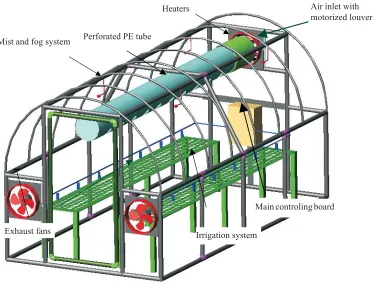
In order to test the system and to evaluate its performance, a small greenhouse was also constructed. In this paper, we intend to discuss and interpret some of the results obtained by using the afore-mentioned system. Before doing so, however, we outline some of the salient features of the system. Figure 1 depicts these devices schematically. A brief summary of the controlling devices shown in Fig. 1 is given next.
Greenhouse
The constructed Quonset type greenhouse has a floor area of 8 m2and is covered with two 200mm polyethylene (PE) films. The Quonset design is based upon an arched roof as shown in Fig. 1. The usage of double glazing was to reduce winter heat losses. It would, however, cause a reduc-tion in light transmission, thereby reducing the crop growth rate (Critten and Bailey, 2002). Environmental systems employed included the followings.
(b) adding water vapour to the air, further increasing the relative humidity, and (c) reducing the vapour pressure deficit which is the force that evaporates water from the leaves. Raising humidity levels without creating excessive free water requires some sort of an evaporative device such as misters, fog units, or roof sprinklers. Four misters to produce tiny water droplets that evaporate are used here.
Irrigation system.Eight dippers for water supply of pots were used. The system operates on a time base schedule.
Heating system.A multistage heater is designed here. Available output powers from the heaters were 1900, 3000 and 4900W.
Fan ventilation system. It consists of an air inlet fan with ventilation rate of 850 m3h-1, with attached perforated PE tube, recirculation and distribution duct, winter air inlet with motorized louver and two exhaust fans, each with a ventilation rate of 280 m3h-1.
Main control board
The controller was designed to maintain temperature, relative humidity and water availability in a desired range. The controller consisted of three temperature sensors and a relative humidity sensor. Three LM335 sensors are used to measure inside and outside temperatures, whereas the relative humidity was measured using a homemade capacitor sensor. The outputs of the controller operate
a number of actuators: a multistage heater to warm the house, a sprayer pump to activate the mist and fog system, eight drippers for water supply, a fan to let air in and two fans to ventilate the air out. The mist and fog system produces tiny water droplets that evaporate, thereby cooling and humidifying the greenhouse air at the same time. In order to select a device for our greenhouse,ieits type, size, power requirement, ventilation rate, etc. empirical formulas as well as interpolation through standard tables were used (Shafaei, 2003).
Hardware. The main controlling board is shown in Fig. 2. It is made up of an AVR microcontroller, a 2´12 segment LCD display, an IC 74C573 to activate the 8 actuators relays, a power supply and an IC MAX-232 interface card for sending/receiving data to microcontroller from RS-232 serial port to a PC. Three LM335 sensors are used to measure inside and outside temperatures. LM335 is a pre-cision, easily calibrated, integrated circuit temperature sensor which operates as a two-terminal Zener and has a breakdown voltage directly proportional to absolute temperature at +10 mV K-1. When calibrated at 25°C, the LM335 has typically less than 1°C error over a 100°C temperature range. The relative humidity was measured with a homemade capacitor type sensor. These sensors are shown in Fig. 3. Conditioning circuits used in conjunction with these sensors are presented in (Omid, 2004).
Fig. 1.The constructed Quonset greenhouse to carry out experiments. Mist and fog system Perforated PE tube
Air inlet with motorized louver
Main controling board
Irrigation system Heaters
Control strategy. Our greenhouse control system implements an ON/OFF algorithm control with hysteresis
ie, each parameter must be maintained continuously within a certain range. The ON/OFF controller brings many benefits to basic parameter controls within a greenhouse. For instance in temperature control, we can have automatic sequence of operation and remote sensing capabilities. Consequently, a single ON/OFF controller takes the place of several thermostats. Further more, ON/OFF controller uses a single sensor element to control both heating and cooling functions in a greenhouse zone. That sensor can be located among the plants while the controller can be located more conveniently and safely outside the plant environment. This type of controller divides the actions of the greenhouse heating and cooling equipment into steps, or stages, called a sequence of operation. Although multiple thermostats with different settings can accomplish the same task, it is difficult
to keep their temperature readings synchronized. As a result, heating and cooling equipment can be on simultaneously.
Software. The design and implementation of ON/OFF algorithm requires a complex control system because there are many conditions that depend on the kind of plant and distribution of parameter values at certain times. Various environmental systems such as fan, heater, ventilator, sprayer and irrigation systems must be installed in the greenhouse. Thus, there are many devices that must be handled (monitored and/or controlled) during automatic operation of the controller. To carry these tasks out correctly, a versatile graphical user interface (GUI) program incorporating control algorithms is needed. Therefore, a GUI, written in visual basic that runs under Windows (98/2000/XP) operating systems, was developed.
RESULTS AND DISCUSSION
Performance of the system was evaluated by installing it in the greenhouse. A number of experiments were carried out during the 2003 autumn season. In the next section, one of the experiments which was conducted from 10 to 12 a.m. on December 7, 2003, in the city of Karaj, is presented and discussed. The system performance was tested for two modes of operations: (a) uncontrolled mode of operation, and (b) controlled mode. During the first hour and a half the system was tested as a data-acquisition system,ieonly data from the sensors were recorded and monitored on the screen with no operation of fans, sprayer or other installed environ-mental systems in the greenhouse. For the last 20 min of the experiment, inside air temperature was controlled by the system.
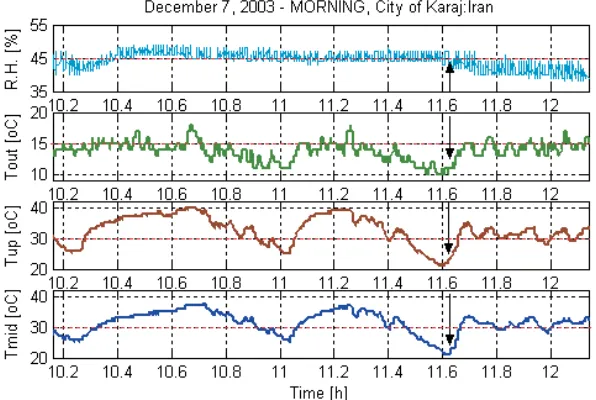
The results from one of the experiments conducted from 10 to 12 a.m. on 7 December, 2003, in the city of Karaj are discussed here. The simulation results of using the system for air temperature and relative humidity (RH) control are shown in Fig. 4. This figure shows a comparison between the inside and the outside,ieambient, condition. The initial part (up to the arrows) shows the recorded data with no operation
AVR
AT90S8535
ADC
PC
RS232
MAX232
Actuators
LCD
Display
Fig. 2.Schematic of greenhouse control and monitoring system.
Fig. 3.Temperature sensor (a) and relative humidity sensor (b).
of fans, sprayer,etc. The latter part in Fig. 4,iefrom arrows upwards, shows the results of controlled operation. In Fig. 4, Tmidis the temperature at the height of plant (approx. 1 m high), Tupis the temperature near the roof (approx. 2 m high) of greenhouse, Toutis the outside temperature and RH is the inside relative humidity. Hence, Tmid, Tupand RH indicate the inside condition whereas Tout indicates the outside condition, respectively. The results indicate that the outside temperature is always less than the inside one. This can be explained as follows; the solar radiation enters the green-house through transparent plastics and is trapped there, hence increasing the inside temperature. This result is a further confirmation of the greenhouse effect.
During temperature increase, it is found that the rate of change of temperature rise in the upper part,ie near the plastic cover, is higher than that at the height of plants. This difference in vertical temperature gradient is due to different amount of received solar incident radiation. Influence of solar radiation is more pronounced near the plastic cover than in the middle. During temperature decrease, on the other hand, it is found that the rate of change of temperature fall near the plastic cover is higher than that at the height of plants. During this phase, heat exchange with ambient mostly occurs through the greenhouse cover. Hence these areas are influenced first, and then the middle parts.
The fluctuations of temperature and, to a lesser extent, of RH during observation time are a consequence of natural conditions such as surface evaporation within the green-house, solar radiation and ambient temperature. At the time of this experiment, outside weather conditions were changing rapidly from sunny to cloudy. This can explain why the maximum and minimum of Tout, Tmid and Tup occurring at the same time,ieare in phase.
For the last 20 min of this experiment, the controller was put into action. Here we were only interested in finding out
our system performance in controlling air temperature and were not concerned with RH control. The parameter settings for this part of experiment were the inside temperature, set point (TSP), and offset values (Tov). TSPwas set to 30°C and Tovwas set to 3°C for maximum on-value and Tovwas set to 1°C for maximum off-value. TSPis defined inSettings Menu
and Tovvalues in Advanced Settings Menu of system GUI (Shafaei, 2003). The result of this experiment is also shown in Fig. 4. The instant when the system took automatic control over the temperature related devices is indicated by arrows in Fig. 4. The following conclusions can be made by looking at the latter part of Fig. 4.
• It is found that Tout<Tmid<Tup. This could be partly due to
the use of re-circulating fan with an attached perforated polyethylene tube in guiding the air toward the plant root zone.
• Relative humidity is decreasing. In reality this is undesirable, as plants require higher RH to grow, and the result seems to be a bit surprising. However, this observation can be justified. (You must bear in mind that here we are only controlling the temperature).
• The overall performance of the system in maintaining the temperature within a given range, around the set point, is satisfactory.
CONCLUSIONS
1. System performance of a recently developed computer-based control and monitoring system which provides visualization, control and coordination of tempe-rature and humidity in a greenhouse was validated.
2. It can be concluded that the overall performance of the developed system to monitor and control the temperature inside a greenhouse is satisfactory.
3. During initial stages of the system design, provisions for adding extra sensors and/or actuators with minor modification, were considered.
4. The presented system can be adapted for bigger greenhouses.
REFERENCES
Ameur S., Laghrouche M., and Adane A., 2001.Monitoring a greenhouse using a microcontroller-based meteorological data-acquisition system. Renewable Energy, 24, 19-30.
Critten D.L. and Bailey B.J., 2002.A review of greenhouse engineering developments during the 1990s. Agricultural and Forest Meteorology, 112, 1-22.
Chalabi Z.S., Bailey B.J., and Wilkinson D.J., 1996.A real-time optimal algorithm for greenhouse heating. Computers and Electronics in Agriculture, 15, 1-13.
Gates R.S., Chao K., and Sigramis N., 1999. Fuzzy control simulation of plant and animal environments. Proc. ASAE Annual Int. Meeting, Toronto, Canada, No. 993196.
Kimball B.A., 1986.Influence of elevated CO2on crop yield. In: Carbon Dioxide Enrichment of Greenhouse Crops (Eds B.A. Kimball and H.Z. Enoch). 2. Physiology, yield, and economics (Chapter 8). Boca Raton, FL, CRC Press.
Marhaenanto B., and Singh G., 2002.Development of a com-puter-based greenhouse environment controller. Proc. World Cong. Computers in Agriculture and Natural Resources, Iguassu Falls, Brazil, 136-146.
Miguel A.F., 1999.Wind-caused air transport through screens: a phy-sical modeling approach. Int. Agrophysics, 13, 191-195.
Omid M., 2004.A computer-based monitoring system to maintain optimum air temperature and relative humidity in greenhouses. Int. J. Agric. Biol., 6, 6, 1084-1088.
Shafaei A., 2003.Computer control of greenhouse climate: design and development a prototype. MSc. Thesis, University of Tehran, Iran (in Farsi).