Copyright © 2013 IJECCE, All right reserved
PAPR Reduction Using Hybrid PTS-Companding-SLM
Technique in OFDM Communication System
Karuna Markam
MITS, GwaliorEmail: [email protected]
Amrita Kranti Mishra
OCT, BhopalEmail: [email protected]
R. P. Singh
MANIT, Bhopal Email: [email protected]Abstract– High Peak-to-Average Power Ratio (PAPR) is one of the exigent matters for Orthogonal Frequency Division Multiplexing (OFDM). In this paper, a PAPR reduction technique is proposed which is a combination of Partial Transmit Sequence (PTS), companding and SLM techniques. Simulation results are presented, commented, and compared with the results obtained applying PAPR reduction methods already proposed in literature.
Keywords - OFDM, MC, DMT, FDM, PAPR, CCDF, SLM, PTS,μ-law, A-law.
I. INTRODUCTION
Orthogonal Frequency Division Multiplexing (OFDM) has developed to a popular communication technique for high speed wireless communication in the last decade. Orthogonal Frequency Division Multiplexing (OFDM), is also called Discrete Multitone Modulation (DMT). It is based upon the principle of frequency division multiplexing (FDM) where each frequency channel is modulated with simpler modulation scheme and splits a high rate data stream into a number of lower rate streams that are transmitted simultaneously over a number of orthogonal subcarriers. The orthogonality of the carriers means that each carrier has an integer number of cycles over a symbol period. Due to this integer number of cycles, the spectrum of each carrier has a null at the center frequency of each of the other carriers in the system that results in no interference between the carriers, allowing them to be spaced as close as possible. The problem of overhead carrier spacing required in Frequency Division Multiplexing (FDM) can be recovered. So this multicarrier transmission scheme allows the overlapping of the spectra of subcarriers for bandwidth efficiency. The increase of symbol duration for the lower rate parallel subcarriers reduces the relative amount of dispersion in time caused by multipath delay spread. Therefore
OFDM is an advanced modulation technique which is suitable for high-speed data transmission due to its advantages in dealing with the multipath propagation problem, high data rate and bandwidth efficiency.
OFDM transmission scheme is a type of multichannel system which avoids the usages of the oscillators and band-limited filters for each sub channel. It divides the frequency spectrum into small sub-bands so that the channel effects are constant (flat) over a given sub-band. Then a classical in phase quadrature modulation (BPSK, QPSK, M-QAM, etc) is sent over the sub-band. A large number of closely spaced orthogonal subcarriers are used to carry data. The data is divided into several parallel data streams or channels, one for each sub-carrier. Each
subcarrier is modulated with a conventional modulation scheme such as Quadrature Amplitude Modulation (QAM) or Phase Shift Keying (PSK) at a low symbol rate. The total data rate is to be maintained similar to that of the conventional single carrier modulation scheme with the same bandwidth. Orthogonal Frequency Division Multiplexing (OFDM) is a promising technique for achieving high speed data transmission due to its advantages in dealing with the multipath propagation problem, high data rate, bandwidth efficiency and combating multipath fading in Wireless Communications. Despite its multidimensional advantages, there are drawbacks of OFDM system. The high Peak-to-Average Power Ratio (PAPR) is the most severe one. This is caused by constructive interference between many sub-carriers, which may occur at few time instants within the symbol duration. Thus, very wide linear dynamic range is required for the power amplifiersat the transmitter RF stage. It is important to minimizing the PAPR for allowing a higher average power to be transmitted for a fixed peak power, improving the overall signal to noise ratio at the receiver. Many individual and hybrid techniques have been suggested in the literature to tackle this problem. The reduction in PAPR achieved by these techniques is relative and is obtained at the expense of either an additional complexity to the OFDM transmitter and receiver.
II. LITERATURE
SURVEY
Copyright © 2013 IJECCE, All right reserved diversity, to improve transmission efficiency. Shannon’s
classical paper in 1948 suggested that the highest data rate can be achieved for frequency-selective channels by using an MC system with an infinitely dense set of sub-channels and adapting transmission powers and data rates according to the signal-to-noise ratio (SNR) at different sub-channels. Based on his theory, a water-filling principle has been derived. Cioffi and his group have extensively investigated OFDM with performance optimization for asymmetric digital subcarrier line, which they discrete multiple tone (DMT). Some of their earlier inventions on practical loading algorithms for OFDM or DMT systems were in [15, 16].
More recently, OFDM has been implemented in mobile wideband data transmission (IEEE 802.11a, Hyper LAN II), high-bit-rate digital subcarrier lines (HDSL), asymmetric digital subcarrier lines (ADSL), very high-speed digital subscriber lines (VHDSL), digital audio broadcasting (DAB), digital television and high-definition television (HDTV), IEEE 802.16 Wi-MAX standard and its predecessor multicarrier multipoint distribution service (MMDS) [17-19].
Despite the widespread acceptance of OFDM, it has its drawbacks. One drawback is that OFDM signals suffer from large envelope variations. Such variations are problematic because practical communication systems are peak power limited. Thus, envelope peaks require a system to accommodate an instantaneous signal power that require lager power efficiencies or power amplifier (PA) saturation. This problem is termed as Peak to Average Power Reduction. PAPR reduction was required for radar and speech synthesis applications. In radar, PAPR reduction was important because radar systems are peak-power limited just like communications system. And for communication system a number of approaches have been proposed to deal with the PAPR problem. These techniques include Clipping, Clipping and Filtering, Tone Reservation, Tone injection; Selected Mapping and Partial Transmit Sequence.[20-27] Clipping is the most straight forward PAPR reduction technique but can lead to significant out-of-band distortion. In order to alleviate such effects filtering can be applied. However, this causes significant peak-regrowth. Distortion-less techniques such as Tone Reservation also requires the receiver to know the location of the reserved tones so as to disregard them when decoding the data signal. Selected Mapping (SLM) is implemented by generating a set of sufficiently different signals from the original data signal. The transmitter selects and submits the candidate signal having the lowest PAPR. Partial Transmit Sequencing (PTS) is a similar technique in which sub-blocks of the original signal are optimally combined at the transmitter to generate a transmitted signal with a low PAPR. Although SLM and PTS are effective at reducing the PAPR, they require the use of side information in order to decode the signal at the receiver.Various hybrid techniques such as SLM–PTS[36],
SLM-TR[37], PTS-Companding[38], and
SLM-Companding[41] have been proposed in the literature. These techniques give better results than the individual techniques at the cost of increased complexity. The first
companding scheme was introduced based on the similarity between OFDM signal and speech signal that large signal occurs infrequently by Wang et al. in 1999 [42]. A μ-Law companding technique introduced [42] to generate optimal companding coefficients to limit PAPR of an OFDM signal and improve the BER performance. A companded signal increases the transmitter signal power while the noise power remains constant and makes the High Power Amplifier (HPA) to operate in the non linear region. The second one is A-Law algorithm In μ law compander the signals with lower amplitudes are amplified with greater gain.
III. MATHEMATICAL
EXPRESSION
FOR
PAPR
Let the data block of length N is represented by a vector
T N X X X
X [ 0, 1,..., 1] . T is the duration of any symbol
K
X in the set X and represents one of the sub-carriers set.
Since the N sub-carriers chosen to transmit the signal are
orthogonal, so we can have fnnf , where
NT f n 1
and NT is the duration of the OFDM data block X. The transmitted OFDM signal for complex data block is given by equation
x e t NTN t
x j n ft
N n
n
n
,01 2
1
0
(3.1)
The PAPR of the transmitted signal is given by equation
tNT
dt t x t x 0 2 0 / 1 max PAPR (3.2)
The principle aim of PARP reduction techniques is to reduce max|x(t)|.
PAPR is usually examined by using statistical property called complementary cumulative distribution function (CCDF). CCDF shows the probability PAPR exceeds a certain value. CCDF for non oversampling signal is given by
CCDF = 1-[1-exp (-PAPR)] N (3.3)
Where N is number of subcarriers and as we increase the N, PAPR increases of N.
High PAPR should be reduced because high PAPR causes:
1. Nonlinear distortion in the high power amplifier (HPA) since HPA limits the output with certain threshold
2. Reduction of the power efficiency of the amplifier 3. Increasing the complexity of the ADC and DAC
IV. PROPOSED
TECHNIQUE
Copyright © 2013 IJECCE, All right reserved input of SLM technique for further reduction of PAPR.
The intention of this combination is to obtain a signal with lowest PAPR than the other methods. This section will present some simulation results obtained using different scenarios for PAPR reduction of OFDM signals. In this way the value of PAPR is reduced substantially. These results are compared with original, SLM, PTS, Companding, SLM-Companding and PTS-Companding techniques. Figure 4.1 depicts the block diagram of PTS-Companding-SLM technique.
Fig. 4.1 Block diagram OF PTS-COMPANDING-SLM technique
V. SIMULATION
RESULTS AND
DISCUSSIONS
The results presented in this section were obtained by considering an Additive White Gaussian Noise (AWGN) channel, 4 subcarriers (N), 4 sub-blocks (V) and a QPSK modulation scheme. Figures show the CCDF performance of the proposed technique (PTS + companding + SLM) as well as different techniques. The complement cumulative distribution function (CCDF) of the PAPR denotes the probability that the PAPR of a data block exceeds a given fixed threshold PAPR. Figure 5.1 presents the CCDF performance of the system without any PAPR reduction and the system equipped only with companding technique for µ=1 and µ=2. As we increases the value of µ the value of PAPR decreases but on the expense of complexity. Figure 5.2 shows the CCDF performance of the system without any PAPR reduction and the system outfitted only with SLM technique for N=4. As we increases the value of N, the value of PAPR decreases but the complexity of the system increases. The result shows that SLM technique gives the lower PAPR value than original signal. Figure 5.3 depicts the CCDF performance of the system without any PAPR reduction and the system prepared only with and PTS technique for V=4. As we increases the value of V, the value of PAPR decreases but the complexity of the system increases. The result shows that in PTS technique, the value of PAPR is lower than the original signal. Figure 5.4 demonstrates the CCDF performance of the system without any PAPR reduction and the system equipped with SLM and PTS for N=4. The graph shows that SLM and PTS techniques give better results than original signal. Moreover, SLM technique shows lowest value of PAPR than the other two methods.
Figure 5.5 depicts the CCDF performance of the system without any PAPR reduction and the system ready with SLM and SLM-Companded techniques for N=4. The graph shows that Companded-SLM gives lowest value of PAPR than the other two methods i.e. original signal and SLM.
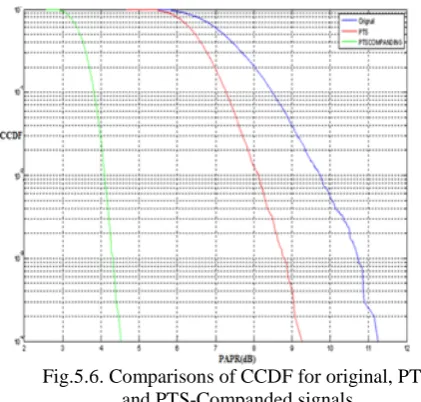
Figure 5.6 shows the CCDF performance of the system without any PAPR reduction and the system ready with PTS and PTS-Companded techniques. The graph shows that PTS and PTS-Companded techniques give better results than original signal. Moreover, PTS-Companded technique shows lowest value of PAPR than the other two methods.
Figure 5.7 demonstrates the CCDF performance of the system without any PAPR reduction and the system equipped with PTS-Companded-SLM techniques. The value of PAPR is lower in PTS-Companded-SLM techniques.
Figure 5.8 shows the comparison of CCDF of all the techniques i.e. SLM, PTS, SLM-Companded, PTS-Companded and PTS-PTS-Companded-SLM. The graph shows that the PAPR value is lower in SLM, PTS-Companded and PTS-Companded-SLM techniques. Moreover, the PTS-Companded and PTS-Companded-SLM technique gives the almost similar PAPR value.
The simulation results shows that the proposed technique gives better PAPR performance than the other individual as well as hybrid techniques discussed in the earlier sections. Thus, the proposed technique gives PAPR reduction of about 4.9dB, 4.2 dB, 0.7 dB and 0.2dBfor PTS, SLM, PTS-compandingand SLM-Companding techniques respectively.
VI. CONCLUSIONS
The thesis proposed a new technique for PAPR reduction which is a PTS-companding SLM technique which is a combination of three traditional PAPR reduction methods i.e. PTS, companding and SLM techniques and the different values of PAPR has been plotted and compared with other techniques. The obtained simulations results prove the good performance of the approach proposed better than the performance which can be obtained using only one of the two composing methods applied separately. Though, the proposed technique gives better PAPR performance but it makes the system more complex than the other techniques which have to be sought out in the future research works.
REFERENCES
[1] R.W Chang, “Synthesis of Band-Limited Orthogonal Signals for Multi-channel Data Transmission,” Bell Syst. Tech., vol.45,
pp.1775-1797, Dec. 1966.
[2] R.W Chang, “Orthogonal Frequency Division Multiplexing,”
U.S Patent 3388455, Jan 6, 1970, Filed Nov.4.1966.
[3] B.R. Satzberg, “Performance of an Efficient Parallel Data Transmission System,” IEEE Trans. Commun. Technol., vol.-15, no.6, pp. 805-811, Dec 1967.
[4] S. Weinstein and P. Ebert, “Data Transmission by Frequency Division Multiplexing Using the Discrete FourierTransform,”
Copyright © 2013 IJECCE, All right reserved
628–634, Oct.1971.
[5] B. Hirosaki, “An Analysis of Automatic Equalizers for Orthogonally Multiplexed QAM Systems,” IEEE Transaction Communication, vol.28, pp.73-83, Jan.1980.
[6] B. Hirosaki, S.Hasegawa, and A. Sabato, “Advanced Group-band Data Modem Using Orthogonally Multiplexed QAM Technique,”IEEE Trans. Commun., vol. 34, no. 6,
[7] A. Peled and A. Ruiz, “Frequency Domain Data Transmission using Reduced Computational Complexity Algorithms,”
Acoustics, Speech, and Signal Processing, IEEE International
Conference on ICASSP’80, vol. 5, pp. 964-967, 9-11 Apr., Denver, USA 1980.
[8] M.S Zimmerman and A.L Kirsch, “The AN/GSC-10 (KATHRYN) Variable rate data modem for HF radio,” IEEE Trans. Commun. Technol., vol.15, no.2, pp. 197-205, Apr. 1967.
[9] W.E. Keasler, Jr., “Reliable Data Communications over the Voice band-width Telephone Using Orthogonal Frequency Division Multiplexing,” Ph.D. dissertation, Univ. Illinois,
Urbana, Il, 1982.
[10] L. J. Cimini, “Analysis and Simulation of a Digital Mobile Channel using Orthogonal Frequency Division Multiplexing,”
IEEE Transaction Communications, vol.33,pp. 665-675. July
1985.
[11] E.F. Casas and C. Leung, “OFDM for Data Communication over Mobile Radio FM Channels. I. Analysis and experimental results,” IEEE Transaction Communications, vol.39, no.5, pp.
783-793, May. 1991.
[12] B.S. Krongold, K. Ramchadran, and D.L Jones, “Computationally Efficient Optimal Power Allocation Algorithms for Multicarrier Communication Systems,” IEEE Transaction Communication, vol.48, no.1, pp.23-27, Jan. 2000.
[13] L.J. Cimini, Jr.B. Daneshrad, and N.R Sollenberger, “Clustered OFDM with Transmitter Diversity and Coding,” proceeding of IEEE Global Tele. Communications. Conf., pp. 703-707, 1996.
[14] P.H. Moose, “A technique for Orthogonal Frequency Division Multiplexing Frequency Offset correction,” IEEE Transaction communication, vol. 42, no. 10, pp. 2908-2914, 1994.
[15] T. S. Rappaport, Wireless Communications, principles andpractice, 2nd prentice-Hall publications, 2002.
[16] V. N. Richard and R. Prasad, “OFDM forWireless Multimedia Communication,”Artech house publisher, London, 2002. [17] Joseph Thaliath, Mabel Mary Joy, Elizabeth Priya John, and
Debabrata Das, “Service Class Downlink Scheduling in WiMAX,” IEEE International conference on Communication System software and middleware (COMSWARE 2008), Jan 5-10,
Bangalore, India, 2008.
[18] G. V. Rangaraj, D. Jalihal, and K. Giridhar, “On usefulness of multipath diversity for multiple antenna OFDM systems,”IETE Technical Review, vol.21, no.5, pp. 317-- 324, Sept.-Oct. 2004.
[19] C. Pradabpet, K.Eupree, S. Chivapreecha, k. Dejhan, “A New Reduction Technique for OFDM-WLAN in 802.11a Systems,”
Ninth ACIS International Conference on Software Engineering, Artificial Intelligence,Networking, and Parallel Distributed
Computing, SNPD ‘08’, Thailand, pp.179-184, 6-8 Aug. 2008. [20] S. H. Han and J. H. Lee, "An Overview of Peak-to-Average
Power Ratio Reduction Techniques for Multicarrier Transmission," IEEE Wireless Communications, vol. 12, no. 2, pp. 56-65, 2005.
[21] Josef Urban and Roman Marsalek, “OFDM PAPR Reduction by Combination of Interleaving with Clipping and Filtering,”IEEE Communication Letter, pp. 249–252, June 2007.
[22] S.H Muller and J.B Huber, “OFDM with Reduced Peak-to-Average power Ratio by Optimum Combination of Partial Transmit Sequences,” IEEE Electronics Letters on Communication & Signal Processing, vol. 33, issue. 5, pp.
368-369, 27 Feb. 1997.
[23] Bauml, R.W.; Fischer, R.F.H.; Huber, J.B, “Reducing the Peak-to-Average Power Ratio of Multicarrier Modulation by Selected Mapping,”IEEE Electronics Letters, vol.32, pp. 2056-2057, 24
Oct. 1996.
[24] R.F.H. Fischer, “Widely-Linear Selected Mapping for Peak-to-Average Power Ratio Reduction in OFDM,”IEEE Electronics Letters, pp. 766–767, July 2007.
[25] L. J. Cimini Jr. and N. R. Sollenberger, "Peak-to-Average Power Ratio Reduction of an OFDM Signal using Partial Transmit Sequences," IEEE Communications Letters, vol. 4, no. 3, pp. 86-88, 2000.
[26] T. T. Nguyen and L. Lampe, "On Partial Transmit Sequences to Reduce PAR in OFDM Systems," Proceedings of IEEE Global
Telecommunications Conference (GLOBECOM '06), pp. 1-6,
San Francisco, Calif, USA, November-December 2006. [27] Siegl, Christian and Fisher, F. H. Robert, “Partial Transmit
Sequences for Peak-to-Average Power Ratio Reduction in Multi-antenna OFDM,” EURASIP Journal on Wireless Communications and Networking, vol.8, pp. 1-11, Jan. 2008. [28] Y. Wu, K. L. Man, Y. Wang, Optimum Selective Mapping for
PAPR Reduction,” IEEE Wireless Telecommunications Symposium (WTS), 13-15 April, New York City, NY, USA, 2011.
[29] A. D. S. Jayalath, and C. Tellambura,“SLM and PTS Peak-Power Reductionof OFDM Signals without SideInformation”,
IEEE transactions on wireless communications, vol. 4, no.5,
September 2005.
[30] Smriti Bhatnagar, Shivali Beakta and Rashmi Manchanda, “ComparativeAnalysis of the Techniques for Reducing PAPR in OFDM”, IEEE Region 8 SIBIRCON-2010,Irkutsk Listvyanka,
Russia, July 11–15,2010.
[31] Lin Chenand Xuelong Hu,“A Modified SLM Scheme for PAPR Reduction,” 3rd International Congress on Image and Signal Processing(CISP2010), 16 Oct - 18 Oct 2010, Yantai, China. [32] Di-xiao Wu, “Selected Mapping andPartial Transmit Sequence
Schemes toReducePAPR in OFDM Systems”,IEEE International Conference on Image Analysis and Signal Processing (IASP), 2011 , 21-23 Oct., Hangzhou, China, 2011
[33] Dae-Woon Lim, Seok-Joong Heo, and Jong-Seon No, “An Overview ofPeak-to-Average Power Ratio Reduction Schemes for OFDM Signals”,Journal of Communications and Networks,
vol. 11,no. 3, June 2009.
[34] Tao Jiang and Yiyan Wu, “AnOverview: Peak-to- average Power Ratio Reduction Techniques for OFDM Signals,” IEEE Transactions on Broadcasting, vol. 54, no. 2, June 2008.
[35] SeungHee Han, Jae Hong Lee “An Overview of Peak-To-Average Power Ratio Reduction Techniques for Multicarrier Transmission,” Modulation, Codingand Signal Processing For Wireless Communications, IEEE Wireless Communications, volume: 12, issue: 2, pp. 56-65, 2005
[36] Kamal Singh, Manoranjan Rai Bhartiand SudhanshuJamwal, “A modified PAP Rreduction scheme based on SLM and PTS Techniques,” IEEE International Conference on Signal Processing, Computing and Control (ISPCC), 15-17 March, Waknaghat, India 2012.
[37] Eugen-Victor Cuteanu and Alexandru Isar, “Hybrid PAPR Reduction Scheme with Selective Mapping and Tone Reservation,”International Conference on Applied Electronics (AE), Abu Dhabi, United Arab Emirates5-7 Sept. 2012. [38] Mountassir Jamal, Isar Alexandru,“Combined Partial Transmit
Sequence and Companding For PAPR Reduction in OFDM Systems,” Proceedings of SPAMEC, Cluj-Napoca, Romania,
2011.
[39] ArvindChakrapani, V. Palanisamy, “ASurvey on CF Method, PTS Approach, Companding Technique and TimeDomain Methods for PAPR Reductionin OFDM Systems”, European Journal of Scientific Research,vol.75,no.4,2012.
[40] B. Ragini, M. SushanthBabu and KKishanRao, “Companding Technique for Reducing Peak-to-Average Power Ratio in OFDM Linear CodedSystems,”International Journal of Power System Operation and Energy Management, pp. 2231– 4407, vol.1, issue2, 2011.
[41] S.P. Vimal and K. R. Shankar Kumar,“A New SLM Technique for PAPRReductionin OFDM Systems”,European Journal of Scientific Research,vol. 6, no. 2, 2011.
[42] Wang, X., Tjhung, T.T., Ng, C.S.,“Reduction of peak to average power ratio of OFDMsystem using a companding technique”,
Copyright © 2013 IJECCE, All right reserved Fig. 5.1.Comparisons of CCDF for original and µ law
Companding for µ=1 and µ=2
Fig. 5.2. Comparisions of CCDF for original and SLM for N=4
Fig.5.3. Comparisons of CCDF for original and PTS for V=4
Fig.5.4. Comparisons of CCDF for original, SLM and PTS for N=4.
Fig.5.5. Comparisons of CCDF for original, SLM and SLM-Companded signals
Copyright © 2013 IJECCE, All right reserved Fig.5.7. Comparisons of CCDF for original and
PTS-Companded-SLM signals