R E S E A R C H
Open Access
Evidence, theory and context - using intervention
mapping to develop a school-based intervention
to prevent obesity in children
Jennifer J Lloyd
*, Stuart Logan, Colin J Greaves and Katrina M Wyatt
Abstract
Background:Only limited data are available on the development and feasibility piloting of school-based interventions to prevent and reduce obesity in children. Clear documentation of the rationale, process of development and content of such interventions is essential to enable other researchers to understand why interventions succeed or fail.
Methods:This paper describes the development of the Healthy Lifestyles Programme (HeLP), a school-based intervention to prevent obesity in children, through the first 4 steps of the Intervention Mapping protocol (IM). The intervention focuses on the following health behaviours, i) reduction of the consumption of sweetened fizzy drinks, ii) increase in the proportion of healthy snacks consumed and iii) reduction of TV viewing and other screen-based activities, within the context of a wider attempt to improve diet and increase physical activity.
Results:Two phases of pilot work demonstrated that the intervention was acceptable and feasible for schools, children and their families and suggested areas for further refinement. Feedback from the first pilot phase suggested that the 9-10 year olds were both receptive to the messages and more able and willing to translate them into possible behaviour changes than older or younger children and engaged their families to the greatest extent. Performance objectives were mapped onto 3 three broad domains of behaviour change objectives -establish motivation, take action and stay motivated - in order to create an intervention that supports and enables behaviour change. Activities include whole school assemblies, parents evenings, sport/dance workshops, classroom based education lessons, interactive drama workshops and goal setting and runs over three school terms.
Conclusion:The Intervention Mapping protocol was a useful tool in developing a feasible, theory based
intervention aimed at motivating children and their families to make small sustainable changes to their eating and activity behaviours. Although the process was time consuming, this systematic approach ensures that the
behaviour change techniques and delivery methods link directly to the Programme’s performance objectives and their associated determinants. This in turn provides a clear framework for process analysis and increases the potential of the intervention to realise the desired outcome of preventing and reducing obesity in children.
Background
Over a very short timescale there has been a substantial increase in the proportion of children in the UK who are overweight [1] The Health Survey for England (2008) reported that 19% of girls and 18% of boys aged 11-15 were obese and 34% of girls and 33% of boys were overweight [1]. The National Child Measurement
Programme reported that by age 10-11 years (Year 6) one in three children were either overweight or obese [2]. Being overweight in childhood is associated with adverse consequences including metabolic abnormalities, increased risk of Type II diabetes, and musculo-skeletal and psychological problems [3]. Over 50% of obese chil-dren become obese adults [4] with significant health consequences [5].
Unfortunately there is currently little evidence that existing, school-based intervention programmes are effective in preventing or reducing obesity in children.
* Correspondence: [email protected]
Institute for Health Service Research, Peninsula College of Medicine and Dentistry, University of Exeter, Exeter, UK
In addition, most intervention programmes have not reported on their rationale, development, exact content, or method of implementation which further hampers our understanding about what works and why. In tack-ling childhood obesity, securing scientific information on what constitutes a healthy diet and an active lifestyle is only the first step. The second step, requiring an equally scientific approach, is to find methods of achiev-ing behaviour change. The determinants of behaviours linked to obesity are complex and inevitably changing these behaviours is difficult and interventions are likely to be complex and multi-faceted. The 2008 MRC Fra-mework for developing and evaluating complex inter-ventions recommends that the mechanisms by which interventions work need to be made explicit during development [6] and such interventions need to be com-prehensively described if they are to be replicable by others. This is important as it provides a basis for checking intervention fidelity, a necessary pre-requisite to understand efficacy. It also provides a basis for pro-cess analysis (relating mechanisms of change to out-comes) which can shed light on why complex interventions succeed or fail and how they can poten-tially be optimised.
Schools have the potential to play a critical role in the prevention of overweight and obesity. With their exist-ing organisational, social and communication structures they provide opportunities for regular health education and for a health enhancing environment. They also enable the researcher to engage children and families across the social spectrum. In England, children attend a primary or junior school up to the age of 11, where they usually have one class teacher who teaches all subjects. This allows for joined up cross-curriculum activities and facilitates communication making both intervention and research in this setting particularly attractive.
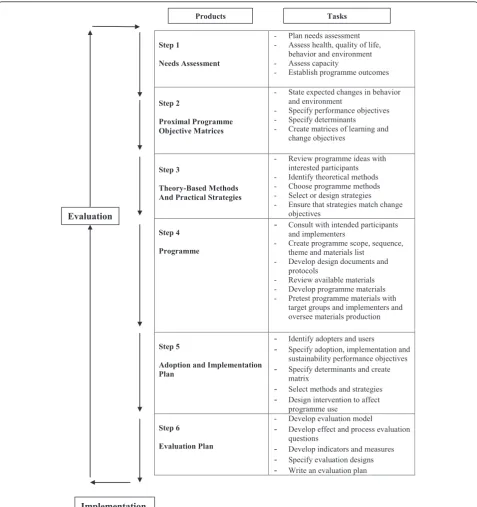
In this paper we describe the application of a systema-tic process, Intervention Mapping (IM) (see Figure 1) [7] to plan a school-based obesity prevention intervention.
Methods
Intervention Mapping
The six main steps of IM (Figure 1) are: i) needs assess-ment; ii) detailed mapping of programme objectives and their behavioural and environmental determinants; iii) selecting techniques and strategies to modify the deter-minants of behaviour and the environment; iv) produ-cing intervention components and materials; v) planning for adoption, implementation and sustainability; and vi) creating evaluation plans and instruments. IM uses behavioural theory and research evidence to develop specific learning and change objectives for the target population and to identify the personal and external determinants of these objectives. Theory and other
considerations (e.g. stakeholder opinions, feasibility data) also guide the choice of intervention methods and stra-tegies to achieve these objectives. We used a variety of methods to gather the appropriate information to enable us to produce a feasible and acceptable intervention that has the potential to change behaviours at a school, child and family level. These included literature reviews, dis-cussions with stakeholders (teachers, head teachers, edu-cation advisors, local public health leads in physical activity and obesity) and experts in behavioural science and obesity research. We also carried out focus groups with children and interviews with parents and teachers during early pilot work to inform our selection of inter-vention techniques and strategies and to ensure that these remained feasible to deliver within normal school activities.
The following sections provide a summary of the first 4 steps of the IM process used to produce the HeLP intervention. Steps 5 and 6 involve programme imple-mentation, adoption, monitoring and evaluation and are not presented here. While the steps are described in lin-ear fashion they are, in fact, iterative. For example, defining a more specific behaviour change objective (e.g. parents need to buy and provide healthier snacks) might lead to the consideration of additional behavioural determinants (those which affect parental shopping behaviours as well as those which affect the child’s eat-ing behaviour).
Step 1: Needs Assessment
The IM process begins with a needs assessment of the health problem, which includes identification of the pro-blem behaviours (and to some extent their determi-nants) and of desired programme outcomes as well as the environmental conditions associated with the problem.
Reviewing the evidence base
The starting point was to review the literature to identify (i) risk factors for childhood obesity and children’s cur-rent eating/drinking and physical activity behaviours (ii) the determinants of these behaviours and (iii) apparently successful and unsuccessful components of previous school-based interventions to prevent and reduce obesity.
increased risk of weight gain or obesity in consumers of sugar-rich drinks. A single carbonated drink per day can add 10% to a child’s energy intake [12]. According to the National Diet and Nutrition Survey (2008/9), in the UK children’s intake of non milk extrinsic sugars (NMES) provides 15% of food energy [13], compared to a recommendation of not more than 11% [14].
Carbonated soft drinks are a major source of NMES providing 19% of NMES intake in children aged 4-10 and over one-third in children aged 11-18 [13].
Reduced energy expenditure has also been associated with weight gain [15] and numerous studies in adults and children reported an association between lower weight gain and higher levels of physical activity [16].
Step 1
Needs Assessment
- Plan needs assessment - Assess health, quality of life,
behavior and environment - Assess capacity
- Establish programme outcomes
Step 2
Proximal Programme Objective Matrices
- State expected changes in behavior and environment
- Specify performance objectives - Specify determinants - Create matrices of learning and
change objectives
Step 3
Theory-Based Methods And Practical Strategies
- Review programme ideas with interested participants - Identify theoretical methods - Choose programme methods - Select or design strategies - Ensure that strategies match change
objectives
Step 4
Programme
- Consult with intended participants and implementers
- Create programme scope, sequence, theme and materials list
- Develop design documents and protocols
- Review available materials - Develop programme materials - Pretest programme materials with
target groups and implementers and oversee materials production
Step 5
Adoption and Implementation Plan
- Identify adopters and users
- Specify adoption, implementation and sustainability performance objectives
- Specify determinants and create matrix
- Select methods and strategies
- Design intervention to affect programme use
Step 6
Evaluation Plan
- Develop evaluation model
- Develop effect and process evaluation questions
- Develop indicators and measures
- Specify evaluation designs
- Write an evaluation plan Evaluation
Implementation
Products Tasks
Stratton et al reported a decrease in the levels of cardio-vascular fitness in 9-11 year olds in England between 1997 and 2003 while the prevalence of obesity increased over the same time period [17]. Children’s TV viewing time and time spent playing electronic games has been associated with overweight and obesity [18-20], total calorific intake [21] and the consumption of snack foods [22]. Longitudinal data from the Avon Longitudinal Study of Parents and Children (ALSPAC), found strong associations between children’s fat mass at age 14 and their physical activity at age 12 [23]. We also know that today’s children are spending more time in front of the television or computer screen than in previous genera-tions - an average of two and a half hours of TV and 1 hour and 50 minutes online a day [24]. (i.e. nearly 4 1/2 hours a day of screen time). An attempt to encourage children to replace screen-based sedentary behaviours with more active pursuits is clearly an appropriate aim in preventing obesity in children and promoting a healthy lifestyle.
(ii)Determinants of behaviours A variety of family and social determinants affecting children’s eating and activ-ity behaviours have been identified. For eating, these include food preferences, food availability and accessibil-ity, modeling (copying the behaviour of others), meal-time structure (social context of meals, the role of TV during mealtimes, eating out, portion size, school meals, snacking habits), feeding styles (the caregivers approach to maintain or modify children’s behaviours with respect to eating) and socio-economic and cultural factors (e.g. family time constraints, education, income, ethnicity and culture) [25]. In terms of children’s physical activity, parental support (e.g. transporting the child, observing the activity, encouraging the child, providing equipment, participating with the child and reinforcing physical activity behaviours) has been identified as a key determi-nant both directly and indirectly through its positive association with self efficacy perceptions [26]. Griew et al recently reported that children’s school time physical activity varied according to the primary school they attended even after accounting for individual demo-graphic and the school compositional factors with a
‘school effect’explaining 14.5% of the variation in pupils’ school-time physical activity [27]. However, it is less clear that school based activities have a substantial effect on total, as opposed to school time, activity. In a study of 3 schools from one area, with different sporting facil-ities and opportunity for physical activity in the curricu-lum, Mallam et al (2003) reported large differences in school time activity levels but virtually no differences in the total activity of the children [28].
This research suggests that while it appears that schools have the potential to create a positive physical activity culture that can influence whether children
engage in physical activity it will be crucial in interven-tion studies to assess whether any effects translate in to changes in total as opposed to only school time activity.
Drawing on the social ecological approach [29] we began from the theoretical perspective that, while both eating and activity behaviours in children are partly determined by choices made by the children, they are highly dependent both on direct intervention by parents (e.g. the food provided, opportunities for physical activ-ity) and by patterns of behaviour within the family, within the school and within peer groups. As children get older the relative importance of self directed, as opposed to family directed, behaviours increases and these behaviours are influenced by wider social factors which include the school environment and peer group norms. Therefore any intervention we designed needed to affect behaviour through influencing the children, their families and the school environment. There is some evidence from previous studies of interventions in children that the use of drama/theatre can be an effec-tive tool to engage children, increase knowledge and change behaviours [30-33]. For example, in an obesity prevention programme aimed at low income children and their parents, an after school theatre-based inter-vention was shown to motivate and engage both parents and children and increase awareness of the need for making changes. However, the authors did conclude that theatre alone is not enough to lead to behavioural change and that the next step should be to incorporate this delivery method into more comprehensive pro-grammes with both educational and environmental components [31]. Two small studies in primary schools in the UK based on drama/the arts reported increases in vegetable, salad and fruit juice consumption [32,33]. Although both these studies had serious methodological weaknesses, the use of drama to engage children to change specific behaviours looked promising and was explored at length with experts from drama and educa-tion as a possible implementaeduca-tion strategy in step 3 of the intervention mapping process.
We were mindful that there were other key drivers including intrinsic factors such as genes and the wider social environment but these are less modifiable and so were not considered as potential points of intervention.
and inconsistent. Results for combined diet and activity were also inconsistent, although there was a suggestion that the combined approach might be more effective in preventing children becoming overweight in the long term. Social Cognitive Theory (SCT), which proposes that a dynamic interaction exists between personal, behavioural and environmental factors, provides a basis for many of these programmes, particularly the con-structs of self efficacy, behavioural capability (knowledge and skills to perform a behaviour), outcome expecta-tions, self regulation and reinforcement [35]. Environ-mental conditions of eating behaviour such as school lunch provision and parental/home environment were often targeted [36,37]. A review of reviews of effective elements of school health promotion across behavioural domains (substance abuse, sexual behaviour and nutri-tion) found that five elements from the highest quality reviews were found to be effective for all three domains using two types of analysis. These were use of theory; addressing social influences (especially social norms); addressing cognitive behavioural skills; training of facili-tators and multiple components. Using one type of ana-lysis only, another two elements were identified: parental involvement and a large number of sessions [38].
The authors concluded that the 5 elements identified should be primary candidates to include in programmes targeting these behaviours.
Stakeholder consultation
A second approach to needs assessment is to collect information to enable a deeper understanding of the context or community in which the intervention is to be delivered [7]. The next step in our needs assessment was therefore to run a workshop with practitioners, pol-icy makers and researchers from education, child health, sports science, the local PCT and the local healthy schools team. In the workshop we addressed the nature of the problem and the findings of our literature review, seeking ideas about possible behavioural objectives for schools, children and their families and what the desired outcomes of the programme should be.
This workshop resulted in agreement about four key principles which it was suggested should guide our intervention design. Firstly, that a public health approach should be adopted including all children rather than targeting the overweight. The adverse health consequences of obesity are not limited to those at the extreme end of the BMI distribution and, although most children remain lean, many will gain weight as adults. In addition, separating children within a class for special intervention risks stigmatising them. Secondly, the inter-vention needed to engage parents and offer them strate-gies through which they could directly (through parenting) or indirectly (through the creation of
supportive environments) foster the development of healthy eating and activity behaviours among their chil-dren/family. Thirdly, in order to provide an intervention that was not only feasible and acceptable to schools, but had potential for long term sustainability, the interven-tion should dovetail with healthy lifestyle initiatives already present in schools and aim to meet National Curriculum requirements for the age group targeted, something previously recommended by Doak et al (2006) in a review of interventions and programmes to prevent obesity in children [39]. Finally, the methods chosen to deliver the intervention to children and par-ents not only needed to engage, motivate and inspire but should also be realistically deliverable by teachers and relevant external groups operating within a school setting.
Outputs
Based on the above needs assessment process we decided to develop an intervention which aimed to sup-port children to achieve small sustainable changes across childrens’patterns of diet and physical activity but with a focus on three key behavioural objectives:
1. to reduce the consumption of sweetened fizzy drinks
2. to increase the proportion of healthy snacks con-sumed and
3. to reduce TV viewing and other screen based activities.
Step 2: Detailed mapping of programme objectives
Step 2 provides the foundation for intervention develop-ment by specifying in detail who and what will change as a result of the programme. The products of step 2
are proximal programme objectivesor PPOs. These are
statements of demonstrable behaviours (in the target group) or changes in the environment that need to occur in order affect the determinants of the overall behavioural objectives that have been identified in step 1 (and further refined in step 2). To define PPOs, we first defined key behavioural objectives (see above) and broke these down into smaller steps (performance objectives) and then identified the determinants of each performance objective. Then we specified‘proximal pro-gramme objectives’(i.e. the most immediate targets of intervention - what needs to be learnt or changed in order to modify behavioural determinants and conse-quently the key behavioural objectives).
As the aim of our intervention was to develop a school-based intervention which was delivered to chil-dren but was able to influence parents and the school as well, activities needed to include parents/families, tea-chers and the senior management team (SMT). Further, more specific behavioural objectives, called performance
(children, parents/family, teachers, SMT). These consti-tuted individual behaviours, motivations, abilities and environmental opportunities in the home and within the school for each group in order for the three key beha-vioural objectives to be achieved. The performance objectives developed for the parents/family, teachers and the SMT were focused on engaging the school and the children’s families in order to create the necessary con-ditions to enable children make sustainable changes to their eating and activity behaviours. For example, at the outset, a PO for the SMT was for them to‘buy into’the Programme and believe it would benefit the school and the children and would dovetail with the existing year 5 curriculum and school initiatives already in operation. For the purposes of this paper we will confine our examples to the performance objectives related to the child, however, a detailed intervention specification sup-porting this paper is available to view (See Additional file 1) which shows the POs, determinants (change tar-gets), BCTs and methods of delivery for all the target groups.
a) Defining overall behavioural objectives
The creation of a behavioural objective requires break-ing down the desired outcome, in this case, preventbreak-ing obesity, into component parts that influence or are required to achieve the desired outcome. The three key target behaviours, reducing consumption of sweetened fizzy drinks, increasing the proportion of healthy snacks consumed and reducing TV viewing and other screen-based activities were expanded into a set of sub-compo-nent behaviours (performance objectives, POs). These performance objectives clarified the exact behavioural performances expected from children, parents and tea-chers in order to meet these key objectives and referred to individual level behaviours, motivations, abilities as well as to environmental opportunities for such beha-viours at the home and school level. As involvement of parents was vital in achieving the three key target beha-viours, we knew we needed children to clearly commu-nicate the messages to their parents and engage them in supporting their goals. This was originally construed as a PPO related to the determinants of social support, modelling and reinforcement but was promoted to a PO so that the intervention could explicitly focus on strate-gies to promote this dialogue between the child and their family. The iterative process of identifying perfor-mance objectives was added to over time as the map-ping process identified additional issues. For example the concept of enabling children to recognize and resist temptation for unhealthy snacks was originally a PPO (which aims to address the determinant of‘urges for unhealthy foodstuff’as related to the objective of‘ redu-cing unhealthy snacks’) which we also promoted to a performance objective to allow a more detailed analysis
of this key issue. Although this process was time con-suming, it was useful in creating a more focused and considered intervention.
b) Identification of Determinants
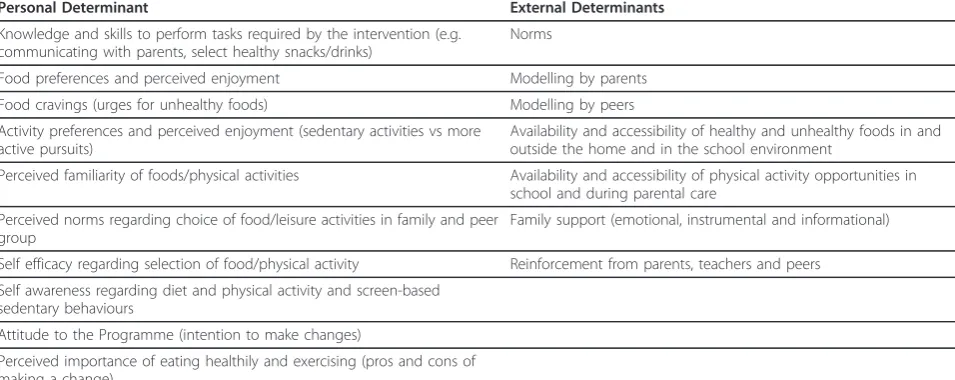
In order to specify our‘change targets’i.e. those poten-tially modifiable determinants of obesity related beha-viours we i) reviewed the determinants of children’s eating and physical activity behaviours reported by experimental and epidemiological studies and compo-nents of previous school-based interventions to prevent and reduce obesity; ii) sought expert opinion from an advisory panel of researchers in the field and beha-vioural scientists; and iii) made reference to theories of behaviour and/or behaviour change. The determinants were categorised as personal (factors within the indivi-dual under their direct control) or external (factors out-side of the individual that can directly influence the health behavior or environmental conditions). The final list of determinants to be targeted is provided in Table 1. These were selected based on their links to the-oretical models of behavior change which have formed a basis for previous school-based interventions and their potential to be modified within a school setting.
A focus on delivering the Programme in such a way that children enjoyed the activities and were motivated to participate was also seen as a key determinant for a number of POs, as affective responses are linked to both physical activity and eating behaviours. It is likely that children will be motivated and enjoy activities if they have positive attitudes towards the behaviour [40], feel competent to make changes [41], perceive significant others to be motivated and perceive they have some control over outcomes [42]. The main determinants or
‘change targets’ for the HeLP Programme therefore, were (i) knowledge and skills (ii) self efficacy, (iii) self awareness, (iv) taste, familiarity and preference, (v) per-ceived norms (vi) support, modelling and reinforcement from family members and (vii) access and availability of opportunity. Having selected our change targets or determinants the next step was to identify the specific behaviours necessary to modify them.
c) Define proximal program objectives
The final part of this step is to define theproximal
pro-gramme objectives (PPOs) by mapping performance
messages to parents and seek their help and support, change in three personal and two external determinants are required (see Table 2). From a personal perspective, the child needs specific knowledge and skills to commu-nicate the messages to their parents and seek their help and support (taught throughout the intervention using a variety of methods) and perceive that their peers are talking about the project and also seeking their parents support. Practising communication through role play and engaging parents using homework tasks, drama pro-ductions and school assemblies may increase self effi-cacy in communicating messages to parents and making suggestions for support. From an external perspective, the child requires support and reinforcement from par-ents, teachers and peers. This increased communication with parents/family needs to increase family awareness of healthy lifestyles and in turn lead to the family increasing availability and accessibility of healthy snacks and active pursuits at home.
The end point of step 2 in the intervention mapping process, i.e. defining proximal programme objectives, is an iterative process and we moved back and forth between the tasks of defining POs and their associated determi-nants from the ones targeted in the HeLP Programme (see Table 1) and the creation of statements of demonstrable behaviours. e.g.‘practices skills to seek parental support’ that would modify a particular determinant and thus help achieve the performance objective. This process produced an overwhelming amount of information which we had to condense in order to develop a feasible and acceptable intervention within the school setting.
During the process of creating the matrix, in order to guide the sequential order in which behaviour change
techniques were delivered in our intervention, we decided to map performance objectives onto a process model of behaviour change. The Health Action Process Model (HAPA) [42] was selected as a‘starting point’as it is consistent with the theoretical models of behaviour change mentioned earlier and suggests that behaviour change occurs through a sequence of adoption, initiation and maintenance processes. This phased model implies a clear order of distinct actions which is easily understood and is compatible with a sequential application of techni-ques spread across the curriculum of a school year. By taking these phases into account, performance objectives and their associated PPOs were mapped onto three pro-cesses of behaviour change;Establish motivation(develop confidence and skills, make decisions);Take action (cre-ate an action plan and implement it);Stay motivated (monitor progress, assess and adapt goals).
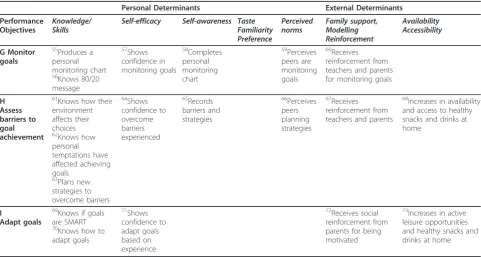
Tables 2, 3 and 4 present matrices of performance objectives and a selection of the key determinants tar-geted in the HeLP intervention for each of the three processes of behavior change. The combination of per-formance objectives, and behavioural determinants, gen-erates (in the cells of the table) the proximal objectives for the Programme (PPOs). These have then been mapped onto the appropriate process of behavior change in the HAPA model. This provided a clear fra-mework to guide the selection and sequencing of the behavior change techniques and practical strategies which constitute the intervention.
Step 3: Specify behaviour change techniques
The product of step 3 is an inventory of behaviour change techniques selected to match each proximal
Table 1 Examples of determinants of eating and physical activity behaviour in children targeted by the Healthy Lifestyles Programme
Personal Determinant External Determinants
Knowledge and skills to perform tasks required by the intervention (e.g. communicating with parents, select healthy snacks/drinks)
Norms
Food preferences and perceived enjoyment Modelling by parents
Food cravings (urges for unhealthy foods) Modelling by peers
Activity preferences and perceived enjoyment (sedentary activities vs more active pursuits)
Availability and accessibility of healthy and unhealthy foods in and outside the home and in the school environment
Perceived familiarity of foods/physical activities Availability and accessibility of physical activity opportunities in school and during parental care
Perceived norms regarding choice of food/leisure activities in family and peer group
Family support (emotional, instrumental and informational)
Self efficacy regarding selection of food/physical activity Reinforcement from parents, teachers and peers
Self awareness regarding diet and physical activity and screen-based sedentary behaviours
Attitude to the Programme (intention to make changes)
Table 2 Matrix of performance objectives and determinants for‘Establish Motivation’
Personal Determinants External Determinants
Performance Objectives
Knowledge/ Skills
Self-efficacy Self-awareness Taste Familiarity Preference Perceived norms Family support, Modelling Reinforcement Availability Accessibility *A Communicate healthy lifestyle messages to parents and seek their help and support 1Understands messages and energy balance concept 2Practices skills to
communicate with parents 3Understands how parents can support a healthy lifestyle 4Practices skills to seek parental support 5Shows confidence knowledge of healthy lifestyle 6 Shows confidence to talk to parents 7Shows confidence and knowledge of family strategies to support a healthy lifestyle 8 Shows confidence to seek parental support
9Perceives other pupils are talking about the project 10 Perceives others are seeking parental support
11Receives social reinforcement from parents/ family for interest in healthy lifestyles 12 Receives reinforcement from parents/ family for suggested support strategies
13Increases in availability of healthy snacks/ drinks and active pursuits
B
Select and try healthy alternatives to unhealthy snacks and drinks at home and at school 14Identifies healthy alternatives to unhealthy snacks and drinks 15Practices skills to ask for healthy alternatives in different settings 16 Taste healthy alternatives to unhealthy snacks and drinks 17shows confidence to select healthy snacks and drinks 18shows confidence to try new snacks and drinks
19Is familiar with and chooses healthy snacks and drinks 20Perceives family, peers, teacher expecting them to select healthy alternatives 21Receives reinforcement from family, peers and teachers
22Increases in availability and accessibility of healthy snacks and drinks at home C Select feasible active alternatives to sedentary activities 23Identifies active alternatives to sedentary leisure pursuits 24 Attends activity workshops Participates in active games 25Shows confidence and enthusiasm
26Is familiar with range of active alternatives to sedentary pursuits 27Perceives family expecting active choices 28Receives reinforcement from family, peers, teachers
29Increases in active leisure opportunities at home D *Understand and resist temptation 30Identifies general barriers to being healthy 31Understands marketing strategies used to tempt children 32Practices skills to resist temptations
33Shows confidence to resist temptation
34Records what tempts them into eating unhealthy snacks and drinks and being sedentary 35Perceives peers and family are resisting temptation
36Sees parents, family and peers resist temptation
37Decreases in temptations in the home
programme objective. A behaviour change technique (BCT) e.g.‘model/demonstrate behaviour’is a technique designed to change a specified theoretical process or determinant of behaviour. For example, using strategies in the intervention that enable children to practice a tar-geted behaviour and/or see role models perform the behaviour, is designed to increase self efficacy
(confidence in being able to perform the target beha-viour), which is a construct of social cognitive theory.
Finding appropriate techniques begins with the ques-tion “How can the learning and change objectives (the PPOs) for each performance objective be accomplished?” Methods for identifying suitable techniques included a) discussions with stakeholders, and experts in behaviour
Table 3 Matrix of performance objectives and determinants for‘Take Action’
Personal Determinants External Determinants
Performance Objectives Knowledge/ Skills Self-efficacy Self-awareness Taste Familiarity Preference Perceived norms Family support, Modelling Reinforcement Availability Accessibility E Reflect own snacking and leisure choices
38Identifies unhealthy snacks in diet and sedentary leisure choices 39 Compares to guideline 40Shows confidence in ability to assess own behaviour
41Completes 2 day food record 42Completes 24 hour activity record 43Receives reinforcement from parents and teachers 44 Sees peers evaluate snacking and activity choices F Set goals and make changes 45
Knows role of goal setting in helping to change behaviours 46Knows goals need to be SMART 47Writes 3 SMART goals
48Knows range of strategies to help achieve goals 49Identifies personal strategies to help achieve goals
50 Shows confidence in ability to make small changes 51 Perceives peers are making changes 52 Receives reinforcement from parents and family 53
Increases in the availability and accessibility of healthy snacks and drinks at home 54
Increases in active leisure opportunities at home
Table 4 Matrix of performance objectives and determinants for‘Stay Motivated’
Personal Determinants External Determinants
Performance Objectives
Knowledge/ Skills
Self-efficacy Self-awareness Taste Familiarity Preference Perceived norms Family support, Modelling Reinforcement Availability Accessibility G Monitor goals 55 Produces a personal monitoring chart 56 Knows 80/20 message 57 Shows confidence in monitoring goals 58 Completes personal monitoring chart 59 Perceives peers are monitoring goals 60 Receives reinforcement from teachers and parents for monitoring goals
H Assess barriers to goal achievement
61Knows how their environment affects their choices 62Knows how personal temptations have affected achieving goals
63Plans new strategies to overcome barriers 64Shows confidence to overcome barriers experienced 65Records barriers and strategies 66Perceives peers planning strategies 67Receives reinforcement from teachers and parents
68Increases in availability and access to healthy snacks and drinks at home
I
Adapt goals
69
Knows if goals are SMART 70
Knows how to adapt goals 71 Shows confidence to adapt goals based on experience 72 Receives social reinforcement from parents for being motivated
73
Increases in active leisure opportunities and healthy snacks and drinks at home
change (behavioural science academics/health promo-tion staff); b) reference to a taxonomy of behavioural change techniques [43,44]; c) consideration of theory and practice in other school-based interventions; d) applying criteria for feasibility, acceptability and cost within a school setting.
A range of suitable BCTs were then selected and included: role modelling, skill and knowledge building, communication skills training, self monitoring, problem solving, modelling/demonstrating behaviour, barrier identification, goal setting, decision balance and social support. For example, to practice skills to communicate the desired healthy lifestyle messages to their parents and seek their support, children modelled and demon-strated the behaviour by participating in a variety of role play scenes, followed up with discussions of issues led by the drama facilitator. Many BCTs may need to be applied to bring about a single PPO e.g. for children to
‘practice skills to resist temptation’ (PPO number 32,
see Table 2), the BCTs used were‘prompt barrier identi-fication’, ‘problem solving’,‘decision balance’,‘model/ demonstrate behaviour’and communication skills train-ing’. This linked to the PO of ‘understand and resist temptation’. (see Table 5).
Step 4: specifying practical strategies and designing the intervention
The implementation strategy is simply the process for delivery of a particular behavior change technique. The strategy needs to be appropriate for the target popula-tion and the setting in which the intervenpopula-tion will be conducted. We were mindful (as per our needs assess-ment) that strategies chosen needed to be deliverable by teachers and relevant external groups operating within a school setting, dovetail with healthy lifestyle initiatives already going on in schools at the time and, where pos-sible, meet National Curriculum requirements for this age group.
Table 5 Behaviour change techniques and strategies for performance objectives associated with‘Establish Motivation’
Performance objectives Behaviour change techniques (theoretical framework)
Implementation strategies
A
Communicate healthy lifestyle messages to parents and seek their help and support
Exchange information (IMB)
Prompt barrier identification Model/demonstrate behaviour
Communication skills training
(SCT)
Prompt identification as a role model (SCT)
Children learn about the healthy lifestyle messages and support strategies through a variety of individual and group tasks delivered by the teacher in PSHE lessons and by actors in drama workshops.‘80/20’used as a general message throughout suggesting we should eat healthily and be active at least 80% of the time.
Parent information sheets given to children following each drama workshop. Characters and children role play scenes to communicate messages to parents and seek their support. Discussion and role play of ways to encourage whole family to make changes.
Characters present scenes, where after having made changes to their behaviours, become role models to others (siblings, parents, friends) followed by group discussion.
B
Select and try healthy alternatives to unhealthy snacks and drinks at home and at school
Exchange information (IMB)
Provide encouragement Modelling (SCT)
Children view and discuss with their chosen character ingredients of both healthy and unhealthy food and drink. Compare fat, sugar and salt content to recommended guidelines.
Children observe characters taste healthy snacks and drinks while role playing in different settings
Characters provide encouragement
Children taste healthy snacks and drinks with their chosen character
C
Select feasible active alternatives to sedentary activities
Modelling (SCT) Children and actors role play home and school scenes focussing on replacing sedentary leisure pursuits with active alternatives.
Children play interactive games to choose and mime active leisure pursuits. Children observe the characters mime their 24 hour clock and discuss their activity in relation to the‘80/20’message.
D
Understand and resist temptation
Prompt barrier identification (SCT) Problem solving (SCT) Decision balance (SCT)
Prompt barrier identification (SCT) Model/demonstrate behaviour (SCT) Communication skills training (SCT)
Children make personalised‘Temptation T shirts’
Children work with their chosen character to prepare ways to tempt the other 3 characters and help their own character to resist temptation. Children participate in the‘Temptation Ladder’activity that enables them to practise skills to resist temptations and help others.
Children observe characters role play marketing scenes Children participate in the role play.
a) Specifying implementation strategies
It was clear the strategies chosen to deliver the key mes-sages needed to inspire and motivate the children so that they discussed the Programme at home with their parents and each other. Previous research has suggested that drama may be an appropriate means of engaging children, increasing knowledge and changing health behaviours [30-33]. Following discussions with experts in education and drama, it was hypothesised that inter-active drama based activities where the children take ownership of the issues was more likely to motivate children to become engaged with the process, make changes and to engage their parents than passive receipt of messages. We also hypothesised that, if the children were involved in the development of materials, including the scenarios they produce (facilitated by actors), they would be more likely to be receptive to the health mes-sages. Drama sessions were also compatible with the existing school curriculum and could provide a frame-work within which to deliver many of the proposed behaviour change techniques in a way which is accessi-ble and engaging for children.
Table 5 presents a summary of behaviour change techniques and implementation strategies chosen to accomplish PPOs (not shown) for each performance objective related to ‘establishing motivation’. To view the table showing techniques and strategies for ‘take action’and ‘stay motivated’see Additional file 2.
b) Designing the Programme
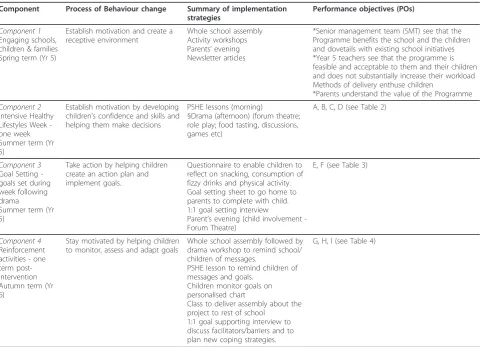
Utilising the Health Action Process Model, our chosen implementation strategies were then ordered to create three intervention components (components 2-4) fol-lowing the sequence of the three broad behaviour change processes in the HAPA model, with an addi-tional component (component 1) designed to create a receptive context within the school (Table 6). The HeLP intervention runs over 3 school terms (Spring and Sum-mer term of year 5 and Autumn term of year 6) so that it is feasible and acceptable to schools and to encourage transfer of knowledge and skills into year 6. Table 6 provides a summary of each component of the interven-tion (with timescales), summarised implementainterven-tion stra-tegies and their associated performance objectives. Performance objectives marked * for component 1 have not been discussed in this paper as they do not relate directly to the child but a detailed intervention specifica-tion showing performance objectives for all target groups is available to view (See Additional file 1).
Piloting
a) Methods
The intervention was piloted in two phases and process evaluation methods included semi structured interviews (teachers and parents), focus groups (children),
questionnaire responses (parents), documentation of parental and child involvement and observations of intervention delivery. The aim of phase 1 was to ensure that the initial intervention components were feasible, appropriate and suitably engaging for the target popula-tion (8-11 year olds). We therefore worked with chil-dren, parents and teachers from a single primary school to assess a variety of possible activities, materials and modes of delivery to 119 children from three age groups (8-9 year olds; 9-10 year olds and 10-11 year olds) using education lessons and either drama or goal setting. Based on the results/feedback from phase 1, the inter-vention was further developed and a second phase of piloting took place in a second primary school, in an area of high deprivation, with 77 children from three year 5 classes (aged 9-10 years). The aim of the second phase was to assess ‘proof of concept’ (i.e whether the intervention could change obesity related behaviours) and the feasibility of taking measures. Height, weight, waist circumference, % body fat, objective physical activ-ity (using accelerometry), food intake (using an adapted version of the Food Intake Questionnaire) [45] and screen time (using an adapted version of the Childrens’ TV Viewing Habits Questionnaire [46] were measured at baseline and 6 weeks post intervention.
b) Results
Pilot 1(one primary school; n = 119 children, aged 8-11) In the questionnaire feedback, many parents reported positive parent/family behaviour changes. Qualitative data from teachers, children and their parents suggested that Year 5 s (9-10 year olds) were more receptive to the messages than the year 4 and 6 children and more able and willing to translate them into possible beha-viour changes. In addition, it appeared that this year group engaged their families to the greatest extent. Tea-chers thought that the education lessons should be taught consecutively over one week to maintain momen-tum and that the drama and goal setting had the poten-tial to work synergistically by engaging the children through the drama and following this up with encoura-ging the children, with their parents support, to make changes through setting simple goals. Parents and chil-dren also highlighted the need for a greater variety of activities to introduce the key messages and concepts in order to engage both boys and girls.
Pilot 2 (one primary school; n = 77 children, aged 9-10) Staff were enthusiastic about the Programme, in part because it met the National Curriculum guidelines for Personal Social Health Education (PHSE) and Citizen-ship, and importantly because they felt it promoted families’engagement with the school. Some teachers felt that the drama had a positive effect on the self esteem of the children, particularly those with additional learn-ing needs. Some teachers suggested further activities for the subsequent term to reinforce the messages and refo-cus the children and their parents on their goals. Many parents reported that their family had made lifestyle changes and that their child was willing to try new foods. The children enjoyed the drama activities and felt that they could relate to the characters within the drama framework that made them more motivated to set their own goals. Some children reported that they had started going to more after school clubs. Table 7 below presents some supporting quotes
Quantitative data from the pre and post intervention behavioural and anthropometric measures showed a
significant self reported decrease in the consumption of energy dense snacks (p = 0.001), TV viewing (p = 0.033). Objective measures of physical activity showed a significant decrease in girls’ sedentary behaviours (p = 0.03) and a significant increase in girls’moderate to vig-orous physical activity (p = 0.001). We note that this is only before and after data and some measures were self report and therefore unreliable, however, these results did provide‘proof of concept’.
ImplicationsAn additional component was added to the intervention - ‘reinforcement activities’ to take place at the beginning of year 6. In addition, minor refinements were made to the education lessons and the drama scripts to enhance delivery and continuity. Table 6 shows the final intervention components, associated processes of change, implementation strategies and POs.
A paper providing more detail of these two piloting phases, including a randomised exploratory trial has been published [47].
The drama/school assembly scripts for the actors and a step by step guide for the drama facilitator have been
Table 6 The HeLP Programme and associated POs
Component Process of Behaviour change Summary of implementation strategies
Performance objectives (POs)
Component 1 Engaging schools, children & families Spring term (Yr 5)
Establish motivation and create a receptive environment
Whole school assembly Activity workshops Parents’evening Newsletter articles
*Senior management team (SMT) see that the Programme benefits the school and the children and dovetails with existing school initiatives *Year 5 teachers see that the programme is feasible and acceptable to them and their children and does not substantially increase their workload Methods of delivery enthuse children
*Parents understand the value of the Programme
Component 2 Intensive Healthy Lifestyles Week -one week Summer term (Yr 5)
Establish motivation by developing children’s confidence and skills and helping them make decisions
PSHE lessons (morning)
§Drama (afternoon) (forum theatre; role play; food tasting, discussions, games etc)
A, B, C, D (see Table 2)
Component 3 Goal Setting -goals set during week following drama
Summer term (Yr 5)
Take action by helping children create an action plan and implement goals.
Questionnaire to enable children to reflect on snacking, consumption of fizzy drinks and physical activity. Goal setting sheet to go home to parents to complete with child. 1:1 goal setting interview
Parent’s evening (child involvement -Forum Theatre)
E, F (see Table 3)
Component 4 Reinforcement activities - one term post-intervention Autumn term (Yr 6)
Stay motivated by helping children to monitor, assess and adapt goals
Whole school assembly followed by drama workshop to remind school/ children of messages.
PSHE lesson to remind children of messages and goals.
Children monitor goals on personalised chart
Class to deliver assembly about the project to rest of school
1:1 goal supporting interview to discuss facilitators/barriers and to plan new coping strategies.
G, H, I (see Table 4)
manualised to enable delivery by a local theatre/drama group. The PSHE lessons (with learning outcomes relat-ing to the National Curriulum) and their associated resources have also been manualised so that class tea-chers are able to deliver the sessions with minimum preparation (these can be obtained from the correspond-ing author).
Discussion
This paper describes the use of Intervention Mapping to develop a school-based intervention to prevent obesity in children. Intervention Mapping was a useful tool to guide us through the process of developing the HeLP intervention, as was Abraham and Michie’s taxonomy of BCTs [43] which helped us to select feasible BCTs for use in the HeLP Programme. However, these tools did not provide much guidance on how to organise these many BCTs and their associated delivery methods into a coherent, efficient and appropriately sequenced frame-work. As a result we took further steps to select techni-ques and strategies to fit around a process model of behavior change The HAPA model provided a frame-work to order the implementation techniques into a coherent, multi component intervention (Table 6) that could run over three school terms and would enable the children and their families to make lifestyle changes.
The HAPA model is consistent with a number of ories of behavior change including social cognitive the-ory and control thethe-ory [35]. We selected the HAPA as
being the‘closest fit’ to the set of theoretical determi-nants we had identified. However, although the HAPA model was useful in helping to identify a broad strategy for sequencing the delivery of BCTs, it did not provide complete coverage of the theoretical determinants we identified. Additional processes we have incorporated included the need to address cravings for unhealthy snacks (affective processes) (see table 1) and the need to build a receptive context within the school environment, component 1 of the intervention (see table 6). Two further BCTs (not addressed in the taxonomy) [43,44] we used to help create a receptive context within the school were the‘identification of barriers’ with teachers and the senior management team to delivering the inter-vention within school time and ‘discussion of possible solutions’ to these. We also understood the importance of ‘showing empathy’ (i.e. understanding the nature school life) when liaising with teachers and the SMT which, we felt, was key in building a trusting relation-ship - essential in getting the school to ‘buy into’ the Programme. (See Additional file 1).
The development process was also consistent with the new MRC framework for the development and evalua-tion of complex intervenevalua-tions [6] which suggests an iterative approach in which an understanding of context is central. The evidence that existing school-based pro-grammes actually prevent obesity is weak [48]. We recognize that there are important social determinants of behaviours related to diet and physical activity which
Table 7 Provides example quotations supporting a selection of performance objectives for teachers, children and their families
Performance Objective Illustrative quotes
Year 5 teachers need to see that the programme is feasible and acceptable to them and their children and does not substantially increase their workload
’I really appreciated you giving me all the lesson plans and resources and
that they linked to the National Curriculum. I found them easy to follow’’
’I knew the drama would work well with our children’
’The parents evening did increase my workload a bit but I thought it was
worthwhile’
Class teachers need to be enthused by the programme and develop their understanding and appreciation of the issues
’I enjoyed observing the children in the drama sessions as I saw what a
great impact it had on my class’
’The project inspired me as I saw what a positive effect it was having on
the children with statements’
’It was good for us to have to teach the PSHE lessons as this helped me to
understand what the project was about’
The methods of delivery need to enthuse children so that they discuss messages with their parents and are motivated to seek family support to make small and simple lifestyle changes
’[Name] talked a lot about the project. She loved the Chiefs and dance visit
despite not being coordinated!’
’The project encouraged [Name] to become interested in cooking and
preparing food.’
’[Name] plays an active part in choosing healthy options when we shop’
Children need to be able to select feasible, active alternatives to
sedentary activities ’
Since moving house, [Name] no longer cycles to school but he realised he misses it so he is now going to cycle to school again even though he has
further to go now. It has come from him and that it good’
’[Name] has definitely increased her activity and chooses this option instead
of TV’
Parents/families need to make changes ’I buy more fruit and veg‘
’We do more activity as a family now’
’I try to make her packed lunches more healthy and interesting’
are difficult to address and which will inevitably militate against successful interventions delivered to individuals and within micro-environments such as schools. None-theless we hope that the rigorous approach employed to develop the HeLP Programme and its modification through iterative pilot phases will increase the likelihood of both efficacy and effectiveness. It also provides us with the basis for the process evaluation we are con-ducting alongside the efficacy trials which will help us to explore possible reasons for its success or failure.
Strength and Limitations: This is one of the few
stu-dies to describe in detail the theoretical basis, interven-tion techniques and strategies of an interveninterven-tion for reducing and preventing childhood obesity. Through the use of IM methods, the theoretical basis, behavior change techniques and implementation strategies can be seen to fit together as a coherent intervention model. Each technique delivered has a clear purpose and a clear place in the model. The IM approach was very useful, although there was a tendency to generate a long list of behavior change techniques, which were not necessarily coherent or compatible. We were able to correct this by application (and extension) of a process model of beha-vior change (The HAPA model). In order to make sure that certain behaviours were targeted (such as encoura-ging the children to engage their parents and talk
mean-ingfully about the project’s messages) we decided to
promote some PPOs to POs so that there could be a second level of ‘peeling down’that would enable us to establish more focused and specific implementation stra-tegies related to a key programme objectives.
Future directions:Two stages of piloting and
refine-ment of the intervention have taken place. In addition an exploratory randomised controlled trial has just been completed involving 202 children to establish feasibility and acceptability of the Programme and the trial design for a future large cluster RCT. The results of this pilot work will be reported elsewhere.
Implications for practice: Interventions to address
overweight/obesity (and other complex behavioural interventions) in children could adopt similar methods to clearly outline their intervention methods and the causal processes hypothesised to underlie the desired changes in child and parent behaviour. We believe that this framework allows a deeper understanding of the processes through which such interventions work, improving our ability to design and deliver consistently effective interventions.
Conclusion
Although time consuming, we found intervention map-ping to be a useful tool for develomap-ping a feasible, theory based intervention aimed at motivating children and their families to make small sustainable changes to their eating
and activity behaviours. The next phase of the research will involve evaluating the effectiveness and cost effective-ness of the HeLP Programme in a large scale cluster RCT.
Additional material
Additional file 1: Detailed Intervention Specification of the HeLP Programme.
Additional file 2: Behaviour change techniques and strategies for performance objectives associated with‘Take Action’and‘Stay Motivated’.
Acknowledgements
The authors are very grateful to the participating schools, children and their families who gave up their time for the study. We would also like to acknowledge Sandy Akerman (Headbangers Theatre Company) who supported the design of the drama component of the intervention. Phase 1, 2 and 3 (the ongoing exploratory trial) of development was funded by the Children’s Research Fund (registered charity no. 226128) and the NIHR Research for Patient Benefit (RfPB) Programme. SL, KW and JL were partially supported by PenCLAHRC, the National Institute for Health Research (NIHR) CLAHRC for the Southwest Peninsula. This paper presents independent research commissioned by the National Institute for Health Research (NIHR). The views expressed are those of the author(s) and not necessarily those of the NHS, the NIHR or the Department of Health.
Authors’contributions
JL and KW led the intervention mapping process and conducted the literature review with CG providing advice on the use of IM and BCTs. JL led the design of intervention delivery methods and the production of intervention materials, coordinated the implementation of the intervention during the piloting phases and conducted interviews with teachers and parents. JL drafted the manuscript and provided the main ideas of this paper with KW, CG and SL providing critical revision. JL and KW conducted the focus groups and with SL designed the study and obtained funding. JL will act as guarantor of the paper. All authors read and approved the final manuscript.
Competing interests
The authors declare that they have no competing interests.
Received: 27 October 2010 Accepted: 13 July 2011 Published: 13 July 2011
References
1. Health Survey for England - 2008 Trend Tables. The NHS Information centre; 2009 [http://www.ic.nhs.uk/pubs/hse08trends].
2. National Child Measurement Programme: results from the school year 2009/10. [http://www.ic.nhs.uk/statistics-and-data-collections/health-and- lifestyles/obesity/national-child-measurement-programme-england-2009-10-school-year].
3. Gunnell DJ, Frankel SJ, Nanchahal K, Peters TJ, Davey Smith G:Childhood obesity and adult cardiovascular mortality: a 57-y follow-up study based on the Boyd Orr cohort.Am J Clinical Nutrition1998,67(6):1111-1118. 4. Serdula MK, Ivery D, Coates RJ, Freedman DS, Williamson DF, Byers T:Do
obese children become obese adults? A review of the literature.Prev Med1993,22(2):167-177.
5. Choi BC, Hunter DJ, Tsou W, Sainsbury P:Diseases of comfort: primary cause of death in the 22nd century.J Epidemiol Community Health2005, 59:1030-4.
6. Craig P, Dieppe P, Macintyre S, Michie S, Nazareth I, Petticrew M: Developing and evaluating complex interventions: the new Medical Research Council guidance.BMJ2008,337:979-983.
7. Bartholomew K, Parcel GS, Kok G, Gottleib NH:Planning Health Promotion
Programmes: An intervention mapping approachSan Francisco: Jossey-Bass;
8. Stubbs J, Ferres S, Horgan G:Energy density of foods: effects on energy intake.Crit Rev Food Sci Nutr2000,40:481-515.
9. Pereira MA, Kartashov AI, Ebbeling CB, Van Horn L, Slattery ML, Jacobs DR Jr, Ludwig DS:Fast food habits, weight gain and insulin resistance (the CARDIA study): 15-year prospective analysis.Lancet2005,365:36-42. 10. Prentice AM, Jebb SA:Fast foods, energy density and obesity: a possible
mechanistic link.Obesity Reviews2003,4:197-194.
11. Ello-Martin JA, Ledikwe JH, Rolls BJ:The influence of food portion size and energy density on energy intake: implications for weight management.
Am J Clin Nutr2005,82(Suppl 1):236-241.
12. DiMeglio DP, Mattes RD:Liquid versus solid carbohydrate: effects on food intake and body weight.Int J Obes2000,24:794-800.
13. Bates B, Lennox A, Swan G:National Diet and Nutrition Survey: Headline results from Year 1 Rolling Programme (2008/9).London: TSO; 2008. 14. Department of Health:Dietary Reference Values (DRVs) for Food Energy
and Nutrients for the UK.HMSO: London; 1991.
15. Ravussin E, Lillioja S, Knowler WC, Christin L, Freymond D, Abbott WG, Boyce V, Howard BV, Bogardus CN:Reduced Rate of Energy Expenditure as a Risk Factor for Body-Weight Gain.Engl J Med1988,318(8):467-72. 16. Wareham NJ, van Sluijs EM, Ekelund U:Physical activity and obesity
prevention: A Review of current evidence.InProceedings of the Nutrition
Society: May 2005. Volume 64.Edited by: Westerterp KR. Cambridge
University Press; 2005:229-247.
17. Stratton G, Canoy D, Boddy LM, Taylor SR, Hackett AF, Buchan IE:Cardio respiratory fitness and body mass index of 9-11 year old English children: a serial cross-sectional study from 1998 to 2004.Int J Obes 2007,31:1172-1178.
18. Stetter N, Singer TM, Suter PM:Electronic games, environmental factors associated with childhood obesity in Switzerland.Obes Res2004, 12:869-903.
19. Hancox RJ, Milne BJ, Poulton R:Association between child health and adolescent TV viewing and adult health: a longitudinal birth cohort study.Lancet2004,364:257-262.
20. Marshall SJ, Biddle SJ, Gorely T, Cameron N, Murdey I:Relationships between media use, body fatness and physical activity in children and youth: a meta analysis.Int J Obes Relat Met Disord2004,28(10):1238-46. 21. Wiecha JL, Peterson KE, Ludwig DS, Kim J, Sobol A, Gortmaker SL:When children eat what they watch. Impact of television viewing on dietary intake in youth.Archives of Pediatrics & Adolescent Medicine2006, 160:436-42.
22. Halford JCG, Gillespie J, Brown V, Pontin EE, Dovey TM:Effect of television advertisements for foods on food consumption in children.Appetite 2004,42:221-5.
23. Riddoch CJ, Leary SD, Ness AR, Blair SN, Deere K, Mattocks C, Griffiths A, Davey-Smith G, Tilling K:Prospective associations between objective measures of physical activity and fat mass in 12-14 year old children: the Avon Longitudinal Study of Parents and Children (ALSPAC).BMJ 2009, 339.
24. Childwise:The Childwise Monitor Trends report 2010/11.Childwise Childwise, Norwich; 2011 [http://www.childwise.co.uk/childwise-published-research-detail.asp?PUBLISH=53].
25. Patrick H, Nicklas PA:Review of Family and Social Determinants of Children’s Eating Patterns and Diet Quality.J Am Col Nutr2005, 24(2):83-92.
26. Trost SG, Sallis JF, Pate RR, Freedson PS, Taylor WC, Dowda M:Evaluating a model of parental influence on youth physical activity.Am J Prev Med 2003,25(4):277-82.
27. Griew P, Page A, Thomas S, Hillsdon P, Cooper AR:The school effect on children’s school time physical activity: The PEACH Project.Prev Med 2010,51(3-4):282-286.
28. Mallam KM, Metcalf BS, Kirkby J, Voss LD, Wilkin TJ:Contribution of timetabled physical education to total physical activity in primary school children: cross sectional study.BMJ2003,327:529-593.
29. Egger G, Swinburn B:An“ecological”approach to the obesity pandemic.
British Medical Journal1997,315:477-480.
30. Aslan D, Sahin A:Adolescent peers and anti-smoking activities.Promot Educ2007,14:36-40.
31. Neumark-Sztainer D, Haines J, Robinson-O’Brian R, Hannan J, Robins M,
et al:’Ready. Set. ACTION!’A theatre-based obesity prevention program
for children: a feasibility study.Health Education Research2008, 24:407-420.
32. Fox L:A drama project to promote the‘Give Me 5’message to primary school children.Health promotion Service, Avon; 2001.
33. Pearson T, Lambert N, Barker ME:Increasing fruit and vegetable consumption in children: the development and evaluation of a school-based intervention using art/play therapy N09008.Project Report FSA, London; 2003.
34. Brown T, Summerbell C:Systematic review of school-based interventions that focus on changing dietary intake and physical activity levels to prevent childhood obesity: an update to the obesity guidance produced by the NICE.Obes Rev2009,10(1):110-41.
35. Bandura A:Social foundations of thought and action: A social cognitive
theoryEnglewood Cliffs, NJ: Prentice-Hall; 1986.
36. Taylor RW, McAuley KA, Barbezat W, Strong A, Williams SM, Mann JI:APPLE Project: 2-y findings of a community-based obesity prevention program in primary school-age children.Am J Clin Nutr2007,86(3):735-742. 37. Singh AS, Chin A Paw MJM, Brug J, Mechelen W:Effectiveness of a School-Based Program on Body Composition and Behaviour Dutch Obesity Intervention in Teenagers.Arch Pediatr Adolesc Med2009, 163(4):309-317.
38. Peters A, Kok LHW, Ten Dam G, Buijs GTM, Paulussen GJ, TGW M:Effective elements of school health promotion across behavioral domains: A systematic review of reviews.BMC Public Health2009.
39. Doak CM, Visscher TLS, Renders CM, Seidell JC:The prevention of overweight and obesity in children and adolescents: a review of interventions and programmes.Obes Rev2006,7:111-136.
40. Ajzen I:From intentions to actions: A theory of planned behavior.In
Action-control: From cognition to behaviour.Edited by: Kuhl J, Beckmann J.
Springer: Heidelberg; 1985:11-39.
41. Harter S:Effectance Motivation Reconsidered Toward a Developmental Model.Hum Dev1978,21:34-64.
42. Schwarzer R:Self-efficacy in the adoption and maintenance of health behaviors: Theoretical approaches and a new model.InSelf-efficacy:
thought control of action.Edited by: Schwarzer R. London: Hemisphere;
1992:217-243.
43. Abraham C, Michie S:A taxonomy of behavior change techniques used in interventions.Health Psychology2008,27(3):379-387.
44. Michie S, Johnston M, Francis J, Hardeman W, Eccles M:From Theory to Intervention: Mapping Theoretically Derived Behavioural Determinants to Behaviour Change Techniques.Applied Psychology: an international
review2008,57(4):660-680.
45. Johnson B, Hackett AF:Eating habits of 11-14 year old school children living in less affluent areas of Liverpool, UK.Journal of Human Nutrition
and Dietetics1997,10:135-144.
46. Owens J, Maxim R, McGuinn M, Nobile C, Msall M, Alario A: Television-viewing habits and sleep disturbance in school children.Pediatrics1999, 104:e27.
47. Wyatt K, Lloyd J, Creanor S, Logan S:The development, feasibility and acceptability of a school-based obesity prevention programme: results from three phases of piloting.BMJ Open2011.
48. Summerbell CD, Waters E, Edmunds L, Kelly SAM, Brown T, Campbell KJ: Interventions for preventing obesity in children.Cochrane Database of
Systematic Reviews2005, ,3:CD001871.
doi:10.1186/1479-5868-8-73
Cite this article as:Lloydet al.:Evidence, theory and context - using