107
METHOD DEVELOPMENT AND VALIDATION OF EZETIMIBE
AND SIMVASTATIN IN PHARMACEUTICAL DOSAGE FORM BY
USING RP-HPLC METHOD
Taj Mohammad Alikhan Pathan
*, M Prasad Rao, D Narasimha Rao, M Manichandana,
D Rama Rao, Ch Malathi Suvarna
M.A.M. College of Pharmacy, Kesanupalli, Narasaraopet, Andhra Pradesh, India.
ABSTRACT
A simple, specific, accurate and precise reverse phase high pressure liquid chromatographic method has been developed for the simultaneous determination of Lornoxicam and Thiocolchicoside in tablets by reverse phase C8 column (X terra, 4.6 x 250mm, 5m, Make: ACE) or equivalent. The sample was analyzed using Buffer (Weighed 2.5milligrams of Sodium di hydrogen ortho phosphate in 1000 ml HPLC water, adjust pH 4.0 with sodium hydroxide) Acetonitrile in the form of 70% and 30% as a mobile phase at a flow rate: 1.0 mL per min and detection at 230 nm. The retention time for Simvastatin and Ezetimbe was found to be 4.65and 6.80 min respectively. The limit of detection is 0.37 μg/ml and the limit of quantitation is 0.12 μg/ml. Linearity for Lornoxicam and Thiocholchicoside were found in the range of 1-50 μg/ml for SIM &5 - 25 μg/ml for EZE. The Accuracy % recoveries are between 98.0 % to 102.0% .The present method is successfully applied for the estimation of Lornoxicam market formulation-Tablet.
Keywords: Simvastatin, Ezetimbe, Reverse-Phase High-Performance Liquid chromatography.
INTRODUCTION
The proposed HPLC method was found to be simple, specific, precise, accurate, rapid and economical for simultaneous estimation of Ezetimibe and Simvastatin in pharmaceutical dosage form. The developed method was validated in terms of accuracy, precision, linearity, robustness and ruggedness, and results will be validated statistically according to ICH guidelines. The Sample recoveries in all formulations were in good agreement with their respective label claims. The literature review reveals that there are some analytical methods reported for Ezetimibe and Simavastatin either individually or in combination with other drugs by RP-HPLC method and most of the work done on biological fluids. Various analytical methods like UV, HPLC, TLC, HPTLC, LC-MS-MS, are reported for the analysis of these two compounds individually and also in combination with other drugs. Present study aims to develop simple, rapid, greater sensitivity and faster elution by RP-HPLC for the
simultaneous estimation of Ezetimibe and Simvastatin and to decrease retention time, low cost. The developed method will be validated in terms of accuracy, precision, linearity, robustness and ruggedness, and results will be validated statistically according to ICH guidelines [1-4].
Instruments and Equipment’s Used Instruments
UV-3000+ LABINDIA Double beam with UV win 5 software UV-Visible spectrophotometer with 1cm matched quartz cells.
WATERS HPLC, Model: Aliance 2695, UV- Visible Dual absorbance Detector 2487, with an automated sample injector. The output signal was monitored and integrated using Empower 2 software, Symmetry C8 (4.6 x 150mm, 5m, Make: XTerra) or equivalent column was used for separations.
Corresponding Author: - Taj Mohammad Alikhan Pathan Email: [email protected]
International Journal of
Medicinal Chemistry & Analysis
108
DRUG PROFILEa) Ezetzamibe:
Structure:
Chemical name :(3R,4S)-1-(4-fluorophenyl)-3-[(3S)-3-(4-fluorophenyl)-3- hydroxypropyl]-4- (4- hydroxyphenyl)azetidin-2-one
Molecular formula : C24H21F2NO3
Molecular Weight : 409.4252 Half life : 19–30 hours
Dose : 10 mg
Description : white coloured
CRYSTALLINE powder
Solubility : freely to very soluble in ethanol, methanol, acetone.
Melting point : 164–166 °C
Category : Anticholesteremic Agents, Cholesterol Absorption Inhibitors
Uses : inhibits the absorption of cholesterol from the intestine
Side effects : gastrointestinal disturbances, headache, fatigue, myalgia; rarely arthralgia, hypersensitivity reactions (including rash, pancreatitis, cholelithiasis, cholecystitis, thrombocytopenia, myopathy, and rhabdomyolysis
Brand Name : Zedoc, Ezetib, Ezetrol, Maxetibe, Zemitra, Zetavim
b) Simvastatin
Structure:
Chemical name :((1S,3R,7S,8S,8aR)-8-{2-[(2R,4R)-4- hydroxy-6-oxooxan-2-yl]ethyl}3,7-dimethyl-1,2,3,7,8,8a-hexahydronaphthalen-1yl2,2dimethylbutanoate.
Molecular formula : C25H38O5
Molecular Weight : 418.5662 Half life : 3 hours
Category : Anticholesteremic Agents, Antilipidemic Agents,
Dose : 5 mg to 80 mg
Description : white coloured powder Solubility : ethanol, Soluble in DMSO, Storage conditions :Store at 20°C.
Use : Treatment of dyslipidemia and the prevention of cardiovascular disease.
Brand Name : Cholestat, Coledis, Colemin, Lipex, Labistatin [5-9].
Reagents and Standard – Ezetimibe & Simvastatin Tablets:
a. Water HPLC Grade.
b.Ezetimibe & Simvastatin Working Standards c. Acetonitrile HPLC Grade
d. Ortho phosphoric acid
Preparation of Phosphate buffer:
Weighed 7.0 grams of KH2PO4 into a 1000ml beaker,
dissolved and diluted to 1000ml with HPLC water. Adjusted the pH to 4 with Orthophosporic acid.
Preparation of mobile phase
Mix a mixture of above buffer 500 mL (50%) and 500 mL of Acetonitrile HPLC (50%) degas in ultrasonic water bath for 5 minutes. Filter through 0.45 µ filter under vacuum filtration.
Diluent Preparation:
Use the Mobile phase as Diluent.
Preparation of the Ezetimibe & Simvastatin Standard & Sample Solution:
Standard Solution Preparation:
Accurately weigh and transfer 10 mg of Ezetimibe and Simvastatin working standard into a 10mL clean dry volumetric flask add about 7mL of Diluent and sonic ate to dissolve it completely and make volume up to the mark with the same solvent.
(Stock solution).
Further pipette 5ml of Ezetimibe & Simvastatin the above stock solution into a 50ml volumetric flask and dilute up to the mark with diluent.
Further pipette 3ml of Ezetimibe & Simvastatin the above stock solution into a 10ml volumetric flask and dilute up to the mark with diluent.
Sample Solution Preparation:
Accurately weigh and transfer equivalent to 10 mg of Ezetimibe and Simvastatin sample into a 10mL clean dry volumetric flask add about 7mL of Diluent and sonicate to dissolve it completely and make volume up to the mark with the same solvent.
(Stock solution).
Further pipette 5ml of Ezetimibe & Simvastatin of the above stock solution into a 50ml volumetric flask and dilute up to the mark with diluent.
Further pipette 3ml of Ezetimibe & Simvastatin the above stock solution into a10ml volumetric flask and dilute up to the mark with diluent
Procedure:
109
Ezetimibe and Simvastatin peaks and calculate the %Assay by using the formulae [10-14].
System Suitability
Tailing factor for the peaks due to Ezetimibe & Simvastatin in Standard solution should not be more than 1.5.
Theoretical plates for the Ezetimibe & Simvastatin peaks in Standard solution should not be less than 2000 [15-17].
Calculation: (For Ezetimibe)
Assay % =
AT WS DT P Avg. Wt
--- x ---x --- x ---x--- X 100 AS DS WT 100 Label Claim
Where:
AT = average area counts of sample preparation. As = average area counts of standard preparation. WS = Weight of working standard taken in mg. P = Percentage purity of working standard LC = LABEL CLAIM OF Ezetimibe mg/ml.
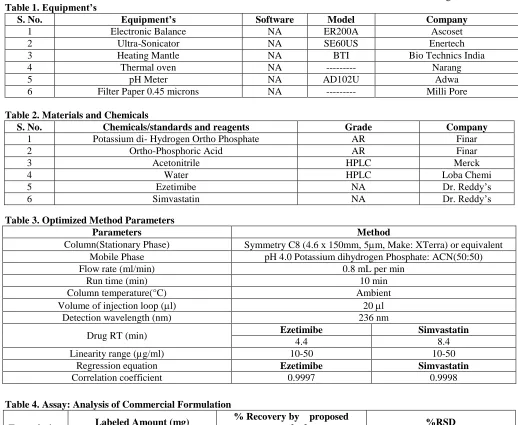
Table 1. Equipment’s
S. No. Equipment’s Software Model Company
1 Electronic Balance NA ER200A Ascoset
2 Ultra-Sonicator NA SE60US Enertech
3 Heating Mantle NA BTI Bio Technics India
4 Thermal oven NA --- Narang
5 pH Meter NA AD102U Adwa
6 Filter Paper 0.45 microns NA --- Milli Pore
Table 2. Materials and Chemicals
S. No. Chemicals/standards and reagents Grade Company
1 Potassium di- Hydrogen Ortho Phosphate AR Finar
2 Ortho-Phosphoric Acid AR Finar
3 Acetonitrile HPLC Merck
4 Water HPLC Loba Chemi
5 Ezetimibe NA Dr. Reddy’s
6 Simvastatin NA Dr. Reddy’s
Table 3.Optimized Method Parameters
Parameters Method
Column(Stationary Phase) Symmetry C8 (4.6 x 150mm, 5m, Make: XTerra) or equivalent Mobile Phase pH 4.0 Potassium dihydrogen Phosphate: ACN(50:50)
Flow rate (ml/min) 0.8 mL per min
Run time (min) 10 min
Column temperature(°C) Ambient
Volume of injection loop (l) 20 l
Detection wavelength (nm) 236 nm
Drug RT (min) Ezetimibe Simvastatin
4.4 8.4
Linearity range (µg/ml) 10-50 10-50
Regression equation Ezetimibe Simvastatin
Correlation coefficient 0.9997 0.9998
Table 4.Assay: Analysis of Commercial Formulation
Formulation Labeled Amount (mg)
% Recovery by proposed
method %RSD
Ezetimibe Simvastatin Ezetimibe Simvastatin Ezetimibe Simvastatin
10 10 99.5 99.7 0.01 0.02
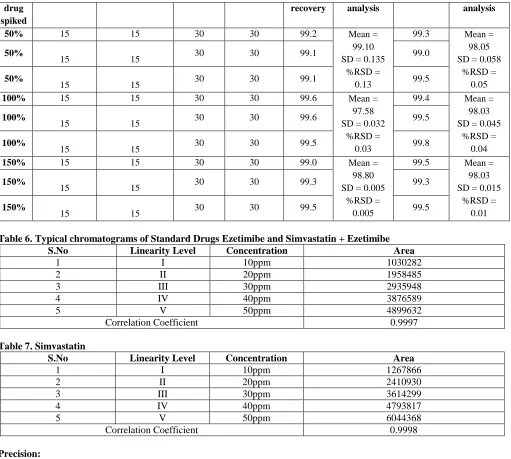
Table 5. Typical chromatogram of formulation (30g/ml of Simvastatin, 30g/ml of Ezetimibe) Accuracy
% of pure
Pure drug Formulation Ezetimibe Simvastatin
110
drugspiked
recovery analysis analysis
50% 15 15 30 30 99.2 Mean =
99.10 SD = 0.135
%RSD = 0.13
99.3 Mean = 98.05 SD = 0.058
%RSD = 0.05
50%
15 15 30 30 99.1 99.0
50%
15 15 30 30 99.1 99.5
100% 15 15 30 30 99.6 Mean =
97.58 SD = 0.032
%RSD = 0.03
99.4 Mean = 98.03 SD = 0.045
%RSD = 0.04
100%
15 15 30 30 99.6 99.5
100%
15 15 30 30 99.5 99.8
150% 15 15 30 30 99.0 Mean =
98.80 SD = 0.005
%RSD = 0.005
99.5 Mean = 98.03 SD = 0.015
%RSD = 0.01
150%
15 15 30 30 99.3 99.3
150%
15 15 30 30 99.5 99.5
Table 6. Typical chromatograms of Standard Drugs Ezetimibe and Simvastatin + Ezetimibe
S.No Linearity Level Concentration Area
1 I 10ppm 1030282
2 II 20ppm 1958485
3 III 30ppm 2935948
4 IV 40ppm 3876589
5 V 50ppm 4899632
Correlation Coefficient 0.9997
Table 7. Simvastatin
S.No Linearity Level Concentration Area
1 I 10ppm 1267866
2 II 20ppm 2410930
3 III 30ppm 3614299
4 IV 40ppm 4793817
5 V 50ppm 6044368
Correlation Coefficient 0.9998
Precision:
Table 8.System Precision (Intra Day)
The results are summarized EZETIMIBE
Injection Area
Injection-1 2876374
Injection-2 2912457
Injection-3 2899301
Injection-4 2910649
Injection-5 2909773
Average 2901711
Standard Deviation 15067.5
%RSD 0.52
The results are summarized SIMVASTATIN
Injection Area
Injection-1 3570678
111
Injection-3 3590517
Injection-4 3599152
Injection-5 3596150
Average 3592462
Standard Deviation 13368.8
%RSD 0.37
The results are summarized EZETIMIBE
Injection Area
Injection-1 2914140
Injection-2 2910592
Injection-3 2910747
Injection-4 2913191
Injection-5 2919374
Average 2913609
Standard Deviation 3570.2
%RSD 0.12
The results are summarized SIMVASTATIN
Injection Area
Injection-1 3597821
Injection-2 3591676
Injection-3 3580581
Injection-4 3592387
Injection-5 3603865
Average 3593266
Standard Deviation 8621.2
%RSD 0.24
Table 9. Robustness Ezetimibe
S.No Flow Rate
(ml/min) Area %RSD
System Suitability Results
Plate Count Tailing
1 Less flow
0.6
3328442
0.016 4537 1.3
3345692 3378545
2 Actual flow
0.8
2910592
0.830 4590 1.3
2910747 2913191
3 More flow
1.0
2585587
0.3165 4264 1.3
2567893 2597432
Simvastatin
S.No Flow Rate
(ml/min) Area %RSD
System Suitability Results
plate count tailing
1 Less flow
0.6
4109709
0.464 7869 1.1
4108935 4106734
2 Actual flow
0.8
3591676
0.340 7822 1.1
3580581 3592387
3 More flow
1.0
3192667
0.076 7232 1.1
112
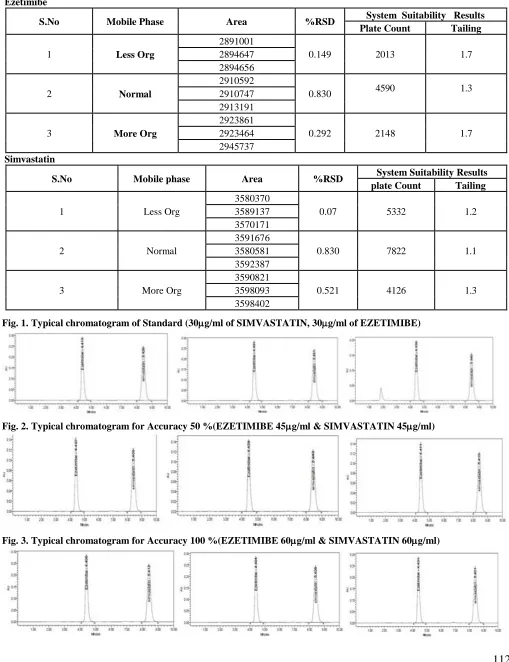
EzetimibeS.No Mobile Phase Area %RSD System Suitability Results
Plate Count Tailing
1 Less Org
2891001
0.149 2013 1.7
2894647 2894656
2 Normal
2910592
0.830 4590 1.3
2910747 2913191
3 More Org
2923861
0.292 2148 1.7
2923464 2945737
Simvastatin
S.No Mobile phase Area %RSD System Suitability Results
plate Count Tailing
1 Less Org
3580370
0.07 5332 1.2
3589137 3570171
2 Normal
3591676
0.830 7822 1.1
3580581 3592387
3 More Org
3590821
0.521 4126 1.3
3598093 3598402
Fig. 1. Typical chromatogram of Standard (30g/ml of SIMVASTATIN, 30g/ml of EZETIMIBE)
Fig. 2. Typical chromatogram for Accuracy 50 %(EZETIMIBE 45g/ml & SIMVASTATIN 45g/ml)
113
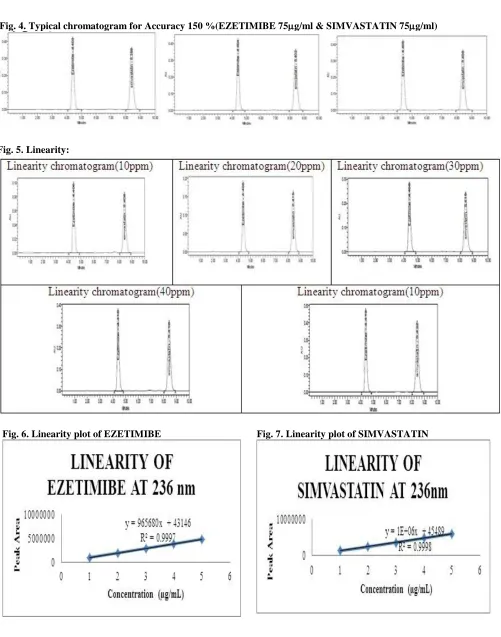
Fig. 4. Typical chromatogram for Accuracy 150 %(EZETIMIBE 75g/ml & SIMVASTATIN 75g/ml)Fig. 5. Linearity:
114
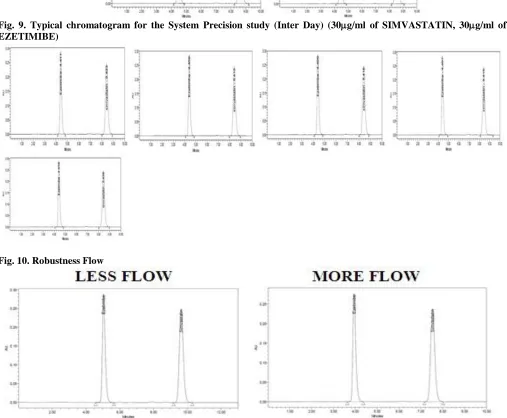
Fig. 8. Typical chromatogram for the System Precision studies (Intra Day) (30g/ml of SIMVASTATIN, 30g/ml of EZETIMIBE) System Precision (Inter Day)Fig. 9. Typical chromatogram for the System Precision study (Inter Day) (30g/ml of SIMVASTATIN, 30g/ml of EZETIMIBE)
115
Fig. 11. Robustness CompositionRESULTS
System Suitability Results
Tailing factor Obtained from the standard injection is 1.1. Theoretical Plates Obtained from the standard injection is 7822.
CONCLUSION
The proposed HPLC method was found to be simple, specific, precise, accurate, rapid and economical
for simultaneous estimation of Ezetimibe and Simvastatin in pharmaceutical dosage form. The developed method was validated in terms of accuracy, precision, linearity, robustness and ruggedness, and results will be validated statistically according to ICH guidelines. The Sample recoveries in all formulations were in good agreement with their respective label claims.
REFERENCES
1. Sharma BK. Instrumental methods of chemical analysis, Introduction to Analytical chemistry, 23thedition, Goal Publishing House Meerut, 2004.
2. Willard HH, Merritt LL, Settle FA. Instrumental Methods of Analysis, 7th edition, CBS publishers and Distributors, New Delhi. 1986, pp.518-521, 580-610.
3. John Adamovies. Chromatographic Analysis of Pharmaceutical, Marcel Dekker Inc. New York, II Ed, 74, 5-15.
4. Gurdeep Chatwal, Sahm K. Anand. Instrumental methods of Chemical Analysis, 5th edition, Himalaya publishing house, New Delhi, 2002, 1.1-1.8.
5. DA Skoog, J Holler, TA Nieman. Principle of Instrumental Analysis, 5th edition, Saunders College Publishing, 1998, 778-787.
6. Skoog, Holler, Nieman. Principals of Instrumental Analysis, 5th Edition, Harcourt Publishers International Company, 2001.
7. William Kemp. Organic Spectroscopy, Palgrave, New York,2005, pp.P7-10, 328-330
8. P.D. Sethi. HPLC: Quantitative Analysis Pharmaceutical Formulations, CBS Publishers and distributors, New Delhi (India), 2001, 3-137.
9. Michael E, Schartz IS, Krull. Analytical method development and Validation. 2004, 25-46.
10. R. Snyder, J. Kirkland, L. Glajch. Practical HPLC method development, II Ed, A Wiley International publication, 1997, 235, 266-268, 351-353, 653-600, 686-695.
11. Basic Education in Analytical Chemistry. Analytical Science, 17(1), 2001.
12. Method validation guidelines International Conference on harmonization; GENEVA; 1996.
13. Berry RI, Nash AR. Pharmaceutical Process Validation, Analytical method validation, Marcel Dekker Inc. New work, 57, 1993, 411-28
14. Anthony C Moffat, M David Osselton, Brian Widdop. Clarke’s Analysis of Drugs and Poisons, Pharmaceutical Press, London, 2004, 1109-1110, 1601-1602.
15. Klaus Florey, Analysis Profile of Drugs Substances, Academic Press, New York, 2005, 406-435. 16. P.N. Arora, P.K. Malhan. Biostatistics, Himalaya Publishers House, India, 113,139-140,154.