[Ezekwe* 5(4): April, 2018] ISSN 2349-4506
Impact Factor: 3.799
G
lobal
J
ournal of
E
ngineering
S
cience and
R
esearch
M
anagement
FACE PROCESSING AND RECOGNITION BASED CLASSROOM ATTENDANCE
SYSTEM
C.G. Ezekwe, I. C. Ituma, P. I. Okwu
* Electronics Development Institute, Awka National agency for Science and Engineering Infrastructure (NASENI) Federal ministry of Science and Technology, Nigeria
Department of Computer Science, Ebonyi State University, Abakiliki
Electronics Development Institute, Awka National agency for Science and Engineering Infrastructure (NASENI) Federal ministry of Science and Technology, Nigeria
DOI: 10.5281/zenodo.1222126
KEYWORDS
:
Eigen faces, face recognition, face training, face detection, Principal Component Analysis.ABSTRACT
Educational institutions’ administrators in our country and the whole world are concerned about regularity of student attendance. Student overall academic performance is affected by it. The conventional method of taking attendance by calling names or signing on paper is very time consuming, and hence inefficient. This problem gave birth to research on Radio frequency identification (RFID) authentication with face processing and recognition though in this paper we basically highlighted on the face processing and recognition. The system is made up of a camera which take the photos of individuals and a computer unit which performs face detection (locating faces from the image removing the background information) and face recognition (identifying the persons) First, face images are acquired using webcam to create the database. Face recognition system will detect the location of face in the image and will extract the features from the detected faces. As a result of feature extraction process, templates or eigenfaces are generated which are reduced set of data that represents the unique features of enrolled user’s face. These templates are stored in database after eigenface calculation. The basis of the eigenfaces calculation in this work is the Principal Component Analysis (PCA). The Principal Component Analysis is a method of projection to a subspace and is widely used in pattern recognition. The objectives of PCA are the replacement of correlated vectors of large dimensions with the uncorrelated vectors of smaller dimensions and to calculate a basis for the data set. C# was used for serial communication, the image training, detection and recognition and for the application interfaces, and in connection other physical components. At the end of this research work, we were able to achieve a classroom attendance system that uses the students’ images for authentication and at the same time, it is able to have high level of security and privacy because another student can never take attendance for the other.
INTRODUCTION
[Ezekwe* 5(4): April, 2018] ISSN 2349-4506
Impact Factor: 3.799
G
lobal
J
ournal of
E
ngineering
S
cience and
R
esearch
M
anagement
have numerous applications in access control systems, network security, crowd surveillance systems, and attendance systems and so on.IMAGE PROCESSING/TRAINING
Image processing implies a set of computational techniques for analyzing, enhancing, compressing and reconstructing images (Prahlad et al, 2008). Image processing has extensive applications in many areas, including astronomy, computer vision, robotics, remote sensing by satellites, medical image processing and biometrics. An overview of face recognition system and the algorithms used for implementing the image processing are described in the coming sections. For this research work, we will use high classifier image processing/training algorithm.
FACE RECOGNITION SYSTEM
The system is made up of a camera which take the photos of individuals and a computer unit which performs face detection (locating faces from the image removing the background information) and face recognition (identifying the persons) (Turk and Pentland, 1991). First, face images are acquired using webcam to create the database. Face recognition system will detect the location of face in the image and will extract the features from the detected faces. As a result of feature extraction process, templates are generated which are reduced set of data that represents the unique features of enrolled user’s face. These templates are stored in database. For an unknown face image, template is generated as described above and is compared with those stored in the database, which outputs the identity of that face if a match occurs. An overview of face recognition system is shown in figure 1. Face detection is the first and the most important step towards face recognition. Given images with different complex backgrounds, a face detection algorithm will identify and locate the faces in the image accurately. Face detection Independent component analysis algorithm with Eigen features are used. It is a method for computing fast approximations to support vector decision functions in the field of object detection.
[Ezekwe* 5(4): April, 2018] ISSN 2349-4506
Impact Factor: 3.799
G
lobal
J
ournal of
E
ngineering
S
cience and
R
esearch
M
anagement
This is a simple approach to extract the information (Turk and Pentland, 1991)
Where is the 1st eigenface
This contained images that capture the different variation in a collection of face images, independent of any judgments of features, and use this information to encode and compare individual face images. The system functions by projecting face images onto a feature space that spans the significant variations among known face images. The significant features are known as eigenfaces because they are the Eigen vectors (principal components) of the set of faces; they do not necessarily correspond to features such as eyes, ears and noses. The projection operation characterizes an individual face by a weighted sum of the Eigen face features, and so to recognize a particular face it is necessary only to compare these weights to those of known individuals. Let the training set of M number of face images be,
(Wang et al, 2005)
Each face differs from the average by the vector. This set of very large vectors is then subject to principal component analysis which seeks a set of M orthonormal vectors which best describes the distribution of the data. The Kth vector ,Uk, is chosen such that
is a maximum subject to Ul. The vectors U(k) and scalars lamda (k) are the eigenvectors and Eigen values respectively of the covariance matrix C
Where the matrix A= [1 2….. M].The covariance matrix C is N2 * N2 and calculating N^2 Eigen vectors and Eigen values is an intractable task for typical image sizes. So a computationally feasible method is needed. Consider the Eigen vectors vi of A^TA such that A^TA vi=μivi Pre multiplying both sides by A, we have AA^TA vi=μi Avi where Avi are the Eigen vectors and μi are the Eigen values of C=AA^T
[Ezekwe* 5(4): April, 2018] ISSN 2349-4506
Impact Factor: 3.799
G
lobal
J
ournal of
E
ngineering
S
cience and
R
esearch
M
anagement
1
THE CLASSROOM ATTENDANCE SYSTEM EIGEN FACES CALCULATION
The basis of the eigenfaces calculation in this work is the Principal Component Analysis (PCA). The Principal Component Analysis is a method of projection to a subspace and is widely used in pattern recognition. An objective of PCA is the replacement of correlated vectors of large dimensions with the uncorrelated vectors of smaller dimensions. Another objective is to calculate a basis for the data set. Main advantages of the PCA are its low sensitivity to noise, the reduction of the requirements of the memory and the capacity, and the increase in the efficiency due to the operation in a space of smaller dimensions. The strategy of the Eigenfaces method consists of extracting the characteristic features on the face and representing the face in question as a linear combination of the so called ‘eigenfaces’ obtained from the feature extraction process. The principal components of the faces in the training set are calculated. Recognition is achieved using the projection of the face into the space formed by the eigenfaces. A comparison on the basis of the Euclidian distance of the eigenvectors of the eigenfaces and the eigenface of the image under question is made. If this distance is small enough, the person is identified. On the other hand, if the distance is too large, the image is regarded as one that belongs to an individual for which the system has to be trained. As a starting point, the training images of dimensions N*N are read and they are converted to N2 *1 dimensions. A training set of N2 *M dimensions is thus created, where M is the number of sample images. The average of the image set is calculated as:
equ 1
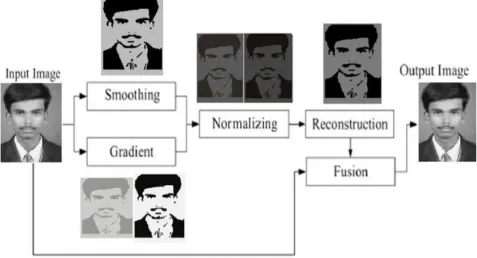
Where ψ is the average image, M: number of images, Ʈ: image vector. The eigenfaces corresponding to the highest eigenvalues are retained. Those eigenfaces define the face space. The eigenspace is created by projecting the image to the face space formed by the eigenfaces. Thus the weight vectors are calculated. Dimensions of the image are adjusted to meet the specifications and the image is enhanced in the preprocessing steps of recognition. The weight vector of the image and the weight vectors of the faces in the database are compared. Average face is calculated and subtracted from each face in the training set. A matrix (A) is formed using the results of the subtraction operation. The dimensions of the matrix C is N*N. M images are used to form C. In practice, the dimensions of C is N*M. On the other hand, since the rank of A is M, only M out of N eigenvectors are nonzero. The eigenvalues of the covariance matrix is calculated. The eigenfaces are created by using the number of training images minus number of classes (total number of people) of eigenvectors. The selected set of eigenvectors are multiplied by the A matrix to create a reduced eigenface subspace.
D.1 Steps in calculation of eigenfaces with PCA Step 1: Prepare the data
In this step, the faces constituting the training set (Γi) should be prepared for processing.
Step 2: Subtract the mean
The average matrix Ψ has to be calculated, then subtracted from the original faces (Γi) and the result stored in the variable Φi:
M
Ψ = X Γn (1) M
n−1
Φi = Γi − Ψ (2)
Step 3: Calculate the covariance matrix
In the next step the covariance matrix C is calculated
step 4: Calculate the eigenvectors and eigenvalues of the co- variance matrix
[Ezekwe* 5(4): April, 2018] ISSN 2349-4506
Impact Factor: 3.799
G
lobal
J
ournal of
E
ngineering
S
cience and
R
esearch
M
anagement
of the exact algorithm for determination of eigenvectors and eigenvalues is omitted here, as it belongs to the standard arsenal of most math programming libraries.Step 5: Select the principal components
From M eigenvectors (eigenfaces) ui, only M0 should be chosen, which have the highest eigenvalues. The higher the eigenvalue, the more characteristic features of a face does the particular eigenvector describe. Eigenfaces with low eigenvalues can be omit- ted, as they explain only a small part of characteristic features of the faces. After M0 eigenfaces ui are determined, the ”training” phase of the algorithm is finished.
The number of eigenvectors depend on the accuracy with which the database is defined and it can be optimized. The group of selected eigenvectors are called the eigenfaces. Once the eigenfaces have been obtained, the images in the database are projected into the eigenface space and the weights of the image in that space are stored. To determine the identity of an image, the eigen coefficients are compared with the eigencoefficients in the database. The eigenface of the image in question is formed. The Euclidian distances between the eigenface of the image and the eigenfaces stored previously are calculated. The person in question is identified as the one whose Euclidian distance is minimum below a threshold value in the eigenface database. If all the calculated Euclidian distances are larger than the threshold, then the image is unrecognizable. The reasons for selecting the eigenfaces method for face recognition are:
1. Its independence from the facial geometry, 2. The simplicity of realization,
3. Possibility of real-time realization even without special hardware, 4. The ease and speed of recognition with respect to the other methods, 5. The higher success rate in comparison to other methods.
The challenge of the eigenfaces face recognition method is the computation time. If the database is large, it may take a while to retrieve the identity of the person under question
THE SYSTEM MODE OF OPERATION
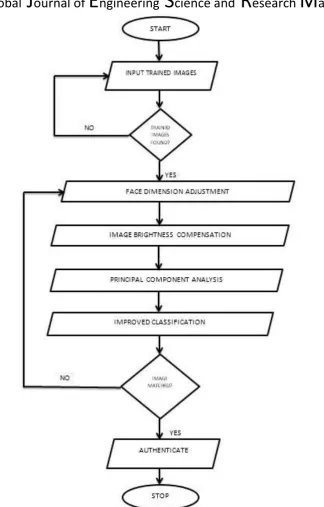
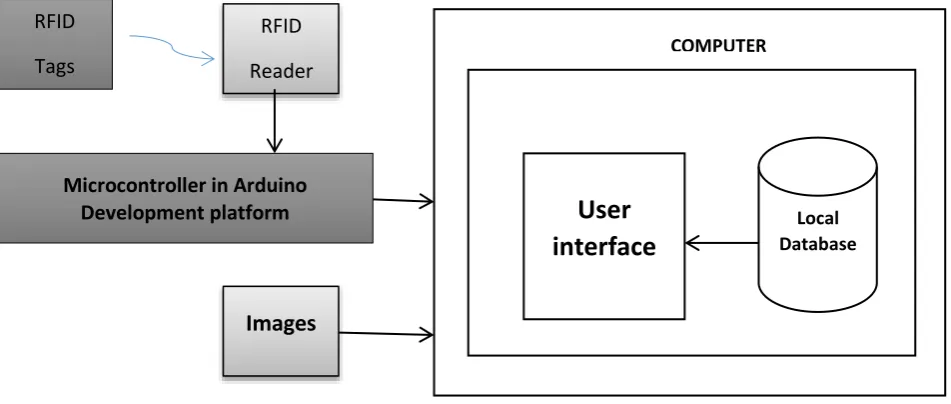
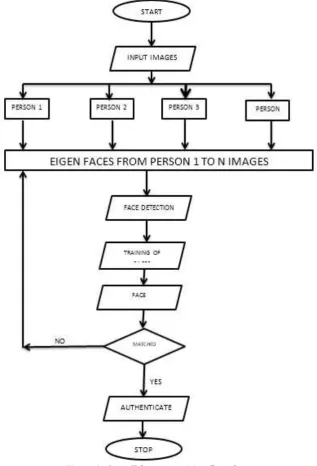
The system mode of operation provides solution to the classroom attendance problem through coordinated hardware and software design handshaking data communications between RFID tag, RFID reader and the camera as shown in the block diagram in figure 2. F o r t h i s p a p e r , w e w i l l d i s c u s s o n l y o n t h e i m a g e p r o c e s s e s . The flowcharts for the image processes are shown in figure 3, figure 4, figure 5 and figure 6.
Figure 2: The Proposed System block diagram
User
interface
Local DatabaseRFID
Tags
Microcontroller in Arduino
Development platform
Images
RFID
Reader
[Ezekwe* 5(4): April, 2018] ISSN 2349-4506
Impact Factor: 3.799
G
lobal
J
ournal of
E
ngineering
S
cience and
R
esearch
M
anagement
The students’ images were captured, trained and stored in the database for the authentication of the classroom attendance system. The procedures were shown in the three figures with the flow in figure 3 as the general face recognition. The captured images that will be sent to the database, will be manipulated by eigenface calculation, when the faces are filtered from the captured images, they are sent to face detection section for full filtering and positioning as shown in figure 4. After the detection phase, the well positioned faces are sent to the training section, where feature extractions are done ready for recognition as shown in figure 5. The last stage is the recognition stage, at this point, face dimension adjustment, components analysis and classification are done as shown in figure 6. When successful recognition is carried out on a face, matching and authentication can easily be done. At this point attendances are recorded for students for a particular class session.[Ezekwe* 5(4): April, 2018] ISSN 2349-4506
Impact Factor: 3.799
G
lobal
J
ournal of
E
ngineering
S
cience and
R
esearch
M
anagement
[Ezekwe* 5(4): April, 2018] ISSN 2349-4506
Impact Factor: 3.799
G
lobal
J
ournal of
E
ngineering
S
cience and
R
esearch
M
anagement
[Ezekwe* 5(4): April, 2018] ISSN 2349-4506
Impact Factor: 3.799
G
lobal
J
ournal of
E
ngineering
S
cience and
R
esearch
M
anagement
Figure 6: Face recognition stage 3
THE SYSTEM INTERFACES
[Ezekwe* 5(4): April, 2018] ISSN 2349-4506
Impact Factor: 3.799
G
lobal
J
ournal of
E
ngineering
S
cience and
R
esearch
M
anagement
taking the attendance no matter how the image came during the attendance process. The features of the editor are fully shown in figure 7.Figure 7: face training and face detection design
The second form is the face recognizer [see figure 8], for face detection and recognition. Here the trained images are matched with the incoming images during attendance processes. The features of the face recognizer are fully shown in figure 8.
Figure 8: face detection and recognition
[Ezekwe* 5(4): April, 2018] ISSN 2349-4506
Impact Factor: 3.799
G
lobal
J
ournal of
E
ngineering
S
cience and
R
esearch
M
anagement
Figure 9: complete system interface part 1
Figure 10: complete system interface part 2
CONCLUSION
At the end of this research work, we were able to achieve a classroom attendance system that uses the students’ images for authentication and at the same time, it is able to have high level of security and privacy because another student can never take attendance for the other. It will significantly improve the current manual process of students’ attendance recording and tracking system and other attendances systems, especially in a university environment. The system was able to promote a fully-automated approach in capturing the students’ attendance using their tag Electronic product code (EPC) and their images.
REFERENCES
1. Alice J., O’Toole, P. and Jonathon P. (2007). “Face Recognition Algorithms Surpass Humans Matching Faces over Changes in Illumination” IEEE transactions on pattern analysis and machine intelligence, vol. 29, no. 9.
2. Beck, L. L. (1996). "System Software: An Introduction to Systems Programming”. Addison Wesley. 3. Prahlad V., Peter L., Liyanage C. D., Liu J., and Li Li L.. (2008). “Multimodal Approach to Human-Face
Detection and Tracking ,” IEEE transactions on industrial electronics, vol. 55, no. 3, pp. 1385-1393. 4. Turk, M. and Pentland. A. (1991). “Face recognition using eigenfaces”, Proceedings of IEEE
[Ezekwe* 5(4): April, 2018] ISSN 2349-4506
Impact Factor: 3.799
G
lobal
J
ournal of
E
ngineering
S
cience and
R
esearch
M
anagement
5. Turk, M. and Pentland, A.(1991). “Eigenfaces for Recognition”, Journal of Cognitive Neurosicence,Vol. 3, No. 1, pp. 71-86.
6. Universal Serial Bus Specification Revision 3.0: 3.1(Zip). 9 September 2011. p. 41 (3–1). Retrieved 14 October 2016
![Figure 4: Face recognition stage 1[face detection]](https://thumb-us.123doks.com/thumbv2/123dok_us/8887009.1823053/7.595.158.482.131.727/figure-face-recognition-stage-face-detection.webp)
![Figure 5: Face recognition stage 2[training]](https://thumb-us.123doks.com/thumbv2/123dok_us/8887009.1823053/8.595.147.504.124.751/figure-face-recognition-stage-training.webp)