STRUCTURE-REACTIVITY CORRELATION IN THE
OXIDATION OF SUBSTITUTED BENZYL ALCOHOLS
BY IMIDAZOLIUM FLUOROCHROMATE
Poonam, D. Sharma
[a], P. Panchariya
[a], P. Purohit
[a]and Pradeep K. Sharma
[a]*Keywords: Correlation analysis; halochromates; imidazolium fluorochromate; kinetics; mechanism; oxidation
Oxidation of benzyl alcohol and some ortho-, meta- and para-monosubstituted ones by imidazolium fluorochromate (IFC) in dimethyl sulphoxide (DMSO) leads to the formation of corresponding banzaldehydes. The reaction is of first order with respect to IFC. A Michaelis – Menten type of kinetics were observed with respect to the alcohols. The reaction is promoted by hydrogen ions; the hydrogen-ion dependence has the form kobs= a + b [H+]. Oxidation of ,-dideuteriobenzyl alcohol (PhCD
2OH) has exhibited a substantial primary kinetic isotope effect (kH/kD = 5.86 at 298 K). The reaction has been studied in nineteen organic solvents and the effect of solvent analysed using Taft's and Swain's multi-parametric equations. The rates of oxidation of para- and meta-substituted benzyl alcohols have been correlated in terms of Charton’s triparametric LDR equation whereas the oxidation of ortho-substituted benzyl alcohols with tetraperametric LDRS equation. The oxidation of para-substituted benzyl alcohols is more susceptible to the delocalization effect than that of ortho- and meta- substituted compounds, which display a greater dependence on the field effect. The positive value of suggests the presence of an electron-deficient reaction centre in the rate-determining step. The reaction is subjected to steric acceleration by the ortho -substituents. A suitable mechanism has been proposed.
Corresponding Authors
E-Mail: [email protected]
[a] Department of Chemistry, J N V University, Jodhpur 342 005, India
Introduction
Halochromates have been used as mild and selective oxidizing reagents in synthetic organic chemistry1.
Imidazolium fluorochromate (IFC) is also one of such compounds used as mild and selective oxidizing agent in synthetic organic chemistry 2. A few reports on the
oxidation aspects of halochromates, including IFC are available in the literature3-6. We have been interested in
the kinetic and mechanistic studies of the reactions of chromium (VI) species. In continuation of our earlier work7-10, we report in the present article the kinetics of
oxidation of some monosubstituted benzyl alcohols by IFC in DMSO as solvent. Attempts have been made to correlate reactivity and structure in this reaction. Oxidation of benzyl alcohols with various oxidants is an important area of chemistry both from kinetics11 and
preparative point of views12.
Experimental Section
Materials
IFC was prepared by the reported method2 and its
purity checked by an iodometric method. The procedure used for the purification of alcohols has been described earlier13a. ,-Dideuteriobenzyl alcohol (PhCH
2OH) was
prepared by the reported method13b. Its isotopic purity, as
ascertained by its NMR spectra, was 95 4%. Due to
non-aqueous nature of the solvent, toluene-p-sulphonic acid (TsOH) was used as a source of hydrogen ions. Solvents were purified by the usual methods13c.
Product analysis
The product analysis was carried out under kinetic conditions. In a typical experiment, benzyl alcohol (5.4 g, 0.05 mol) and IFC (3.10 g, 0.01 mol) were made up to 50 cm3 in DMSO and kept in the dark for ca. 15 h to ensure
completion of the reaction. The solution was then treated with an excess (200 cm3) of a saturated solution of
2,4-dinitrophenylhydrazine in 2 mol dm-3 HCl and kept
overnight in a refrigerator. The precipitated
2,4-dinitrophenylhydrazone (DNP) was filtered off, dried, weighed, re-crystallized from ethanol, and weighed again. The yields of DNP before and after re-crystallization were 2.59 g (91 %) and 2.26 g (79 %) respectively. The DNP was found identical (m.p. and mixed m.p.) with the DNP of benzaldehyde. Similar experiments were performed with other alcohols also. The oxidation state of chromium in completely reduced reaction mixtures,
determined by an iodometric method was 3.950.1.
Kinetic measurement
The pseudo-first order conditions were attained by
maintaining a large excess ( 15 or more) of the alcohol
reactant or product has any significant absorption at this wavelength. The pseudo-first order rate constant, kobs,
was evaluated from the linear (r=0.990 - 0.999) plots of log [IFC] against time for up to 80% reaction. Duplicate kinetic runs showed that the rate constants were reproducible to with in 3 %. The second order rate
constant, k2, was obtained from the relation:
k2=kobs/[alcohol]. All experiments, other than those for
studying the effect of hydrogen ions, were carried out in the absence of TsOH.
Results and Discussion
The rates and other experimental data were obtained for all the alcohols. Since the results are similar, only representative data are reproduced here.
Stoichiometry
Oxidation of benzyl alcohols by IFC results in the oxidation of corresponding benzaldehydes. Analysis of products and the stoichiometric determinations indicate the following overall reaction (1).
ArCH2OH+CrO2FOIH ArCHO + (HO)2CrFOIH (1)
Thus IFC undergoes a two electron change. This is in accord with the earlier observations with other halochromates7-10 also. It has already been shown that
both PFC14 and PCC15 act as two electron oxidants and
are reduced to chromium (IV) species, by determining the oxidation state of chromium by magnetic susceptibility, ESR and IR studies
Rate laws
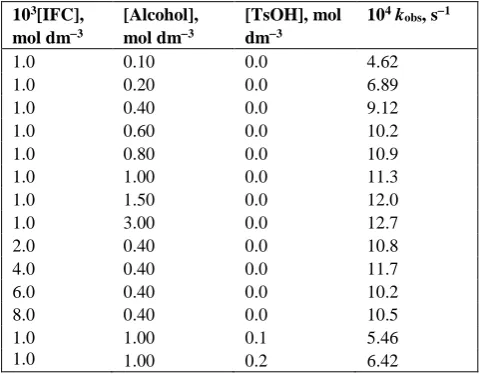
The reactions are of first order with respect to IFC. Figure 1 depicts a typical kinetic run. Further, the pseudo-first order rate constant, kobs is independent of the initial
concentration of IFC. The reaction rate increases with increase in the concentration of the alcohols but not linearly (Table 1)..
Table 1. Rate constants for the oxidation of benzyl alcohol by IFC at 298 K
103[IFC], mol dm3
[Alcohol], mol dm3
[TsOH], mol dm3
104 kobs, s1
1.0 0.10 0.0 4.62
1.0 0.20 0.0 6.89
1.0 0.40 0.0 9.12
1.0 0.60 0.0 10.2
1.0 0.80 0.0 10.9
1.0 1.00 0.0 11.3
1.0 1.50 0.0 12.0
1.0 3.00 0.0 12.7
2.0 0.40 0.0 10.8
4.0 0.40 0.0 11.7
6.0 0.40 0.0 10.2
8.0 0.40 0.0 10.5
1.0 1.00 0.1 5.46
1.0 1.00 0.2 6.42
1.0 1.00 0.4 7.84
1.0 1.00 0.6 9.27
1.0 1.00 1.0 12.6
1.0 0.40 0.0 9.72*
*contained 0.001 mol dm-3 acrylonitrile
Figure 1. Oxidation of Benzyl alcohol by IFC: A typical kinetic run
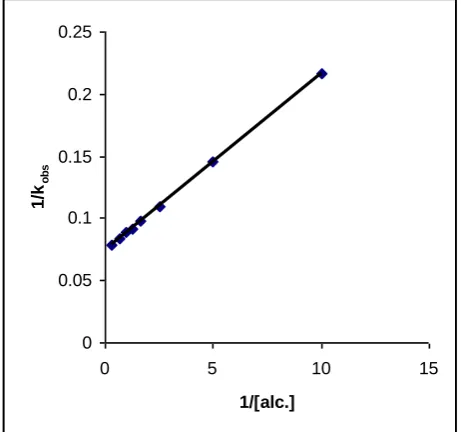
A plot of 1/kobs against 1/[Alcohols] is linear (r>0.995)
with an intercept on the rate-ordinate (Figure 2). Thus, Michaelis-Menten type kinetics are observed with respect to the alcohols. This leads to the postulation of following overall mechanism (2) and (3) and rate law (4).
Alcohol + IFC
K
[complex] (2)[Complex]
k2
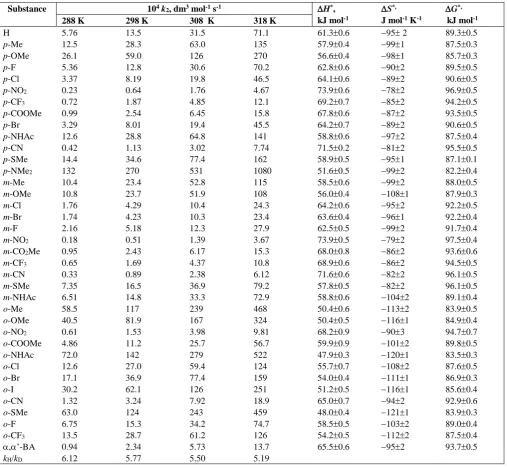
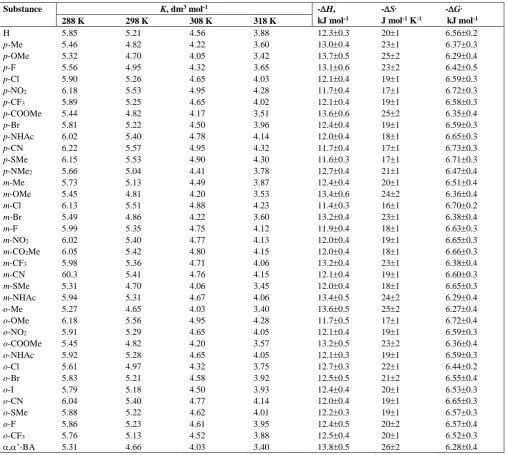
Products (3)The dependence of reaction rate on the reductant concentration was studied at different temperatures and the values of formation constants K and decomposition constants of the complex k2 were evaluated from the
double reciprocal plots. The thermodynamic parameters of the complex formation and activation parameters of the decomposition of the complexes were calculated from the values of K and k2 respectively at different temperatures
(Tables 2 and 3).
Tests for free radicals
Alcohol IFC 2
Rate (4)
1 Alcohol
k K
K
0 0.5 1 1.5 2 2.5
0 500 1000 1500 2000
tim e(s)
lo
g
(a
-x
)+
The oxidation of benzyl alcohol by IFC, in an
atmosphere of nitrogen failed to induce the
polymerisation of acrylonitrile. Further, an addition of a
radical scavenger, acrylonitrile, had no effect on the rate (Table 1).
Table 2. Rate constants and activation parameters of oxidation of substituted benzyl alcohols by IFC
Substance 104 k2, dm3 mol-1 s-1 H*,
kJ mol-1
S*, J mol-1 K-1
G*, kJ mol-1
288 K 298 K 308 K 318 K
H 5.76 13.5 31.5 71.1 61.30.6 95 2 89.30.5
p-Me 12.5 28.3 63.0 135 57.90.4 991 87.50.3
p-OMe 26.1 59.0 126 270 56.60.4 981 85.70.3
p-F 5.36 12.8 30.6 70.2 62.80.6 902 89.50.5
p-Cl 3.37 8.19 19.8 46.5 64.10.6 892 90.60.5
p-NO2 0.23 0.64 1.76 4.67 73.90.6 782 96.90.5
p-CF3 0.72 1.87 4.85 12.1 69.20.7 852 94.20.5
p-COOMe 0.99 2.54 6.45 15.8 67.80.6 872 93.50.5
p-Br 3.29 8.01 19.4 45.5 64.20.7 892 90.60.5
p-NHAc 12.6 28.8 64.8 141 58.80.6 972 87.50.4
p-CN 0.42 1.13 3.02 7.74 71.50.2 812 95.50.5
p-SMe 14.4 34.6 77.4 162 58.90.5 951 87.10.1
p-NMe2 132 270 531 1080 51.60.5 992 82.20.4
m-Me 10.4 23.4 52.8 115 58.50.6 992 88.00.5
m-OMe 10.8 23.7 51.9 108 56.00.4 1081 87.90.3
m-Cl 1.76 4.29 10.4 24.3 64.20.6 952 92.20.5
m-Br 1.74 4.23 10.3 23.4 63.60.4 961 92.20.4
m-F 2.16 5.18 12.3 27.9 62.50.5 992 91.70.4
m-NO2 0.18 0.51 1.39 3.67 73.90.5 792 97.50.4
m-CO2Me 0.95 2.43 6.17 15.3 68.00.8 862 93.60.6
m-CF3 0.65 1.69 4.37 10.8 68.90.6 862 94.50.5
m-CN 0.33 0.89 2.38 6.12 71.60.6 822 96.10.5
m-SMe 7.35 16.5 36.9 79.2 57.80.5 822 96.10.5
m-NHAc 6.51 14.8 33.3 72.9 58.80.6 1042 89.10.4
o-Me 58.5 117 239 468 50.40.6 1132 83.90.5
o-OMe 40.5 81.9 167 324 50.40.5 1161 84.90.4
o-NO2 0.61 1.53 3.98 9.81 68.20.9 903 94.70.7
o-COOMe 4.86 11.2 25.7 56.7 59.90.9 1012 89.80.5
o-NHAc 72.0 142 279 522 47.90.3 1201 83.50.3
o-Cl 12.6 27.0 59.4 124 55.70.7 1082 87.60.5
o-Br 17.1 36.9 77.4 159 54.00.4 1111 86.90.3
o-I 30.2 62.1 126 251 51.20.5 1161 85.60.4
o-CN 1.32 3.24 7.92 18.9 65.00.7 942 92.90.6
o-SMe 63.0 124 243 459 48.00.4 1211 83.90.3
o-F 6.75 15.3 34.2 74.7 58.50.5 1032 89.00.4
o-CF3 13.5 28.7 61.2 126 54.20.5 1122 87.50.4
,’-BA 0.94 2.34 5.73 13.7 65.50.6 952 93.70.5
kH/kD 6.12 5.77 5.50 5.19
Effect of acidity
The reaction is catalysed by hydrogen ions. The hydrogen-ion dependence taking the form: kobs = a +
b[H+] (Table 1). The values for a and b for benzyl
alcohol are 4.670.25104 s1 and 8.140.41104 mol1
dm3 s1 respectively (r2 = 0.9898)
Kinetic isotope effect
To ascertain the importance of the cleavage of the
CH bond in the ratedetermining step, oxidation of
,-di-deuterio benzyl alcohol was studied. Results
showed the presence of a substantial primary kinetic isotope effect (Table 2).
Effect of solvents
The oxidation of benzyl alcohol was studied in 19 different organic solvents. The choice of solvents was limited by the solubility of IFC and its reaction with primary and secondary alcohols. There was no reaction with the solvents chosen. Kinetics were similar in all the solvents. The values of K and k2 are recorded in Table 3.
very good (r2 = 0.9042). The value of the isokinetic
temperature is 59333 K. However, according to Exner16,
an isokinetic relationship between the calculated values of activation enthalpies and entropies is often vitiated by random experimental errors.
Table 3. Formation constants for the decomposition of IFCAlcohol complexes and thermodynamic parameters
Substance K, dm3 mol-1 -H,
kJ mol-1
-S, J mol-1 K-1
-G, kJ mol-1
288 K 298 K 308 K 318 K
H 5.85 5.21 4.56 3.88 12.30.3 201 6.560.2
p-Me 5.46 4.82 4.22 3.60 13.00.4 231 6.370.3
p-OMe 5.32 4.70 4.05 3.42 13.70.5 252 6.290.4
p-F 5.56 4.95 4.32 3.65 13.10.6 232 6.420.5
p-Cl 5.90 5.26 4.65 4.03 12.10.4 191 6.590.3
p-NO2 6.18 5.53 4.95 4.28 11.70.4 171 6.720.3
p-CF3 5.89 5.25 4.65 4.02 12.10.4 191 6.580.3
p-COOMe 5.44 4.82 4.17 3.51 13.60.6 252 6.350.4
p-Br 5.81 5.22 4.50 3.96 12.40.4 191 6.590.3
p-NHAc 6.02 5.40 4.78 4.14 12.00.4 181 6.650.3
p-CN 6.22 5.57 4.95 4.32 11.70.4 171 6.730.3
p-SMe 6.15 5.53 4.90 4.30 11.60.3 171 6.710.3
p-NMe2 5.66 5.04 4.41 3.78 12.70.4 211 6.470.4
m-Me 5.73 5.13 4.49 3.87 12.40.4 201 6.510.4
m-OMe 5.45 4.81 4.20 3.53 13.40.6 242 6.360.4
m-Cl 6.13 5.51 4.88 4.23 11.40.3 161 6.700.2
m-Br 5.49 4.86 4.22 3.60 13.20.4 231 6.380.4
m-F 5.99 5.35 4.75 4.12 11.90.4 181 6.630.3
m-NO2 6.02 5.40 4.77 4.13 12.00.4 191 6.650.3
m-CO2Me 6.05 5.42 4.80 4.15 12.00.4 181 6.660.3
m-CF3 5.98 5.36 4.71 4.06 13.20.4 231 6.380.4
m-CN 60.3 5.41 4.76 4.15 12.10.4 191 6.600.3
m-SMe 5.31 4.70 4.06 3.45 12.00.4 181 6.650.3
m-NHAc 5.94 5.31 4.67 4.06 13.40.5 242 6.290.4
o-Me 5.27 4.65 4.03 3.40 13.60.5 252 6.270.4
o-OMe 6.18 5.56 4.95 4.28 11.70.5 171 6.720.4
o-NO2 5.91 5.29 4.65 4.05 12.10.4 191 6.590.3
o-COOMe 5.45 4.82 4.20 3.57 13.20.5 232 6.360.4
o-NHAc 5.92 5.28 4.65 4.05 12.10.3 191 6.590.3
o-Cl 5.61 4.97 4.32 3.75 12.70.3 221 6.440.2
o-Br 5.83 5.21 4.58 3.92 12.50.5 212 6.550.4
o-I 5.79 5.18 4.50 3.93 12.40.4 201 6.530.3
o-CN 6.04 5.40 4.77 4.14 12.00.4 191 6.650.3
o-SMe 5.88 5.22 4.62 4.01 12.20.3 191 6.570.3
o-F 5.86 5.23 4.61 3.95 12.40.5 202 6.570.4
o-CF3 5.76 5.13 4.52 3.88 12.50.4 201 6.520.3
,’-BA 5.31 4.66 4.03 3.40 13.80.5 262 6.280.4
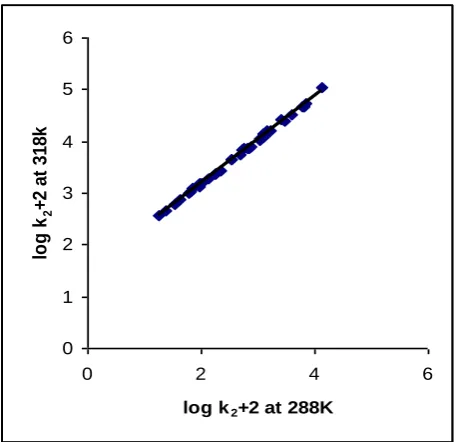
Exner suggested an alternative method for establishing the isokinetic relationship. Exner's plot between log k2 at
288 K and at 318 K was linear (r2 = 0.9990) (Figure 3).
The value of isokinetic temperature evaluated from the
Exner's plot is 69037 K. The linear isokinetic
correlation implies that all the alcohols are oxidized by the same mechanism and the changes in the rate are governed by changes in both the enthalpy and entropy of activation.
Reactivity oxidizing species
The observed hydrogen-ion dependence suggests that the reaction follows two mechanistic pathways, one acid-independent and another acid-dependent. The acid-catalysis may well be attributed to a protonation of IFC as equation 5 to yield a protonated Cr(VI) species
which is a stronger oxidant and electrophile.
Formation of a protonated Cr(VI) species has earlier been postulated in the reactions of structurally similar PCC17.
The rate constants, k2, in seventeen solvents (CS2 was
not considered as the complete range of solvent parameters was not available) were correlated in terms
of linear solvation energy relationship (Eqn. 6) of Kamlet
et al18.
Figure 2. Oxidation of benzyl alcohol by IFC: A double reciprocal plot
log k2 = A0 + p* + b + a (6)
In Eq. (3) * represents the solvent polarity, the
hydrogen bond acceptor basicities and is the hydrogen
bond donor acidity. A0 is the intercept term. It may be
mentioned here that out of the 18 solvents, 13 has a value of zero for . The results of correlation analyses terms of Eq. (3), a biparametric equation involving * and , and
separately with * and are given below (equation
7 - 10).
log k2 = 3.71 + 1.60(0.21)* + 0.19(0.17) +
0.09(0.16) (7)
R2 =0.8409; sd=0.19; n=18; =0.44
log k2= 3.73 + 1.63(0.20)* + 0.15(0.16) (8)
R2 = 0.8371; sd = 0.19; n = 18; = 0.43
log k2 = 3.70 + 1.67(0.19)* (9)
r2 = 0.8271; sd = 0.19; n = 18; = 0.43
log k2 = 3.02 + 0.45 (0.36) (10)
r2 = 0.0878; sd = 0.43; n = 18; = 0.98
Here n is the number of data points and is Exner's statistical parameter19.
Kamlet's19 triparametric equation explains ca. 84 % of
the effect of solvent on the oxidation. However, by Exner's criterion the correlation is not even satisfactory (cf. equation 7). The major contribution is of solvent polarity. It alone accounted for ca. 83 % of the data. Both and play relatively minor roles.
The data on the solvent effect were also analysed in terms of Swain's equation20 of cation- and anion-solvating
concept of the solvents equation 11.
log k2 = a A + b B + C (11)
Here A represents the anion-solvating power of the solvent and B the cation-solvating power of the solvent. C
is the intercept term. (A+B) is postulated to
represent the solvent polarity. The rates in different solvents were analysed in terms of equation (11), separately with A and B and with (A + B).
log k2 = 0.69 + (0.05)A + 1.71 (0.03)B 3.95 (12)
R2 = 0.9941; sd = 0.04; n = 19; = 0.08
log k2 = 0.45 (0.57)A 2.77 (13)
r2 = 0.0358; sd = 0.46; n = 19; = 1.01
log k2 = 1.38 (0.13)B 3.62 (14)
r2 = 0.8625; sd = 0.17; n = 19; = 0.38
log k2 = 1.66 0.13 (A+B) 3.63 (15)
r2 = 0.9099; sd = 0.14; n = 19; = 0.31
The rates of oxidation of benzyl alcohol in different solvents show an excellent correlation in Swain's equation (12) with the cation-solvating power playing the major role. In fact, the cation-solvation alone accounts for ca. 99% of the data. The solvent polarity, represented by (A +
B), also accounted for ca. 91% of the data. In view of the fact that the solvent polarity is able to account for ca.
0 0.05 0.1 0.15 0.2 0.25
0 5 10 15
1/[alc.]
1
/k
91 % of the data, an attempt was made to correlate the rate with the relative permittivity of the solvent. However, a plot of log(rate) against the inverse of the relative permittivity is not linear (r2 = 0.0584 sd = 0.33, = 0.99).
Figure 3. Exner’s Isokinetic Relationship in the oxidation of benzyl alcohols by IFC
Correlation analysis of reactivity
The effect of structure on reactivity has long been correlated in terms of the Hammett equation21 or with
dual substituent-parameter equations22,23. In the late
1980s, Charton24 introduced a triparametric LDR
equation for the quantitative description of structural effects on chemical reactivities. This triparametric equation results from the fact that substituent types differ in their mode of electron delocalization. This difference reflected in a different sensitivity to the electron demand for the phenomenon being studied. It has a advantage of not requiring a choice of parameters as the same three substituents constants are reported to cover the range of electrical effects of the substituents. In this work we have applied the LDR equation 16 to the rate constants, k2.
log k2 = L
l + D
d + R
e + h (16)Here,
l is a localized (field and/or inductive) effectparameter,
d is the intrinsic delocalized electrical effectparameter when active site electronic demand is minimal and
e represents the sensitivity of the substituent tochanges in electronic demand by the active site. The latter two substituent parameters are related by equation (17).
D =
e +
d (17)Here
represents the electronic demand of the reaction site and is given by
= R/D, and
D represents thedelocalized electrical parameter of the diparametric LD equation.
For ortho-substituted compounds, it is necessary to account for the possibility of steric effects and Charton24,
therefore, modified the LDR equation to generate the LDRS equation (15).
log k2= L
l + D
d + R
e + S + h (18)where is the well known Charton's steric parameter based on Van der Waals radii.25
Table 4 - Solvent effect on the oxidation of benzyl alcohol by IFC at 298 K
Solvents K,
dm-3 mol-1
104 k2, s-1
Chloroform 5.58 41.7
Toluene 5.31 10.7
1,2-Dichloroethane 4.76 51.3
Acetophenone 6.21 60.3
Dichloromethane 4.35 39.8
THF 4.75 19.1
DMSO 5.21 135
t-Butylalcohol 4.38 17.8
Acetone 5.33 44.7
1,4-Dioxane 4.27 20.4
DMF 4.65 64.6
1,2-Dimethoxyethane 5.40 12.3
Butanone 5.85 32.4
CS2 4.95 5.25
Nitrobenzene 4.67 47.9
Acetic acid 5.90 7.94
Benzene 6.03 15.5
Ethyl acetate 5.40 16.6
Cyclohexane 5.25 1.51
The rates of oxidation of ortho-, meta- and
para-substituted benzyl alcohols show an excellent
correlation in terms of the LDR/LDRS equations (Table 4). We have used the standard deviation (sd), the coefficient of multiple determination (R2), and Exner's19
parameter,
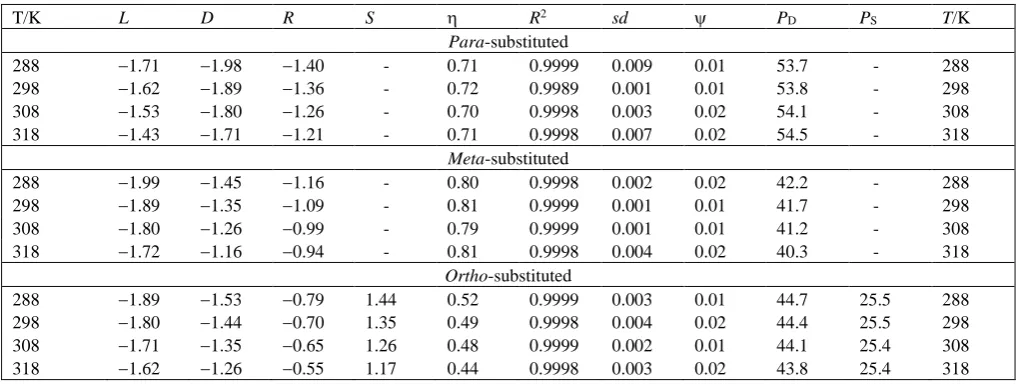
, as the measures of goodness of fit.The comparison of the L and D values for the
substituted benzyl alcohols showed that the
oxidation of para-substituted benzyl alcohols is more susceptible to the delocalization effect than to the localized effect. However, the oxidation of ortho- and
meta-substituted compounds exhibited a greater
dependence on the field effect. In all the cases, the magnitude of the reaction constants decreases with an increase in the temperature, pointing to a decrease in selectivity with an increase in temperature.
0 1 2 3 4 5 6
0 2 4 6
log k2+2 at 288K
lo
g
k2
+
2
a
t
3
1
8
All three regression coefficients, L, D and R, are negative indicating an electron-deficient carbon centre in the activated complex for the rate-determining step. The positive value of
adds a negative increment to
d,reflecting the electron-donating power of the substituent and its capacity to stabilise a cationic species. The positive value of S indicates that the reaction is subject to steric acceleration by an ortho-substituent.
Table 5 - Temperature dependence for the reaction constants for the oxidation of substituted benzyl alcohols by IFC
T/K L D R S R2 sd PD PS T/K
Para-substituted
288 1.71 1.98 1.40 - 0.71 0.9999 0.009 0.01 53.7 - 288
298 1.62 1.89 1.36 - 0.72 0.9989 0.001 0.01 53.8 - 298
308 1.53 1.80 1.26 - 0.70 0.9998 0.003 0.02 54.1 - 308
318 1.43 1.71 1.21 - 0.71 0.9998 0.007 0.02 54.5 - 318
Meta-substituted
288 1.99 1.45 1.16 - 0.80 0.9998 0.002 0.02 42.2 - 288
298 1.89 1.35 1.09 - 0.81 0.9999 0.001 0.01 41.7 - 298
308 1.80 1.26 0.99 - 0.79 0.9999 0.001 0.01 41.2 - 308
318 1.72 1.16 0.94 - 0.81 0.9998 0.004 0.02 40.3 - 318
Ortho-substituted
288 1.89 1.53 0.79 1.44 0.52 0.9999 0.003 0.01 44.7 25.5 288
298 1.80 1.44 0.70 1.35 0.49 0.9998 0.004 0.02 44.4 25.5 298
308 1.71 1.35 0.65 1.26 0.48 0.9999 0.002 0.01 44.1 25.4 308
318 1.62 1.26 0.55 1.17 0.44 0.9998 0.003 0.02 43.8 25.4 318
To test the significance of localized, delocalized and steric effects in the ortho-substituted benzyl alcohols, multiple regression analyses were carried out with (i) l, d and e (ii) d, e and and (iii) l , e and . The
absence of significant correlations showed that all the four substituent constants are significant.
log k2 =1.52(0.50) l 1.53(0.39)d 3.32(2.25)e
2.41 (19)
R2 = 0.7628; sd = 0.34; n = 12; = 0.56
log k2 = 1.61(0.46)d 1.28(2.87)e + 1.06 (0.53)
3.43 (20)
R2 = 0.6638; sd = 0.41; n = 12; = 0.67
log k2 = 2.02(0.61)l 0.05(2.94)e + 1.47(0.55)
2.22 (21)
R2 = 0.6457; sd = 0.42; n = 12; = 0.69
Similarly in the cases of oxidation of para- and meta -subsituted benzyl alcohols, multiple regression analyses indicated that both localization and delocalization effects are significant. There is no significant collinearity between the various substituents constants for the three
series. The percent contribution26 of the delocalized
effect, PD, is given by equation (22).
Similarly, the percent contribution of the steric parameter25 to the total effect of the substituent, P
S, was
determined by using equation (23).
The values of PD and PS are also recorded in Table 5.
The value of PD for the oxidation of para-substituted
benzyl alcohols is ca. 54% whereas the corresponding values for the meta- and ortho-sobstituted alcohols are ca.
42 and 44% respectively. This shows that the balance of localization and delocalization effects is different for differently substituted benzyl alcohols. The less
pronounced resonance effect from the ortho-position than
from the para-position may be due to the twisting away
of the alcoholic group from the plane of the benzene ring. The magnitude of the PS value shows that the
steric effect is significant in this reaction.
The positive value of S showed a steric acceleration of the reaction. This may be explained on the basis high
100
(22)
D PD
L D
100
(23)
S PS
L D S
ground state energy of the sterically crowded alcohols. Since the crowding is relieved in the in the product aldehyde as well as the transition state leading to it, the transition state energy of the crowded and uncrowded alcohols do not differ much and steric acceleration, therefore results.
Mechanism
A hydrogen abstraction mechanism leading to the formation of the free radicals is unlikely in view of the failure to induce polymerization of acrylonitrile and no effect of the radical scavenger on the reaction rate. The presence of a substantial kinetic isotope effect confirms the cleavage of a -C-H bond in the rate-determining step.
The negative values of the localization and
delocalization electrical effects i.e. of L, D and R points
to an electron-deficient reaction centre in the
rate-determining step. It is further supported by the positive value of
, which indicates that the substituent is better able to stabilise a cationic or electron- deficient reactive site. Therefore, a hydride-ion transfer in the rate-determining step is suggested. The hydride-ion transfer mechanism is also supported by the major role of cation-solvating power of the solvents. The hydride ion transfer may take place either by a cyclic process via an ester intermediate or by an acyclic one-step bimolecularprocess. Kwart and Nickle26 have shown that a
dependence of kinetic isotope effect on temperature can be gainfully employed to determine whether the loss of hydrogen proceeds through a concerted cyclic process or by an acyclic one.
The data for protio-and deuterio-benzyl alcohols, fitted to the familier expression: kH/kD=AH/AD(H*/RT)27,28
show a direct correspondence with the properties of a symmetrical transition state in which activation energy difference for protio and deuterio compounds is equal to the difference in the zero-point energy for the respective CH and CD bonds (4.5 kJ mol-1) and the entropies of
activation of the respective reactions are almost equal. Similar phenomena were also observed earlier in the oxidation of benzaldehydes by IFC.29 Bordwell30 has
documented a very cogent evidence against the occurrence of concerted one-step bimolecular processes by hydrogen transfer and it is evident that in the present studies also the hydrogen transfer does not occur by an acyclic biomolecular process.
It is well-established that intrinsically concerted sigmatropic reactions, characterised by transfer of hydrogen in a cyclic transition state, are the only truly symmetrical processes involving a linear hydrogen transfer.31 Littler32 has also shown that a cyclic hydride
transfer, in the oxidation of alcohols by Cr(VI), involves six electrons and, being a Huckel-type system, is an allowed process. Thus, a transition state having a planar, cyclic and symmetrical structure can be envisaged for the decomposition of the ester intermediate. Hence, the overall mechanism is proposed to involve the formation of a chromate ester in a fast pre-equilibrium step and then a decomposition of the ester in a subsequent slow step via a cyclic concerted symmetrical transition state leading to the product (Schemes 1 and 2).
The observed negative value of entropy of activation also supports the proposed mechanism. As the charge separation takes place in the transition state, the charged ends become highly solvated. This results in an immobilization of a large number of solvent molecules, reflected in the loss of entropy.33
Conclusion
The reaction is proposed to proceed through a hydride-ion transfer from alcohol to the oxidant in the rate-determining step. It has also been observed that an -C-H bond is cleaved in the rate-determining step. Both deprotonated and protonated forms of IFC are the reactive oxidising species.
Acknowledgements
Thanks are due to University Grants Commission, New Delhi for financial support in the form of BSR-One Time
Grant, No. F. 410/2010 (BSR) dated 07.03.2012.
References
1Corey, E.J., Suggs, W.J. Tetrahedron Lett., 1975, 2647; Guziec, F.S., Luzio, F.A. Synthesis, 1980, 691; Bhattacharjee, M..N., Choudhuri , M.K., Dasgupta, H.S., Roy, N., Khathing, D.T. Synthesis, 1982, 588; Balasubramanian, K., Prathiba, V. Indian J. Chem., 1986, 25B, 326;
Ar C OH
H H + Cr O O F OIH Cr OIH O C Ar H H OH F O Cr OIH O H C H Ar H2O
CrOFOIH O + + + Slow k2 F OH Ar C H O Acid-independent Path - Scheme - 1
# K
Ar C OH
H
H
+ Cr+
HO O F OIH Cr+ OIH HO C Ar H H OH F O Cr+ OIH O H C H Ar H2O
HCr+OFOIH
O Ar + + + Slow k2 F OH
OCrOFOIH + H+ HOCr+ OFOIH
H C
H
O Acid-dependent Path - Scheme - 2
Pandurangan, A., Murugesan, V., Palamichamy, P. J. Indian Chem. Soc., 1995, 72, 479.
2Pandurangan A., Rajkumar A., Arabindoo G.A. and Murugesan V. Indian J. Chem., 1999, 38B, 99.
3Kumbhat, R., Prasadrao, P.T.S.R.K., Sharma, V., Oxid. Commun., 2007, 30 (1) 97.
4Choudhary, A., Agarwal, S., Sharma, V., Indian J. Chem., 2009, 48A, 362.
5Gehlot, M., Gilla, M., Mishra, P., Sharma, V. J. Indian Chem. Soc., 2011, 88(5) 685.
6Khatri, J., Choudhary, A., Purohit, P., Kumbhat, R., Sharma, V., Eur. Chem. Bull., 2012, 1(3 4) 49.
7Malani, N., Baghmar, M., Sharma, P.K., Int. J. Chem. Kinet, 2009, 41, 65.
8Vadera, K., Yajurvedi, D., Purohit, P., Mishra, P., Sharma PK. Prog. React. Kinet. Mech., 2010, 35, 265.
9Sharma, D., Panchariya, P., Vadera K., Sharma P.K. J. Sulfur Chem., 2011, 32(4) 315–326
10 Sharma, D., Panchariya, P., Purohit P., Sharma, P.K. Oxid. Commun., 2012, 35(4) 821.
11Banerji, K. K., J. Chem. Soc., Perkin Trans. 2, 1978, 639; Kumar, A., Sharma, P. K., Banerji, K. K., J. Phys. Org. Chem., 2002, 15(10), 721–727; Vyas, V. K., Kothari, S., Banerji, K. K., Int. J. Chem. Kinetics, 1997, 29, 9-16; Kothari, S., Banerji, K., Can. J. Chem., 1985, 63, 2726; Kumar, A., Mishra, P., Kótai L., Banerji, K. K., Ind. J. Chem., 2003, 42A, 72.
12Choudhary, V. R., Jha, R., and Jana, P., Green. Chem., 2007, 9, 267; Bugarcic, Z., Novokmet, S., Kostic, V., J. Serb. Chem. Soc., 2005, 70(5), 681.; Kotai, L., Kazinczy, B., Keszler, A., Holly, S., Gacs, I., Banerji, K. K., Z. Naturforsch. B-J. Chem. Sci., 2001, 56(8), 823.
13aBanerji, K.K., Indian J. Chem., 1983, 22B, 413.
13bBunnet, J.F., Devis, G.T., Tanida, H., J. Am. Chem. Soc., 1962, 84, 1606.
13cPerrin, D.D., Armarego, W.L., Perrin, D.R. , Purification of Organic Compounds, Oxford, Pergamon Press, 1966. 14Bhattacharjee, M.N., Choudhuri, M.K., Purakayastha S.
Tetrahedron, 1987, 43, 5389.
15Brown, H.C., Rao, G.C., Kulkarni, S.U. J. Org. Chem., 1979, 44, 2809.
16Exner, O. Collect. Chem. Czech. Commun., 1977, 38, 411.
17Saraswat, S., Sharma, V., Banerji , K.K. Indian J. Chem., 2001, 40A, 583.
18Kamlet, M.J., Abboud, J L.M., Abraham, M.H., Taft, R.W. J. Org. Chem., 1983, 48, 2877.
19Exner, O. Collect. Chem. Czech. Commun., 1966, 31, 3222. 20Swain, C.G., Swain, M.S., Powel, A.L., Alunni, S. J. Am.
Chem. Soc., 1983, 105, 502.
21Johnson, C.D. The Hammett equation, University Press, Cambridge, 1973, 78.
22Dayal, S.K., Ehrenson, S., Taft, R.W. J. Am.. Chem. Soc., 1974, 94, 9113.
23Swain, C.G., Unger, S.H., Rosenquest, N.R., Swain, M.S. J. Am. Chem. Soc., 1983, 105, 492.
24Charton, M., Charton, B. Bull. Soc. Chim. Fr., 1988, 199 and references cited therein.
25Charton, M. J. Org. Chem., 1975, 40, 407.
26Kwart, H., Nickel, J.H. J. Am. Chem. Soc., 1973, 95, 3394. 27Kwart, H., Latimer, M.C., J. Am. Chem. Soc., 1971, 93, 3770. 28Kwart, H., Slutsky, J. J. Chem. Soc. Chem. Commun., 1972,
1182.
29Khatri, J. Choudhary, A., Purohit, P., Kumbhat R., Sharma, V. Eur. Chem. Bull., 2012, 1(3-4), 49.
30Bordwell, F.G., Acc. Chem. Res., 1974, 5, 374.
31Woodward, R.W., Hoffmann R. Angew. Chem. Int. Ed Eng, 1969, 8, 781.
32Litller, J.S., Tetrahedron, 1971, 27, 81.
33Gould, E.S. Mechanism and Structure in Organic Chemistry, Holt, Rinehart & Winston Inc., NY,1964.