10.
Vector and pest control
10.1
The importance of vector and pest control in disasters and emergencies
Some disasters give rise to increases in the populations of vector or nuisance species, usually insects or rodents. Floods may create new mosquito breeding sites in disaster rubble and stagnant pools. A general breakdown of sanitation may favour the multipli-cation of houseflies and rodents. People living in partially destroyed houses or primitive shelters may have lost the normal protection afforded by screened windows or mosquito nets.
Serious infection hazards may arise when massive migrations bring people of differ-ent origins together in temporary camps infested with disease vectors. Under such conditions, people who are relatively immune carriers of parasites can set off a disease-transmission cycle to which weaker people and people who are not immune fall victim. Examples of disease outbreaks observed in such situations include malaria (transmitted by Anopheles mosquitoes), epidemic typhus (transmitted by lice) and dengue fever (trans-mitted by Aedes mosquitoes).
Malaria is one of the five leading causes of mortality in emergency situations, and in endemic areas its control is likely to be one of the main health priorities. The implica-tion of flies in the transmission of diarrhoeal disease is open to some debate, but fly control is likely to have a positive impact on health in most postdisaster situations, par-ticularly when sanitary conditions are poor and diarrhoea, Shigella dysentery, or typhoid prevalence are high. Other vectors may be important in specific locations, depending on the prevalences of the vector and the disease before the disaster, and the suscepti-bility of the population.
In addition to the disease hazards presented by vector species, many insects and other arthropods can constitute a major nuisance in disasters. The impact of nuisance further adds to the stress and psychosocial instability from which disaster victims usually suffer. Standing water rich in organic matter can produce massive numbers of biting midges (Culicoides spp.) which do not transmit any disease, but cause extreme nuisance and often trigger allergic reactions in sensitive people. Several mosquito species can also be a great nuisance without presenting a direct risk to health. On the other hand, some of the most serious disease vectors are hardly considered a nuisance in many areas as their bites are almost painless (e.g. Anopheles mosquitoes, the vectors of malaria).
When wild or domestic host animals have been killed or driven away by disaster, ectoparasites, such as ticks, bugs, lice and fleas, may invade a community and produce a serious additional risk of zoonotic vector-borne disease. Another, related, vector-borne disease risk may arise when refugees enter territory formerly occupied only by wildlife and accompanying parasites. Examples of diseases that may then emerge include plague (from rats) and Lyme disease (from ticks).
When action against such pest organisms is considered during disasters, a distinction must be made between disease control and nuisance control (see Section 10.2).
The vectors likely to be present in emergency settlements and the diseases they carry are shown in Box 10.1.
10.1.1 Assessment
At an early stage in the emergency response, and in planning for possible emergency settlements, an assessment should be made of vector-borne disease risks and pest nuisance, and the scope for their control using the techniques available. Special mea-sures for vector and nuisance pest control (as distinct from general environmental health measures, such as wastewater disposal and excreta disposal) may be expensive and time-consuming, so it is important to know that they are worth carrying out in an emergency, when there are many other health priorities demanding action. As vector-borne disease risk is a function of the presence of the vector, the prevalence of the disease organism, and the susceptibility of the population, these three conditions need to be assessed to justify a major environmental management activity. The assessment of vector-borne disease risk and patterns requires specialist expertise and cooperation between the sectors of health, water supply and sanitation, and site selection and planning.
10.2
Disease control and nuisance control
10.2.1 Disease control
The control of a vector-borne disease can be achieved by various means. In emergen-cies, these include, in order of priority:
1. Diagnosis and treatment. 2. Vector control.
3. Environmental hygiene. 4. Personal protection.
10.2.2 Nuisance control
In emergencies, nuisance control will not be the most important priority, so targeted applications of pesticides will seldom be justified. The measures to be taken should aim at medium- and longer-term environmental improvement, in the following order of priority:
1. Identification of the causative agent. 2. Environmental hygiene.
3. Personal protection.
Box 10.1 Vectors and diseases likely to be present in emergency settlements
Vector Main diseases
Mosquitoes Malaria, yellow fever, dengue, viral encephalitis, filariasis. Houseflies Diarrhoea, dysentery, conjunctivitis, typhoid fever, trachoma. Cockroaches Diarrhoea, dysentery, salmonellosis, cholera.
Lice Endemic typhus, pediculosis, relapsing fever, trench fever, skin irritation. Bedbugs Severe skin inflammation.
Triatomid bugs Chagas’ disease.
Ticks Rickettsial fever, tularaemia, relapsing fever, viral encephalitis, borreliosis. Rodent (mites) Rickettsial pox, scrub typhus.
Rodent (fleas) Bubonic plague, endemic typhus.
10.3
Available control measures
This section is concerned primarily with the control of insect vectors. For information on rodent control, see United Nations High Commissioner for Refugees (1997).
Appropriate diagnosis and treatment of patients are possible only in the presence of adequately trained medical and/or paramedical personnel. Most vector-borne diseases require a microscopic diagnosis by trained laboratory personnel. Some parasites (e.g. Plasmodium falciparum, which may cause cerebral malaria) may be resistant to most or all available drugs. Serious cases of viral vector-borne infections, such as dengue and yellow fever, require careful clinical management, combined with symptomatic treatment. If these are not available, vector control becomes even more important.
The success of vector control will depend on reducing the density and longevity of the species responsible. In the context of an acute emergency, longevity reduction is generally the more cost-effective option. In contrast, nuisance control is exclusively a matter of density reduction.
10.3.1 Density reduction
Reducing the population density of vectors and nuisance species is achieved by measures directed at the breeding sites: environmental management (drainage, filling, levelling of depressions and borrow pits, etc.) or the use of insecticides (larvicides). In the latter case, the target organisms must be susceptible to the chemical. In addition, this chemi-cal should not kill nontarget organisms (such as fish) or present a hazard to people drinking water from the same source. For further information on density reduction by environmental management, see Section 10.4.
10.3.2 Longevity reduction with pesticides
Longevity reduction depends on the use of insecticides that kill the adult vectors. Although environmental management is the preferred strategy for reducing vector density (Section 10.4), the use of insecticides for longevity reduction is often called for in emergencies, due to the urgent nature of the problem and the risk of epidemics of vector-borne disease among susceptible populations.
Insecticides for killing adult vectors must be applied in places where the vector will rest, such as the inside surfaces of houses in the case of Anopheles mosquitoes, or cracks in walls and other hiding places in the case of triatomid bugs. In addition, the target species must be susceptible to the chemical and the chemical must not be a health hazard to the population or personnel carrying out the spraying. The design and implementa-tion of these measures must therefore be the responsibility of specialized personnel.
The following questions must be answered before insecticides are used to control larvae or adult forms of disease vectors:
What is the vector species responsible for disease transmission among the population?
To which insecticides is it susceptible? Where does it breed?
Where does it rest?
Which is expected to be more cost-effective and rapid: killing larvae or killing adults?
Can the required pesticide be obtained in the correct formulation?
Is the use of this pesticide to control the target vector compatible with national strategies for vector control?
Is the correct equipment available?
What precautions must be taken to protect human safety?
Will it be possible to adopt more permanent measures (such as personal protec-tion, environmental management, etc.) at a later stage?
It is risky and inadvisable to use insecticides unless these questions can be answered sat-isfactorily. Environmental health staff should obtain advice from vector specialists to answer many of these questions, via the Ministry of Health, WHO or other organizations with expertise in this field.
Box 10.2 provides information on methods of pesticide application. For further infor-mation on the choice of pesticides, equipment for applying pesticides, and instructions for their safe use, see: Chavasse & Yap (1997), Rozendaal (1997), United Nations High Commissioner for Refugees (1997).
Certain pesticides, e.g. the persistent organic pesticides such as DDT, are banned or subject to restrictions in many countries. It is necessary to determine which pesticides can be used for vector control in a country affected by a disaster. A pesticide banned for agricultural purposes may be permitted for use in disease control (and vice versa). Most legal restrictions are based on assumed or proven hazards to the environment, but some are related to proven human toxicity hazards associated with short exposures. In general, appropriately registered pesticides should not pose an unacceptable risk if properly used. Under the conditions prevailing in emergencies, there is usually no need to use persistent insecticides; vector susceptibility is a more critical criterion when selecting an insecticide.
With specific reference to DDT, the text of the Stockholm Convention on Persistent Organic Pollutants, agreed in May 2001, contains the following paragraphs that are relevant if indoor residual spraying is part of an emergency response:
1. The production and use of DDT shall be eliminated except for Parties that have notified the Secretariat of their intention to produce and/or use it. A DDT Register is hereby established and shall be available to the public. The Secretariat shall maintain the DDT Register.
. . .
Box 10.2 Pesticide application methods and equipment for emergencies
Dusting Hand-held dusters, manually operated or mechanized.
Residual insecticide Knapsack sprayers with
spraying special nozzles.
Ultra-low volume Low-dosage applications to
spraying large areas from fixed-wing aircraft or helicopters.
Space spraying Interior or exterior applications with pesticide aerosols dispersed under pressure from vaporizers or fogging
machines.
Impregnation The treatment of materials such as bedding, clothing and mosquito nets with pesticides in emulsion or solution (by dipping and drying, or by spraying with knapsack sprayers).
3. In the event that a Party not listed in the DDT Register determines that it requires DDT for disease vector control, it shall notify the Secretariat as soon as possible in order to have its name added forthwith to the DDT Register. It shall at the same time notify the World Health Organization.
Rapid procurement of DDT may be the main obstacle to using DDT in an emergency. Should it be decided to use DDT, then WHO guidelines should be strictly adhered to (World Health Organization, 1995c).
If it is decided to use pesticides for the control of epidemics in a post-disaster situa-tion, the order of priority from the point of view of safety should be as follows:
1. Spray personnel (applicators, loaders, drivers, pilots). 2. The population to be protected.
3. Supplies of food and drinking-water. 4. Domestic animals and livestock. 5. The wider environment.
Spray personnel are listed first because they are likely to be the most vulnerable, both because of their greater exposure risk and because of the likelihood that, in disasters, such personnel may be relatively poorly trained in safety precautions. Pesticides of low human toxicity in the concentrate formulation needed are to be preferred. A compre-hensive classification of pesticides by hazard has been made by the International Pro-gramme for Chemical Safety and WHO (World Health Organization, 1998a). For advice on accidental poisoning by pesticides, see Annex 3.
Information on common types of insecticide formulations suitable for use in disas-ters, their characteristics and advantages, is given in Box 10.3.
Chemical vector control is an immediate priority in many disasters. In the aftermath of a disaster and over the longer term, environmental hygiene and personal protection are more cost-effective in reducing vulnerability. This is equally true for the manage-ment of nuisance organisms.
Box 10.3 Characteristics and advantages of common insecticide formulations used in disasters
Dusts and granules
Composed of the active ingredient and an inert carrier. This type of formulation is used mainly to control lice and fleas. When used to control pests in vegetation, granules provide better pen-etration than dusts.
Water-dispersible powders
Composed of the active ingredient, a wetting agent, and an inert carrier. Before being used, the powder must be mixed with water to obtain a suspension. This type of formulation is usually relatively cheap. For public health use, these powders should contain no more than 200– 800 g of active ingredient per kg (20–80%). Suitable for residual applications, e.g. to achieve long-lasting control of mosquitoes in buildings.
Emulsifiable concentrates
Composed of the active ingredient, a solvent and an emulsifier. Must be mixed with water before use.
Slow-release formulations
The active ingredient is microencapsulated and made into briquettes or strands, to provide con-trolled release of insecticides for controlling mosquito larvae.
10.4
Environmental management for vector and pest control
WHO defines environmental management as the modification or manipulation of environmental conditions, or of their interaction with the human population, with a view to preventing or minimizing vector propagation and reducing human–vector–pathogen contact (World Health Organization, 1980). This definition can easily be extended to include the management of nuisance pests.
10.4.1 The benefits of environmental management
Even if the most appropriate immediate response to vector or pest outbreaks is chemi-cal control, sustained spraying is generally not recommended unless there are no other, more sustainable alternatives. A procedure such as environmental management, which has more long-lasting effects, will contribute to a healthier environment and thus to vulnerability reduction in the population concerned. The timing of the switch from chemical control to other methods will depend on many factors: environmental manage-ment may not be the preferred choice as long as life-threatening hazards exist. It is often advisable to pursue the two approaches at the same time. For instance, insecticides may be used for rapid reduction of the adult fly population during a Shigella dysentery out-break, at the same time as refuse control and excreta control measures are taken to reduce opportunities for fly breeding. Such an integrated approach requires clear deci-sion-making criteria and procedures adapted to local conditions.
The advantages of environmental management over pesticides are: (1) there are no problems of pesticide resistance; (2) there is no risk of intoxication or environmental contamination from the inappropriate management of chemicals; and (3) the results are often longer lasting and will contribute to vulnerability reduction and improvements in public health. Environmental management is not necessarily cheaper than control with chemicals and seldom provides “quick fixes”. To be successful, it requires good cooperation with other sectors (public works, agriculture, water supply and sanitation). Choosing the mix of most cost-effective environmental management methods in post-disaster health programmes is difficult and demands fairly high-level technical skills and experience.
10.4.2 Environmental management measures for vector and pest control
Environmental management generally requires an understanding of the biology of the vector or pest organism. It is equally important to have a solid understanding of the role of human behaviour in vector-borne disease transmission. Even if there is no man-made determinant underlying the problem, there is always a need for community involvement in implementing the solution.
Most disease vectors are insects, such as mosquitoes, midges and flies. Mosquitoes require water for their immature stages, but not all kinds of water are suitable for all kinds of mosquitoes. Some require relatively small pools of clean, stagnant water (e.g. the Anopheles malaria vectors). Others prefer water in containers such as jars, bottles, tanks, etc. (e.g. the Aedes vectors of dengue and yellow fever). Large bodies of water, such as reservoirs or flooded land, will usually not be acceptable to mosquitoes unless there are floating mats of debris or vegetation. Environmental measures for the control of mos-quito breeding can therefore range from levelling land, filling borrow pits and draining flooded areas etc., to covering/mesh screening of water containers and removing float-ing debris and plants from lagoons.
Human activities, particularly those that concern food production, eating, drinking, sleeping, defecation and laundering, can promote the propagation of vectors and pests or affect contacts between humans and vectors. Defecation fields, for example, should always be kept at a distance from cooking areas, because of flies and possible surface
rainfall run-off. In most of tropical Africa, they should also be situated away from rain-fall run-off to bathing or fishing waters, because of the risk of contamination with schis-tosomes. Another example is the promotion of animal production and farming to reduce dependence on food distributions. If well managed, the presence of animals near emer-gency settlements may keep mosquitoes away from people. On the other hand, animals may be reservoirs of vector-borne and other infectious diseases unless they are properly treated or vaccinated.
Environmental engineering intended to improve the quality of life may have nega-tive health impacts if the biology of disease vectors or parasites is not taken into account. For instance, if hand pumps are installed in poorly drained locations, the resultant water-logging may result in mosquito breeding habitats, produce puddles containing water snails, or increase soil moisture sufficiently for hookworm transmission to become possible. Run-off water should therefore be drained some distance away or allowed to percolate into the ground in soakaways.
Environmental management should also extend to the environment of human set-tlements, both indoors and outside. To prevent mosquitoes resting around houses, weeds and shrubs should be regularly cut down. Rubbish should be removed or burned at least once a week to avoid the build-up of housefly populations, and food stocks should be kept in rat-proof buildings. In Latin American countries, shelters should be constructed in such a way as to avoid providing hiding places for the triatomid bugs that carry Chagas disease. In large parts of Asia, ponds and pools should be regularly cleared of water hyacinth and other floating vegetation as these harbour the larvae of Mansonia mos-quitoes, the major vectors of Brugian filariasis (elephantiasis).
Competent authorities in the local health department and relevant literature should be consulted before the most appropriate environmental management method is chosen.
10.5
Hygiene and personal protection
10.5.1 The importance of hygiene and personal protection
Whereas environmental management aims to protect populations from the risks of vector-borne disease transmission, hygiene and personal protection are measures intended for individuals. Population-based interventions will do much to protect each individual in a disaster-stricken community if undertaken properly. However, some vulnerable groups, such as the sick and wounded, children, the elderly, pregnant women and people who lack immunity (including relief workers), may need additional protection.
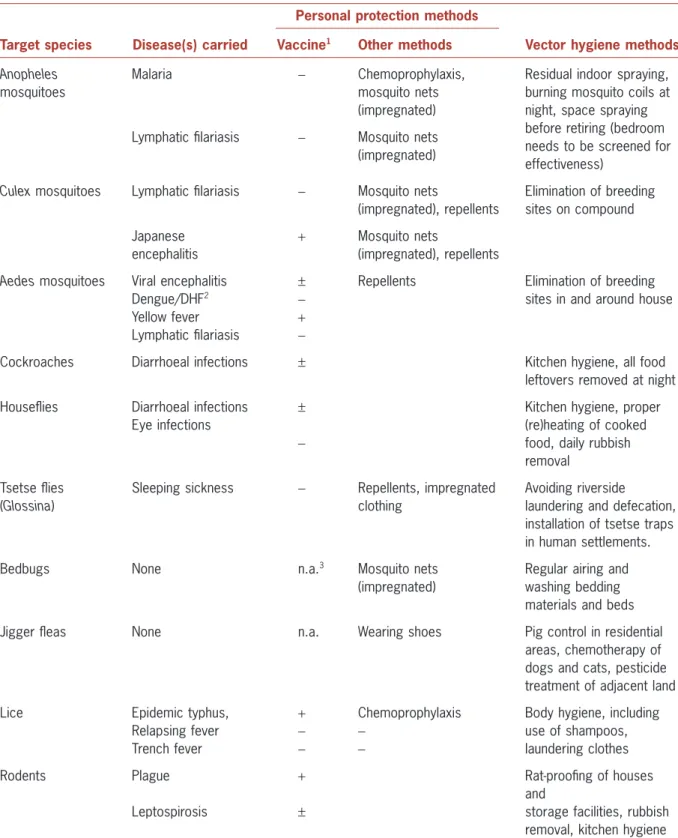
Information on both hygiene and personal protection should be provided to the public in the same way as any other health education message. Personal protection measures that involve the use of vaccines, drugs (e.g. for prophylaxis) or pesticides (e.g. in impregnated mosquito nets) should be promoted by qualified health staff and used under their guidance. Table 10.1 gives examples of hygiene and personal protection methods for use against some target vectors or pests.
10.5.2 Repellents
In many societies accustomed to nuisance pests and vectors, people use a variety of sub-stances as repellents. When these practices are effective and harmless, they should be encouraged in emergency situations, and it may be locally popular and effective to provide repellents of proven efficacy to the affected population. However, there is insuf-ficient evidence of the effectiveness of repellents in reducing vector-borne disease at a population level to make this a general recommendation.
Table 10.1 Examples of hygiene practices and personal protection methods against selected disease vectors, diseases, and nuisance pests
Personal protection methods
Target species Disease(s) carried Vaccine1 Other methods Vector hygiene methods
Anopheles Malaria - Chemoprophylaxis, Residual indoor spraying,
mosquitoes mosquito nets burning mosquito coils at
(impregnated) night, space spraying before retiring (bedroom Lymphatic filariasis - Mosquito nets
needs to be screened for (impregnated)
effectiveness)
Culex mosquitoes Lymphatic filariasis - Mosquito nets Elimination of breeding (impregnated), repellents sites on compound
Japanese + Mosquito nets
encephalitis (impregnated), repellents
Aedes mosquitoes Viral encephalitis ± Repellents Elimination of breeding
Dengue/DHF2 - sites in and around house
Yellow fever +
Lymphatic filariasis
-Cockroaches Diarrhoeal infections ± Kitchen hygiene, all food
leftovers removed at night
Houseflies Diarrhoeal infections ± Kitchen hygiene, proper
Eye infections (re)heating of cooked
- food, daily rubbish
removal
Tsetse flies Sleeping sickness - Repellents, impregnated Avoiding riverside
(Glossina) clothing laundering and defecation,
installation of tsetse traps in human settlements.
Bedbugs None n.a.3 Mosquito nets Regular airing and
(impregnated) washing bedding materials and beds Jigger fleas None n.a. Wearing shoes Pig control in residential
areas, chemotherapy of dogs and cats, pesticide treatment of adjacent land Lice Epidemic typhus, + Chemoprophylaxis Body hygiene, including
Relapsing fever - - use of shampoos,
Trench fever - - laundering clothes
Rodents Plague + Rat-proofing of houses
and
Leptospirosis ± storage facilities, rubbish
removal, kitchen hygiene
1-: no operational vaccine available; +: operational vaccine available; ±: operational vaccine available for some. 2dengue haemorrhagic fever.
3n.a.: not applicable.
N.B.: Relief workers and health personnel should wear protective clothing (often impregnated with pesticide), or take other precautions in accordance with existing WHO and ILO guidelines.
10.5.3 Impregnated materials for malaria control
There is growing experience with using insecticide-impregnated mosquito nets, curtains and wall fabrics for providing protection against mosquitoes in emergency situations. The most effective of these methods is the use of impregnated mosquito nets, which have been shown in trials in several countries to be effective in reducing malaria trans-mission and nuisance biting by mosquitoes. In addition, they can also reduce the preva-lence of sandflies, bedbugs, and head and body lice (Thomson, 1995).
The preferred insecticides for impregnating nets, curtains and fabrics are pyrethroids, such as permethrin and deltamethrin, in emulsifiable concentrates (United Nations High Commissioner for Refugees, 1997). Mosquito nets may be purchased already impregnated, or may need to be impregnated before use. All materials need to be reimpregnated after six months, and should not be washed during that period. Reim-pregnation should be carried out immediately before the main malaria transmission season, when there is a seasonal pattern (Thomson, 1995).
There are a number of operational difficulties associated with the use of impregnated materials in disasters and emergencies that have to be resolved if these measures are to be effective. These include ensuring that the majority of the population actually keeps the mosquito nets and uses them correctly; ensuring that nets are not frequently washed, which reduces the concentration of the insecticide; and ensuring that nets are reim-pregnated when needed.
10.5.4 Disinfection and disinfestation
Some disease vectors may be controlled by disinfestation, which is the process of removing from the body and clothing, or killing, animals that transmit disease (lice, mites, fleas, ticks, etc.) and their eggs.
Disinfestation by mass dusting people and their clothing with insecticides is humiliating, usually unnecessary, and dangerous if done incorrectly. It is better, if possible, to use a disinfection unit for this purpose. If mass dusting is considered necessary (e.g. because of an epidemic of flea-borne or louse-borne disease), the process must be explained to the population concerned, and the least toxic effective dust used.
Disinfection methods (for destroying disease organisms) can also be used for disin-festation, though the reverse is not true. Methods of disinfection effective against disease vectors and nuisance pests on clothing include the use of physical agents, such as ultra-violet light, dry heat, boiling water and steam, or chemical agents such as sulfur dioxide, ethylene oxide, formaldehyde, formol, cresol, phenol and carbolic acid. Some of these agents are dangerous and should be used only under expert supervision.
All articles not likely to be damaged may be disinfected by steam. Leather goods, clothing with leather facings or strapping, furs, rubber and other material that may be spoilt by steam can be sprayed with a 5% formol solution.
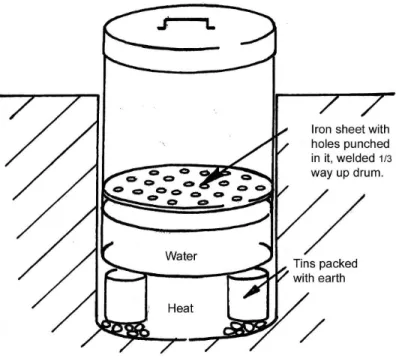
A simple steamer for clothing is illustrated in Figure 10.1. To kill lice and fleas, cloth-ing should be steamed for 15 minutes, in combination with insecticide treatment. The process may need to be repeated every month.
10.6
Further information
For further information on:
— pesticides for vector control, see: Chavasse & Yap (1997);
— pesticide poisoning, see: World Health Organization (1998b), Group of Agricultural Pesticides Manufacturers (1993), Keifer (1997);
— vector and pest control in displacement emergencies, see: Thomson (1995) and United Nations High Commissioner for Refugees (1997), Sphere Project (2000); — environmental management, see: Cairncross & Feachem (1993);
— protection at the community or household level, see: Rozendaal (1997).
Figure 10.1 Simple steamer for clothing1