TECHNICAL UNIVERSITY OF CLUJ-NAPOCA
ACTA TECHNICA NAPOCENSIS
Series: Applied Mathematics, Mechanics, and Engineering Vol. 62, Issue II, June, 2019
UPPER LIMB REHABILITATION WITH A COLLABORATIVE ROBOT
Bogdan GHERMAN, Alin BURZ, Daniela JUCAN, Fidelian BARA, Giusepe CARBONE, Doina PISLA
Abstract: The interest in rehabilitation robotics is showing a steady growth over the last decades. This paper presents a rehabilitation application for the upper limb, achieved using a well-known industrial collaborative robot. The proposed robotic system has been programmed and a specific layout has been developed to provide an active-assistive control strategy.
Key words: robotic rehabilitation, upper limb, collaborative robot, control strategy, post-stroke.
1. INTRODUCTION
Stroke is a neurological disease, due to the death of brain cells, caused by a blockage of a blood vessel (ischemic stroke) or bleeding into or around the brain (hemorrhagic stroke) [1]. Stroke can induce death and is the first factor which provokes long-term disabilities. Studies show us at this time the World Health Organization estimates, 15 million people suffer stroke worldwide each year. The incidence of stroke is expected to grow up in future [1]. More than a half stroke survivors some level of lasting hemiparesis or hemiplegia resulting from the damage of the neuronal brain tissues.
Robot-assisted therapy has been developed along of the three decades with the advances in robotic technology such as the exoskeletons and the bioengineering, which become a significant supplement to traditional physical therapy. They are designed for help and improve physically therapy.
At this time two types of robotic structures for upper limb rehabilitation that can assist movement therapy: exoskeletons and manipulators with specific end-effector. The exoskeletons reproduce the natural movements of the arm, moving each join, but they require a perfect mapping between the robot active joints and the patient’s joints, any misalignment
leading to possible injuries (especially since most of the patient lack sensing abilities on the impaired limb). The second category (with specific end-effectors) is present in a much lower number in the field of rehabilitation robotics, since they require a large task workspace and a lot of safety systems. The latter disadvantage begins to fade since collaborative robots already implement such safety systems, as a part of their standards, [2].
supination and the other for the wrist rehabilitation: adduction / abduction and flexion / extension. Others [8], [9] have developed simple devices (robotic or not) for the upper limb rehabilitation, especially for elbow and wrist.
Collaborative robots are specially designed for direct interaction with human operators. A renowned collaborative robotic system is the KUKA LBR IIWA. It comes in two variants: KUKA LBR IIWA 7 or KUKA LBR IIWA 14, each one with 7 DOF, developed by KUKA. The differences between them is the robot payload (IIWA 7 has 7 kilograms payload and IIWA 14 has 14 kilograms payload) and the size of the workspace [10].
Baxter is another collaborative robot produced and designed by Rethink Robots. This robot has two arms with 7 DOF for each arm and a payload of 2.2 kilogram for each arm [11].
The present paper presents an application for lower limb rehabilitation using the industrial collaborative robot ABB IRB 14000 YuMi [12]. Section 2 presents an assessment of the main control strategies used in rehabilitation robotics, section 3 presents the rehabilitation application and, section 4 some preliminary results using healthy patients several and conclusions are presented at the end.
2. ROBOTIC ASSISTED
REHABILITATION: STRATEGIES
The upper limb rehabilitation consists eventually in the rehabilitation of each joint of the limb: shoulder, elbow and wrist. At the level of the shoulder, four motions have been defined: shoulder flexion (without rotation) and extension (performed in a plane parallel with the sagittal plane of the body), shoulder adduction and abduction. At the level of the elbow, three motions have been defined: elbow flexion, elbow pronation and supination. At the level of the wrist, there four types of motion: wrist flexion and extensions as well as wrist adduction and abduction (ulnar deviation and radial deviation). The motion ranges have been defined in [13] and are presented in Table 1 (for the shoulder and elbow). At this moment, the wrist motions are disregarded, as these are not targeted in the present paper.
Table 1 Motion amplitudes in degrees for the shoulder and elbow motions as measured from the starting position
[13] Motion
type
Maximum Value
Mean Value Minimum value Lef
t Righ
t
Left Righ t Lef t Righ t Shoulder
flexion 120 114 98.3 93.7
5 72 72
Shoulder
extension 65 72 48.7
7 48.6
6 30 29
Shoulder
abduction 114 102 90.9 89.1
5 68 74
Shoulder
adduction 44 44 25.3 24.5
5 7 8
Elbow
flexion 150 152 131.
1 137.
7 56 122
Elbow
pronation 92 104 77.7
5 81.1 54 40
Elbow supinatio n
100 128 84.5 5
81.5
5 60 62
According to [14], considering the control strategy, the rehabilitation robots can be programmed to achieve different exercises, thus assisting the patient in several ways:
• Passive mode: the robotic device moves the patient’s limb, without any (active) involvement of the patient;
• Active non-assist mode: the subject performs the exercise without any help from the robot; • Active-assistive mode in which the patient attempts to move, but the motion is incomplete or inadequate, so the robot has to provide assistance;
• Resistive mode: the patient is required to perform an exercise, while an antagonistic force is provided by the robot (as a perturbation);
• Bimanual exercise or mirroring: the healthy limb performs a motion which is mirrored with the help of robotic devices by the impaired limb.
This paper presents the rehabilitation of the upper limb by implementing a passive and an active-assistive mode.
The passive mode can be used in the early stages of rehabilitation, when the patient is unable to move his hand (or even to counter the gravity force).
patient in his motions. A direct advantage of this approach consists in the fact that the patient is more involved in his performance, since he is initiating the motion. This further leads to his encouragement and to more motivation to produce better results. This, combined with high-intensity repetitive movements will contribute to the effectiveness of the therapy. Indeed, increasing the number of repetitions has produced far better results as reported in [15]. Applying other typologies of feedback (visual, auditory or haptic) proves to be highly benefic since it maximizes the attention to the task and enhances the motor performance.
Another advantage of using robotic system in rehabilitation consists in the ability to apply controlled force-fields and at the same time record the motion/force data as a result from the patient/robot interaction. Robotic rehabilitation has proved to be very efficient if active-assistive movements are applied, since brain stimuli and motion gain are more intense than in passive movements. This is due to the fact that this approach increases the motor cortex excitability and modulates the motor cortex function [14].
3. APPLICATION DEFINITION
3.1 Proposed hardware setup
The paper presents a rehabilitation exercise using the collaborative robot IRB 14000 YuMi from ABB Robotics [12]. The authors have developed an application, using custom designed devices, for the rehabilitation of the upper limb, dedicated to patients in an advanced stage of rehabilitation.
The ABB YuMi is a collaborative robot with two arms, each one having 7 DOFs. The programmer has the possibility to set the sensitivity in terms of maximum driving force of the actuators. The force is proportional to the measured currents in each motor. As a result, the robot is able to safely interact with human operators, which is why it has been used especially in industrial assembly operations. The robot has two smart-grippers on each arm, each having a maximum gripping force of 15N and a maximum opening of the jaws of 50mm.
The proposed application targets the rehabilitation of the upper limb. Considering the reduced payload capacity of YuMi (0.5 kg without the smart-gripper), a planar path has been conceived by the authors (in the horizontal plane, on a table), consisting of linear and circular trajectories (fig. 1). The patient’s task is to follow the trajectories of the path from a “START” point up to a “STOP” point.
Fig. 1. The imposed path for the rehabilitation exercise
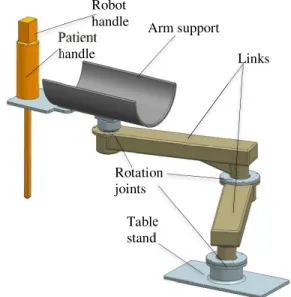
A custom arm support has been designed (fig. 2), to fully compensate the arm gravity of the patient, thus the only recorded force would be the one to keep the patient’s arm on the desired imposed path, for the rehabilitation exercise.
Fig. 2. Custom gravity-compensation arm support The custom support has a table stand with which it will be fixed on the working table. It also has two links that can freely move using the rotation joints, each one having two ball bearings in back-to-back arrangement. The patient rests his arm in the arm support and will
Patient handle
Robot
handle Arm support
Links
grab the handle, while the tip of the handle will move along each trajectory of the imposed path. All the elements are printed using the STRATASYS Fortus 380mc 3D production system [16].
3.2 The proposed operation planning
In order to achieve the required task, a rehabilitation medical protocol has been developed:
1. The patient must be in the sub-acute and chronic phases, when he/she has a well-known hemiparesis level with clear indication and an assessment score. The patient must be able to stand on a chair, even if supplementary specific equipment is used.
2. The patient is evaluated by the physical therapist who establishes what kind of motions the patient is able to achieve, conditioned by the limb mobility and patient overall state.
2. The patient (sitting on the chair) is positioned in the front of the table (on which the proposed path is drawn), facing YuMi.
3. The patient’s arm is attached to the custom gravity-compensation arm support.
4. The procedure motion parameters are set (in the robot control) based on the physical therapist recommendations, namely the speed and the robot sensitivity (to external forces).
5. The rehabilitation procedure is initiated and, again based on the physical therapist recommendations, one of the two types of control are selected: passive or active – assistive. 6. The patient’s hand is detached from the device.
7. The physical therapist evaluates the integrity of the patient’s limb (muscles and ligaments). 8. Steps 3-7 are repeated for each rehabilitation session.
The proposed path targets the rehabilitation of the following motions: shoulder flexion/extension, abduction /adduction and internal/external rotation, and the elbow flexion/extension, according to the protocols described in [13]. The wrist remains fixed and the pronation/supination motions are not achieved. Of course, the motion amplitudes for each targeted type of motion will be quite reduced (compared to a healthy patient capability), but this ensures that the selected path
can be followed by (virtually) any patient suffering of hemi-paresis.
The main steps in the development of the application are:
1. Learn the trajectory: the robot “learns” the trajectory points. The imposed trajectory has been previously fixed on the working table, namely the starting and ending point of each segment for lines or arc circles.
2. Set the force threshold: according to the rehabilitation stage of each patient, certain force sensitivity has to be set. This sets the robot compliance regarding to how much the patient may deviate from the trajectory while performing the exercise. The sensitivity can be set on a defined percentage range: 0% - 300%. At 0% sensitivity, the robot will not move. The authors have tested using a dynamometer other levels and in the case of passive movements, when the patient is not actively involved in the exercise, the sensitivity can be set to a higher value, between 200 – 300%. To increase the compliance (in the case of active-assisted movements), the sensitivity should be set to a lower value and experimentally it has been determined to be between 30% - 70%. After an initial evaluation, based on the patient’s rehabilitation stage, experimental tests should be carried out, to increase the efficiency of the exercise.
3. Set the speed of the robot: Based on the rehabilitation stage of the patient, the motion speed of the robot between each pair of defined points (from 1 mm/s up to 1500 mm/s, values given in the robot datasheet) can be defined. The default speed for the proposed rehabilitation exercise has been experimentally determined and set to 10 mm/s, a value at which the robot moves smoothly from point to point (without shocks or vibrations).
4. Test the application: Using the layout presented in fig. 3, the robotic device has been tested on healthy subjects. The three main components of the layout are: the ABB YuMi collaborative robot, the hand support and the path to follow. And, of course, the patient.
with separately. The proposed path is discretized into 13 trajectories, 11 linear and 2 circular). For the passive movement, the robot does all the job, from the moment patient rests his arm on the arm support up to the finish point. In the case of active-assisted movements, the patient rests his arm on the arm support and the robot is waiting for an input force on the right trajectory. If the input force has the right amount, the robot will assist the patient in the achievement of each trajectory of the path. If not, the robot will guide the patient’s arm using passive movements. After all the trajectories that compose the path have been covered, the robot will release the handle and the exercise is over.
If the patient deviates from the imposed path, the robot will stop and bring the handle back to the correct route. The low sensitivity in the robot actuators is also used as a safety mechanism, so that if something goes wrong during the execution of the exercise, the robot will stop immediately. Actually, ABB has implemented the ISO/TS 15066 standard for YuMi, consisting in requirements on collaborating robots including biomechanical criteria for power-and-force-limiting. YuMi also integrates the ISO 10218-1 standard, while the ISO 10218-2 integration is planned. Besides the collaborative implemented standards, YuMi has the ABB traditional Flex Pendant (with which it can be programmed online) with the safety switch that stops the robot instantly. The robot has been initially programmed offline check if all the path points are in the robot workspace, as in [17].
4. PRELIMINARY RESULTS
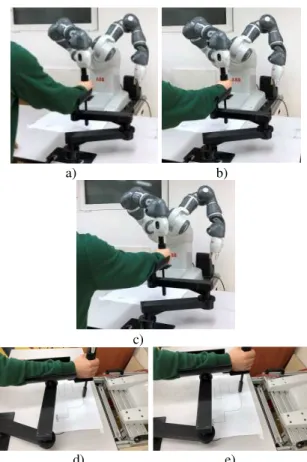
Fig. 5 presents snapshots taken during an upper limb rehabilitation exercise. The exercises were performed using healthy patients in laboratory conditions, in order to assess the usability of the robotic system for this type of task. For this exercise, the robot sensitivity regarding the input force (as well as for safety reasons) has been set to 30%, which means that the robot is highly sensitive.
Fig. 3. Testing layout of the robotic system for upper limb rehabilitation
a) b)
c)
d) e)
Fig. 5. Snapshots taken during rehabilitation exercises
5. CONCLUSIONS
This paper presents an upper limb rehabilitation application using the ABB IRB 14000 YuMi collaborative robot. Both hardware and set-ups are described. Preliminary tests have been carried out and they prove that the robot can be used as a robotic rehabilitation system for the upper limb, even with a low payload ABB YuMi
Hand support Path to
capacity, provided that a gravity compensation arm support is used as proposed.
6. ACKNOWLEDGEMENT
The paper presents results from the research activities of the project ID 37_215, MySMIS code 103415 “Innovative approaches regarding the rehabilitation and assistive robotics for
healthy ageing” cofinanced by the European Regional Development Fund through the Competitiveness Operational Programme 2014-2020, Priority Axis 1, Action 1.1.4, through the financing contract 20/01.09.2016, be-tween the Technical University of Cluj-Napoca and ANCSI as Intermediary Or-ganism in the name and for the Ministry of European Funds.
7. REFERENCES
[1] Yue, Z, Zhang, X, Wang, J. Hand Rehabilitation Robotics on Poststroke Motor
Recovery, Behav. Neurol., doi:
10.1155/2017/3908135, 2017.
[2] Ceccarelli, M. Problems and Experiences on
Cable-Based Service Robots for
Physiotherapy Applications, New Trends in Medical and Service Robots, Springer, Dordrecht, Vol. 16, pp.27-42, 2013
[3] Stefano, M., Patrizia, P., Mario, A., Ferlini, G., Rizzello, R., Rosati,G., Robotic Upper Limb Rehabilitation after Acute Stroke by NeRoBot: Evaluation of Treatment Costs, BioMed Research International, doi: 10.1155/2014/265634, 2014.
[4] Hogan, N., Krebs, H.I., Charnnarong, J., Skikrishna,P., Sharon, A., MIT – Manus: A Workstation for Manual Therapy and Training, IEEE Int. Workshop on Robot and Human Communication ROMAN, pp. 161– 165,Tokyo, 1992.
[5] Izard, JB., Dubor, A., Hervé, PE. et al.,
Large-scale 3D printing with cable-driven parallel robots, Construction Robotics Vol. 1 pp. 69-76, 2017.
[6] Plitea, N, Vaida, C., Carbone, G., Pisla, A., Ulinici I., Pisla, D., On the Kinematics of an Innovative Spherical Parallel Robot for
Shoulder Rehabilitation, Multibody
Mechatronic Systems, pp. 464-473, 2017. [7] Birlescu, I., Pisla, D., Gherman, B., Pisla, A.,
Vaida, C., Carbone, G., Plitea, N., On the Singularities of a Parallel Robotic System Used for Elbow and Wrist Rehabilitation, Advances in Robot Kinematics, pp. 203-2011, 2018.
[8] Chetran, B., Aluței, A.M., Szelitzky, E., Mandru, D., Rehabilitation exercisers – from simple devices to robotic systems, ACTA TECHNICA NAPOCENSIS, Series: Applied Mathematics and Mechanics, Vol. 54(1), 2011.
[9] Murar, M., Brad, S., Fulea, M., Dual arm robot grippers’ teach-in and control architecture for handling of small objects with complex shapes towards elder care
services, ACTA TECHNICA
NAPOCENSIS, Series: Applied
Mathematics and Mechanics, Vol. 59(1), 2016.
[10] Mokaram S. et al., A ROS-integrated API for the KUKA LBR iiwa collaborative robot, IFAC-PapersOnLine, Vol. 50(1), pp. 15859-15864, 2017.
[11] Reddivari, H., et al., Teleoperation control of Baxter robot using body motion tracking, International Conference on Multisensor Fusion and Information Integration for Intelligent Systems (MFI), DOI: 10.1109/MFI.2014.6997722, 2014.
[12] Kirschner, D., Velik, R., Yahyanejad, S., Brandstötter, M., Hofbaur, M., YuMi, Come and Play with Me! A Collaborative Robot for
Piecing Together a Tangram Puzzle,
Interactive Collaborative Robotics, pp. 243-251, 2016
[13] Vaida, C., Carbone, G., Major, K., Major, Z., Plitea, N., Pisla, D., On human robot interaction modalities in the upper limb
rehabilitation after stroke, ACTA
TECHNICA NAPOCENSIS, Series: Applied Mathematics and Mechanics, Vol. 60(1), 2017.
[14] Poli, P., Morone, G., Rosati, G., Masiero, S.
Robotic Technologies and Rehabilitation: New Tools for Stroke Patients' Therapy, Biomed Res Int., 2314-6141, doi: 10.1155/2013/153872, 2013.
[15] Chen, S.H. at al. Assistive Control System for Upper Limb Rehabilitation Robot, IEEE Trans Neural Syst Rehabil Eng, Vol. 24(1), pp. 1199-1209, 2016.
[16] Stratasys Inc., https://www.stratasys.com/-
/media/files/printer-spec-sheets/pss_fdm_fortus380mc450mc_0418a. pdf, March 2019
RECUPERAREA MEDICALĂ A MEMBRULUI SUPERIOR CU AJUTORUL UNUI ROBOT COLABORATIV
Rezumat: Interesul acordat recuperării medicale asistate robotic arată o creștere constantă în ultimele decenii. Această lucrare prezintă o aplicație destinată recuperării medicale post-AVC realizată utilizând un robot industrial colaborativ cunoscut. Sistemul robotic utilizat a fost programat și a fost dezvoltat un stand experimental pentru a asigura o strategie de control activ asistiv în relația cu pacientul.
Bogdan GHERMAN, S.L. Dr. Ing., CESTER - Research Center for Industrial Robots Simulation and Testing, Technical University of Cluj-Napoca, [email protected], Office Phone: +40 -264-401684, 103-105 Muncii blv., Cluj-Napoca, Romania
Alin BURZ, Ing., CESTER - Research Center for Industrial Robots Simulation and Testing, Technical University of Cluj-Napoca, [email protected], Office Phone: +40 -264-401684, 103-105 Muncii blv., Cluj-Napoca, Romania
Daniela JUCAN, Ing., CESTER - Research Center for Industrial Robots Simulation and Testing, Technical University of ClujNapoca, [email protected], Office Phone: +40 -264-401684, 103-105 Muncii blv., Cluj-Napoca, Romania
Fidelian BARA, Ing., ABB Romania, [email protected], Office Phone: +40 -264-426268, 6-8 Calea Motilor, Cluj-Napoca, Romania
Giuseppe CARBONE, Conf. Dr. Ing., DIMEG – Department of Mechanical, Energy and Management Engineering, University of Calabria, [email protected], Office phone: ++39 0984 4911, Via Pietro Bucci, 87036 Arcavacata, Rende CS, Italia and CESTER - Research Center for Industrial Robots Simulation and Testing, Technical University of Cluj-Napoca, [email protected], Office Phone: +40 -264-401655, 103-105 Muncii blv., Cluj-Napoca