Dr Ambika Sood JMSCR Volume 07 Issue 08 August 2019 Page 623
Original Research Article
Daily versus intermittent Anti-tuberculous Treatment in Pediatric
Tuberculosis: A Comparative Study
Author
Dr Ambika Sood
Department Of Pediatrics, Indira Gandhi Medical College Shimla *Corresponding Author
Dr Ambika Sood
Address: 98, Lower Bazaar, Shimla. Pin-171001, India
Abstract
Background: The World Health Organization (WHO) declared tuberculosis (TB) a global public health emergency in 1993. It is the second leading cause of death from an infectious disease worldwide and leading cause of ill- health among millions of people. Treatment options of tuberculosis include intermittent therapy in DOTS and daily therapy. Aim of our study is to compare daily versus intermittent antituberculous treatment.
Methods: This observational prospective study was conducted at Indira Gandhi Medical College, Shimla. Detailed information was collected on predesigned proformas and results were compiled and evaluated on master chart.
Results: 460 children were diagnosed with various forms of tuberculosis, out of which 82 children fulfilling the inclusion criteria were enrolled in this study. These were divided into two groups (Group 1 and Group 2). The mean age at the time of enrollment was 10.34 years 42 (53.16%) were males and 37 (46.83%) females, with a sex ratio of M:F=1.1:1. sputum negativity in the daily therapy group showed statistical significance with a p value of < .05, an odds ratio of 0.17 with Confidence Intervals : 0.02 – 0.94.
Conclusion: Tuberculosis remains a major cause of mortality and morbidity in Pediatric population. Daily therapy may be a futuristic treatment option with better results.
Keywords: Tuberculosis Pediatric, Daily, Intermittent, Gastric aspirate.
Introduction
The World Health Organization (WHO) declared tuberculosis (TB) a global public health emergency in 1993. It is the second leading cause of death from an infectious disease worldwide and leading cause of ill- health among millions of people.[1] Latest WHO estimates reveal that in 2013, an estimated 9.0 million people developed TB and of these 1.5 million died from the disease,
360000 of them being HIV positive.[2] Childhood Tuberculosis remains an important cause of morbidity and mortality in the developing countries.[3,4] In 2013, there were an estimated 550, 000 cases (about 6% of the total number) 9.0 million incident cases and 80,000 deaths among children.[2] Data on TB in Indian children are scarce. Tuberculin surveys are the only surveys which suggest that the annual risk of TB infection http://jmscr.igmpublication.org/home/ ISSN (e)-2347-176x ISSN (p) 2455-0450
Dr Ambika Sood JMSCR Volume 07 Issue 08 August 2019 Page 624 is above 1.5%.[5,6] The aim of anti- tubercular
treatment (ATT) in adults and children is alike to cure the patient of TB, minimize the spread to others and avoid the development of drug resistance. Most of the clinical trials of ATT have only been carried out in adults with microbiologically proven pulmonary TB, following objective microbiological case definitions and treatment outcomes. Treatment protocols of tuberculosis include DOTS intermittent therapy and daily regimen.
A meta-analysis comparing daily and intermittent (mostly twice-weekly) regimens conducted at All India Institute of Medical Sciences (AlIMS), New Delhi over a period of five years 2000-2005 in children age 2-15yrs. It concluded that twice weekly intermittent short course therapy is less likely to cure tuberculosis in children as compared to daily therapy (14). Therefore, keeping in view the limited data from our country, we aim to compare the effectiveness of intermittent therapy with daily short course chemotherapy in childhood tuberculosis, in the age group between 1-18 yrs, in achieving cure/significant improvement in children, and side effect profile in either therapy.
Aims & Objectives
1. To Compare the Effectiveness of Intermittent (thrice weekly) versus Daily short course chemotherapy in childhood tuberculosis in the population age group 1-18yrs in achieving cure/significant improvement in children.
2. To compare incidence of side effects profile in both the groups.
Methodology
This prospective observational study was conducted in the Department of Pediatrics, and Dept. of Pulmonary Medicine, Indira Gandhi Medical College Shimla, Himachal Pradesh, India over a period of one year w. e. f. June 2013- May 2014. Patients aged 1-18yrs, with confirmed tuberculosis attending to the outpatient as well as in-patient department were enrolled in the study.
After confirmation of the diagnosis of pulmonary/ extra-pulmonary TB, patients were administered ATT, using the inclusion criteria.
Inclusion Criteria
All children between 1-18yrs diagnosed as Pulmonary/ Extrapulmonary tuberculosis were administered Intermittent / Daily Chemotherapy, after allocation of the children into 2 groups. Informed consent was taken in all the cases from the parents/caregivers. These patients were randomly allocated into two treatment groups, one group received DOTS therapy (group 1), and the second group received Daily therapy (group 2) for a period of 6 months. Based on the age of the patients enrolled, they were further subdivided into 3 groups, 1-5 yrs, 6-10 yrs and 11-18 yrs. The drugs used for treatment were Isoniazid (H), Rifampicin (R), Pyrazinamide (Z), Ethambutol (E).
Following two dosing regimens were used in the DOTS therapy group based on the weight of the child as per Revised National Tuberculosis Control Programme (RNTCP) pediatric guidelines
1. PC 13(R- 75mg, H- 75mg, E-200 mg, Z-250 mg)
2. PC 14(R- 150 mg, H- 150 mg, E-400 mg, Z-500 mg)
In Daily therapy group drug doses used were Rifampicin – 10mg/kg. (maximum dose 600mg), Isoniazid– 10mg/kg.(maximum dose-300mg), Ethambutol–15-20mg/kg (maximum dose-2500mg), Pyrazinamide–15-30mg/kg (maximum dose-2000mg). The children were followed over the next 6 months for the comparison of efficacy of either treatment or side effect profile in both the therapies.
Follow up
These cases were assessed on the following points:
1. Subjective Improvement- improvement of initial symptoms e.g. afebrile, weight gain, increase in appetite.
Dr Ambika Sood JMSCR Volume 07 Issue 08 August 2019 Page 625 3. Radiological improvement to be assessed by
chest x-ray examination in all patients who had radiological signs earlier, smear-negative pulmonary TB cases at 2nd month and as needed.
4. Death – while on treatment or within 6 months after treatment
5. Adherence – seen by empty blister pack, color of urine or discontinuation of therapy for at least 1 month on their own accord. 6. Toxicity – adverse drug reactions requiring
interruption / alteration of therapy 7. Relapse
Data Analysis: Data was collected on predesigned proforma and transferred to excel sheet for further processing and analysis. SSPS version 22(American) and epi info version 7 software were used for analysis.
Results
Four hundred and sixty children were diagnosed with various forms of tuberculosis, out of which 82 children fulfilling the inclusion criteria were enrolled in this study. Three subjects (two in Group 1 and one in Group 2) were lost to follow up and the rest 79 patients completed the study protocol.
Baseline characteristics of enrolled children
Both the study groups were sub-divided into three
age groups (Table 1). The mean age at the time of enrollment was 10.34 years with a standard deviation of 4.69 (± 2S.D) in Group 1 and 10.18 years with standard deviation of 4.66 (±2S.D) in Group 2, which is comparable.
42 (53.16%) were males and 37 (46.83%) females, with a sex ratio of M:F=1.1:1(Figure 1). Of the total 42 males, 22 (52.38%) were in Group 1 whereas remaining 20 (47.62%) were in Group 2. Female children in Group 1 were 17 (45.95%) and 20 (54.05%) in Group 2. (Figure 2)
Figure 2: Sex wise distribution of cases in Group 1 and Group 2.
42 37
Figure 1: Sex Wise Distribution
of cases
Males
Females
22
20
17
20
0 5 10 15 20 25
Group 1 Group 2
Male
Female Table 1: Distribution of cases
Age group GROUP 1 (n= 39)
GROUP 2 (n = 40)
Dr Ambika Sood JMSCR Volume 07 Issue 08 August 2019 Page 626
Profile of children with Tuberculosis
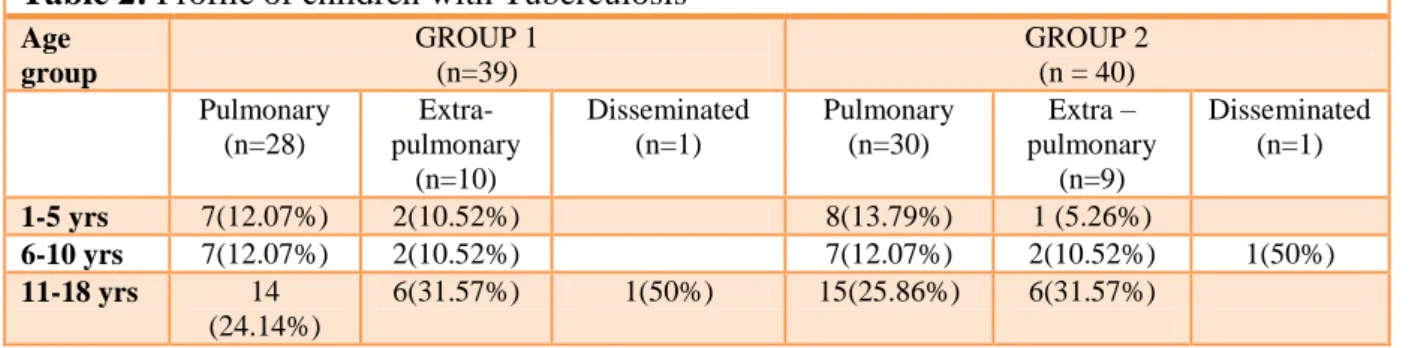
Children were diagnosed as Pulmonary (PTB), extra-pulmonary and disseminated tuberculosis. Fifty-eight (73.41%) children had PTB, 19
(24.05%) children had extra-pulmonary tuberculosis and 2 (2.53%) children had disseminated tuberculosis at the time of enrollment (Table 2).
Table 2: Profile of children with Tuberculosis
Age group
GROUP 1 (n=39)
GROUP 2 (n = 40) Pulmonary
(n=28)
Extra-pulmonary
(n=10)
Disseminated (n=1)
Pulmonary (n=30)
Extra – pulmonary
(n=9)
Disseminated (n=1)
1-5 yrs 7(12.07%) 2(10.52%) 8(13.79%) 1 (5.26%)
6-10 yrs 7(12.07%) 2(10.52%) 7(12.07%) 2(10.52%) 1(50%) 11-18 yrs 14
(24.14%)
6(31.57%) 1(50%) 15(25.86%) 6(31.57%)
The diagnosis of pulmonary tuberculosis was
based on the sputum/gastric lavage positivity, characteristic of pleural aspirate as well as other radiological signs. 35(60.34%) children of 58 were sputum/ lavage positive, out of which 18 (51.42%) were in the Group 1 and17 (48.57%) were in the Group 2. Majority of sputum positive cases (48.57%) were adolescents. Of the 58 children with pulmonary TB, 48 children had radiological signs. Pleural effusion was the commonest radiological abnormality seen in 21 (43.75%) children, followed by adenitis in 8 (16.66%) and parenchymal lesions in 19 (39.58%) as shown in Table 4. Out of 19 children with extra-pulmonary TB, 9 (47.36%) had ascitis, 3 (15.79%) had arthritis, 2 (10.52%) had lymph node TB and 5 (26.32%) had mixed presentation.
Follow up
Follow up sputum smears were done in all sputum/lavage positive cases as per RNTCP guidelines. In Group 1, 55.55% (n=10) became sputum negative at the end of intensive phase of therapy, 83.33% (n=15) by 3 months, 94.44% (n=17) at the end of 4 months and 100% by 5 months of therapy. While in Group 2, 88.23% showed sputum smear conversion by 2months, and 100% by 3 months of therapy (Table 3).
In this study, sputum negativity in the daily therapy group showed statistical significance with a p value of < .05, an odds ratio of 0.17 with Confidence Intervals : 0.02 – 0.94.
Table 3: Cumulative frequency of sputum negativity
Time after start of ATT
Group 1 (n=18)
Group 2 (n =17)
P value Odds ratio
2 months 10 (55.55%) 15 (88.23%) 0.04 .17(0.02-0.94) 3 months 5 (27.78%) 2 (11.76%) 0.27 2.8(.46-23.87) 4 months 2 (11.11%) - - - 5 months 1 (5.55%) - - -
Of the 79 study subjects, 48 (60.76%) had radiological signs, 45.83% were in Group 1and 54.16% were in Group 2. In Group 1, 40.90% of children achieved radiological clearance at 2 months, 72.72 % at the end of 3 months, 86.36% at 4 months and 90.90% at 5 months and 100% at
Dr Ambika Sood JMSCR Volume 07 Issue 08 August 2019 Page 627 parameters as per protocol were assessed for the
evaluation of subjective improvement: weight gain and resolution of symptoms. In the intensive phase, 82.05% (n=32) of the children showed symptomatic improvement in Group1 compared to 90% (n=36) in Group 2, and 100% in both groups during the continuation phase.
Adverse events
Adverse reactions were documented in 30.37 % (n=24) children, mainly in the intensive phase of therapy. Gastrointestinal intolerance was the commonest presentation seen in 25% (n=6) in Group 1 and 37.5% (n=9) in Group 2. The other recorded side effects were arthralgia in 29.16% (n=7), headache in 12.5% (n=3) and jaundice with raised transaminase levels [5 times the normal age specific values] in 8.33% (n=2) cases. In group 1 raised transaminase levels were observed only during the Intensive phase of therapy while in Group 2 they were also documented in the continuation phase. Adverse reactions were comparable in both the groups and statistically insignificant with a p value of >.05. During the study period and follow up, no relapse or death was reported in either of the groups.
Outcome
In this study, of the total 79 children, cure rates were comparable in both the groups. Time interval from the initiation of therapy to sputum negativity in Group 2 (on Daily therapy) was statistically significant compared to group 1 (p value 0.04). Subjective improvement, radiological clearance, adherence to therapy and profile of adverse events were comparable in both groups. There was no relapse or death in either of the groups during the study period as well as follow up.
Discussion
Initially, childhood TB was treated with daily therapy. However, with its success in adults, intermittent therapy (twice/thrice weekly) therapy has also been recommended in children. Till date many studies comparing daily and intermittent twice weekly therapy have been carried out in children, but hardly any study has compared
WHO recommended thrice weekly (DOTS) with daily therapy. Therefore, we aim to compare the efficacy and outcome of the DOTS (thrice weekly) versus daily therapy in children from one to 18 years of age with regards to subjective improvement, rate of sputum conversion, radiological clearance as well as their side effect profile.
Seventy nine of the 82 cases enrolled between one to 18 years, completed the study. Mean age of the subjects was 10.2 years ± SD 4.6. Our study included 53.16% males. The male to female ratio was 1.1:1, which is similar to another study by Kansoy et al. who reported a mean age of 7.6 yrs.
[8]
Sarin et al. in their study enrolled children with a mean age 11.2 years, but there was a female predominance.[9] Naude et al. in a study from South Africa reported a mean age of 2.1years. [10] Ramachandran et al. included children <16 years (19), while Gocmen et al. included children between 6 months to17 years of age[11] and in a prospective study in USA,2002, Al-Dossary et al
included children aged between 5 months to 17 years. [12] The slight gender bias in our study could be attributed to the fact that males are relatively better cared for in our society.
Thirty five children were sputum/ lavage positive in the present study, 16 (45.71%) in the age group of 11-18 years and 9 (25.71%) in the 6-10 years age group. It was similar to a study by Sarin et al. who reported highest sputum positivity of 59% in the 11-14 years age group at the time of enrollment. [9] In the present study 28.57% were sputum/lavage positive in the 1-5 year age group supporting the fact that gastric aspirate and induced sputum specimens are useful tools for confirmation of the diagnosis of TB.
Dr Ambika Sood JMSCR Volume 07 Issue 08 August 2019 Page 628 therefore showing early sputum conversion in
children on daily therapy compared to DOTS therapy. Limited number of studies in children has compared the rates of sputum conversion at the end of intensive phase. In studies conducted in adults, Salih et al. reported early conversion at the end of first month on daily therapy compared to intermittent therapy, however the difference being statistically insignificant.[13] Prasad et al. also reported comparable sputum conversion rate at end of 2 months with both forms of therapy in adults. [14] Qayyum et al. in a retrospective study carried out in Karachi reported sputum negativity at the end of intensive phase in 83% of subjects on intermittent therapy and 80% with daily therapy. It was statistically insignificant, but they used 2RHZE3/2HE3 as intermittent therapy instead of
2HRZE3/4HR3.[15] Mandal et al. also showed
comparable sputum conversion rate at end of intensive phase with both the regimens.[25] Kashyap et al, in their study on DOTS regimen reported a sputum conversion rate of 87.27% at end of intensive phase.[17] In the present study, the 100% cure rates were documented in both the groups, although 10.25% in group 1 required extension of intensive phase, whereas it was 7.5% in group 2, which is similar to other studies in children. Kansoy et al. reported cure rates of 100% in both the groups.[8] Kumar et al. similarly reported high cure rates of 97% with intermittent regimen and 100% with daily regimen. [18] Naude
et al. in a study reported cure rates of 89% and 97% in intermittent and daily regimen respectively.[10] Ramachandran et al. reported a low cure rate of 60% with daily regimen and 48% in the intermittent therapy and it was insignificant.
[19]
This may be attributed to the use of twice and thrice weekly regimen instead of one set regimen as laid down by WHO.
Of the 79 study subjects, 48 (60.76%) had radiological signs, 45.83% (n=22) were in Group 1and 54.16% (n=26) were in Group 2. In Group 1 40.90% children achieved radiological clearance at 2 months, whereas in group 2, 57.69% had evidence of radiological clearance after
completion of intensive phase and one child had incomplete resolution at completion of therapy, all the radiological assessment was done by a single radiologist. Indumati et al. in a study on children reported 13% residual radiological lesions.[20] Diga Ret al in their study in children reported regression of radiological lesions in both groups with no significant difference.[21]
The reported adverse reactions in the study subjects was 30.37%, with 28.20% in group 1 and 40% in group 2, and majority of them were documented during the intensive phase of therapy. The commonest adverse effect was GI intolerance (nausea and vomiting), observed in 25% in group 1 and 37.5% in group 2, which is comparable to that in adults, 17.39% as reported in a study done by Mehrota,[22] 28.7% in a study conducted at Singapore[23] and 29.27% in the study done at Hongkong.[24] Mandal et al reported the incidence of vomiting in 9.9% cases in intermittent therapy and none in subjects on daily therapy [16] whereas Mohamed Taher et al also documented vomiting in 11% and gastritis in 9% of cases on DOTS therapy.[25] Joint pains/ arthralgia was documented in 8.86% of the subjects in the present study, which is higher than that reported by Kumar et al
Dr Ambika Sood JMSCR Volume 07 Issue 08 August 2019 Page 629
Conclusion
Treatment of tuberculosis in children has undergone vast changes in the past few decades, with WHO recommending short course DOTS (thrice weekly) therapy as an alternative to daily therapy. This study was unique in the sense that very few studies had compared daily and intermittent (thrice weekly) therapy in children. The strength of this study was the documentation of early sputum conversion in children on daily therapy and, with regular and meticulous follow up, the compliance can be as high as 100% and also highlights that anti-tubercular drugs are well tolerated by children.
Funding: No funding source
Conflicts of Interest: None declared
Ethical approval: This study was approved by institutional ethical committee.
Bibliography
1. Dias Hannah Monica, Falzon Dennis. Global tuberculosis Report 2012, World Health Organization, 2012 (WHO/HTM/ STB/2012.
2. Global tuberculosis control— epidemiology, strategy, financing. WHO
Report 2014
http://www.who.int/tb/publications/global _report/2014/en/index.html. Accessed 31 May 2014.
3. Kochi A. The global tuberculosis situation and the new control strategy of the World Health Organization.Tubercle 1991; 72:1– 6.
4. Raviglione M C, Snider D E, Kochi A. Global epidemiology of tuberculosis. JAMA 1995; 273:220–226.
5. Munoz Flor M, Starke Jeffery R 213.Nelson 19th edition ;Elisevier: 960 61 6. Chadha VK, Kumar P, Jagannatha PS,
Vaidyanathan PS, Unnikrishnan KP. Average annual risk of tuberculous infection in India.Int J Tuberc Lung Dis 2005; 9(1):116-8.
7. Padmesh. RNTCP new pediatric guidelines 2012 National Guidelines on diagnosis and treatment of Pediatric Tuberculosis.
8. Kansoy S, Kurta N, Ak ít S, Aksoylar S, Yaprak I, Çalayan S. Superiority of intermittent-short course chemotherapy in childhood pulmonary tuberculosis. Turkish Journal of Medical Sciences1996; 26(1):41–3.
9. Sarin R, Sharma S, Khalid U.K, et al. The DOTS strategy for treatment of pediatric pulmonary tuberculosis in South Delhi, India. Int J Tuberc Lung Dis; 11(12): 74-80.
10. Naude Te Water, Donald PR, Hussey GD, Kibel MA, Louw A, Perkins DR, et al. Twice- weekly vs daily chemotherapy for childhood TB. Pediatr Infect Dis J 2000; 19:405-410.
11. Göçmen A, Özçelic U, Kiper M, et al. Short course intermittent chemotherapy in childhood tuberculosis. Infection 1993; 21: 324-327.
12. Al-Dossary FS, Ong LT, Correa AG, Starke JR. Treatment of childhood tuberculosis with a six month directly observed regimen of only two weeks of daily therapy. Pediatr Infect Dis J 2002; 21:91-97.
13. Salih M, Eltayeb I, Zaki A, et al. Intermittent chemotherapy compared to the daily regimen in Sudanese patients with pulmonary tuberculosis. Time Journal of Medical Sciences Report and Research; 1(3): 2013.
14. Prasad R, Rizavi D M, Kant S, et al. A comparison of unsupervised treatment along with intensive health education and directly observed treatment in pulmonary tuberculosis. Ind.J. Tub, 2001; 48,21. 15. Qayyum S, Ahmed, Ansari G. Comparing
Dr Ambika Sood JMSCR Volume 07 Issue 08 August 2019 Page 630 programme: OJHA Institute of Chest
Diseases, Karachi.
16. Mandal P, Mandal A,et al. comparing daily versus intermittent regimens of anti-tubercular chemotherapy. Journal of Clinical and Diagnostic Research,2012. 17. Anil K Kashyap, Jagdeep Whig, Dinesh
Gupta, Smiley Joshi. Clinical outcome of patients of tuberculosis under directly observed treatment short course in a tertiary care centre in Ludhiana India; Chest: Nov 3,2009.
18. Kumar L, Dhand R, Singhi PD, Rao KL, Katarriya S. A randomized trial of fully intermittent and daily followed by intermittent short-course chemotherapy for childhood tuberculosis. Pediatr Infect ds J 1990; 9:802-806.
19. Ramachandran P, Kripasankar A S, Duraipandian M. Shortcourse chemotherapy for pulmonary tuberculosis in children. Indian Journal of Tuberculosis 1998; 45:83-7.
20. Indumati C K, Prasanna K, Dinakar C, et al. Intermittent short course therapy for pediatric tuberculosis. Indian Pediatrics; Vol 47, Jan: 2010.
21. Diga R, Dalisay C. Comparison of modified directly observed therapy versus conventional treatment for active pulmonary tuberculosis. Phil Journal of Chest Diseases; 12(1):1-6.
22. Mehrotra ML. Agra study of short course chemotherapy in pulmonary tuberculous patients: Ind J Tub.1982; 29:29-39.
23. Singapore Tuberculosis Service, BMR Council. Long term follow up of a clinical trial of six-month and four-month regimens of chemotherapy in the treatment of pulmonary tuberculosis. Am Rev Respir Dis 1986; 133: 779–783.8.
24. Hong Kong Chest Service/BMR Council. Controlled trial of 2, 4, and 6 months of pyrazinamide in 6-month, three-times weekly regimens for smear-positive pulmonary tuberculosis, including an assessment of a combined preparation of isoniazid, rifampin, and pyrazinamide: Results at 30 months. Am Rev Respir Dis 1991;143: 700–706.