Fast Easy Unsupervised Domain Adaptation
with Marginalized Structured Dropout
Yi Yang and Jacob Eisenstein School of Interactive Computing Georgia Institute of Technology {yiyang, jacobe}@gatech.edu
Abstract
Unsupervised domain adaptation often re-lies on transforming the instance represen-tation. However, most such approaches are designed for bag-of-words models, and ignore the structured features present in many problems in NLP. We propose a new technique calledmarginalized struc-tured dropout, which exploits feature structure to obtain a remarkably simple and efficient feature projection. Applied to the task of fine-grained part-of-speech tagging on a dataset of historical Por-tuguese, marginalized structured dropout yields state-of-the-art accuracy while in-creasing speed by more than an order-of-magnitude over previous work.
1 Introduction
Unsupervised domain adaptation is a fundamen-tal problem for natural language processing, as we hope to apply our systems to datasets unlike those for which we have annotations. This is par-ticularly relevant as labeled datasets become stale in comparison with rapidly evolving social media writing styles (Eisenstein, 2013), and as there is increasing interest in natural language processing for historical texts (Piotrowski, 2012). While a number of different approaches for domain adap-tation have been proposed (Pan and Yang, 2010; Søgaard, 2013), they tend to emphasize bag-of-words features for classification tasks such as sen-timent analysis. Consequently, many approaches rely on each instance having a relatively large number of active features, and fail to exploit the structured feature spaces that characterize syn-tactic tasks such as sequence labeling and pars-ing (Smith, 2011).
As we will show, substantial efficiency im-provements can be obtained by designing domain
adaptation methods for learning in structured fea-ture spaces. We build on work from the deep learning community, in which denoising autoen-codersare trained to remove synthetic noise from the observed instances (Glorot et al., 2011a). By using the autoencoder to transform the original feature space, one may obtain a representation that is less dependent on any individual feature, and therefore more robust across domains. Chen et al. (2012) showed that such autoencoders can be learned even as the noising process is analyt-ically marginalized; the idea is similar in spirit to feature noising (Wang et al., 2013). While the marginalized denoising autoencoder (mDA) is considerably faster than the original denoising au-toencoder, it requires solving a system of equa-tions that can grow very large, as realistic NLP tasks can involve105or more features.
In this paper we investigate noising functions that are explicitly designed for structured feature spaces, which are common in NLP. For example, in part-of-speech tagging, Toutanova et al. (2003) define several feature “templates”: the current word, the previous word, the suffix of the current word, and so on. For each feature template, there are thousands of binary features. To exploit this structure, we propose two alternative noising tech-niques: (1)feature scrambling, which randomly chooses a feature template and randomly selects an alternative value within the template, and (2) structured dropout, which randomly eliminates all but a single feature template. We show how it is possible to marginalize over both types of noise, and find that the solution for structured dropout is substantially simpler and more efficient than the mDA approach of Chen et al. (2012), which does not consider feature structure.
We apply these ideas to fine-grained part-of-speech tagging on a dataset of Portuguese texts from the years 1502 to 1836 (Galves and Faria, 2010), training on recent texts and evaluating
on older documents. Both structure-aware do-main adaptation algorithms perform as well as standard dropout — and better than the well-known structural correspondence learning (SCL) algorithm (Blitzer et al., 2007) — but structured dropout is more than an order-of-magnitude faster. As a secondary contribution of this paper, we demonstrate the applicability of unsupervised do-main adaptation to the syntactic analysis of histor-ical texts.
2 Model
In this section we first briefly describe the de-noising autoencoder (Glorot et al., 2011b), its ap-plication to domain adaptation, and the analytic marginalization of noise (Chen et al., 2012). Then we present three versions of marginalized denois-ing autoencoders (mDA) by incorporatdenois-ing differ-ent types of noise, including two new noising pro-cesses that are designed for structured features. 2.1 Denoising Autoencoders
Assume instances x1, . . . ,xn, which are drawn from both the source and target domains. We will “corrupt” these instances by adding different types of noise, and denote the corrupted version of xi byx˜i. Single-layer denoising autoencoders recon-struct the corrupted inputs with a projection matrix
W:Rd→Rd, which is estimated by minimizing the squared reconstruction loss
L= 12Xn i=1
||xi−Wx˜i||2. (1)
If we writeX = [x1, . . . ,xn]∈ Rd×n, and we write its corrupted versionX˜, then the loss in (1) can be written as
L(W) = 1 2ntr
X−WX˜>X−WX˜.
(2) In this case, we have the well-known closed-form solution for this ordinary least square prob-lem:
W=PQ−1, (3) where Q = ˜XX˜> and P = XX˜>. After
ob-taining the weight matrixW, we can insert non-linearity into the output of the denoiser, such as tanh(WX). It is also possible to apply stack-ing, by passing this vector through another autoen-coder (Chen et al., 2012). In pilot experiments, this slowed down estimation and had little effect on accuracy, so we did not include it.
High-dimensional setting Structured predic-tion tasks often have much more features than simple bag-of-words representation, and perfor-mance relies on the rare features. In a naive im-plementation of the denoising approach, both P
and Q will be dense matrices with dimension-ality d ×d, which would be roughly 1011
ele-ments in our experiele-ments. To solve this problem, Chen et al. (2012) propose to use a set of pivot features, and train the autoencoder to reconstruct the pivots from the full set of features. Specifi-cally, the corrupted input is divided toS subsets ˜
xi = h
(˜x)1
i>, . . . ,(˜x)Si> i>
. We obtain a projec-tion matrixWs for each subset by reconstructing the pivot features from the features in this subset; we can then use the sum of all reconstructions as the new features,tanh(PSs=1WsXs).
Marginalized Denoising Autoencoders In the standard denoising autoencoder, we need to gen-erate multiple versions of the corrupted data X˜
to reduce the variance of the solution (Glorot et al., 2011b). But Chen et al. (2012) show that it is possible to marginalize over the noise, analyt-ically computing expectations of both Pand Q, and computing
W =E[P]E[Q]−1, (4)
where E[P] = Pni=1E[xix˜>i ] and E[Q] = Pn
i=1E[˜xix˜>i ]. This is equivalent to corrupting the datam→ ∞times. The computation of these expectations depends on the type of noise.
2.2 Noise distributions
Chen et al. (2012) used dropout noise for domain adaptation, which we briefly review. We then de-scribe two novel types of noise that are designed for structured feature spaces, and explain how they can be marginalized to efficiently computeW. Dropout noise In dropout noise, each feature is set to zero with probabilityp > 0. If we define the scatter matrix of the uncorrupted input asS =
XX>, the solutions under dropout noise are
E[Q]α,β = (
(1−p)2Sα,β ifα6=β
(1−p)Sα,β ifα=β , (5)
and
whereαandβ index two features. The form of these solutions means that computingWrequires solving a system of equations equal to the num-ber of features (in the naive implementation), or several smaller systems of equations (in the high-dimensional version). Note also thatpis a tunable parameter for this type of noise.
Structured dropout noise In many NLP set-tings, we have several feature templates, such as previous-word, middle-word, next-word, etc, with only one feature per template firing on any token. We can exploit this structure by using an alterna-tive dropout scheme: for each token, choose ex-actly one feature template to keep, and zero out all other features that consider this token (transition feature templates such as hyt, yt−1i are not
con-sidered for dropout). Assuming we haveKfeature templates, this noise leads to very simple solutions for the marginalized matricesE[P]andE[Q],
E[Q]α,β = (
0 ifα6=β
1
KSα,β ifα=β
(7)
E[P]α,β = K1Sα,β, (8)
ForE[P], we obtain a scaled version of the scat-ter matrix, because in each instancex˜, there is ex-actly a 1/K chance that each individual feature survives dropout. E[Q]is diagonal, because for any off-diagonal entryE[Q]α,β, at least one ofα and β will drop out for every instance. We can therefore view the projection matrixWas a row-normalized version of the scatter matrix S. Put another way, the contribution of β to the recon-struction forαis equal to the co-occurence count ofαandβ, divided by the count ofβ.
Unlike standard dropout, there are no free hyper-parameters to tune for structured dropout. SinceE[Q]is a diagonal matrix, we eliminate the cost of matrix inversion (or of solving a system of linear equations). Moreover, to extend mDA for high dimensional data, we no longer need to di-vide the corrupted inputx˜to several subsets.1
For intuition, consider standard feature dropout with p = K−1
K . This will look very similar to structured dropout: the matrixE[P]is identical, and E[Q] has off-diagonal elements which are scaled by (1−p)2, which goes to zero as K is
1E[P]is anrbydmatrix, whereris the number of pivots.
large. However, by including these elements, stan-dard dropout is considerably slower, as we show in our experiments.
Scrambling noise A third alternative is to “scramble” the features by randomly selecting al-ternative features within each template. For a fea-tureαbelonging to a templateF, with probability
p we will draw a noise feature β also belonging to F, according to some distribution q. In this work, we use an uniform distribution, in which
qβ = |F1|. However, the below solutions will also hold for other scrambling distributions, such as mean-preserving distributions.
Again, it is possible to analytically marginal-ize over this noise. Recall that E[Q] = Pn
i=1E[˜xix˜>i ]. An off-diagonal entry in the ma-trixx˜x˜>which involves featuresαandβ
belong-ing to different templates (Fα6=Fβ) can take four different values (xi,αdenotes featureαinxi):
• xi,αxi,β if both features are unchanged, which happens with probability(1−p)2.
• 1if both features are chosen as noise features, which happens with probabilityp2qαqβ.
• xi,α orxi,β if one feature is unchanged and the other one is chosen as the noise feature, which happens with probabilityp(1−p)qβ orp(1−p)qα.
The diagonal entries take the first two values above, with probability 1 − p and pqα respec-tively. Other entries will be all zero (only one feature belonging to the same template will fire inxi). We can use similar reasoning to compute the expectation of P. With probability (1−p), the original features are preserved, and we add the outer-productxix>i ; with probabilityp, we add the outer-productxiq>. ThereforeE[P]can be com-puted as the sum of these terms.
3 Experiments
We compare these methods on historical Por-tuguese part-of-speech tagging, creating domains over historical epochs.
3.1 Experiment setup
historical Portuguese, from 1502 to 1836. We di-vide the texts into fifty-year periods to create dif-ferent domains. Table 1 presents some statistics of the datasets. We hold out 5% of data as develop-ment data to tune parameters. The two most recent domains (1800-1849 and 1750-1849) are treated as source domains, and the other domains are tar-get domains. This scenario is motivated by train-ing a tagger on a modern newstext corpus and ap-plying it to historical documents.
Dataset # of Tokens
Total Narrative Letters Dissertation Theatre 1800-1849 125719 91582 34137 0 0 1750-1799 202346 57477 84465 0 60404 1700-1749 278846 0 130327 148519 0 1650-1699 248194 83938 115062 49194 0 1600-1649 295154 117515 115252 62387 0
1550-1599 148061 148061 0 0 0
1500-1549 182208 126516 0 55692 0 Overall 1480528 625089 479243 315792 60404
Table 1: Statistics of the Tycho Brahe Corpus
CRF tagger We use a conditional random field tagger, choosing CRFsuite because it supports arbitrary real valued features (Okazaki, 2007), with SGD optimization. Following the work of Nogueira Dos Santos et al. (2008) on this dataset, we apply the feature set of Ratnaparkhi (1996). There are16 feature templates and 372,902 fea-tures in total. Following Blitzer et al. (2006), we consider pivot features that appear more than 50 times in all the domains. This leads to a total of 1572pivot features in our experiments.
Methods We compare mDA with three alterna-tive approaches. We refer tobaselineas training a CRF tagger on the source domain and testing on the target domain with only base features. We also include PCA to project the entire dataset onto a low-dimensional sub-space (while still including the original features). Finally, we compare against Structural Correspondence Learning (SCL; Blitzer et al., 2006), another feature learning algorithm. In all cases, we include the entire dataset to com-pute the feature projections; we also conducted ex-periments using only the test and training data for feature projections, with very similar results.
Parameters All the hyper-parameters are de-cided with our development data on the training set. We try different low dimensionK from10to
2000for PCA. Following Blitzer (2008) we per-form feature centering/normalization, as well as rescaling for SCL. The best parameters for SCL are dimensionality K = 25 and rescale factor
α = 5, which are the same as in the original pa-per. For mDA, the best corruption level isp= 0.9 for dropout noise, and p = 0.1 for scrambling noise. Structured dropout noise has no free hyper-parameters.
3.2 Results
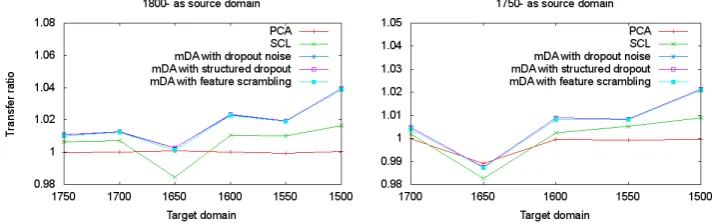
Table 2 presents results for different domain adap-tation tasks. We also compute the transfer ra-tio, which is defined as adaptation accuracybaseline accuracy , shown in Figure 1. The generally positive trend of these graphs indicates that adaptation becomes progres-sively more important as we select test sets that are more temporally remote from the training data.
In general, mDA outperforms SCL and PCA, the latter of which shows little improvement over the base features. The various noising approaches for mDA give very similar results. However, struc-tured dropout is orders of magnitude faster than the alternatives, as shown in Table 3. The scram-bling noise is most time-consuming, with cost dominated by a matrix multiplication.
Method PCA SCL mDA
dropout structured scambling Time 7,779 38,849 8,939 339 327,075
Table 3: Time, in seconds, to compute the feature transformation
4 Related Work
Task baseline PCA SCL mDA
dropout structured scrambling from 1800-1849
→1750 89.12 89.09 89.69 90.08 90.08 90.01 →1700 90.43 90.43 91.06 91.56 91.57 91.55 →1650 88.45 88.52 87.09 88.69 88.70 88.57 →1600 87.56 87.58 88.47 89.60 89.61 89.54 →1550 89.66 89.61 90.57 91.39 91.39 91.36 →1500 85.58 85.63 86.99 88.96 88.95 88.91 from 1750-1849
→1700 94.64 94.62 94.81 95.08 95.08 95.02
→1650 91.98 90.97 90.37 90.83 90.84 90.80
[image:5.595.155.445.64.229.2]→1600 92.95 92.91 93.17 93.78 93.78 93.71 →1550 93.27 93.21 93.75 94.06 94.05 94.02 →1500 89.80 89.75 90.59 91.71 91.71 91.68
Table 2: Accuracy results for adaptation from labeled data in 1800-1849, and in 1750-1849.
Figure 1: Transfer ratio for adaptation to historical text
on dropout noise, which has also been applied as a general technique for improving the robustness of machine learning, particularly in neural net-works (Hinton et al., 2012; Wang et al., 2013).
On the specific problem of sequence labeling, Xiao and Guo (2013) proposed a supervised do-main adaptation method by using a log-bilinear language adaptation model. Dhillon et al. (2011) presented a spectral method to estimate low di-mensional context-specific word representations for sequence labeling. Huang and Yates (2009; 2012) used an HMM model to learn latent rep-resentations, and then leverage the Posterior Reg-ularization framework to incorporate specific bi-ases. Unlike these methods, our approach uses a standard CRF, but with transformed features.
Historical text Our evaluation concerns syntac-tic analysis of historical text, which is a topic of in-creasing interest for NLP (Piotrowski, 2012). Pen-nacchiotti and Zanzotto (2008) find that part-of-speech tagging degrades considerably when ap-plied to a corpus of historical Italian. Moon and Baldridge (2007) tackle the challenging problem of tagging Middle English, using techniques for
projecting syntactic annotations across languages. Prior work on the Tycho Brahe corpus applied su-pervised learning to a random split of test and training data (Kepler and Finger, 2006; Dos San-tos et al., 2008); they did not consider the domain adaptation problem of training on recent data and testing on older historical text.
5 Conclusion and Future Work
Denoising autoencoders provide an intuitive so-lution for domain adaptation: transform the fea-tures into a representation that is resistant to the noise that may characterize the domain adaptation process. The original implementation of this idea produced this noise directly (Glorot et al., 2011b); later work showed that dropout noise could be an-alytically marginalized (Chen et al., 2012). We take another step towards simplicity by showing that structured dropout can make marginalization even easier, obtaining dramatic speedups without sacrificing accuracy.
[image:5.595.118.477.270.382.2]References
John Blitzer, Ryan McDonald, and Fernando Pereira. 2006. Domain adaptation with structural
correspon-dence learning. In Proceedings of the 2006
Con-ference on Empirical Methods in Natural Language Processing, EMNLP ’06, pages 120–128, Strouds-burg, PA, USA. Association for Computational Lin-guistics.
John Blitzer, Mark Dredze, and Fernando Pereira. 2007. Biographies, bollywood, boom-boxes and blenders: Domain adaptation for sentiment classi-fication. InAssociation for Computational Linguis-tics, Prague, Czech Republic.
John Blitzer. 2008. Domain Adaptation of Natural
Language Processing Systems. Ph.D. thesis, Uni-versity of Pennsylvania.
Minmin Chen, Zhixiang Xu, Kilian Weinberger, and Fei Sha. 2012. Marginalized denoising autoen-coders for domain adaptation. In John Langford and Joelle Pineau, editors,Proceedings of the 29th Inter-national Conference on Machine Learning
(ICML-12), ICML ’12, pages 767–774. ACM, New York,
NY, USA, July.
Hal Daum´e III. 2007. Frustratingly easy domain adap-tation. InACL, volume 1785, page 1787.
Paramveer S Dhillon, Dean P Foster, and Lyle H Ungar. 2011. Multi-view learning of word embeddings via
cca. InNIPS, volume 24, pages 199–207.
C´ıcero Nogueira Dos Santos, Ruy L Milidi´u, and Ra´ul P Renter´ıa. 2008. Portuguese part-of-speech tagging using entropy guided transformation
learn-ing. InComputational Processing of the Portuguese
Language, pages 143–152. Springer.
Jacob Eisenstein. 2013. What to do about bad
lan-guage on the internet. In Proceedings of NAACL,
Atlanta, GA.
Jenny Rose Finkel and Christopher D Manning. 2009.
Hierarchical bayesian domain adaptation. In
Pro-ceedings of Human Language Technologies: The 2009 Annual Conference of the North American Chapter of the Association for Computational Lin-guistics, pages 602–610. Association for Computa-tional Linguistics.
Charlotte Galves and Pablo Faria. 2010.
Ty-cho Brahe Parsed Corpus of Historical
Por-tuguese. http://www.tycho.iel.unicamp.br/
ty-cho/corpus/en/index.html.
Xavier Glorot, Antoine Bordes, and Yoshua Bengio.
2011a. Deep sparse rectifier networks. In
Proceed-ings of the 14th International Conference on Arti-ficial Intelligence and Statistics. JMLR W&CP
Vol-ume, volume 15, pages 315–323.
Xavier Glorot, Antoine Bordes, and Yoshua Bengio. 2011b. Domain adaptation for large-scale sentiment
classification: A deep learning approach. In
Pro-ceedings of the 28th International Conference on Machine Learning (ICML-11), pages 513–520.
Geoffrey E Hinton, Nitish Srivastava, Alex Krizhevsky, Ilya Sutskever, and Ruslan R Salakhutdinov. 2012. Improving neural networks by preventing
co-adaptation of feature detectors. arXiv preprint
arXiv:1207.0580.
Fei Huang and Alexander Yates. 2009. Distribu-tional representations for handling sparsity in super-vised sequence-labeling. InProceedings of the Joint Conference of the 47th Annual Meeting of the ACL and the 4th International Joint Conference on Natu-ral Language Processing of the AFNLP: Volume 1-Volume 1, pages 495–503. Association for Compu-tational Linguistics.
Fei Huang and Alexander Yates. 2012. Biased rep-resentation learning for domain adaptation. In Pro-ceedings of the 2012 Joint Conference on Empiri-cal Methods in Natural Language Processing and Computational Natural Language Learning, pages 1313–1323. Association for Computational Linguis-tics.
Jing Jiang and ChengXiang Zhai. 2007. Instance
weighting for domain adaptation in nlp. In ACL,
volume 2007, page 22.
F´abio N Kepler and Marcelo Finger. 2006. Comparing two markov methods for part-of-speech tagging of portuguese. In Advances in Artificial Intelligence-IBERAMIA-SBIA 2006, pages 482–491. Springer. Taesun Moon and Jason Baldridge. 2007.
Part-of-speech tagging for middle english through align-ment and projection of parallel diachronic texts. In
EMNLP-CoNLL, pages 390–399.
C´ıcero Nogueira Dos Santos, Ruy L. Milidi´u, and Ra´ul P. Renter´ıa. 2008. Portuguese part-of-speech tagging using entropy guided transformation
learn-ing. In Proceedings of the 8th international
con-ference on Computational Processing of the Por-tuguese Language, PROPOR ’08, pages 143–152, Berlin, Heidelberg. Springer-Verlag.
Naoaki Okazaki. 2007. Crfsuite: a fast implementa-tion of condiimplementa-tional random fields (crfs).
Sinno Jialin Pan and Qiang Yang. 2010. A survey on
transfer learning. Knowledge and Data
Engineer-ing, IEEE Transactions on, 22(10):1345–1359. Marco Pennacchiotti and Fabio Massimo Zanzotto.
2008. Natural language processing across time:
An empirical investigation on italian. InAdvances
in Natural Language Processing, pages 371–382. Springer.
Adwait Ratnaparkhi. 1996. A maximum entropy
model for part-of-speech tagging. In Proceedings
of the Conference on Empirical Methods in Natural Language Processing, April 16.
Noah A Smith. 2011. Linguistic structure prediction.
Synthesis Lectures on Human Language Technolo-gies, 4(2):1–274.
Anders Søgaard. 2013. Semi-supervised learning and domain adaptation in natural language processing.
Synthesis Lectures on Human Language Technolo-gies, 6(2):1–103.
Kristina Toutanova, Dan Klein, Christopher D Man-ning, and Yoram Singer. 2003. Feature-rich part-of-speech tagging with a cyclic dependency network. InProceedings of the 2003 Conference of the North American Chapter of the Association for Computa-tional Linguistics on Human Language Technology-Volume 1, pages 173–180. Association for Compu-tational Linguistics.
Pascal Vincent, Hugo Larochelle, Yoshua Bengio, and Pierre-Antoine Manzagol. 2008. Extracting and composing robust features with denoising
autoen-coders. In Proceedings of the 25th international
conference on Machine learning, pages 1096–1103. ACM.
Sida I. Wang, Mengqiu Wang, Stefan Wager, Percy Liang, and Christopher D. Manning. 2013. Fea-ture noising for log-linear strucFea-tured prediction. In
Empirical Methods in Natural Language Processing (EMNLP).
Min Xiao and Yuhong Guo. 2013. Domain adapta-tion for sequence labeling tasks with a probabilis-tic language adaptation model. In Sanjoy Dasgupta
and David Mcallester, editors, Proceedings of the