TopicSpam: a Topic-Model-Based Approach for Spam Detection
Jiwei Li , Claire Cardie School of Computer Science
Cornell University Ithaca, NY, 14853
[email protected] [email protected]
Sujian Li
Laboratory of Computational Linguistics Peking University
Bejing, P.R.China, 150001
Abstract
Product reviews are now widely used by individuals and organizations for decision making (Litvin et al., 2008; Jansen, 2010). And because of the profits at stake, peo-ple have been known to try to game the system by writing fake reviews to promote target products. As a result, the task of de-ceptive review detection has been gaining increasing attention. In this paper, we pro-pose a generative LDA-based topic mod-eling approach for fake review detection. Our model can aptly detect the subtle dif-ferences between deceptive reviews and truthful ones and achieves about 95% ac-curacy on review spam datasets, outper-forming existing baselines by a large mar-gin.
1 Introduction
Consumers rely increasingly on user-generated online reviews to make purchase decisions. Pos-itive opinions can result in significant financial gains. This gives rise to deceptive opinion spam
(Ott et al., 2011; Jindal et al., 2008), fake reviews written to sound authentic and deliberately mis-lead readers. Previous research has shown that humans have difficulty distinguishing fake from truthful reviews, operating for the most part at chance (Ott et al., 2011). Consider, for example, the following two hotel reviews. One is truthful and the other is deceptive1:
1. My husband and I stayed for two nights at the Hilton Chicago. We were very pleased with the accommoda-tions and enjoyed the service every minute of it! The bedrooms are immaculate, and the linens are very soft. We also appreciated the free wifi, as we could stay in touch with friends while staying in Chicago. The bath-room was quite spacious, and I loved the smell of the shampoo they provided. Their service was amazing,
1The first example is a deceptive review.
and we absolutely loved the beautiful indoor pool. I would recommend staying here to anyone.
2. We stayed at the Sheraton by Navy Pier the first week-end of November. The view from both rooms was spec-tacular (as you can tell from the picture attached). They also left a plate of cookies and treats in the kids room upon check-in made us all feel very special. The hotel is central to both Navy Pier and Michigan Ave. so we walked, trolleyed, and cabbed all around the area. We ate the breakfast buffet on both mornings and thought it was pretty good. The eggs were a little runny. Our six year old ate free and our two eleven year old were
$14 (instead of the adult$20). The rooms were clean, the concierge and reception staff were both friendly and helpful...we will definitely visit this Sheraton again when we stay in Chicago next time.
Because of the difficulty of recognizing deceptive opinions, there has been a widespread and growing interest in developing automatic, usually learning-based methods to help users identify deceptive re-views (Ott et al., 2011; Jindal et al., 2008; Jindal et al., 2010; Li et al., 2011; Lim et al., 2011; Wang et al., 2011).
The state-of-the-art approach treats the task of spam detection as a text categorization prob-lem and was first introduced by Jindal and Liu (2009) who trained a supervised classifier to dis-tinguish duplicated reviews (assumed deceptive) from original ones (assumed truthful). Since then, many supervised approaches have been proposed for spam detection. Ott et al. (2011) employed standard word and part-of-speech (POS) n-gram features for supervised learning and built agold−
standardopinion dataset of 800 reviews. Lim et al. (2010) proposed the inclusion of user behavior-based features and found that behavior abnormali-ties of reviewers could predict spammers, without using any textual features. Li et al. (2011) care-fully explored review-related features based on content and sentiment, training a semi-supervised classifier for opinion spam detection. However, the disadvantages of standard supervised learning methods are obvious. First, they do not gener-ally provide readers with a clear probabilistic
diction of how likely a review is to be deceptive vs. truthful. Furthermore, identifying features that provide direct evidence against deceptive reviews is always a hard problem.
LDA topic models (Blei et al., 2003) have widely been used for their ability to model latent topics in document collection. In LDA, each docu-ment is presented as a mixture distribution of top-ics and each topic is presented as a mixture distri-bution of words. Researchers also integrated dif-ferent levels of information into LDA topic mod-els to model the specific knowledge that they are interested in, such as user-specific information (Rosen-zvi et al., 2006), document-specific mation (Li et al., 2010) and time-specific infor-mation (Diao et al., 2012). Ramage et al. (2009) developed a Labeled LDA model to define a one-to-one correspondence between LDA latent topics and tags. Chemudugunta et al. (2008) illustrated that by considering background information and document-specific information, we can largely im-prove the performance of topic modeling.
In this paper, we propose a Bayesian approach called TopicSpam for deceptive review detection. Our approach, which is a variation of Latent Dirichlet Allocation (LDA) (Blei et al., 2003), aims to detect the subtle differences between the topic-word distributions of deceptive reviews vs. truthful ones. In addition, our model can give a clear probabilistic prediction on how likely a review should be treated as deceptive or truth-ful. Performance is tested on dataset from Ott et al.(2011) that contains 800 reviews of 20 Chicago hotels. Our model achieves more than 94% accu-racy on that dataset.
2 TopicSpam
We are presented with four subsets of ho-tel reviews, M = {Mi}ii=4=1, representing
deceptive train,truthf ul train,deceptive test and truthf ul test data, respectively. Each re-view r is comprised of a number of wordsr =
{wt}tt==1nr. Input for the TopicSpam algorithm is
the datasets M; output is the label (deceptive, truthful) for each review inM3andM4. V denotes
vocabulary size.
2.1 Details of TopicSpam
[image:2.595.332.498.63.160.2]In TopicSpam, each document is modeled as a bag of words, which are assumed to be gener-ated from a mixture of latent topics. Each word is associated with a latent variable that specifies
Figure 1: Graphical Model for TopicSpam
the topic from which it is generated. Words in a document are assumed to be conditionally inde-pendent given the hidden topics. A general back-ground distribution φB and hotel-specific distri-butions φHj(j = 1, ...,20) are first introduced
to capture the background information and hotel-specific information. To capture the difference between deceptive reviews and truthful reviews, TopicSpam also learns a deceptive topic distribu-tion φD and truthful topic distribution φT. The generative model of TopicSpam is shown as fol-lows:
• For a training review inr1j ∈M1, words are
originated from one of the three different top-ics:φB,φHj andφD.
• For a training review inr2j ∈M2, words are
originated from one of the three different top-ics:φB,φHj andφT.
• For a test review in rmj ∈ Mm, m = 3,4, words are originated from one of the four dif-ferent topics:φB,φHjφD andφT.
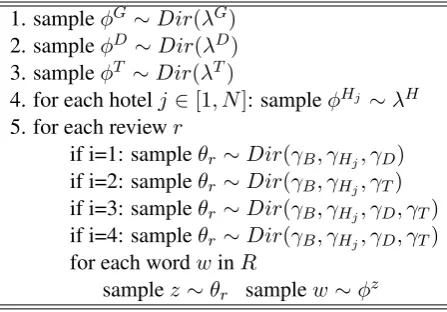
The generation process of TopicSpam is shown in Figure 1 and the corresponding graphical model is illustrated in Figure 2. We use λ = (λG, λHi, λD, λT) to represent the
asym-metric priors for topic-word distribution genera-tion. In our experiments, we set λG = 0.1, and λHi = λD = λT = 0.01. The
intu-ition for the asymmetric priors is that there should be more words assigned to the background topic. γ = [γB, γHi, γD, γT] denotes the priors for
the document-level topic distribution in the LDA model. We setγB = 2andγT =γD =γHi = 1,
reflecting the intuition that more words in each document should cover the background topic.
2.2 Inference
1. sampleφG∼Dir(λG) 2. sampleφD ∼Dir(λD) 3. sampleφT ∼Dir(λT)
4. for each hotelj ∈[1, N]: sampleφHj ∼λH
5. for each reviewr
if i=1: sampleθr∼Dir(γB, γHj, γD)
if i=2: sampleθr∼Dir(γB, γHj, γT)
if i=3: sampleθr∼Dir(γB, γHj, γD, γT)
if i=4: sampleθr∼Dir(γB, γHj, γD, γT)
for each wordwinR
[image:3.595.73.297.62.218.2]samplez∼θr samplew∼φz
Figure 2: Generative Model for TopicSpam
sampling, for each wordw in reviewr, we need to calculate P(zw|w, z−w, γ, λ)in each iteration, where z−w denotes the topic assignments for all words except that of the current wordzw.
P(zw =m|z−w, i, j, γ, λ) Nrm+γm
P
m0(Nrm0+γm0 ) ·
Emw +λm
PV
w0Emw +V λm (1)
whereNrmdenotes the number of times that topic mappears in current reviewrandEmw denotes the number of times that wordw is assigned to topic m. After each sampling iteration, the latent pa-rameters can be estimated using the following for-mulas:
θmr = N m r +γm
P
m0(Nrm0+γm)
φ(mw) = E w m+λm
P
w0Emw0 +V λm (2)
2.3 Labeling the Test Data
For each reviewr in the test data, letND
r denote the number of words generated from the decep-tive topic andNrT, the number of words generated from the truthful topic. The decision for whether a review is deceptive or truthful is made as follows:
• ifND
r > NrT,ris deceptive.
• ifNrD < NrT,ris truthful.
• ifNrD =NrT, it is hard to decide.
Let P(D) denote the probability thatris deceptive and P(T) denote the probability thatris truthful.
P(D) = N D r ND
r +NrT
P(T) = N T r ND
r +NrT (3)
3 Experiments
3.1 System Description
Our experiments are conducted on the dataset from Ott et al.(2011), which contains reviews of the 20 most popular hotels on TripAdvisor in the Chicago areas. There are 20 truthful and 20 decep-tive reviews for each of the chosen hotels (800 re-views total). Deceptive rere-views are gathered using Amazon Mechanical Turk2. In our experiments, we adopt the same 5-fold cross-validation strat-egy as in Ott et al., using the same data partitions. Words are stemmed using PorterStemmer3.
3.2 Baselines
We employ a number of techniques as baselines: TopicTD: A topic-modeling approach that only considers two topics: deceptive and truthful. Words indeceptive trainare all generated from the deceptive topic and words intruthf ul train are generated from the truthful topic. Test docu-ments are presented with a mixture of the decep-tive and truthful topics.
TopicTDB: A topic-modeling approach that only considers background, deceptive and truthful information.
SVM-Unigram: Using SVMlight(Joachims, 1999) to train linear SVM models on unigram fea-tures.
SVM-Bigram: Using SVMlight(Joachims, 1999) to train linear SVM models on bigram fea-tures.
Removal1: In SVM-Unigram-Removal, we first train TopicSpam. Then words generated from hotel-specific topics are removed. We use the remaining words as features in SVM-light.
Unigram-Removal2: Same as SVM-Unigram-removal-1 but removing all background words and hotel-specific words.
Experimental results are shown in Table 14. As we can see, the accuracy of TopicSpam is 0.948, outperforming TopicTD by 6.4%. This il-lustrates the effectiveness of modeling background and hotel-specific information for the opinion spam detection problem. We also see that Top-icSpam slightly outperforms TopicTDB, which
2https://www.mturk.com/mturk/. 3http://tartarus.org/martin/PorterStemmer/ 4Reviews withND
Approach Accuracy T-P T-R T-F D-P D-R D-F TopicSpam 0.948 0.954 0.942 0.944 0.941 0.952 0.946
[image:4.595.123.474.62.146.2]TopicTD 0.888 0.901 0.878 0.889 0.875 0.897 0.886 TopicTDB 0.931 0.938 0.926 0.932 0.925 0.937 0.930 SVM-Unigram 0.884 0.899 0.865 0.882 0.870 0.903 0.886 SVM-Bigram 0.896 0.901 0.890 0.896 0.891 0.903 0.897 SVM-Unigram-Removal1 0.895 0.906 0.889 0.898 0.887 0.907 0.898 SVM-Unigram-Removal2 0.822 0.852 0.806 0.829 0.793 0.840 0.817
Table 1: Performance for different approaches based on nested 5-fold cross-validation experiments.
neglects hotel-specific information. By check-ing the results of Gibbs samplcheck-ing, we find that this is because only a small number of words are generated by the hotel-specific topics. Top-icTD and SVM-Unigram get comparative accu-racy rates. This can be explained by the fact that both models use unigram frequency as fea-tures for the classifier or topic distribution train-ing. SVM-Unigram-Removal1 is also slightly better than SVM-Unigram. In SVM-Unigram-removal1, hotel-specific words are removed for classifier training. So the first-step LDA model can be viewed as a feature selection process for the SVM, giving rise to better results. We can also see that the performance of SVM-Unigram-removal2 is worse than other baselines. This can be ex-plained as follows: for example, word ”my” has large probability to be generated from the back-ground topic. However it can also be generated by deceptive topic occasionaly but can hardly be gen-erated from the truthful topic. So the removal of these words results in the loss of useful informa-tion, and leads to low accuracy rate.
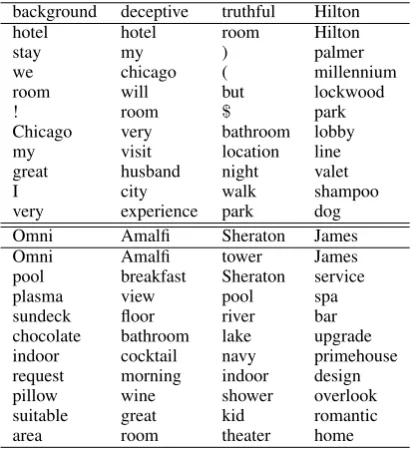
Our topic-modeling approach uses word fre-quency as features and does not involve any fea-ture selection process. Here we present the re-sults of the sample reviews from Section 1. Stop words are labeled in black, background topics (B) in blue, hotel specific topics (H) in orange, de-ceptive topics (D) inredand truthful topic (T) in
green.
1. MyhusbandandI stayedfortwo nightsat theHilton
Chicago. Wewerevery pleasedwith the accommoda-tionsandenjoyedtheservice everyminuteof it! The
bedroomsareimmaculate,and thelinensarevery soft.
We also appreciatedthefree wifi, aswe could stayin
touchwithfriendswhile stayinginChicago. The bath-roomwasquitespacious, andI lovedthesmellof the
shampoothey providednotlike most hotelshampoos.
Their servicewasamazing,andweabsolutelylovedthe
beautiful indoorpool.I wouldrecommendstaying here
toanyone.
[B,H,D,T]=[41,6,10,1] p(D)=0.909 P(T)=0.091 2. We stayedat theSheratonbyNavy Pierthefirst
week-endofNovember. Theviewfrom bothroomswas
spec-tacular(asyou can tellfrom thepicture attached).They also leftaplateofcookiesandtreatsin thekidsroom upon check-in made us all feel very special. The ho-teliscentraltobothNavy PierandMichiganAve. so we walked,trolleyed, andcabbedall aroundthearea.
We atethebreakfast buffetbothmorningsandthought
it waspretty good. Theeggswere alittlerunny. Our
sixyear old ate freeandour two eleven year oldwere
$14(insteadof theadult$20)Theroomswereclean, the concierge and reception staff were bothfriendly
andhelpful...wewilldefinitely visit thisSheratonagain when we’reinChicago next time.
[B,H,D,T]=[80,15,3,18] p(D)=0.143 P(T)=0.857
background deceptive truthful Hilton
hotel hotel room Hilton
stay my ) palmer
we chicago ( millennium
room will but lockwood
! room $ park
Chicago very bathroom lobby
my visit location line
great husband night valet
I city walk shampoo
very experience park dog
Omni Amalfi Sheraton James
Omni Amalfi tower James
pool breakfast Sheraton service
plasma view pool spa
sundeck floor river bar
chocolate bathroom lake upgrade indoor cocktail navy primehouse request morning indoor design
pillow wine shower overlook
suitable great kid romantic
area room theater home
Table 2: Top words in different topics from Topic-Spam
4 Conclusion
In this paper, we propose a novel topic model for deceptive opinion spam detection. Our model achieves an accuracy of 94.8%, demonstrating its effectiveness on the task.
5 Acknowledgements
[image:4.595.307.515.338.564.2]References
David Blei, Andrew Ng and Micheal Jordan. Latent Dirichlet allocation. 2003. In Journal of Machine Learning Research.
Carlos Castillo, Debora Donato, Luca Becchetti, Paolo Boldi, Stefano Leonardi Massimo Santini, and Se-bastiano Vigna. A reference collection for web spam. InProceedings of annual international ACM SIGIR conference on Research and development in information retrieval, 2006.
Chaltanya Chemudugunta, Padhraic Smyth and Mark Steyers. Modeling General and Specific Aspects of Documents with a Probabilistic Topic Model.. In Advances in Neural Information Processing Systems 19: Proceedings of the 2006 Conference.
Paul-Alexandru Chirita, Jorg Diederich, and Wolfgang Nejdl. MailRank: using ranking for spam detection. InProceedings of ACM international conference on Information and knowledge management. 2005.
Harris Drucke, Donghui Wu, and Vladimir Vapnik. 2002. Support vector machines for spam categoriza-tion. InNeural Networks.
Qiming Diao, Jing Jiang, Feida Zhu and Ee-Peng Lim. InProceeding of the 50th Annual Meeting of the As-sociation for Computational Linguistics. 2012
Thorsten Joachims. 1999. Making large-scale support vector machine learning practical. In Advances in kernel methods.
Jack Jansen. 2010. Online product research. InPew In-ternet and American Life Project Report.
Nitin Jindal, and Bing Liu. Opinion spam and analysis. 2008. InProceedings of the international conference on Web search and web data mining
Nitin Jindal, Bing Liu, and Ee-Peng Lim. Finding Unusual Review Patterns Using Unexpected Rules. 2010. InProceedings of the 19th ACM international conference on Information and knowledge manage-ment
Pranam Kolari, Akshay Java, Tim Finin, Tim Oates and Anupam Joshi. Detecting Spam Blogs: A Machine Learning Approach. InProceedings of Association for the Advancement of Artificial Intelligence. 2006.
Peng Li, Jing Jiang and Yinglin Wang. 2010. Gener-ating templates of entity summaries with an entity-aspect model and pattern mining. InProceedings of the 48th Annual Meeting of the Association for Com-putational Linguistics.
Fangtao Li, Minlie Huang, Yi Yang, and Xiaoyan Zhu. Learning to identify review Spam. 2011. In Proceed-ings of the Twenty-Second international joint confer-ence on Artificial Intelligconfer-ence.
Ee-Peng Lim, Viet-An Nguyen, Nitin Jindal, Bing Liu, and Hady Wirawan Lauw. Detecting Product Re-view Spammers Using Rating Behavior. 2010. In Proceedings of the 19th ACM international confer-ence on Information and knowledge management. Stephen Litvina, Ronald Goldsmithb and Bing Pana.
2008. Electronic word-of-mouth in hospitality and tourism management. Tourism management, 29(3):458468.
Juan Martinez-Romo and Lourdes Araujo. Web Spam Identification Through Language Model Analysis. InAIRWeb. 2009.
Arjun Mukherjee, Bing Liu and Natalie Glance. Spot-ting Fake Reviewer Groups in Consumer Reviews. InProceedings of the 18th international conference on World wide web, 2012.
Alexandros Ntoulas, Marc Najork, Mark Manasse and Dennis Fetterly. Detecting Spam Web Pages through Content Analysis. In Proceedings of international conference on World Wide Web 2006
Myle Ott, Yejin Choi, Claire Cardie and Jeffrey Han-cock. Finding deceptive opinion spam by any stretch of the imagination. 2011. InProceedings of the 49th Annual Meeting of the Association for Computa-tional Linguistics: Human Language Technologies Bo Pang and Lillian Lee. Opinion mining and
senti-ment analysis. InFound. Trends Inf. Retr.
Daniel Ramage, David Hall, Ramesh Nallapati and Christopher D. Manning. Labeled LDA: a super-vised topic model for credit attribution in multi-labeled corpora. 2009. In Proceedings of the 2009 Conference on Empirical Methods in Natural Lan-guage Processing 2009.
Michal Rosen-zvi, Thomas Griffith, Mark Steyvers and Padhraic Smyth. The author-topic model for authors and documents. InProceedings of the 20th confer-ence on Uncertainty in artificial intelligconfer-ence.
Guan Wang, Sihong Xie, Bing Liu and Philip Yu. Re-view Graph based Online Store ReRe-view Spammer Detection. 2011. In Proceedings of 11th Interna-tional Conference of Data Mining.
Baoning Wu, Vinay Goel and Brian Davison. Topical TrustRank: using topicality to combat Web spam. InProceedings of international conference on World Wide Web 2006.