M
ASTERT
HESISSignature-Based DDoS Attack Mitigation:
Automated Generating Rules for
Extended Berkeley Packet Filter and
Express Data Path
Author:
HuubVANWIEREN
Examiners:
Dr. J. J. CARDOSO DESANTANNA
W.VAN DER HOUVENMSC (KPMG) Dr. A. PETER
Abstract
Contents
Abstract iii
1 Introduction 1
2 Background of DDoS Attacks & Mitigation 3
2.1 DDoS Attacks . . . 4
2.2 DDoS Attack Detection and Mitigation . . . 10
2.3 eBPF and XDP . . . 18
2.4 Conluding Remarks . . . 24
3 Method & Design 27 3.1 Requirements . . . 28
3.2 Implementation . . . 30
3.3 Evaluation Metrics . . . 36
3.4 Concluding Remarks . . . 37
4 Results & Discussion 39 4.1 XDP filter Accuracy & Limitations . . . 40
4.2 The usability of the filter . . . 48
4.3 Concluding Remarks . . . 50
5 Conclusion 53 5.1 Contribution . . . 55
List of Acronyms
ACL AccessControlList
AS AutonomousSystem
BGP BorderGatewayProtocol
C&C Command andControl
CDN ContentDeliveryNetwork
DDoS DistributedDoS
DoS DistributedDenial ofService
DPS DDoSProtectionService
eBPF extendedBerkeleyPacketFilter
IDS IntrusionDetectionSystem
IP InternetProtocol
IPS IntrusionPreventionSystem
IRC InternetRelay ofChat
ISP InternetServiceProvider
RTBH RemoteTriggeredBlackHoling
WAF WebApplicationFirewall
Chapter 1
Introduction
Distributed Denial of Service (DDoS) attacks are not a new threat in our society. The presence of studies against DDoS attacks from the early 2000’s, prove that the fight against DDoS attacks is ongoing for already a long time [3]. Reports show that DDoS attacks still form a severe threat and are actually growing in number, intensity and diversity [4]. For example, Netscout [1], reports a threefold increase in the number of DDoS attacks against third party data centers and cloud services with a record breaking 1.7 Tbps in size. Also Akamai’s annual report of 2018 shows that the size of DDoS attacks is growing with 9% quarterly and that attackers are still finding new ways to leverage their DDoS attacks. For instance the new memcached reflection attacks in 2017, formed the cause of some record breaking DDoS attacks [5]. All those facts together highlight the need for more research into DDoS mitigation, despite the many mechanisms that actually already exist as shown by Osanaiye et al. [6].
DDoS attack mitigation can be realised by recognising and dropping the DDoS network packets in a network. Dropping packets at high speeds has to be done care-fully, because legitimate traffic should ideally not be dropped. To be able to classify whether a packet is legitimate traffic or malicious traffic, classification techniques have to be adopted. As defined by Osanaiye et al. [6], those techniques to detect DDoS attacks can be split into signature based detection techniques and anomaly based techniques. The Signature based detection techniques use a set of DDoS tack characteristics in a database. Those characteristics are derived from known at-tacks that occurred the past for example. Those characteristics can be used to match against monitored traffic to detect any malicious activity. Anomaly based detection methods use techniques without any prior known information and usually leverage some form of machine learning. Signature-based techniques usually have a higher accuracy on detecting attacks over anomaly based methods. New attacks however, are more difficult to detect with signature-based techniques as maintaining up to date signatures is challenging.
in general [9]. Their solution is capable of automatically updating rules, but again, unclear is how those rules are generated. Outside the solutions of Cloudflare and Facebook there are little to no other public production use-cases that use eBPF and XDP as a packet filter. Høiland-Jørgensen et al. [10] show with their study on eBPF and XDP that DDoS traffic filtering is possible without the need for special hard-ware. A search on Google Scholar with the search term ’DDoS XDP eBPF’ returns 25 academic works, but none of these works study how to automatically generate rules for signature-based DDoS mitigation with eBPF and XDP. Our hypothesis is that by studying rule generation in this domain, an effective method can be created to mitigate DDoS attacks.
An existing platform containing DDoS signatures is called DDoSDB launched by dr. Jair Santanna from the Univeristy of Twente [11]. Those signatures open the possibility to study signature based detection techniques, including how to derive rules from those signatures. This platform also hosts attack traffic which can also be used for research against DDoS attacks. With DDoSDB as a source of DDoS attack signatures, it could potentially function as a base to automatically generate rules for a eBPF and XDP filter. As mentioned there are however no studies that show how to do this automatic generation for eBPF and XDP. Therefore the goal of this study is to design a method for automated rule generation inside eBPF and XDP together with signatures from DDoSDB.
To pursue our goal, the following research questions (RQ) are defined as the basis of this research:
• RQ1:What methods currently exist that automatically update rules in a
signa-ture based DDoS mitigation?
• RQ2: How to automatically generate eBPF rules for DDoS mitigation using
DDoS attack signatures?
• RQ3:What is the effectiveness and the usability of the designed DDoS
mitiga-tion system using DDoS attack signatures?
Chapter 2
Background of DDoS Attacks &
Mitigation
2.1
DDoS Attacks
For the first section in this chapter, we want to understand what DDoS attacks actually are and how they work. The goal of this section is to give some background on DDoS attacks, how are they performed and which kind of attacks actually form a threat nowadays.
2.1.1 DDoS Background and Taxonomy
DoS and DDoS attacks are performed with the purpose of stopping a certain target or multiple targets from delivering a service. In the case of a DoS attack, the attack is performed with the use of just a single machine. Kenig et al. [12] outlines the history of DoS and DDoS attacks and states that the first DoS attack dates back to 1974. Then one of the first large-scale Distributed DoS attack occurred in 1999. As a distributed attack it obtained its strength by harnessing the resources of many machines together. DDoS attacks were due to their distributed character way more powerful then DoS attacks and caused bigger problems in the early 2000’s. In 2002 a targeted victim by a DDoS attack was a DNS server [13], which caused that many internet users were not able to browse the web. Since then DDoS attacks still causes unavailable services on the internet.
Understanding what the weaknesses are of DDoS victims is essential to under-stand how DDoS attacks work and why it is possible that an online services be-come unavailable. Back in 2004, Mirkovic and Reiher [14] classified DDoS attacks by several different features, including the classification by what weakness they try to exploit. They make a distinction between semantic and brute-force attacks. By sending requests semantic attacks misuse a certain feature or bug from a protocol or application at the victim, that causes the victim to consume all resources it has. This kind of attacks do not focus on the the amount of requests that is send to the victim, but about what the victim does with those requests. An example could be to sent very complicated database queries to a database server which causes the database server to waist all computational resources and therefore, becomes unavailable for other users of the database. The other type of attacks, brute-force attacks focus on generating and sending more traffic than the victim can process. This can also ex-haust resources at the victim, but this time it is due to the amount of traffic the victim receives. The categorisation of flooding attacks and semantic attacks is commonly used in literature [15], other studies refer to brute-force attacks as flooding or vol-umetric attacks [16]. Note that, the two classes of attacks do not mutually exclude each other, which means that an attack can fall in both classes of flooding attacks and semantic attacks. Furthermore, also note that by definition even semantic DDoS attacks use multiple machines to target the victim, since the attack is distributed. Therefore the amount of requests to successfully perform an semantic DDoS attack also plays a role, but doesn’t have the focus.
to deliver messages to the correct processes in layer 5. TCP and UDP are examples of protocols functioning in L4. Application level attacks exploit protocols on layer 7 (L7) of the OSI model, where protocols as HTTP can be found. This way DDoS traffic that reaches this last layer by targeting the HTTP protocol for instance, has been trough all the other layers as well. A DDoS attack with requests targeted at the TCP protocol in L4, will however not reach L7.
Concluded can be that, as long as they exist, DDoS attacks are made possible by sending requests in a distributed manner to its victim. Those requests are exploiting weaknesses of its victim by using semantic attacks and flooding attacks. How these attacks exactly cause a victim to stop delivering a service is determined by what protocols are involved, occuring in different layers of the OSI model.
2.1.2 Attack motivations
Akamai specifies 6 common types of motivations for DDoS attackers [18]. Further-more also Fenil and Mohan Kumar [19] sums up several incentives to perform DDoS attacks. Some DDoS attack incentives and motivation together with some examples attack motivations are listed as follows.
• Hacktivismincludes all hacking acts that have political motivations by attack-ing companies or governmental institutions. DDoS attacks are a subset of those hacking acts. The DDoS attacks against payment companies as Mastercard and Paypal when they closed donations to wikileaks are examples of hacktivism attacks [20].
• Extortion is another motivation of attackers to use DDoS attacks. Attackers demand the victim to pay ransom, by threating them with DDoS attacks [21]. The group that called themselve DD4BC is an example of attacker that asked bitcoins to their victims via mail, in exchange for stopping DDoS attacking the victim.
• Script Kiddies form another threat on the internet. Young people, often chil-dren form a threat if they are playing around with freely available tools or booters. They perform attacks to just play around, trying to make news head-lines or hitting their friends to gain advantages in online games [22].
• Distractioncan also be an incentive to perform DDoS attacks. Sometimes this is called DDoS as a Smokescreen and is performed to hide other malicious ac-tivity. The Sony Playstation hack for example was masked by days long DDoS attacks. Most times companies find out days later that they have financial loses or that data is stolen [23].
• Market manipulation can be the goal a DDoS attacker. By DDoSing certain companies, attackers can gain advantages with their position on stock markets [24].
2.1.3 Architecture of DDoS attacks
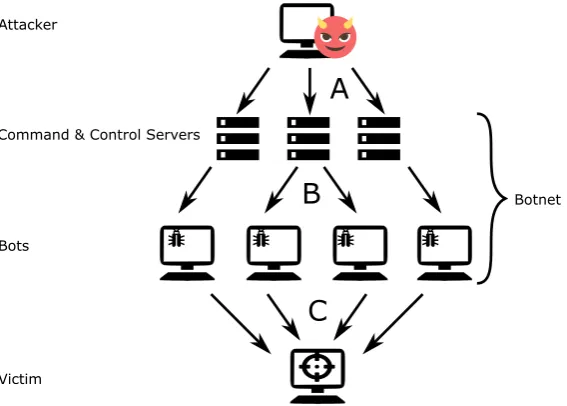
A DDoS attacker is the initiator of a DDoS attack. To perform a DDoS attack an at-tacker has to have a set of machines to target his victim. In a typical DDoS attack those machines are malware infected machines that thereby become remotely con-trollable. Literature refers to those machines with different names, such as zombies, slaves, daemons, bots or agents [14, 19]. The number of bots used in a in a DDoS attack can be over thousands [27]. It is possible to command and control those bots either in a more manual way or in an automated controlled way [14]. The level of au-tomation varies between semi-automatic and fully automatic communication. In an fully automatic method no direct communication with the bots is needed between the attacker and bots, since they are fully hard-coded with a specified with the start time, attack type, attack duration, and source IPs of the victim machines [28]. Semi-automatic attacks can offer more control to the attacker as the attack type, victims, time and duration can be specified by him. To command and control those bots a botnet has to be formed [29]. In a botnet the bots are not only controlled, but botnets can also adopt mechanisms to infect new bots in an automatic way. Hoque et al. [28] defines a botnet as a collection of many malware infected machines controlled by malicious entities. Note that this definition does not necessarily mean that botnets are used to perform DDoS attacks, but can also be used to perform other mailicous activities. In modern botnets, bots are not directly controlled by the attacker, but via controllers that operate on Command and Control (C&C) servers [30]. Figure 2.1 gives an overview of a botnet structure.
Attacker
Command & Control Servers
Bots
A
B
C
Botnet
Victim
FIGURE2.1: DDoS attack trough a botnet structure
[image:14.595.169.453.398.601.2]are other compromised computers systems called handlers. Those handlers are in-fected with software that is able to command and control the bots called agents. In an Internet Relay Chat (IRC) model an attacker doesn’t compromise machine other then the bots. IRC is normally used as a text-based chat system through communi-cation channels. Those communicommuni-cation channels can also be used to create a botnet by sending commands in a private chatroom full of infected and connected bots. The final C&C model is the web-based model, where commands towards the bots are send trough the web protocol HTTP or HTTPS. The C&C web-based model for botnet became most common and popular nowadays [32].
Instead of directly sending traffic to the victim, bots can also send requests trough reflectors [33]. Figure 2.2 shows how those reflectors are operating is DDoS attack.
Attacker
A
C
D
Botnet
E
Victim Reflectors
FIGURE2.2: Reflected DDoS attack
In a reflection attack, bots can send their traffic to any device on the internet that gives a response. The traffic at D in Figure 2.2 is directly coming from the bots in the botnet and exists of requests for the reflectors. The reflectors respond on those requests with a response. Those responses are then send to the victim at E, made possible by IP address spoofing. IP address spoofing is done by, altering the source address of the traffic at D. The reflector then assumes the response has to be send to this false IP address, which is the IP address of the victim. Compared to non-reflected DDoS attacks, non-reflected attacks become even more distributed and even harder to trace back. Due to Reflection attacks, amplification attacks become possible which can increase the malicous traffic size. When the response of the reflector is bigger in size then the request, traffic size can be amplified. The amplification factor determines the ratio between the response size and request size and can easily be one order of magnitude big, Thomas et al. [34] shows this by using DNS requests for example. Note that those amplification attacks misuse the behaviour of normal innocent services that are just freely available such as DNS servers for example.
2.1.4 DDoS attack vectors
An attack vector of a DDoS is determined by the kind of messages sent by the bots of a botnet. Table 2.1 displays today’s common attack vectors, together with its descrip-tion. Roughly from the top to the bottom of the table, the attack vector generates less malicious traffic. As described in section 2.1.1, semantic attacks gain their strength by misusing a certain feature or bug in a protocol and flooding attacks gain their strength by the amount of traffic generated. Therefore, flooding attacks in OSI layer 3 and 4 generate the highest volumes of malicious traffic, semantic attacks in those layer are already effective with less traffic. Attacks in OSI layer 7 or the application layer tend to come in the lowest volumes of traffic, compared to the other attack vectors. In the table, one of the columns ’S’ or ’F’ is ticked respectively whether the attack is more semantic in nature or if the attack is more focused on flooding. The Protocol column shows which protocol is targeted with the attack and the ’OSI L’ column shows in which OSI layer this protocol operates. The final column shows if the vector typically uses reflectors as in Figure 2.2.
TABLE2.1: DDoS attack vectors
Attack Vector
Description S F Protocol OSI
L
Can be reflected UDP
Flood
An UDP attack targets random ports on a victim its computer or network to flood as much, not necesar-rily valid, packets as possible. The system of the vic-tim will try to determine what application is listen-ing on this port and will eventually send back that the destination is not reachable. Spoofed ip address make sure that this response directed to the bots. By flooding the this traffic the victims network link can be overflooded [36].
x UDP L4
UDP amplifi-cation
Protocols on top of the UDP protocol can be used to generated malicious response messages. Instead of TCP, UDP doesn’t require to establish a connection between device before sending messages. Therefore messages on top of UDP can be spoofed and then be reflected towards the victim. The reflected mes-sages are amplified and the amplification factor de-pends on the protocol [34].
x UDP/* * x
ICMP flood
ICMP echo requests are used to ping a certain tar-get. The attacker will try to send those requests in a higher number than the victim can handle [37].
x ICMP L3
SYN flood
Every TCP connection is initiated with a SYN mes-sage, followed by a responding SYN-ACK from the receiver. The connection is then finally established by an ACK message from the initiator. To exploit the behaviour of this protocol an attacker can flood SYN messages to its victim, but then not respond on the SYN-ACK messages. This way the victim keeps open half-open connections in its memory which will eventually be exhausted [38].
x TCP L4
SYN-ACK flood
An attacker can also choose to overload its victim by overloading it with SYN-ACK messages by sending SYN messages to reflectors on which the victim will exhaust its resources by trying to figure out why those messages are incoming [39].
x TCP L4 x
ACK flood
After establishing a TCP connection, the receiver of a messages from the other side acknowledges the re-ceivement with an ACK message. In an ACK flood attack, the victim receives ACK messages and failes to link them to an active TCP session. As a result the victim resources can be exhausted by [16].
x TCP L4
DNS flood
With this attack a DNS server is targeted by over-loading it with DNS requests [40].
HTTP GET flood
The attacker sends legitimate looking HTTP traffic to the victims webserver containing GET requests. These request are normally used to obtain a web-page. When the Get request are flooded to the vic-tim it will consume potentially more resources on the server than it can handle, sometimes also called an excessive VERB attack [41].
x TCP/HTTP L7
HTTP fragmen-tation
The bots of the attacker establish a valid HTTP con-nection HTTP concon-nections with the webserver of the victim. By fragmenting packets send to the web-server and sending them very slowly, the webweb-server will have to hold up many connection, which ulti-mately can exhaust its resources [41].
x TCP/HTTP L7
Note that table 2.1 doesn’t specify all available attack vectors, but structures some common ones and gives an idea on which different kind of attacks are possible. Singh et al. [41] for example specifies 20 different attack vector only using the HTTP protocol. Furthermore the UDP amplification vector in table 2.1 doesn’t specify any targeted protocol. This is because several protocols can be used on top of UDP to amplify traffic. Next some examples of those amplifying protocols and how they amplify traffic.
• TheNTPprotocol is generally used to synchronise time between computer
sys-tems. An NTP server can also return up to the last 600 used IP addressees that have connected to the server by using the MONLIST command. The MON-LIST command of 64 bytes can be amplified up to 100 responses of 482 bytes each. The typical UDP listening port of NTP is port 123. [42].
• The DNS protocol is used to translate domain names into IP addresses. The
ANY request to a DNS server returns all records available for a certain domain name, which results in response message of over 4000 bytes with just a request message of 60 bytes. The typical UDP listening port of DNS is port 53 [43].
• The SSDPprotocol part of the UPnP protocol, which is made for devices on
a network to discover each other, such as as personal computers or printers. With a SSDP discovery request, all other device with UPnP services reply with a packet for each service they have configured. This way traffic amplification factor of 75 and higher can be reached. The typical UDP listening port of SSDP is port 1900 [43].
• TheCharGenis an old protocol initially intended for testing purposes by gen-erating random characters, but not really used for this purpose anymore. This protocol can be misused to generate amplified DDoS traffic return 358.8 bytes on average, with requests of just a single byte. The typical UDP listening port of CharGen is port 19 [43].
• Quote of the Day (QOTD) is a protocol that is old and barely used anymore.
It has been used to generate a quote for users in the network and can also be misused to generate amplified traffic. The typical UDP listening port of QOTD is port 17 [43].
• The Memcached protocol is generally used to cache memory for database-driven websites. An open port on 11211 can result in an 15 byte request being amplified up to 750000 bytes [45].
According to DDoSMon [46] more than half of all DDoS attack vectors today are UDP amplification attacks. Other common UDP based attacks are UDP flood and DNS flood. The most common TCP attacks are the SYN floods and ACK floods. Other common attacks are against webservers using HTTP, but DDoSMon does not specify what attack vectors exactly. Apart from the QOTD protoco, the previously summed up amplification protocols are the most frequently used ones according to DDoSMon. Also Akamai reports those protocols as most frequently used in am-plification attack [5]. Last sections the term ’attacker’ is constantly referred to as a person that initiates a DDoS attack, in practice however, an attacker doesn’t neces-sarily need any knowledge of any of the above technical aspects of a DDoS attack. Booters or stressers form platforms that offer DDoS attacks targeting a specified vic-tim, in return of a payment. This way anyone with web access is able to start an actual DDoS attack [47].
Several aspects of DDoS attacks are summed up in this section; the working of DDoS attacks, different DDoS attack types and the kind of protocols that are used and mis-used within DDoS attacks. The essence of a DDoS attack is that is that it exhausts resources of its victim in such a way that the victim is not able to deliver a certain service properly. This means that as long as resources of a certain service are limited, the service will be prone to resource exhaustion and thus also vulnerable for DDoS attacks. The next section will look into existing ways to defend such a service against those DDoS attacks.
2.2
DDoS Attack Detection and Mitigation
In the previous section we gained insight in what DDoS attacks are and how they work. The goal of this section is to study existing ways to mitigate DDoS attacks. Also available DDoS attack mitigation studies will be evaluated in order to gain insight in the whole field of DDoS mitigation.
2.2.1 DDoS Defense Taxonomy
Where Mirkovic and Reiher [14] classify different DDoS attacks, they also classify defense mechanisms to protect against DDoS attacks. First of all, defense mecha-nisms are divided into preventive mechamecha-nisms and reactive mechamecha-nisms. Then the reactive mechanisms can be sub-classified by their detection method. Finally a clas-sification can be made by the deployment location of the defense mechanism. All those different classes will be described in this section.
Reactive mechanisms are relying on DDoS detection methods in the first place. The detection has be done as fast and accurate as possible to be adequately respond on a DDoS attack. The detection of a DDoS attack is typically done by either an anomaly-based detection method or a signature-based detection method. Signature-based detection methods detect the occurrence of attack with already known attack patterns, whereas anomaly-based detection methods use machine learning for ex-ample to detect abnormal behavior. Besides detecting DDoS attacks as fast as pos-sible, those detection methods should also identify malicious traffic as accurate as possible. This means that normal traffic and malicious traffic are classified in the correct class as much as possible. Normal traffic is often also called benign traffic. Making a distinction between benign traffic and malicious traffic can be challenging, as attackers can try to imitate benign traffic as close as possible to make malicious look like just normal traffic. On the other side benign traffic can have behaviour patterns that are very similar to DDoS attacks. Flash crowd events for example, in which a server receives a sudden peak in the amount of traffic, can cause a detec-tion mechanism to think of a DDoS attack. Flash crowd events can happen because of breaking news on a news website for instance [49]. Signature-based mechanisms in general have a higher accuracy than anomaly-based mechanisms, but signature-based mechanisms can only detect attacks that are specified by a limited amount of rules. However, anomaly-based mechanisms in general are better in detecting all possible attacks including common attacks, rare attacks and new attacks. Also anomaly-based detection do not need a constant update of rules as with signature-based mechanisms. After the detection of an attack, a reactive defense mechanism responds to the attack. Typically those responses include filter mechanisms to filter out the malicious traffic, but they can also include a reconfiguration of a network.
defense mechanisms in a similar way and also recommends to further study col-laboration methods between different defense mechanisms. Overall, concluded can be that DDoS defense mechanisms can be broken down in preventive and reactive mechanisms, where reactive mechanisms use anomaly-based and signature-based detection methods. Further conclusion is that those reactive defense mechanisms can occur in different deployment locations, ideally having methods that enable de-fense mechanisms to collaborate with other dede-fense mechanisms.
2.2.2 DDoS Attack Mitigation methods
In the previous section an overall idea is given on how and where DDoS defense mechanisms operate. This section will elaborate on some specific mitigation meth-ods that are used in DDoS defense mechanisms. Source-based methmeth-ods as Ingress and Egress filtering [51], D-Ward [52] and MULTOPS [53] are mainly focusing on network devices near the sources of an DDoS attack. Those devices are typically not reachable by entities that actively try to defend themselves against DDoS attacks. Given that based methods lay out of scope for many parties and that source-based methods have a low accuracy in general [54], source-source-based methods will not be further discussed here. Source-based methods as such however can still be rele-vant as they can and exist complementary to network-based and destination-based methods, but are not relevant for the scope of this research. In the next subsections, specific network-based and destination based mitigation methods will be further discussed.
2.2.2.1 BGP routing
The internet consists of a network of Autonomous Systems (ASs), which are collec-tions of IP routing prefixes. By 2019 there are over 90000 autonomous systems with an unique number [55]. Internet Service Providers (ISPs) are the most typical owners of ASs, but also other large organisations such as universities can own an AS. The Border Gateway Protocol (BGP) is the protocol that helps ASs to exchange routing information with each other. Determining the shortest path between ASs is part of this protocol for instance. BGP is also involved at Internet Exchange Points (IXPs), that form the physical infrastructure through which ISPs can route traffic between their ASs. On the internet level of IXPs and ISPs, BGP enables methods to mitigate DDoS attacks with the following methods.
• Blackholingor more specific ’Remote Triggered Blackholing’ (RTBH) [56], is used inside a single or multiple ASs to drop network traffic. Instead of di-recting traffic the through the correct route, blackholing causes network traffic to be dropped by directing it to a null route . BGP announcements towards all other BGP routers, cause that all traffic directed to or coming from a cer-tain range of IP addresses is being dropped. After the detection of a DDoS attack, these announcements can be initiated by the victim, but also by an in-termediate device in the network. Note that traffic that is being ’blackholed’, is dropped purely based on an IP prefix of either the source or the destination of the traffic, no other properties of the traffic are used to drop traffic. Therefore, dropping traffic using RTBH can be effective to mitigate a DDoS attack, but it is likely that legitimate benign traffic is also dropped [57].
Access Control Lists (ACLs) can be distributed among all BGP Flowspec en-abled routers. These ACLs contain filter rules based on 12 different parameters with details available in OSI layer 3 and 4, such as IP addresses, ports and TCP flags for example. Filtering traffic based on more information than just IP ad-dress prefixes, BGP flowspec has the potential to mitigate DDoS attacks more accurately than RTBH. Studies show that with BGP flowspec, both the detec-tion of DDoS attacks and mitigadetec-tion can be automated in systems as RADAR [59] and Stellar [60] for example.
As stated, BGP operates on a high level at IXPs and ISPs, to provide communica-tion between different autonomous systems. Therefore BGP processes internet data in high volumes that involves all different kind of internet traffic. Even with BGP Flowspec, the latter makes it challenging to accurately filter DDoS attack traffic from benign traffic. Furthermore, BGP Flowspecs rules are limited by the the fact that only 12 different parameters can be used and no further packet information can be used. Besides this limitation, there is also a limit on the amount of rules a BGP router can apply. For example, in the documentation of Ciscos BGP Flowspec enabled routers, a maximum of 3000 rules is stated [61]. Nevertheless, mitigating DDoS traffic with BGP Flowspec can potentially be done in a more granular way than with RTBH.
2.2.2.2 Network Firewall
The purpose of a network firewall is to form a barrier between two networks, by filtering network packets. With that definition of a network firewall, BGP Flowspec can be seen as a network firewall. However BGP Flowspec can only be deployed on BGP enabled routers available on ISP and IXP levels, whereas more traditional firewalls can occur on all sorts of network edges.
With a study by Mogul [62], the first generation of network firewalls dates back to 1989. It was a packet filter to filter network packets based on their source and destination addresses, ports and protocol. Since then all sorts of firewalls are devel-oped with the purpose of filtering incoming and outgoing network traffic. In 1998 Julkunen and Chow [63] introduced a dynamic packet filter, which was able to keep track of connection states. From that moment, two sorts of packet filtering firewalls existed, the ’stateless’ and ’stateful’ firewalls. A stateful firewall is also able to deter-mine if a packet is initiating a new connection or if the packet is part of an already established connection. Next some open-source firewalls for the Linux operating system will described.
• The Iptables [64] packet filter was introduced as part of the Linux kernel in 2001. Since then it has been the main Linux firewall for years and is also used in the fight against DDoS attacks [65, 66]. With Iptables it is possible to put rules in a table that specify what traffic should be filtered. To optimize the filtering process, those rules should be ordered in a way that the rules with the highest change to match should be on top of the table. Ip also provides the possible to track connection in a table table, which makes Iptables a stateful firewall.
• The extended Berkeley Packet Filter (eBPF) [70] is an extension of a former BPF [71] and improves on the performance. eBPF enables the possibility to put programs including filtering rules inside the Linux operating system. The
filtering itself is can be done via the eXpress Data Path (XDP) hook, which
enables higher packet processing speeds than other hooks in the kernel. Not only processing speeds are improved, but eBPF also adds possibilities to in-teract dynamically with other programs running in user-space. Furthermore, filtering rules are not bound to specific packet header fields, but rules can ba-sically be made on all possible bytes in a network packet. Studies show that eBPF is a promising DDoS mitigation method since it has flexible filtering rules and packets can be dropped had higher speeds than Nftables and Iptables [72].
The use of network firewalls against DDoS attacks can be limited by the fire-wall configuration or processing speed. To mitigate a DDoS attack with a network firewall, the firewall must be able to process the packets at least as fast as they are incoming. If the network firewall is not able to process those packets in time, a con-gestion can take place resulting in a denial of service. Therefore, firewalls should be carefully configured and also be as fast as possible. As shown by Salah et al. [73], network firewalls can potentially be targeted by a DDoS attack depending on the behaviour and the properties of the network firewall.
2.2.2.3 IDS and IPS
As described by Liao et al. [74], the Intrusion Detection System (IDS) and the Intru-sion Prevention System (IPS), are systems that detect and stop an intruder of bypass-ing security mechanisms. Such an IPS or IDS can either function on a computer or on a whole network of devices. Characteristic for an IDS or IPS is that they usually exist of multiple elements and they can analyse all sorts of events and objects on multiple places in a network. For example, Hwang and Gangadharan [75] shows that already in 2001, a former version of Iptables is used as a building block inside an IDS. Strictly an IDS is a system that purely monitors and detects intrusion without taking care of stopping it. In literature often the terms IDS and IPS are used as synonyms, since in practice most systems contain both detection functionalities as well as stopping functionalities. This research will generally refer to an IPS from now on, considering it also contains detection mechanisms. The term IDS will only be used to specifically refer to the detection part of a certain system.
IPSs can be categorized in signature-based and anomaly-based systems, similar to the categorisation of DDoS defense mechanisms as outlined in subsection 2.2.1. Signature-based systems use certain rules derived from known DDoS attack to de-tect attacks, whereas anomaly-based systems dede-tect attacks based on irregular be-haviour on all sorts of components in a system. Anomaly-based DDoS defense mechanisms do most often occur in IPSs instead of other DDoS defense mechanisms, since IPSs often have access to many resources in a network. Some specific IPS tech-niques and methods related to the detection and mitigation of DDoS attacks will be summed up and categorized by their detection method.
database to store and match known DDoS attacks. Furthermore, Lo et al. [79] propose an Snort based IPS in the cloud with their study. Their system adopts the cooperation with other IPSs, to be a able to alert other systems of ongoing attacks.
• Anomaly-based Systems. Statistical anomaly detection, first normal traffic is gathered which is then used to compare it with incoming traffic. Statistical tests on the data can be applied to label the traffic as malicious or benign. A study by Khamruddin and Rupa [80] proposes an statistical anomaly detection technique using a Gaussian model to defend against DDoS attacks that target the HTTP protocol. Another study by [81] uses a statistical anomaly detection technique by calculating using a statistical method called the ’Jensen-Shannon divergence’ method. Data mining techniques are also adopted by anomaly detection methods to help detecting attacks in environments where big data is involved. For example, Shamsolmoali and Zareapoor [81] uses Hadoop to be able to monitor network traffic with big volumes.
• Hybrid Systems. Some methods, use the techniques of both, signature and anomaly based techniques in a hybrid system. For example Bro is an example of a open-source hybrid system [82]. In hybrid solutions a signature-based detection method usually comes first in line, to be able to detect and filter all known attacks first. After that, an anomaly-based can detect missed DDoS attacks and try to filter this traffic. Teng et al. [83] propose an IPS where the first layer of defense works similar to other Snort systems. After passing this layer, the second layer uses statistical methods to detect anomalies in the network traffic.
For a more comprehensive overview of available methods, the study of Osanaiye et al. [6] can be reviewed, including all advantages and disadvantages of the meth-ods. In general, the biggest disadvantage of signature-based detection are that un-known attacks cannot be detected and that it can be challenging to maintain an up-to-date signature database. However, the advantage of signature-based detection is that it has a low false positive rate. At the other side, anomaly-based detection has the advantage that is can detect new DDoS attacks as well. The downsides of anomaly-based detection generally include that traffic is classified less accurately and that it can be challenging to respond on an attack [84]. Hybrid detection meth-ods can provide the advantages of both methmeth-ods and have therefore the focus in newer studies. An advantage of a hybrid method is that signatures can be made from detected anomalies, that can directly be applied as rules in the signature-based methods. The limitation is that a hybrid system can also get complex and chal-lenging to implement. A complex system can cause an overhead, resulting in the exhaustion of resources. This exhaustion means that monitoring and handling the network traffic can cause a denial of service on itself, which is the opposite of the DDoS IPS its goals.
2.2.2.4 Web Application Firewall (WAF)
and stop DDoS attacks [41]. Next some methods will be described on how WAFs are able to mitigate DDoS attacks.
• Request analysis can be used to decide whether a user request is part of a DDoS attack or not. Those requests must be part of a certain application layer protocol. For example, a widespread used protocol on webservers is HTTP, which is also a target for all sort DDoS attack types [41]. With WAFs such as Modsecurity [86] or Modevasive [87], HTTP request inspection can be done to detect those types of DDoS attacks [88]. Those WAF examples are open-source and can be configured to be part of an Apache server.
• The use ofCAPTCHAsis commonly used on web servers to distinct normal
users from bots by giving the user a certain challenge [89]. Those challenges can also be used to filter DDoS attack requests coming from bots [90]. The lenges given to users can include a only human-readable pictures, but chal-lenges can also involve a certain human behaviour detection [91]. An exam-ple of performing human behaviour detection could be the analyses of mouse movements.
The advantage of WAFs is that specific DDoS attacks can be detected, while they are not detected on other places. However, the limitation is that not all types of DDoS attacks can be mitigated, since WAFs are only able to detect certain DDoS attack in the application layer. Also handling requests on an application level is not as fast as doing it on a network level. One way of overcoming this problem, is to move the filtering part to a network level. For example, Endraca [92] propose a method to filter packets with Iptables after the detection of a DDoS attack with a WAF.
2.2.2.5 Overview mitigation methods
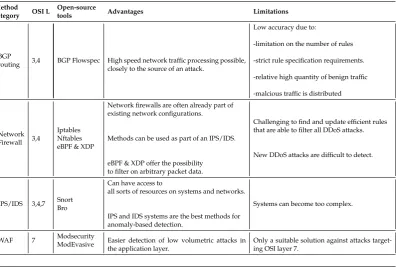
The previous subsections elaborate on different existing methods to mitigate DDoS attacks. This section will highlight the differences between the methods including their advantages and disadvantages. The methods are described under one one of the following names; BGP routing, Network Firewall, IPS and IDS or WAF. Gen-erally, as a DDoS attack occurs, it passes those mitigation methods in the same se-quence. Ideally a DDoS attack is mitigated as fast as possible, since closer to the victim it becomes more likely that a network congestion takes place as resources become more scarce. That congestion can result in a denial of service on itself. How-ever, the further away from its victim it is more challenging to accurately detect the malicious traffic. The first reason for this, is that the amount of traffic is less closer to the victim, which makes it easier to analyse. Secondly, network traffic can be in-spected more deeply closer to the victim, which results in more available data about the malicious traffic. Especially, attacks that do not occur in high volumes, typically attacks hitting the application layer, are more easily to detect with methods that are able to inspect network traffic with a high granularity. Concluded can be that with the choice of a mitigation method, a trade-off will occur between the accuracy of the detection and likeliness of resource exhaustion.
be able to detect DDoS attacks with lower volumes of malicious traffic. The mitiga-tion method categories as outlined in the previous subsecmitiga-tions of this chapter can be found in Table 2.2.
TABLE2.2: Mitigation methods
Method category OSI L
Open-source
tools Advantages Limitations
BGP
routing 3,4 BGP Flowspec High speed network traffic processing possible,
closely to the source of an attack.
Low accuracy due to:
-limitation on the number of rules
-strict rule specification requirements.
-relative high quantity of benign traffic
-malcious traffic is distributed
Network
Firewall 3,4
Iptables Nftables eBPF & XDP
Network firewalls are often already part of existing network configurations.
Methods can be used as part of an IPS/IDS.
eBPF & XDP offer the possibility to filter on arbitrary packet data.
Challenging to find and update efficient rules that are able to filter all DDoS attacks.
New DDoS attacks are difficult to detect.
IPS/IDS 3,4,7 Snort
Bro
Can have access to
all sorts of resources on systems and networks.
IPS and IDS systems are the best methods for anomaly-based detection.
Systems can become too complex.
WAF 7 Modsecurity
ModEvasive Easier detection of low volumetric attacks in
the application layer.
Only a suitable solution against attacks target-ing OSI layer 7.
Table 2.2 shows with column ’OSI L’, what OSI layers the methods usually can access. As discussed, some open-source tools can be found back in the table as well as the advantages and the limitations of the methods. Note that BGP Flowspec and eBPF and XDP are relatively new open-source tools that all overcome some limi-tations of their former methods. BGP routing is bound to only specific routers and high level network routers at ISPs for example, whereas eBPF and XDP can in theory operate on any device with a Linux kernel. The latter makes it possible for eBPF and XDP to operate on more different locations than what is possible with BGP Flowspec. Another advantage of eBPF and XDP over BGP Flowspec is that filter rules can be more granular, with even the possibility to inspect packet data destined to all other OSI layers.
WAFs have the limitation that they are not able to mitigate all sorts of DDoS attacks as they only operate in the application application layer. However in collab-oration with other systems, WAFs can be an effective mitigation methods.
With the use of an IPS, anomaly-based detection methods can be used, which can be an advantage over signature-based only methods. Signature-based can only be effective if correct rules are maintained and applied, which exactly the main chal-lenge for new methods using eBPF and XDP.
2.2.3 DDoS Protection Services
[image:25.595.91.490.153.420.2]methods itself, but it can also choose to outsource it to a cloud-based DDoS Protec-tion Service (DPS) [93]. This secProtec-tion will elaborate on those DPSs, how they operate and what the biggest DPS vendors are.
DPSs are commercial online services that offer protection against DDoS attacks. This protection is realised by implementing mechanisms against different kinds of DDoS attacks and also by adopting multiple techniques. Those techniques include partly the methods of the previous section, but also include the use of Content De-livery Networks (CDNs). A CDN is a distributed network network of servers and data centers, with the goal of delivering high availability and performance to its end-users [94]. Due to this distributed nature of a CDN it can be used divert inter-net traffic. This traffic diversion can balance loads and help to defend against DDoS attacks. For example, the DNS protocol or the BGP protocol can be used to redi-rect and divert the internet traffic, after which malicious traffic can be filtered. DPSs combine the features of CDNs and other mitigation methods to be able to mitigate DDoS attacks for their clients. Since, DPSs are commercial parties they typically do not fully disclose how their methods exactly work, but some of them publish how their methods work to some extend.
According to a IDC MarketScape assessment from 2019, Cloudflare, Akamai, Radware and Arbor Networks are all examples of leader vendors in their field [95]. Those vendors all have in common that they use CDNs and its features to mitigate DDoS attacks. Furthermore, all DPSs use a layered system using different sort of fire-walls and scrubbing centers [96]. They also all stress the need for good collaboration amongst all sorts of DDoS mitigation methods, also including ISP level solutions. Akamai claims to serve between 15% and 30% of the global web traffic and offers a DDos mitigation service called Kona [97]. They deployed mitigation methods in the application layer as wel as in the network layer with network firewalls and WAFs. Arborer Networks offers a DPS with underlying systems called Pravail APS, Peak-flow SP and PeakPeak-flow TMS [96].
Cloudflare implemented an automatic system called Gatebot [98] that analyses sampled incoming traffic from all their CDN edge servers. The central Gatebot is able to detect DDoS attacks and deploys mitigation rules on to the edge servers using L4Drop. On every edge-servers a network firewall is running which uses eBPF and XDP in order to mitigate DDoS attacks [8, 99]. Before dropping the malicous packet a small sample is send via Sflow packets back to Gatebot to keep track of the dropped traffic. Besides filtering network traffic, Cloudflare uses WAFs on their edge servers to protect against web application attacks. With their ’I’m under attack mode’ [100], Cloudflare tries to mitigate DDoS attacks targeting the application layer. By using Javascript and cookies, Cloudflare checks if the traffic is coming from a legitimate user or a bot.
Concluded can be that DPSs can be helfpul for protecting online services against DDoS attacks. Especially due to the used CDNs and easy deployment, DPSs can have an advantages over self-implemented mitigation methods. Cloudflare pub-lishes more technical articles about their DDoS mitigation methods than the other leaders in the market. From multiple blogposts it becomes clear that Cloudflare em-braces the use of eBPF and XDP within their DPS.
2.3
eBPF and XDP
solutions, which indicates that benign traffic is less often classified as malicious with sig-nature based methods. We learned that eBPF and XDP form relatively new methods to mitigate DDoS attacks. Those methods are able to make a signature-based DDoS mitigation that shows packet dropping speeds that are higher then other available methods. Besides the speed, eBPF and XDP also have some features that offer the possibility to communicate with user-space. Furthermore, with eBPF and XDP, full packet inspection is possible. This section aims to study all available materials on eBPF and XDP.
2.3.1 extended Berkeley Packet Filter (eBPF)
This section will elaborate on how eBPF works and how it interacts with other sys-tems. First will be described how its predecessor, the Berkeley Packet Filter (BPF) works. BPF is a virtual machine model that runs inside the Linux kernel. It was designed for filtering and capturing network packets matching specific rules. It was introduced by Steve McCanne and Van Jacobson in 1992 [71] and it came with the ability to run programs inside the kernel of a Linux operating sytem. One well-known program that is able to capture network packets using BPF is tcpdump. After compiling tcpdump turns a readable expression into an BPF bytecode, which con-tains a set of instructions. This expression forms a rule for the BPF filter. A rule, for example, could be that all incoming UDP packets at a certain port and coming from a certain IP address have to be filtered. A rule can be broken down in all separate parts as IP addresses and ports, these are called parameters.
A rule can be created for a tcpdump expression that filters all outgoing packets with a certain destination IP address. In the next example the rule contains only one parameter which is 192.168.0.1 for filtering all IPv4 packets with this IP address. Listing 2.1 gives the set of instructions that represent the BPF bytecode of the rule.
LISTING2.1: Tcpdump instructions
( 0 0 0 ) ldh [ 1 2 ]
( 0 0 1 ) j e q # 0 x800 j t 2 j f 5
( 0 0 2 ) l d [ 3 0 ]
( 0 0 3 ) j e q # 0 x c 0 a 8 0 0 0 1 j t 4 j f 5
( 0 0 4 ) r e t # 262144
( 0 0 5 ) r e t # 0
More details on the syntax and meanings of the code in listing 2.1 can be found at [101]. The first instruction (000) loads 2 bytes from the packet with offset 12 into memory. The second instruction (001) checks if the IPv4 protocol is used. If the latter is true the code jumps to instruction (002) and otherwise to (005). The third instruc-tion (002) loads the the destinainstruc-tion address. Then the next instrucinstruc-tion does the actual check if this is destination address 192.168.0.1 and returns true at instruction (004) or false at the last instruction (005). Note that this filter exactly costs six instructions, for a rather simple rule with not so many parameters. A more complicated rule with more parameters will require a lot more instructions.
maps that make it possible to share data between applications in the user-space and kernel-space. For example, an application like an internet browser which can di-rectly interact with the user, runs in the user-space, whereas the driver of a computer screen runs inside the operating system. Those maps are not restricted in size. The execution of eBPF code is hardware independent which makes it possible to run on any architecture.
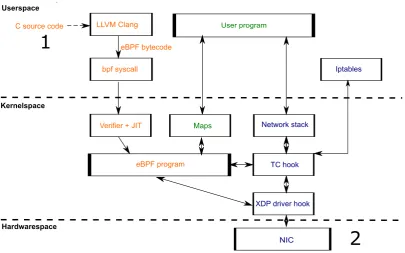
The shown tcpdump example was just an example of a program that in this case uses the former BPF. The creation of an eBPF program with the purpose of eventu-ally running inside the eBPF VM, starts typiceventu-ally with the creation of ’C source code’. Figure 2.3 shows this step in the up left corner at ’1’. The ’LLVM Clang compiler’ [102] is able to compile this code into the ’eBPF bytecode’ in the form of an ELF file [103]. After this compilation the bytecode can be loaded into the kernel with a sys-tem call (syscall). A syscall is the typical way for a program in userspace to request a service from the kernel of the operating system. An eBPF program loaded into the kernel is done via the ’bpf syscall’ [104]. Together with this syscall, maps can be initiated and the program type has to be specified. This program type essentially defines which kernel functions can be called from the eBPF program. As can be seen in Figure 2.3 the eBPF bytecode reaches the ’verifier’. Inside the kernel the eBPF verifier comes with some checks on the byte code to ensure some safety, for example no backward jumps are allowed to make sure no loops are possible. Furthermore an eBPF program can not have more than 4096 instructions and each instruction has a length of 64 bits. With the fact that simple filter rules can already cost multiple in-structions as it is the case with tcpdump, it means that the bytecode can only contain a very limited amount of filtering rules. If finally the bytecode is considered safe by the verifier, the ’JIT’ compiler compiles the bytecode into machine code that matches the right architecture. Finally the eBPF program runs inside the kernel where it can interact with other kernel functions and can also interact with userspace programs via ’maps’.
Userspace
Kernelspace
eBPF bytecode C source code
Hardwarespace
User program
bpf syscall LLVM Clang
Verifier + JIT
eBPF program
NIC
Maps
XDP driver hook TC hook Network stack
Iptables
1
2
[image:28.595.107.513.471.724.2]2.3.2 eXpress Data Path (XDP)
This section will elaborate on XDP and how it is possible that it enables high packet processing speeds. To reach the userspace, normally a network packet coming from the Network Interface Card (NIC) flows through the kernel of an operating sys-tem. Figure 2.3 shows this NIC at the ’2’, after which an incoming packet will flow through all the elements inside the kernel. An alternative way is Kernel bypass-ing; a method to process those packets directly in user-space by skipping the kernel. The main advantage of doing this, can be that a high-speed packet processing per-formance is possible. Some toolkits already use a form of kernel bypassing to gain performance, such as the Data Plane Development Kit (DPDK) [105], Cisco’s Vector Packet Processing (VPP) [106], Netmap [107] and Snabb [108]. Bypassing the ker-nel to gain speed has some disadvantages. All networking functionality normally provided by the kernel has become useless. There is also almost no ability to inter-act with other parts of the OS and the user-space application needs to manage their hardware resources directly. This all results in increased system complexity which could introduce some security problems. XDP is a solution that does basically the opposite of kernel bypassing. It actually adds programmability with eBPF programs directly at the operating system networking stack [10]. This is done by adding a new layer in the kernel network stack. An eBPF program can be directly executed at the NIC driver at the first possible moment after a packet is received. The latter is called the the ’XDP driver hook’ as shown in Figure 2.3. As explained is the previous sec-tion, the bpf syscall allows eBPF bytecode to be executed as an ’eBPF program’. A declaration inside the syscall has to be given to specify that the ’XDP driver hook’ should be used and the eBPF program therefore can also be called a ’XDP program’. In the fight against DDoS attacks, an import feature of a network filter is that it should drop malicious packets as fast as possible. According to the performance evaluation from Høiland-Jørgensen et al. [10], the packet dropping performance of XDP is significantly faster then older methods, such as Iptables. This performance advantage of XDP over Iptables can be explained by the fact that XDP has the possi-bility to filter right at the network device driver, which is an earlier stage then where Iptables does its job. As shown in Figure 2.3, the fastest way for Iptables to drop packets is in the prerouting phase near the traffic control (TC) hook. At the TC, the incoming packets already have passed the driver space. This ’TC hook’ however will come after the ’XDP driver hook’ and is therefore also a lot slower. According to Høiland-Jørgensen et al. [10] packets an the ’XDP driver hook can be dropped with a speed of 24 Mpps on a single CPU against a dropping rate of 4.8 Mpps at the TC hook. This shows that packets can be dropped significantly faster with the use of XDP than former methods using Iptables. The speed improvement of XDP over Iptables is in the case of Cloudflare, one of the reasons for the replacement of an Iptables filter [7]. With Cloudflare’s use of NICs that can handle two times the speed of 25Gbps in their edge-servers, the network links themselves are not the bottleneck when it comes to handling packets [109].
2.3.3 Related Work
the full written terms ’extend Berkeley Packet Filter’ and ’eXpress Data Path’ have been used. Those searches resulted in up over thousand result for only ’eBPF’ and just below hundred results for the combination with ’XDP’. Table 2.3 shows the cov-erage of the 25 most important papers found.
TABLE2.3: Studies overview
Reference Paper Topics
DDoS eBPF XDP Rule Generation
Tran and Bonaventure [111] X
Hong et al. [112] X
Massimo [113] X X
Bertrone et al. [114] X X
Bertrone et al. [115] X X
Hemminger [116] X X
Ahern [117] X X
Miano et al. [118] X X
Lakhani and Miller [119] X X
Rüth et al. [120] X X
Chaignon et al. [121] X X
Van Tu et al. [122] X X
Xhonneux et al. [123] X X
Tu and Ruffy [124] X X
Viljoen and Kicinski [125] X X
Brouer [126] X X X
Bertin [7] X X X
Fabre [127] X X X
Høiland-Jørgensen et al. [10] X X X
Miano et al. [128] X X X
Miano et al. [129] X X X
Scholz et al. [72] X X X
Khamruddin and Rupa [80] X X
Aljuhani et al. [130] X X
Makita [131] X X
First of all, several studies found via Google Scholar did mention the use of XDP and eBPF in combination with DDoS mitigation, but the main topics of those studies involve other topics that are not relevant for this study [132, 133, 134].
Furthermore some studies found are are about different use-cases for eBPF. Apart from packet filtering against DDoS attacks, eBPF offers solutions to other problems inside to Linux kernel. For example Tran and Bonaventure [111], propose an exten-sion on the TCP stack inside the linux kernel. Another use of eBPF is the proposal of a virtual network switch by Hong et al. [112].
of network functionalities that can be built with eBPF and XDP, such as routers, NATs and bridges.
The third category of studies focus on the use of eBPF and XDP related to the mit-igation of DDoS attacks. From 2017, the study of Bertin [7] is an explorative study for Cloudflare that concludes that XDP is a promising technology for the mitiga-tion DDoS attacks. Two years later in 2019 is now clear that Cloudflare successfully adopted XDP. In 2019, Fabre [127] describes for Cloudflare how they adopted XDP by hard-coding filter rules inside the XDP program. The paper concludes that they are successfully able to mitigate DDoS attacks, but are still constrained by the num-ber of rules that can be specified. Høiland-Jørgensen et al. [10] tests the capability of eBPF and XDP to drop packets at high speeds. They show a raw packet process-ing performance of up to 24 Mpps on a sprocess-ingle CPU. The paper of Miano et al. [129], specify ’bpf-iptables’ based on eBPF and XDP, which is able to replace the former Iptables. They tested their bpf-iptables performance under simulated DDoS attacks. Further, they achieved higher packet dropping rates than Iptables with the use of eBPF and XDP. Their matching was done on IP source, transport layer protocol and source ports. In another study, Miano et al. [128] shows the same performance ad-vantage of using eBPF and XDP over Iptables.
No studies have been found in how filtering rules should be generated in order to mitigate DDoS attacks with XDP and eBPF. Due to the unique behaviour of the eBPF environment, studies into rule generation methods can be helpful in order to optimize DDoS attack mitigation. Existing studies such as [80, 130, 131] can be used to find similiar methods for the use with eBPF and XDP.
2.3.3.1 Number of rules restriction
With eBPF and XDP together, it is possible to fit filter rules into an single XDP pro-gram. There is however a limitation in the amount of rules that be used in a XDP program, since XDP program can not be larger then 4096 instructions. As can been seen in subsection 2.3.1 the number of instructions needed can add up pretty quickly if the number of rules are increasing, especially when the rules become more com-plex. Scholz et al. [72] managed to create a efficient filter containing up to 100 rules. Facebook’s XDP packet filtering solution uses eBPF maps to store rules [9]. In the-ory those maps can be infinitely large which means that there is much more space for specifying rules. An extra advantage is that the XDP program doesn’t need to be recompiled to add or remove rules. However, Fabre [127] reports that looking up certain rules in maps also comes with the minimal costs of 4 instructions. Facebook doesn’t show how their use of maps affects their performance results and only little implementation details are given by Facebook.
2.3.3.2 Packet filter algorithms
rules. In a presentation, the same authors suggest that Tuple-Merge [136] might also work efficiently, but this is still open for research.
2.4
Conluding Remarks
The goal of this chapter is to answer the research question;What methods currently
exist that automatically update rules in a signature based DDoS mitigation? The answer on this question has been realised by first looking into DDoS attacks in gen-eral in section 2.1. Then in section 2.2 the field of DDoS detection and mitigation has been explored. Finally section 2.3, elaborates on the related work, the advantages and the limitations of using eBPF and XDP as a DDoS attack mitigation method.
The second section 2.1 gives a brief overview of what to most important aspects of a DDoS attack are. It explained that victims of DDoS attacks are targeted to ex-haust their resources. By exex-hausting the resources of a victim, it will not be able to deliver a service to other legitimate users of the service. Those resources get ex-hausted by flooding the victim with network traffic or by misusing the behaviour of a certain protocol to cause the exhaustion of the victim its resources. The conclu-sion is that as long as resources are limited, they will always be prone to exhaustion and thus vulnerable for a denial of service. Further observation is that DDoS attacks still form a threat with huge revenues losses and reputation damage, due to 5 dif-ferent attack motivations. At the end section 2.1 elaborates on the distributed nature of DDoS attacks. Nowadays typical DDoS attacks are performed by built botnets existing out bots and C&C servers, where the bots are compromised machines. De-pending on the attack vector, an extra layer in to a DDoS architecture is added with reflectors. Most common attack vector is UDP amplification through those reflectors and the 7 most misused protocols are given.
Section 2.2 starts with describing different kind of defense mechanisms. Argued is that reactive mechanisms will always be needed against DDoS attacks and that they can are ideally deployed on multiple collaborative locations. Detection mech-anisms of DDoS attacks can be classified into signature-based and anomaly-based, with the main challenge for signature-based methods to maintain an up to date rule-set. However signature-based mechanisms, have a lower false positive rate. Fur-ther it describes different mitigation methods that are categorised by four different categories; BGP routing, Network Firewalls, IPSs and WAFs. Concluded was that the relatively new open-source tools eBPF and XDP have some features that could overcome the limitations of other methods. These tools can be deployed on a wide variety of devices and enable the possibility to collaborate with other applications via user-space. This collaboration can overcome the limitation that signature-based mechanisms have, since it enables the possibility to dynamically update filter rules, that are automatically generated by secondary program.
Furthermore eBPF and XDP are able to fully inspect incoming packets at a even higher processing rate than former network firewall methods. Finally section 2.2, describes is that DPSs are a popular way to outsource the defense against DDoS at-tacks. Those DPSs use CDNs to be able to redirect internet traffic, which can be used to mitigate DDoS attacks. Implementation details on further methods are generally not public, but Cloudflare posts openly about their successful method using eBPF and XDP.
Chapter 3
Method & Design
In the previous chapter we saw what DDoS attacks are, how they work and what mitigation methods exist to be able to defend against them. We concluded that the features of eBPF & XDP can potentially help mitigating DDoS attacks. These features include the possibility to dynamically update filter rules from userspace into kernelspace and also the possibility to drop packets at faster speeds than former methods. With eBPF and XDP as tools, this chapter its aim is to study how those tools can fit in a DDoS mitigation system. Therefore, the goal of this chapter is to find an answer onhow to automatically generate eBPF rules for DDoS mitigation using DDoS attack signatures (RQ2).
In section 3.1 we will give the predefined requirements of the system we created, by taking RQ2 into account. Then, insection 3.2we will elaborate on the implementation of our own system and on how the requirements of the system are met. After that,section 3.3
3.1
Requirements
The requirements for the DDoS mitigation system of this study are specified in this section. We first take a look at how our built DDoS attack mitigation system is part of a bigger system. How this bigger system will look like on a high level has been shown in Figure 3.1. At the left side of the figure, normal traffic as well as attack traffic flows into the system. At the right side of the figure the filtered traffic flows out of the system and should ideally only exist out of normal traffic.
Normal Traffic
Attack Traffic
XDP filter
Anomaly Detection
Rule Generation
Normal Traffic Dropped Traffic Sample
FIGURE3.1: Design of DDoS Attack mitigation system
The parts in orange, will be a part in the system that is created for this study. The
blue anomaly detection part the traffic isNOTpart of this study, therefore further
requirements apply on the orange part. To take full advantage of the characteristic of eBPF and XDP, we choose that our system should be part of a bigger collaborative system. The incoming traffic will first pass the XDP filter that is able to apply certain filter rules on the traffic. The traffic will than flow trough an anomaly detection sys-tem which should be able to detect new attacks. By dissecting the traffic the anomaly detection system should also be able to compare the traffic with already known at-tacks. As soon as the anomaly detection has warned the rule generation system with a certain incoming attack, the rule generation system can create rules to be applied inside the XDP filter. This way we have a hybrid mitigation system that uses both signature-based and anomaly-based methods to mitigate DDoS attacks. Within the system the XDP filter is able to sample parts of dropped traffic. From those samples can be derived how many and what kind of packets are being dropped. With that information can be approximated how big the attack is and how much normal traffic has been dropped.
perspective. To create a realistic system which is operated by a network operator, the requirements of the system take into account that the system can be part of different networks and different attack scenarios. Those factors are considered to be the con-text of the actual DDoS mitigation system. The requirements are grouped by 3 main requirements, that all include several sub-requirements in the following way.
1. The system should be able to filter network traffic using eBPF and XDP.
1.1 The system should be able to load eBPF programs inside the Linux kernel. 1.2 The eBPF programs should have a XDP hook that is able to filter network
packets.
1.3 The system should be able to store filter rules in eBPF maps.
1.4 The system should be able to store hard-coded rules inside the eBPF pro-gram.
2. The system should be able to generate XDP rules in order to drop packets from DDoS attacks.
2.1 The system should be able to derive filter rules from DDoS attack finger-prints.
2.2 The system should be able to filter on all different features in OSI layers 3 and 4.
2.3 The system should be able to filter on important features inside OSI layers higher than 4.
2.4 The system should be able to filter on multiple features at once.
3. The system should be able to mitigate DDoS attacks in a realistic situation.
3.1 The system should be able to take its own context into account when gen-erating XDP rules.
3.2 The network operator of the system should be able to manually change the type of rules that are used in the XDP filter.
3.3 The network operator of the system should be able to see what the kind of packets are being dropped and how many of them are being dropped.
The first requirement directly specifies the use eBPF and XDP. The use of those tools are justified by chapter 2. The second requirement is set in order to drop pack-ets from DDoS attacks specifically. The system should be able filter based on specific DDoS attack properties. As learned from chapter 2, DDoS attacks can have a variety of different features that describe the specific DDoS attack. Besides being able to mitigate different sorts of DDoS attacks, the third requirement specifies that the sys-tem should also be able to work in a realistic network environment. With the term realistic is meant that there are many variables in the context of the system that can influence its behaviour.