Abstract—With the rapid development of microelectronics, wireless sensor networks (WSNs) have started to evolve into various applications that require complex operations, ranging from health care to multimedia transmission. However, successful deployment of resource-limited WSNs in such applications requires strict quality-of-service (QoS) constraints. This paper presents an ant-based multi-constrained QoS routing protocol (AntMQoS) for wireless sensor networks. It is a hierarchical routing protocol which takes independent routing decision to meet the application-specific QoS requirements (latency and reliability) of heterogeneous traffic generated by the source nodes. Simulation results reveal that AntMQoS performs better in terms of reliable data transmission, on-time data delivery, and energy efficiency to maximize the network lifetime..
Index Terms— Wireless sensor network (WSN); Quality-of-service (QoS); Ant colony optimization (ACO); End-to-end (E2E) delay; Residual energy; Routing protocol; Packet delivery ratio (PDR)
I. INTRODUCTION
IRELESS sensor network is a collection of small
autonomous devices called sensor nodes deployed over geographical areas to monitor physical or environmental phenomena such as temperature, pressure, sound, vibrations, motion and seismic events at different locations. The construction of the sensor node mainly focuses on conserving energy, reducing cost and complexity, increasing flexibility, and providing robustness and fault tolerance [1].
The early research on WSN has mainly focused on monitoring applications, such as habitat and environmental monitoring, but with immense proliferation in micro-electromechanical systems (MEMS) along with large acceptance of wireless networking technologies have enabled widespread utilization of WSNs in different environments and for different purposes [2].
Manuscript received April 01, 2017; revised April 18, 2017.
D.K. is with the Sant Longowal Institute of Engineering and Technology, Longowal, Sangrur, Punjab 148106 India (corresponding author to provide phone: +919417213652; e-mail:[email protected]).
T.K. is with the Sant Longowal Institute of Engineering and Technology, Longowal, Sangrur, Punjab 148106 India (e-mail:[email protected]).
The new applications domains of WSNs have received some denominations in the literature. Sensor networks composed of smart sensor nodes used for transmitting video, audio, still images and scalar data in real-time and non-real-time may be called wireless mulnon-real-timedia sensor networks (WMSNs). Sensor networks deployed inside factories or industries used to monitor or control an industrial process termed as industrial wireless sensor networks (IWSNs). Sensor network composed of biomedical sensor nodes used for fostering health care applications termed as wireless body area networks (WBANs) [3-4]. These application domains generate diverse traffic which requires QoS assurance in terms of delay, reliability, energy efficiency, bandwidth utilization, jitter and throughput [5]. QoS guarantees in WSNs are a difficult and more challenging task to achieve due to the heterogeneous sensor nodes and the various applications domains running over these networks have different constraints in their nature and requirements [6].
Routing protocols have the ability to facilitate application-specific QoS requirements under multiple constraints such as bandwidth, delay, packet loss, hop count, and energy [7]. In multi-constrained QoS routing determining an optimal route that satisfies the multiple constraints has been proven to be NP-complete [8], because the optimization of one metric leads to deprivation of another. So there is need of designing and developing routing protocols which can focus more and more on multiple metrics. An ACO algorithm is essentially a system based on agents which simulate the natural behavior of ants to solve the various optimization problems.
This paper revisits the issue of QoS in WSNs to propose a new multi-constrained routing protocol (AntMQoS) that uses ACO to meet the application-specific QoS requirements of heterogeneous traffic generated by the source nodes. AntMQoS is a hierarchical routing protocol which takes independent routing decision by relying on three QoS metrics associated with the link: residual energy, end-to-end delay and packet loss ratio. It distributes the diverse traffic over multiple paths by estimating the quality of the path in order to reduce congestion and improves the network lifetime.
The rest of the paper is organized as follows: Section 2 presents the related work. The proposed protocol is described in section 3. Section 4 describes the performance analysis of protocol through simulation. Finally, section 6 concludes the paper.
AntMQoS: An Ant-based Multi-Constrained
QoS Routing Protocol for Wireless Sensor
Networks
Dilip Kumar, Tarunpreet Kaur
II. RELATED WORK
In recent years, many routing techniques have been proposed for multi-constrained QoS in WSN. Dorigo et al. [9] have adopted the idea and proposed an artificial algorithm based on the behavior of real ants in their colonies. While moving, ants deposit a chemical substance called pheromone, on the paths between the food sources and the nest. Thus, when other ants are searching for food, they can smell the pheromone deposited on their paths and they tend to choose a path marked by strong pheromone concentration. The ACO model was initially used to solve the travelling salesman problem (TSP). Since then, the model has been widely studied and improved.
Camilo et al. [10] proposed an improved version of ant-based routing protocol (EEABR) designed to extend the network lifetime by determining optimal routes in terms of energy consumption and distance. In Yang et al. [11] a multipath routing protocol is proposed, which extends the network lifetime by employing dynamic clustering and ant colony optimization mechanism. Cobo et al. [12] proposed an ant-based routing protocol (AntSensNet) which combines hierarchical structure with ACO-based routing to satisfy the QoS requirements of WMSNs. It utilizes a power efficient multipath video packet scheduling mechanism to reduce distortion in the video packet transmission.
Yu and Luo [13] presented an ant colony optimization based QoS routing algorithm (ACOWMSN) to maximize the network lifetime by utilizing delay, energy, bandwidth, and packet loss rate as QoS constraints to find minimum cost route from the source to the destination. Malik et al. [14] proposed an aco-based QoS-aware routing protocol (EAQHSeN) designed for heterogeneous WSNs to support both multimedia traffic and scalar data. EAQHSeN has the ability to achieve differentiated QoS requirements for control, multimedia, and scalar traffic by making the independent routing decision for each type of traffic.
Based on the above survey, it is observed that there are very few studies that consider the hierarchical structure to provide QoS support to diverse traffic classes generated by the sensor nodes. However, the major issue with flat ant-based routing protocol is scalability. This issue arises since each source node has to send ants to every other node in order to find multiple optimal routes towards the destination. As the number of sensor nodes increases, a number of ants generated by nodes would also increase and leads to congestion. Further, there are few protocols which only consider pheromone concentration for providing service differentiation to diverse traffic classes, which leads to the generation of large pheromone tables. There is a lack of studies which simultaneously consider heuristic factor and pheromone concentration factor to provide QoS support. Moreover, the routing protocols that support multi-constrained QoS are not energy efficient. Since energy efficiency is considered as the major constraint due to resource-limited WSN. Therefore, this protocol addresses these issues by combining hierarchical structure with ACO-based routing to satisfy the application-specific QoS requirements of heterogeneous traffic generated by the sensor nodes, while respecting the minimum energy
consumption in order to maximize the network lifetime and scalability.
III. ANT-BASEDMULTI-CONSTRAINEDQOS ROUTINGPROTOCOL(ANTMQOS)
AntMQoS is an ant-based multi-constrained QoS routing protocol designed for heterogeneous wireless sensor networks (HWSNs). It is a reactive routing protocol in which cluster heads (CHs) aggregate the heterogeneous traffic generated by the sensor nodes and takes independent routing decision based on the traffic requirements by determining multiple optimal routes between the CH and the sink node. This section describes the network model and ant-based multi-constrained QoS routing protocol for heterogeneous WSNs.
A. Network model
A WSN can be presented as connected and weighted graph
G
=
( , )
V E
hereV
=
{ , ,... }
v v
i jv
n represents the set of nodes i.e. the CHs and the sink node in the network andE
=
{ ,
e e
ij jk,... }
e
xy represents the set ofbi-directional links between the CHs such that the nodes
,
i j
v v
∈
V
andi
≠
j
.Each node
v
iinV
maintains a pheromone table containing the pheromone valueτ
ijsof neighbor nodes which is required to reach the sink nodes
via neighborv
jand hop counth
s, AntMQoS considers end-to-end delay, packet delivery ratio, and residual energy as QoS metrics for optimal path selection between CHs and the sink node.B. Queuing model
AntMQoS is a hierarchical routing protocol in which CH organizes the data traffic generated by the sensor nodes into four different traffic classes based on the delay and reliability constraints and maintains the appropriate queue for each traffic class. A priority scheduler organizes the incoming packets according to their classes and priority. CHs distribute the diverse traffic over the multiple paths by estimating the quality of the path in order to reduce congestion and improve the network lifetime.
C. Route Discovery
In AntMQoS, each CH maintains two tables: neighbor table and pheromone table which contains routing information about the neighbors. When the CH wants to communicate to the sink node S, it generates forward ant (FAnt) to search an optimal path for appropriate traffic class of the packet. The CH either broadcasts or unicasts the FAnt based on the routing information stored in neighbor and pheromone table. On its way to the sink node, the FAnt maintains the records of the intermediate nodes. The packet format of FAnt is shown in Fig. 2.
becomes 0, the FAnt is discarded. The Sequence number (Seq. No.) is the number of FAnt. S_id indicates the previous node ip address and D_id indicates the next node ip address. Dmax is the maximum queuing delay, Emin is the residual energy of minimum energy node and SRmin is the minimum success rate of each traffic class.
When the intermediate node receives the FAnt packet, it updates the S_id, D_id,Dmax, Emin, SRmin fields of the FAnt packet. Based on the routing information of QoS requirements of each traffic class, the intermediate node either broadcasts or unicasts the FAnt packet. If the appropriate route towards the sink node is available, then the node makes the probabilistic decision for selecting the next hop node according to the following equation
( ) ( )
( )( )
d i
k k ij ij k
ij k k
ij ij s N
P
α β
β
τ
η
τ η
∈
=
(1)
where
P
ijkis the probability of selecting the next nodej
or traffic classk
.τ
ijkdenotes the pheromone value for nodej
andη
ijkdenotes the heuristic factor of nodej
for traffic classk
.N
idis the set of neighbor nodes ofi
,α
,β
are the control parameters for pheromone and heuristic respectively.The heuristic factor in equation (1) considers three QoS constraints: E2E delay
( 2 _
k,)
i j
E E D
residual energy(
k)
j
RE
and packet loss ratio(
k)
j
PLR
to select the appropriate next hop nodej
for particular traffic class. For pathP
=
( , ,.... )
v v
a bS
from CHv
ato the sink nodeS
its QoS metrics are computed as follows:1) E2E Delay: The E2E delay associated between two CH nodes can be evaluated from three parameters: the propagation delay
d
prop which depends on the distance between the nodes, the transmission delayd
txis the time between the first bit sent and last bit received by the destination node and the queuing delayd
queue is the amount of the time has to wait in the queue
D
i j,=
d
prop+
d
tx+
d
queue (2) The E2E delay between nodei
andj
for traffic classk
is defined as, 1 .
2 _
x
p p i j p k i j
x
t
E E D
p
=
Δ
=
(3)where
p
x is the total number of packets generated by the source nodei
,Δ
t
i jp, is the time of packetp
transmitted from nodei
toj
along the route.2) Residual energy: The residual energy of neighboring nodes of node
i
influences the chance of sensor nodej
,j V
∈
as the next-forwarder node. The total energy consumption of nodej
is given by( )
r cpu tE t
=
E
+
E
+
E
(4) The residual energy of nodej
for traffic classk
isdefined as
1
( )
x
p
k p
j i p
RE
E
E t
=
=
−
(5)where
E
idenotes the initial energy of nodej
,
r
E
denotes the energy consumption for receiving data packets,E
t denotes the energy consumption for transmitting packets ,E
cpuis the energy consumption in computation and sensing, andp
xis the total number of packets transmitted or received by the nodej
.
3) Packet loss ratio: Packet loss rate can be assessed by the ratio between the numbers of packets lost to the total number of packets transmitted by the source node. A high value can indicate a congestion problem, bad channel quality caused by fading and interference. The packet loss ratio metrics for traffic class
k
is expressed as follows1
k k
j j
PLR
= −
SR
(6) Based on these QoS metrics, the heuristic factor can be computed as follows1
3 2
,
(
)
( 2 _
) (
)
k ij k
i j k k
ij ij
RE
E E D
PLR
β
β β
η
=
(7)where
β β
1,
2,
andβ
3are the constants which indicates the importance of each QoS metrics for the selection of the next hop node. Higher value ofβ
1 increases the probability of choosing a node with more residual energy from the neighboring node ofi
. Higher value ofβ
2 increases the probability of selecting a node with minimum packet loss ratio.β
3is a parameter that controls the selection of the next-hop node based on their E2E delay.When the FAnt reaches the sink node, it has the maximum delay associated with route Dmax, the minimum residual energy of the route Emin , and the minimum success rate SRmin supported by route. This information is evaluated by the sink node in order to check the quality of the path for each QoS metrics according to the application requirements. The backward ant (BAnt) is generated corresponding only to the FAnt which meets the application requirements. If the route does not satisfy the application requirements, then the FAnt is discarded.
Packet type
H TTL Seq No
S_id D_id Dmax Emin SRmin
The BAnt contains the information corresponding to the FAnt and travels along the same path traversed by the FAnt and updates the pheromone value on the intermediate nodes until it reached the sink node. The amount of pheromone on each path is determined by using two pheromone update rules given below.
1) The local pheromone update rule: Local pheromone update is performed by all the ants after each construction step. Every ant applies the pheromone only to the last edge traversed. Moreover, expressions (8) and (9) are used to update the quality of pheromone on the path between node
i
andj
timet
.,
(
1) (1
)
.( )
.(
1)
k k k
i j
t
i jt
i jt
τ
+ = −
ρ τ
+
ρ τ
+
(8)1 1
,
(
1) [
( )] [
]
k m
i j
t
N S t
Fh
countτ
+ =
−
− −
(9)where
ρ
refers to the pheromone evaporating rate(
ρ ∈
(0,1]),
k, i jτ
is the pheromone increment on the path( , )
i j
for traffic classk
in the current round.N
is number of sensor nodes with energy greater than the threshold energy,S
Fm represents the total number of sensor nodes that antm
visited as it traverses from the source node to the destination node at time t.h
count represents the number of hops from the sink node. Equation (9) builds a better pheromone distribution near the sink node and will encourage remote CHs to find better path.2) The global pheromone update rule: The global update rule adds pheromone to the completed path of all paths traversed. The best path traversed indicates the optimal path. The global update rule is determined as follows
,
(
1) (1
) ( )
k k
i j
t
gt
τ
+ = −
γ τ
(10)1 2 3
( )
( )
( )
(
)
k
g
t
D
E
SR
τ
=
α
+
α
+
α
(11)max
kj
D
=
D
(12)min
kj
E
=
RE
(13)min
kj
SR
=
SR
(14) whereγ
refers to the pheromone evaporatingrate
(
p
∈
(0.1)]
,τ
gk is the global pheromone increment on the path( , )
i j
in the current round.α α
1,
2,
andα
3 are the weight factors assigned to the delay, residual energy and success rate, respectively and their values depend upon the QoS requirements.IV. PERFORMANCE ANALYSIS
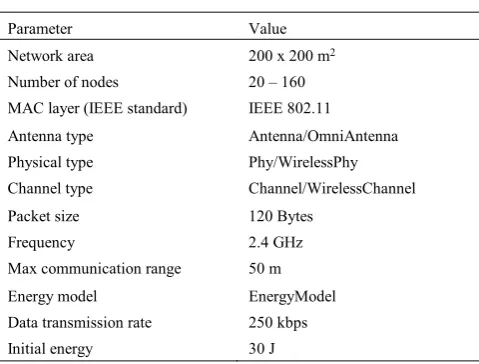
In this section, the performance of the proposed AntMQoS protocol is evaluated and compared against that of AODV and EEABR [14] protocols. The proposed protocol is simulated in NS2 simulator of version 2.35 with the following simulation environment as shown in Table 1.
We report the following performance metrics for evaluating the performance of proposed protocol.
A. Energy Consumption
The results for energy consumption of proposed protocol is shown in Fig. 2. The results obtained show that proposed AntMQoS protocol has better performance as compared with EEABR, and AODV protocols. This is because AntMQoS reduces the flooding of ants for locating the sink node in the network by adopting the hierarchical structure for data transmission in which traffic is distributed among the CHs without propagating the entire network. Thus a number of control routing overheads are lesser than as compared to EEABR, which consequently reduces the energy consumption of AntMQoS and hence improves the network lifetime.
B. End-to-end Delay
The results for end-to-end delay of proposed protocol are depicted in Fig 3. The results obtained show that the average delay associated with data packets of diverse traffic class in AntMQoS is lower than those of EEABR and AODV. Since it is a multipath routing protocol, it would immediately recover the path failure by forwarding the data packet over another path without introducing any delay. Moreover, the congestion control mechanism at CH in AntMQoS efficiently reduces the queuing delay by releasing less pheromone concentration at congested CH. Thus, multipath routing as well as congestion mechanism of AntMQoS reduces the E2E delay as compared to EEABR and AODV.
TABLEI
SIMULATION ENVIRONMENT
Parameter Value
Network area 200 x 200 m2
Number of nodes 20 – 160
MAC layer (IEEE standard) IEEE 802.11
Antenna type Antenna/OmniAntenna
Physical type Phy/WirelessPhy
Channel type Channel/WirelessChannel
Packet size 120 Bytes
Frequency 2.4 GHz
Max communication range 50 m
Energy model EnergyModel
Data transmission rate 250 kbps
Initial energy 30 J
100 200 300 400 500
0 5 10 15 20 25
E
ne
rg
y Co
ns
ump
ti
on
(
jo
ul
e)
Simulation Time
(sec
)
[image:4.595.304.544.73.255.2]AODV AntMQoS EEABR
C. Packet Delivery Ratio
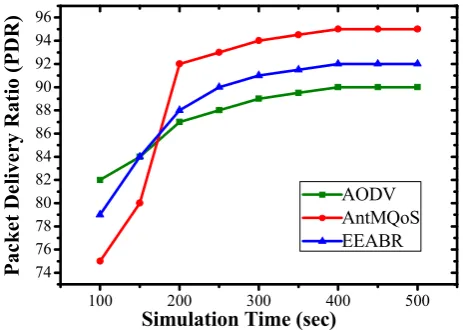
The results for packet delivery ratio (PDR) of AntMQoS protocol is depicted in Fig. 4. The results obtained show that AntMQoS and EEABR exhibit similar increasing trends with minimum delivery ratio during the initial period of simulation. This is because of lack of sufficient information to find the appropriate routes at the beginning and when the ants have gathered much information the algorithm starts converges. Due to hierarchical approach, AntMQoS generates less amount of control traffic and does neither expand energy nor route packets on non-optimal paths. This is the reason that PDR in the case of proposed protocol is better than EEABR and AODV.
V. CONCLUSION
This paper proposes an ant-based multi-constrained QoS routing protocol (AntMQoS) for heterogeneous wireless sensor networks in which traffic is classified based on the delay and reliability constraints. The proposed protocol takes independent routing decision to meet the application-specific QoS requirements of the diverse traffic classes. Moreover, the protocol provides congestion control at cluster head by taking into account the amount of data of each traffic class currently processed by the cluster head and thus reduces the queuing delay of the appropriate traffic class. Simulation results reveal that the proposed protocol Algorithm of Proposed Protocol
Input:
(1) The neighbor table: A table containing information of neighborhood nodes.
(2) Pheromone table: A table containing pheromone values associated with these neighbors. Initial pheromone for all nodes = 0
Output:
Update table with all values required to transmit data. Pheromone values of selected nodes.
Steps:
1. Nodes send data packets to CH While CH receives data packets do Aggregate data packets from all nodes
End while
2. Source CH node sends FAnts
If routing information towards the sink node is available
Unicast FAnt to next CH node according to routing information Else
Broadcast FAnt End If
3. Intermediate node receives FAnt If routing information is available
Determine nest hop node with probability P using Eq. 1 Else
Broadcast FAnt End If
4. FAnt reaches destination
If Dmax, Emin and SRmin meets the application requirements
Construct BAnt and calculate local and global pheromone contribution to BAnt Else
Discard BAnt End If
While intermediate CH nodes receives BAnt do
Compute local pheromone to be released by BAnt using Eq. 8 Compute global pheromone to be released by BAnt using Eq. 10 Save pheromone information and unicast BAnt
End while
5. When the source CH node receives BAnt While data packet do
If data packet = delay intolerant
Select next hop CH node using Eq. 9 by considering control parameter
β
3 only Else If data packet = loss intolerantSelect next hop CH node using Eq. 9 by considering control parameter
β
2only ElseSelect next hop CH node using Eq.9 by considering all control parameters
β β
3,
2andβ
1 End Ifperforms better in terms of energy efficiency, end-to-end delay, and packet delivery ratio as compared to EEABR and AODV routing protocol.
REFERENCES
[1] Ye, Wei, John Heidemann, and Deborah Estrin, "An energy-efficient MAC protocol for wireless sensor networks," in INFOCOM Twenty-First Annual Joint Conference of the IEEE Computer and Communications Societies, vol. 3, pp. 1567-1576, 2002.
[2] Yigitel, M. Aykut, Ozlem Durmaz Incel, and Cem Ersoy, "QoS-aware MAC protocols for wireless sensor networks: A survey," Computer Networks, vol. 55, no. 8, pp. 1982-2004, 2011.
[3] Mendes, Lucas DP, and Joel JPC Rodrigues, "A survey on cross-layer solutions for wireless sensor networks," Journal of Network and Computer Applications, vol. 34, no. 2, pp. 523-534, 2011.
[4] Liao, Yangzhe, Mark S. Leeson, and Matthew D. Higgins, "Flexible quality of service model for wireless body area sensor networks," Healthcare technology letters, vol. 3, no. 1, pp. 12-15, 2016. [5] Almalkawi, Islam T., Manel Guerrero Zapata, Jamal N. Al-Karaki,
and Julian Morillo-Pozo, "Wireless multimedia sensor networks: current trends and future directions," Sensors 10, no. 7, pp. 6662-6717, 2010.
[6] Alwan, Hind, and Anjali Agarwal, "MQoSR: A multiobjective QoS routing protocol for wireless sensor network," ISRN Sensor Networks 2013.
[7] Lin, Chunhung Richard, and Jain-Shing Liu, "QoS routing in ad hoc wireless networks," IEEE Journal on selected areas in communications, vl. 17, no. 8, pp. 1426-1438, 1999
[8] Bhandary, Vikas, Amita Malik, and Sanjay Kumar, "Routing in Wireless Multimedia Sensor Networks: A Survey of Existing Protocols and Open Research Issues," Journal of Engineering, 2016. [9] Dorigo, Marco, Mauro Birattari, and Thomas Stutzle, "Ant colony
optimization," IEEE computational intelligence magazine, vol. 1, no. 4, pp. 28-39, 2006.
[10] Camilo, Tiago, Carlos Carreto, Jorge Sá Silva, and Fernando Boavida, "An energy-efficient ant-based routing algorithm for wireless sensor networks," In International Workshop on Ant Colony Optimization and Swarm Intelligence, pp. 49-59, Springer Berlin Heidelberg, 2006.
[11] Yang, Jing, Mai Xu, Wei Zhao, and Baoguo Xu, "A multipath routing protocol based on clustering and ant colony optimization for wireless sensor networks," Sensors 10, no. 5, pp. 4521-4540, 2010. [12] Cobo, Luis, Alejandro Quintero, and Samuel Pierre, "Ant-based
routing for wireless multimedia sensor networks using multiple QoS metrics," Computer networks, 54, no. 17, pp. 2991-3010, 2010. [13] Yu, Xiaohua, Jiaxing Luo, and Jinwen Huang. "An ant colony
optimization-based QoS routing algorithm for wireless multimedia sensor networks." In IEEE 3rd International Conference on Communication Software and Networks (ICCSN), pp. 37-41, 2011. [14] Malik, Sanjay K., Mayank Dave, Sanjay K. Dhurandher, Isaac
Woungang, and Leonard Barolli, "An ant-based QoS-aware routing protocol for heterogeneous wireless sensor networks," Soft Computing, pp. 1-12, 2016.
Dilip Kumar received the B.E. degree in electronics and telecommunication engineering from the Army Institute of Technology, University of Pune, India, in 2000, the M.E. degree in electronics product design and technology from the Panjab University, Chandigarh, India, in 2013 and the Ph.D. degree in faculty of engineering and technology from the M.M. University, Mullana, India, in 2010. In 2005, he joined the Centre for Department of Advanced Computing (CDAC) Mohali, India as a Design Engineer, and in 2009 became a Senior Design Engineer. He joined SLIET Longowal, Deemed University, India, in February 2014. Since 2014, he has been with the Department of Electronics and Communication Engineering, SLIET Longowal, Deemed University, where he is currently an Associate Professor. His current research interests include embedded systems, electronic system design, wireless sensor networks, and vehicular ad hoc networks. He has published more than 60 research papers in reputed international journals and conferences. Currently, he was the recipient of the 2015 Premium Award for Best Paper in IET Wireless Sensor Systems.
Tarunpreet Kaur received a M.Tech in Embedded Systems from Centre for Department of Advanced Computing (CDAC) Mohali, Punjab, India in 2014. Currently, she is pursuing his Ph.D. in Electronics and Communication Engineering at Sant Longowal Institute of Engineering and Technology (SLIET), Longowal, Punjab, India. Her research interests include primarily in wireless sensor networks, soft computing and embedded systems. She has published 4 papers in international and national journal/conferences.
100 200 300 400 500
0.034 0.036 0.038 0.040 0.042 0.044 0.046 0.048 0.050
En
d-to
-e
nd
D
ela
y
(s
ec
)
[image:6.595.49.281.92.255.2]Simulation Time (sec) AODV AntMQoS EEABR
Fig. 3 End-to-end Delay of AntMQoS, EEABR, and AODV
100 200 300 400 500
74 76 78 80 82 84 86 88 90 92 94 96
P
ack
et
D
el
iv
er
y R
ati
o (P
D
R
)
Simulation Time (sec) AODV AntMQoS EEABR
[image:6.595.49.281.283.448.2]