An Empirical Study on the Effect of Morphological and Lexical Features in
Persian Dependency Parsing
Mojtaba Khallash,Ali Hadian and Behrouz Minaei-Bidgoli
Department of Computer Engineering Iran University of Science and Technology
{khallash,hadian}@comp.iust.ac.ir, b [email protected]
Abstract
This paper investigates the impact of dif-ferent morphological and lexical information on data-driven dependency parsing of Per-sian, a morphologically rich language. We explore two state-of-the-art parsers, namely MSTParser and MaltParser, on the recently re-leased Persian dependency treebank and es-tablish some baselines for dependency pars-ing performance. Three sets of issues are addressed in our experiments: effects of us-ing gold and automatically derived features, finding the best features for the parser, and a suitable way to alleviate the data sparsity problem. The final accuracy is 87.91% and 88.37% labeled attachment scores for Malt-Parser and MSTMalt-Parser, respectively.
1 Introduction
Researchers have paid a lot of attention to data-driven dependency parsing in recent years (Bohnet and Kuhn, 2012; Bohnet and Nivre, 2012; Balles-teros and Nivre, 2013). This approach is language-independent and is solely dependent on the availabil-ity of annotated corpora. Using data-driven parsers for some languages requires careful selection of fea-tures and tuning of the parameters to reach maxi-mum performance. Difficulty of dependency pars-ing in each language depends on havpars-ing either free word order or morphological information. Lan-guages with free word order have a high degree
of freedom in arranging the words of a sentence. Consequently, they usually have a high percentage of non-projective structures. Morphology is deter-mined by large inventory of word forms (Tsarfaty et al., 2010).
According to the results from CoNLL shared task 2007, languages are classified to three classes, namelylow, mediumandhighaccuracy languages. Among them, low-accuracy languages have high de-gree of free word order along with inflection (Nivre et al., 2007a). Languages which are more challeng-ing in parschalleng-ing are called morphologically rich lan-guages (MRLs). In MRLs, multiple levels of infor-mation, concerning syntactic units and relations, are expressed at the word-level (Tsarfaty et al., 2010).
Free word order can be handled by non-projective parsing algorithms via either post-processing the output of a strictly projective parser (Nivre and Nilsson, 2005), combining adjacent (Nivre, 2009) or non-adjacent sub-structures (McDonald et al., 2005). Nevertheless, there is no general solution for resolving rich morphology issue and hence many researcher focus on features of a specific language. Most data-driven dependency parsers do not use any information that is specific to the language being parsed, but it is shown that using language specific features has a crucial role in improving the overall parsing accuracy (Ambati et al., 2010a).
Persian is an Indo-European language that is writ-ten in Perso-Arabic script (writwrit-ten from right to left). The canonical word order of Persian is SOV
(subject-object-verb), but there are a lot of frequent exceptions in word order that turn this language into a free word order language (Shamsfard, 2011). This language has a high degree of free word order and complex inflections. As an example of rich mor-phology, there are more than 100 conjugates and 2800 declensions for some lemmas in Persian (Ra-sooli et al., 2011).
Dependency treebank for Persian (Rasooli et al., 2013) language has newly become available. Due to the lack of deep research on dependency parsing in Persian, we establish some baselines for dependency parsing performance. We also conduct a set of ex-periments in order to estimate the effect of errors in morphological disambiguation on the parsers. We show that with two simple changes to the input data, performance of the two parsers can be improved for both gold (manually annotated) and predicted data.
The remainder of the paper is organized as fol-lows. Section 2 presents a brief overview of recent studies on parsing morphologically rich languages. In section 3, we introduce available morphological features annotated in our experiments. Section 4 de-scribes the experimental setup, including corpus and parsers we use, and presents our experiments. Ex-perimental evaluation and analysis of parsing errors are demonstrated in Section 5. Finally, we draw con-clusions and suggest future work in Section 6.
2 Related work
Many studies have been done on using morpholog-ical features for parsing morphologmorpholog-ically rich lan-guages, (e.g. Bengoetxea and Gojenola (2010), Seeker and Kuhn (2013), etc.). Koo et al. (2008) in-troduce cluster-based features that incorporate word clusters derived from a large corpus of plain text, to improve statistical dependency parsing for English and Czech. Agirre et al. (2011) use lexical semantic information derived from WordNet.
Marton et al. (2011) augment the baseline model for Arabic with nine morphological features. They show that using predicted features causes a substan-tial drop in accuracy while it greatly improves per-formance in the gold settings. They show that us-ing noisy morphological information is worse than using nothing at all. Same phenomenon is re-ported for Hebrew (Goldberg and Elhadad, 2010),
except that using morphological-agreement feature improves the accuracy of both gold and predicted morphological information.
Another interesting research direction is to find the most beneficial features for dependency parsing for each language. Ambati et al. (2010b) explored the pool of features for Hindi through a series of ex-periments. In their setting, features are incremen-tally selected to create the best parser feature set. In Korean, Choi and Palmer (2011b) focus on feature extraction and suggest a rule-based way of selecting important morphemes to use only these as features to build dependency parsing models.
For the Persian language, Seraji et al. (2012b) in-vestigated state-of-the-art dependency parsing algo-rithms on UPDT1 (Seraji et al., 2012a). They test three feature settings, namely gold POS tags for both the training and the test sets (GG), gold POS tags for the training set and auto-generated POS tags for the test set (GA), and auto-generated POS tags for both the training and the test sets (AA). The best result is obtained in GG setting with 68.68% and 63.60% LAS, for MaltParser (Nivre et al., 2007b) and MST-Parser (McDonald et al., 2005) respectively. Using AA and GA settings show worse results than GG, namely 2.29% and 3.66% drop in accuracy for Malt-Parser, and 1.8% and 3.23% drop for MSTParser. They only explore the effect of gold and non-gold POS tags with a small treebank with about 1,300 sentences. We apply GG and AA settings in our ex-periments on a larger treebank that contains richer morphological information. We define pool of 10 morphological and lexical semantic features in or-der to create the best feature set for the parser.
3 Features of Persian
In this section, among possible morphological and semantic features that exist in Persian, we briefly re-view a subset of them that is either annotated in Per-sian dependency treebank (Rasooli et al., 2013) or is available from other studies.
3.1 Features from Treebank
Table 1 represents the features available in the Per-sian dependency treebank, along with possible val-ues for each feature.
Feature Values
Attachment {NXT, PRV, ISO}
Animacy {animate, inanimate}
Number {singular, plural}
Person {1, 2, 3}
Comparison {positive, comparative, superlative}
[image:3.612.316.538.57.238.2]TMA see Table 2
Table 1: Description of features in Treebank
In some special cases, we have to break a word into smaller parts in order to capture the syntac-tic relations between the elements of the sentence. For example, the two-word sentence
XQ» Õç'@Y
‘se-dAyam kard’ (called me), consist of three mor-phemes:@Y
(calling),Õç'
(me), andXQ»
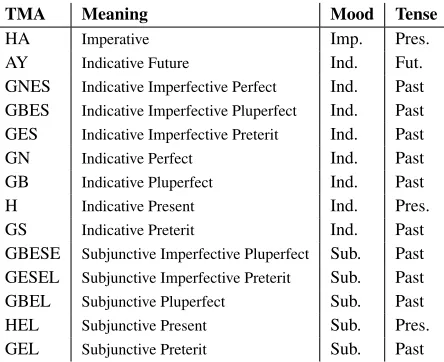
(to do) that have NXT (attached to the next word), PRV (attached to the previous word), and ISO (isolated word) attachment, respectively.Person and number play a role in constraining syntactic structure. Verbs usually agree with sub-ject in person and number (Shamsfard, 2011). This agreement is useful feature to detect subject of sen-tence. for example in “
Y JJ ¯P Aëém'. ,Qå
” (hey boy, the kids are gone) sentence, both boy andkids are noun, but only kids has number agreement with verb. Tense, mood, and aspect are not separately anno-tated in the treebank, but they can be induced from the TMA value. Table 2 shows the conversion ta-ble which consists of 14 valid TMA values. There is not a unique mapping from TMA to aspect, because in some conditions there is interference between the aspects. For example, in indicative imperfective per-fect, the verb has perfect or continuous aspects.3.2 Automatic Semantic Features
Word Clusters [WC] We use all the words of the treebank as inputs to the modified version of Brown clustering algorithm (Liang, 2005). In order to tune the parameters for the two parsers, we tweak the cluster count from 50 to 300 with steps of 50, and bit strings from 4 to 14. Finally, we choose 300 clusters and 6–bit strings for MaltParser and 150 clusters and 10–bit strings for MSTParser2.
2https://github.com/mojtaba-khallash/
word-clustering
TMA Meaning Mood Tense
HA Imperative Imp. Pres.
AY Indicative Future Ind. Fut.
GNES Indicative Imperfective Perfect Ind. Past GBES Indicative Imperfective Pluperfect Ind. Past GES Indicative Imperfective Preterit Ind. Past
GN Indicative Perfect Ind. Past
GB Indicative Pluperfect Ind. Past
H Indicative Present Ind. Pres.
GS Indicative Preterit Ind. Past
GBESE Subjunctive Imperfective Pluperfect Sub. Past GESEL Subjunctive Imperfective Preterit Sub. Past GBEL Subjunctive Pluperfect Sub. Past HEL Subjunctive Present Sub. Pres. GEL Subjunctive Preterit Sub. Past Table 2: Tense/Mood/Aspect types in Persian verbs. Imp., Ind., Sub., Fut., and Pres. stand for imperative, in-dicative, subjunctive, future and present, respectively.
Semantic Verb Clustering [VC]: Semantic verb cluster is a generalization over verbs according to their semantic properties that capture large amounts of verb meaning without defining details for each verb. Aminian et al. (2013) clustered 1082 Persian verbs into 43 (fine-grained) semantic classes using spectral clustering. For each verb in the treebank, we included the corresponding cluster ID if the verb exists in the list of clustered verbs3.
Synset Identifier [SID]: FarsNet (Shamsfard et al., 2010) is a lexical ontology for the Persian lan-guage that contains approximately 10000 synsets. For each word in the treebank, we look up for pos-sible synsets in FarsNet. If any synset is found, we add the ID of the first synset to our feature set. About 59% of words in the treebank were supplied with a synset.
Semantic File [SF]: In English WordNet, each synset belongs to a unique semantic file. There is a total of 45 semantic files (1 for adverbs, 3 for adjectives, 15 for verbs, and 26 for nouns), based on syntactic and semantic categories (Agirre et al., 2011). FarsNet has a mapping to those of WordNet synsets. We use both synsetID and semantic files as instances of fine-grained and coargrained se-mantic representations, respectively. Thus, we can
3https://github.com/mojtaba-khallash/
[image:3.612.78.292.60.155.2]learn what level of granularity in semantic features can help improve performance of the parser4.
4 Experiments
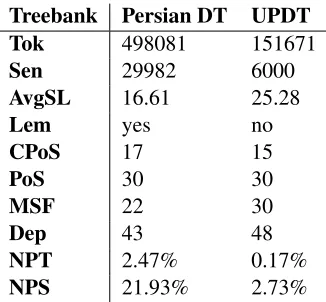
[image:4.612.320.534.255.347.2]Corpus Persian dependency treebank version 1.0 (Rasooli et al., 2013) is a freely-available re-source5with about 30,000 sentences, and half a mil-lion tokens, annotated with syntactic roles in addi-tion to morpho-syntactic features. The annotaaddi-tion employs 17 coarse-grained and 30 fine-grained POS tags, 22 morphological feature values and 43 depen-dency labels. 21.93% of the sentences and 2.47% of the edges are non-projective.
Table 3 provides statistical properties of Persian dependency treebank, compared to UPDT6. In Per-sian dependency treebank, syntactic and/or morpho-logical features are represented as key-value pairs separated by vertical bars (‘|’), while in UPDT, they are represented as a single atomic feature.
Treebank Persian DT UPDT
Tok 498081 151671
Sen 29982 6000
AvgSL 16.61 25.28
Lem yes no
CPoS 17 15
PoS 30 30
MSF 22 30
Dep 43 48
NPT 2.47% 0.17%
[image:4.612.104.267.327.478.2]NPS 21.93% 2.73%
Table 3: Comparison of UPDT (Seraji et al., 2012a) and Persian dependency treebank (Rasooli et al., 2013). Tok = number of tokens; Sen = number of sentences; AvgSL = Average sentence length; Lem = lemmatiza-tion present; CPoS = number of coarse-grained speech tags; PoS = number of (fine-grained) part-of-speech tags; MSF = number of morphosyntactic features (split into atoms); Dep = number of dependency types; NPT = proportion of non-projective dependencies/tokens (%); NPS = proportion of non-projective dependency graphs/sentences (%)
The data is split into standard train, development
4https://github.com/mojtaba-khallash/
semantic-tagger
5http://www.dadegan.ir/en 6
Freely available at http://stp.lingfil.uu.se/ ˜mojgan/UPDT.html
and test sets by the ratio of 80-10-10 percent in the CoNLL dependency format. Furthermore, the tree-bank is released in two representations with little changes in their annotations. A sample comparison between the two annotations is shown in Figure 1. In the first representation, which is manually anno-tated, the accusative case marker
@P
/rA/ is supposed to be the head of the object plus rA. In the second representation, which is an automatic conversion of the first one obtained by reverse ordering the man-ual annotation,rAis not the head of the object word. Instead,rAis regarded as the accusative case marker for the direct object..
ÐY K@ñ k úæ ®Ã é»
@P
úG.A
J»
root. read said that acc. the book
PUNC V V SUBR POSTP N
PUNC
ROOT
OBJ
PREDEP
NCL
POSDEP
(a) First representation: Manually annotating accusative case marker
@P
as object of the sentence.
ÐY K@ñ k úæ ®Ã é»
@P
úG.A
J»
root. read said that acc. the book
PUNC V V SUBR POSTP N
PUNC
ROOT OBJ
ACC-CASE NCL POSDEP
(b) Second representation: Automatic conversion of first rep-resentation. The accusative case marker
@P
depends on original object of the sentence.Figure 1: Two representation of object-verb relation for “I read the book that you mentioned.” (Rasooli et al., 2013).
[image:4.612.321.532.398.490.2]type. We use LAS as our evaluation metric and take punctuation into account as for evaluating out parsing results. We use McNemars statistical signif-icance test as implemented by (Nilsson and Nivre, 2008), and denotep < 0.05 andp < 0.01 with +
and++, respectively.
Parsers We use two off-the-shelf data-driven parsers, namely MaltParser (Nivre et al., 2007b) and MSTParser (McDonald et al., 2005), which are the two state-of-the-art dependency parsers that rep-resent dominant approaches in data-driven depen-dency parsing.
MaltParser7 is based on a transition-based proach to dependency parsing. Transition-based ap-proach is based on transition systems for deriving dependency trees, that greedily searches for highest scoring transitions and uses features extracted from parse history to predict the next transition (Choi and Palmer, 2011a). We use MaltParser 1.7.1 along with nine different parsing algorithms. In order to se-lect the best algorithm and tune the parameters of MaltParser, we useMaltOptimizer (Ballesteros and Nivre, 2012) on the whole of training data. Mal-tOptimizer analyzes data in three-phase optimiza-tion process: data analysis, parsing algorithm selec-tion, and feature selection.
MSTParser8 is based on a graph-based approach to dependency parsing. The algorithm searches globally in a complete graph to extract a spanning tree during derivations using dynamic programming. We use MSTParser 0.5 which has two implementa-tions of maximum spanning tree (MST) algorithm with projective and non-projective models9.
Baseline Experiments We run three phases of MaltOptimizer on the training set in order to find the best parsing algorithm in MaltParser. The first phase validates the data and gains 84.02% LAS with the default settings. In the second phase, using non-projective version of the Covington algorithm, which has the best accuracy, and after parameter
tun-7http://www.maltparser.org/ 8
http://www.seas.upenn.edu/˜strctlrn/ MSTParser/MSTParser.html
9
We developed an all-in-one dependency parsing tool-box that integrates different dependency parsing algo-rithms: https://github.com/mojtaba-khallash/ dependency-parsing-toolbox
ing, 85.86% LAS was obtained. In the third phase, the feature model was optimized and by tuning the regularization parameter of the multiclass SVM; it led to 87.43% LAS. Finally, we trained the best algorithm with optimized settings on training set and parsed on development set, thereby we reached 87.70% LAS as the baseline of MaltParser.
We tested four parsing algorithms that exist in MSTParser and as a result, non-projective algorithm with a second-order feature decoder gave 88.04% LAS, which shows the highest improvement. There-fore, we selected that as our baseline for MSTParser. The baselines are obtained on the first represen-tation of the treebank. We found baselines for the second representation of the treebank on the devel-opment set. Results are compared in Table 4.
The first representation performs better than the second one. This was expected before, sincerAis a constant word that is annotated as the object of a sen-tence in the first representation. This helps parsers to find the object in a sentence. Moreover, as shown in Figure 1,rAis closer to the verb than the direct ob-ject, hence it has more chance to select.
Representation Malt MST
First 87.70 88.04
Second 87.22 (-0.48) 87.03 (-1.01)
Table 4: Comparison of two representations of Persian treebank
Results In our experiments, we use the first repre-sentation of treebank with algorithms and new con-figurations presented in previous paragraph. For all experiments in this section, we use training and de-velopment sets of the treebank. In order to study the effects of morphology in dependency parsing of Persian, we organize experiments into three types of challenges which are presented by Tsarfaty et al. (2010): architecture and setup, representation and modeling, and estimation and smoothing.
corpus that consists of morpho-syntactic and mini-mal semantic annotation of words. It is commonly used to train POS tagger, but its POS tagset is differ-ent from tagset of the treebank that we use. Sarabi et al. (2013) introduce PLP Toolkit which is a compre-hensive Persian Language Processing (PLP) toolkit that contains fundamental NLP tools such as to-kenizer, POS tagger, lemmatizer and dependency parser. They merged the POS tagset of 10 million words from bijankhan corpus with Persian depen-dency treebank in order to create a bigger corpus with the same tagset. They choose the tagset of Per-sian dependency treebank as the base setting and convert Bijankhan tagset to them. They have 11 coarse-grained and 45 fine-grained POS tags. PLP POS tagger can automatically recognize three mor-phological features, namely number, person, and TMA. TMA values of the PLP tool are not the same as Persian dependency treebank. Despite 14 possi-ble TMA values in dependency treebank (Tapossi-ble 2), only four out of the 14 values exist in PLP (AY, GS, H, and HA), because there is no other value in Bi-jankhan tagset for verbs. The accuracy of PLP POS tagger on the fine grained tagset is about 98.5%. We use this tagger and apply it on our training, develop-ment, and test data. Results from these experiments are presented in Table 5.
POS tags type Malt MST
Gold 87.70 88.04
[image:6.612.334.517.56.223.2]Predicted 86.98 (-0.72) 86.81 (-1.23)
Table 5: Effect of gold vs. predicted POS tags and mor-phological information in dependency parsers for Per-sian.
Representation and Modeling In our experi-ment, we use ten features of morphological and se-mantic information. Using a forward selection pro-cedure, the best feature set for each parser can be found. Beside morphological features which exist in the treebank (Attachment [A],Person [P], Num-ber [N],TMA), we addTense [T] andMood [M]
with a simple conversion table, shown in Table 2, based on the value of TMA.
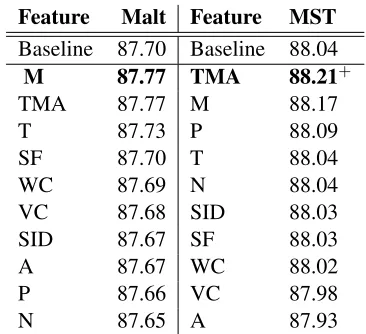
Table 6 shows the effect of each feature for Malt-Parser and MSTMalt-Parser parser. For the former, mood with slight differences achieves the best result and
Feature Malt Feature MST
Baseline 87.70 Baseline 88.04
M 87.77 TMA 88.21+
TMA 87.77 M 88.17
T 87.73 P 88.09
SF 87.70 T 88.04
WC 87.69 N 88.04
VC 87.68 SID 88.03
SID 87.67 SF 88.03
A 87.67 WC 88.02
P 87.66 VC 87.98
N 87.65 A 87.93
Table 6: Effect of each feature on two parsers
for the latter, TMA has the highest accuracy than other features. TMA and two derivate features, namely T and M, stands at the top of this ranking, and four semantic features are placed in the middle. This means that our newly added features can help to improve performance of each parser.
In the next steps, we incrementally add one fea-ture to the best result from previous step. As shown in Table 7, combination of M and SF obtains the best result for MaltParser (87.81%), while for MST-Parser, combination of TMA and WC is the best (88.25%). In the second step, adding one seman-tic feature gets the best result. By trying to continue this approach, we do not see any improvement in the accuracy for both parser10.
Feature Malt Feature MST {M,SF} 87.81 {TMA,WC} 88.25 {M,T} 87.79 {TMA,SID} 88.21 {M,VC} 87.78 {TMA,N} 88.16 {M,TMA} 87.77 {TMA,P} 88.14 {M,N} 87.76 {TMA,M} 88.13 {M,WC} 87.75 {TMA,A} 88.11 {M,A} 87.75 {TMA,T} 88.11 {M,P} 87.73 {TMA,VC} 88.07 {M,SID} 87.69 {TMA,SF} 88.05
Table 7: Combinations of two features
10https://github.com/mojtaba-khallash/
[image:6.612.325.528.495.632.2]Estimation and Smoothing Using a few training data, especially for languages with rich morphol-ogy, lexical features may infrequently appear during training. In MRLs like Persian, due to many feature combination by the inflectional system, we face a high rate of out-of-vocabulary. There are some ways to cope with this problem:
• Replacing word forms by lemma:Lemma of a word has less data sparsity than word form.
• Number NormalizationThis is the default ap-proach in MSTParser, in which each number is replaced by a constant. We apply this approach for numbers written either in English or Persian scripts.
• Word Clustering and Semantic File: The cluster ID of a word or its semantic file can be used instead of the original word form. These are two ways to categorize words into a group bigger than their lemma.
Table 8 illustrates the effect of each smoothing method on the accuracy for parsing MaltParser and MSTParser. For MaltParser, number normalization is the only technique that improves the accuracy. For MSTParser, replacing word forms by lemma and number normalization improves the accuracy. In the case of MSTParser, we apply each method sepa-rately and simultaneously on the development set, but replacing word forms by lemma gets the best im-provement, and hence we use it in our final configu-ration.
Smoothing Malt MST
Baseline 87.70 88.04
Replacing word forms by lemma 87.38 88.10
Number Normalization 87.71 88.09
Word Clustering 86.98 87.47
Semantic File 87.31 85.25
Table 8: Accuracy obtained after applying different sparsity-reduction tricks.
5 Error Analysis
We use the best configurations from the previous section on the training and test data, for gold an-notation and an automatically derived one. Table 9
shows the final test results of the two parsers for Per-sian. In addition to LAS, we also include UAS and LA to facilitate comparisons in the future. Baseline results are included in the table. In the case of Malt-Parser, after applying new configurations on data, we repeat the third phase of MaltOptimizer in order to find the best feature template for the new training data. It seems that the graph-based parser performs better than transitions-based parsers in general. De-spite a high overall parsing accuracy, only 1017 and 922 (33.91% and 30.74%) of sentences in the test set (with 2999 sentences) are parsed without errors by MaltParser and MSTParser, respectively. Malt-Parser has lower overall accuracy compared to MST-Parser, but the number of completely correct parsed sentences for MaltParser is more than MSTParser. In the case of predicted setting, as mentioned in sec-tion 4, there are four values for TMA. This means that we cannot create tense and mood from TMA. For this reason, we force to use TMA in the final configuration of both parsers in the predicted setting. In order to evaluate parsing errors, we use the same approach as (McDonald and Nivre, 2011) to shows a set of linguistic and structural properties of the baseline and our best setting for each parser11.
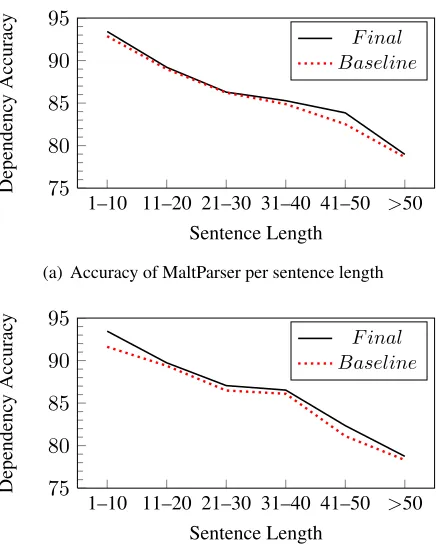
Length Factors Figure 2 shows the accuracy rel-ative to the sentence length in test data. Since there are very limited long sentences in our treebank, the parser cannot predict longer sentences correctly. Consequently, the two parsers tend to have lower ac-curacies for longer sentences. Both parsers have the same performance, but MSTParser tends to perform better on shorter sentences, that is in contrast with results showed by McDonald and Nivre (2011). We compare each parser with its corresponding base-lines. Both parsers in all lengths perform better than their baselines. For MaltParser, improvements occur for longer sentences while for MSTParser improve-ments occur at smaller sentences. These results are in contrast with the results reported by McDonald and Nivre (2011).
Graph Factors Figure 3 shows the accuracy for arcs relative to their distance to the artificial root node12. The area under the curve of final MaltParser
11In our analysis, we use MaltEval (Nilsson and Nivre, 2008). 12
Parser Method LAS UAS LA
Malt
Baseline 87.68 (87.04) 90.41 (89.92) 90.03 (89.49) Final 87.91++
(87.16)+
90.58+
(90.05)++
90.22+
(89.60)+
Diff. +0.23 (+0.12) +0.17 (+0.13) +0.19 (+0.11)
MST
Baseline 87.98 (86.82) 91.30 (90.27) 90.53 (89.90) Final 88.37++ (86.97) 91.55++ (90.36) 90.86++ (90.05)
[image:8.612.107.508.58.160.2]Diff. +0.39 (+0.15) +0.25 (+0.09) +0.33 (+0.15)
Table 9: Baseline and final results of gold (predicted) test data for MaltParser
1–10 11–20 21–30 31–40 41–50 >50 75
80 85 90 95
Sentence Length
D
ep
en
d
en
cy
A
cc
u
ra
cy
F inal Baseline
(a) Accuracy of MaltParser per sentence length
1–10 11–20 21–30 31–40 41–50 >50 75
80 85 90 95
Sentence Length
D
ep
en
d
en
cy
A
cc
u
ra
cy
F inal Baseline
[image:8.612.319.537.130.486.2](b) Accuracy of MSTParser per sentence length Figure 2: Accuracy relative to sentence length. Both parsers perform better than their baselines.
is less than baseline, but it is over baseline for MST-Parser. F-score of MSTParser for shorter distance is much better than the baseline and by increasing the distance to root, F-score degrades to be less than the baseline.
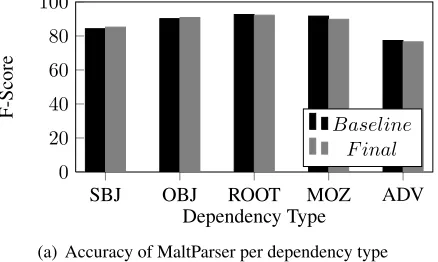
Linguistic Factors MaltParser and MSTParser can find 90.22% and 90.86% of all labels correctly. Figure 4 shows the F-score of some important de-pendency labels in the test data. MaltParser only improves subject and object categories, while MST-Parser improves object, ROOT, and adverb
cate-1 2 3 4 5 6 >6
85 86 87 88 89
Distance to Root
F
-S
co
re
(a) Baseline ( ) and final ( ) accuracy of MaltParser
1 2 3 4 5 6 >6
86 87 88 89
Distance to Root
F
-S
co
re
[image:8.612.79.298.201.478.2](b) Baseline ( ) and final ( ) accuracy of MSTParser Figure 3: Dependency arc F-score relative to the distance to root
gories. If we only consider the final results, Malt-Parser performs better for predicting subject and ob-ject, while MSTParser performs better for predicting ROOT and ezafe dependent (MOZ)13, and both have the same accuracy for adverb.
Table 10 gives the accuracy of arcs for each de-pendent part-of-speech. Final MSTParser performs
13
Ezafe constructionis referred to nouns or pronouns that im-ply a possessed-possessor relation (like first name-last name). The relation between the possessed and possessor is called mozaf (MOZ) that its sign is a vowel /e/ that pronounced right
[image:8.612.319.538.206.323.2] [image:8.612.321.539.356.469.2]SBJ OBJ ROOT MOZ ADV 0
20 40 60 80 100
Dependency Type
F
-S
co
re
Baseline F inal
(a) Accuracy of MaltParser per dependency type
SBJ OBJ ROOT MOZ ADV
0 20 40 60 80 100
Dependency Type
F
-S
co
re
Baseline F inal
[image:9.612.79.298.64.195.2](b) Accuracy of MSTParser per dependency type Figure 4: Dependency label F-score relative to some de-pendency types.
better than its baseline for all categories, except pro-nouns and better than MaltParser for all categories, except preposition. Final MaltParser, performs bet-ter than its baseline in all categories, except preposi-tion.
6 Conclusion
In this paper, we have investigated a number of is-sues in data-driven dependency parsing of Persian. Because there is no previous study on parsing the
POS Malt MST
Baseline Final Baseline Final
Verb 89.96 90.09 90.96 91.86
Noun 89.67 90.13 90.15 90.23
Pronoun 92.56 92.94 93.53 93.43
Adjective 87.80 88.37 87.77 88.56
Adverb 80.80 82.37 82.61 83.94
Conjunction 86.03 86.40 86.58 87.36
Preposition 70.93 70.32 69.74 70.76
Table 10: Accuracy for each dependent part of speech
Persian dependency treebank (Rasooli et al., 2013), we first have drawn the baseline for each parser, by selecting best performing algorithm and tuning its parameters. For MaltParser (Nivre et al., 2007b) dif-ferent between best algorithm (non-projective ver-sion of Covington) with default settings and after op-timizing feature template by the third phase of Mal-tOptimizer (Ballesteros and Nivre, 2012) is about 1.5 percent. This shows that the definition of fea-ture template is a crucial aspect of transition-based parsing.
Our first experiment shows the effect of using au-tomatic annotation of POS tags and morphological information. Our new configuration improves two parsers in both gold and predicted setting, but the improvement for MSTParser is higher than for Malt-Parser. MSTParser has higher accuracy in the gold setting, while MaltParser has better performance in predicted setting. It might mean that MaltParser is more robust against noisy information.
In the second experiment, we have explored the best combination of morphological and lexical se-mantic features for dependency parsing of Persian. We find that the combination of one morphological feature and one lexical semantic feature gets the best combination for each parser. Our lexical semantic features can be automatically produced for any word and thus we need to predict one morphological fea-ture for real-world settings.
Finally we have proposed two simple methods for reducing data sparsity of each parser. After apply-ing our solutions to three types of challenges, we reached 87.91% and 88.37% LAS on the test set (0.23% and 0.39% improvement over our baseline) for MaltParser and MSTParser, respectively.
Note that all of the experiments we reported in this paper use existing parsers as black boxes. We only changed the input data to obtain the best pos-sible performance given our data sets. We plan to explore modifications of the underlying parsing al-gorithms to better make use of morphological infor-mation.
Acknowledgments
[image:9.612.74.298.558.681.2]for providing us the data and information about the PLP toolkit.
References
Eneko Agirre, Kepa Bengoetxea, Koldo Gojenola, and Joakim Nivre. 2011. Improving Dependency Pars-ing with Semantic Classes. InProceedings of the 49th Annual Meeting of the Association for Computational Linguistics (ACL ’11): shortpapers, pages 699–703. Baharat Ram Ambati, Samar Husain, Sambhav Jain,
Dipti Misra Sharma, and Rajeev Sangal. 2010a. Two methods to incorporate local morphosyntactic fea-tures in Hindi dependency parsing. In Proceedings of NAACL HLT 2010 First workshop on Statistical Parsing of Morphologically-Rich Languages (SPMRL 2010), pages 22–30.
Baharat Ram Ambati, Samar Husain, Joakim Nivre, and Rajeev Sangal. 2010b. On the Role of Morphosyntac-tic Features in Hindi Dependency Parsing. In Proceed-ings of the NAACL HLT 2010 First Workshop on Sta-tistical Parsing of Morphologically-Rich Languages, pages 94–102.
Maryam Aminian, Mohammad Sadegh Rasooli, and Hos-sein Sameti. 2013. Unsupervised Induction of Persian Semantic Verb Classes Based on Syntactic Informa-tion. InLanguage Processing and Intelligent Informa-tion Systems, pages 112–124.
Miguel Ballesteros and Joakim Nivre. 2012. MaltOp-timizer: A System for MaltParser Optimization. In Proceedings of the Eighth International Conference on Language Resources and Evaluation (LREC 2012), pages 23–27.
Miguel Ballesteros and Joakim Nivre. 2013. Going to the Roots of Dependency Parsing. Computational Lin-guistics, pages 5–13.
Kepa Bengoetxea and Koldo Gojenola. 2010. Applica-tion of Different Techniques to Dependency Parsing of Basque. InProceedings of the NAACL HLT 2010 First Workshop on Statistical Parsing of Morphologically-Rich Languages, pages 31–39.
Mahmood Bijankhan. 2004. The role of the corpus in writing a grammar: An introduction to a software. Ira-nian Journal of Linguistics.
Bernd Bohnet and Jonas Kuhn. 2012. The Best of Both Worlds A Graph-based Completion Model for Transition-based Parsers. InProceedings of the 13th Conference of the European Chapter of the Associa-tion for ComputaAssocia-tional Linguistics, pages 77–87. Bernd Bohnet and Joakim Nivre. 2012. A
Transition-Based System for Joint Part-of-Speech Tagging and Labeled Non-Projective Dependency Parsing. In Pro-ceedings of the 2012 Joint Conference on Empirical
Methods in Natural Language Processing and Compu-tational Natural Language Learning (EMNLP-CoNLL 2012), pages 1455–1465.
Jinho D. Choi and Martha Palmer. 2011a. Getting the Most out of Transition-based Dependency Parsing. In Proceedings of the 49th Annual Meeting of the Associ-ation for ComputAssoci-ational Linguistics (ACL ’11): short-papers, pages 687–692.
Jinho D. Choi and Martha Palmer. 2011b. Statistical De-pendency Parsing in Korean: From Corpus Genera-tion To Automatic Parsing. InProceedings of the 2nd Workshop on Statistical Parsing of Morphologically-Rich Languages (SPMRL 2011), pages 1–11.
Dadegan Research Group. 2012. Persian Dependency Treebank Annotation Manual and User Guide. Tech-nical report, SCICT.
Yoav Goldberg and Michael Elhadad. 2010. Easy First Dependency Parsing of Modern Hebrew. In Proceed-ings of the NAACL HLT 2010 First Workshop on Sta-tistical Parsing of Morphologically-Rich Languages, pages 103–107.
Terry Koo, Xavier Carreras, and Michael Collins. 2008. Simple Semi-supervised Dependency Parsing. In Pro-ceedings of ACL-08: HLT, pages 595–603.
Percy Liang. 2005. Semi-Supervised Learning for Natu-ral Language. Ph.D. thesis, Massachusetts Institute of Technology.
Yuval Marton, Nizar Habash, and Owen Rambow. 2011. Improving Arabic Dependency Parsing with Form-based and Functional Morphological Features. In Pro-ceedings of the 49th Annual Meeting of the Association for Computational Linguistics (ACL ’11), pages 1586– 1596.
Ryan McDonald and Joakim Nivre. 2011. Analyzing and Integrating Dependency Parsers. Computational Linguistics, pages 197–230.
Ryan McDonald, Fernando Pereira, Kiril Ribarov, and Jan Hajiˇc. 2005. Non-projective Dependency Parsing using Spanning Tree Algorithms. InProceedings of the conference on Human Language Technology and Empirical Methods in Natural Language Processing, pages 523–530.
Jens Nilsson and Joakim Nivre. 2008. MaltEval: An Evaluation and Visualization Tool for Dependency Parsing. In Proceedings of the Sixth International Language Resources and Evaluation (LREC ’08). Joakim Nivre and Jens Nilsson. 2005. Pseudo-Projective
Dependency Parsing. InProceedings of the 43rd An-nual Meeting of the Association for Computational Linguistics (ACL ’05), pages 99–106.
Parsing. InProceedings of the CoNLL Shared Task Session of EMNLP-CoNLL 2007, pages 915–932. Joakim Nivre, Johan Hall, Jens Nilsson, Atanas Chanev,
G¨ulsen Eryigit, Sandra K¨ubler, Svetoslav Marinov, and Erwin Marsi. 2007b. MaltParser: A language-independent system for data-driven dependency pars-ing.Natural Language Engineering, pages 95–135. Joakim Nivre. 2009. Non-Projective Dependency
Pars-ing in Expected Linear Time. In Proceedings of the Joint Conference of the 47th Annual Meeting of the ACL and the 4th International Joint Conference on Natural Language Processing (IJCNLP) of the AFNLP, pages 351–359.
Mohammad Sadegh Rasooli, Omid Kashefi, and Behrouz Minaei-Bidgoli. 2011. Effect of Adaptive Spell Checking in Persian. In7th International Conference on Natural Language Processing andKnowledge En-gineering (NLP-KE), pages 161–164.
Mohammad Sadegh Rasooli, Manouchehr Kouhestani, and Amirsaeid Moloodi. 2013. Development of a Per-sian Syntactic Dependency Treebank. InProceedings of the 2013 Conference of the North American Chap-ter of the Association for Computational Linguistics: Human Language Technologies, pages 306–314. Zahra Sarabi, Hooman Mahyar, and Mojgan Farhoodi.
2013. PLP Toolkit: Persian Language Processing Toolkit. In 3rd International eConference on Com-puter and Knowledge Engineering (ICCKE 2013). Wolfgang Seeker and Jonas Kuhn. 2013. Morphological
and Syntactic Case in Statistical Dependency Parsing. Computational Linguistics, pages 23–55.
Mojgan Seraji, Be´ata Megyesi, and Joakim Nivre. 2012a. Bootstrapping a Persian Dependency Treebank. Lin-guistic Issues in Language Technology, pages 1–10. Mojgan Seraji, Be´ata Megyesi, and Joakim Nivre. 2012b.
Dependency Parsers for Persian. In Proceedings of 10th Workshop on Asian Language Resources, COL-ING 2012, 24th International Conference on Compu-tational Linguistics.
Mehrnoush Shamsfard, Akbar Hesabi, Hakimeh Fadaei, Niloofar Mansoory, Ali Famian, Somayeh Bagher-beigi, Elham Fekri, Maliheh Monshizadeh, and S. Mostafa Assi. 2010. Semi Automatic Development Of FarsNet: The Persian Wordnet. InProceedings of 5th Global WordNet Conference (GWA2010).
Mehrnoush Shamsfard. 2011. Challenges and Open Problems in Persian Text processing. InThe 5th Lan-guage and Technology Conference (LTC 2011), pages 65–69.
Reut Tsarfaty, Djam´e Seddah, Yoav Goldberg, Sandra K¨ubler, Marie Candito, Jennifer Foster, Yannick Ver-sley, Ines Rehbein, and Lamia Tounsi. 2010. Sta-tistical Parsing of Morphologically Rich Languages